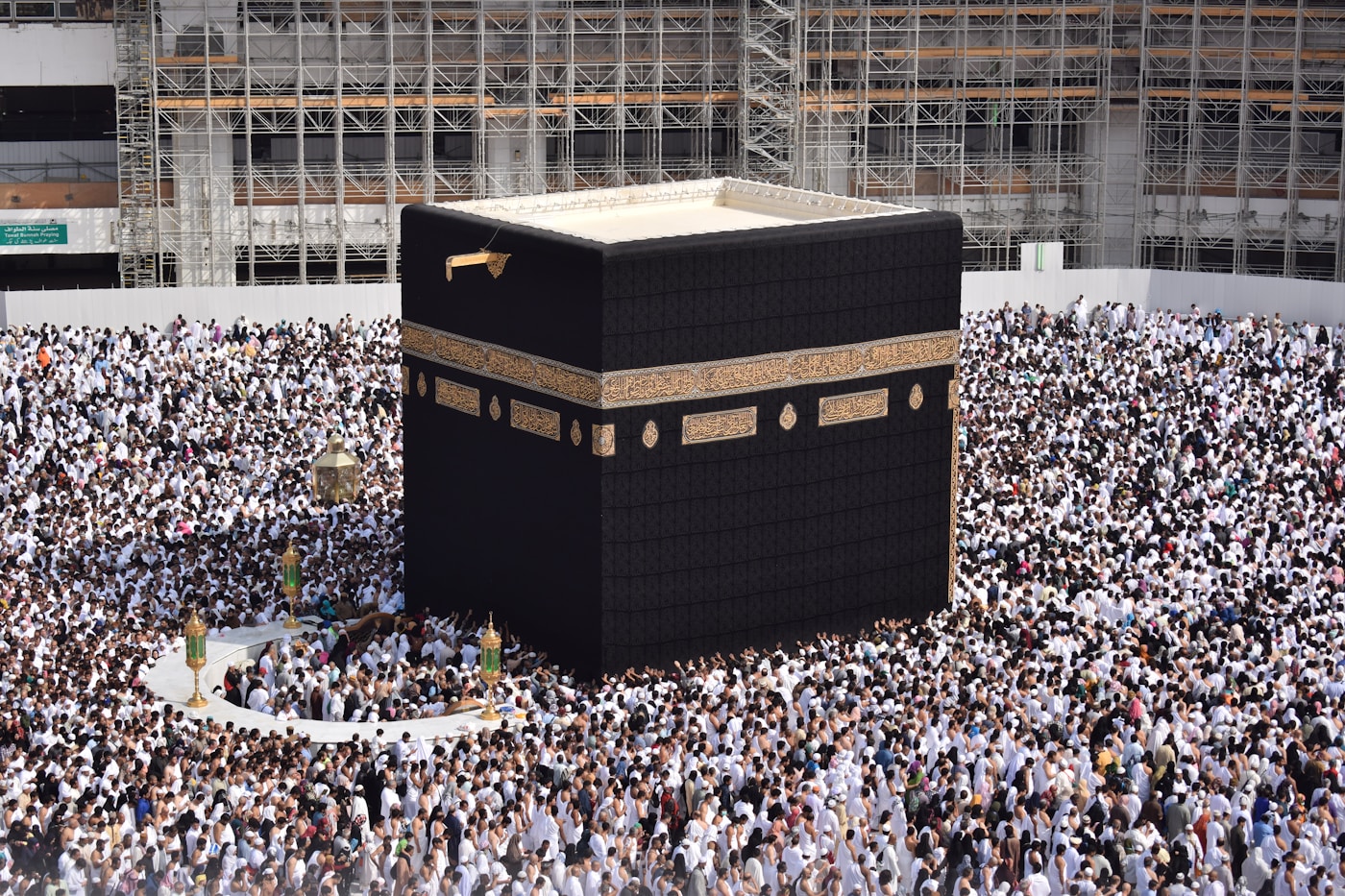

Mecca is the holiest city in Islam, the birthplace of the Prophet Muhammad, and the spiritual centre of a faith practised by nearly two billion people. Every year, millions of Muslims travel to this ancient Hejazi city to perform Hajj and Umrah, fulfilling obligations that date back more than fourteen centuries. Whether you are planning your first pilgrimage or returning after years away, this guide covers everything you need to know about visiting Mecca in 2026 — from the Grand Mosque and its ongoing expansion to hotels, transport, weather, and the practicalities that no pilgrim should overlook.
- The Grand Mosque — Masjid al-Haram
- King Salman Gate Expansion
- Sacred Sites Beyond the Haram
- Hajj and Umrah — What You Need to Know
- Getting to Mecca
- Where to Stay — Hotels in Mecca
- Weather and When to Visit
- Health and Safety
- Ihram — The Sacred State
- Food and Dining
- Complete Guide to Mecca: All Pages
- Masjid al-Haram Detailed Guide
- Hajj 2026 Complete Guide
- Umrah Guide
- Medina Travel Guide
- Saudi Arabia Visa Guide
The Grand Mosque — Masjid al-Haram
Masjid al-Haram is the largest mosque on earth and the single most visited religious site in the world. At its centre stands the Kaaba, the cubic granite structure draped in black silk (the Kiswah) that every Muslim faces during prayer. The mosque’s current footprint spans more than 400,000 square metres, but ongoing expansion projects are set to more than double that figure.
The Kaaba
The Kaaba measures approximately 13.1 metres high, 11.03 metres wide, and 12.86 metres long. Islamic tradition holds that it was originally built by the Prophet Ibrahim (Abraham) and his son Ismail. The Black Stone (al-Hajar al-Aswad), embedded in the eastern corner, is the starting and ending point of Tawaf — the ritual circumambulation that pilgrims perform seven times in an anti-clockwise direction.
The Kiswah, the black cloth embroidered with gold Quranic calligraphy that covers the Kaaba, is replaced annually before Hajj. It is produced at a dedicated factory in Mecca’s Umm al-Joud district, using approximately 670 kilograms of raw silk and 120 kilograms of gold and silver thread.
Tawaf and the Mataf
The Mataf is the open area immediately surrounding the Kaaba where Tawaf is performed. Following recent infrastructure improvements, the Mataf can now accommodate approximately 107,000 worshippers per hour, according to Saudi authorities. During peak Hajj and Umrah seasons, the area operates around the clock with crowd-management barriers and multiple levels to maintain flow.
The Masa — Sa’i Between Safa and Marwa
The Sa’i is the ritual walk between the hills of Safa and Marwa, performed seven times as part of both Hajj and Umrah. The enclosed, air-conditioned gallery stretches 394.5 metres in each direction and is divided into four levels. The ritual commemorates Hajar’s (Hagar’s) desperate search for water for her infant son Ismail — a search that, according to Islamic tradition, ended when the Zamzam spring miraculously appeared.
Zamzam Water
The Zamzam well is located approximately 20 metres east of the Kaaba and reaches a depth of about 31 metres. According to Saudi authorities, the well produces between two and three million litres of water daily, with a pumping rate of up to 18.5 litres per second. The original wellhead is preserved under glass within the mosque, but water is now piped to a nearby processing plant where modern filtration and ultraviolet sterilisation ensure safety without altering the water’s mineral composition.
Zamzam water is freely available to worshippers throughout the mosque via coolers and dispensers. Pilgrims may also take sealed containers home, though airlines enforce weight limits — typically five litres per passenger on Saudi carriers.
Capacity and the Third Saudi Expansion
The King Abdullah Expansion, also known as the Third Saudi Expansion, is the largest construction project in the mosque’s history. Spanning more than 300,000 square metres and nearly 15 years of construction, the project increased the mosque’s prayer-area footprint from approximately 390,000 to 912,000 square metres, according to the Saudi Press Agency. The expanded mosque can accommodate more than two million worshippers simultaneously.
| Metric | Figure |
|---|---|
| Total prayer area (post-expansion) | 912,000 m² |
| Maximum capacity | 2 million+ worshippers |
| Mataf throughput | 107,000 per hour |
| Minarets | 13 |
| Gates | 210+ |
| Zamzam well output | 2–3 million litres/day |
King Salman Gate — The Next Mega-Expansion
In October 2025, Crown Prince Mohammed bin Salman announced the King Salman Gate project, the most ambitious urban development in Mecca’s modern history. Developed by PIF-owned Rua AlHaram AlMakki, the project covers up to 12 million square metres of gross floor area adjacent to the Grand Mosque, according to an official PIF announcement.
King Salman Gate will add indoor prayer halls and outdoor courtyards capable of accommodating approximately 900,000 additional worshippers. The project will also include hotels, residential units, commercial space, cultural and heritage areas spanning 19,000 square metres, and integrated public transport connections. The Saudi government projects that the development will create more than 300,000 jobs by 2036, aligning with Vision 2030 economic diversification targets.
Separately, the MASAR project — developed by Umm Al-Qura — is a 3.5-kilometre mixed-use corridor stretching from Mecca’s third ring road to within 550 metres of the mosque’s King Fahad Gate. As of late 2024, key infrastructure works were reported to be 99.77 per cent complete.
The Abraj Al-Bait Clock Tower
The Abraj Al-Bait complex dominates the Mecca skyline. The central Makkah Royal Clock Tower stands 601 metres tall with 120 floors, making it the fourth-tallest building in the world. Its clock faces measure 43 by 43 metres — the largest in the world, according to Guinness World Records. The top four floors house the Clock Tower Museum.
The complex comprises seven towers in total, with the six surrounding towers rising between 42 and 48 storeys. At ground level, a five-storey shopping mall houses approximately 800 retail units and operates 24 hours a day. The complex also contains several of Mecca’s most prestigious hotels (see accommodation section below).
Sacred Sites Beyond the Haram
Jabal al-Nour and the Cave of Hira
Jabal al-Nour (Mountain of Light) rises approximately 270 metres above the surrounding terrain, roughly four kilometres northeast of Masjid al-Haram. Near its summit sits the Cave of Hira, where the Prophet Muhammad received the first verses of the Quran — the opening of Surah al-Alaq — during the Night of Power (Laylat al-Qadr).
The cave itself is small, measuring about 3.7 metres in length and 1.6 metres in width. The climb involves approximately 1,750 rocky steps and takes between 30 minutes and three hours depending on fitness level and conditions. During Hajj season, an estimated 5,000 visitors make the ascent daily.
Practical tips: Wear sturdy closed-toe shoes. Bring water — vendors sell bottles along the route, but carrying your own is advisable. Visit early morning or late afternoon to avoid peak heat. Entry to the cave is limited to approximately one minute per person due to demand. The adjacent Hira Cultural Centre offers a multimedia Revelation Exhibition and modern facilities including restaurants and a prayer hall.
Jabal Thawr and the Cave of Thawr
Jabal Thawr, located south of Mecca, is the mountain where the Prophet Muhammad and his companion Abu Bakr sheltered for three days during the Hijra (migration) to Medina in 622 CE. The cave sits near the summit at approximately 760 metres above sea level. The climb is steeper and more challenging than Jabal al-Nour, and the cave receives fewer visitors, making it a quieter alternative.
Mina, Arafat, and Muzdalifah — The Hajj Sites
These three locations form the ritual heart of the Hajj pilgrimage, and while they are primarily associated with the five days of Hajj, understanding them is essential for any visitor to Mecca.
Mina — The Tent City
Located eight kilometres southeast of the Grand Mosque, Mina is the largest temporary city on earth. More than 100,000 permanent, fire-resistant tents — made of fibreglass with a Teflon outer coating, installed after the deadly 1997 tent fires that killed more than 340 pilgrims — cover approximately 20 square kilometres. At peak capacity, Mina accommodates up to three million people.
Pilgrims stay in Mina on the 8th, 10th, 11th, and 12th of Dhul Hijjah. The Ramy al-Jamarat (stoning of the pillars) takes place here at the multi-level Jamarat Bridge, designed to handle hundreds of thousands of pilgrims simultaneously and reduce the stampede risks that plagued earlier, single-level designs.
The Plain of Arafat
On the 9th of Dhul Hijjah — the Day of Arafat — pilgrims gather on this vast plain approximately 20 kilometres east of Mecca. Standing at Arafat (Wuquf) from noon to sunset is the single most important rite of Hajj; the Prophet Muhammad said, “Hajj is Arafat.” The Jabal al-Rahmah (Mount of Mercy) at the centre of the plain marks the spot where Muhammad delivered his Farewell Sermon in 632 CE.
Muzdalifah
After sunset at Arafat, pilgrims travel to the open plain of Muzdalifah, located between Arafat and Mina. Here they perform the Maghrib and Isha prayers combined, spend the night under the open sky, and collect pebbles for the stoning ritual at Mina. The Mashaer Railway, a light-rail system connecting all three Hajj sites, now facilitates pilgrim movement during this intensive overnight transit.
| Site | Distance from Haram | Hajj Day | Key Ritual |
|---|---|---|---|
| Mina | 8 km | 8th, 10th–12th Dhul Hijjah | Stoning of the Jamarat |
| Arafat | 20 km | 9th Dhul Hijjah | Wuquf (Standing) — “Hajj is Arafat” |
| Muzdalifah | 12 km | Night of 9th–10th | Night prayer, pebble collection |
Hajj and Umrah — What You Need to Know
Hajj 2025 Statistics
According to Saudi Arabia’s General Authority for Statistics (GASTAT), 1,673,230 pilgrims performed Hajj in 2025 — an 8.5 per cent decrease from the 1,833,164 recorded in 2024. Of the 2025 total, 1,506,576 arrived from abroad (95.3 per cent by air, 4.4 per cent by land, and 0.3 per cent by sea), while 166,654 were Saudi citizens and residents. Male pilgrims numbered 877,841 and female pilgrims 795,389.
Based on recent trends, total Hajj attendance for 2026 is expected to remain between 1.7 and 1.9 million pilgrims.
Hajj Permits and Visas
All international pilgrims require a Hajj visa, issued exclusively through authorised travel operators in their home country. Saudi Arabia allocates Hajj quotas by country, generally based on one permit per 1,000 Muslim citizens. Domestic pilgrims (Saudi residents and citizens) must also obtain permits through the official Nusuk platform. Hajj visas are valid only during the designated Hajj season and cannot be used for Umrah outside that window.
Umrah
Unlike Hajj, Umrah can be performed at any time of year, though it is especially popular during Ramadan. Since 2019, Saudi Arabia has offered e-visas for Umrah that can be obtained online. The Nusuk app and website are the official platforms for Umrah visa applications, mosque visit bookings, and transport arrangements. Umrah typically takes two to four hours to complete and involves Ihram (ritual dress), Tawaf, Sa’i, and shaving or cutting the hair.
Getting to Mecca
The Haramain High-Speed Railway
The Haramain Railway is the most convenient way to reach Mecca from Jeddah and Medina (where you can visit the Masjid Nabawi). The 450-kilometre line connects Mecca, Jeddah, King Abdulaziz International Airport (KAIA), King Abdullah Economic City (KAEC), and Medina, with trains operating at speeds of up to 300 km/h.
| Route | Journey Time | Economy Class (approx.) | Business Class (approx.) |
|---|---|---|---|
| Mecca → Jeddah | ~25 minutes | SAR 60–75 (~$16–20) | SAR 120–150 (~$32–40) |
| Mecca → KAIA (Jeddah Airport) | ~35 minutes | SAR 75–100 (~$20–27) | SAR 150–180 (~$40–48) |
| Mecca → Medina | ~2 hours 20 minutes | SAR 150 (~$40) | SAR 250 (~$67) |
The railway operates approximately 35 to 40 services daily in each direction, with departures every 30 to 60 minutes during peak times. Both Economy and Business class offer wide seats, foldable tables, and charging ports. Business class adds priority boarding, lounge access, and complimentary refreshments. Tickets can be booked through the official HHR website or mobile app.
By Air
Mecca has no airport. The nearest is King Abdulaziz International Airport (KAIA) in Jeddah, approximately 80 kilometres west. KAIA’s dedicated Hajj Terminal handles millions of pilgrims annually during peak season. From KAIA, options include the Haramain train (35 minutes), taxi or ride-hail (roughly 90 minutes depending on traffic), and SAPTCO bus services.
By Road
Major highways connect Mecca to Jeddah (80 km west), Taif (90 km southeast), and Medina (420 km north). Non-Muslims approaching by road will encounter clearly marked checkpoints and diversion routes well before the city boundary (see access restrictions below).
Non-Muslim Access — Strictly Prohibited
Mecca is closed to non-Muslims — only Muslims may enter. This is not a guideline or a custom — it is Saudi law, enforced through a multi-layered security system. Road checkpoints are positioned on every highway approaching the city, with signs in Arabic and English directing non-Muslims to alternative routes. Security personnel verify identification and travel documentation at these checkpoints.
During Hajj season, enforcement intensifies further. Entry requires a valid Hajj permit or Umrah visa, both issued exclusively to Muslims. Saudi authorities have implemented biometric verification and facial-recognition systems at key entry points. Penalties for non-Muslims who attempt entry include immediate removal, fines, detention, deportation, and potential long-term re-entry bans.
There are no exceptions, no “tourist zones,” and no partial-access arrangements. Non-Muslim travellers visiting Saudi Arabia should plan itineraries that route around Mecca entirely. The Haramain Railway, for instance, has a Jeddah-to-Medina service that bypasses Mecca station for non-Muslim passengers.
Where to Stay — Hotels in Mecca
Accommodation in Mecca ranges from five-star towers overlooking the Kaaba to budget rooms in the outer ring roads. Proximity to the Haram is the single biggest factor in both price and convenience — a hotel with a direct pedestrian connection to the mosque can mean the difference between a five-minute walk and a 45-minute shuttle ride.
Luxury — The Clock Tower Complex
The Abraj Al-Bait complex houses Mecca’s most prestigious hotels, all within 50 to 100 metres of the Haram with direct pedestrian access.
| Hotel | Rooms | Distance to Haram | Nightly Rate (approx.) |
|---|---|---|---|
| Fairmont Makkah Clock Royal Tower | 1,662 | ~100 m (direct access) | $180–500+ |
| Swissotel Al Maqam Makkah | 1,623 | ~50 m (direct access) | $200–450+ |
| Pullman ZamZam Makkah | 1,315 | ~50 m (direct access) | $150–400+ |
The Fairmont Clock Royal Tower is the flagship property, occupying the upper floors of the central 601-metre tower. Kaaba-view rooms command a premium of 50 to 100 per cent over city-view equivalents. The Swissotel Al Maqam completed a renovation in 2025, adding contemporary interiors while maintaining its location advantage. All three hotels offer 24-hour room service, prayer-time wake-up calls, and Zamzam water in rooms.
Upscale — Jabal Omar District
The Jabal Omar development, west of the Haram, is a newer hotel district built on the site of formerly dense residential neighbourhoods. Properties include:
- Hilton Makkah Convention Hotel — 8 to 12 minutes’ walk to the Haram. Modern facilities, multiple restaurants, conference space. From approximately $200 per night.
- Conrad Makkah — Five-star Hilton brand in the same development. Spacious rooms, dedicated Haram shuttle.
- Hyatt Regency Makkah Jabal Omar — Connected to the Jabal Omar commercial district with its own shopping arcade.
Mid-Range and Budget
Hotels along the second and third ring roads offer significantly lower rates — from $40 to $120 per night — but require shuttle transport or a 20-to-40-minute walk to the Haram. Brands like Elaf, Dar Al Tawhid, and local three-star properties dominate this segment. During Hajj season, prices across all tiers can increase by 200 to 400 per cent, and availability must be booked months in advance through authorised Hajj operators.
Booking tip: Outside of Hajj and Ramadan, Umrah-season rates drop significantly. January to March typically offers the best combination of moderate weather and reasonable hotel pricing.
Shopping in Mecca
Abraj Al-Bait Shopping Mall
The five-storey mall at the base of the Clock Tower complex is the most convenient shopping destination for pilgrims. With approximately 800 units across six retail levels, it operates 24 hours a day. International brands like H&M, MAC, Bath and Body Works, and Pandora sit alongside shops selling prayer mats, tasbeeh (prayer beads), abayas, and Islamic art. A food court and the Abraj Hypermarket occupy the lower levels.
Traditional Markets
For a more authentic experience, Souq Al-Hijaz is one of Mecca’s oldest markets — a warren of narrow lanes selling Arabic fragrances, handmade prayer beads, traditional textiles, and gold jewellery. The Clock Tower Souq nearby offers similar goods in a more modern setting.
What to Buy
- Prayer mats — From mass-produced to hand-woven, prices range from SAR 10 to SAR 500+
- Oud and perfume — Arabian oud oils and attars are Mecca’s signature luxury purchase
- Dates — Ajwa dates from Medina (home to the Prophet’s Mosque) are widely available, but check freshness and packaging
- Zamzam water — Sealed containers available throughout the city for transport home
- Abayas and thobes — Wide selection from budget to designer
- Tasbeeh — Prayer beads in every material from plastic to precious stone
Shopping tip: Shop in the early morning or late evening to avoid the worst crowds. Markets are quietest during prayer times, but many close briefly — plan accordingly. Budget souvenirs can be found for as little as SAR 1 to 3 at discount shops near the Haram.
Weather and When to Visit
Mecca has a hot desert climate. Summers are extreme, with average highs exceeding 43°C in June and July and occasional spikes above 48°C. Winters are warm but tolerable, with January highs averaging around 30°C and overnight lows dropping to approximately 19°C. Rainfall is minimal — roughly 111 millimetres annually — falling mostly in small amounts between November and January.
| Month | Avg. High (°C) | Avg. Low (°C) | Humidity (%) |
|---|---|---|---|
| January | 30 | 19 | 59 |
| February | 31 | 19 | 52 |
| March | 35 | 21 | 47 |
| April | 38 | 24 | 41 |
| May | 41 | 27 | 34 |
| June | 43 | 28 | 33 |
| July | 43 | 29 | 34 |
| August | 43 | 29 | 38 |
| September | 42 | 28 | 40 |
| October | 39 | 25 | 44 |
| November | 34 | 22 | 52 |
| December | 31 | 20 | 57 |
Best months for Umrah (weather): November through March, when temperatures are most comfortable. January and February offer the mildest conditions.
Hajj timing: Because the Islamic calendar is lunar, Hajj shifts approximately 10 to 11 days earlier each Gregorian year. In 2026, Hajj falls in approximately late May to early June — meaning pilgrims will face temperatures approaching 40°C or higher. Hydration, sun protection, and pacing are essential.
Crowd Management Tips
- Tawaf: The upper floors and rooftop level of the Mataf area are less crowded than ground level. Night-time Tawaf (after Isha prayer) tends to be quieter than daytime.
- Prayer times: Arrive at the mosque 30 to 45 minutes before the call to prayer if you want a spot in the main hall. After prayer, wait 15 to 20 minutes for crowds to thin before attempting to exit.
- Wheelchair access: Dedicated lanes exist for wheelchair users and the elderly on all Mataf levels. Electric wheelchairs can be rented inside the mosque.
- Lost-and-found: The mosque has a dedicated lost-property office. Attach identification to valuables and agree on a meeting point with companions before entering.
Health and Safety
Heat-Related Illness
Heatstroke is the single greatest health risk in Mecca, particularly during summer Hajj seasons. The Saudi Red Crescent Authority operates medical stations throughout the Haram and at all Hajj sites. Carry water at all times, use electrolyte supplements, wear a hat or umbrella outdoors, and recognise the early signs of heat exhaustion: dizziness, nausea, rapid pulse, and confusion.
Vaccinations
Saudi Arabia requires meningococcal meningitis (ACWY) vaccination for all Hajj and Umrah pilgrims, with the certificate to be issued no fewer than 10 days and no more than three years before arrival. Additional recommended vaccinations include seasonal influenza, COVID-19 (check current requirements), and routine immunisations. Specific country-based requirements may apply — check with your national Hajj authority.
Crowd Safety
Saudi authorities have invested billions in crowd-management infrastructure following past tragedies, including the 2015 Mina stampede that killed more than 2,400 people (Saudi official figure: 769). The multi-level Jamarat Bridge, expanded Mataf, one-way flow systems, and real-time crowd-monitoring technology have significantly improved safety. Nevertheless, pilgrims should move with the crowd rather than against it, avoid stopping in high-flow areas, and follow instructions from security personnel at all times.
Getting Around Mecca
Within the city, transport options include:
- Walking: For hotels within the Clock Tower complex or Jabal Omar district, walking is the fastest option. Allow extra time during prayer hours when pedestrian flows intensify.
- Hotel shuttles: Most mid-range and budget hotels operate free shuttle services to the Haram entrance. Frequency varies from every 15 minutes to every hour.
- Taxis and ride-hail: Uber and Careem operate in Mecca. Fares within the city typically range from SAR 15 to SAR 50. During Hajj, surge pricing applies and availability drops.
- SAPTCO buses: Public buses connect outer districts to the Haram area, though routes are limited and vehicles can be extremely crowded during peak periods.
- Mashaer Railway: During Hajj only, this light-rail system connects Mina, Arafat, and Muzdalifah. Access is managed through Hajj operators.
Practical Information
| Detail | Information |
|---|---|
| Country | Saudi Arabia |
| Province | Makkah Province |
| Population (city) | ~2.4 million (metro area larger during Hajj) |
| Elevation | 277 metres above sea level |
| Currency | Saudi Riyal (SAR); 1 USD ≈ 3.75 SAR |
| Language | Arabic (English widely understood in tourist areas) |
| Time zone | AST (UTC+3) |
| Electricity | 220V, Type G plugs (UK-style three-pin) |
| Non-Muslim access | Strictly prohibited — enforced by law |
| Nearest airport | King Abdulaziz International (KAIA), Jeddah (~80 km) |
Essential Packing List for Mecca
Whether you are preparing for Hajj or packing for Umrah, the essentials are similar. See also our dedicated Umrah costs breakdown for budgeting your trip.
- Ihram garments — Two unstitched white cloths for men; modest clothing for women (no specific colour required)
- Comfortable walking shoes — Slip-on sandals for the mosque (shoes must be removed); sturdy shoes for Jabal al-Nour
- Sun protection — Wide-brimmed hat or umbrella, high-SPF sunscreen
- Reusable water bottle — Refill at Zamzam coolers throughout the Haram
- Small prayer mat — For overflow prayer areas outdoors
- Unscented toiletries — Scented products are prohibited during Ihram
- Money belt or secure pouch — Pickpocketing is rare but crowds create opportunity
- Portable phone charger — Navigation, Nusuk app, and communication drain batteries quickly
- Medications — Bring sufficient personal medications plus basic first-aid supplies
Accessibility and Special Needs
The Saudi government has invested significantly in making the Haram accessible to worshippers with disabilities and mobility limitations. Electric wheelchairs are available for hire inside the mosque, with dedicated lanes on all Mataf levels. Elevators and escalators connect all floors, and designated prayer areas for wheelchair users are positioned with clear sightlines to the Kaaba. During Hajj season, the General Presidency for the Affairs of the Grand Mosque deploys additional staff to assist elderly and disabled pilgrims.
For hearing-impaired worshippers, sermon translations in sign language are broadcast on screens throughout the mosque during Friday prayers and Hajj sermons. Braille copies of the Quran are available at information desks.
Pilgrims with chronic health conditions should register with their Hajj or Umrah operator and carry a medical card in Arabic listing conditions and medications. The Saudi Red Crescent Authority operates more than 25 medical stations in and around the Haram, staffed by multilingual medical teams during peak seasons.
Mecca’s History in Brief
Mecca’s history predates Islam by millennia. The city has been a centre of trade and pilgrimage since at least the 5th century CE, when the Quraysh tribe established it as a commercial hub on the incense route between Yemen and the Mediterranean. The Prophet Muhammad was born in Mecca around 570 CE, received his first revelation in 610 CE, and returned to conquer the city peacefully in 630 CE, rededicating the Kaaba to monotheistic worship.
Under successive Islamic empires — Umayyad, Abbasid, Fatimid, Ayyubid, Mamluk, and Ottoman — the city remained Islam’s spiritual centre, though political power shifted elsewhere. Each dynasty left its mark on the Grand Mosque, with the Ottomans alone ruling Mecca for four centuries from 1517 to 1916. The Ottoman Empire controlled Mecca from 1517 until 1916, when Sharif Hussein bin Ali led the Arab Revolt. The Al Saud dynasty took Mecca in 1924, and the city has been under Saudi governance since the founding of the modern kingdom in 1932. Each Saudi king has expanded the Grand Mosque, with the most dramatic transformations occurring under Kings Fahd, Abdullah, and Salman.
Planning Your Visit — A Summary
| Step | Action | Timing |
|---|---|---|
| 1 | Obtain Hajj visa (via authorised operator) or Umrah e-visa (via Nusuk) | 6–12 months before (Hajj); 2–4 weeks (Umrah) |
| 2 | Book accommodation — proximity to Haram is paramount | As early as possible; Hajj hotels sell out 6+ months ahead |
| 3 | Arrange transport — Haramain train or airport transfer from Jeddah | Book train tickets 2–4 weeks ahead online |
| 4 | Vaccinations — meningitis ACWY mandatory; flu and COVID recommended | At least 10 days before travel |
| 5 | Download Nusuk app — for mosque bookings, Rawdah permits, transport | Before departure |
| 6 | Pack Ihram, comfortable shoes, sun protection, medications | 1 week before travel |
Mecca is not a city you visit casually. It demands preparation, patience, and reverence. But for the Muslim pilgrim who arrives ready, it offers an experience that no other place on earth can replicate — the chance to stand where Ibrahim stood, to drink from the spring that saved Ismail, and to circle the house that every Muslim faces in prayer, five times a day, from every corner of the globe.
Ihram — The Sacred State
Before entering Mecca for Hajj or Umrah, every pilgrim must enter Ihram — a state of ritual purity and consecration — at one of five designated boundary points called Miqat. For pilgrims arriving from Jeddah or by air, the Miqat is typically at Al-Juhfah (near Rabigh) or, for those coming from Medina, at Dhul Hulaifah (Abyar Ali), approximately 13 kilometres from the Prophet’s Mosque.
For men, Ihram involves wearing two plain, unstitched white cloths — one wrapped around the waist (Izar) and one draped over the left shoulder (Rida). Footwear must be open-toed sandals. Women have no specific colour or garment requirement beyond modest dress that covers everything except the face and hands; niqab and gloves are not worn during Ihram.
While in Ihram, pilgrims must abstain from: cutting hair or nails, using scented products, sexual relations, hunting, arguing, and any form of violence. These restrictions remain in force until the pilgrim completes the relevant rituals (Tawaf and Sa’i for Umrah; or the stoning, sacrifice, and head-shaving sequence during Hajj).
The Haramain Railway station in Mecca has dedicated Ihram preparation facilities, including changing rooms and ablution areas, for pilgrims who enter Ihram before boarding in Medina or Jeddah.
Ramadan in Mecca
Mecca during Ramadan is an experience of extraordinary intensity. The Grand Mosque fills to capacity for Tarawih prayers each evening, with worshippers spilling into the surrounding streets and plazas. The final ten nights of Ramadan — during which Laylat al-Qadr (the Night of Power) falls — draw the largest crowds of the year outside Hajj, with the mosque accommodating its full two-million-plus capacity nightly.
Iftar (the breaking of the fast at sunset) is provided free of charge throughout the mosque and its surroundings, with volunteers distributing dates, water, and meals. The atmosphere shifts from the quiet intensity of the daytime fast to a communal celebration at Maghrib. Hotels near the Haram offer special Ramadan packages, though rates increase substantially — typically 50 to 150 per cent above standard pricing.
For pilgrims combining Umrah with Ramadan, the Prophet said that “Umrah during Ramadan is equal in reward to Hajj” (Sahih al-Bukhari). This hadith drives enormous demand, and both mosque visit slots and hotel rooms must be booked well in advance.
Food and Dining
Mecca’s dining scene is dominated by the needs of its pilgrim population. Restaurants cater to a global Muslim clientele, with South Asian, Middle Eastern, Turkish, and Southeast Asian cuisines well represented.
- Al-Baik — Saudi Arabia’s beloved fried chicken chain has multiple branches near the Haram, and queues are legendary. The broasted chicken meal (approximately SAR 16) is a pilgrim rite of passage.
- Hotel restaurants — The Fairmont, Swissotel, and Hilton properties offer international buffets, though prices reflect their Haram-adjacent locations (SAR 150 to SAR 300 per person for dinner).
- Street food and cafeterias — Shawarma, foul (fava bean stew), and tamees bread are available from vendors throughout the Ibrahim al-Khalil Street area for SAR 5 to SAR 25.
- Food courts — The Abraj Al-Bait mall food court offers the widest variety in a single location, with chains and independent outlets serving everything from biryani to burgers.
During Ramadan, most restaurants close during daylight fasting hours and open at Maghrib. The hours between Iftar and Suhoor (pre-dawn meal) become the primary dining window. Water and Zamzam are freely available throughout the mosque at all times of year.
Connectivity and Communication
Saudi Arabia’s mobile networks (STC, Mobily, Zain) provide strong 4G and 5G coverage throughout Mecca, including inside the Grand Mosque. Prepaid SIM cards are available at the airport, shopping malls, and dedicated telecom shops. Most hotels offer complimentary Wi-Fi, though speeds can be slow during peak occupancy. The Nusuk app requires mobile data to function — ensure you have an active data plan before arriving.
Money and Currency
The Saudi Riyal (SAR) is pegged to the US dollar at a fixed rate of approximately 3.75 SAR to 1 USD. ATMs are widely available throughout Mecca, including inside the Abraj Al-Bait complex and at the Haramain Railway station. Most hotels, restaurants, and larger shops accept Visa and Mastercard. Smaller vendors, market stalls, and taxis often prefer cash. Apple Pay and mada (the Saudi debit card system) are increasingly accepted at retail outlets.
Currency exchange offices (Sarraf) are found throughout the Haram area, particularly along Ibrahim al-Khalil Street. Rates are competitive, though airport exchanges typically offer slightly worse terms. Tipping is not obligatory in Saudi Arabia but is appreciated — rounding up taxi fares and leaving SAR 5 to SAR 10 for hotel housekeeping is customary.
Etiquette Inside the Haram
Observing proper mosque etiquette is essential for every visitor to the Grand Mosque. The following guidelines apply at all times:
- Shoes: Remove shoes before entering the prayer areas. Shoe storage shelves are available, but carrying shoes in a bag is more reliable during peak times.
- Photography: While not formally banned, photography inside the prayer halls is strongly discouraged. Security personnel may confiscate phones if filming is deemed disruptive. The Kaaba area is particularly sensitive.
- Prayer direction: During Tawaf, do not stop to pray or prostrate in the flowing crowd. Designated prayer areas exist beyond the Mataf.
- Cleanliness: The mosque employs thousands of cleaning staff working in continuous shifts. Dispose of water bottles and food wrappers in provided bins.
- Respect for space: Do not reserve large areas with prayer mats during peak times. Security may remove unattended items.
Complete Guide to Mecca: All Pages
Pilgrimage Guides
- Hajj 2026 Complete Guide — Everything you need to know about performing Hajj this year
- Umrah Guide — Step-by-step guide to performing Umrah in Mecca
- Umrah for First Timers — What to expect on your first Umrah pilgrimage
- Umrah Packing List — Essential items for your Umrah journey
- Umrah Costs Breakdown — Budget planning for Umrah pilgrims
- Mecca for Muslims — Practical guide for Muslim visitors to the holy city
The Holy Mosques
- Masjid al-Haram Guide — Detailed guide to the Grand Mosque in Mecca
- Saudi Mosque Etiquette — Rules and customs for visiting mosques in Saudi Arabia
- Prophet’s Mosque Guide — Visiting the Prophet’s Mosque in Medina
- Masjid Nabawi Guide — Comprehensive guide to Medina’s holiest site
Visas and Practicalities
- Saudi Arabia Visa Guide — All visa types for visiting the Kingdom
- Umrah Visa Guide — How to obtain your Umrah e-visa via Nusuk
Nearby Destinations
- Medina Travel Guide — The Prophet’s city and Islam’s second holiest site
- Jeddah Travel Guide — Gateway city to Mecca with its own rich heritage
For the complete Saudi Arabia travel resource, visit our Saudi Arabia Travel Hub.