
Al-Masjid an-Nabawi — the Prophet’s Mosque — is the second holiest site in Islam and the spiritual heart of Medina. Built by the Prophet Muhammad himself in 622 CE after his migration from Mecca, this sacred mosque draws millions of worshippers and visitors each year. Whether you are performing Umrah, completing your Hajj pilgrimage, or visiting Medina independently, understanding the mosque’s layout, etiquette, and booking systems will transform your experience from overwhelming to deeply fulfilling. This guide covers everything you need to know: from booking your Rawdah permit on the Nusuk app to navigating all 42 gates, performing ziyarat at key sacred sites, and practical tips for women, families, and first-time visitors.
Best Time to Visit: October–March (cooler weather); Ramadan for spiritual intensity; avoid peak Hajj season (June 2026) unless performing Hajj
Getting There: Fly into Prince Mohammad Bin Abdulaziz International Airport (MED), 25-minute drive to the mosque
Visa Required: Yes — tourist e-visa or Umrah visa
Budget: $80–$200/day (accommodation near the mosque varies widely; the mosque itself is free)
Must-See: Rawdah (Riyad ul Jannah), the Green Dome, Jannatul Baqi cemetery
Avoid: Visiting without a Rawdah permit — book through the Nusuk app before you arrive in Medina
History of Masjid al-Nabawi
The Prophet Muhammad laid the foundation of Masjid al-Nabawi upon arriving in Medina in 622 CE (1 AH). The original structure was modest — roughly 35 metres long and 30 metres wide, built with palm trunks and mud bricks, with a roof of palm leaves. It served simultaneously as a place of worship, a community centre, and the Prophet’s residence. His chambers adjoined the mosque’s eastern wall, and it was here that he was eventually buried after his death in 632 CE.
Over fourteen centuries, the mosque has undergone at least ten major expansions. Caliph Umar ibn al-Khattab enlarged it in 638 CE to accommodate the rapidly growing Muslim community. Caliph Uthman replaced the mud-brick walls with stone in 649 CE. The Umayyads, under Caliph al-Walid I, carried out a dramatic reconstruction between 707 and 710 CE, incorporating the Prophet’s burial chamber within the mosque for the first time and adding the first minarets.
The Ottoman era brought lavish decorative additions, including the ornate calligraphy, marble columns, and colourful tilework still visible in the older prayer hall today. Sultan Abdulmecid I remodelled much of the site between 1849 and 1860, laying the groundwork for the architectural character the Ottoman section retains.
The Saudi Expansions
The first Saudi expansion (1952–1955) added approximately 16,326 square metres and increased capacity to 28,000 worshippers. The second expansion (1985–1994), ordered by King Fahd, was far more ambitious, bringing the total area to roughly 400,000 square metres with capacity for 698,000 worshippers. It introduced the iconic retractable umbrella canopies and the vast marble courtyards that define the modern mosque.
The third Saudi expansion, announced by King Abdullah in 2012, remains ongoing. When complete, it will increase the prayer area from 390,000 to 912,000 square metres, with total complex coverage of over 1.5 million square metres and capacity for 1.8 million worshippers — one million inside and 800,000 in the surrounding courtyards.
Key Sacred Sites Within the Mosque
Rawdah ash-Sharifah (Riyad ul Jannah)
The Rawdah — literally “The Noble Garden” — is the area between the Prophet’s minbar (pulpit) and his burial chamber. The Prophet Muhammad said: “The area between my house and my minbar is one of the gardens of Paradise.” This small section, distinguished by its green carpet (while the rest of the mosque uses red), is the single most sought-after prayer spot in Medina. Praying two rak’ahs here is considered one of the great spiritual privileges a Muslim can experience.
The Rawdah contains several historically significant features, including the Musalla — the exact spot where the Prophet led prayers — and the Mihrab an-Nabawi, marking the direction of prayer as established by the Prophet himself. The area is approximately 22 metres long and 15 metres wide.
Important: Access to the Rawdah requires a permit booked through the Nusuk app (see Rawdah booking section below). Visits are limited to approximately 10–20 minutes per session. Book before arriving in Medina for the best availability.
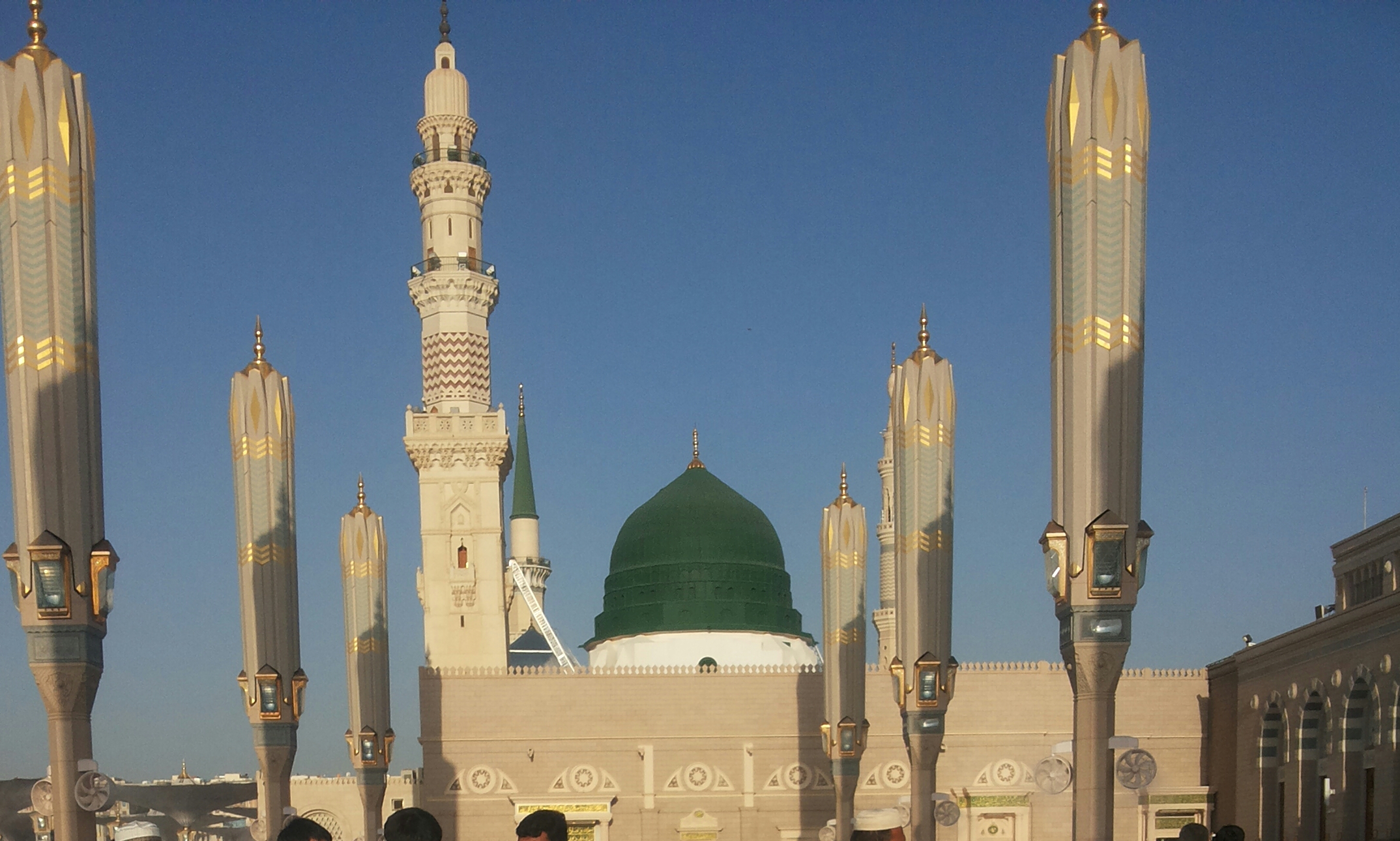
The Green Dome (al-Qubbah al-Khadra)
The Green Dome is the most recognisable feature of Masjid al-Nabawi, visible from across the city. Situated in the south-east corner of the mosque, it marks the exact location of the Prophet Muhammad’s tomb. He is buried alongside two of his closest companions and the first two caliphs of Islam: Abu Bakr as-Siddiq and Umar ibn al-Khattab.
The dome was originally built in 1279 CE during the Mamluk era as a simple wooden structure. It was painted white, then blue, before being painted green in 1837 during the Ottoman period — the colour it has retained ever since. A smaller silver dome nearby sits above the Mihrab Uthmani, the prayer niche installed during Caliph Uthman’s time.
Visiting the Prophet’s Grave
The burial chamber is enclosed behind gold-coloured brass grilles. Visitors approach from the eastern side, facing the grille, and offer salutations: “As-salamu alayka ya Rasool Allah” (Peace be upon you, O Messenger of Allah). You then step to the right to greet Abu Bakr and then Umar. The visit is performed standing — there is no prayer directed at the graves, as Islamic tradition holds that prayer is directed only to God.
Etiquette tip: Keep your voice low when offering salutations. Do not crowd or push. Photography is not permitted in this area. Move through steadily to allow others their turn.
Jannatul Baqi
Adjacent to the eastern wall of the mosque lies Jannatul Baqi, the oldest and most significant Islamic cemetery. Thousands of the Prophet’s companions, family members, and early scholars are buried here, including Uthman ibn Affan (the third caliph), several of the Prophet’s wives, his daughter Fatimah (according to some traditions), and his grandson Hasan ibn Ali. The cemetery is open to male visitors after the five daily prayers. Women may view it from the perimeter but are traditionally not permitted to enter.
Booking Your Rawdah Visit
Since 2023, all access to the Rawdah requires a digital permit booked through the Saudi government’s official Nusuk app. This system replaced the old queue-and-wait method, making access more orderly but requiring advance planning.
Step-by-Step Booking Process
- Download the Nusuk app from the Google Play Store or Apple App Store
- Create an account using your passport number, visa number, date of birth, nationality, and contact details
- Navigate to “Prophet’s Mosque Services” on the home screen, then tap “Praying in the Noble Rawdah”
- Select your gender (male or female) — separate time slots are allocated
- Choose your date and time slot from the calendar. Slots are released approximately 3 days in advance
- Confirm your booking — a QR code permit will be generated instantly
- Screenshot your QR code — mobile signal inside the mosque courtyard can be unreliable
Important Changes Since January 2025
The Saudi authorities significantly relaxed the Rawdah booking rules in early 2025:
- No more 365-day waiting period — you can now revisit the Rawdah every 20 minutes, provided you are near the mosque
- The “Instant Track” option allows bookings with very short lead times when you are physically in or near the mosque
- Both men and women can now book on all days of the week (previously, women had restricted days)
Practical Tips for Rawdah Access
- Book at least 3 days ahead for the best slot availability, especially during Ramadan and Hajj season
- Arrive 20–30 minutes before your slot — security staff begin scanning QR codes right on time
- Ensure your phone battery is charged; staff will check your permit on the Nusuk app
- If you cannot get a slot, try booking very early morning (after Fajr) or late night (after Isha) — these tend to have more availability
- Use multiple devices if your group is trying to book simultaneously — this increases your chances during peak periods
Mosque Layout and Navigation
The 42 Gates
Masjid al-Nabawi has 42 gates, and knowing which gate to use can save you considerable time and confusion, especially during peak prayer times. The gates are numbered and named, with specific gates designated for women’s access.
| Section | Gate Numbers | Notes |
|---|---|---|
| Southern gates (Qibla side) | 1–5 | Closest to the Rawdah and Prophet’s grave |
| Western gates | 6–11 | General access; nearest to many hotels |
| Women’s designated gates | 12–14, 23–30 | Direct access to women’s prayer sections |
| Eastern gates | 28–35 | Near Jannatul Baqi; Ali Ibn Talib gate (28–30) is among the largest |
| Northern gates | 36–42 | Newest section; closest to expansion areas |
The Nisa Gate (Gate of the Women) on the eastern flank provides direct access to the Rawdah for women visitors. Bab as-Salam (Gate 1) is traditionally used by visitors arriving to greet the Prophet — it opens directly toward the Rawdah area.
Prayer Hall Sections
The mosque is divided into distinct architectural zones, each with a different character:
- Ottoman prayer hall (south) — The oldest surviving section, with ornate columns, colourful decorations, small domes, and ceiling fans. This is where the Rawdah and Prophet’s burial chamber are located
- First Saudi expansion — Connects to the Ottoman hall, with wider columns and improved ventilation through grilles in the column pedestals
- Second Saudi expansion (King Fahd section) — The vast modern prayer hall to the north and east, characterised by white marble columns with brass capitals, slightly pointed arches in black and white stone, and air conditioning
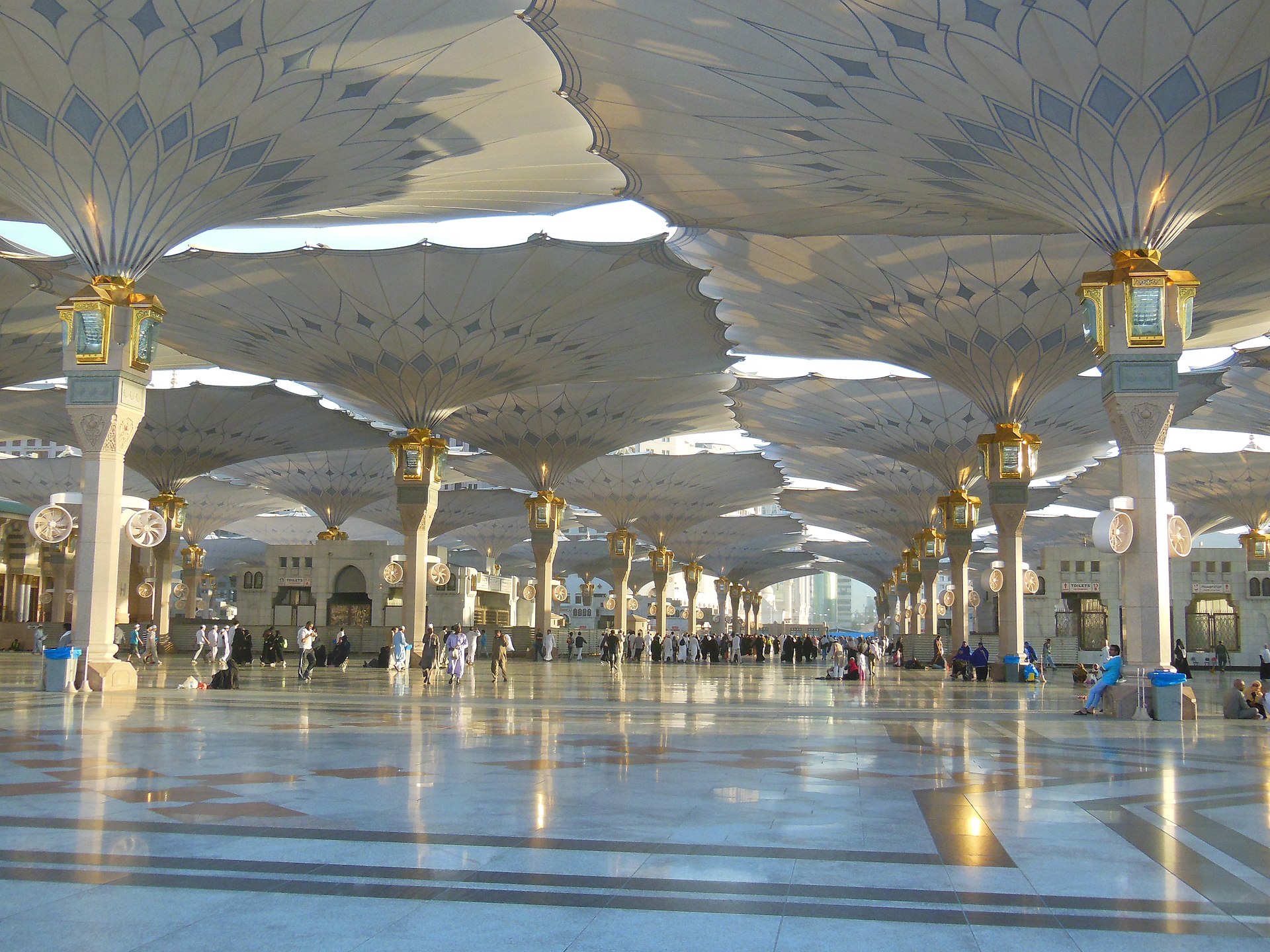
- Courtyards — The open-air marble courtyards surround the covered prayer halls, shaded by the 250 retractable umbrella canopies during the day. These courtyards overflow with worshippers during Friday prayers and Ramadan
Women’s Prayer Areas
Masjid al-Nabawi has designated women’s sections on both the eastern and western sides of the mosque, with corresponding courtyard areas. Women should enter through gates 12–14 on the western side or gates 23–30 on the eastern side. The women’s sections are well-equipped with ablution facilities, rest areas, and clear signage.
For Rawdah access, women follow the same Nusuk app booking process. Historically, women had dedicated time slots (typically post-Fajr mornings and post-Isha evenings), though since 2025, slots are available throughout the day for both genders.
Etiquette and Conduct
Visiting Masjid al-Nabawi is a profound spiritual experience. Observing proper etiquette is both a mark of respect and an Islamic obligation when entering any mosque — and especially this one.
Entering the Mosque
- Enter with your right foot and recite the du’a for entering a mosque: “Bismillah, was-salatu was-salamu ala Rasulillah. Allahumma iftah li abwaba rahmatik” (In the name of Allah, and peace and blessings upon the Messenger of Allah. O Allah, open for me the doors of Your mercy)
- Perform Tahiyyat al-Masjid — two rak’ahs of prayer to “greet” the mosque — immediately upon entering, provided it is not a prohibited prayer time
- Remove your shoes at the entrance and carry them in the plastic bags provided, or use the shoe racks near the gates
Inside the Mosque
- Keep your voice low — loud conversation, raised voices, and arguments are strictly prohibited
- Phones on silent — a ringing phone during prayer disturbs thousands of worshippers
- Photography restrictions — general photography is permitted in the courtyards and newer sections, but flash photography and selfies near the Prophet’s grave and Rawdah are not allowed
- Do not step over people who are praying or seated. Walk around them
- Do not block pathways — sit to the side if you are reciting Quran or making du’a
- Food is not permitted inside the prayer halls. Zamzam water dispensers are available throughout the mosque
Dress Code
| Men | Women |
|---|---|
| Long trousers or thobe — no shorts above the knee | Full-length abaya required |
| Sleeved shirt (short sleeves acceptable) | Headscarf (hijab) covering all hair |
| Clean, modest clothing | Face and hands may remain uncovered |
| Ihram clothing accepted if performing Umrah | Niqab optional |
Leaving the Mosque
Exit with your left foot first and recite the du’a for leaving: “Bismillah, was-salatu was-salamu ala Rasulillah. Allahumma inni as’aluka min fadlik” (In the name of Allah, and peace and blessings upon the Messenger of Allah. O Allah, I ask You for Your bounty).
Common Mistakes to Avoid
Certain practices at Masjid al-Nabawi contradict Islamic teaching or Saudi regulations. Being aware of these will ensure your visit is both spiritually valid and hassle-free:
- Do not pray toward the grave — prayer is directed to God alone, through the Qibla (toward Mecca). Praying toward the Prophet’s tomb is considered shirk (associating partners with God)
- Do not touch, kiss, or rub the grilles around the burial chamber. This is not part of the Sunnah and is discouraged
- Do not ask the Prophet for intercession directly — offer greetings (salam) only. Du’a is made to Allah alone
- Do not circle (tawaf) the grave — tawaf is performed only around the Ka’bah in Mecca
- Do not push or shove in the Rawdah area. This causes injuries and is antithetical to the spirit of the place
- Do not take selfies at the grave — security staff will intervene, and your phone may be temporarily confiscated
- Do not place items on the grave grilles — no letters, cloths, or personal belongings
Ziyarat Sites in and Around Medina
A visit to Medina extends well beyond the Prophet’s Mosque. The city and its surroundings contain dozens of historically and spiritually significant sites. Here are the most important:
Masjid Quba
Located 3.5 kilometres south of Masjid al-Nabawi, Quba Mosque is the first mosque ever built in Islam. The Prophet Muhammad laid its foundation upon first arriving in the Medina region, before entering the city itself. The Prophet said that praying two rak’ahs in Masjid Quba is equivalent in reward to performing an Umrah. The mosque has been extensively renovated and expanded, with a striking modern white marble design. It is open 24 hours and is easily reached by taxi (10–15 SAR) or the free Medina bus service.
Mount Uhud and the Martyrs’ Cemetery
Approximately 6 kilometres north of the mosque, Mount Uhud is the site of the Battle of Uhud (625 CE), one of the most significant early Islamic battles. The cemetery at the foot of the mountain contains the graves of 70 martyrs, including Hamza ibn Abdul-Muttalib, the Prophet’s uncle. The Prophet said: “Uhud is a mountain that loves us and we love it.” Organised tours typically include Uhud, but you can also reach it independently by taxi (15–20 SAR).
Masjid al-Qiblatain
The “Mosque of the Two Qiblas” is where the Prophet Muhammad received the divine command to change the direction of prayer from Jerusalem to Mecca, midway through a congregational prayer. Located about 4 kilometres north-west of Masjid al-Nabawi, it is one of the most historically important mosques in Islam. Recently renovated, it now features a single mihrab facing Mecca.
The Seven Mosques (Sab’u Masajid)
A cluster of small mosques approximately 5 kilometres from the Prophet’s Mosque, located at the site of the Battle of the Trench (Khandaq) in 627 CE. The mosques are named after prominent companions who were positioned at these spots during the siege. The site offers panoramic views of Medina and is a peaceful place for reflection.
Other Notable Ziyarat Sites
- Masjid al-Ghamama — where the Prophet performed the Eid prayer, just 300 metres south-west of Masjid al-Nabawi
- Bir Ha (Well of Uthman) — a historic well from which the Prophet drank; now enclosed within a garden
- The Hejaz Railway Station — an Ottoman-era railway terminus, now a museum, from the old Damascus–Medina line
Practical tip: Most ziyarat sites outside the mosque require a taxi. Negotiate fares in advance or use the Uber/Careem apps, which are widely available in Medina. A half-day ziyarat tour covering Quba, Uhud, Qiblatain, and the Seven Mosques typically costs 150–250 SAR by private taxi.
Getting to Medina
By Air
Prince Mohammad Bin Abdulaziz International Airport (MED) is Medina’s main airport, located approximately 15 kilometres north-east of the city centre. Direct flights operate from major international hubs including Dubai, Istanbul, Cairo, Kuala Lumpur, Jakarta, Islamabad, and London. Domestic flights connect Medina to Jeddah (1 hour), Riyadh (1.5 hours), and Dammam (2 hours) via Saudia, flynas, and flyadeal.
From the airport to the mosque area:
- Taxi/Uber/Careem: 25 minutes, approximately 50–80 SAR
- Airport bus (Route 400): Stops outside the baggage claim exit (rightmost edge). Single stop near the mosque. Pay by credit card on board. The bus drops you 10 minutes’ walk north of the mosque
- Hotel shuttle: Many hotels near the Haram offer airport transfers — confirm when booking
By Road
Medina is connected to Jeddah (420 km, ~4 hours), Mecca (440 km via Jeddah), and Riyadh (900 km, ~8 hours) by well-maintained highways. Visitors with a tourist e-visa can rent a car, though parking near the mosque is extremely limited during peak seasons.
By Train
The Haramain High-Speed Railway connects Medina to Mecca via Jeddah and King Abdullah Economic City. Journey time to Jeddah is approximately 2 hours, and to Mecca approximately 2.5 hours. Tickets can be booked through the SAR (Saudi Arabia Railways) app or website. The Medina station is at the north end of the city, with bus and taxi connections to the Haram area.
Where to Stay
Accommodation in Medina is concentrated around the Haram (mosque) district, with hotels ranging from budget to ultra-luxury. Proximity to the mosque is the primary consideration — many visitors pray all five daily prayers at Masjid al-Nabawi, making a short walk essential. For a broader overview of accommodation across the Kingdom, see our Saudi Arabia hotels guide.
Luxury Hotels (Walking Distance)
- Dar Al Taqwa Hotel — Directly on the mosque courtyard, just 3 metres from the main entrance. The closest hotel to the Haram
- Anwar Al Madinah Mövenpick Hotel — 5-star, 2 minutes’ walk from the mosque. Rooftop views of the Green Dome
- Madinah Hilton Hotel — 2 minutes’ walk with direct access near Gate 25. 19 km from the airport
- Pullman Zamzam Madina — 300 metres from the mosque, recently renovated rooms
Mid-Range and Budget Options
- Millennium Taiba Hotel — 8 minutes’ walk, good value with airport shuttle available
- Budget hotels along As Salam Road — numerous 2–3 star options within 10–15 minutes’ walk, from 150–300 SAR/night
- Serviced apartments — available through Booking.com and Airbnb, suitable for families and longer stays
Booking tip: During Ramadan and Hajj season, hotel prices near the Haram can triple or quadruple. Book 3–6 months in advance for these periods. Outside peak season (October–February), rates are significantly lower and room availability is rarely an issue.
Best Time to Visit
Medina can be visited year-round, but timing significantly affects your experience:
| Season | Months | Temperature | Crowds | Notes |
|---|---|---|---|---|
| Winter (best) | Nov–Feb | 15–25°C | Moderate | Most comfortable for outdoor ziyarat |
| Spring | Mar–Apr | 25–35°C | Moderate–High | Ramadan may fall here; pleasant mornings |
| Summer | May–Sep | 35–45°C | Hajj peak in June | Extreme heat; limit outdoor time |
| Autumn | Oct | 30–38°C | Low–Moderate | Heat subsiding; good value |
The mosque’s interior is fully air-conditioned, so prayer and worship inside are comfortable regardless of season. The courtyard umbrellas provide shade during daytime, but the marble floors absorb significant heat in summer — footwear is essential when crossing the courtyard between June and September.
Practical Tips for First-Time Visitors
What to Bring
- Comfortable, modest clothing — you will walk extensively on marble floors
- A small prayer rug — useful when the mosque is crowded and you pray in the courtyard
- A bag for shoes — plastic bags are provided, but having your own is more reliable
- Portable phone charger — essential for keeping your Nusuk app QR code accessible
- Sunscreen and a hat — for outdoor ziyarat sites like Uhud
- A water bottle — Zamzam water dispensers are inside, but carry water for excursions
Prayer Times and Best Visiting Hours
The mosque is open 24 hours, every day of the year. There is no admission fee and no ticket required. Prayer is led by renowned imams, and the experience of praying in congregation with tens of thousands of worshippers is unforgettable.
- Fajr prayer: Approximately 5:00–5:30 AM (varies by season)
- Dhuhr prayer: Approximately 12:15–12:30 PM
- Asr prayer: Approximately 3:30–3:45 PM
- Maghrib prayer: At sunset
- Isha prayer: Approximately 1.5 hours after sunset
The quietest times to visit are late morning (between Dhuhr and Asr) and late at night (after Isha until Fajr). Friday prayers draw the largest crowds — arrive at least 2 hours early to secure a spot inside the covered prayer hall.
Accessibility
Masjid al-Nabawi is wheelchair accessible, with ramps at most major gates, dedicated wheelchair areas inside the prayer hall, and accessible ablution facilities. Wheelchairs are available for loan near the main entrances — ask the security staff. Electric golf carts transport visitors with mobility limitations across the vast courtyard during peak times.
Families with Children
Children are welcome in the mosque but must be supervised. During peak prayer times, families with small children may find the women’s section more comfortable, as it tends to be less congested. Pushchairs should be left at the gate — use a baby carrier instead. The mosque has no dedicated childcare facilities.
The Umbrella Canopies: An Architectural Marvel
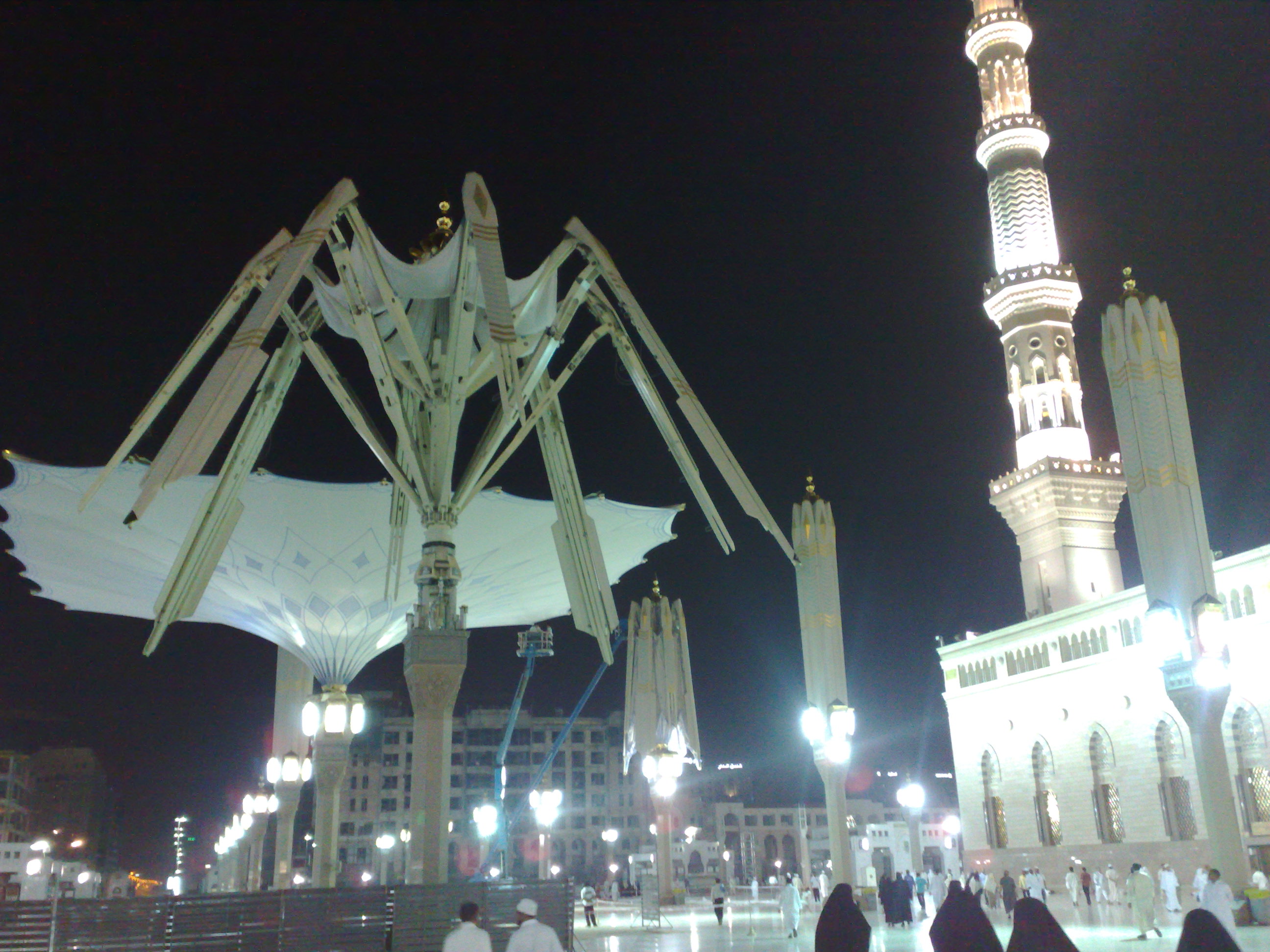
One of the most distinctive features of modern Masjid al-Nabawi is its 250 retractable umbrella canopies, installed during the second Saudi expansion. Each umbrella spans 25 by 25 metres when fully open — covering 625 square metres — and is mounted on a freestanding column in the courtyard. The fabric is engineered for high tensile strength, fire resistance, UV protection, and optimal light penetration. The undersides are decorated with traditional Islamic geometric motifs in blue PTFE (Teflon-coated fabric).
The umbrellas open in the morning to shade worshippers from the sun and close at night, revealing the sky above the marble courtyard. During rain — rare in Medina but not unheard of — they provide shelter. Watching the umbrellas open or close in synchronised motion is itself a remarkable sight, drawing visitors and photographers at sunrise and sunset.
Architecture Worth Noticing
The Ottoman Prayer Hall
The oldest surviving section of the mosque is the Ottoman prayer hall, located in the southern portion. Its low ceiling, intimate scale, colourful decorations, and densely spaced columns give it a dramatically different atmosphere from the modern Saudi expansions. The columns are adorned with intricate calligraphy and floral motifs. Ceiling fans supplement the ventilation. This is where the Rawdah and burial chamber are located, making it the spiritual centre of the entire complex.
The Minarets
The mosque has ten minarets — the original Ottoman minaret (Suleymaniyya) and nine added during the Saudi expansions. The tallest minarets reach approximately 104 metres. The call to prayer (adhan) is broadcast from these minarets five times daily and can be heard across much of central Medina.
Climate Control and Ventilation
The modern sections feature an advanced climate control system. Ventilation grilles in the marble column pedestals regulate temperature inside the prayer hall, while chilled water flows through an underground cooling system. Even at the height of summer, the interior remains comfortable for extended worship.
Non-Muslim Visitors
Unlike the Masjid al-Haram in Mecca, the city of Medina is accessible to non-Muslims. However, the immediate Haram area — the mosque and its surrounding courtyards — is restricted to Muslims only. Non-Muslim visitors to Medina can explore the city’s other historical and cultural attractions, including the Hejaz Railway Museum, the old Medina markets, and the surrounding landscapes. The boundaries of the restricted zone are clearly marked.
Explore More Saudi Arabia Travel Guides
- Hajj 2026 Guide — Complete guide to performing Hajj this year, including rituals, logistics, and preparation
- Umrah Guide — Step-by-step guide to performing Umrah, from ihram to tawaf and sa’i
- Saudi Arabia Visa Guide — Every visa type explained, including tourist e-visa, Umrah visa, and Hajj visa
- Saudi Arabia Hotels Guide — Where to stay across the Kingdom, from budget to luxury
- Saudi Arabia Travel Guide 2026 — The complete guide to visiting the Kingdom