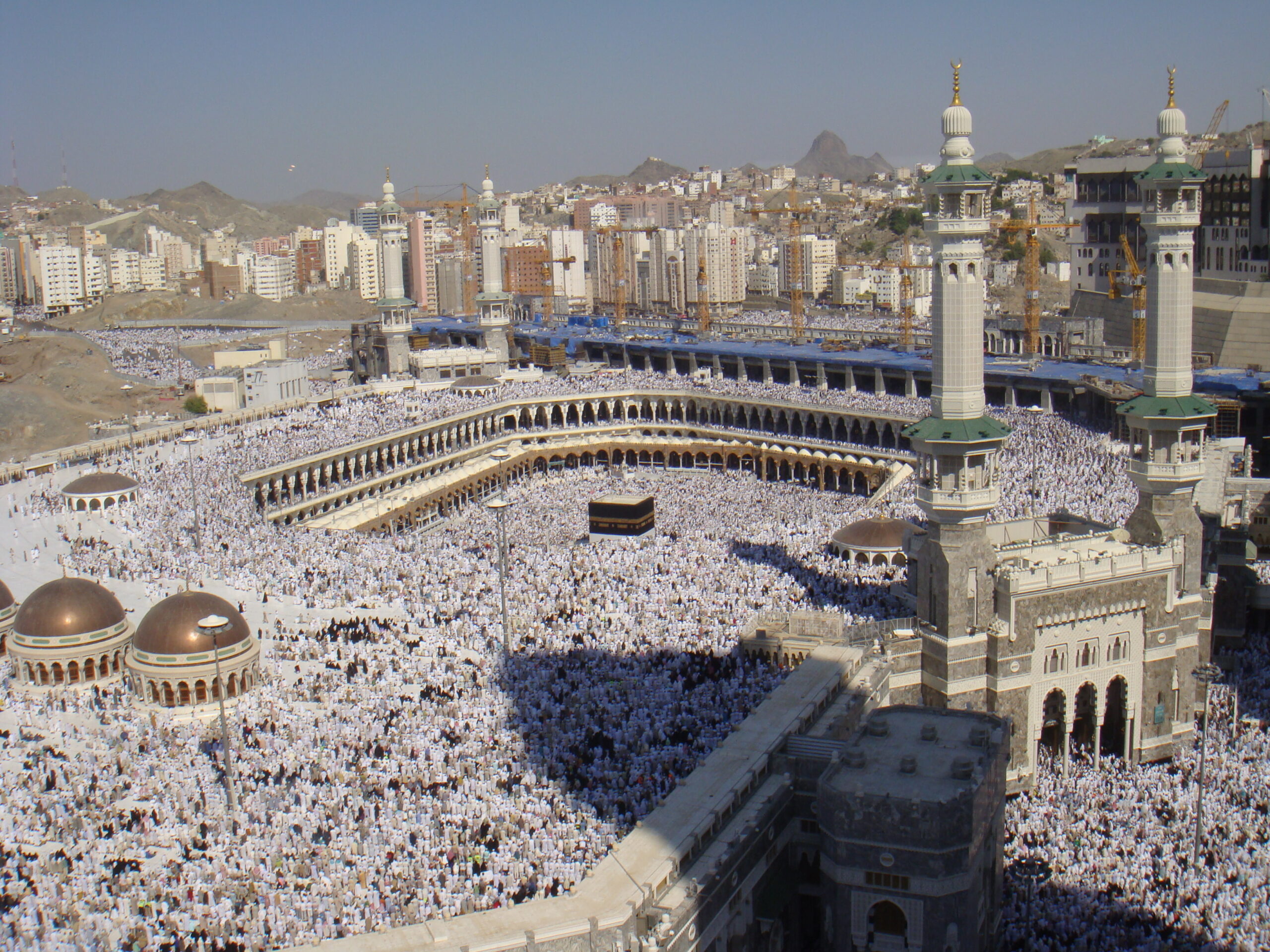

Masjid al-Haram — the Sacred Mosque — is the largest and holiest mosque on earth, enclosing the Kaaba in the heart of Mecca. Every year, millions of Muslims travel here for Hajj and Umrah, making it the most visited religious site in the world. Whether you are planning your Hajj pilgrimage in 2026 or performing Umrah outside the Hajj season, this guide covers everything you need to know about visiting the Grand Mosque: its sacred landmarks, ritual procedures, accessibility, accommodation, and practical tips to help you prepare for one of the most profound spiritual experiences of your life. For a broader look at the holy city itself, see our complete Mecca guide for Muslim travellers.
Best Time to Visit: November to February (cooler weather); Ramadan and Hajj season for spiritual significance
Getting There: Fly to Jeddah (IATA: JED) then 80 km by road, or take the Haramain High-Speed Railway to Makkah station
Visa Required: Yes — Hajj visa, Umrah visa, or tourist e-visa for Muslims
Budget: USD 80–300/day depending on hotel proximity and season
Must-See: The Kaaba, Maqam Ibrahim, Zamzam Well, Safa and Marwa
Avoid: Attempting Tawaf at ground level during peak hours if elderly or with children — use the upper floors instead
The Holiest Site in Islam
Masjid al-Haram is not simply a mosque — it is the spiritual axis of the Islamic world. The Quran refers to it as the first house of worship established for humanity, and it is the qibla that 1.8 billion Muslims face during their five daily prayers. A single prayer offered here is believed to carry the reward of 100,000 prayers offered elsewhere, according to authentic hadith.
The mosque has expanded dramatically over fourteen centuries, from an open courtyard around the Kaaba to a multi-storey complex spanning approximately 356,800 square metres of indoor and outdoor prayer space. After the King Abdullah expansion, the total prayer area grew to roughly 912,000 square metres, accommodating over two million worshippers simultaneously. Nine minarets — each rising approximately 89 metres — punctuate the skyline, while some 262 gates allow entry and exit from every direction.
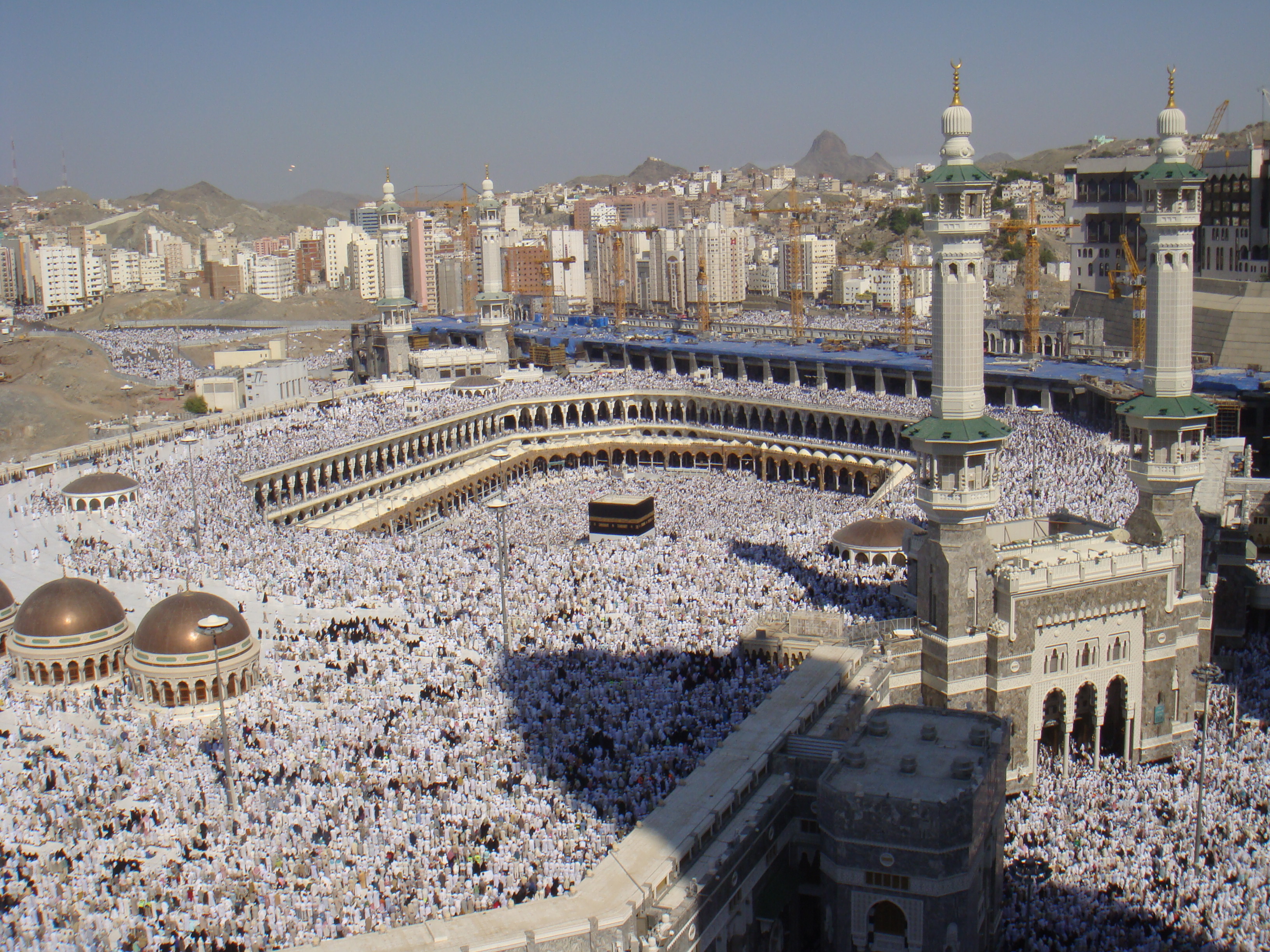
Important: Only Muslims are permitted to enter the city of Mecca. The restriction is enforced at road checkpoints on all highways leading into the city. Non-Muslims who attempt to enter face deportation and potential entry bans. This guide is written for Muslim visitors planning their pilgrimage.
Sacred Landmarks Within the Mosque
Masjid al-Haram contains several sites of extraordinary religious significance. Understanding what each one is — and the etiquette for approaching it — will deepen your experience and help you navigate the mosque with confidence. If you are visiting for the first time, our Umrah first-timer guide walks through the complete ritual step by step.
The Kaaba
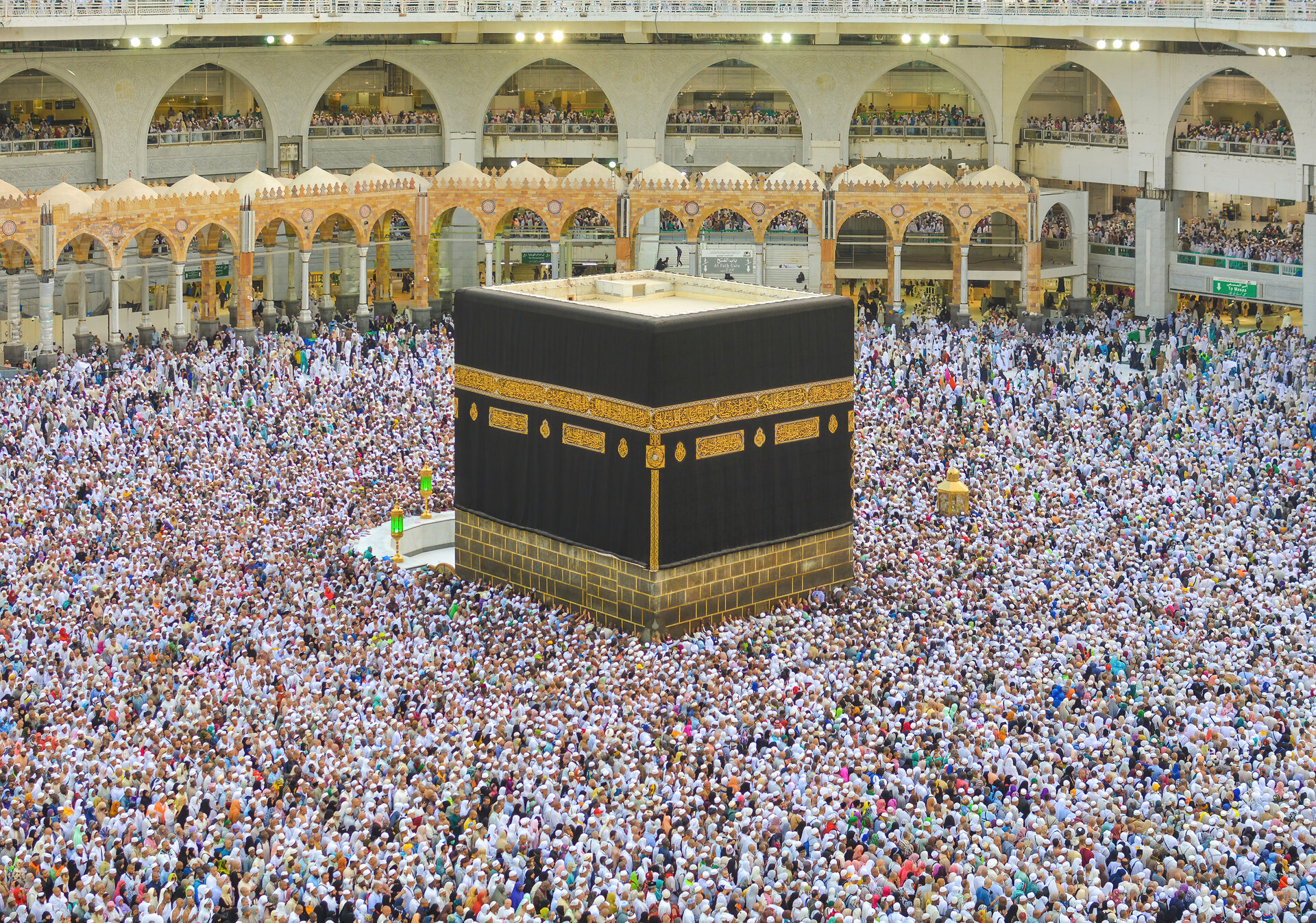
The Kaaba is the cubic granite structure at the exact centre of the mosque, draped in the black silk Kiswah embroidered with gold Quranic calligraphy. It stands approximately 13.1 metres tall with walls just over a metre thick. Muslims do not worship the Kaaba itself — it serves as the focal point (qibla) of prayer and the axis of the Tawaf ritual. The Kiswah is replaced annually during Hajj, and the old cloth is cut into pieces and distributed as gifts.
The Black Stone (Al-Hajar al-Aswad)
Set into the eastern corner of the Kaaba, the Black Stone marks the starting and ending point of each circuit of Tawaf. Pilgrims traditionally kiss or touch the stone, though during crowded periods most simply raise their hand toward it and say “Bismillah, Allahu Akbar” as they pass. A green light on the wall opposite marks the starting line.
Maqam Ibrahim
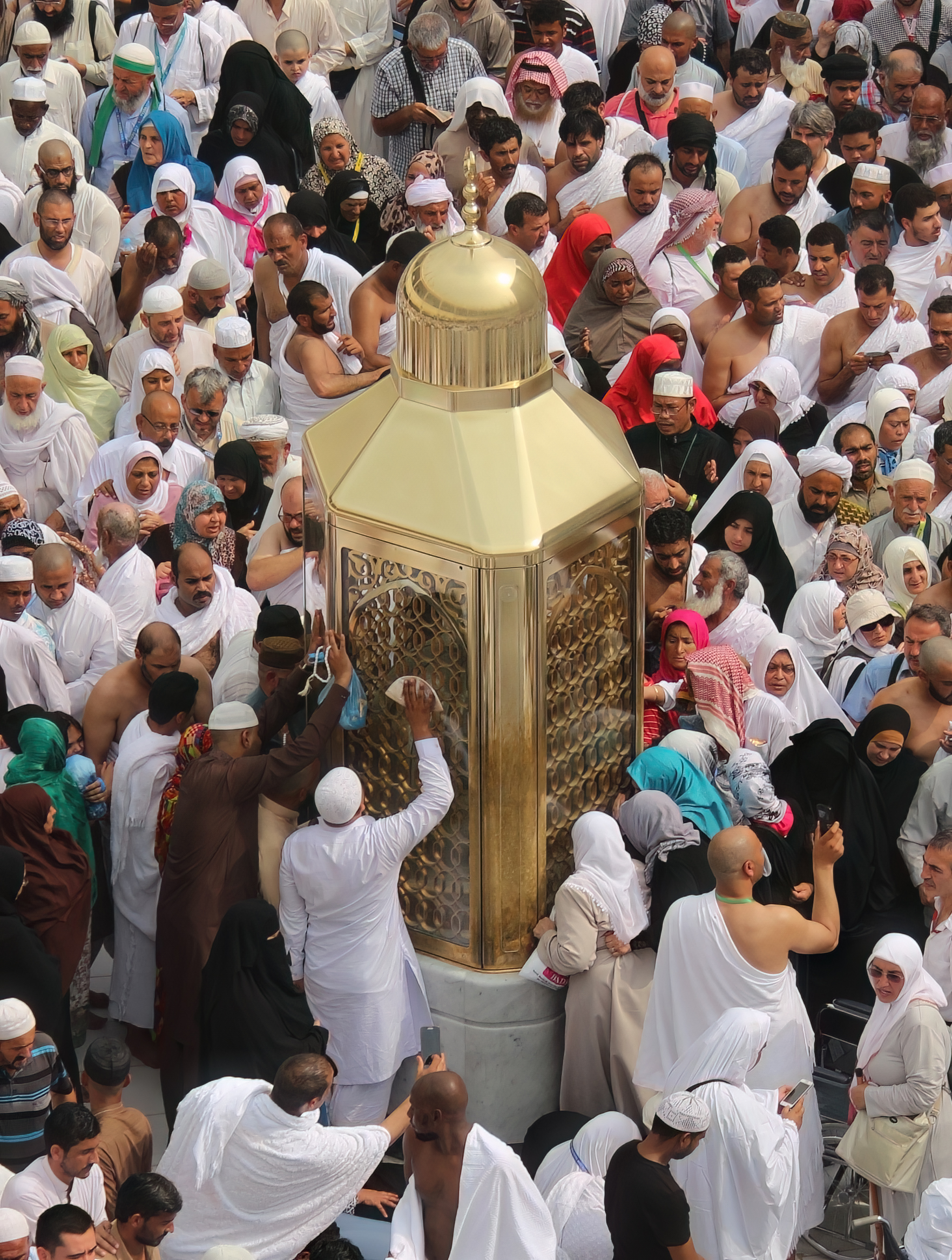
A small glass-and-gold enclosure near the Kaaba houses a stone bearing what Islamic tradition identifies as the footprints of Prophet Ibrahim (Abraham), who built the Kaaba with his son Ismail. After completing Tawaf, pilgrims pray two rak’ahs behind this station, as directed in the Quran (2:125). The area around the Maqam is typically very crowded — if you cannot reach it, you may pray the two rak’ahs anywhere in the mosque.
Zamzam Well
Located approximately 20 metres east of the Kaaba, the Zamzam Well has supplied water for thousands of years. According to Islamic tradition, God caused the spring to appear for Hajar (Hagar) and her infant son Ismail when they were left in the desert valley of Mecca. Today, Zamzam water is distributed through coolers and dispensers placed throughout the mosque. The original well shaft is no longer accessible to the public, but a dedicated drinking area in the basement provides direct access to Zamzam water.
Hijr Ismail (The Hateem)
The crescent-shaped white marble wall on the northwest side of the Kaaba marks the Hijr Ismail, also known as the Hateem. This semi-circular area is considered part of the original Kaaba — praying inside it is equivalent to praying inside the Kaaba itself. During Tawaf, pilgrims must walk around the outside of the Hateem wall, not through it, for the circuit to be valid.
The Multazam
The Multazam is the section of the Kaaba wall between the Black Stone and the door of the Kaaba. It is a place where supplications (du’a) are considered especially likely to be accepted. Pilgrims press their chest, cheeks, and hands against this wall and pray. Reaching the Multazam requires patience, as it is always crowded — late night hours offer the best opportunity.
Safa and Marwa (Al-Mas’a)
Two small hills enclosed within the mosque complex, connected by the 395-metre-long Al-Mas’a corridor. Pilgrims walk between them seven times during the Sa’i ritual, commemorating Hajar’s desperate search for water for her son. The corridor is now fully air-conditioned and divided into lanes — with a dedicated elevated path for wheelchair users. Green fluorescent lights mark the section where men are encouraged to jog (raml), while women walk at a normal pace throughout.
Architecture and Expansion History
The mosque you see today is the product of fourteen centuries of continuous expansion, each era leaving its architectural signature. Understanding this history helps you navigate the different sections — Ottoman-era colonnades, Saudi-era prayer halls, and ultra-modern climate-controlled extensions blend into one enormous complex.
Historical Timeline
| Period | Ruler / Era | Key Changes |
|---|---|---|
| 638 CE | Caliph Umar ibn al-Khattab | First formal enclosure around the Kaaba; demolished surrounding houses |
| 692 CE | Caliph Abd al-Malik | Added marble columns and mosaic decoration |
| 1571 | Ottoman Sultan Selim II | Major renovation directed by architect Sinan; added domes |
| 1629 | Ottoman era | Rebuilding after floods; total of seven minarets |
| 1955–1976 | King Saud / King Faisal | First Saudi expansion — marble flooring, four additional minarets, two-storey galleries |
| 1988–2005 | King Fahd | Second Saudi expansion — new wing, air conditioning, escalators, two more minarets; capacity increased to 820,000 |
| 2007–2020s | King Abdullah / King Salman | Third expansion — Mataf enlarged, prayer area expanded to 912,000 sq m, capacity over 2 million |
The King Abdullah Expansion
The most recent completed expansion dramatically enlarged the mosque footprint from roughly 414,000 to over 1.5 million square metres. The Mataf (Tawaf area) around the Kaaba was widened and a temporary bridge structure added to enable multi-level Tawaf during peak periods. New air conditioning systems cool the marble floors, and hundreds of escalators connect the multiple prayer levels. The lighting system for the Mataf extension was completed in 2025.
The King Salman Gate Project
Announced in October 2025 by Crown Prince Mohammed bin Salman, the King Salman Gate is a transformative mega-development adjacent to Masjid al-Haram. Spanning up to 12 million square metres of gross floor area, it will accommodate an additional 900,000 worshippers in indoor and outdoor prayer spaces. The project will restore approximately 19,000 square metres of heritage sites, add residential, hospitality, and cultural facilities, and connect to public transport networks for seamless access to the Grand Mosque. It is expected to create over 300,000 jobs by 2036 and marks the largest single development in Mecca’s history, being developed by RUA AlHaram AlMakki Company under the Public Investment Fund (PIF).
Performing Tawaf
Tawaf — the act of circling the Kaaba seven times in a counter-clockwise direction — is the central ritual of both Hajj and Umrah. It is also performed voluntarily (Tawaf al-Nafl) at any time by visitors to the mosque.
Rules and Etiquette
- Wudu (ablution) is required before starting Tawaf. If your wudu breaks during Tawaf, you must renew it and resume from where you stopped.
- Start at the Black Stone corner. Face the stone, raise your right hand toward it, and say “Bismillah, Allahu Akbar.” A green light on the opposite wall marks the exact starting line.
- Move counter-clockwise with the Kaaba on your left side. Walk around the Hateem (Hijr Ismail) — do not cut through it.
- Seven complete circuits constitute one Tawaf. Each return to the Black Stone corner completes one circuit.
- Keep moving. Avoid stopping suddenly, as thousands of people flow behind you. If you need to rest, step out of the Tawaf lanes.
- Avoid pushing near the Black Stone and Maqam Ibrahim. Raising your hand from a distance is a valid and safer alternative to kissing the stone.
- Pray two rak’ahs behind Maqam Ibrahim after completing Tawaf. If the area is too crowded, pray anywhere in the mosque.
- Maintain respectful speech. The Prophet advised that any words spoken during Tawaf should be good and meaningful.
- Zamzam water: Coolers and dispensers are placed throughout the mosque and its courtyards. A dedicated Zamzam drinking area is available in the basement level.
- Air conditioning: The entire mosque interior is climate-controlled, including the Mataf extension and the Mas’a corridor. Heated floors are installed in certain sections for winter months.
- Washrooms and wudu areas: Large ablution facilities are located at the basement level and near major gates. Accessible washrooms are available for pilgrims with disabilities.
- Lost and found: A dedicated office operates near the main gates. Report lost belongings to mosque security.
- Medical services: First-aid stations are positioned throughout the mosque. During Hajj season, fully staffed medical clinics operate within the Haram complex.
- Security volunteers: Staff and volunteers are stationed at every level to offer directions and assistance in multiple languages.
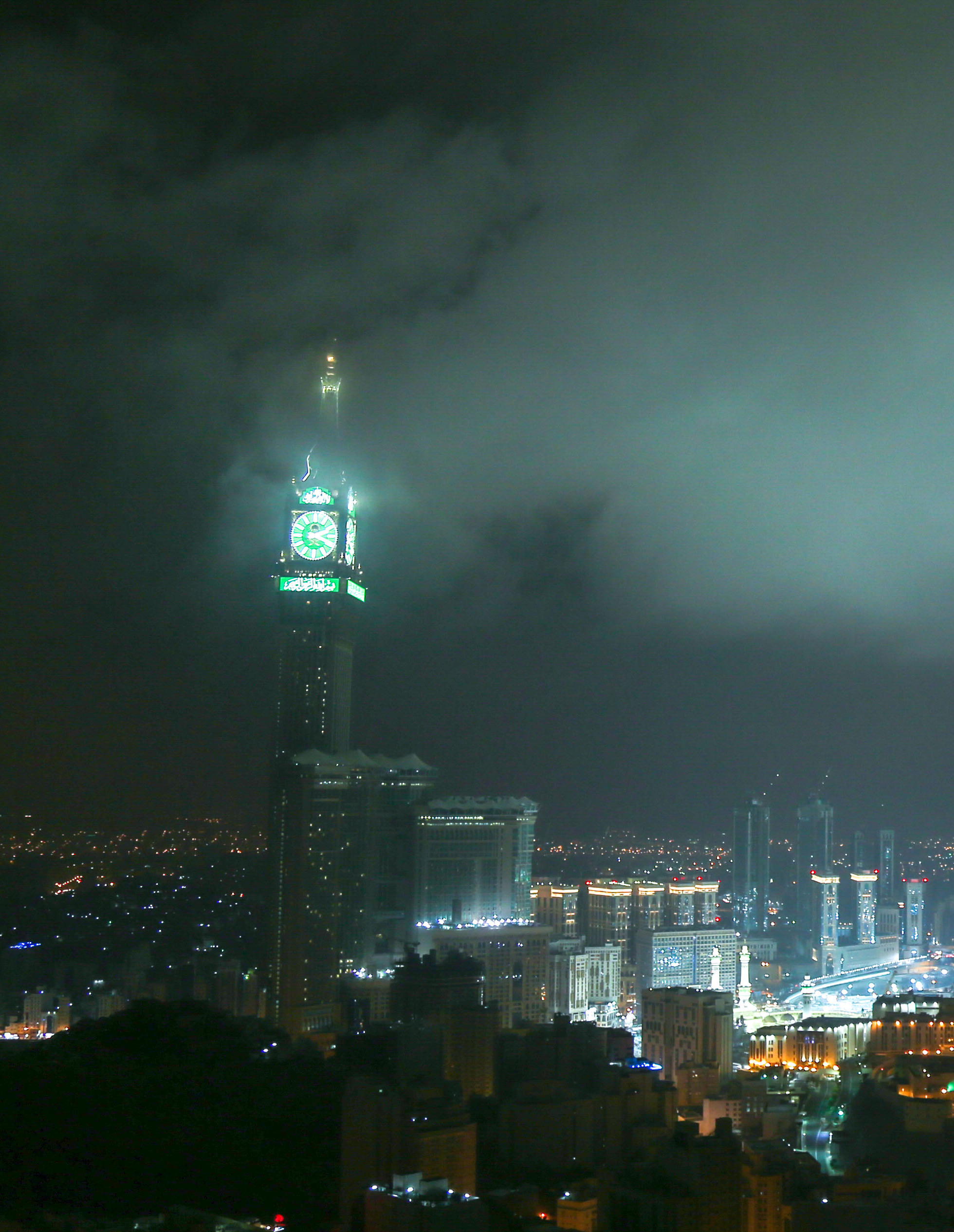
- Makkah Clock Royal Tower, A Fairmont Hotel — The tallest building in the complex at 76 floors with 1,650 rooms. Multiple dining options and direct Haram access. Rates from approximately SAR 2,000–8,000/night depending on season and room view.
- Swissotel Makkah — 1,487 rooms with contemporary design, many with full or partial Kaaba views.
- Swissotel Al Maqam Makkah — 1,624 rooms with direct tunnel access to the Haram via Ibrahim Al-Khalil Street, especially practical for pilgrims with mobility needs.
- Mövenpick Hotel & Residences Hajar Tower — Directly on the Haram Court facing King Abdul Aziz Gate, with five dining venues.
- 8 Dhul Hijjah (approx. 25 May): Yawm al-Tarwiyah — pilgrims enter Ihram and depart for Mina
- 9 Dhul Hijjah (approx. 26 May): Day of Arafah — standing at the plain of Arafat, the spiritual climax of Hajj
- 10 Dhul Hijjah (approx. 27 May): Eid al-Adha — stoning at Jamarat, sacrifice, Tawaf al-Ifadah at Masjid al-Haram
- Arrive early for prayer. The best spots near the Kaaba fill up 30–60 minutes before prayer times, especially Fajr and Isha. Arriving early also lets you absorb the atmosphere in relative calm.
- Memorise your gate number. With 262 gates, it is remarkably easy to get lost. Note the gate number nearest your hotel and use it consistently. Take a photo of nearby landmarks for reference.
- Carry a small bag for shoes. Plastic bags are available at most entrances, but bringing your own reusable bag saves time and keeps your footwear safe.
- Stay hydrated. Mecca’s temperatures regularly exceed 40°C in summer. Drink Zamzam water frequently — coolers are everywhere. Carry a small water bottle.
- Use the upper floors. The ground level around the Kaaba is spiritually magnetic, but the upper prayer levels offer the same reward with far more space. Especially valuable for elderly visitors and families.
- Protect your valuables. Pickpocketing, while uncommon, does occur in the dense crowds around the Mataf. Use a money belt or neck pouch for your passport, phone, and cash.
- Download the Nusuk app. The official Saudi pilgrimage app provides real-time prayer times, crowd levels, facility locations, and navigation within the Haram complex.
- Respect the staff and volunteers. Security guards and stewards manage enormous crowds under extreme conditions. Follow their instructions — they exist for everyone’s safety.
- Plan your du’a in advance. The atmosphere inside the Haram is overwhelming. Many pilgrims recommend writing down your supplications beforehand so the emotion of the moment does not cause you to forget what you wanted to ask for.
- Hajj 2026 Guide — Complete planning guide for the annual pilgrimage to Mecca
- Mecca for Muslim Travellers — The full city guide covering hotels, transport, and sacred sites
- Umrah for First Timers — Step-by-step guide for your first Umrah pilgrimage
- Umrah Packing List — Everything men and women need to bring
- Umrah Costs Breakdown — Detailed budget planning for your pilgrimage
- Masjid al-Nabawi Visitor Guide — Visiting the Prophet’s Mosque in Medina
- Medina Travel Guide — The Prophet’s city and what to see beyond the mosque
- Saudi Arabia Travel Guide 2026 — The complete guide to visiting the Kingdom
- Saudi Arabia Visa Guide — Every visa type explained
Best Times for Tawaf
The Mataf is accessible 24 hours a day, but crowd levels vary dramatically. The least crowded periods are typically between Fajr and Dhuhr prayers and late at night after Isha. Friday afternoons and the hours immediately before and after Maghrib prayer tend to be the most congested. During Hajj season (expected 25–30 May 2026) and the last ten days of Ramadan, the Mataf operates at full capacity around the clock — expect significant waiting times at ground level.
Tip: The upper floors of the Mataf offer the same spiritual reward as the ground level but with far less crowding. Wheelchair users and elderly pilgrims will find the upper-level circular path significantly easier to navigate. Access via escalators or lifts at multiple points around the mosque.
Wheelchair Access and Pilgrims with Disabilities
The General Presidency for the Affairs of the Two Holy Mosques provides free wheelchair services inside Masjid al-Haram, available near major gates including Gate King Abdul Aziz, Gate 74, and Gate Ajyad. The King Fahd expansion includes six dedicated prayer halls for people with disabilities, equipped with ramps, designated paths, and free electric and manual carts.
For Tawaf, a dedicated circular wheelchair path is available on the upper floors of the Kaaba courtyard. Between Safa and Marwa, a clearly marked, slightly elevated wheelchair lane runs the full length of the Al-Mas’a corridor. Of the mosque’s 262 gates, 13 are designated for pilgrims with disabilities or special needs. For more on planning an accessible pilgrimage, see our Hajj 2026 guide.
Practical Visitor Information
Who Can Visit
Mecca is exclusively for Muslims. The entire city lies within the defined Haram boundary, marked by physical signs and checkpoints on all major highways. Non-Muslims are not permitted to enter under any circumstances — violators face deportation and long-term entry bans to Saudi Arabia. If you have recently converted to Islam, you are welcome provided you comply with Saudi visa and pilgrimage regulations.
Visa and Entry Requirements
To visit Masjid al-Haram, you need either a Hajj visa (issued specifically for the annual pilgrimage season), an Umrah visa, or the Saudi tourist e-visa which permits Muslims to perform Umrah outside Hajj season. Hajj visas are allocated through country quotas — apply well in advance through an authorised Hajj travel agency in your home country. For a detailed breakdown of all visa types and application steps, consult our Saudi Arabia visa guide.
What to Wear
Men performing Hajj or Umrah must wear Ihram — two unstitched white cloths, one wrapped around the waist and one draped over the left shoulder. Outside of Ihram, modest clothing that covers the body is required inside the mosque.
Women should wear loose, modest clothing covering the entire body except the face and hands. A headscarf (hijab) is obligatory. During Ihram, women’s faces must remain uncovered (no niqab) and gloves are not worn, though they may wear any modest stitched clothing.
Footwear must be removed before entering the prayer areas. Bring a bag to carry your shoes — the mosque’s shoe racks fill quickly during peak times. For a comprehensive list of what to bring, see our Umrah packing list.
Facilities and Services
Prayer Times
Masjid al-Haram is open 24 hours a day, 365 days a year. The five daily prayers are led by the mosque’s designated imams, and the timing shifts throughout the year with the solar cycle. As a general guide, Fajr (dawn) prayer falls between approximately 4:30 and 5:30 AM, Dhuhr (noon) around 12:15–12:30 PM, Asr (afternoon) between 3:30 and 3:50 PM, Maghrib (sunset) between 6:15 and 6:45 PM, and Isha (night) between 7:45 and 8:15 PM. For exact daily times, use the official mosque portal or the Nusuk app.
Accommodation Near Masjid al-Haram
Mecca’s hotel landscape revolves entirely around proximity to the Haram. The closer your hotel, the easier your pilgrim routine — but the higher the price, especially during Hajj and Ramadan. Budget carefully using our Umrah costs breakdown to plan your stay.
Premium Hotels in the Abraj Al-Bait Complex
The Abraj Al-Bait (Clock Tower) complex towers directly over the southern edge of Masjid al-Haram, just 100–300 metres from the Kaaba. This government-owned cluster of seven skyscraper hotels includes:
Mid-Range and Budget Options
Dozens of hotels line the streets within a 500-metre to 2-kilometre radius of the mosque. Areas like Ajyad, Al-Misfalah, and Al-Aziziyah offer three- and four-star hotels at significantly lower rates — from SAR 300–800/night outside peak season. Many provide shuttle services to the Haram. During Hajj season, prices across all categories can increase three- to fivefold, and availability must be booked months in advance. For a wider selection, see our Saudi Arabia hotels guide.
Getting to Masjid al-Haram
By Air
The nearest major airport is King Abdulaziz International Airport (JED) in Jeddah, approximately 80 kilometres west of Mecca. During Hajj season, a dedicated Hajj terminal processes arriving pilgrims. Taxis and organised transport from the airport to Mecca take approximately 60–90 minutes depending on traffic. For full airport details, see our Saudi Arabia airport guide.
By High-Speed Rail
The Haramain High-Speed Railway connects Mecca to Medina via Jeddah and King Abdullah Economic City, travelling at 300 km/h. Makkah Central Station is located near the 3rd Ring Road in Rusaiyfah District, with park-and-ride connections to the Grand Mosque. During Ramadan 2025, the railway operated over 3,662 trips with more than 1.7 million seats. Tickets can be booked at sar.hhr.sa or haramainrailway.com. The train is the most comfortable option if you are combining a visit to Mecca with Medina and the Prophet’s Mosque.
By Road
From Jeddah, Mecca is connected via the well-maintained Makkah–Jeddah Expressway. Private taxis and ride-hailing apps (Uber and Careem both operate in Saudi Arabia) are widely available. During Hajj and Umrah peak periods, expect heavy traffic and checkpoints on all approaches to the city.
Hajj 2026 at Masjid al-Haram
Hajj 2026 is expected to fall around 25–30 May 2026 (8–13 Dhul Hijjah 1447 AH), subject to the official lunar sighting. The key ritual days include:
During these days, Masjid al-Haram operates at absolute peak capacity, with crowd management systems, expanded security, and round-the-clock medical services in full operation. Tawaf al-Ifadah on 10 Dhul Hijjah is one of the most crowded moments of the year — many pilgrims delay it to 11 or 12 Dhul Hijjah to avoid the crush. For the full pilgrimage planning guide, see our complete Hajj 2026 guide.