
Saudi Arabia’s northwest corner holds one of the Kingdom’s most dramatic concentrations of natural and historical landscapes. The Tabuk region — covering roughly 136,000 square kilometres of desert plateau, sandstone canyons, volcanic lava fields, and 700 kilometres of Red Sea and Gulf of Aqaba coastline — is the kind of destination that forces travellers to recalibrate their expectations of Arabia entirely. Snow-capped peaks in winter, turquoise island archipelagos in spring, Nabataean tombs rivalling Petra year-round: this is a province that rewards every type of explorer. For a broad overview of the province, including NEOM developments and logistics, see our Tabuk Travel Guide. This page goes deeper — every canyon, coastline, heritage site, and highland worth your time in the Tabuk region, with practical details to plan your trip.
Best Time to Visit: October to March (mild days, cool nights, occasional highland snow in December–January)
Getting There: Prince Sultan Bin Abdulaziz International Airport (TUU) — direct flights from Riyadh (~2 hrs), Jeddah (~1.5 hrs), and Dammam via Saudia, flynas, and flyadeal. Flights from SAR 219 one-way.
Visa Required: Yes — tourist e-visa available for 60+ nationalities
Budget: USD 50–150/day (budget travellers from $50; mid-range $80–120; comfort $120–150+)
Must-See: Wadi Al-Disah canyon, Maghaer Shuaib (Caves of Jethro), Haql Shipwreck Beach
Avoid: June to August — daytime temperatures exceed 40°C in the lowlands; many desert sites become dangerously hot
Why the Tabuk Region Deserves a Deep Dive
Most visitors to Saudi Arabia concentrate on Riyadh, Jeddah, or the Hajj cities. The Tabuk region is what awaits those willing to push further. The province borders Jordan to the north, Egypt across the Gulf of Aqaba to the west, and the vast Nafud desert to the east. Within that territory lies an extraordinary range of landscapes: the 15-kilometre sandstone slot canyon of Wadi Al-Disah, now on UNESCO’s tentative World Heritage list; the ancient oasis of Tayma, where Babylonian king Nabonidus held court in the 6th century BC; Jabal al-Lawz, a 2,549-metre peak that receives snowfall almost every winter; and a Red Sea coastline sheltering over 100 islands, with coral reefs supporting more than 1,200 fish species near Umluj.
The region is also home to NEOM, the $500-billion giga-project that encompasses the northwestern corner of the province. While much of NEOM remains a construction zone in 2026, the broader Tabuk coastline already offers genuine, accessible attractions — and the province’s heritage sites have been receiving visitors for millennia.
Tabuk City: The Gateway
Tabuk city sits at 770 metres above sea level, giving it a noticeably milder climate than Riyadh or Jeddah. With a population of roughly 670,000, it serves as the administrative capital and the logistical hub from which every regional excursion begins. The city itself merits a full day before heading into the backcountry.
Tabuk Castle (Tabuk Archaeological Castle)
Built in 1559 during the Ottoman period, Tabuk Castle served as a fortified water station and security post along the Hajj pilgrimage route connecting Damascus to Medina via the Syrian route. The castle was restored in 1654, again in 1843, and most recently in 2013 by the Ministry of Tourism, which converted it into the Tabuk Archaeological Castle Museum. Inside you will find a mosque, watchtowers, a large courtyard, and exhibit halls displaying artefacts spanning the region’s pre-Islamic, Islamic, and Ottoman history. Admission is free. Opening hours are typically 9:00 AM to 7:00 PM daily, though it is advisable to confirm locally as hours can shift during Ramadan.
Hejaz Railway Station and Tabuk Museum
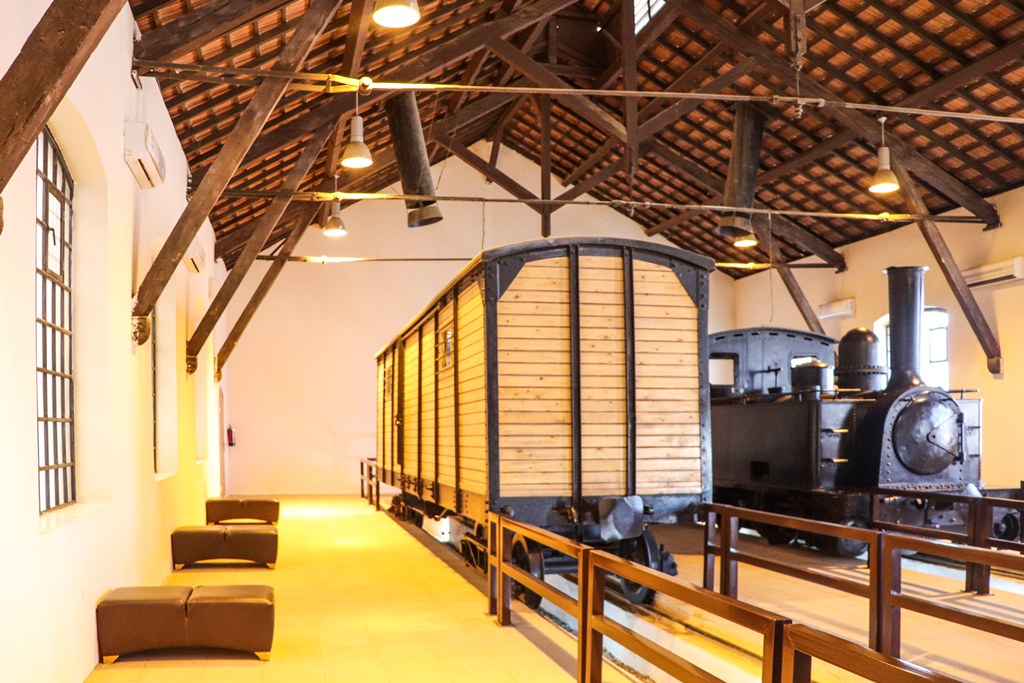
Tabuk’s early-20th-century Hejaz Railway station is one of the best-preserved along the legendary line that once connected Damascus to Medina. Construction of the railway began in 1900 under the Ottoman Caliphate and took eight years to complete. During World War I, sections of the line were attacked during the Arab Revolt — T. E. Lawrence’s raids targeted this very infrastructure — and by 1920 the track south of Medina had been abandoned permanently. The Tabuk station has been refurbished and since 2019 operates as a museum spread across 13 buildings over 80,000 square metres. Highlights include a restored locomotive, a freight car, Ottoman-era relics, a handicrafts workshop, and documentary exhibits on the railway’s construction and destruction. Entry is free.
Staying and Eating in Tabuk City
Hotel prices in Tabuk are substantially lower than in Riyadh or Jeddah. Budget apartment-hotels start around SAR 100–150 per night (USD 27–40), mid-range options from SAR 200–350 (USD 55–95), and the city’s top properties — including Hilton Garden Inn Tabuk and Swiss Hotel Tabuk — range from SAR 400–600 (USD 105–160). The dining scene leans heavily toward traditional Saudi and Levantine fare: Mandi (slow-cooked rice and lamb), Kabsa, and grilled meats dominate local menus. Al-Qaryah Al-Turathiyah is a well-regarded spot for authentic Saudi cuisine, while Syed Al Biryani offers excellent Indian dishes. For international options, Western Road Steak and Grill is consistently rated among the city’s best. Tabuk also has a growing coffee-shop culture, with speciality roasters now scattered across the Muruj district. For more accommodation guidance across the Kingdom, see our Saudi Arabia Hotels Guide.
The Great Canyons: Wadi Al-Disah and Wadi Tayyib al-Ism
Wadi Al-Disah (Wadi Qaraqir)
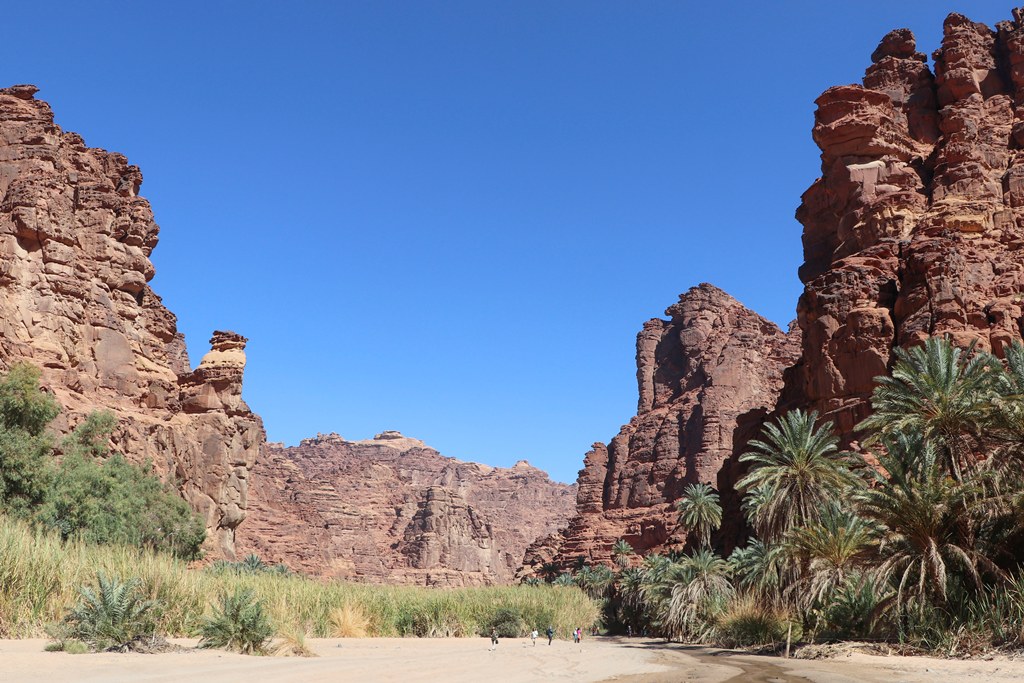
If you visit only one site in the Tabuk region, make it Wadi Al-Disah. This 15-kilometre-long canyon slices through the Jebel Qaraqir sandstone massif roughly 200 kilometres south of Tabuk city. Towering russet cliffs rise up to 400 metres on either side, their walls sculpted by wind and water into pillars, arches, and overhangs that catch the light in kaleidoscopic patterns throughout the day. At the canyon floor, freshwater springs feed palm groves and wild herbs — a startling ribbon of green in an otherwise arid landscape.
The wadi sits at the crossroads of three valleys and has been inhabited for millennia. Nabataean tombs are carved into the rock faces, and petroglyphs depicting hunting scenes and wildlife dot the canyon walls. In 2023, Wadi Al-Disah was added to UNESCO’s tentative list of World Heritage sites under the designation “Bioclimatic Refuges of Western Arabia,” recognising its exceptional ecological and geological value.
Practical tip: Access is via a paved road from the town of Disah, followed by a graded track into the canyon. A 4WD vehicle is strongly recommended. The best time for photography is early morning, when the eastern cliffs glow amber-gold. There are no facilities inside the canyon — bring all water, food, and sun protection. Camping is possible at designated areas near the wadi entrance.
Wadi Tayyib al-Ism (Valley of Moses)
Located on the Gulf of Aqaba coast, roughly 15 kilometres north of the coastal village of Maqna, Wadi Tayyib al-Ism is one of Saudi Arabia’s most visually arresting natural formations. A 600-metre-high granite massif plunges sharply into the turquoise Gulf waters, its sheer walls creating a narrow canyon that opens to a hidden beach at the waterline. In Islamic tradition, this is identified as the place where the Prophet Musa (Moses) spent ten years in voluntary exile after fleeing Egypt — hence the name “Valley of the Good Name.”
The hike through the canyon involves wading through shallow pools and scrambling over boulders, with the route eventually emerging at a secluded beach framed by towering cliffs. As of early 2026, access to Wadi Tayyib al-Ism requires a permit, and the site has been intermittently closed for conservation and NEOM-related development. Check current access status before planning your visit.
The Coastline: 700 Kilometres of Red Sea and Gulf of Aqaba
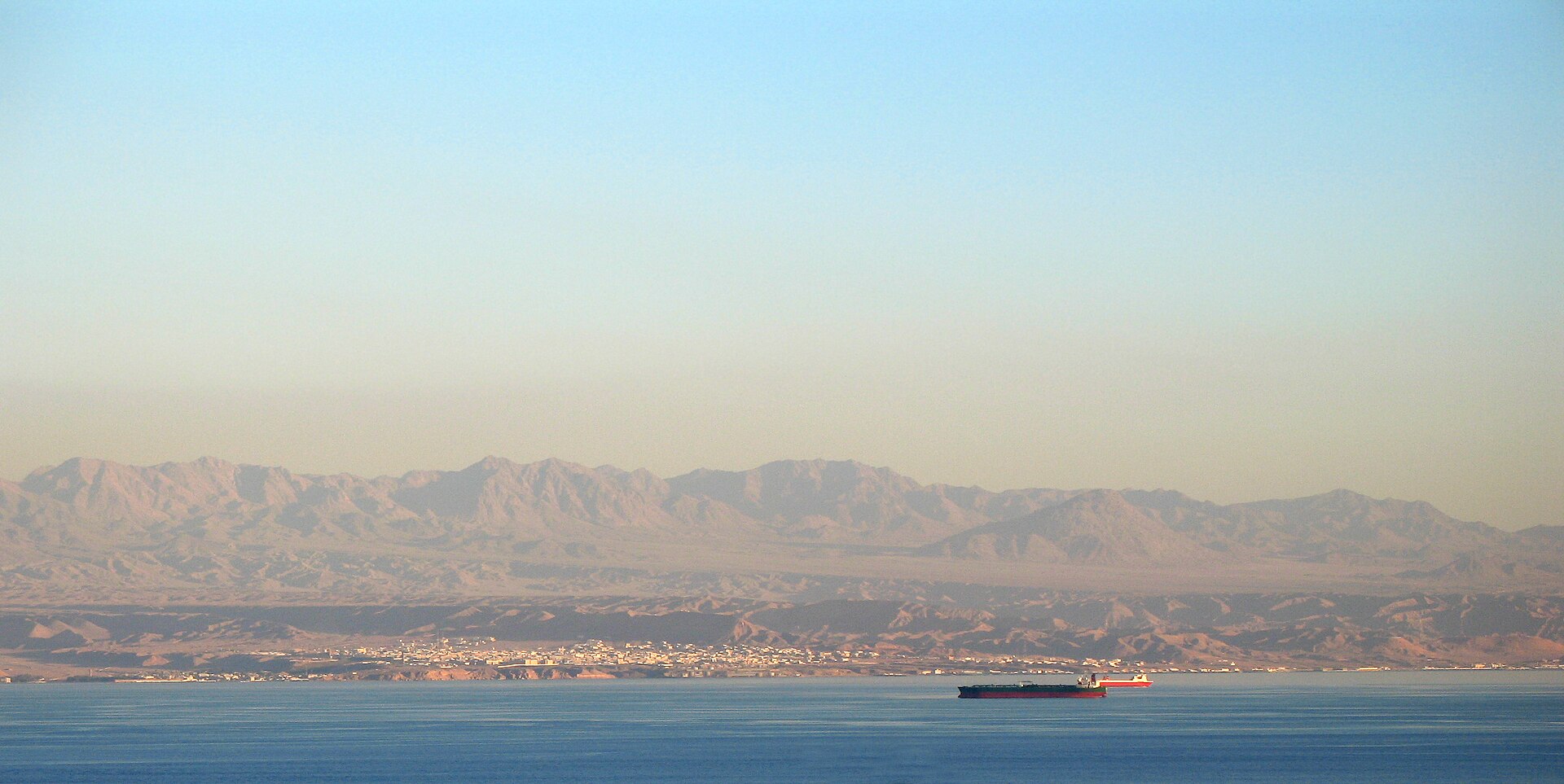
The Tabuk region’s western and northern boundaries are defined by water. From the Gulf of Aqaba in the north — where Saudi Arabia faces Egypt’s Sinai Peninsula across a narrow strait — the coastline sweeps south along the Red Sea through a succession of ports, beaches, and offshore archipelagos. This stretch hosts some of the Kingdom’s finest beaches and the most accessible coral reefs outside the far south.
Haql and the Georgios G Shipwreck
Haql is Saudi Arabia’s northernmost coastal town, sitting at the head of the Gulf of Aqaba. Its main attraction is the Georgios G, a 71.6-metre British-built cargo ship that ran aground on coral reefs in 1978 while carrying foodstuffs to the Jordanian port of Aqaba. The ship drifted off course at night, struck the reef roughly 55 kilometres south of Haql, and has stood half-submerged ever since — earning the local nickname “Titanic of Saudi Arabia.” The wreck has become a thriving artificial reef, attracting snorkellers and divers drawn by colourful fish, sea turtles, and exceptional water clarity. The beach itself features pristine sand backed by the Sinai mountains on the far shore. Note: there are no facilities at the wreck site, the last 400 metres of access road is sand (4WD required), and you should bring all supplies including fresh water.
Duba: Pearl of the Red Sea
Located 180 kilometres southwest of Tabuk city, Duba is a port town that serves as the nearest Saudi Arabian port to the Suez Canal. Regular ferry connections link Duba to Egypt and Jordan, making it a potential overland entry point for travellers arriving from the Sinai. The town’s beaches are largely undeveloped, the water is clear, and the surrounding mangrove-lined inlets are excellent for kayaking. For travellers combining a Tabuk trip with a broader Red Sea itinerary, Duba makes a logical overnight stop.
Sharma Beach and AMAALA
The fishing village of Sharma sits roughly 140 kilometres from Tabuk along the Duba highway. Its beach — soft white sand, crystalline turquoise water, rocky headlands — is one of the finest on the Saudi Red Sea coast. A new Tabuk–Sharma tourism road has reduced driving time to approximately one hour. Sharma also sits adjacent to the AMAALA development, Red Sea Global’s 4,155-square-kilometre luxury tourism zone focused on wellness and art. AMAALA’s Triple Bay precinct, housing six luxury resorts along a five-kilometre promenade, is expected to receive its first guests in 2026. The Six Senses AMAALA is among the marquee openings. For independent travellers, the existing Sharma coastline offers free, uncrowded beach access while the mega-resort complex takes shape nearby.
Umluj: The Maldives of Saudi Arabia
Further south along the Tabuk Province coast, the town of Umluj is often called the “Maldives of Saudi Arabia” — and the comparison is not idle. The Umluj archipelago comprises 104 islands set in waters supporting over 200 types of coral reef and roughly 1,200 fish species. Water visibility frequently reaches 40 metres. Boat trips to Jabal Hassan Island, the most popular excursion, depart from Umluj harbour daily and cost SAR 200–400 per person depending on group size. Snorkelling gear is usually included; divers will find wall and drift conditions that compare favourably with Egypt’s better-known Red Sea sites. Umluj is approximately 400 kilometres south of Tabuk city (4–5 hours by car) or 150 kilometres south of Al-Wajh. For detailed coverage, see our Umluj guide.
Al-Wajh
Al-Wajh, the province’s third-largest settlement with roughly 50,000 residents, sits on the Red Sea coast between Duba and Umluj. It has historically functioned as a fishing port and regional market town. Today it is increasingly positioned as a gateway to the Red Sea Project islands and AMAALA. The town has a small heritage quarter worth an hour’s wander, and its fish market is one of the best on the coast for fresh catch. Al-Wajh Airport (EJH) receives domestic flights from Jeddah and Riyadh, providing an alternative entry point to the southern Tabuk coastline.
Heritage Sites: Millennia of History
Maghaer Shuaib (Caves of Jethro)
Located near the oasis settlement of Al-Bad’, approximately 225 kilometres west of Tabuk city, Maghaer Shuaib is one of Saudi Arabia’s most undervisited archaeological marvels. The site features Nabataean tombs carved into sandstone cliffs in the 1st century CE — elegantly ornamental facades that recall Petra in Jordan and Hegra at AlUla, but without the crowds or the entrance fee. In Islamic tradition, Al-Bad’ is identified with the ancient land of Midian, where the Prophet Musa (Moses) met the Prophet Shuaib (Jethro) after departing Egypt. The Sauaidani Well at the site is referred to in Islamic sources as the Well of Moses.
Guided tours lasting approximately one hour are available. Nearby, the Moses Spring at Maqna is another pilgrimage-adjacent site believed to mark where Musa struck a rock to bring forth water. Allow a full day for the round trip from Tabuk, combining Maghaer Shuaib with a coastal detour to Haql or Wadi Tayyib al-Ism.
Tayma Oasis and Bir Haddaj
Tayma, 220 kilometres southeast of Tabuk city at the western edge of the Nafud desert, is one of the largest and most historically significant archaeological sites in Saudi Arabia. The oasis occupied a strategic position on the ancient incense trade route linking South Arabia to the Eastern Mediterranean, and served as a crossroads between Mesopotamia, the Levant, and Egypt. Its most dramatic historical chapter came in the 6th century BC, when Babylonian king Nabonidus relocated his court to Tayma for a decade, leaving inscriptions and administrative records that still intrigue scholars.
At the heart of the oasis sits Bir Haddaj, one of the most famous ancient wells on the Arabian Peninsula. Measuring roughly 18 metres in diameter and 13 metres deep, it dates to at least the 6th century BC. The well is surrounded by palm gardens and has been designated as part of “The Ancient Walled Oases of Northern Arabia” on UNESCO’s tentative World Heritage list. Tayma’s broader archaeological zone includes defensive walls, Lihyanite and Nabataean inscriptions, and fragments of a monumental palace complex. Admission is free, and the site is open during daylight hours.
Highlands and Mountains
Jabal al-Lawz (Almond Mountain)
Rising to 2,549 metres above sea level in the far northwest of Tabuk Province, Jabal al-Lawz is one of the highest peaks in Saudi Arabia and the only reliable location in the Kingdom for snowfall. Between November and March, the upper slopes are frequently dusted with snow, and in heavy years the white blanket extends well below the summit. Saudi families from across the country drive to Jabal al-Lawz in winter to experience snow — a genuinely rare phenomenon in Arabia.
The mountain falls within NEOM’s designated boundaries and is partially access-controlled. As of 2026, the public road is open to approximately 2,100 metres elevation; access to the summit itself is restricted. The drive from Tabuk city takes roughly 2.5 hours. Winter visitors should carry warm clothing, as temperatures at elevation drop well below freezing. For more highland hiking opportunities across Saudi Arabia, including the Asir Highlands and the Hejaz Escarpment, see our dedicated guide.
Harrat al-Rahah: The Volcanic Lava Fields
South of Tabuk city, the Harrat al-Rahah lava field preserves an extraordinary collection of rock art dating back thousands of years. Petroglyphs carved into basalt boulders depict hunting expeditions, wildlife (including what appear to be ostriches and ibex), and symbolic motifs whose meanings remain debated. The lava fields themselves are a surreal landscape — blackened basalt stretching to the horizon, punctuated by craters and eroded formations. Access requires a local guide and a 4WD vehicle; there are no marked trails or facilities. This is a site for serious archaeological enthusiasts and landscape photographers rather than casual visitors.
NEOM and the Evolving Northwest
No discussion of the Tabuk region in 2026 is complete without addressing NEOM, the $500-billion giga-project reshaping the province’s northwestern corner. NEOM encompasses roughly 26,500 square kilometres of coastal, desert, and mountain terrain, and its sub-projects include The Line (a 170-kilometre linear city, currently paused), Trojena (a mountain resort and the site of the 2029 Asian Winter Games, delayed), and Sindalah (a luxury marina island). In March 2026, several major NEOM contracts were cancelled, and the project’s scope has been significantly recalibrated.
For travellers, the practical impact is this: much of the NEOM zone remains a construction area with restricted access. Sindalah Island, a $2-billion-plus yacht club and marina resort designed by Italian architect Luca Dini, is the most likely component to welcome visitors in 2026, though as of this writing it has not opened to the public. The broader region around NEOM — the Sharma coastline, Jabal al-Lawz, and the Gulf of Aqaba beaches — remains accessible and continues to offer some of Saudi Arabia’s finest natural scenery. For the latest on what visitors can actually access, see our NEOM Travel Guide.
Practical Information
Getting to Tabuk
| Route | Airline(s) | Flight Time | Approx. Fare (one-way) |
|---|---|---|---|
| Riyadh (RUH) → Tabuk (TUU) | Saudia, flyadeal, flynas | ~2 hours | SAR 220–400 (USD 59–107) |
| Jeddah (JED) → Tabuk (TUU) | Saudia, flynas | ~1.5 hours | SAR 200–350 (USD 53–93) |
| Dammam (DMM) → Tabuk (TUU) | Saudia, flyadeal | ~2.5 hours | SAR 250–450 (USD 67–120) |
Prince Sultan Bin Abdulaziz International Airport (TUU) is located 3 kilometres from Tabuk city centre. Taxis and ride-hailing apps (Uber, Careem) operate from the airport. For regional exploration, renting a car is essential — distances between sites are large, and public transport outside the city is virtually nonexistent. Major car rental agencies (Budget, Hertz, Lumi) have desks at the airport.
Overland options: Tabuk is connected to Medina by a 600-kilometre highway (roughly 6 hours by car) and to the Jordanian border at Halat Ammar (roughly 2 hours north). SAPTCO intercity buses serve the Tabuk–Riyadh and Tabuk–Medina routes, but journey times are long (12+ hours to Riyadh). For international travellers, note that you will need a valid Saudi tourist visa regardless of entry point.
Getting Around the Region
A rental car with four-wheel drive is the single most important logistical decision for a Tabuk trip. Key distances from Tabuk city:
| Destination | Distance | Drive Time | Road Condition |
|---|---|---|---|
| Wadi Al-Disah | ~200 km south | 2.5–3 hrs | Paved to Disah village, graded track into canyon (4WD) |
| Maghaer Shuaib (Al-Bad’) | ~225 km west | 2.5–3 hrs | Fully paved |
| Haql (Shipwreck Beach) | ~200 km north | 2–2.5 hrs | Paved to Haql; last 400m to wreck on sand (4WD) |
| Jabal al-Lawz | ~180 km northwest | ~2.5 hrs | Paved mountain road to 2,100m |
| Tayma | ~220 km southeast | 2.5–3 hrs | Fully paved highway |
| Sharma Beach | ~140 km southwest | ~1 hr | New paved tourism road |
| Umluj | ~450 km south | 4.5–5 hrs | Fully paved coastal highway |
| Duba | ~180 km southwest | ~2 hrs | Fully paved |
Best Time to Visit
The optimal window is October through March. Autumn (October–November) brings warm days (25–30°C) and cool, comfortable nights. Winter (December–February) sees daytime highs of 15–22°C, cold nights (sometimes near freezing in the highlands), and the possibility of snow on Jabal al-Lawz. Spring (March–April) is pleasant at lower elevations but warming fast. Summer (June–August) should be avoided for desert and inland sites — temperatures routinely exceed 40°C — though the coast remains swimmable. For Kingdom-wide seasonal planning, see our best time to visit Saudi Arabia guide.
Budget Planning
| Category | Budget (per day) | Mid-Range | Comfort |
|---|---|---|---|
| Accommodation | SAR 100–180 ($27–48) | SAR 200–400 ($53–107) | SAR 450–700+ ($120–187+) |
| Meals | SAR 50–80 ($13–21) | SAR 100–180 ($27–48) | SAR 200–350 ($53–93) |
| Car Rental (4WD) | SAR 200–300 ($53–80) | SAR 300–450 ($80–120) | SAR 500+ ($133+) |
| Fuel | SAR 40–80 ($11–21) | SAR 60–120 ($16–32) | SAR 80–150 ($21–40) |
| Daily Total | SAR 390–640 ($104–170) | SAR 660–1,150 ($176–307) | SAR 1,230+ ($328+) |
Money-saving tip: Petrol in Saudi Arabia is among the cheapest in the world (SAR 2.18 per litre for 91 octane as of 2025). A full tank for a mid-size SUV costs roughly SAR 120–150, making long road trips remarkably affordable by international standards.
Safety and Etiquette
The Tabuk region is safe for travellers, though the remote desert and canyon sites demand basic precautions. Always carry more water than you think you need (minimum 3 litres per person per day for desert excursions), inform your hotel of your itinerary when heading to remote sites, and carry a fully charged phone with an offline map downloaded. Mobile coverage is patchy to nonexistent in Wadi Al-Disah, the Harrat lava fields, and along stretches of the Gulf of Aqaba coast. Dress modestly in towns — while the tourist dress code has relaxed significantly under Vision 2030, covering shoulders and knees remains respectful. At beaches, swimwear is acceptable at resort and designated beach areas.
Suggested Itineraries
3 Days: Tabuk Highlights
- Day 1: Arrive at Tabuk airport, visit Tabuk Castle and the Hejaz Railway Museum, drive to Sharma Beach for a sunset swim
- Day 2: Full-day excursion to Wadi Al-Disah — depart early, explore the canyon, return via the Disah village
- Day 3: Drive north to Maghaer Shuaib and Al-Bad’, continue to Haql Shipwreck Beach, return to Tabuk for departure
- Day 1: Tabuk city — castle, railway museum, local dinner at Al-Qaryah Al-Turathiyah
- Day 2: Drive to Wadi Al-Disah, spend the afternoon hiking the canyon floor, camp near the wadi entrance
- Day 3: Morning at Wadi Al-Disah for photography, then drive to Tayma Oasis. Explore Bir Haddaj, the defensive walls, and Nabataean inscriptions. Overnight in Tayma
- Day 4: Return to Tabuk, then head west to Maghaer Shuaib. Continue to the coast — Haql for the shipwreck and Gulf of Aqaba views. Overnight at Haql
- Day 5: Morning beach time at Haql, drive south to Sharma or Duba for a final Red Sea swim, return to Tabuk for evening flight
- Add Jabal al-Lawz (winter only), the Harrat al-Rahah rock art, extended time at Umluj for diving and snorkelling, and an overnight ferry crossing from Duba to Egypt for a cross-border Red Sea loop
- Tabuk Travel Guide — The complete overview of Tabuk Province including NEOM, logistics, and planning
- NEOM Travel Guide — What you can actually visit at Saudi Arabia’s $500-billion giga-project in 2026
- Umluj: The Maldives of Saudi Arabia — Island-hopping, coral reefs, and Red Sea beaches
- AlUla Travel Guide — Hegra, Elephant Rock, and the ancient Nabataean Kingdom of Dadan
- Saudi Arabia Hiking Guide — Highland treks, canyon walks, and mountain trails across the Kingdom
- Saudi Arabia Beaches — The best coastline from the Red Sea to the Arabian Gulf
- Saudi Arabia Visa Guide — Every visa type explained, including the tourist e-visa
- Best Time to Visit Saudi Arabia — Seasonal planning for every region
5 Days: The Comprehensive Circuit
7+ Days: The Full Tabuk Region
When to Avoid and What to Watch
Warning — Summer heat: Between June and August, inland temperatures regularly exceed 42°C. Desert canyon excursions become genuinely dangerous. If you must visit in summer, restrict activities to the coast and early morning hours.
NEOM access restrictions: Parts of the Tabuk coastline and mountain zones fall within NEOM’s security perimeter. Road checkpoints may redirect you. Always carry your passport and visa documents when driving in the northwest.
Wadi Tayyib al-Ism permit: Access has been intermittently restricted since 2024. Check with Tabuk tourism authorities or your hotel concierge before attempting the drive.