
Saudi Arabia is home to one of the most ambitious conservation programmes on earth. Across 36 protected areas spanning deserts, volcanic highlands, coral archipelagos, and mountain escarpments, the Kingdom is rewilding species once thought lost and opening landscapes that few travellers have ever seen. Whether you are planning a dedicated wildlife trip or adding a nature detour to a broader hiking itinerary across Saudi Arabia, the country’s reserves offer something genuinely rare: large-scale wilderness with almost no crowds. This guide covers every major reserve open or opening to visitors, with practical details on permits, access, seasons, and what you will actually see on the ground.
Best Time to Visit: October through April (cooler temperatures, migratory bird season)
Getting There: Domestic flights to regional airports (Tabuk, AlUla, Jizan, Riyadh); 4×4 recommended for most reserves
Visa Required: Yes — tourist e-visa
Budget: $80–200/day depending on region and accommodation
Must-See: Uruq Bani Ma’arid (UNESCO), Sharaan Nature Reserve (AlUla), Farasan Islands
Avoid: Visiting May–September when daytime temperatures regularly exceed 45°C in desert reserves
Saudi Arabia’s Conservation Revolution
Under the Saudi Green Initiative launched in March 2021, the Kingdom has committed to protecting 30 per cent of its land and sea by 2030. As of 2025, 36 protected areas cover 18.1 per cent of Saudi Arabia’s terrestrial territory and 6.49 per cent of its marine waters — a fourfold increase from 2016 levels. The National Centre for Wildlife (NCW) manages most reserves, while a separate Council of Royal Reserves oversees the four vast Royal Natural Reserves created by royal decree.
For visitors, the practical effect is that places which were completely off-limits a decade ago are now opening with managed access, ranger-guided experiences, and seasonal ecotourism programmes. The NCW’s Fatri digital platform (fatri.ncw.gov.sa) is the single portal for obtaining visitor permits to most reserves. Some sites — particularly those in the AlUla region — are fully set up for tourism, while others remain frontier wilderness requiring advance planning and self-sufficiency.
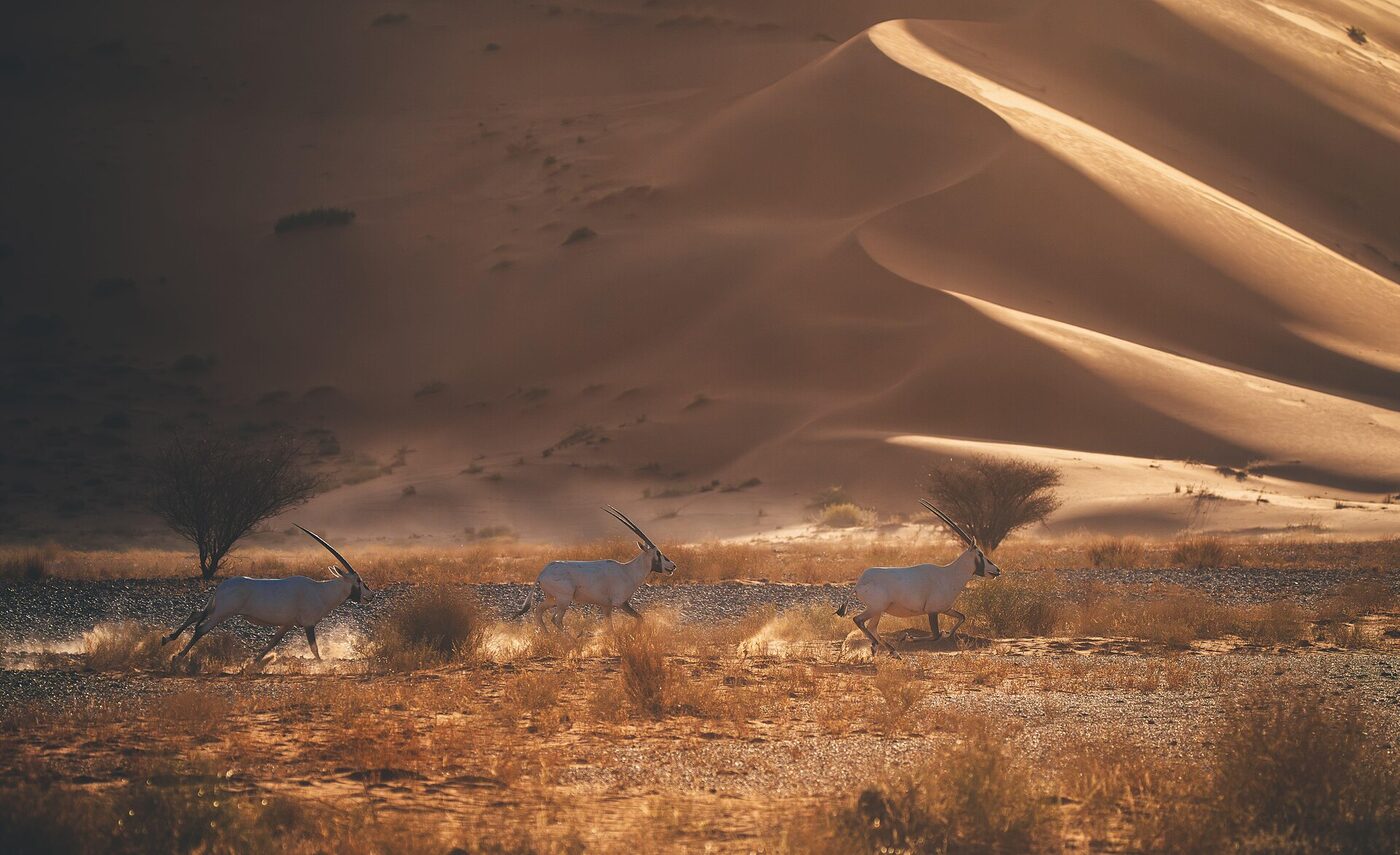
Uruq Bani Ma’arid — UNESCO World Heritage Site
Inscribed as Saudi Arabia’s first Natural World Heritage Site on 20 September 2023, Uruq Bani Ma’arid sits on the western edge of the Rub’ al Khali (Empty Quarter) near Najran. At 12,658 square kilometres, it protects the richest flora in the Empty Quarter — 118 plant species — alongside 526 recorded species overall, including five reptile species endemic to Arabia.
The Arabian Oryx Story
Uruq Bani Ma’arid is the last place where Arabian oryx were observed in the wild before the species went extinct in the 1970s. Between 1995 and 2013, 149 oryx were reintroduced into the unfenced reserve. By 2013, the population had grown to approximately 500 individuals — currently the only truly wild, free-ranging population of Arabian oryx on earth. The reserve also supports sand gazelle, mountain gazelle, and the critically endangered Nubian ibex.
Visiting Uruq Bani Ma’arid
This is frontier territory. The reserve is remote, with limited tourist infrastructure, and access requires NCW permits through the Fatri platform. The nearest city is Najran, served by domestic flights from Riyadh and Jeddah. A 4×4 vehicle is essential. Most visitors come as part of organised wildlife expeditions. The best months are November through March, when temperatures drop to a comfortable 15–25°C and the chance of spotting oryx at dawn or dusk is highest. If you are building a wider Saudi Arabia travel itinerary, consider pairing this with the Empty Quarter dune experiences accessible from the Eastern Province.
Sharaan Nature Reserve — AlUla’s Arabian Leopard Sanctuary
Named one of TIME’s World’s Greatest Places 2024, Sharaan Nature Reserve covers 1,540 square kilometres in the AlUla region of northwestern Saudi Arabia. Managed by the Royal Commission for AlUla, Sharaan has a singular mission: to bring back the critically endangered Arabian leopard, of which an estimated 120 remain in the wild and none have been recorded in Saudi Arabia for over a decade.
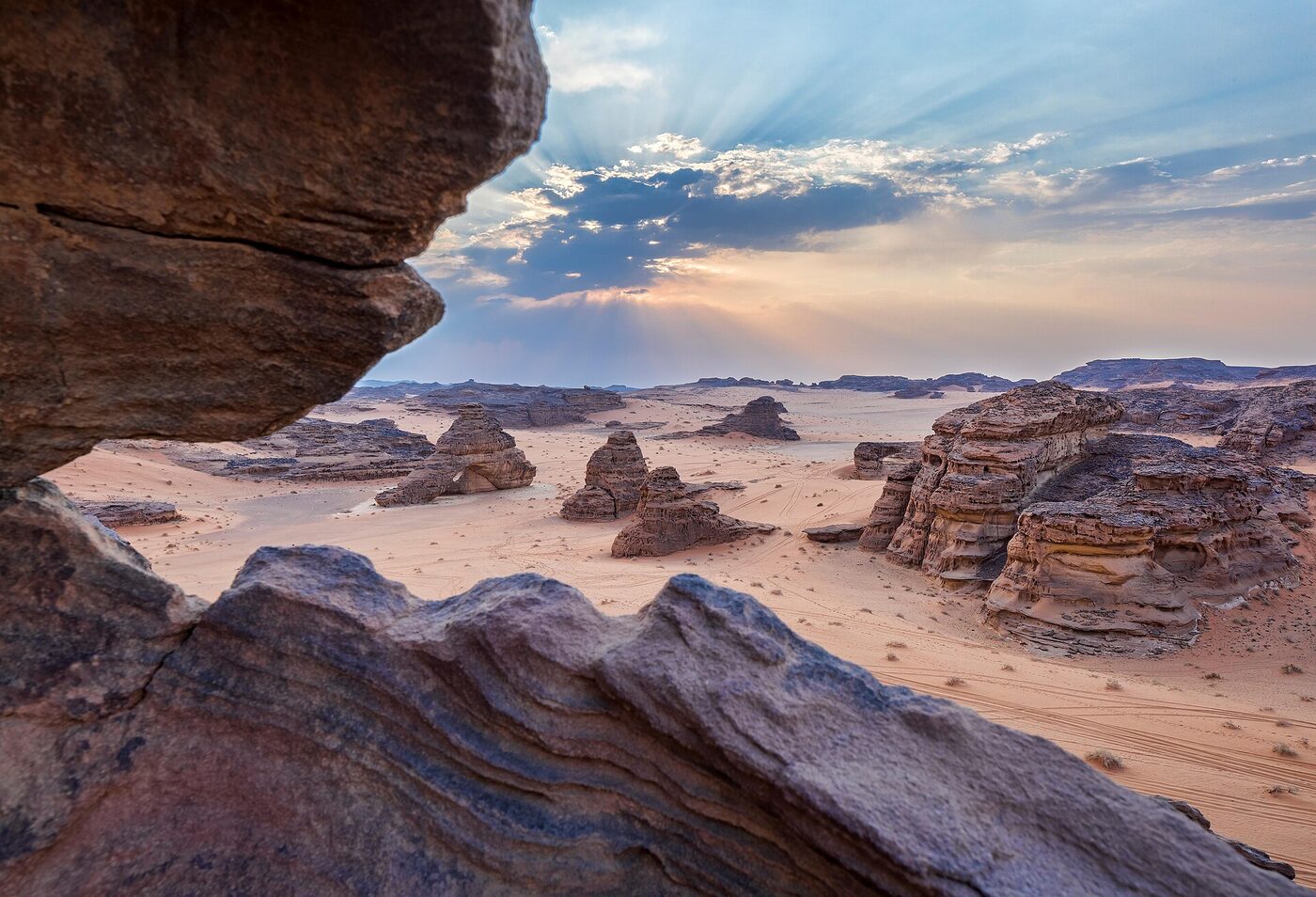
What Lives in Sharaan
A dedicated Arabian Leopard Rewilding Centre is under construction as part of the reserve’s long-term breeding and release programme. In the meantime, four threatened species have already been successfully reintroduced: Arabian oryx, Arabian gazelle, sand gazelle, and Nubian ibex. Over 500,000 native seedlings have been planted to restore the reserve’s vegetation cover. The landscape itself is extraordinary — layered sandstone formations, deep canyons, and open desert plateaux that look like they belong on another planet.
Visiting Sharaan
Sharaan is one of the most visitor-friendly reserves in the Kingdom. AlUla has a well-developed tourism infrastructure with direct flights from Riyadh and Jeddah, plus international connections. The Hegra archaeological site is next door. Book experiences through experiencealula.com. While inside Sharaan itself, guided safari-style excursions are the primary way to explore, and visitor numbers are carefully managed to minimise disturbance to rewilded populations.
Al Khunfah and the King Salman Royal Natural Reserve
Al Khunfah, originally a standalone 19,339-square-kilometre reserve on the western fringe of the Great Nafud Desert near Tayma, has been absorbed into the vastly larger King Salman bin Abdulaziz Royal Natural Reserve (KSRNR). At over 130,000 square kilometres spanning the Al-Jawf, Tabuk, Hail, and Northern Borders regions, KSRNR is one of the largest protected areas in the Middle East.
Wildlife
The reserve supports goitered gazelle, mountain gazelle, foxes, hares, and gerbils, alongside over 100 bird species including the lappet-faced vulture, houbara bustard, sandgrouse, rock doves, and curlew. The varied terrain — from red sand dunes to rocky plateaux — creates a patchwork of habitats far richer than the uniform desert many visitors expect.
Access and Permits
KSRNR is managed by the Council of Royal Reserves. Visitor permits are available through the NCW’s Fatri digital platform. The nearest airports are in Tabuk and Hail. Visit between October and April for the most comfortable conditions. The reserve is enormous, so plan on multi-day excursions with camping — there are no hotels within the reserve boundaries. A 4×4 and GPS are essential.
Harrat Uwayrid — AlUla’s Volcanic Highlands
Harrat Uwayrid is a 240-kilometre-long volcanic field of dark olivine basalt about 30 minutes’ drive from AlUla Old Town. The last known eruption was in 640 AD. The harrat (lava field) rises to 1,219 metres at the Harrat Viewpoint, where a free public observation platform offers panoramic views over AlUla’s oasis, the ancient Dadan site, the Old Town, and the surrounding sandstone valleys.
Visiting the Harrat Viewpoint
Unlike most Saudi reserves, the Harrat Viewpoint requires no booking or permit. It is open daily from 13:00 to 22:00 (14:00 to 22:00 during Ramadan) with free parking. Telescopes are provided for stargazing after dark — the elevation and desert air make this one of the best stargazing spots in the region. There is even a pizzeria (Pizza Bar IOI) at the summit. The contrast between the craggy black basalt and AlUla’s golden sandstone below is one of the most striking landscapes in Saudi Arabia.
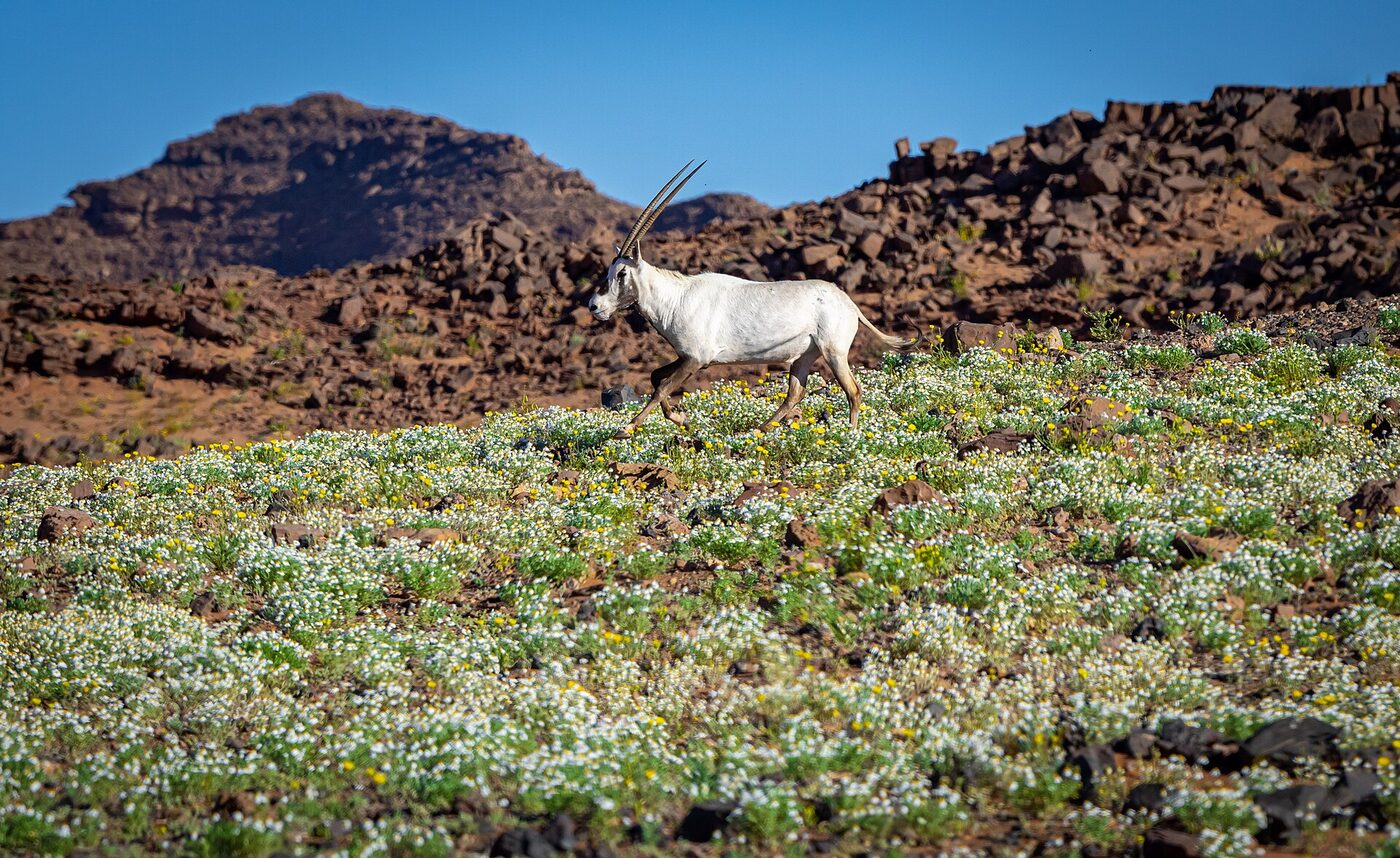
Ibex Reserve — Tuwaiq Escarpment Wilderness
Located approximately 180 kilometres south of Riyadh, the Ibex Reserve covers 1,841 square kilometres of the rugged Tuwaiq mountain escarpment, with elevations reaching 1,097 metres. In 2024, it became the first Saudi protected area added to the IUCN Green List — one of only 77 sites worldwide to hold this status.
What You’ll See
The reserve protects the Kingdom’s largest population of Nubian ibex, living in truly wild conditions across the plateau’s ravines and cliff faces. Rock hyrax, foxes, sand partridge, and several rodent species round out the fauna. The landscape of deep valleys cutting through the Tuwaiq escarpment is dramatic and largely untouched.
Access
Permits are required through the NCW Fatri platform. The reserve is south of al-Hariq Governorate, reachable by road from Riyadh in about two hours. The terrain is rugged — expect rocky tracks rather than paved roads once inside the reserve. This is a strong option for visitors based in Riyadh who want a genuine wilderness day trip or overnight without flying to a distant region.
Farasan Islands Marine Sanctuary
The Farasan archipelago — nearly 200 coral islands and islets in the southeastern Red Sea off the coast of Jizan — has been a protected area since a 1996 Royal Decree. In 2021, it was designated a UNESCO Biosphere Reserve and placed on the tentative World Heritage list. The sanctuary covers 1,050 square kilometres of marine habitat.
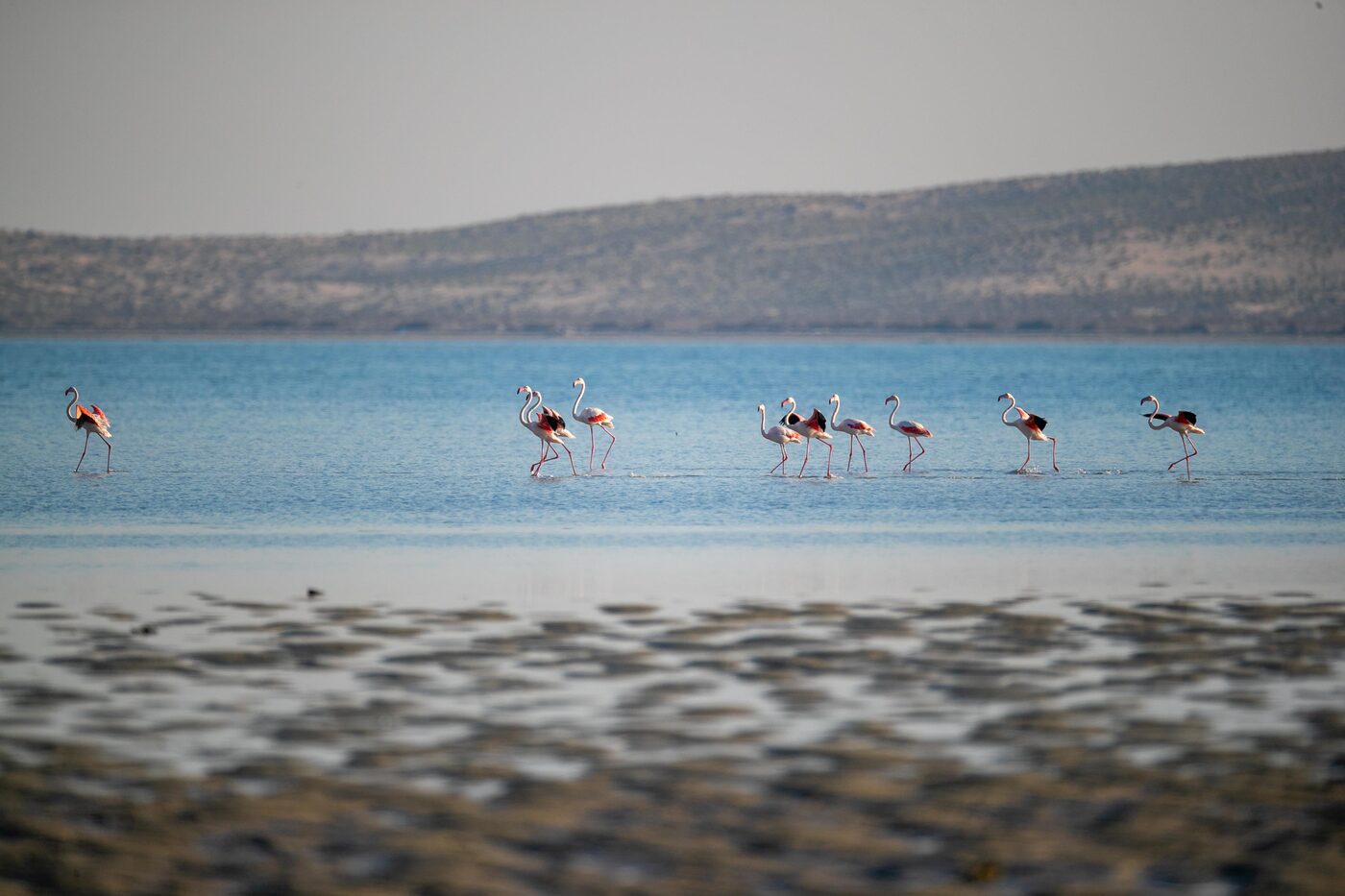
Marine and Terrestrial Life
The waters around Farasan hold more than 50 coral species and 230 fish species, plus extensive mangrove forests, seagrass beds, and saltmarshes. On land, the islands support the largest population of Farasan (idmi) gazelle in Saudi Arabia, along with high concentrations of greater flamingo, pink-backed pelican, Eurasian spoonbill, and osprey. For diving and snorkelling enthusiasts, Farasan offers pristine reefs with almost no commercial diving pressure.
Getting to Farasan
Regular daily ferries depart from Jizan Port, with the crossing taking approximately 90 minutes. Arrive early — space is limited and vehicle spots require advance booking. Jizan has a regional airport with domestic flights from Riyadh and Jeddah. There are basic guesthouses on the main island, but bring supplies for extended exploration of the outer islands. The best season is November through March, when temperatures are mild and migratory birds are present.
Imam Turki bin Abdullah Royal Reserve
At 91,500 square kilometres in northeastern Saudi Arabia, this is the Kingdom’s largest single reserve. Designated a UNESCO Man and the Biosphere reserve, its habitats span from desert to steppe. The reserve supports 41 mammal species including Arabian oryx, sand gazelle, and caracal, plus houbara bustard, the endangered steppe eagle, and the Eastern imperial eagle.
Tourist access is managed through seasonal ecotourism programmes, including the Al-Urumah Season. The nearest major city is Hail. Like KSRNR, this is expedition-scale territory — plan for self-sufficient multi-day camping trips with a 4×4.
Prince Mohammed bin Salman Royal Reserve
Covering 24,500 square kilometres in the northwest between NEOM and the Red Sea coast, PMBSRR encompasses 15 distinct ecosystems and hosts over 50 per cent of the Kingdom’s marine and terrestrial species. Eleven of 23 native species have been reintroduced, including sand gazelle, mountain gazelle, onager, and pharaoh eagle owl. Five species new to science have been discovered within its boundaries. The reserve also operates the first all-women ranger unit in the Middle East.
Access is currently limited and managed through the Council of Royal Reserves. The nearest airport is at Tabuk. As NEOM and Red Sea tourism infrastructure develops, PMBSRR is expected to become increasingly accessible to visitors.
Aramco Mangrove Eco-Park — Ras Tanura
For visitors based in the Eastern Province, the Aramco Mangrove Eco-Park at Ras Tanura offers a more accessible nature experience. The park features boardwalk trails through Avicennia marina mangrove communities, a visitor centre, and educational observation points. Saudi Arabia has 204 square kilometres of total mangrove forest coverage, and the NCW has been actively expanding planting programmes since 2020. The Eco-Park is open to visitors and provides a good introduction to Saudi Arabia’s coastal ecosystems without requiring permits or expedition-level planning.
Practical Information for Visitors
Permits and Booking
Most reserves require a visitor permit obtained through the NCW’s Fatri platform at fatri.ncw.gov.sa. Permits cover individuals, businesses, and government entities. Processing times vary, so apply at least two weeks before your planned visit. AlUla sites (Sharaan, Harrat Viewpoint) are bookable through experiencealula.com. The Harrat Viewpoint is free and requires no booking. For a tourist e-visa to enter Saudi Arabia, apply online before your trip.
Best Seasons
| Reserve | Best Months | Peak Wildlife |
|---|---|---|
| Uruq Bani Ma’arid | November–March | Oryx active at dawn/dusk |
| Sharaan (AlUla) | October–April | Ibex, gazelle year-round |
| King Salman Reserve | October–April | Migratory birds Nov–Feb |
| Ibex Reserve | November–March | Ibex most visible in winter |
| Farasan Islands | November–March | Flamingos, migratory birds |
| Harrat Uwayrid | October–April | Stargazing best Dec–Feb |
What to Bring
- Sun protection — even in winter, UV exposure is intense at desert elevations
- Water — carry at least 4 litres per person per day in desert reserves
- 4×4 vehicle — essential for all reserves except Harrat Viewpoint and Farasan Islands
- Binoculars — birdwatching is a major draw at every reserve
- Camping gear — most reserves have no accommodation within their boundaries
- GPS/offline maps — mobile coverage is patchy or absent in remote reserves
Tour Operators
Several operators run guided nature and wildlife excursions into Saudi reserves. Memphis Tours and Saudi Private Tours both offer multi-day wildlife itineraries. For AlUla, the Royal Commission’s own booking platform at experiencealula.com offers curated experiences with local guides. For Farasan Islands, Jizan-based operators arrange boat tours to outer islands and snorkelling spots.
Tip: The seasonal ecotourism programmes run by the Royal Reserves — such as Al-Touqi Season (King Abdulaziz Royal Reserve, October–April) and Al-Urumah Season (Imam Turki bin Abdullah Reserve) — are the easiest way to access reserves that are otherwise difficult to visit independently. Check the NCW and Council of Royal Reserves websites for current season dates.
Saudi Arabia’s Conservation Targets at a Glance
| Metric | Current (2025) | Target (2030) |
|---|---|---|
| Terrestrial protected area | 18.1% | 30% |
| Marine protected area | 6.49% | 30% |
| Number of protected areas | 36 | Expanding |
| Trees to plant | In progress | 10 billion |
| Degraded land to restore | In progress | 40 million hectares |
Explore More Saudi Arabia Travel Guides
- Saudi Arabia Hiking Guide — Trails, trekking routes, and mountain adventures across the Kingdom
- AlUla Travel Guide — Ancient tombs, desert canyons, and the Sharaan reserve
- Saudi Arabia Diving and Snorkelling Guide — Red Sea reefs, wrecks, and marine life
- Tabuk Travel Guide — Gateway to NEOM, the northwest, and the King Salman Reserve
- Abha and Asir Travel Guide — Highland forests, cool temperatures, and mountain culture
- Saudi Arabia Visa Guide — Every visa type explained