
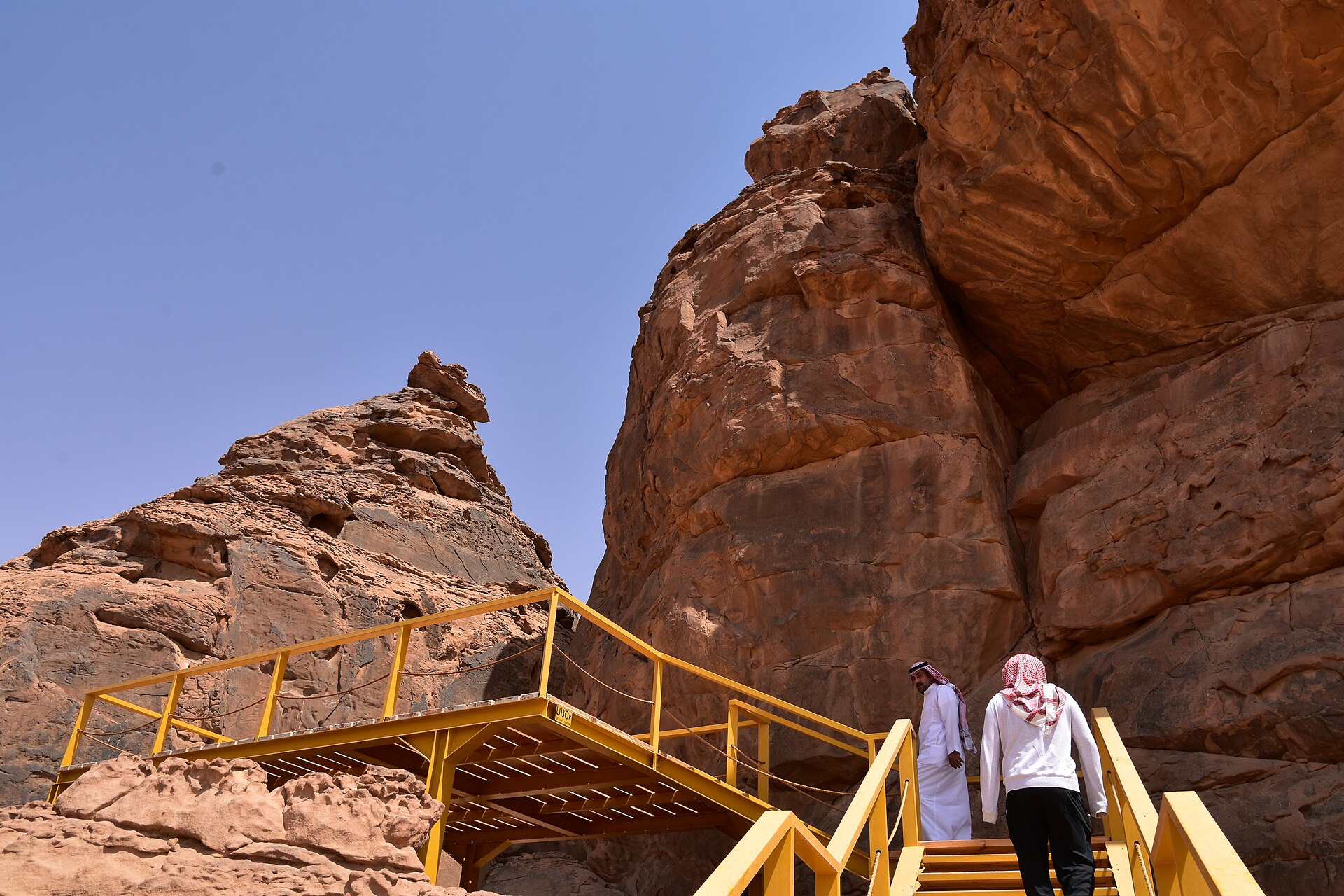
Ninety kilometres northwest of Hail, a sandstone mountain called Jabal Umm Sinman rises from the edge of the Great Nafud Desert. Carved into its faces are roughly 15,000 petroglyphs — human figures, ibex, cattle, camels, dogs, and warriors — spanning 10,000 years of continuous habitation. This is Jubbah, the centrepiece of the UNESCO World Heritage Site “Rock Art in the Hail Region”, inscribed in 2015, and one of the most significant prehistoric art sites in the Arabian Peninsula. Whether you are building a wider Saudi Arabia travel itinerary or visiting the Hail region specifically, a day trip to Jubbah pairs world-class archaeology with the rust-red dunes of the Nafud — a combination found nowhere else in the Kingdom.
Best Time to Visit: October to March (15–25 °C daytime)
Getting There: 90 km / ~75 minutes by car northwest of Hail city
Visa Required: Yes — tourist e-visa
Budget: $50–120 USD per day (entry is free; costs are transport and meals)
Must-See: Jabal Umm Sinman petroglyphs, Nafud dunes at sunset, Visitor Centre orientation
Avoid: Visiting June–September — temperatures exceed 45 °C with no shade at the rock art site
Why Jubbah Matters: 10,000 Years Carved in Stone
Jubbah’s rock art is not a single-era snapshot. The petroglyphs on Jabal Umm Sinman record an unbroken cultural sequence from the Mesolithic through the Islamic period — one of the longest such sequences anywhere in the world. The UNESCO World Heritage Committee inscribed the site under criteria (i) and (iii), recognising it as containing “stunning expressions of the human creative genius” and an exceptional testimony to cultural traditions stretching back to the Neolithic.
The inscribed property covers 2,043 hectares at Jubbah, with a buffer zone of 3,609 hectares. It forms one of two components — the other being Shuwaymis, roughly 250 km south of Hail — that together constitute the UNESCO Rock Art in the Hail Region listing. But Jubbah is by far the more accessible and visually impressive of the two.
What You Will See: The Petroglyphs Explained
The carvings at Jubbah fall into distinct periods, each reflecting the climate and culture of its age. Understanding the timeline transforms the visit from a walk past scratched rocks into a journey through Arabia’s deep history.
Neolithic Period (c. 8000–5000 BC)
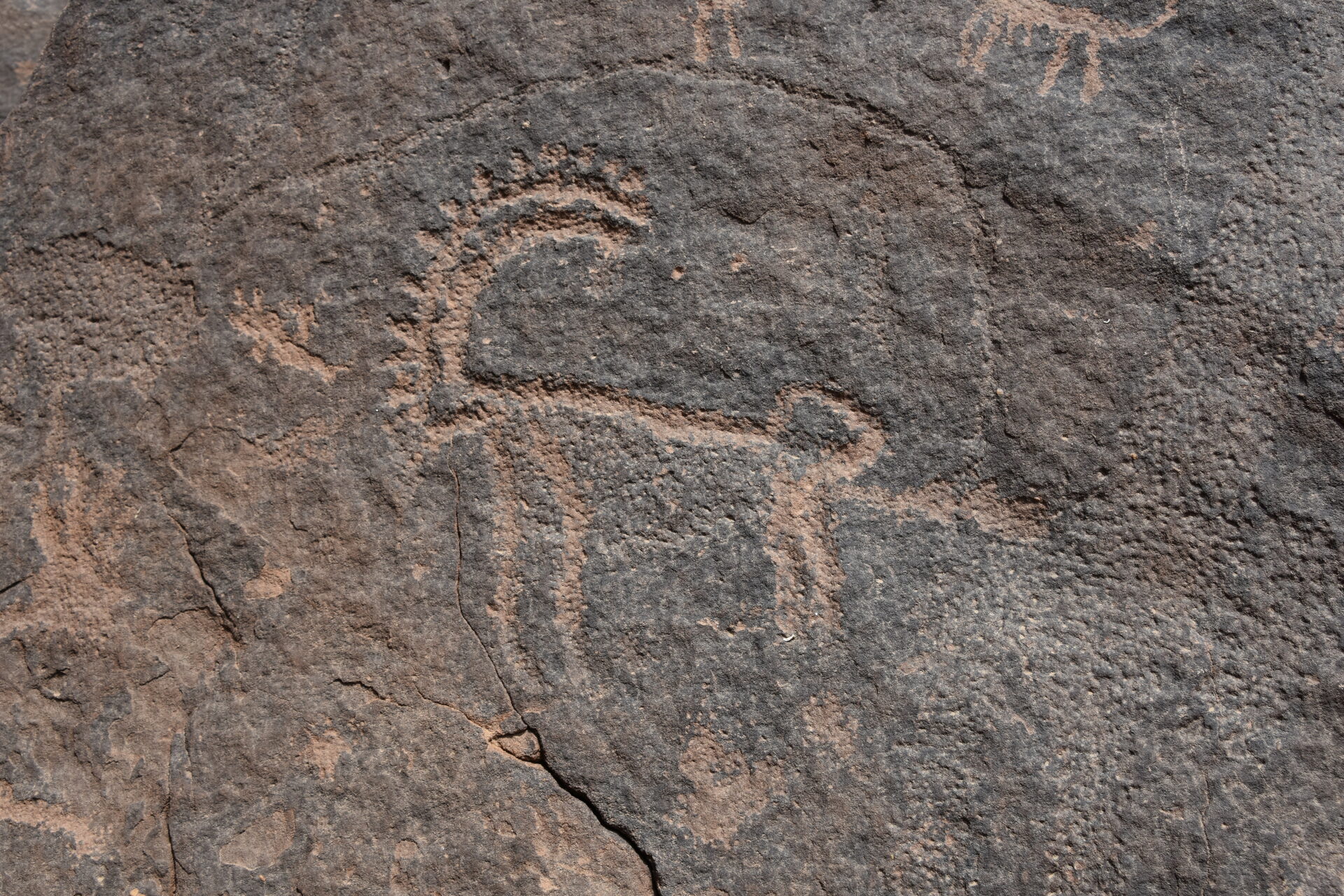
The earliest carvings date to when Jubbah sat beside a freshwater paleolake up to 20 km long and 5 km wide. These include depictions of wild cattle, ibex, and hunting scenes with dogs — evidence that Arabian communities were using hounds for hunting as early as the Mesolithic. The human figures from this era are the most elaborate: full-body representations showing hairstyles, clothing, and what appear to be ritual scenes.
Bronze Age and the Cattle Period (c. 5000–1000 BC)
As the climate shifted, the lake shrank but the area remained habitable. Carvings from this period show domesticated cattle, horses, and — remarkably — wheeled chariots, suggesting trade connections across the ancient Near East. The craftsmanship of mid-Holocene carvings is often the finest on the mountain, with deeply incised lines and careful attention to anatomical detail.
The Camel Period and Thamudic Inscriptions (c. 1000 BC onward)
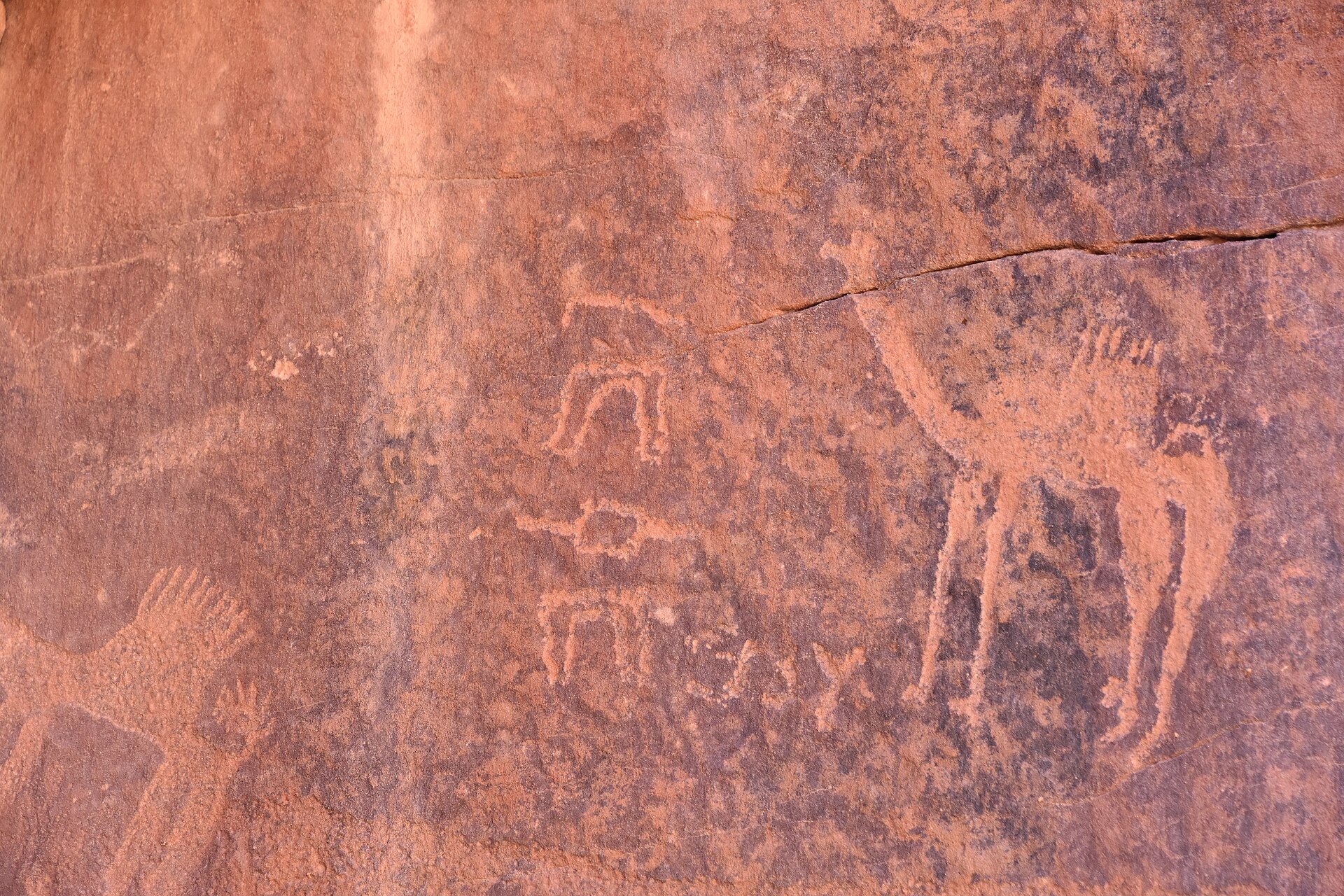
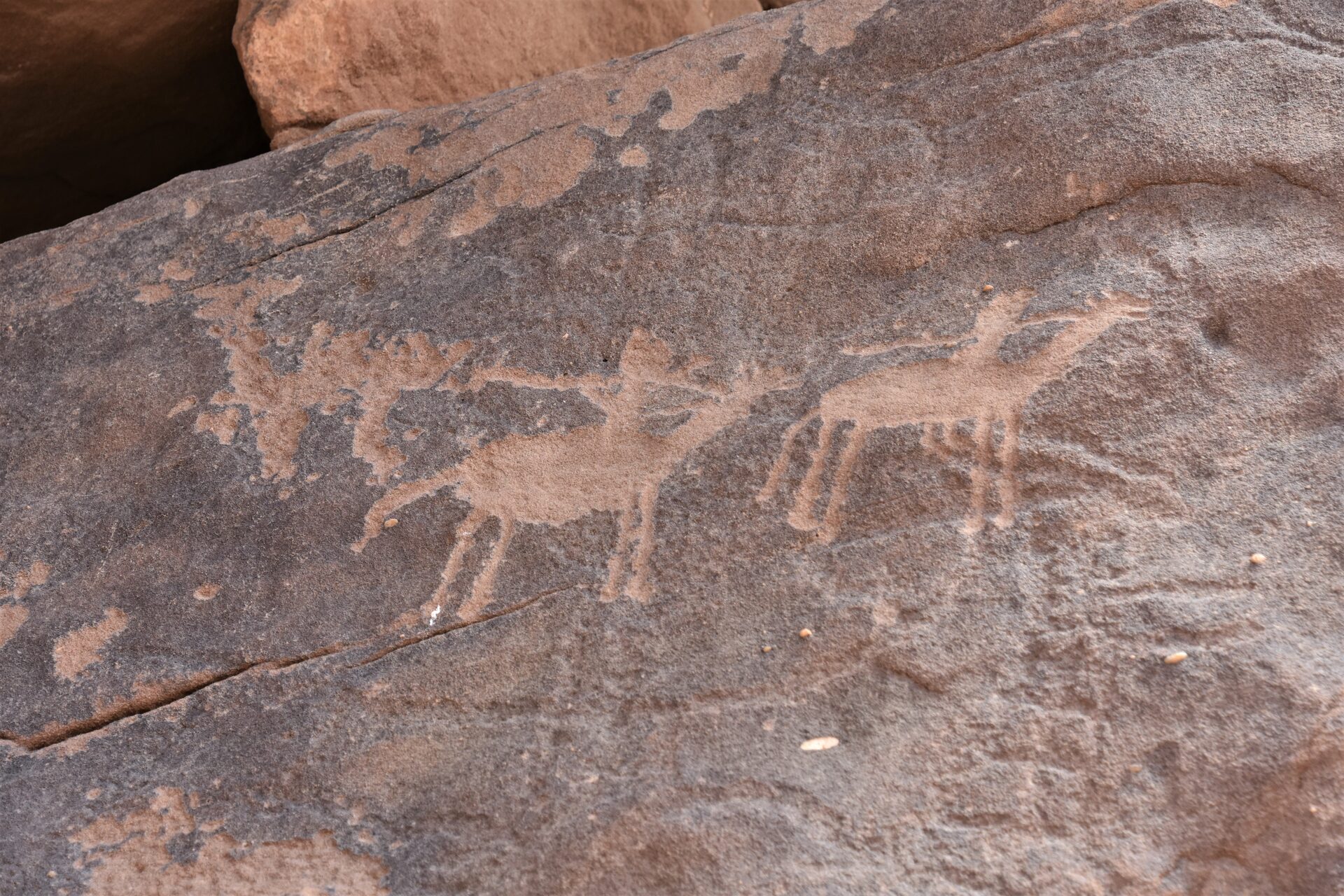
As full desertification took hold around 3,000 years ago, camels became the dominant animal in the rock art. Thousands of Thamudic inscriptions — an early Arabian script — appear alongside the animal carvings, recording names, lineages, and short messages. By this point Jubbah had become a staging post on caravan routes crossing the Nafud, and the inscriptions are evidence of the literacy and social organisation of Arabia’s pre-Islamic desert communities.
Nabataean and Islamic Periods
Later additions include Nabataean script and early Arabic inscriptions, layered over and alongside the prehistoric art. For visitors who have seen Hegra’s Nabataean tombs or the inscriptions at Jabal Ikmah in AlUla, the Jubbah Nabataean carvings provide a fascinating northern counterpoint — evidence that the Nabataean cultural sphere extended well into the Hail region.
The Nafud Desert: Red Dunes at Jubbah’s Doorstep
Jubbah sits at the southern edge of the An Nafud (also spelled Nefud), one of Arabia’s three great sand deserts. The Nafud stretches over 103,600 square kilometres across the Hail, Al Jouf, and Tabuk provinces — roughly 290 km from Tayma in the west to Hail in the east. Its signature is colour: the sand ranges from deep rust-red to orange and pale gold, depending on the iron oxide content and the angle of sunlight.
Unlike the towering dunes of the Rub’ al-Khali (Empty Quarter), the Nafud’s dunes are broad, crescent-shaped, and relatively navigable — typically 30 to 50 metres high. This makes the Nafud far more accessible for activities while remaining visually spectacular, especially at sunrise and sunset when the red sand seems to glow.
Did you know? In 2018, archaeologists discovered an 85,000-year-old fossilised human finger bone in the Nafud Desert near Jubbah — the oldest Homo sapiens fossil found outside Africa and the Levant, rewriting the timeline of human migration out of Africa.
Activities: What to Do at Jubbah and the Nafud
Walk the Rock Art Trail
The primary activity at Jubbah is walking the designated trail at Jabal Umm Sinman. Metal walkways, viewing platforms, and shade structures guide visitors along the carved rock faces. The trail takes roughly 60–90 minutes at a comfortable pace, though enthusiasts with a guide can spend half a day examining individual panels. The angled light of early morning and late afternoon brings out the deepest relief in the carvings — midday sun flattens them.
Dune Bashing and Off-Roading
The Nafud dunes near Jubbah are a playground for dune bashing — SUVs and buggies powering up and over the crescent dunes. Tour operators based in Hail offer half-day and full-day off-road experiences that combine the rock art site with a dune driving session. A 4×4 vehicle is essential if you plan to drive into the dunes independently.
Sandboarding
The Nafud’s broad, stable dunes make excellent sandboarding terrain. Several tour operators combine Jubbah rock art visits with sandboarding sessions on nearby dunes. The red sand is finer than the Empty Quarter’s, giving a faster ride.
Camel Trekking: The Rakayb Jubbah Programme
For a deeper desert experience, the Rakayb Jubbah programme offers three-day camel trekking expeditions through the Nafud, covering roughly 20 km per day over six hours of riding. The programme operates within the King Salman Royal Natural Reserve — at 130,700 square kilometres, the largest natural reserve in Saudi Arabia and the fourth largest in the world. Participants learn traditional Bedouin navigation, desert plant identification, and Hail folklore, with overnight camping under the desert sky. Minimum age is 18, and medium fitness is required.
Desert Camping and Stargazing
The Nafud’s low light pollution makes it one of Saudi Arabia’s finest stargazing locations. Desert camping near Jubbah — either independently or through a tour operator — offers unobstructed views of the Milky Way. Winter nights (December–February) are cold, dropping near freezing, so bring warm layers.
The Visitor Centre at Jabal Umm Sinman
The refurbished Jabal Umm Sinman Visitor Centre sits at the site entrance on the northwestern edge of Jubbah town. Visitors are greeted with coffee and dates — a traditional Saudi welcome — before a 20-minute orientation that includes two short films covering the site’s history and significance. Archaeological displays provide context for the petroglyphs, and staff can explain what to look for along the trail. The centre is signposted from the centre of Jubbah town.
Practical tip: Entry to the rock art site and visitor centre is free. The site is open during standard daytime hours, but if you are visiting on a weekend, phone ahead to confirm availability. There is no food or drink sold on site — bring water and snacks from Hail.
Getting to Jubbah from Hail
Jubbah is approximately 90 km northwest of Hail city, a drive of around 75 minutes on well-maintained roads. The route is straightforward and signposted.
By Car
The most practical option. From Hail, take Route 65 northwest toward Jubbah. The road is paved and in good condition throughout. A standard sedan will get you to the rock art site, but a 4×4 is essential if you plan to venture onto the Nafud dunes. Rental cars are available at Hail Regional Airport (HAS).
By Organised Tour
Several Hail-based tour operators offer day trips to Jubbah, typically departing at 08:00 and returning by 14:00–15:00. These usually include transport, a guide, the visitor centre orientation, and sometimes a dune bashing session. Expect to pay SAR 300–600 ($80–160) per person depending on group size and inclusions.
Flying to Hail
Hail Regional Airport (HAS) receives daily flights from Riyadh (1 hour 15 minutes) and Jeddah (1 hour 45 minutes) on Saudia and flynas. From the airport, Jubbah is roughly 100 km. There is no public transport to Jubbah — you will need a rental car or pre-arranged tour.
Visa note: All visitors to Saudi Arabia need a valid visa. Most tourists can obtain an e-visa online before arrival — the process takes minutes and costs SAR 535 ($142) including insurance.
Best Time to Visit Jubbah
The Hail region has a continental desert climate with extreme seasonal variation:
| Season | Months | Daytime Temperature | Verdict |
|---|---|---|---|
| Winter | December–February | 15–20 °C | Best — ideal for hiking and dunes |
| Spring | March–April | 20–32 °C | Good — warming but comfortable |
| Summer | May–September | 38–45 °C | Avoid — no shade at the rock art site |
| Autumn | October–November | 22–30 °C | Good — pleasant and fewer crowds |
January to March is the peak window, coinciding with the best weather and cultural events in the Hail region. Winter nights can drop near freezing, so pack warm layers if you plan to camp in the desert.
Other Attractions Near Jubbah in the Hail Region
Jubbah is best combined with a broader exploration of the Hail region. Within the city and surrounding area:
- A’arif Fort — a 200-year-old mud-brick castle perched on a hill overlooking Hail city. Built during the Rashidi dynasty era (c. 1840), it has 30 watchtowers and was historically used for sighting the Ramadan crescent moon. About 3 km from the city centre.
- Al-Qishlah Castle — a 1940s fortification with massive mud-brick walls and tall watchtowers in central Hail.
- Aja and Salma Mountains — granite and volcanic peaks 15–30 km from Hail offering hiking, photography, and visits to historic spring-fed villages.
- Barzan Market (Souq) — Hail’s traditional market, good for local produce, dates, and regional crafts.
- Shuwaymis Rock Art — the second component of the UNESCO listing, roughly 250 km south of Hail. Contains similarly ancient petroglyphs including some of the earliest known depictions of dogs in Arabia. A serious detour but rewarding for rock art enthusiasts.
- “Whispers of Jubbah” — a two-day journey focused on Jubbah’s prehistoric carvings and Diriyah
- “The Northern Sands” — a three-day route including Jubbah rock art, Marid Castle in Dumat al-Jandal, and desert camping
- Water: Bring at least 2 litres per person. There is no water sold at the rock art site.
- Footwear: Sturdy closed-toe shoes for the rock trail; sandals will not work on the metal walkways and uneven ground.
- Sun protection: Hat, sunscreen, and sunglasses are essential even in winter — the desert sun is strong and there is minimal shade.
- Photography: Morning and late afternoon light (golden hour) is best for photographing the petroglyphs. A polarising filter helps cut glare on the rock faces.
- Timing: Allow 2–3 hours for the rock art site including the visitor centre, plus additional time for dune activities.
- Fuel: Fill up in Hail before departing. Jubbah town has a petrol station, but do not rely on it.
- Respect the site: Do not touch the petroglyphs. The oils from human skin accelerate erosion of the carved surfaces. Stay on designated paths.
- Connectivity: Mobile signal is available in Jubbah town but patchy at the rock art site and in the dunes.
- Hail Region Guide — the complete guide to Saudi Arabia’s desert rose, covering A’arif Fort, the Aja Mountains, and local culture
- Rock Art in Saudi Arabia — every major petroglyph site in the Kingdom, from Jubbah and Shuwaymis to Bir Hima
- Saudi Arabia UNESCO Sites — the full list of World Heritage Sites including Hegra, At-Turaif, and the Hail rock art
- Camel Trekking in Saudi Arabia — routes, operators, and what to expect on a multi-day desert trek
- Desert Safari Guide — dune bashing, camping, and the Empty Quarter explained
- Saudi Arabia Travel Guide 2026 — the complete guide to visiting the Kingdom
- Saudi Arabia Visa Guide — every visa type explained
Coming Soon: The Dream of the Desert Luxury Train
From late 2026, a new way to reach Jubbah will launch. The Dream of the Desert is Saudi Arabia’s first ultra-luxury sleeper train, developed by Italy’s Arsenale Group with Saudi Arabia Railways. The 14-carriage train — featuring 33 suite cabins, two restaurant cars, and a majlis-inspired lounge — will run along the Northern Railway from Riyadh through Al Qassim and Hail to Al Jouf.
Two dedicated itineraries feature Jubbah:
Pricing starts from SAR 30,000 (~$8,000) per cabin per night. Pre-reservations are open with a refundable SAR 2,500 pre-booking fee. For travellers reaching Hail by more conventional means, the Hail region guide covers all practical transport options.