
Saudi Arabia holds one of the densest concentrations of rock art on earth. More than 1,500 documented petroglyph sites stretch from the Nafud Desert in the north to the Najran plateau near the Yemen border, spanning roughly 12,000 years of continuous human expression. Two of these complexes — in the Ha’il Region and at Hima — are UNESCO World Heritage Sites, while a third at AlUla earned a place on the UNESCO Memory of the World register in 2023. Whether you are planning a wider Saudi Arabia travel itinerary or making a dedicated heritage trip, the Kingdom’s rock art rewards serious exploration. This guide covers every major site, what you will see there, and exactly how to visit.
Best Time to Visit: October – March (mild desert temperatures, best light for photography)
Getting There: Domestic flights to Ha’il, AlUla, Najran or Tabuk, then drive to sites
Visa Required: Yes — tourist e-visa
Budget: USD 80–200/day depending on region and guide costs
Must-See: Jubbah (Ha’il), Jabal Ikmah (AlUla), Hima Cultural Area (Najran)
Avoid: Visiting June–August — interior desert temperatures exceed 45°C
Why Saudi Arabia’s Rock Art Matters
The Arabian Peninsula was not always desert. During the Holocene Wet Phase (roughly 10,000–5,000 BCE), much of what is now the Nafud and Rub’ al-Khali supported lakes, grasslands and herds of wild cattle. The people who lived beside those lakes carved what they saw into sandstone cliffs: hunting scenes, animal processions, human figures with headdresses and weapons, chariots, and eventually camels, horses and Arabic script. What makes Saudi rock art exceptional is the sheer density — thousands of panels across dozens of sites — and the unbroken cultural timeline from the early Neolithic through the Islamic period.
The Saudi Heritage Commission, established in 2020 under the Ministry of Culture, now manages these sites as part of Vision 2030’s heritage tourism strategy. In 2025 alone, 1,516 new archaeological sites were registered across the Kingdom, bringing the total to over 11,577. Several of the sites below are fully developed for tourism; others require permits and planning. All of them are extraordinary.
Jubbah — Jabal Umm Sinman (UNESCO World Heritage)
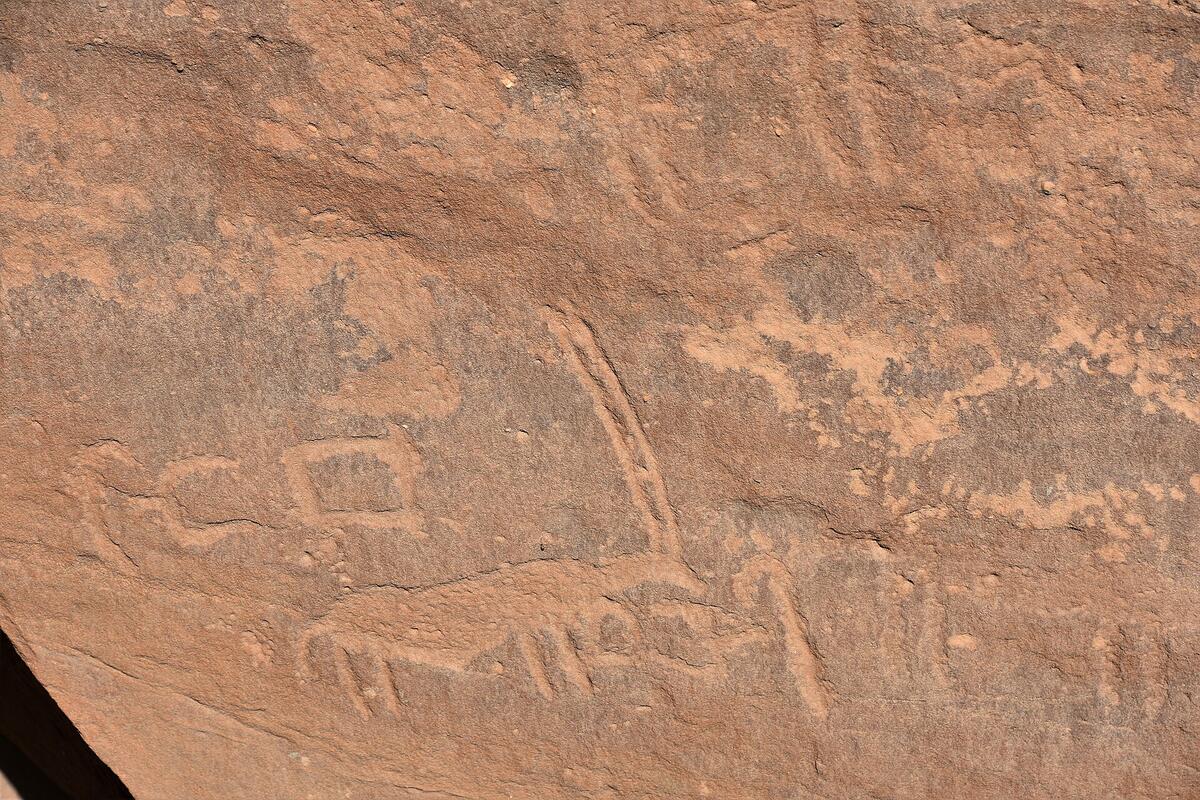
Jubbah is the flagship site. Located approximately 100 km northwest of Ha’il city at the edge of the Great Nafud Desert, Jabal Umm Sinman (“Two Camel-Hump Mountain”) rises 450 metres above the surrounding sand. The petroglyphs here once overlooked a freshwater paleolake up to 20 km long and 5 km wide, which explains why Neolithic communities gathered in such numbers and left such a rich artistic record.
Jubbah was inscribed on the UNESCO World Heritage List in 2015 as part of the serial nomination “Rock Art in the Ha’il Region” (WHS No. 1472), meeting criteria for masterpiece of human creative genius and exceptional testimony to a cultural tradition. You can read more about all of Saudi Arabia’s inscribed sites in our UNESCO World Heritage guide.
What You Will See at Jubbah
- Neolithic hunting scenes (7,000–9,000+ years old) — male and female human figures, cattle, gazelles, oryx, ibex, dogs
- Chariot carvings pulled by equids, indicating Bronze Age contact with Mesopotamia
- A prominent lion relief — one of the most celebrated individual panels
- Thamudic and early Arabic inscriptions from the 1st millennium BCE onward
- Feet impressions — a rare form of rock art found at very few sites worldwide
Archaeologist Juris Zarins has called Jubbah “the number-one or number-two site in the whole of the Middle East” for rock art concentration and importance.
How to Visit Jubbah
Getting there: Ha’il has a domestic airport with flights from Riyadh and Jeddah (check our flights guide for carriers and booking tips). From Ha’il city, drive approximately one hour northwest on paved roads to Jubbah town. The petroglyph site is at the northwestern edge of town beside the visitor centre.
Visitor facilities: Jubbah has a refurbished visitor centre with archaeological displays, designated walking paths with viewing platforms, and shade structures. Guided day tours from Ha’il are available through operators such as Wadi Trip ([email protected]) and Saudi Arabia Tours (saudiarabiatours.net).
Permits: Not formally required for the main viewing area at Jubbah, but confirm with the Heritage Commission or local operators before visiting, especially on weekends.
Photography tip: Visit at early morning or late afternoon. Oblique sunlight fills the carved lines and makes petroglyphs stand out dramatically against the dark rock varnish. Midday light flattens everything. See our photographer’s guide for more location-specific advice.
Shuwaymis — Jabal Al-Manjor and Jabal Raat (UNESCO World Heritage)
The second component of the Ha’il Region UNESCO inscription, Shuwaymis lies approximately 250 km southwest of Ha’il (and 190 km north of Medina) on the provincial border. The two main carving areas — Rata and Al-Manjoor — sit 30 km west of Shuwaymis village on rock escarpments in a sand-covered wadi.
What You Will See at Shuwaymis
- Naturalistic Neolithic carvings (from ~10,000 BCE) — wild lions, cheetahs, leopards, gazelles, ibex, hunting dogs and cattle depicted with extraordinary anatomical detail
- Some of the earliest known depictions of dogs wearing leashes — hunting scenes dated to approximately 8,000 BP, identified in a 2017 study as possibly the oldest dog imagery in the world
- Later Chalcolithic panels (5,000–3,000 BCE) — camels, horses, donkeys, ostriches and elongated human figures in a less detailed style
The carvings at Shuwaymis span roughly 10,000 years. The site is less accessible than Jubbah but widely considered the more artistically significant of the two.
How to Visit Shuwaymis
Getting there: Fly to Ha’il or Medina and drive. A 4WD vehicle is recommended; some sections involve desert tracks. A new paved road from the west now leads to the site gate.
Permits: Mandatory. You must obtain permission from the Heritage Commission prior to visiting. Permits are nominative (name-specific) and date-specific. Both the Rata and Al-Manjoor areas are fenced and permanently guarded. Carry your passport or national ID at all times. Guided tours are available through operators such as Horizons Tours.
Hima Cultural Area — Najran (UNESCO World Heritage)
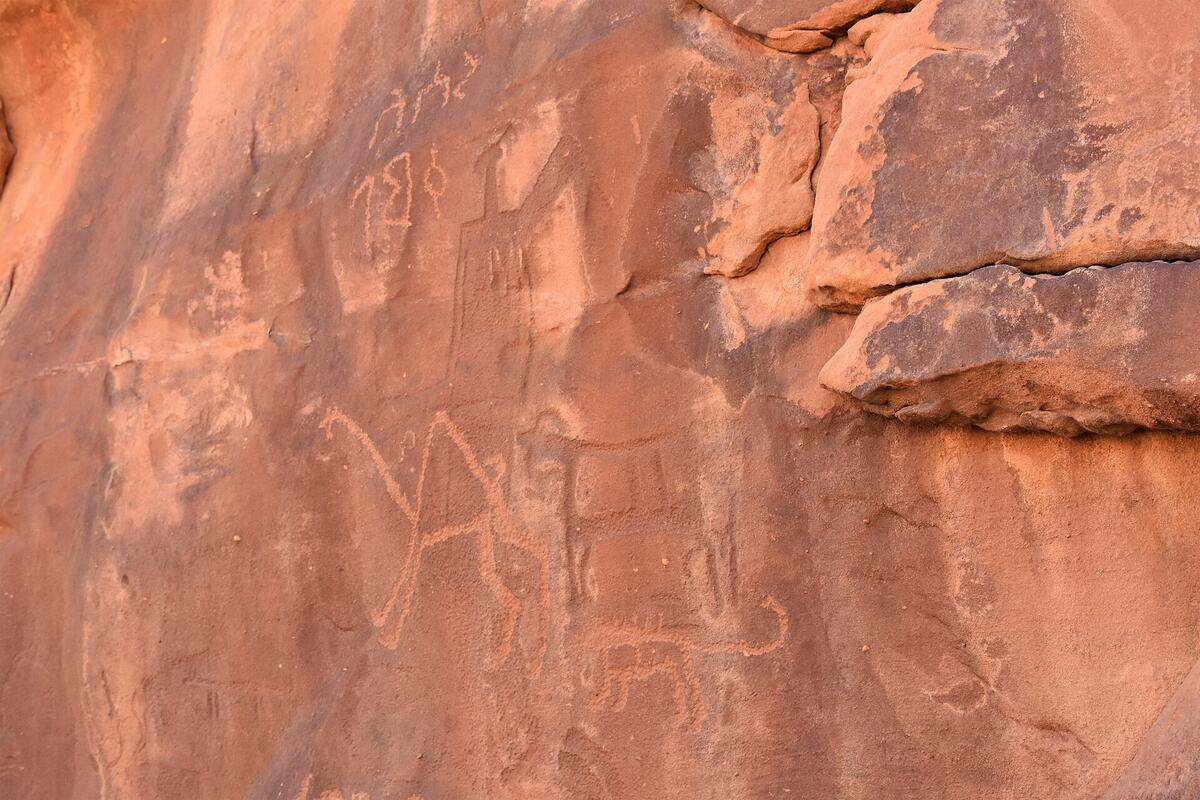
Inscribed in July 2021 (WHS No. 1619), the Hima Cultural Area in Najran Province is the largest of Saudi Arabia’s rock art World Heritage Sites at 557 km². Located approximately 120 km north of Najran city on one of the Arabian Peninsula’s oldest caravan routes, Hima contains an estimated 100,000 or more petroglyphs across 550 identified rock panels — making it one of the largest rock art complexes in the world.
What You Will See at Hima
- Over 1,800 camel depictions and more than 1,300 human figures
- Giraffes, cattle, horses, ibex and other fauna no longer found in the region
- Hunting scenes with detailed weapons — daggers, swords, bows, sickle swords and throw-sticks
- Multi-script inscriptions in al-Musnad (South Arabian), Aramaic-Nabataean, Thamudic, Greek, and Arabic — reflecting the route’s role as a crossroads of civilisations
- Six ancient wells (Bi’r Hima) — still producing fresh water after at least 3,000 years, making this possibly the oldest toll station on an ancient desert caravan route
The cultural continuity here is staggering: the Bir Hima Complex alone covers roughly 7,000–1,000 BCE, with later inscriptions dating to the 6th century CE including references to the Himyarite King Dhu Nuwas and the Christian community of Najran.
How to Visit Hima
Getting there: Fly to Najran Domestic Airport (EAM) — domestic connections from Riyadh (~1 hour 50 minutes) and Jeddah. Then drive 100–120 km north (1.5–2 hours) to the site. Car rental is available at Najran Airport but should be pre-booked. Alternatively, drive from Abha (approximately 4.5 hours) or Riyadh (approximately 10 hours).
Visitor facilities: A Visitor and Management Centre is located in Hima Township. Certain sectors require authorised guides — these are strongly recommended for safety and navigation in any case.
Rules: Do not touch, wet, chalk, trace or climb petroglyph panels. UNESCO conservation rules apply strictly.
Safety note: Hima is in Najran Province, relatively close to the Yemen border. Check your government’s current travel advisories before visiting. The site itself is safe and managed, but the regional context matters.
Jabal Ikmah and Dadan — AlUla
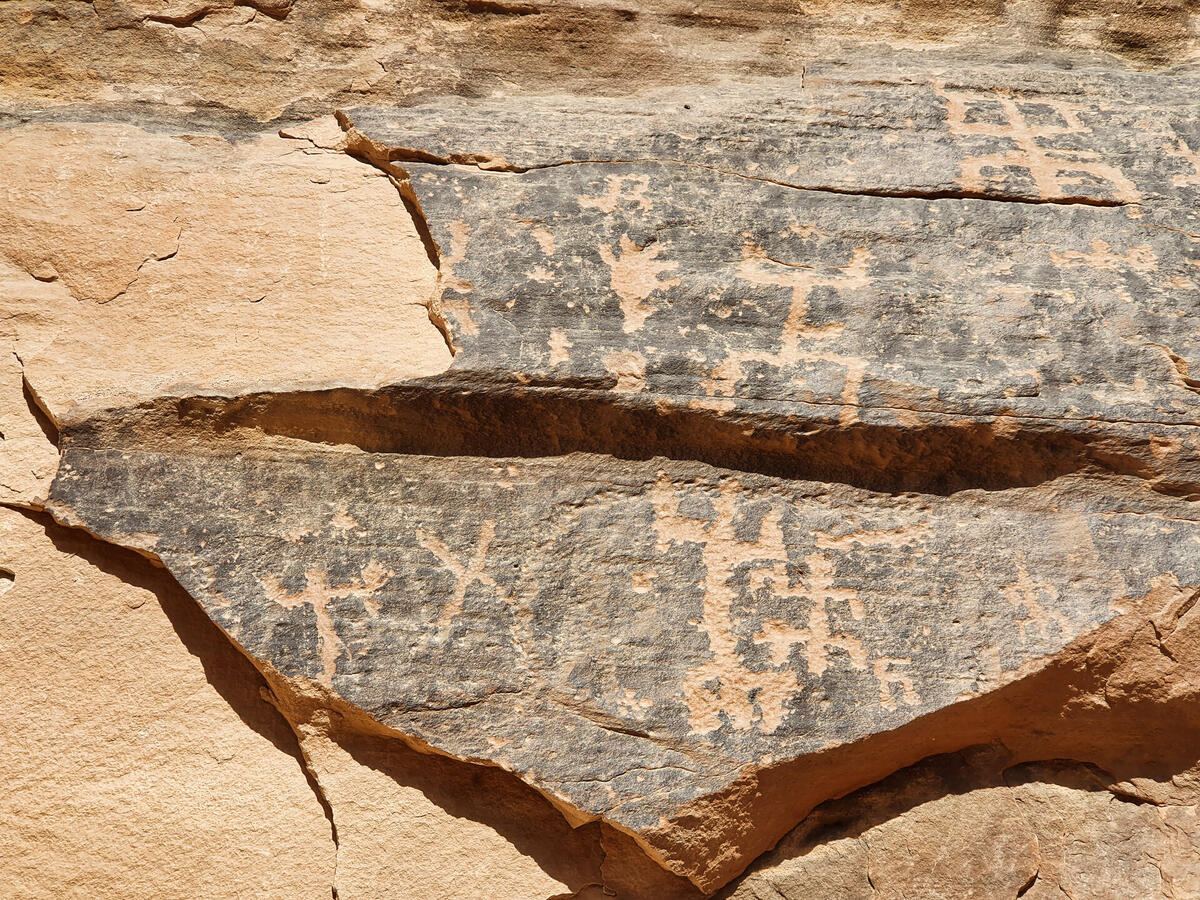
AlUla is best known for the Nabataean tombs at Hegra (Madain Saleh), but the valley also holds exceptional rock art and inscription sites that predate the Nabataeans by millennia.
Jabal Ikmah — The Open-Air Library
Jabal Ikmah is a desert canyon containing one of the largest and most diverse collections of ancient inscriptions in Saudi Arabia. In 2023 it was added to the UNESCO Memory of the World International Register. The inscriptions span the 1st millennium BCE and include Dadanitic, Thamudic, Minaic and Nabataean scripts — messages from pilgrims and traders including dedications, blessings, and prayers for crops and health. It is an extraordinary record of daily life at a crossroads of ancient civilisations.
Jabal Ikmah is paired with the nearby Dadan archaeological site, the former capital of the Dadanite and Lihyanite kingdoms, which includes stone-carved tombs etched into a cliff face plus inscriptions in Dadanitic and Lihyanite scripts.
Ar-Ruzeiqiah
South of AlUla town, Ar-Ruzeiqiah is a mountain with a large petroglyph panel featuring hundreds of images: hunting scenes with humans, ibexes, camels, horses, three lions, and a chariot pulled by two equids — unusual for the region and evidence of long-distance cultural contact.
Booking and Prices for AlUla Rock Art Tours
AlUla is the most developed rock art tourism destination in Saudi Arabia. Structured tours are available year-round through Experience AlUla:
| Tour | Adult (SAR) | Child 5–12 (SAR) | Duration |
|---|---|---|---|
| Dadan & Jabal Ikmah Standard (guided) | 60 | 30 | ~2 hours |
| Dadan & Jabal Ikmah Audio Tour | 90 | 45 | ~2 hours |
| Oasis Heritage Trail | From 35 | — | ~90 min |
| Hegra Day Tour | From 95 | — | ~3 hours |
Advance booking is required. Arrive 15 minutes before your tour time with your e-ticket and ID. Cancellations are allowed up to 3 days before; date changes up to 1 day prior.
Getting to AlUla: AlUla Regional Airport (ULH) has direct flights from Riyadh, Jeddah and Medina. The airport is approximately 45 minutes from most sites. If you are combining AlUla with other northwest destinations, see our Tabuk region guide. Don’t miss Elephant Rock while you are in the area.
Al Naslaa and Tayma — Tabuk Province
The ancient oasis of Tayma sits on the western edge of the Nafud Desert, approximately 220 km southeast of Tabuk city. Tayma has been continuously inhabited for at least 3,500 years — Babylonian king Nabonidus lived here in the 6th century BCE — and the surrounding desert holds remarkable rock art.
Al Naslaa Rock
Al Naslaa is one of the most photographed natural formations in Arabia: a large sandstone rock approximately 6 metres high and 9 metres wide, split perfectly in two halves, each balanced on small natural pedestals. The split is geological (a natural joint or fault), not man-made, though conspiracy theories persist online. The south-east face is covered with petroglyphs — horses, ibex, human figures — and Thamudic inscriptions dating back roughly 3,000 years.
Other Tayma Rock Art
The broader Tayma area includes sites at Jebel Habib, Al Daksh, Hafrat Berd and Uqulqh, featuring equine depictions, chariots and cavalry scenes spanning the Iron Age onward. The ancient well of Bir Haddaj (18 metres in diameter, referenced in Isaiah 21:14) is also worth visiting for historical context.
Getting there: Fly to Tabuk Regional Airport, then drive 3–4 hours southeast. A 4WD vehicle is recommended for the final approach to Al Naslaa. Bring water and snacks. Visit early morning or late afternoon for the best photography light and to avoid extreme heat.
Kilwa — The Remote Northern Frontier
For specialist visitors, Kilwa in the Jabal Tubaiq hills (approximately 280 km northeast of Tabuk) offers rock art dated between 9,000 and 7,000 BCE. First documented by Western visitors in 1932, the site includes petroglyphs of humans and ibex alongside stone tools — hand axes, scrapers, drills and chisels. A 2020 archaeometric study published in Arabian Archaeology and Epigraphy confirmed Holocene dating spanning the Pre-Pottery Neolithic through the historical period.
Kilwa has no published visitor infrastructure and is extremely remote. Contact the Heritage Commission or the Tabuk tourism office for access information. This is not a casual tourist destination.
Al-Magar — Possible Earliest Horse Domestication
Al-Magar in southwestern central Najd (near Al-Gayirah town) is primarily an archaeological site rather than a rock art viewing destination, but it deserves mention. Excavations have yielded a large stone horse sculpture (86 cm long, over 135 kg) that appears to show a bridle, suggesting domestication. Radiocarbon dating places the settlement at approximately 9,000 years old (founded ~9,000 BCE, abandoned ~7,000 BCE), which — if the domestication interpretation is confirmed — would make it one of the earliest horse domestication sites in the world. Rock art at the site includes depictions of leashed dogs resembling the Saluki breed.
Al-Magar is remote and not open for regular tourism. The key sculpture is held by the Saudi Heritage Commission.
Timeline: 12,000 Years of Rock Art
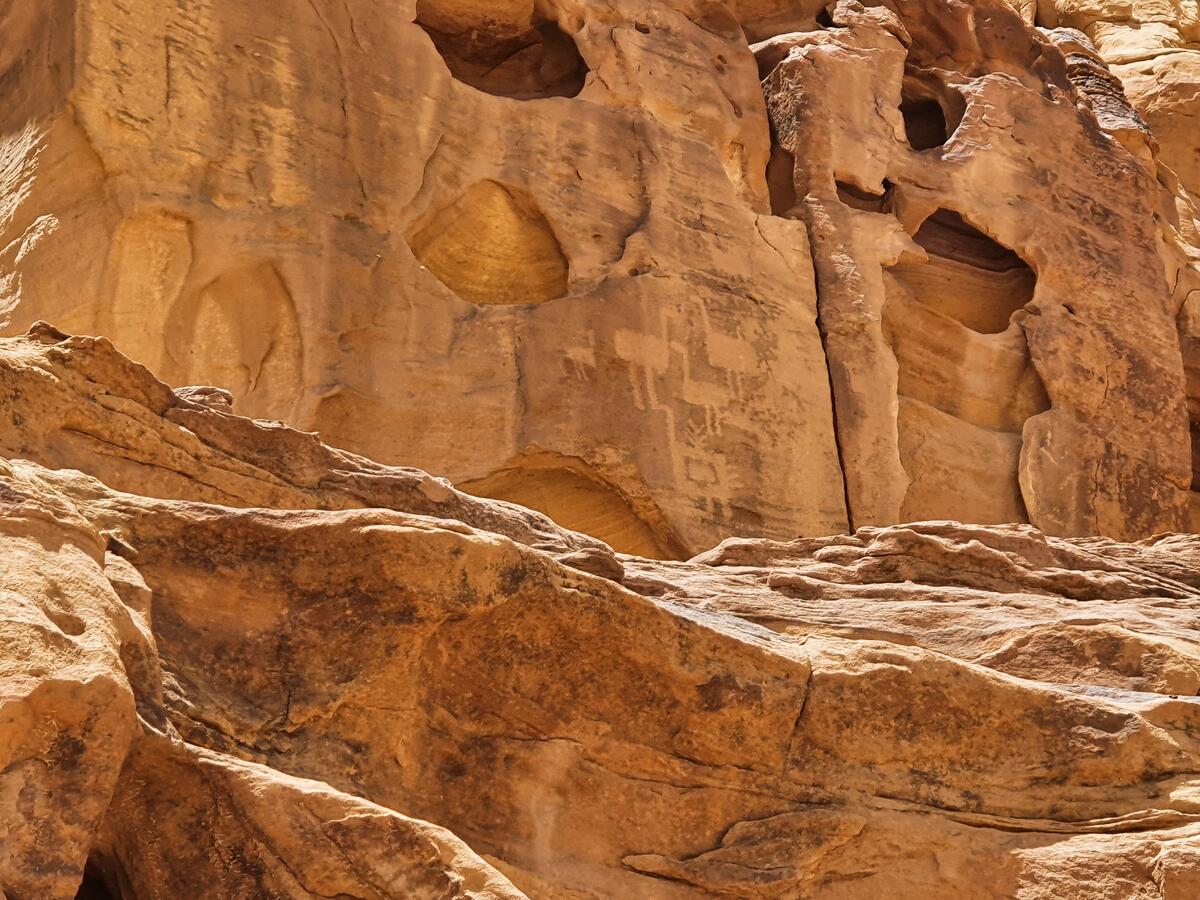
Understanding the chronology helps you appreciate what you are looking at. Here is a simplified timeline of Saudi rock art by period:
| Period | Approximate Date | Key Sites | What to Look For |
|---|---|---|---|
| Pre-Pottery Neolithic | 10,000–12,000 BCE | Nafud engravings, Al-Magar, Kilwa | Life-sized animals, stone tools |
| Pottery Neolithic | 7,000–9,000 BCE | Jubbah, Shuwaymis, Hima | Hunting scenes, cattle, leashed dogs |
| Chalcolithic | 5,000–3,000 BCE | Shuwaymis (later phase) | Camels, horses, elongated human figures |
| Bronze Age | 3,000–1,200 BCE | Hima, Kilwa (later phase) | Weapons, chariots, metalwork depictions |
| Iron Age / 1st millennium BCE | 1,200–100 BCE | Tayma, Hima, Jabal Ikmah | Thamudic and Dadanitic inscriptions |
| Nabataean / Historic | 300 BCE – 650 CE | AlUla (Jabal Ikmah), Hima | Nabataean and Greek script, trade records |
| Islamic | 650 CE onward | Hima | Arabic inscriptions, pilgrim records |
Best Time to Visit
All Saudi rock art sites are in desert or semi-arid environments. The universal rule is October through March, when daytime temperatures range from 13–26°C and skies are clear. The Saudi weather guide has region-by-region breakdowns.
| Site | Best Months | Notes |
|---|---|---|
| Jubbah / Shuwaymis (Ha’il) | October – March | Nafud Desert; winter is mild and sunny |
| Hima (Najran) | November – February | Southwest interior; summers exceed 40°C |
| AlUla | October – March | Coincides with AlUla Season (Dec–Jan); winter season guide |
| Tayma / Al Naslaa (Tabuk) | October – March | 3–4 hours from Tabuk; desert road |
| Kilwa (Tabuk, remote) | November – February | Remote desert; experienced guide essential |
Lighting tip: Petroglyphs are carved into desert-varnished rock. They are most visible in raking light — the first and last two hours of daylight, when the sun is low and oblique. Plan site visits for early morning or late afternoon. Midday sun washes everything flat. This matters more than any camera setting you can change.
Practical Information
Visas and Entry
All foreign visitors need a visa. The Saudi e-visa is available to citizens of 49+ countries and can be obtained online in minutes. It is valid for one year with multiple entries and allows stays of up to 90 days per visit.
Getting Around
Rock art sites are spread across the Kingdom. The most practical approach is to fly to regional airports (Ha’il, AlUla, Najran or Tabuk) and rent a car. A 4WD is essential for Shuwaymis and recommended for Tayma/Al Naslaa and any off-road approaches. For general transport options, see our guide to getting around Saudi Arabia.
Heritage Commission Rules
Saudi Arabia’s Law of Antiquities, Museums and Urban Heritage protects all rock art sites. Key rules for visitors:
- Do not touch petroglyph panels — skin oils accelerate weathering
- Do not wet, chalk, or trace carvings (a common “trick” for photography that permanently damages surfaces)
- Do not climb on or near carved rock faces
- Do not remove any objects — even loose stones — from archaeological sites
- Carry identification at all times, especially at gated sites like Shuwaymis
- Photography is generally permitted at open sites, but confirm with site rangers at gated locations
Suggested Itineraries
For a dedicated rock art trip, consider these routes (see our Saudi itinerary planner for broader trip ideas):
- 3–4 days (Ha’il + AlUla): Fly to Ha’il → Jubbah (day trip) → drive to AlUla (~5 hours) → Jabal Ikmah + Dadan → Hegra → fly out from AlUla
- 5–7 days (comprehensive): Ha’il (Jubbah + Shuwaymis with permit) → AlUla (Jabal Ikmah, Dadan, Ar-Ruzeiqiah) → Tabuk/Tayma (Al Naslaa) → fly home
- 2–3 days (AlUla only): If time is short, AlUla alone offers Jabal Ikmah, Dadan, Ar-Ruzeiqiah and Hegra — enough rock art and archaeology for a fulfilling trip with the best visitor infrastructure
What to Bring
- Plenty of water (3+ litres per person per day in the desert)
- Sun protection: hat, sunscreen, lightweight long sleeves
- Sturdy closed-toe shoes for rocky terrain
- A torch/flashlight for examining shaded panels
- Binoculars for viewing high panels you cannot approach
- A camera with a polarising filter (cuts glare on varnished rock)
For a full packing checklist, see our Saudi Arabia packing list.
Combining Rock Art with Other Activities
Saudi Arabia’s rock art sites sit in landscapes that reward broader exploration. If you are already in the Ha’il region, the surrounding Nafud Desert offers exceptional stargazing conditions. AlUla pairs rock art with hot air balloon flights and hiking through sandstone canyons. The Najran plateau near Hima is one of the least-visited corners of the Kingdom — genuine frontier travel for those who want it.
Explore More Saudi Arabia Travel Guides
- Saudi Arabia Travel Guide 2026 — The complete guide to visiting the Kingdom
- Saudi Arabia UNESCO World Heritage Sites — All eight inscribed sites explained
- AlUla Travel Guide 2026 — Hegra, Elephant Rock, desert camps and ancient Arabia
- Ha’il Region Guide — Saudi Arabia’s desert rose and gateway to Jubbah
- Najran Travel Guide — Ancient history on the Yemen border
- Tayma Oasis Guide — Babylonian ruins and Al Naslaa in the northwest desert
- Dadan Archaeological Site — Capital of an ancient Arabian kingdom at AlUla
- Saudi Arabia Visa Guide — Every visa type explained