
Riyadh eats late, eats outdoors, and eats with its hands. Away from the hotel buffets and mall food courts is a much older city built around clay-oven bread, rice cooked for hours under a weight of spice, and a late-night shawarma culture that only really gets going after ten. This is a practical, street-level guide to where to find that food in the Saudi capital, what to order when you get there, and how to eat like a resident rather than a tourist passing through. It sits alongside our wider Riyadh travel itinerary for visitors planning their first trip to the city.
Street food in Riyadh is not a single cuisine. It is a layering — Najdi dishes from the central Saudi heartland, Hejazi influences from the western coast, Yemeni smoked-meat traditions brought north with migrant workers in the twentieth century, and more recent South Asian and Levantine arrivals who have made Al Bat’ha one of the most densely fed streets in the Gulf. Most of it is cheap, most of it is halal by default, and nearly all of it is better after dark.
Best Time to Visit: November to March (cool evenings make outdoor eating comfortable); Ramadan nights are exceptional but crowded
Getting There: Fly into King Khalid International Airport (RUH); most street food districts are a 20–30 minute taxi from the airport
Visa Required: Yes — tourist e-visa
Budget: SAR 15–50 ($4–$13) per person for a full street-food meal; SAR 80–150 ($21–$40) at a sit-down traditional restaurant
Must-See: Souq Al-Zal for mutabbaq; Al Bat’ha for shawarma and grilled meats; Najd Village for a full Najdi banquet
Avoid: Skipping cash — many street vendors still don’t take cards, and most close briefly during the five daily prayers
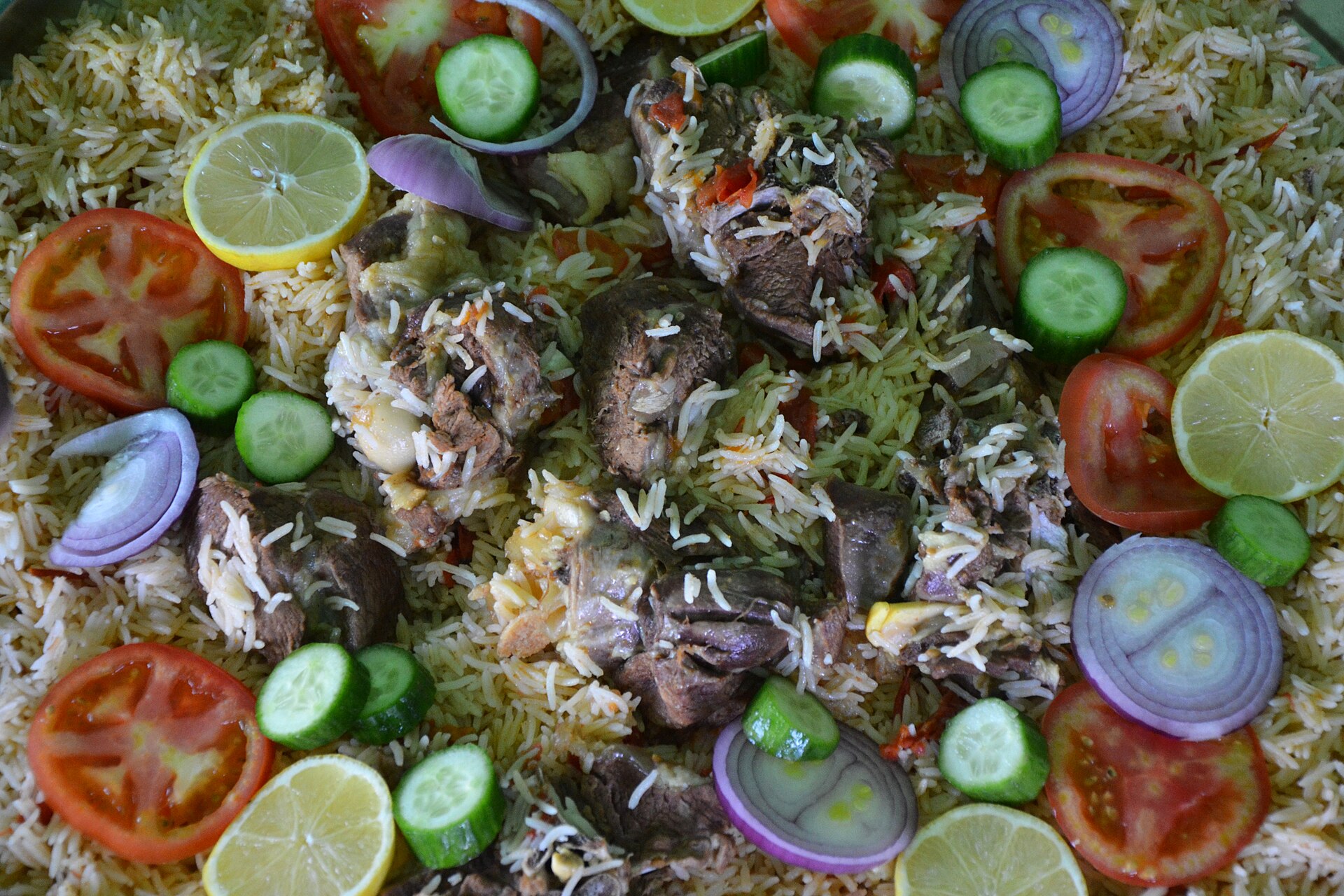
Start Here: The Dishes You Need to Know
Before you go hunting a specific stall, learn the vocabulary. Riyadh menus rotate around a core of perhaps a dozen dishes, and once you can read them you can walk into almost any local place and order with confidence. The names below are the ones you will see repeatedly, transliterated the way they typically appear on menus and signage across the city.
Kabsa — the national dish
Kabsa is the dish that anchors Saudi cuisine. At its simplest it is long-grain rice cooked with meat — usually lamb or chicken — in a single pot, flavoured with a spice mix called baharat that typically includes cinnamon, cardamom, cloves, black lime (loomi), black pepper and nutmeg. The rice is cooked in the meat stock, so every grain carries the flavour. A good kabsa arrives at the table on a communal platter, topped with the meat, a scatter of toasted almonds and raisins, and a small dish of sharp tomato and chilli sauce called daqqus on the side. It is designed to be eaten with the right hand, from the edge of the platter inward, with a group.
Mandi and Madhbi
Mandi is Yemeni in origin but is eaten in Riyadh nearly as often as kabsa. The technique is what distinguishes it: a whole lamb shoulder or chicken is suspended inside a covered clay pit over burning charcoal, with a tray of rice beneath to catch the dripping fat. The result is meat so tender it falls off the bone and rice stained with smoke. Madhbi is a close cousin — the same cut of meat, but grilled flat over coals rather than suspended. Haneeth is a third variant, slow-baked in a sealed oven until the lamb collapses.
Shawarma
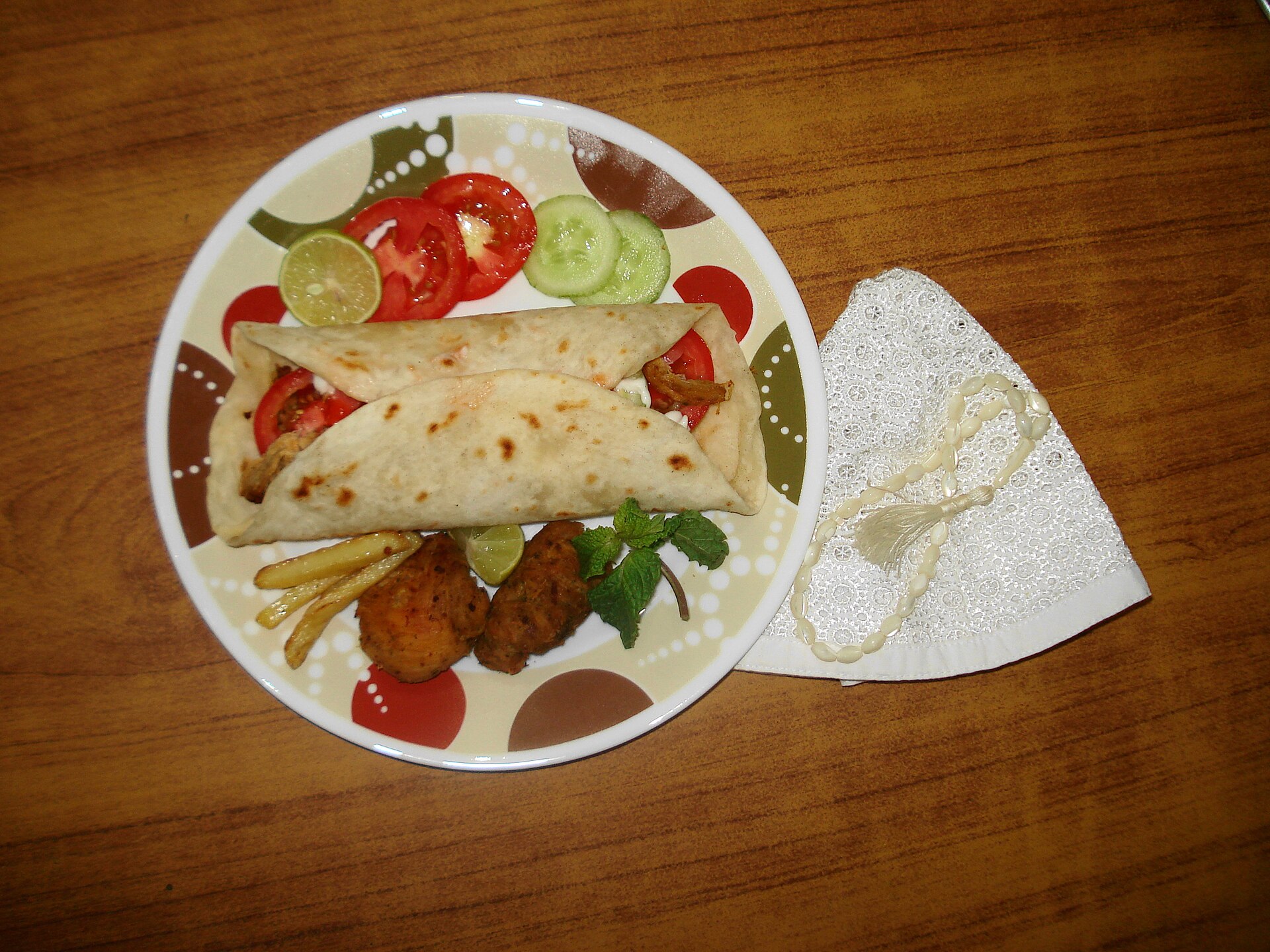
The Saudi shawarma sits slightly apart from its Levantine cousins. The meat — almost always chicken in the everyday version, lamb at the better shops — is stacked on a vertical spit, shaved thin as it crisps on the outside, and rolled into a soft flatbread with pickles, tomato, tahini or garlic sauce, and sometimes a drizzle of chilli. Chains like Shawarmer and Mama Noura have expanded this into a national format; independent stalls in neighbourhoods like Al Olaya and Al Bat’ha run later and often taste better.
Mutabbaq
Mutabbaq — the word means “folded” — is a thin, almost translucent dough pulled out paper-thin by hand, filled with spiced minced meat, egg, onion, and leek or parsley, then folded into a square and fried on a flat griddle until the outside is shatteringly crisp. It is a speciality of Souq Al-Zal and the older markets, cooked to order in front of you. Sweet versions exist, filled with banana or cheese, but the savoury meat mutabbaq is the one to start with.
Samboosa
Small triangular pastries stuffed with minced meat, cheese, potato, or lentils, deep-fried until the shell blisters. Samboosa are eaten year-round but explode in volume during Ramadan, when every household fries them by the tray for iftar. Almost every bakery and grocery in Riyadh sells them for one or two riyals apiece.
Jareesh, Qursan and Margoog — the Najdi staples
These are the old dishes, the ones your Saudi friends’ grandmothers cooked. Jareesh is crushed wheat simmered with chicken, yoghurt and fried onions until it reaches a porridge-like consistency — warming, savoury, and deeply satisfying in winter. Qursan (also spelled gursan) is a stack of thin, slightly dry flatbreads layered with a tomato-and-vegetable stew that softens the bread into something between lasagne and bread pudding. Margoog is a rustic stew of hand-torn dough discs cooked with meat, tomatoes and root vegetables. Matazeez is the same basic idea with thicker pasta-like squares. These dishes are harder to find at street stalls but feature at traditional sit-down restaurants like Najd Village and Al Romansiah.
Bukhari rice and biryani
Bukhari rice — sometimes written bokhari — is fragrant basmati toasted with tomato paste, cumin, raisins and toasted nuts, usually served with roasted chicken. The name nods to the Central Asian Silk Road influence that reached the Hejaz centuries ago. It is the house rice at many of the Pakistani-owned restaurants that dot Al Bat’ha and Al Suwaidi, which also sell excellent biryani.
Areeka and Masoub — sweet endings
Areeka is a southern Saudi dish of soft, slightly sweet flatbread crumbled into a bowl and mashed with dates, honey, butter and sometimes cream — served warm. Masoub is its cousin, built on ripe bananas, brown bread crumbs and honey. Both show up in Riyadh at restaurants with southern or Yemeni roots and make an unusual, filling dessert.
Where to Eat: The Best Street Food Districts
Riyadh is flat and enormous, but its street food clusters in a small number of identifiable districts. These are the ones worth travelling for.
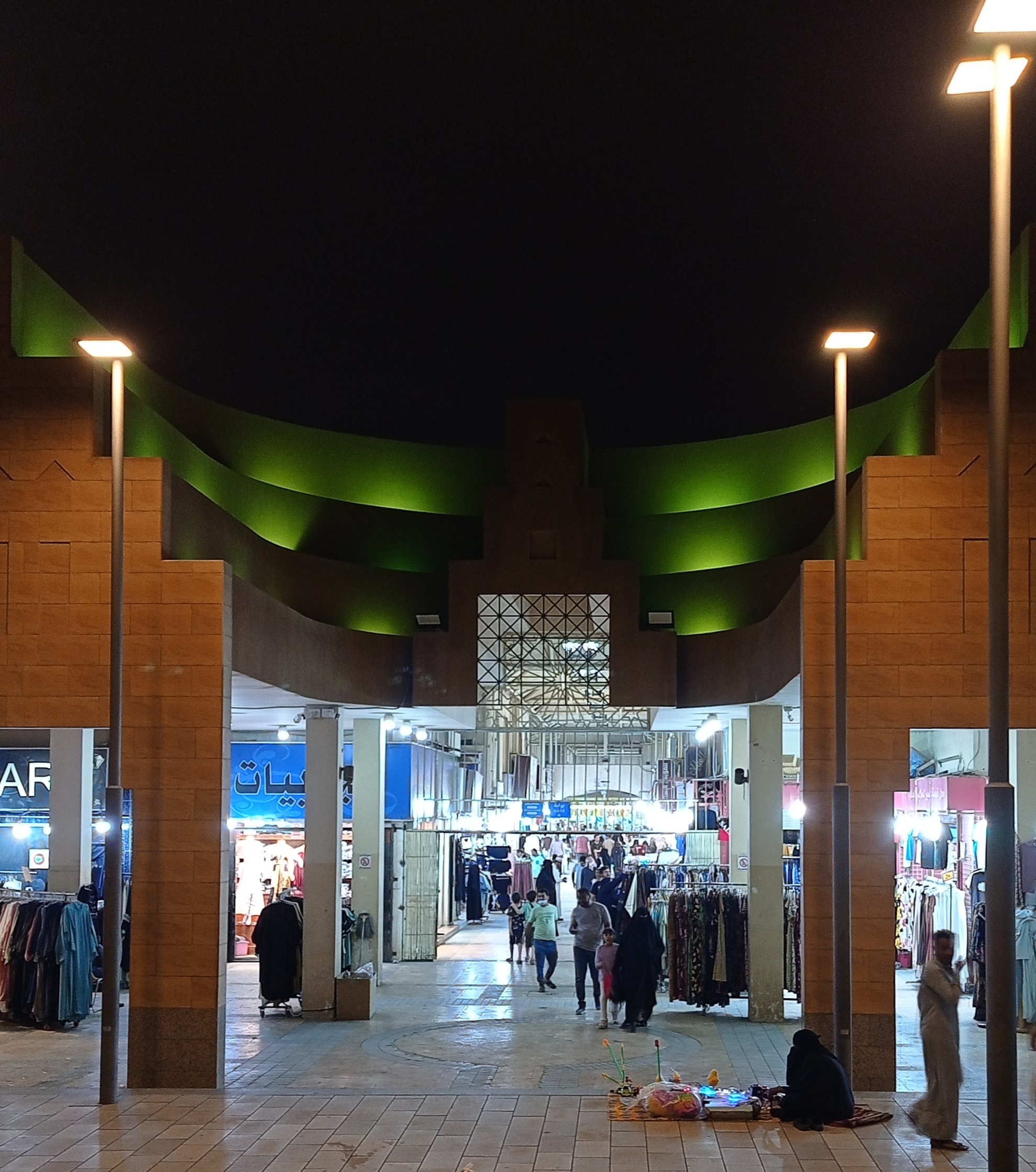
Souq Al-Zal — the old capital
Souq Al-Zal, founded in 1901 and sitting in the shadow of Al Masmak Fortress, is Riyadh’s oldest market and the starting point for any street-food tour. Its name comes from the carpets (zal) historically traded here, but today the lanes around the souq are where you will find the best mutabbaq in the city, cooked on open griddles by men who have been doing it for decades. Look for stalls selling baleela (warm chickpeas with lemon and chilli), fresh samboosa, and glasses of sobia, a lightly fermented drink the colour of weak tea.
In early 2026 part of the souq was relaunched as Azzal Street Food, an open-air development adding more seating, walkable alleys and a curated selection of Saudi food stalls to what was already the old city’s culinary core. The area is walkable from Al Masmak and the Qasr Al-Hukm district, making it a natural evening stop after an afternoon of sightseeing. Our Riyadh travel guide covers the neighbouring heritage sites in more detail.
Tip: Go after Maghrib prayer — around 6 to 7 pm depending on the season — when the stalls reopen and the crowd is at its liveliest. Stalls typically close briefly during the five daily prayer times, so time your visit between them.
Al Bat’ha — the melting pot
Al Bat’ha is the old commercial core of Riyadh and the most polyglot street-food district in the city. Here, Pakistani karahi houses sit next to Yemeni mandi kitchens, which sit next to Egyptian koshari counters and Levantine shawarma joints. It is louder, more chaotic, and less polished than Souq Al-Zal — and for many residents it is where they actually eat when they are not cooking at home.
The strip is particularly good for late-night shawarma, mandi served in paper-lined trays with communal scoops, and skewers of grilled tikka from Pakistani grills. Prices are low — a full plate of mandi with lamb will run SAR 25–40 ($7–$11) — and portions are aggressive. Go hungry, and ideally in a group, so you can order across several stalls.
Souq Al Thumairi — heritage shopping and sobia
Souq Al Thumairi sits in the same heritage district as Al-Zal, just north of Deira Square. It is smaller and more oriented toward souvenirs — daggers, perfumes, thobes — but the surrounding streets hide a handful of long-running samboosa shops and tea stands. If you are already walking the heritage area, a glass of sobia and a hot samboosa here is a worthwhile pause.
Al Olaya and Tahlia Street — the modern evening strip
Al Olaya is the glass-tower half of central Riyadh, and the stretch of Tahlia Street (Prince Mohammed Bin Abdulaziz Road) that runs through it is the city’s most accessible evening food corridor. This is less raw street food than a dense cluster of mid-priced restaurants, late-opening shawarma shops, and mixed-origin grills, but it is where you go if you want to walk between options after dark. Shawarma House on Al Olaya, Assaraya on Prince Sultan Road, and several Mama Noura branches run deep into the night — a useful fallback after the older markets have closed.
For a deeper dive into sit-down options across the city, see our guide to the best restaurants in Riyadh right now, which covers fine dining alongside the well-known street-food chains.
Diriyah and Bujairi Terrace — the premium end
A short drive north-west of central Riyadh, the restored Bujairi Terrace beside At-Turaif sits at the opposite end of the price spectrum from Al Bat’ha. This is where Saudi fine dining has rebuilt itself in the past few years, with outposts of Hakkasan, Myazu, LPM, Long Chim and the Saudi concept Maiz AlKhozama. It is not street food in any conventional sense, but it is where to go for modernised takes on traditional Najdi dishes in a setting built around the UNESCO-listed mudbrick city. Budget SAR 300–600 ($80–$160) per person for dinner.
Traditional Sit-Down Restaurants
There is a point on every street-food trip where you want to stop walking, sit down and order a proper spread. These are the Riyadh institutions that matter.
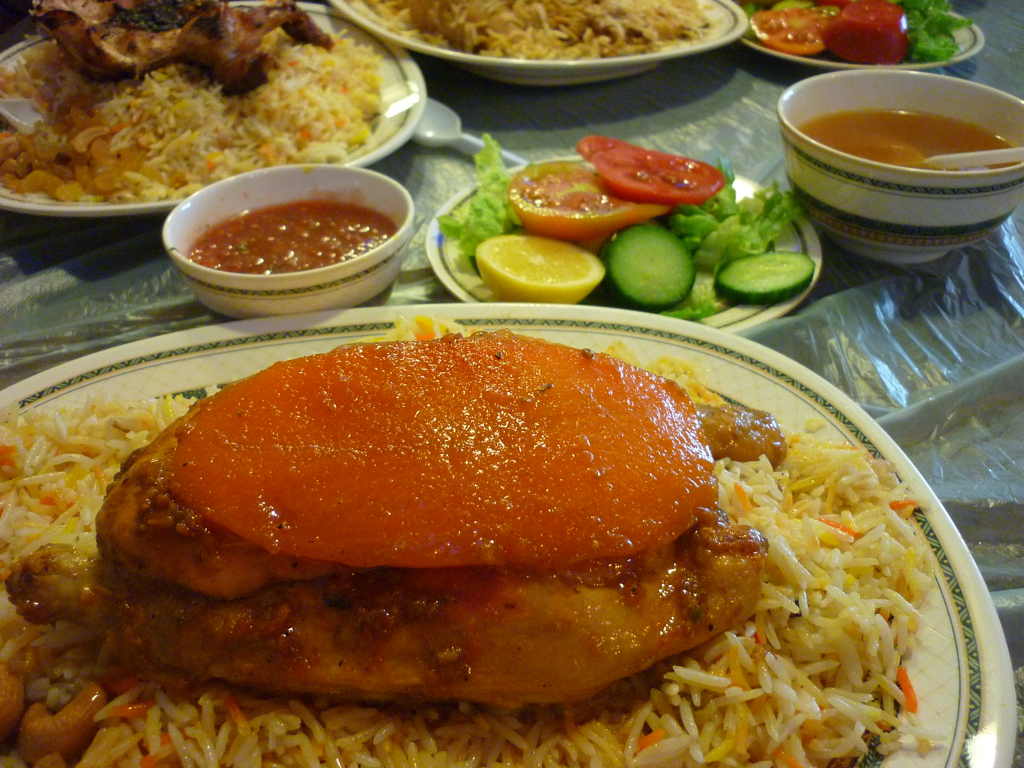
Najd Village
Najd Village is the obvious first stop for visitors who want a single room that captures Najdi cuisine. Guests sit on the floor on low majlis cushions, and dishes arrive on shared platters — kabsa, matazeez, qursan, jareesh, mogalgal — with a pot of Arabic coffee and a dish of dates for the beginning and end of the meal. Branches exist across the city; the original on Takhassousi Street remains the most atmospheric. Expect SAR 100–180 ($27–$48) per person for a full meal with group sharing.
Al Romansiah
Al Romansiah is a larger, faster-moving chain focused on traditional Saudi food at workable prices. Its speciality is mathloutha, a Najdi dish that layers jareesh, qursan and margoog into a single bowl — a sort of edible cross-section of the local cookbook. Al Romansiah has dozens of branches; most Riyadh residents have a nearest outlet within a short drive. Typical bill: SAR 40–80 ($11–$21) per person.
Al Saudi Restaurant
A long-running kabsa and mandi specialist that Riyadh locals have been eating at for years. Less ornate than Najd Village, less standardised than Al Romansiah — the kind of place judged by the quality of its rice rather than its décor. Several branches across the city, most operating a large communal dining hall plus private family rooms.
Suhail
Suhail is the quieter, more design-led entry in Saudi traditional dining. It leans into a refined take on Najdi dishes, with plated presentation and a wine-list-style menu, and is a useful choice for a first sit-down meal if a floor-cushion majlis feels intimidating. Reservations advisable on weekends.
Drinks to Order With Your Food
Saudi Arabia is dry — there is no alcohol, anywhere, full stop — and the country’s drinks culture has built an impressive range of non-alcoholic options to fill the gap. A few are essential to a street-food day.
- Gahwa (Arabic coffee): Pale-gold, unsweetened coffee flavoured heavily with cardamom and sometimes saffron or cloves. Served in small handleless cups (finjan), always with dates. Refuse a refill by shaking the cup from side to side.
- Karak chai: Strong black tea brewed with evaporated milk, cardamom and a generous hand of sugar. Sold from roadside kiosks across the city for a few riyals a cup — the drink that powers the taxi-driver economy.
- Sobia: A lightly fermented barley-and-bread drink, usually served cold and sometimes flavoured with cinnamon or rose. Volumes spike in Ramadan, when it is the classic iftar refresher.
- Laban: Salted drinking yoghurt, cold and thin enough to sip. The traditional partner to a heavy kabsa meal.
- Jallab and tamarind juice: Date-syrup and tamarind-based cold drinks, widely available in Ramadan and increasingly year-round at traditional restaurants.
- Fresh juice stalls: Every major street in Riyadh has at least one juice stall pressing pomegranate, mango, orange and sugarcane to order, typically SAR 8–15 ($2–$4) a cup.
- Bring cash. Card payment is standard at chain restaurants but unreliable at market stalls. Carry SAR 100–200 in small notes for street food days.
- Follow the queues. At any souq stall, the busy one is the one to eat at. High turnover is the best quality signal for street food anywhere in the Gulf.
- Time around prayer. Shops close for roughly 20–30 minutes at each of the five daily prayers. The relevant ones for evening eating are Maghrib (sunset) and Isha (about 90 minutes later). Check the daily prayer times and plan to be between them.
- Eat with your right hand. Traditional meals at places like Najd Village are eaten without cutlery from a shared platter. Use the right hand only. Cutlery is always available if you prefer.
- Dress conservatively. The relaxation of dress rules under the 2019 tourist visa means visitors are no longer required to wear an abaya, but modest clothing — shoulders and knees covered — still fits the room at traditional restaurants.
- Women-only and family sections. The strict segregation of the past has been largely dismantled, but many traditional restaurants still maintain separate family and singles sections. Solo women and mixed-gender groups sit in the family section by default.
- Tipping. Not expected at street stalls. At sit-down restaurants, 10 per cent is appreciated but not automatic; check whether service charge has already been added.
- Avoid tap water. Residents drink bottled water almost exclusively and so should you. Every restaurant serves cold bottled water on request.
- Delivery. If you prefer to eat in, HungerStation, Jahez and Mrsool deliver from almost every restaurant mentioned in this guide. This is how most Riyadh residents actually eat day to day.
- Ride-hailing apps (Uber, Careem) work throughout the city and are the standard choice. A cross-city fare is typically SAR 20–50 ($5–$13).
- The Riyadh Metro, opened in stages through 2025, now connects Olaya, the heritage district and King Khalid International Airport on intersecting lines. A single ride costs SAR 4 ($1). The metro is the fastest way to cover long distances, particularly at weekends when traffic thickens.
- Walking is practical within Al Bat’ha, within the Al-Zal / Thumairi / Masmak heritage cluster, and along the Tahlia Street evening strip — not between them.
- Riyadh Travel Guide 2026 — The complete overview of the Saudi capital, from itineraries to neighbourhoods
- Best Restaurants in Riyadh Right Now — Sit-down dining across the city, from fine dining to neighbourhood favourites
- Best Hotels in Riyadh — Every budget covered, with a focus on location relative to the evening food districts
- Saudi Arabia Food Tour Itinerary — A multi-city eating plan spanning Riyadh, Jeddah, AlUla and Abha
- Riyadh vs Jeddah — How the two cities compare for first-time visitors
- Saudi Arabia Travel Guide 2026 — The complete guide to visiting the Kingdom
- Saudi Arabia Visa Guide — Every visa type explained
How a Day of Riyadh Street Food Actually Looks
Timing matters in Riyadh. Kitchens run on the prayer schedule, the heat dictates when anyone wants to be outdoors, and the best food districts are purely nocturnal. A workable one-day plan looks like this.
| Time | Where | What |
|---|---|---|
| 09:00–10:30 | Foul and tamees bakery (any neighbourhood) | Breakfast: hot flatbread, mashed fava beans (foul), shakshuka, mint tea |
| 11:00–13:00 | Masmak Fortress + Souq Al-Zal | Sightseeing; snack on samboosa and baleela from souq stalls |
| 13:00–14:30 | Najd Village or Al Saudi | Lunch: full kabsa or matazeez spread, gahwa and dates after |
| 14:30–17:00 | Back to hotel | Rest through the heat — nothing worthwhile is open anyway |
| 18:00–19:30 | Tahlia Street / Al Olaya | Evening coffee and karak chai; window-browse |
| 20:00–22:00 | Al Bat’ha | Mandi, tikka and late shawarma; juice stall for a nightcap |
| 22:00–late | Boulevard World / Via Riyadh | Shisha, desserts, people-watching |
Visitors planning a more structured national food tour can build Riyadh into our Saudi Arabia food tour itinerary, which pairs it with Jeddah’s Hejazi cooking and the coffee culture of Abha.
Ramadan — The One Time Everything Changes
If you visit during Ramadan — mid-February to mid-March in 2026 — the entire street-food rhythm inverts. Restaurants are closed during daylight hours and street stalls cannot sell to anyone visibly eating in public. But the moment the cannon fires at Maghrib, the city’s food culture explodes.
Iftar begins with dates and laban, followed by soup (often lentil) and a plate of samboosa. The main course is typically kabsa, mandi or bukhari rice, with a table of sweets (kunafa, luqaimat) for the end. Many restaurants run all-you-can-eat iftar buffets from around 5 pm, and a traditional Najdi dessert of dates, brown bread and butter flavoured with cardamom and saffron appears on tables across Riyadh — a winter dish that provides both sweetness and warmth.
Suhoor, the pre-dawn meal, keeps restaurants and some cafés open until around 3 am. This is when you will see karak stalls at their busiest and hear the loudest trade at shawarma shops in Al Olaya. Visiting Riyadh during Ramadan is a completely different experience — denser, more social, and with far better food than any other time of year, as long as you are prepared to flip your clock.
Practical Tips for Eating Out in Riyadh
Getting Around Between Food Districts
Riyadh is a car city. Distances between the four main food districts — Souq Al-Zal, Al Bat’ha, Al Olaya, Bujairi Terrace — can easily hit 20 kilometres, and walking is not realistic outside the immediate heritage area. The practical options:
Visitors planning a longer stay often base themselves in Al Olaya for walking access to the evening eating scene; see our picks for the best hotels in Riyadh if you are still booking, or serviced apartments in Riyadh if you are in the city for more than a week.
Visa, Arrival and the Basics
Saudi Arabia introduced its tourist e-visa in 2019 and the system has been extended and simplified several times since. Most Western passport holders can apply online in minutes and receive a multiple-entry visa valid for a year, with stays of up to 90 days per visit. The full process, eligibility list and current pricing is covered in our Saudi Arabia visa guide, which is updated regularly as rules change. Pilgrimage visas are a separate system; the Hajj 2026 guide covers those in detail for anyone combining a food-focused Riyadh visit with pilgrimage.
Flights land at King Khalid International Airport (RUH), about 35 km north of the city centre. Taxis and ride-hailing take 30–45 minutes; the metro airport extension takes about 50 minutes. Hotels near Riyadh airport are the best choice for short layovers; for longer stays, anywhere central works.
Common Questions
Is Riyadh street food safe to eat?
Yes — Saudi hygiene standards are high, and the Ministry of Municipal Affairs inspects food premises regularly. The same caveats apply as anywhere: eat at busy stalls where turnover is fast, avoid pre-made salads that have been sitting out, and drink bottled water. Most travellers report no issues.
Do I need Arabic to order?
No. Most menus are in Arabic and English, and staff in central Riyadh restaurants almost always speak at least some English. Learning the dish names — kabsa, mandi, mutabbaq, shawarma — is more useful than learning Arabic phrases.
Is Riyadh street food vegetarian-friendly?
Partly. Samboosa come in potato, cheese and lentil versions; baleela is pure chickpea; foul and hummus are widely available at breakfast counters; most bakeries sell cheese or spinach fatayer pastries. But the major rice dishes — kabsa, mandi, bukhari — are built around meat, and pure vegetarian versions are uncommon outside dedicated Indian restaurants.
How does Riyadh street food compare to Jeddah?
Jeddah is Hejazi — more Red Sea influence, more seafood, stronger Egyptian and Sudanese presence, and a genuinely different food culture built around the Old Town (Al-Balad). Riyadh is Najdi at its core, with heavier rice-and-meat dishes and a stronger Yemeni and Pakistani overlay. Our detailed comparison of the two cities sits at Riyadh vs Jeddah.
Can I tip in foreign currency?
Avoid it — small USD or EUR notes are hard to change. Use Saudi riyals in cash, or round up the card bill at sit-down restaurants.