
Saudi Arabia’s handicraft traditions stretch back thousands of years, shaped by the desert, the mountains and the oases that sustained the communities who made them. From the geometric Sadu weaving of Bedouin women in Najd to the vibrant Al-Qatt Al-Asiri wall paintings of the southern highlands, each region developed its own visual language, materials and techniques. Today, as part of a broader Saudi Arabia travel itinerary, visitors can watch artisans at work, try their hand at a pottery wheel, and carry home objects that have been made the same way for centuries. The Kingdom declared 2025 the Year of Handicrafts, and the momentum has carried into 2026 with new artisan houses, licensed workshops and a growing network of craft markets across the country.
Best Time to Visit: October to March (cooler weather for souq browsing and workshop visits)
Getting There: Fly into Riyadh, Jeddah or Dammam; regional airports serve Al-Ahsa, Abha and AlUla
Visa Required: Yes — tourist e-visa
Budget: SAR 50–500+ per item (USD 13–135+), depending on craft and quality
Must-See: Dougha Pottery Factory (Al-Ahsa), Souq Al Zal (Riyadh), Rijal Almaa Heritage Village (Asir)
Avoid: Buying mass-produced imports labelled as handmade — always ask the artisan or vendor about origin
Understanding Saudi Arabia’s Craft Regions
Geography dictated craft. In the central Najd plateau, Bedouin communities relied on camel hair, sheep wool and goat hair — the raw materials for Sadu weaving. Along the Red Sea coast in the Hejaz, centuries of maritime trade brought woodworking tools and metalwork traditions, visible in the latticed rawashin (wooden balconies) of Jeddah’s Al Balad district. In the Eastern Province, abundant clay near oases like Al-Ahsa created a pottery tradition that has survived more than 600 years. And in the mountains of Asir, isolation preserved a distinctive culture of stone architecture, colourful wall painting and basket weaving using palm fronds and wild grasses.
The Heritage Commission, which oversees Saudi Arabia’s craft sector, had licensed 4,855 individual artisans by 2025. The Ibda’a platform issues these licences, and a licensed artisan’s mark is one of the most reliable indicators that a piece is genuinely handmade in the Kingdom.
Sadu Weaving — The Bedouin Textile Tradition
Al Sadu is the most recognisable Saudi craft internationally. Inscribed on UNESCO’s Representative List of Intangible Cultural Heritage in 2020, Sadu describes a specific ground-loom weaving technique used by Bedouin women to produce tents, floor rugs, camel saddle bags, cushion covers and decorative bands. The geometric patterns — triangles, diamonds, zigzags and stylised representations of camels, tents and trees — are not merely decorative. They functioned as tribal identifiers, with each motif carrying specific meaning within its community.
Materials and Process
Traditional Sadu uses hand-spun yarn from three sources: sheep wool (soft, takes dye well), camel hair (naturally brown and cream, extremely durable) and goat hair (coarse, used for tent panels and structural elements). The wool is cleaned, carded, spun on a drop spindle, and dyed using natural pigments — historically from pomegranate skin, indigo, saffron and henna. Modern Sadu weavers sometimes use commercially dyed yarn, though purists maintain the natural palette.
The ground loom is staked directly into the earth with four pegs, and the weaver sits on the ground, beating the weft with a wooden comb. A single rug can take weeks to complete. The tight, flat weave produces textiles that withstand desert wind and sand, which is why Bedouin chose this technique for tent walls and floor coverings.
Regional Variations
Najdi Sadu tends toward stark, angular motifs in black, white, red and orange — reflecting the austere desert landscape. In the northern regions closer to Jordan and Iraq, colour palettes expand to include blues and purples, and patterns sometimes incorporate wider bands. In the Asir highlands, weaving traditions overlap with the region’s broader love of colour, producing multicoloured bands that echo the Al-Qatt wall art found in nearby villages.
Where to Buy Sadu Textiles
- Souq Al Zal, Riyadh — The city’s oldest market (established 1901) stocks antique and contemporary Sadu rugs, cushion covers and wall hangings in its textile section
- Souq Taibah, Riyadh — Known as the ladies’ market, with Sadu cushion covers, embroidered throws and woven accessories
- Banan Handicrafts Week, Riyadh — The annual Saudi International Handicrafts Week features live Sadu weaving demonstrations and direct purchases from artisans
- AlUla Old Town Market — Over 70 stalls in the restored old town sell Bedouin weavings sourced from the surrounding Harrat region
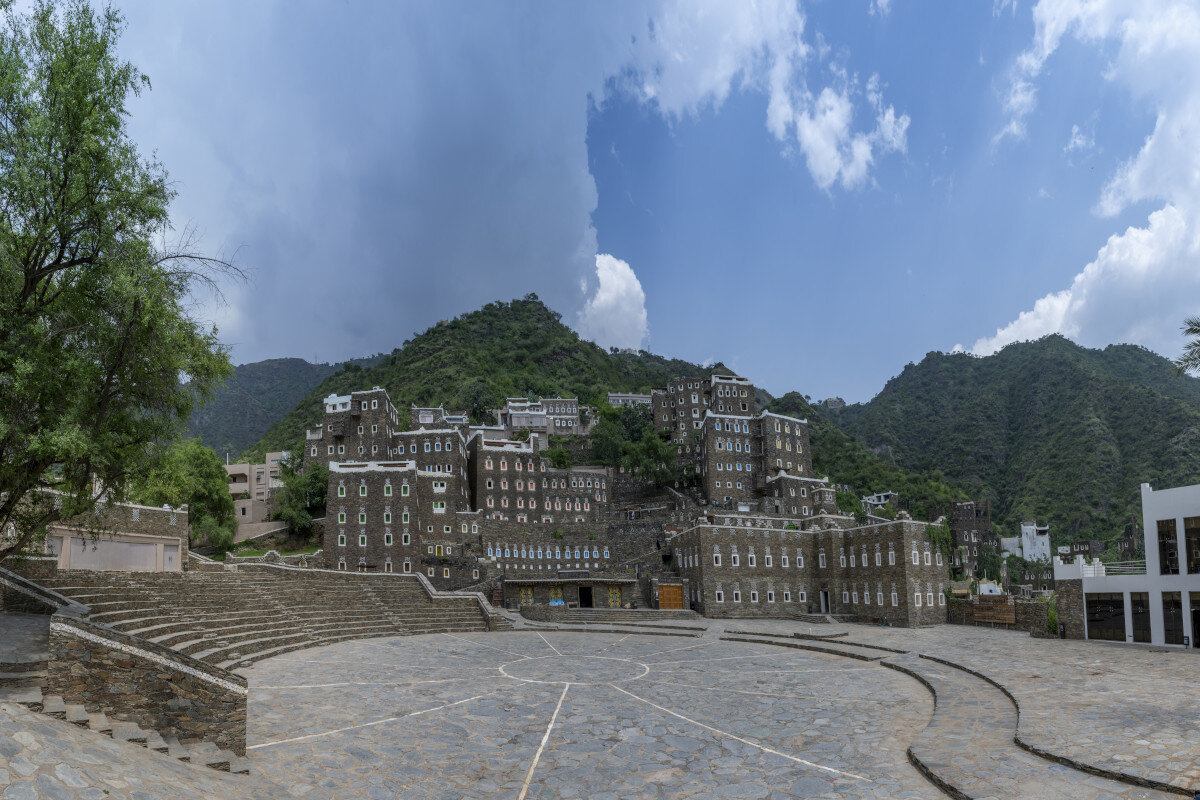
- Rijal Almaa Heritage Village — A restored stone village 45 km west of Abha, with original Al-Qatt murals preserved inside the museum houses. The village’s heritage museum (entry SAR 10) displays examples dating back several generations.
- Fatimah’s Museum of Aseeri Women’s Heritage, Abha — A private museum dedicated to Asiri women’s crafts, including painting demonstrations
- Shada Palace Museum, Abha — King Abdulaziz’s former southern residence, now a museum showcasing Asiri material culture including wall paintings
- Weight: A genuine hand-hammered dallah is heavier than a machine-pressed reproduction
- Seams: Handmade versions show visible soldering where the spout meets the body
- Lid hinge: Traditional dallahs have a chain or pin hinge, not a stamped-metal clip
- Finial: The decorative top piece (often bird or crescent-shaped) should be individually attached, not moulded in one piece
- Souq Al Zal — Riyadh’s oldest market, established in 1901 and covering 9.5 acres. The textile and antiques sections stock Sadu rugs, antique dallahs, Bedouin silver and carved wooden items. Friday afternoon is the liveliest trading session.
- Al-Thumairi Market — Adjacent to Souq Al Zal, specialising in handmade rosary beads (misbaha), spices, traditional coffee equipment and gold jewellery sold by weight.
- Souq Taibah — Embroidered cushion covers, beaded jewellery, woven carpets and abayas with handmade detailing.
- Saudi Scenes Gallery — A curated souvenir shop in Riyadh offering ceramics, pottery and craft items with Saudi themes.
- Souq Al Alawi — The largest souq in Saudi Arabia, selling Arabian carpets, spices, handicrafts, jewellery and traditional attire. Bargaining is expected.
- Souq Qabil — One of Jeddah’s oldest markets, a compact street under 100 metres long packed with vendors selling perfumes, textiles, gold trinkets and handmade accessories.
- Gabel Street Souq — Handmade bags, Middle Eastern spices, incense, oils and handicrafts.
- Dougha Pottery Factory — Hands-on pottery experience (see above)
- Qaisariah Market, Hofuf — A century-old covered market with narrow alleyways, wooden doors and artisans selling pottery, textiles, bishts and palm-woven goods. The architecture alone is worth the visit.
- Tuesday Market (Souq al-Thalatha), Abha — A weekly open-air market where highland artisans sell baskets, stone vessels, honey and woven goods
- Rijal Almaa Heritage Village — The village museum shop sells Al-Qatt-inspired pottery, postcards and painted woodwork
- Fragile items: Most pottery vendors will wrap purchases in newspaper and bubble wrap. For valuable pieces, carry them in your hand luggage.
- Antiques: Saudi Arabia restricts the export of items considered national heritage. If purchasing anything genuinely old — antique dallahs, Bedouin silver, old Sadu textiles — keep your receipt. Customs officials may ask for documentation.
- Oud and incense: Solid oud wood chips and bukhoor travel well in checked baggage. Oud oil (dehn al oud) must comply with airline liquid restrictions in carry-on.
- Saudi Arabia Travel Guide 2026 — The complete guide to visiting the Kingdom
- Saudi Arabia Shopping Guide — Best malls, souks and what to buy across the country
- Buying Oud in Saudi Arabia — The fragrance guide for first-time visitors
- Saudi Perfume Shopping — Oud, bakhoor and the best shops
- Jeddah Souq Guide — Best traditional markets to explore in Jeddah
- Saudi Dates Guide — Best varieties, where to buy and how to gift them
- Saudi Arabia Visa Guide — Every visa type explained
Tip: Genuine Sadu is heavy, tightly woven and slightly irregular. If a rug is perfectly uniform and lightweight, it is likely machine-made. Ask to see the reverse — handwoven Sadu looks almost the same on both sides.
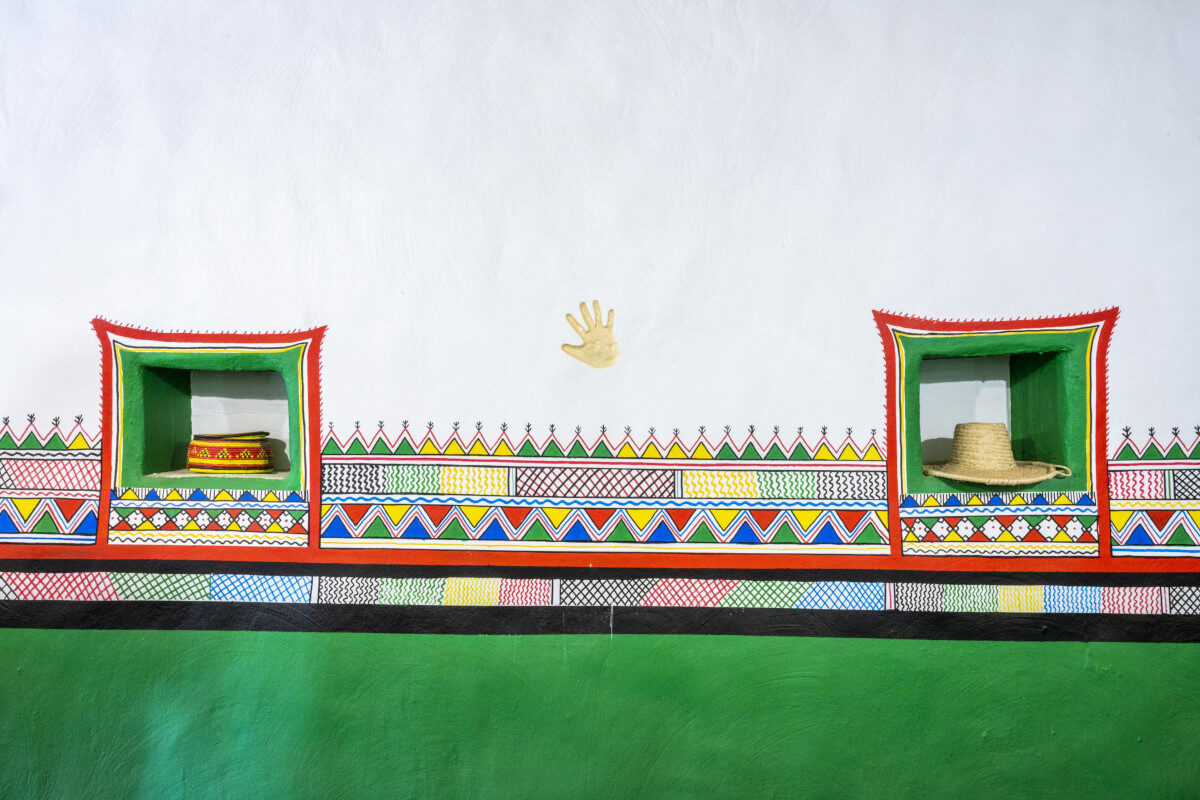
Al-Qatt Al-Asiri — The Painted Walls of the South
In the villages of Asir province, women have painted the interior walls of their homes with bold geometric designs for centuries. Known as Al-Qatt Al-Asiri, this practice was inscribed on UNESCO’s Intangible Cultural Heritage list in 2017. The paintings use bright primary colours — red, green, yellow, blue, black and white — applied freehand in bands of repeating patterns: triangles, diamonds, zigzags, tree forms and architectural outlines.
Traditionally, women repainted these murals for weddings, Eid celebrations and the arrival of guests. The patterns served as markers of taste, skill and social standing. Today, Al-Qatt motifs appear on everything from ceramic plates to fashion accessories, making them one of the most accessible Saudi crafts for visitors to purchase.
Where to See Al-Qatt Al-Asiri
Pottery and Ceramics
Saudi pottery is centred in the Eastern Province, where the clay-rich soils around Al-Ahsa’s oases have supported potters for over six centuries. The tradition is distinct from the painted ceramics of the Levant — Saudi pottery tends toward functional earthenware: water jugs (zeer), cooking pots, incense burners (mabkhara) and storage vessels.
Dougha Pottery Factory, Al-Ahsa
The Dougha Handmade Pottery Factory, located near Al-Qarah Mountain in the Eastern Province, is the most important pottery site in Saudi Arabia. Founded over 150 years ago, it has been operated by the same families for generations. The factory covers approximately 50,000 square metres and is open to visitors.
The experience is hands-on. Visitors watch the full production cycle — raw clay is shaped on kick-wheels, sun-dried in the courtyard, fired in traditional kilns, and hand-painted with geometric designs. You can try the potter’s wheel yourself and purchase finished pieces directly. Products range from small cups and incense burners (SAR 20–50) to large decorative vases and water storage vessels (SAR 200+).
Opening hours: Saturday to Thursday 8:00 AM – 12:00 PM and 4:00 PM – 8:00 PM; Fridays 4:00 PM – 8:00 PM.
Qassim Province Pottery
The agricultural heartland of Al-Qassim has its own pottery tradition, shaped by the region’s farming communities. Qassim pottery tends toward utilitarian pieces — irrigation channels, grain storage jars and date-drying trays — though modern potters also produce decorative items for the tourist market. The weekly markets in Buraidah and Unaizah are the best places to find Qassim ceramics.
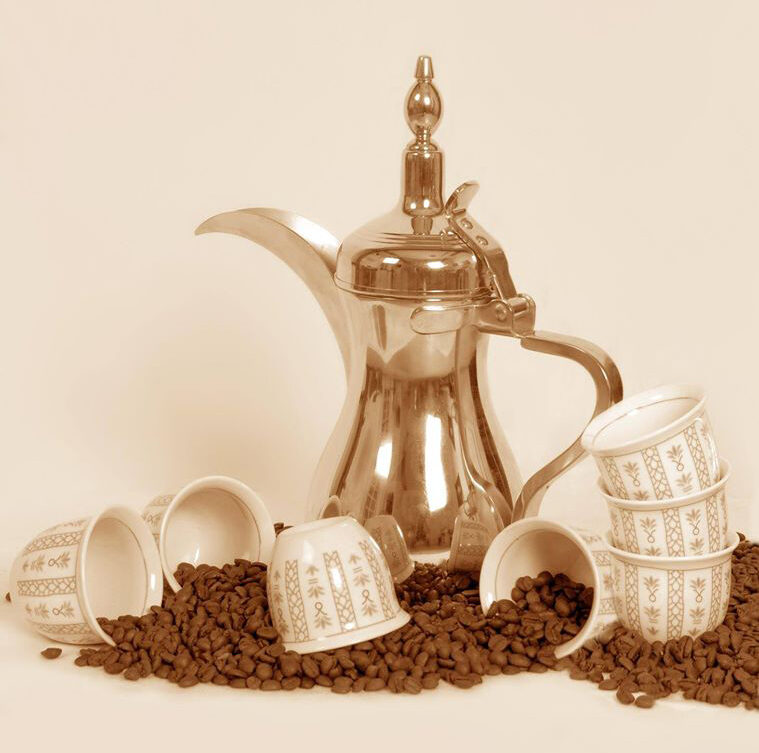
The Dallah — Saudi Arabia’s Iconic Coffee Pot
No Saudi handicraft is more recognisable than the dallah, the long-spouted coffee pot that has become a national symbol. The dallah appears on Saudi currency, in the national emblem and as a monumental sculpture at roundabouts across the Kingdom. For visitors, a handmade dallah is the quintessential Saudi souvenir.
Traditional dallahs are made from brass or copper, hammered by hand and often engraved with geometric patterns. The distinctive elongated spout is designed to pour Saudi qahwa — lightly roasted coffee spiced with cardamom — into small handle-less cups called finjal. Antique dallahs, identifiable by their patina and hand-forged irregularities, can sell for SAR 500–2,000+ in Souq Al Zal. New handmade versions typically run SAR 100–400.
What to Look For
Palm Weaving and Basketry
Saudi Arabia has over 30 million date palms, and their fronds have been woven into functional objects for millennia. Palm weaving (khoos) is one of the oldest crafts in the Arabian Peninsula, producing floor mats, food trays, storage baskets, fans, roofing material and decorative wall hangings.
The process involves harvesting young palm fronds, splitting them into strips, drying them in the sun, and weaving them by hand. Some artisans dye the strips with natural colours before weaving, creating patterns in the finished product. In Al-Ahsa, palm weaving is still practised widely — the Qaisariah Market in Hofuf sells palm baskets, trays and mats made by local artisans.
Palm-woven items make lightweight, affordable souvenirs. A small decorative basket costs SAR 30–80, while a full-size floor mat can run SAR 150–300.
Other Traditional Crafts Worth Knowing
Bisht Cloaks
The bisht is the gold-trimmed cloak worn over the thobe on formal occasions. Handmade bishts — particularly those from Al-Ahsa — are woven from fine camel hair or wool and edged with gold or silver thread (zari). A genuine hand-embroidered bisht can cost SAR 2,000–10,000+, and the best examples take weeks to finish. Al-Ahsa’s Qaisariah Market has been selling bishts for over a century.
Silver Jewellery
Bedouin silver jewellery — chunky bracelets, anklets, necklaces and hair ornaments — was traditionally a woman’s portable wealth, carried across migrations. Older pieces incorporate coral, turquoise, amber and carnelian. The best hunting grounds are Souq Al Zal in Riyadh and Souq Al Alawi in Jeddah, where vendors mix antique Bedouin pieces with newer reproductions.
Woodwork and Lattice Carving
Hejazi woodwork is most visible in the rawashin (projecting wooden window screens) of Jeddah’s Al Balad district, a UNESCO World Heritage site. While you cannot buy a rawashin, smaller carved wooden boxes, Quran stands and decorative panels are sold in Al Balad’s souqs. The craftsmanship involves teak or rosewood imported historically through the Red Sea trade.
Incense Burners (Mabkhara)
The mabkhara is the conical incense burner used to burn bukhoor (scented wood chips) in Saudi homes. Handmade versions come in carved soapstone, painted pottery or engraved metal. They are sold in every souq in the Kingdom and make excellent gifts, especially when paired with locally sourced bukhoor or oud wood chips.
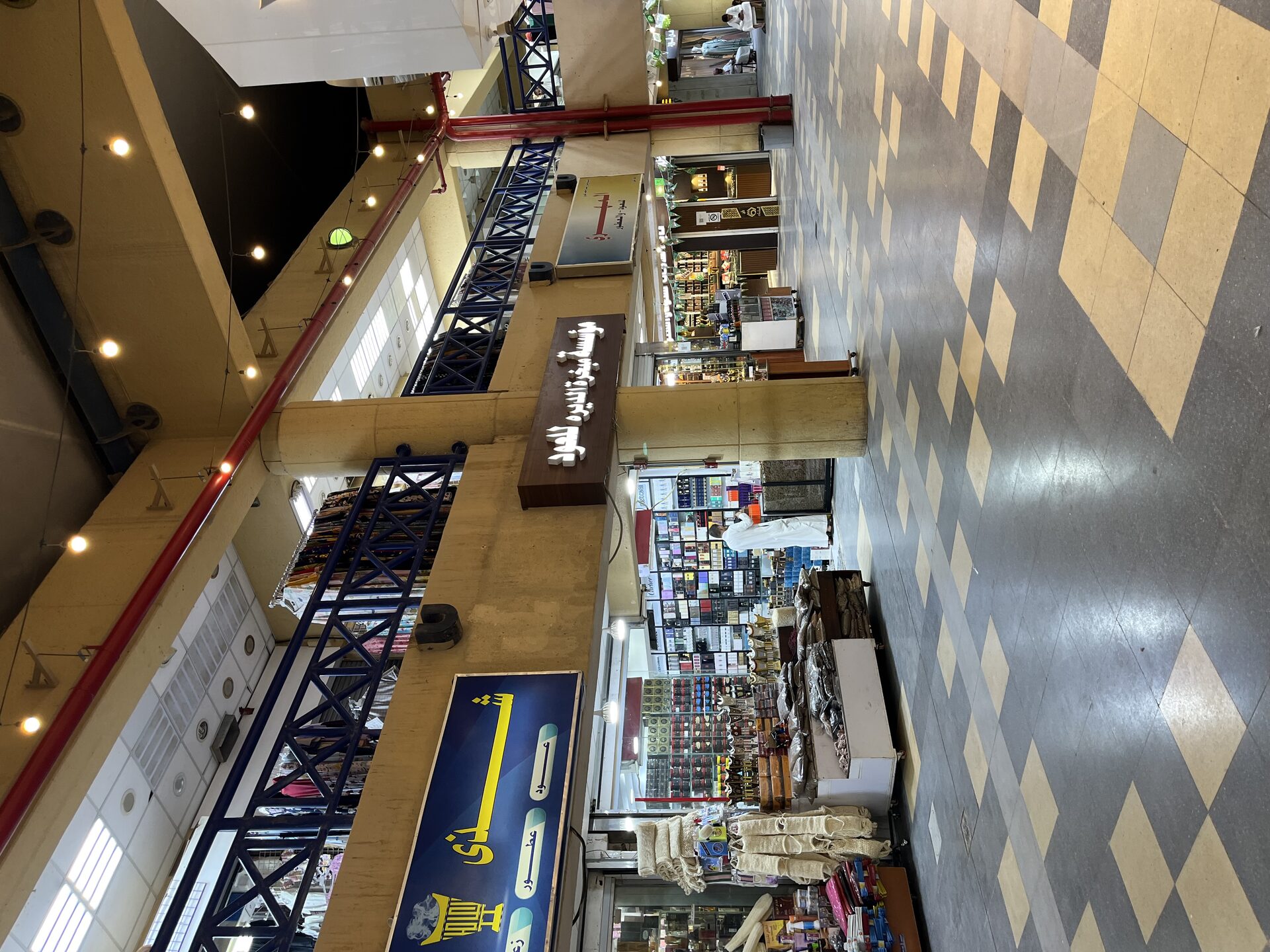
Where to Buy Handicrafts — City-by-City Guide
Riyadh
Riyadh offers the widest selection of handicrafts from across the Kingdom, concentrated in the historic Ad-Dirah district.
Jeddah
Jeddah’s Al Balad district has been a trading centre since the seventh century. Its UNESCO-listed coral-stone buildings and narrow alleyways create the most atmospheric handicraft shopping in the country.
Al-Ahsa (Eastern Province)
Al-Ahsa is a UNESCO Creative City and the best destination for pottery enthusiasts.
AlUla
The AlUla Old Town has been restored as a heritage and shopping destination, with over 70 stalls selling locally made pottery, Bedouin jewellery, handwoven textiles, incense, dates and citrus products from nearby farms.
Abha and Asir
The best region for Al-Qatt Al-Asiri painted crafts, woven baskets and stone utensils.
Taif
Taif’s Al-Balad Market has dedicated sections for pottery, woven baskets, traditional clothing and gold and silver jewellery. The city is also known for its rose products — rose water, rose oil and rose-scented soaps — which, while not strictly handicrafts, are handmade locally from Taif’s famous Damask roses.
The Year of Handicrafts and What It Means for Visitors
Saudi Arabia declared 2025 the Year of Handicrafts, a national initiative led by the Ministry of Culture through the Heritage Commission. The programme launched Artisan Houses — dedicated spaces for training, demonstration and sales — in cities including Riyadh, Jeddah and Al-Ahsa. The Nama Accelerator programme provides funding, mentorship and international exposure to help artisans build sustainable businesses.
For travellers in 2026, the practical impact is significant: there are more licensed workshops open to visitors, more live demonstrations at heritage sites, and more curated retail spaces where you can buy directly from makers. The annual Banan — Saudi International Handicrafts Week in Riyadh is the largest event, featuring live demonstrations in pottery, weaving, calligraphy, leather arts, perfume making and embroidery, alongside craft markets and cultural performances.
Practical Tips for Buying Saudi Handicrafts
| Craft | Price Range (SAR) | Best Location | What to Check |
|---|---|---|---|
| Sadu rug (small) | 200–800 | Souq Al Zal, Riyadh | Weight, tight weave, hand-spun yarn |
| Dallah (handmade) | 100–400 (new); 500–2,000+ (antique) | Souq Al Zal, Riyadh | Hand-hammered marks, soldered spout |
| Pottery piece | 20–200+ | Dougha Factory, Al-Ahsa | Kiln-fired, hand-painted |
| Palm basket/tray | 30–150 | Qaisariah Market, Hofuf | Tight weave, natural fibre smell |
| Bedouin silver | 150–1,500+ | Souq Al Alawi, Jeddah | Patina, stone quality, weight |
| Bisht cloak | 2,000–10,000+ | Qaisariah Market, Hofuf | Hand-stitched zari edging |
| Mabkhara (incense burner) | 30–200 | Any souq | Material (stone vs. pottery vs. metal) |
Bargaining: Haggling is expected in traditional souqs but not in curated retail shops or artisan houses. Start at roughly 60–70% of the quoted price and work toward a middle ground. Vendors in Souq Al Zal and Souq Al Alawi expect to negotiate.
Packing and Customs
Getting a Visa
Visitors from over 60 countries can obtain a Saudi tourist e-visa online before arrival. The visa is valid for one year with multiple entries and allows stays of up to 90 days per visit.