
Coffee is not a beverage in Saudi Arabia. It is a welcome, a conversation starter, a ceremony, and — since November 2022, when UNESCO inscribed Khawlani bean cultivation on the Representative List of the Intangible Cultural Heritage of Humanity — a formally protected cultural practice. If you arrive in the Kingdom expecting cappuccinos, you will find them everywhere. But alongside them you will find qahwa: a pale, golden, cardamom-scented brew poured from a long-spouted brass dallah into a tiny handleless cup, offered with dates before the first question is asked. This guide is part of our wider Saudi Arabia travel guide for 2026 and explains everything you need to drink coffee the right way in Riyadh, Jeddah and beyond — from the thousand-year-old rituals of the majlis to the third-wave specialty roasters redefining Arabica in 2026.
Best Time to Visit: Year-round; Ramadan and the post-sunset iftar hours are especially rich for coffee rituals
Getting There: Qahwa is served in homes, hotels, majlis rooms and every specialty cafe nationwide
Visa Required: Yes — tourist e-visa
Budget: Specialty pour-overs SAR 18–35 (US$5–10); qahwa free in hotel lobbies and majlis
Must-Try: Qahwa with dates in a majlis; a Khawlani single-origin at a Riyadh specialty roaster; iced V60 at Elixir Bunn or Camel Step
Avoid: Taking the cup with your left hand, refusing the first serving outright, or filling the finjan more than a third
What Saudi Coffee Actually Is
Saudi coffee — called qahwa (قهوة), sometimes transliterated as gahwa or kahwa — is a loose family of brews built on lightly roasted Arabica beans and ground cardamom. It is almost always pale gold or amber in the cup, never the dark espresso-brown most visitors expect. The low roast preserves the bean’s natural acidity and lets cardamom (hayl) sit forward on the palate instead of being masked by roast bitterness.
The basic ratio used across the Kingdom is remarkably consistent: roughly 40 grams of ground coffee to 30 grams of ground cardamom per 800 ml of water, simmered — never boiled violently — and served strained. Beyond that, the recipe varies by house and by region. Some families add a few strands of saffron for colour and perfume; others whole cloves, a splinter of cinnamon bark, a whisper of ground ginger, a pinch of fennel seed, or a drop of rose water. Sugar is rarely added to the pot. Sweetness arrives separately, in the form of fresh or semi-dried dates eaten between sips.
Crucially, qahwa is a different animal to the Turkish coffee (sometimes also called qahwa turkiyya) you will meet across the wider Arab world. Turkish coffee is dark, unfiltered, and served with its grounds settled at the bottom of the cup. Saudi qahwa is light, strained clear, and built on the aromatic — not the bitter — side of the bean.
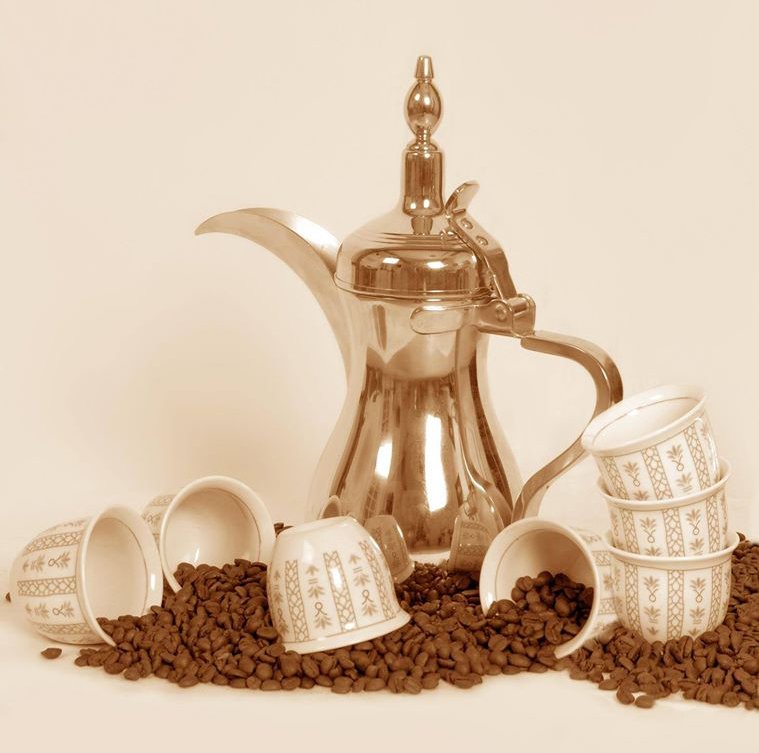
The Ritual — How Qahwa Is Served
The serving of qahwa is a piece of choreography that predates Saudi Arabia itself. It goes back centuries, through Bedouin encampments and Hijazi trading towns, and it is performed today in royal palaces, provincial government majlis rooms, ordinary family homes, and the foyer of every five-star hotel in Riyadh.
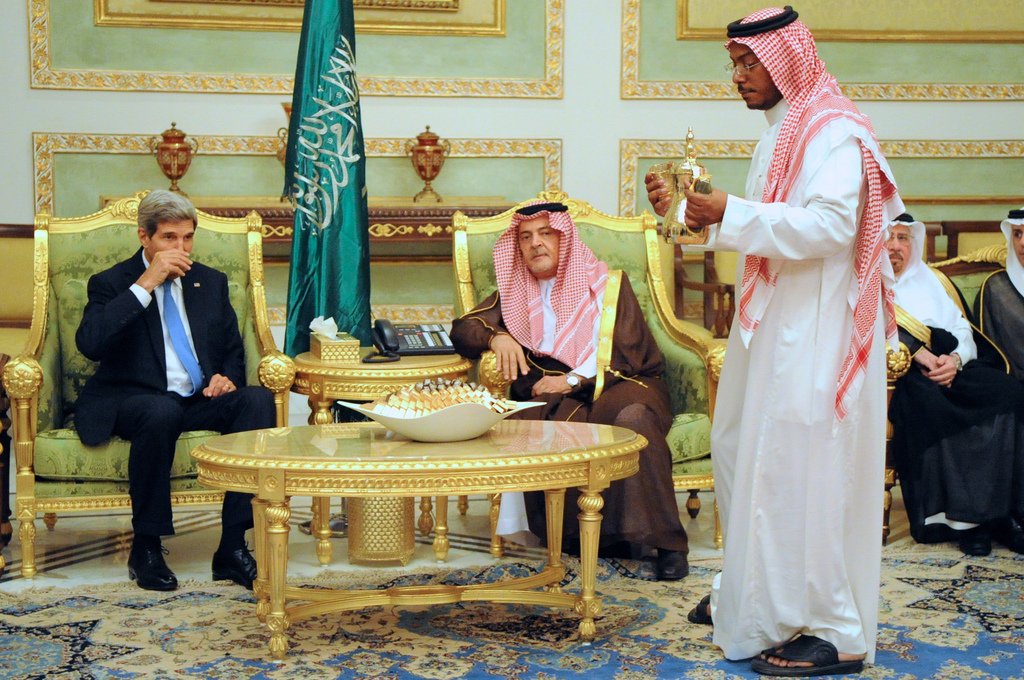
A correct serving goes roughly like this. The host — or a designated server — stands beside the seated guests, holding the dallah (the brass or silver pot with its distinctive curved spout) in the left hand and a stack of nested finjan cups in the right. The server pours each cup in a standing position, starting with the guest of honour or the eldest present, then proceeds clockwise or to the right around the room. The cup is never filled more than a third full. Filling it further signals either inattention or, worse, a desire to get rid of the guest quickly — both catastrophic breaches of karam, the Arabic code of hospitality.
The guest accepts the cup with the right hand. Using the left hand is a minor scandal. Three cups is the traditional arc: the first drunk for pleasure, the second for friendship, and the third for honour (some families frame this as flavour, reflection, and blessing — the numbers matter more than the precise wording). When you have had enough, you do not ask the server to stop and you do not set the cup down empty. You hand it back with a small side-to-side shake of the wrist, and the server will move on.
UNESCO inscribed Arabic coffee as "a symbol of generosity" on the Representative List of the Intangible Cultural Heritage of Humanity in 2015. The listing — a joint submission by Saudi Arabia, the United Arab Emirates, Oman and Qatar — explicitly recognises the serving ritual, not just the drink.
The Majlis Setting
The natural home of qahwa is the majlis (مجلس) — literally "a place of sitting". In traditional Saudi homes the majlis is a long reception room lined with floor cushions and low cushioned benches, often carpeted with Persian or Najdi weaves, with incense burners smoking at the corners. It is the room where guests are received, where marriages are negotiated, where business is settled, and where tribal disputes are historically resolved. The coffee is the connective tissue of all of this. UNESCO inscribed the majlis itself — as a cultural space — on its heritage list in 2015 alongside the coffee.
Most visitors will encounter a modern, hotel-scale version of the majlis on arrival at a five-star property or when invited into a Saudi home. The dallah and the dates will always be there.
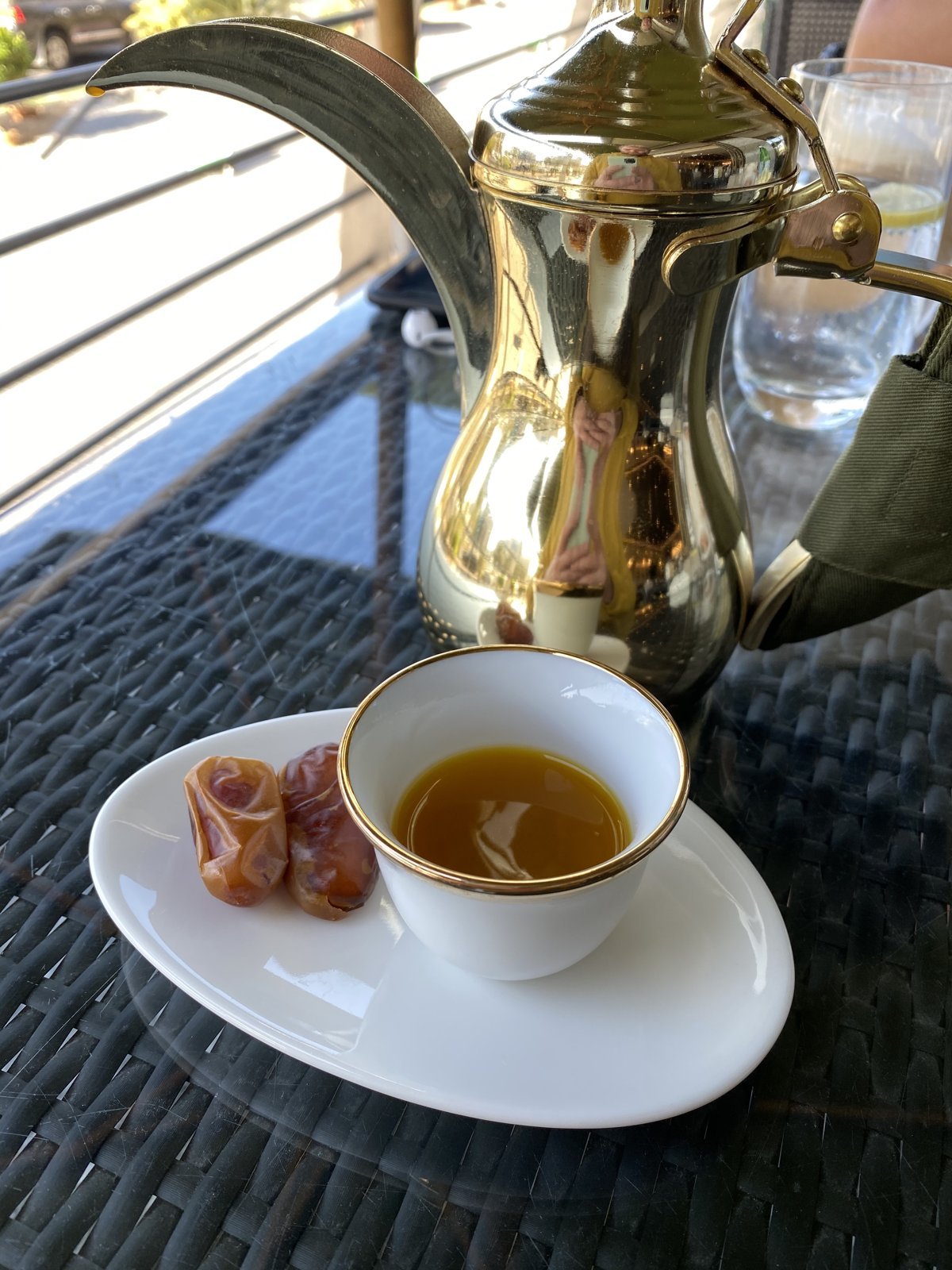
The Equipment — Dallah, Finjan, Mihbaj
Three pieces of equipment define traditional Saudi coffee, and all three are still in everyday use across the Kingdom.
The dallah is the brass or silver long-spouted pot that holds the brewed coffee. A classic dallah has a bulbous body, a tall finial lid, a curved handle, and the distinctive crescent-moon spout that lets the coffee pour in a controlled, narrow stream. Dallah sets come in graduated sizes. A large ceremonial dallah may hold 3 litres and is used to brew for the majlis; smaller pots of 500 ml to 1 litre are used to serve. A silhouetted dallah is one of the most common motifs in Saudi design — you will see it on roadside sculptures, the 200-riyal banknote of earlier eras, hotel signage, and coffeehouse logos nationwide.
The finjan (sometimes finjaan or fingaan) is the small handleless cup you drink from. It holds only a few sips by design — the small volume is a deliberate signal of humility and of the host’s intent to keep pouring. Traditional finjans are plain white porcelain, often with a slim gold band. Antique hand-beaten copper finjans still turn up in souk stalls across Jeddah and Riyadh.
The mihbaj is the mortar-and-pestle used to pulverise roasted beans. Bedouin mihbajs were carved from hardwood or hollowed camel bone. Urban households and hotels in 2026 mostly use modern grinders, but ceremonial mihbajs are still passed down as heirlooms and are played rhythmically at weddings — the pestle strikes the mortar in a recognisable cadence that announces a guest’s arrival.
Regional Coffee Recipes Across Saudi Arabia
Saudi Arabia is geographically vast, and the qahwa pot reflects that. The ratio stays roughly fixed, but the spice blend shifts as you travel.
| Region | Roast colour | Typical spices | House character |
|---|---|---|---|
| Najd (Riyadh, central Kingdom) | Light to golden | Cardamom; occasional cloves, saffron | Restrained, aromatic, the default "Saudi qahwa" served in palaces |
| Hejaz (Jeddah, Mecca, Medina) | Light | Cardamom, ginger, occasional rose water | Slightly spicier; influenced by pilgrim-route trading and Yemeni coffee |
| Asir and Jazan (southwest) | Very light | Cardamom, cinnamon, cloves, ginger, fennel, saffron, mastic | The broadest spice blend in the Kingdom; often noticeably yellow |
| Eastern Province (Dammam, Hofuf, Al Ahsa) | Medium-light | Cardamom, saffron | Drier, cleaner profile; served with local Khalas dates from Al Ahsa |
| Northern provinces (Tabuk, Hail) | Light | Cardamom, sometimes cloves | Bedouin-inflected; often prepared over open flame |
A visitor who drinks qahwa at a Riyadh hotel, a Jeddah heritage house and a Jazan mountain lodge will notice genuine differences, not just house quirks. Southern blends in particular can taste almost curry-like to an uninitiated palate — that spice density is deliberate, not a slip.
Khawlani Beans — Saudi Arabia’s UNESCO Coffee
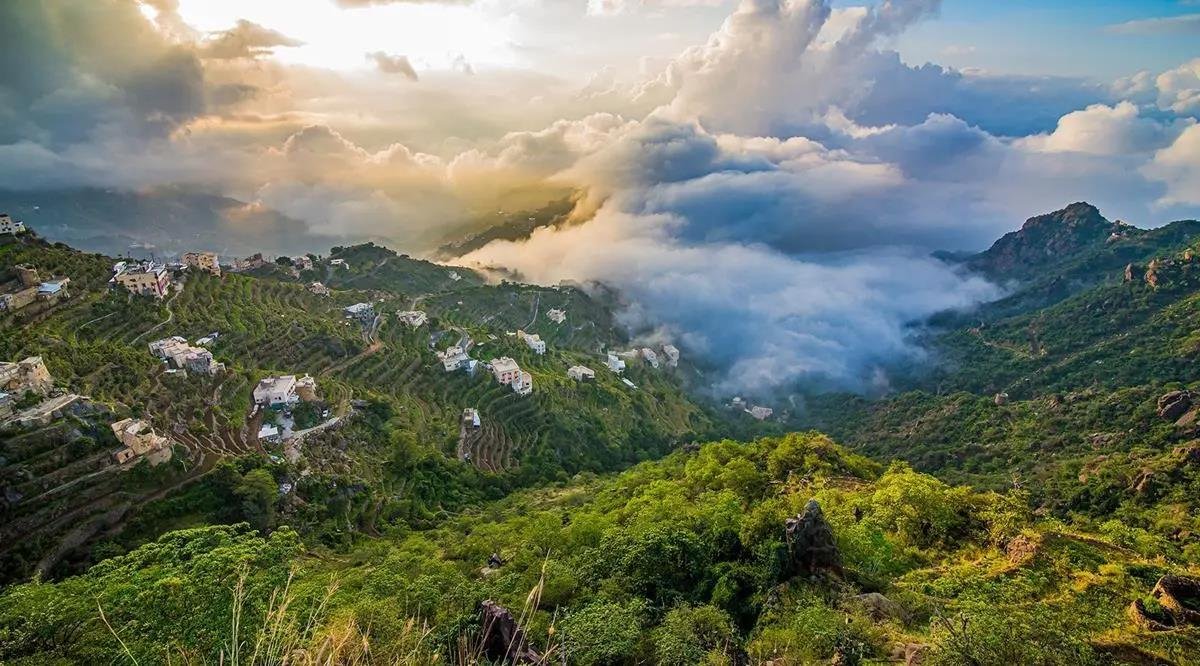
The most consequential event in Saudi coffee in the past decade happened on 30 November 2022, when UNESCO’s Intergovernmental Committee added "Knowledge and practices related to cultivating Khawlani coffee beans" to the Representative List of the Intangible Cultural Heritage of Humanity. The inscription recognised more than eight centuries of coffee cultivation in the Sarat Khawlan mountains of the Jazan region in Saudi Arabia’s southwest, where Khawlani tribes have been terracing hillsides and growing Arabica at altitudes between 900 and 2,000 metres.
The Jazan growing region is the only place on the Arabian Peninsula with the altitude, the rainfall and the cool-season temperature swings Arabica demands. The small farms there — many still worked by hand, the beans sun-dried on rooftops — produce what is now classified and marketed as Khawlani coffee. It is distinct from Yemeni Mokha coffee across the southern border, though the two share a common ancestor.
What makes Khawlani interesting to visitors in 2026 is that it has finally broken out of tribal and regional circulation. Specialty roasters in Riyadh and Jeddah now carry single-origin Khawlani bags, the Saudi government has subsidised cooperative processing infrastructure in Jazan, and festival events in the Fayfa highlands draw roasters and buyers from across the Gulf every autumn. If you want to taste the Kingdom’s own bean, the specialty cafes listed further down are your best route.
The Year of Saudi Coffee — 2022 and What Changed
In February 2022, the Saudi Ministry of Culture and the Culinary Arts Commission jointly designated the year as the Year of Saudi Coffee, under the Vision 2030 Quality of Life Program. Two practical decisions came out of that initiative and they shape what you will see on cafe menus today.
First, the Ministry issued guidance (and the Culinary Arts Commission followed up) that "Arabic coffee" on menus within the Kingdom should, where appropriate, be relabelled Saudi coffee. That is why you will see menus in Riyadh and Jeddah offering a "Saudi coffee" alongside espresso-based drinks — it is the same qahwa, reframed under Saudi national branding.
Second, funding and programming went into supporting Khawlani cultivation, training baristas, and promoting the cafe sector as a tourism and cultural asset. A great deal of the modern specialty coffee boom you will experience on the ground — the third-wave pour-over bars, the single-origin menus, the nitro cold brews in Riyadh — traces its acceleration back to that 2022 policy push.
The Kingdom now consumes roughly 36 million cups of coffee a day — about 13 billion cups a year across a population of just over 33 million. The domestic cafe market is valued at US$4.5–5 billion and has been growing at 10–12 percent annually. That growth is not driven by international chains (though Starbucks and Costa are everywhere). It is driven by homegrown Saudi brands.
Saudi Arabia’s Modern Specialty Coffee Scene
If qahwa is the ritual half of Saudi coffee, the specialty cafe sector is the contemporary half — and it is genuinely one of the most dynamic in the world right now. The third-wave movement arrived late in the Kingdom (roughly a decade after London, Melbourne and Portland) but it arrived with capital, ambition, and a strong homegrown identity. Visitors used to Dubai’s cafe scene are often surprised at how much deeper and more design-literate the Riyadh and Jeddah cafes now are.
Riyadh
Riyadh is the centre of gravity for specialty coffee in Saudi Arabia. The scene runs roughly from the Al Nakheel and Al Olaya districts through King Abdullah Financial District (KAFD), Diriyah, and the leafy compounds of northern Riyadh. The anchor names to know:
- Elixir Bunn Coffee Roasters — opened 2014 in Al Nakheel, widely credited as the first true specialty roaster in Riyadh. Minimalist interior, well-trained baristas, single-origins rotating from Ethiopia, Colombia and Khawlani. The long-running reference point for the city’s scene.
- Camel Step Coffee Roasters — a pioneer of sourcing and roasting Saudi and Yemeni beans, with strong design identity and outlets across Riyadh and Jeddah. The name references the measured pace of a crossing camel — a deliberate counterweight to global chain speed.
- Half Million — launched in 2018 and now close to a cultural phenomenon; the name refers to the number of coffee varieties the founders are chasing. Outlets sprawl from Riyadh across the Kingdom and into the wider Gulf.
- Barn’s (sometimes styled Barns) — the Saudi-born mass-market specialty brand, now past 800 outlets nationwide and still expanding. Not third-wave pure but a genuine local success story.
- Nabt Fnjan — a fast-growing specialty chain with a flower-farmhouse aesthetic; smaller footprint than the giants but known for strong house blends.
For visitors staying downtown, Riyadh’s cafe density makes it easy to hop between three or four serious places in an afternoon. Pair a morning qahwa at a heritage restaurant in Diriyah or historic Riyadh with an afternoon V60 at Elixir Bunn — a city tour in two brews.
Jeddah
Jeddah’s cafe scene has a different flavour: closer to the Red Sea, more influenced by Hijazi trading history, and with a stronger pastry culture layered in. Brew92 is the widely cited anchor — an urban specialty concept with strong third-wave credentials, multiple outlets across Jeddah, and a reputation for consistent espresso. Camel Step, Half Million and Elixir Bunn all maintain Jeddah branches. Heritage-era cafes in the Al-Balad old town serve Saudi qahwa and Turkish coffee side-by-side; the district’s UNESCO-listed coral-stone houses make a strong morning walk. A well-planned Jeddah itinerary will build at least two proper coffee stops in.
Dammam, Al Khobar and the Eastern Province
The Eastern Province has developed its own specialty cafe culture — less publicised than Riyadh, but substantial. Al Khobar and Dammam support a dense corniche cafe strip, and Al Ahsa’s oasis town layers in date-growing tradition with coffee service (Al Ahsa is famous for its Khalas and Shaishi date varieties, both superb qahwa pairings). Camel Step and Barn’s are well represented, alongside independent shops. The corniche cafes are especially pleasant for evening coffee in winter. See our wider Dammam and Al Khobar travel guide for neighbourhood context.
AlUla, Abha and the Regional Scene
AlUla’s tourism build-out has come with a curated selection of cafes inside the old town and the Ashar Valley heritage zone — a blend of specialty coffee, wood-fired pastries and heritage-style qahwa served in restored mudbrick houses. Abha and the Asir highlands are worth seeking out for regional-style qahwa served with the full southern spice blend; several highland farmstay guesthouses now roast their own beans on-site. Our AlUla travel guide and Abha and Asir travel guide cover the broader food-and-drink context for those regions.
How to Experience Saudi Coffee as a Visitor
Four routes give you the complete picture of Saudi coffee in a week-long visit.
1. The hotel arrival ceremony. Every major Saudi hotel — Four Seasons Riyadh, Ritz-Carlton Riyadh, Jeddah Rosewood, AlUla Our Habitas, the Assila in Jeddah — greets arriving guests with a dallah, three finjans poured in sequence, and a plate of dates. This is the single most accessible exposure to the ritual and it costs nothing.
2. A heritage restaurant meal. Restaurants serving traditional Saudi cuisine — Najd Village (Riyadh), Al Nakheel (Riyadh), Byblos Najdi (Riyadh), and multiple heritage houses in Jeddah’s Al-Balad — include qahwa as a matter of course after the meal. Order a traditional Saudi kabsa or mandi, and qahwa will follow automatically, poured by a server in traditional dress.
3. A specialty roaster. Book an hour at Elixir Bunn, Camel Step or Brew92 and ask for the single-origin pour-over menu. If you request a Khawlani specifically, good baristas will walk you through the bean’s cultivation region, processing method and flavour notes. Many roasters offer brewing classes to visitors — a worthwhile two-hour experience for any coffee-curious traveller.
4. A majlis invitation. The gold standard. If you are invited to a Saudi home, you will be served qahwa in a traditional majlis setting, usually with dates and often with kleeja (cardamom-and-date biscuits, a northern Saudi classic) or modern sweets. Accept the first cup. Drink it. Take the second if offered. A refusal of the first cup after an invitation is a significant breach of hospitality — if you genuinely cannot drink coffee, accept the cup and sip once as a gesture.
Saudi Coffee Etiquette for Travellers
The etiquette is simple once learned, but learning it matters. A summary you can use in the moment:
- Take the cup with your right hand. Never the left. This is the single most important rule.
- Accept at least one cup. Refusing the first serving outright is read as a refusal of hospitality. If you do not drink coffee, accept and sip ceremonially.
- Do not ask for sugar or milk. Qahwa is unsweetened. Dates provide the sweetness. Asking for sugar is read as a criticism of the coffee.
- Shake the cup to signal "no more". Hand the empty cup back with a small side-to-side wrist shake and the server will move on. A cup returned still upright and still means "pour again".
- Three cups is the social arc. Beyond three, you will be seen to be pushing the host’s generosity — a compliment in some contexts and an imposition in others. Read the room.
- Respect the pouring order. Do not reach for a cup before the guest of honour or the eldest has been served. The server sets the sequence.
- Compliment the coffee, not the server. The correct phrase is "qahwa taybah" (the coffee is good) or "ma sha Allah". Complimenting the server individually can be awkward.
Tip: In formal Saudi settings, incense (bakhoor or oud) is often burned during or after the coffee service. The polite response is to waft the smoke briefly over your robes, hair and beard as a blessing, then pass the burner on to the next guest. You do not have to do this, but acknowledging it with a small hand gesture is appreciated.
What to Pair with Qahwa
Qahwa is a drink designed to be paired. The classic accompaniments you will encounter are:
- Dates (tamr) — always. Saudi Arabia produces roughly 1.5 million tonnes of dates a year and Al Ahsa’s Khalas, Qassim’s Sukkari, and Medina’s Ajwa are the headline varieties. Ajwa in particular is a traditional Ramadan and qahwa pairing.
- Kleeja — cardamom-and-date biscuits with a crumbly texture, originally from Qassim and the northern provinces. The bitterness of the qahwa and the dense sweetness of kleeja are the archetypal contrast.
- Ma’amoul — semolina-flour cookies stuffed with dates, walnuts or pistachios; more common during Eid.
- Nuts and dried fruit — mixed bowls of almonds, cashews, pistachios and dried apricots are common in a majlis.
- Fresh fruit — in modern Saudi homes, sliced oranges, pomegranate seeds and persimmons often appear alongside the dates.
In a good specialty cafe, the modern reinterpretation pairs a Khawlani pour-over with a date-and-tahini tart or a saffron-pistachio Basbousa. A qahwa-dates set at a heritage restaurant runs SAR 15–30 (US$4–8) per person and is a worthwhile way to close a meal of mandi, kabsa or a traditional Saudi breakfast.
Practical Tips for Visiting Cafes in Saudi Arabia
Payment and pricing
Specialty pour-overs run SAR 18–35 (US$5–10). Espresso-based drinks are SAR 14–22 (US$4–6). House qahwa in a hotel or restaurant is usually complimentary; in a dedicated Saudi coffee house, a qahwa-and-dates set runs SAR 15–35. All specialty cafes accept Mada, Apple Pay and major international cards; cash is rarely needed.
Opening hours
Saudi cafes tend to open late (07:30–10:00) and stay open very late. It is entirely normal for specialty roasters to be at full capacity at 23:00. Friday mornings are quiet across the Kingdom because of Friday prayers (Jum’ah); most cafes reopen after Dhuhr prayer around 13:30. During Ramadan, cafes are closed during daylight hours and open from sunset (Maghrib) through to the small hours.
Seating and gender arrangements
Saudi Arabia has substantially liberalised cafe seating over the past five years. Most specialty cafes in Riyadh, Jeddah, Al Khobar and AlUla are single-area (mixed) seating by default. Some traditional establishments still maintain separate family sections. Female solo travellers are welcome in all specialty cafes without issue.
Coffee to take home
Most specialty roasters sell 250 g and 500 g bags of whole bean and ground coffee. Khawlani single-origin bags typically run SAR 75–150 (US$20–40) per 250 g and make a genuinely distinctive gift. A traditional dallah-and-finjan set from a souk (Souq Al Zal in Riyadh, Al-Balad souks in Jeddah) runs SAR 200–800 (US$55–215) depending on metal and size. Check your airline’s liquid restrictions — ground coffee travels fine in checked luggage.
Getting around and language
English is spoken at effectively every specialty cafe in the major cities. Qahwa-only establishments in smaller towns may be Arabic-first; basic phrases help. All tourist visitors need a valid tourist e-visa — see our Saudi Arabia visa guide for eligibility, costs and current processing times. Uber and Careem run in every major city.
Ramadan tip: If you are visiting during Ramadan, do not try to buy coffee during daylight hours. Cafes are closed. But from sunset onward, the Kingdom transforms: majlis rooms fill, dallahs come out, and cafe queues stretch around the block. The post-Maghrib hours are arguably the single best time to experience Saudi coffee culture at full intensity.
A Brief History of Coffee on the Arabian Peninsula
Coffee’s route into the Arabian Peninsula runs through Yemen. The bean arrived from the Ethiopian highlands sometime before the 15th century and by the 1500s was being cultivated at scale in the Yemeni highlands and exported through the port of Mokha — the name that still attaches to a certain style of Arabica. From Mokha the trade spread north along the Red Sea, across the peninsula, and into the Hijazi cities of Mecca and Medina, where it became associated with pilgrimage-era trading and Sufi devotional practice.
The Khawlani region of what is now Jazan province began cultivating Arabica sometime in the same window. Scholars consulted during the 2022 UNESCO inscription process placed the tradition at more than eight centuries old. The Khawlani tribes terraced the mountain slopes, developed processing techniques adapted to the short rainy season, and passed on cultivation knowledge through extended family networks. That continuity of practice — more than the bean itself — is what the UNESCO listing protects.
Saudi Arabia’s coffee culture today sits in a double inheritance: Yemeni Arabica and the trade routes that moved it, plus the indigenous Khawlani growing tradition that quietly persisted through centuries in the southern mountains. The specialty coffee boom of the 2020s is the third layer — cosmopolitan, technically sophisticated, and increasingly defined by pride in the Kingdom’s own bean.
Where Saudi Coffee Culture Is Going
Three trends are reshaping the sector in 2026.
Khawlani at export scale. Subsidised processing infrastructure in Jazan and formal GI (geographical indication) protection are pushing Khawlani into Dubai, London and Tokyo specialty markets for the first time. Expect to see Khawlani on European specialty menus within two to three years.
Barista training as a national priority. The Culinary Arts Commission has expanded SCA-accredited barista qualification centres across Riyadh, Jeddah and Dammam. A generation of Saudi baristas is now coming through formal training, which is visible in cup quality.
Qahwa in luxury hospitality. The new wave of Red Sea resorts — AMAALA, Sindalah, Shebara on Shura Island — and AlUla’s Banyan Tree, Chedi, and Our Habitas properties have all invested in majlis-style qahwa presentation as a signature. If you stay at any of these, expect the coffee ceremony to be front-and-centre of the arrival experience.
For travellers, the bottom line is this: you no longer need to choose between "traditional Saudi coffee" and "specialty coffee". The Kingdom in 2026 delivers both, often in the same venue, and increasingly with the same bean.
Explore More Saudi Arabia Travel Guides
- Saudi Arabia Travel Guide 2026 — The complete guide to visiting the Kingdom, from visas to itineraries
- Saudi Arabian Breakfast Guide — What to eat and where across the Kingdom
- Saudi Kabsa Guide — The national dish explained, with where to eat the best version in every city
- Saudi Mandi Guide — Best mandi restaurants by city, Hadhrami origins, Yemeni-Saudi variations
- Riyadh Street Food Guide — Where to find the best street-level eating in the capital
- Jeddah Street Food Guide — Kabsa, mutabbaq and the Hijazi food scene
- Saudi Arabia Visa Guide — Every visa type explained, current fees, processing times