
Perched atop a white marble cliff in the Al Bahah highlands of southwestern Saudi Arabia, Thee Ain (also written Dhee Ayn or Zi Ain) is one of the Kingdom’s most visually striking heritage villages. Built roughly 400 years ago from volcanic stone quarried from the surrounding Sarawat Mountains, this cluster of 49 multi-storey structures cascades down a rocky outcrop above lush banana plantations and a natural spring. As part of a broader Saudi Arabia travel itinerary, Thee Ain offers an extraordinary window into the tribal architecture, water engineering, and daily life of the Zahran people long before modern urbanisation reshaped the region. The village sits on the UNESCO World Heritage Tentative List, and a multi-million riyal restoration programme is steadily transforming it into one of the southwest’s premier cultural destinations.
Best Time to Visit: October to April (15–25 °C daytime)
Getting There: 24 km from Al Bahah city, 40-minute drive via the scenic Al Aqabah mountain road
Visa Required: Yes — tourist e-visa available online
Budget: Free admission; day trip from Al Bahah costs USD 30–60 including fuel and meals
Must-See: The marble cliff panorama, the restored mosque, the banana plantation oasis
Avoid: Arriving after 3 PM — the sun drops behind the mountains early, cutting light and photo opportunities short
History of Thee Ain Village
Thee Ain dates to approximately the 10th century AH (roughly the 16th century AD), making its oldest structures around 400 years old. The village takes its name from the Arabic word ain — meaning spring or eye — after the natural freshwater spring that flows from the mountains through the settlement, sustaining terraced agriculture on the slopes below.
The Zahran tribe, one of the two dominant tribal confederations of the Al Bahah region alongside the Ghamid, built and inhabited Thee Ain for centuries. The village’s elevated position atop a marble cliff was no accident: it provided a natural defensive advantage. Small window openings in the thick stone walls served the dual purpose of admitting light while confusing would-be attackers about the internal layout of each building. Fortified watchpoints crowned the highest elevations, and the single narrow access corridor made the settlement remarkably defensible.
Ottoman-era Conflict
The village witnessed significant conflict when the combined forces of the Zahran and Ghamid tribes clashed with the Ottoman Turkish army during the campaigns of Muhammad Ali Pasha. Turkish graves from this period remain in the village and its surroundings — a tangible reminder of the fierce resistance the highland tribes mounted against imperial encroachment. The region was not fully pacified until the unification of the Kingdom under King Abdul Aziz Al Saud in the early 20th century.
Abandonment and Rediscovery
Like many heritage villages across Saudi Arabia, Thee Ain was gradually abandoned from the 1980s onward as residents migrated to modern towns with better infrastructure, services, and employment. By the early 2000s the village stood empty, its stone structures slowly deteriorating. Recognition of its heritage value has since reversed that trajectory: the Saudi Heritage Commission allocated SR 16 million (approximately USD 4.27 million) for a phased restoration programme, and the village was placed on the UNESCO World Heritage Tentative List — a critical step toward potential full inscription.
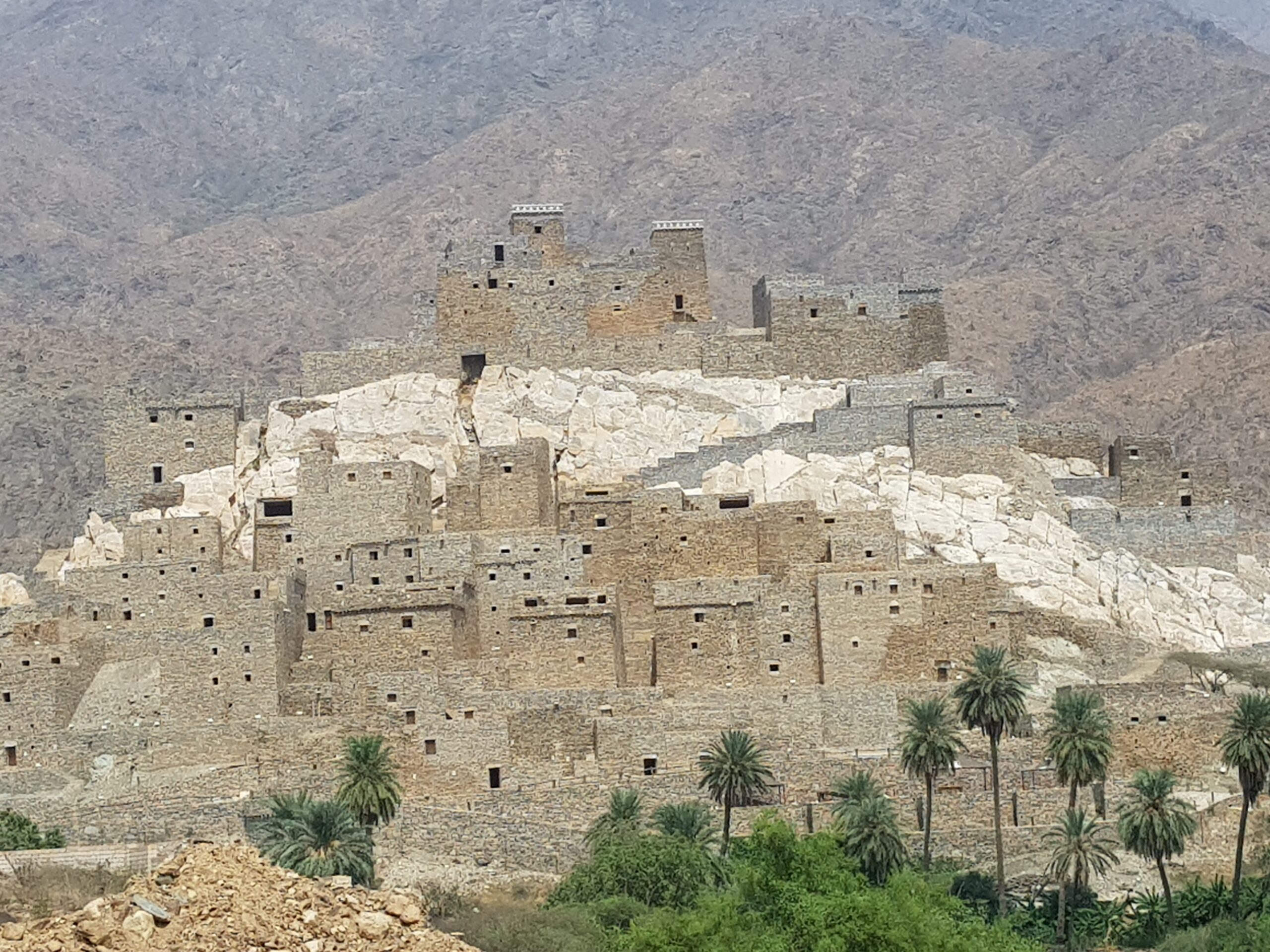
Architecture: The Marble Village
Thee Ain is often called the “Marble Village” because of the striking white marble cliff on which it sits. The buildings themselves are constructed from polished volcanic rock and granite quarried from the surrounding mountains, with quartz-covered exterior walls that catch the light at different angles throughout the day.
Building Design
The village covers an area of approximately 15,350 square metres and contains 49 structures of varying heights:
| Building Type | Count | Notes |
|---|---|---|
| Single-storey | 9 | Storage, livestock, service buildings |
| Two-storey | 19 | Standard family dwellings |
| Three-storey | 11 | Extended family homes with reception rooms |
| Four-storey | 10 | Prominent family residences and defensive towers |
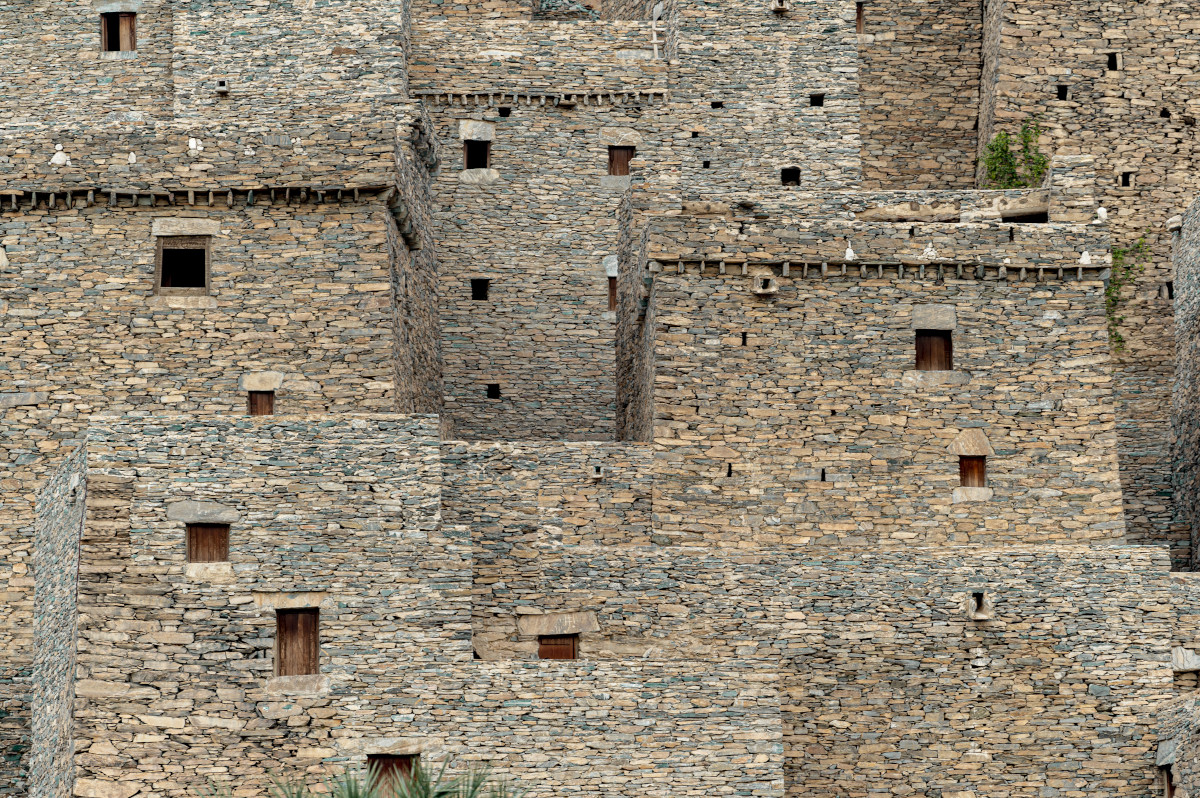
The walls are 70–90 cm thick, built using a load-bearing system called Madamek. Each wall narrows by roughly 18 cm per storey as it rises, creating the distinctive tapered or pyramidal profile visible across the village skyline. This technique enhanced structural stability without requiring complex buttressing. Roofing uses beams of Sidr (jujube) wood, topped with flat stone slabs called Salat, then sealed with mud. Interior columns known as al-zafer support upper floors, and a decorative “prayer stone” above the main Sidr beam marks each entrance.
This style of construction is characteristic of traditional architecture in Saudi Arabia’s southwestern highlands, where stone was abundant and the steep terrain demanded creative engineering solutions.
Water Engineering
The village’s namesake spring feeds an ingenious network of stone-lined channels that distribute water through terraced agricultural plots below the settlement. These channels irrigated banana, lemon, basil, palm, pepper, and kadi (an aromatic plant) plantations — a remarkable feat of hydro-engineering at altitude. The lush green oasis directly below the stark stone village creates one of the most photographed contrasts in Saudi Arabia.
What to See at Thee Ain
The Restored Mosque
Located in the central area of the village adjacent to the spring channel, the old mosque has been reopened as part of the restoration programme. Its simple stone construction and small prayer hall reflect the understated religious architecture of highland tribal communities — a world away from the grand mosques of the Hejaz cities. The mosque’s rooftop offers one of the best vantage points in the village.
The Banana Plantation Oasis
Below the marble cliff, the spring-fed oasis supports dense banana plantations that remain productive today. An outdoor café in the oasis area allows visitors to sit amid the vegetation with the village towering above — the ideal spot for mid-visit refreshment. The contrast between the arid mountain backdrop and the tropical greenery below is genuinely striking.
Fortified Watchpoints
At the highest elevation of the village, several fortified watchpoints provided early warning of approaching threats. These positions command panoramic views of the Rash Valley to the west and the surrounding mountain passes. Reaching the top takes approximately 45 minutes of climbing uneven stone pathways, but the view rewards the effort.
Turkish Graves
The Ottoman-era graves scattered around the village perimeter are a less-visited but historically significant feature, marking the site of tribal resistance to Muhammad Ali Pasha’s forces.
The Visitor Centre
A dedicated visitor centre at the village entrance houses interactive exhibits on the cultural history of Thee Ain, the Zahran tribe, and highland agricultural practices. Local guides trained through a Heritage Commission programme are available here to lead walking tours through the village — recommended for first-time visitors, as the layout and historical context are far richer with narration.
Practical Information
Opening Hours and Admission
Hours: Daily, approximately 7 AM to 6 PM. Arrive by mid-morning at the latest — the sun drops behind the western mountains well before the official closing time, and the light in the village fades earlier than you might expect.
Admission: Free. Guided tours are also free, though availability depends on staffing.
Facilities: Large car park, public restrooms, outdoor café in the oasis, rest areas with shade. There are no shops at the village itself — bring water and snacks if you plan an extended visit.
What to Wear
Standard Saudi public dress code applies: shoulders and knees should be covered. Abayas and headscarves are not mandatory for female visitors at the site. Far more important is footwear — the paths through the village are uneven stone, often steep, and occasionally slippery. Closed-toe shoes with good grip are essential. Lightweight, loose-fitting clothing is ideal given the heat in the Tihama lowlands.
Accessibility
Thee Ain is not wheelchair accessible. Exploring the village involves walking on uneven stone paths and climbing stairs between levels. The full circuit to the top takes around 45 minutes and requires moderate physical fitness. The visitor centre and lower oasis area are accessible on relatively flat ground.
Photography
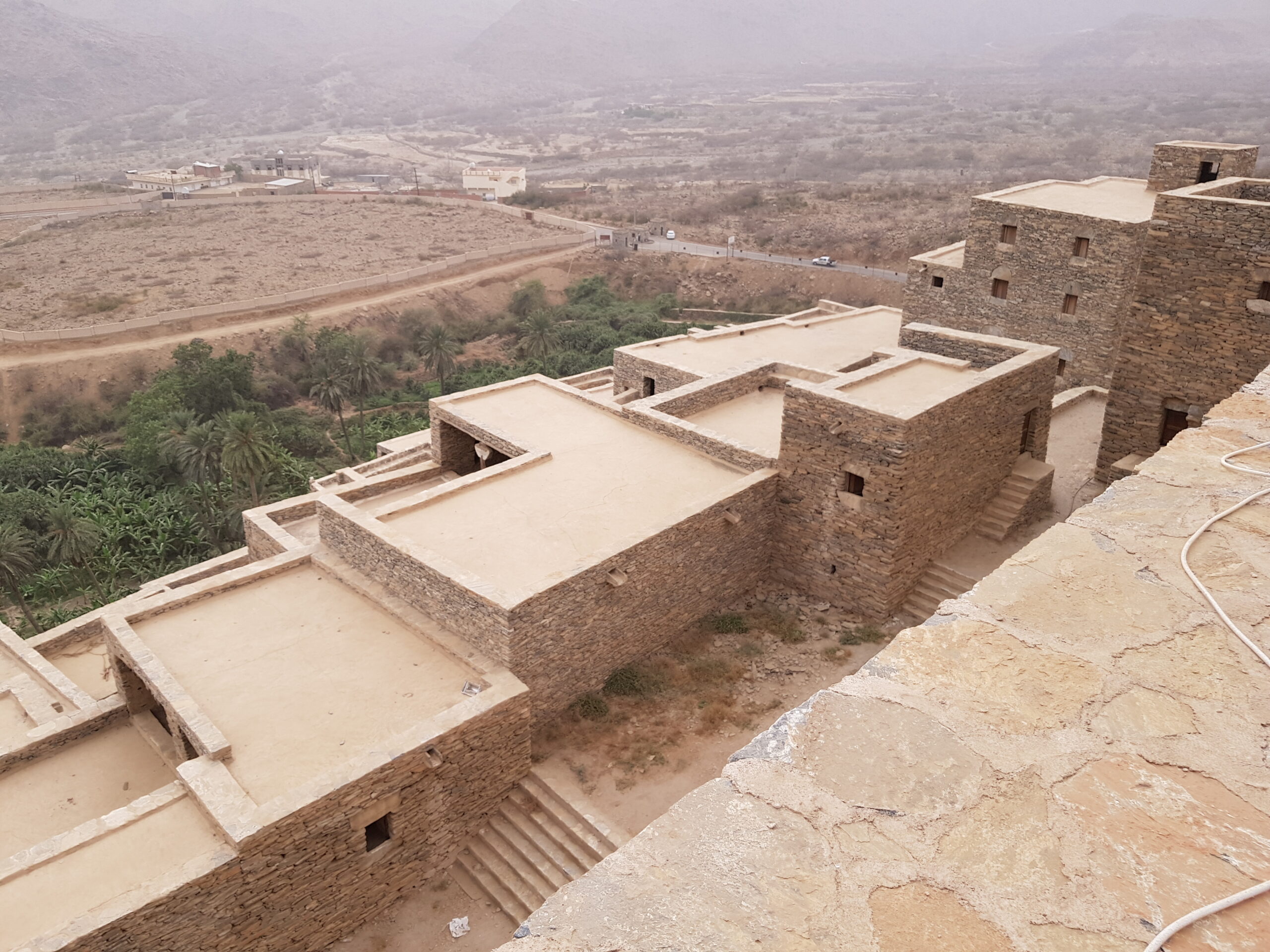
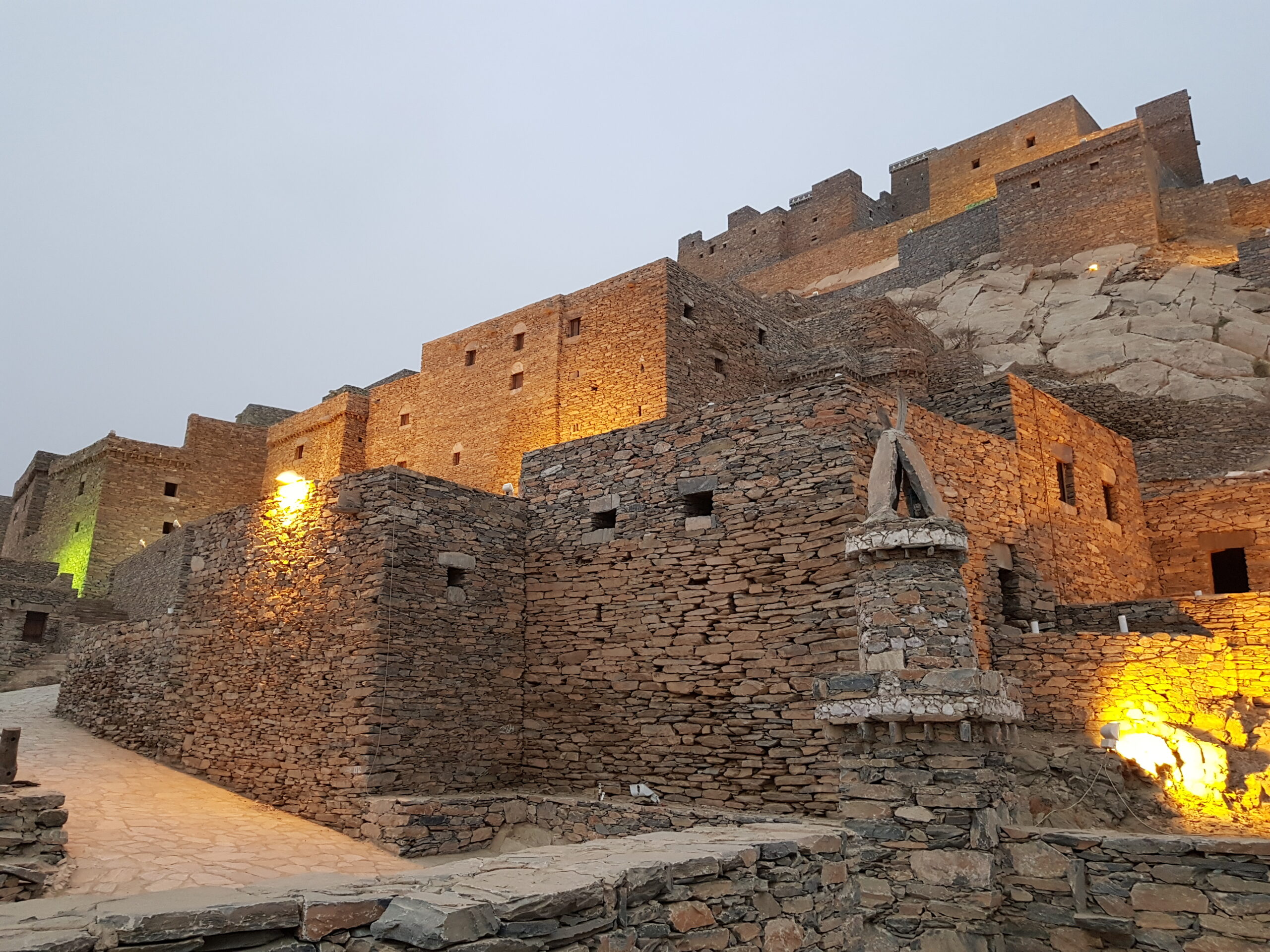
The village is exceptional for photography. The white marble base, golden-brown volcanic stone walls, and green oasis below create dramatic contrasts at any time of day. Morning light from the east illuminates the full facade; sunset hours (when the village is sometimes illuminated) produce atmospheric results. Several rooftops are accessible and offer the best elevated perspectives. A wide-angle lens is useful for capturing the full village from across the valley.
Getting to Thee Ain
From Al Bahah
Thee Ain is 24 km from Al Bahah city centre, a 40–50 minute drive via the scenic Al Aqabah road. This mountain road descends from the Sarat plateau into the Tihama lowlands and is one of the most dramatic drives in the region — tight switchbacks with views into deep valleys. Al Bahah’s domestic airport (Saud bin Abdul Aziz Airport) receives flights from Jeddah and Riyadh, and the drive from the airport to Thee Ain takes roughly 40 minutes.
From Taif
The drive from Taif to Al Bahah covers approximately 220 km and takes 3–3.5 hours. The route passes through the Sarawat highlands with mountain scenery throughout. Multiple sources strongly advise against driving this route at night — the winding mountain roads have limited lighting and sharp drops. Add 40 minutes from Al Bahah to Thee Ain.
From Jeddah
The total journey from Jeddah is approximately 390 km (4–5 hours). Most travellers drive via Taif, though a coastal route is available with better road conditions for part of the journey. Alternatively, fly from Jeddah to Al Bahah (roughly 1 hour) to eliminate the mountain driving.
From Riyadh
At over 900 km, driving from Riyadh is a 10–12 hour journey and not practical as a day trip. Fly to Al Bahah or Taif and drive from there. A Riyadh to Abha road trip can incorporate a stop in Al Bahah if you have several days.
Visa note: All visitors to Saudi Arabia need a valid visa. Most tourists can obtain an e-visa online before travel — the process takes minutes and the visa is valid for one year with multiple entries.
Best Time to Visit Thee Ain
The ideal window is October to April, when daytime temperatures range from 15–25 °C. Thee Ain sits in the Tihama lowlands at approximately 800 metres elevation — significantly lower and warmer than Al Bahah city on the Sarat plateau above. Summer temperatures can exceed 40 °C and make the unshaded stone pathways uncomfortable.
Winter months (December–February) offer the mildest conditions and the best light for photography. If visiting during the summer, plan for early morning or late afternoon and bring plenty of water.
Nearby Attractions in Al Bahah
Al Bahah is one of Saudi Arabia’s least-visited provinces by international tourists, which means fewer crowds and a more authentic experience. The region is sometimes called “the province of 1,001 towers” for the stone guard towers (qasaba) that dot its mountains. Several worthwhile sites lie within easy reach of Thee Ain.
Raghadan Forest Park
A misty mountain forest of ancient juniper trees at high altitude, Raghadan features nature trails, barbecue areas, an open-air theatre, and waterfalls. Morning fog rolling through the junipers is a signature Al Bahah experience — a dramatic contrast to the desert landscapes most visitors associate with Saudi Arabia.
Shada Mountains
Two peaks — Shada al-Asfal (lower) and Shada al-Ala (upper, rising to 1,700 m) — with unusual rock formations popular with hikers and campers. The area is accessible as a day trip from Al Bahah and pairs well with Thee Ain for a two-day itinerary. Hikers should also consider the wider Saudi Arabia hiking guide for route planning across the southwest.
Al Kharrara Waterfall
Approximately 30 km from Al Bahah city, this stream cascading through mountains surrounded by dense vegetation is particularly impressive after seasonal rains.
Asir National Park
Further south in the neighbouring Asir Province, the Asir National Park offers highland hiking, juniper forests, and dramatic escarpment views. Al Bahah and Asir together form Saudi Arabia’s green mountain belt — a corridor of surprising biodiversity and temperate climate.
Al Bahah Tuesday Market
One of the largest traditional markets in the region, held every Tuesday in Al Bahah city with vendors from the Tihama coastal lowlands. Honey, herbs, woven baskets, and local produce are the main draws.
Where to Stay
There is no accommodation at Thee Ain itself. Al Bahah city, 24 km away, is the practical base. Hotel options are limited compared to major Saudi cities but serviceable. Budget between USD 50–120 per night for a clean hotel room. Staying overnight in Al Bahah rather than day-tripping from Taif is advisable — it avoids the mountain drive at night and gives you early morning access to Thee Ain before the heat builds.
The Restoration Programme
The Saudi Heritage Commission’s SR 16 million restoration programme is divided into three phases over five years. Completed work includes rehabilitation of the main corridor, reopening of the mosque, conversion of several buildings into museum spaces, and construction of the visitor centre and café. The programme also includes a community engagement component, training local residents as heritage guides.
This investment is part of the broader Saudi Vision 2030 tourism diversification strategy, which aims to develop heritage sites across the Kingdom’s lesser-known regions. Thee Ain’s candidacy for full UNESCO World Heritage inscription — moving beyond its current Tentative List status — is being actively prepared by the Heritage Commission.
Tips for Visiting Thee Ain
- Arrive early. Light and temperature are both best before noon. The sun disappears behind the mountains well before sunset.
- Take a guided tour. The village’s history and architectural details are far more meaningful with narration. Ask at the visitor centre.
- Wear proper shoes. This is non-negotiable — the stone paths are steep and uneven.
- Bring water and snacks. The café may not always be open, and there are no nearby shops.
- Budget 2–3 hours. A thorough visit including the oasis, mosque, upper terraces, and visitor centre takes at least two hours.
- Watch for baboons. Families of baboons from the surrounding mountains occasionally visit the village — keep food secured and maintain distance.
- Combine with Raghadan Forest. A morning at Thee Ain followed by an afternoon at Raghadan makes an excellent day in Al Bahah.
- Saudi Arabia Heritage Villages — Preserved mountain settlements and traditional life across the Kingdom
- Traditional Architecture in Saudi Arabia — Mud towers, stone forts, and wind towers explained
- Asir National Park Guide — Hiking, wildlife, and highland scenery south of Al Bahah
- Riyadh to Abha Road Trip — The mountain drive through Saudi Arabia’s green belt
- Saudi Arabia Travel Guide 2026 — The complete guide to visiting the Kingdom
- Saudi Arabia Visa Guide — Every visa type explained