
Saudi Arabia’s built heritage spans thousands of years and an extraordinary range of climates, from the baking Najd plateau to the humid Red Sea coast and the mist-wrapped Asir highlands. Each region developed its own construction logic — mud towers in the interior, coral-stone mansions on the coast, layered-stone fortresses in the mountains — yet all share a genius for passive cooling and defensive design. Whether you are planning a broader Saudi Arabia travel itinerary or a dedicated heritage road trip, traditional architecture offers some of the most visually arresting and historically rich experiences in the Kingdom.
Best Time to Visit: October – March (cooler weather for walking heritage sites)
Getting There: Fly into Riyadh (Najd sites), Jeddah (Al-Balad), Abha (Asir), or AlUla; rent a car for remote villages
Visa Required: Yes — tourist e-visa available for 49 nationalities
Budget: $40–$120/day depending on region and accommodation
Must-See: Diriyah At-Turaif (UNESCO), Jeddah Al-Balad (UNESCO), Rijal Almaa village
Avoid: Visiting open-air mud-brick sites in summer (45 °C+); always check restoration status before travelling
Najdi Architecture: Mud-Brick Towers of Central Arabia
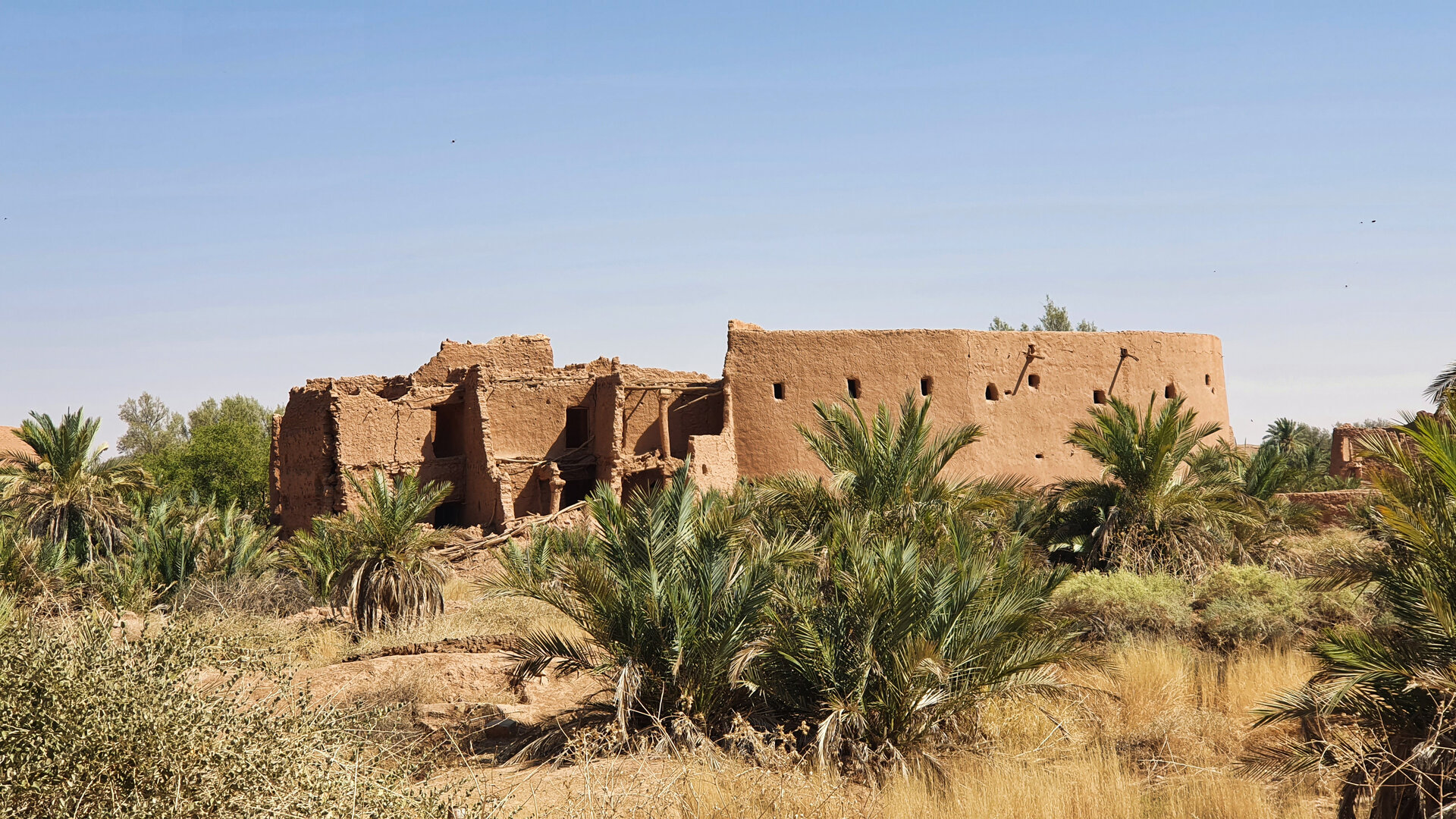
The Najd region — the vast interior plateau surrounding Riyadh — produced Saudi Arabia’s most iconic architectural tradition. With virtually no timber and no stone quarries nearby, Najdi builders turned to what they had: earth, straw and water. Sun-dried mud bricks (libn), mixed with chopped straw for tensile strength, were stacked into walls up to 60 cm thick. The mass of dried earth absorbs heat during the day and releases it at night, creating a natural temperature buffer that can lower interior temperatures by 10–15 °C compared to the outside air.
Roofs were spanned with tamarisk wood beams and palm-trunk joists, covered with palm fronds and sealed with a mud-plaster layer. Gypsum rendered the interior walls smooth and paintable. The result is a warm, ochre-toned aesthetic punctuated by distinctive architectural features found nowhere else in the Gulf.
Key Features of Najdi Design
- Furjat — small rectangular, triangular and arrow-shaped perforations in upper walls that provide ventilation, light and defensive observation without compromising privacy
- Shurfat — decorative crenellated parapets crowning rooflines, which also channel rainwater away from mud walls
- Tarma — peepholes above doorways allowing occupants to identify visitors without being seen
- Central courtyards — one or two storeys arranged around an open inner yard, separating private family quarters from the public majlis (reception room)
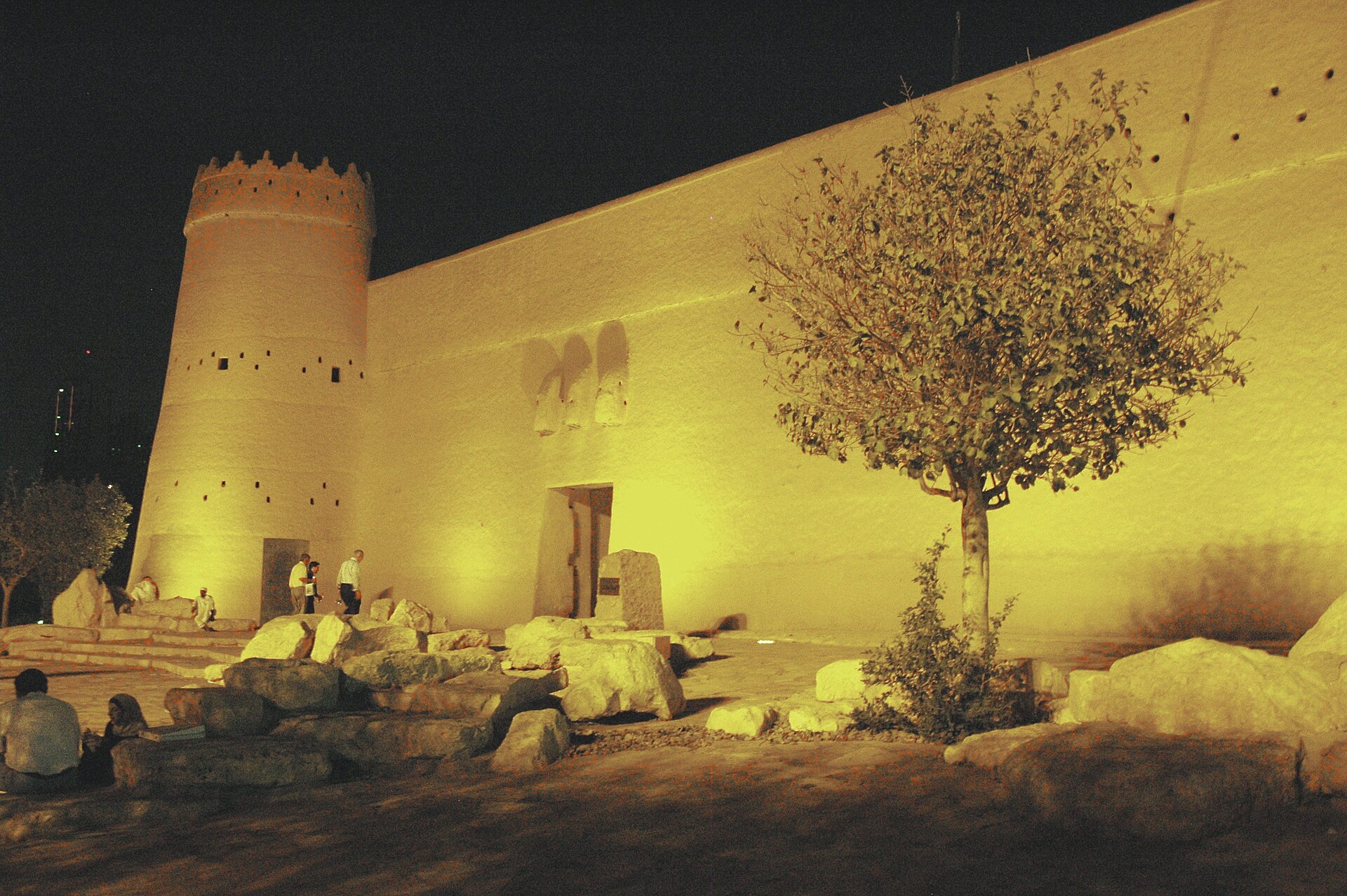
Masmak Fortress, Riyadh
No building better encapsulates Najdi architecture — or Saudi national identity — than Masmak Fortress in central Riyadh. Construction began in 1865 under Abdullah bin Faisal Al Saud and was completed in 1895 during Rashidi rule. Its walls stand roughly 5 metres high and 1.25 metres thick, with four conical watchtowers rising 18 metres at each corner. The western gate, made from palmwood 10 cm thick, still bears the spear mark from Abdulaziz ibn Saud’s raid on 15 January 1902 — the battle that recaptured Riyadh and launched the formation of modern Saudi Arabia.
Inside you will find a mosque to the left of the entrance, a rectangular majlis, a well in the northeastern corner and a courtyard ringed by three residential units. The fortress was converted into a museum in 1995 as part of the King Abdulaziz Historical Centre. Entry is free. Opening hours are Sunday–Thursday 8:00 AM–12:00 PM and 4:00–9:00 PM, Friday from 4:00 PM, Saturday from 9:00 AM. If you are spending a full day exploring the capital, the fortress pairs well with the nearby National Museum and a stroll through the old Dira Souq.
Tip: Masmak has undergone restoration work in recent years. Check current opening status before visiting — the exterior and courtyard are usually accessible even when interior galleries are closed.
At-Turaif District, Diriyah (UNESCO World Heritage Site)
Fifteen minutes northwest of central Riyadh, At-Turaif is the ruined capital of the First Saudi State (1727–1818) and a UNESCO World Heritage Site inscribed in 2010. The palaces of the House of Saud here represent a complete catalogue of Najdi architectural elements — some walls reach 3 metres thick, built using an unusually high-quality mud-brick technique. The district overlooks Wadi Hanifah and the palm-fringed Diriyah oasis, and its silhouette of crenellated towers against the desert sky is one of Saudi Arabia’s most photographed views.
The site is open Saturday–Tuesday 9:00 AM–12:00 AM and Wednesday–Friday 9:00 AM–1:00 AM. A Diriyah Pass costs 50 SAR and grants access to At-Turaif and the adjacent Bujairi Terrace dining district. Paid parking is 30 SAR for three hours.
At-Turaif is the centrepiece of the Diriyah Gate giga-project, a $63 billion Vision 2030 initiative transforming the area into a major cultural destination with museums, a royal opera house and an arena. Major assets are scheduled to open through 2027–2030, so expect the visitor experience to keep expanding.
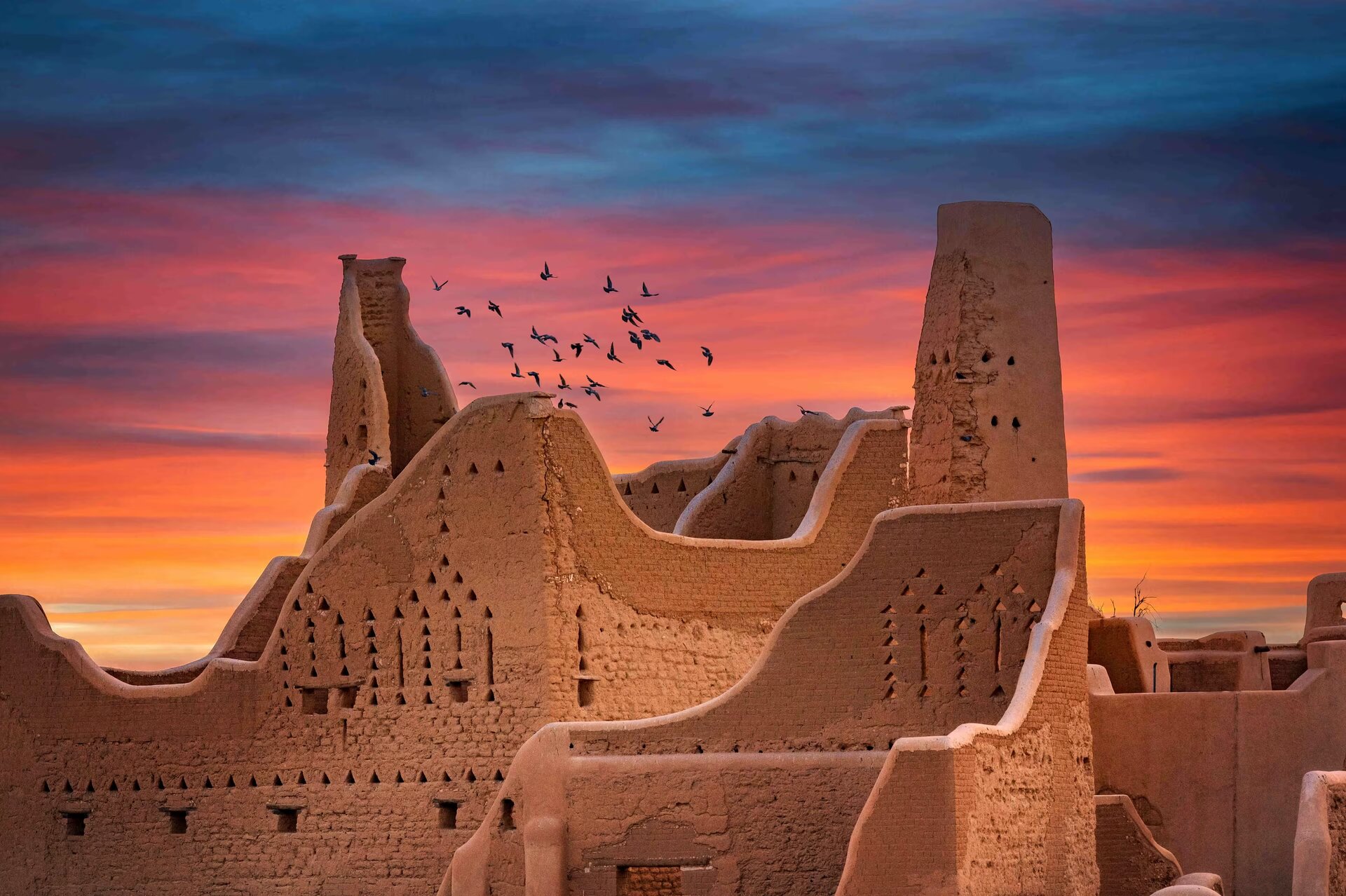
Ushaiger Heritage Village
For the most immersive Najdi village experience, drive 200 km northwest of Riyadh to Ushaiger, within Shaqra Governorate. This settlement stretches back over 1,500 years and was a crucial stopping point for pilgrims travelling from Kuwait, Iraq and Iran to Mecca. A labyrinth of winding alleyways and timber-framed walkways connects around 400 mud-brick houses, 25 mosques and 7 distinct quarters. Walls are built from libn, roofs from tamarisk beams, and the distinctive triangular windows and ornately carved wooden doors are some of the finest surviving examples of Najdi domestic decoration.
Entry is free. There is no public transport — rent a car from Riyadh and search GPS for “Shaqra” rather than “Ushaiger” for more reliable navigation. Spring and autumn are the best seasons. The nearby town of Shaqra itself has decorated mud-brick heritage structures worth a stop.
Hijazi Architecture: Coral Stone and Wooden Balconies of Jeddah
The Red Sea coast demanded entirely different materials and solutions. In historic Jeddah, builders quarried blocks of fossilised coral from the shallow seabed — a material that is lightweight, naturally insulating and surprisingly strong in compression. These coral-stone blocks were stacked into multi-storey tower houses reaching five or six floors, their facades adorned with rawashin: projecting enclosed wooden balconies carved from imported teak.
The rawashin (also called mashrabiya) served multiple functions simultaneously. Their intricate lattice screens allowed women to observe the street below without being seen, channelled sea breezes into interior rooms, and filtered harsh sunlight into dappled patterns. The exterior walls were often finished with a white lime wash that reflected heat. The result is a streetscape of extraordinary visual richness — vertical towers of pale stone punctuated by dark wooden projections, every surface textured.
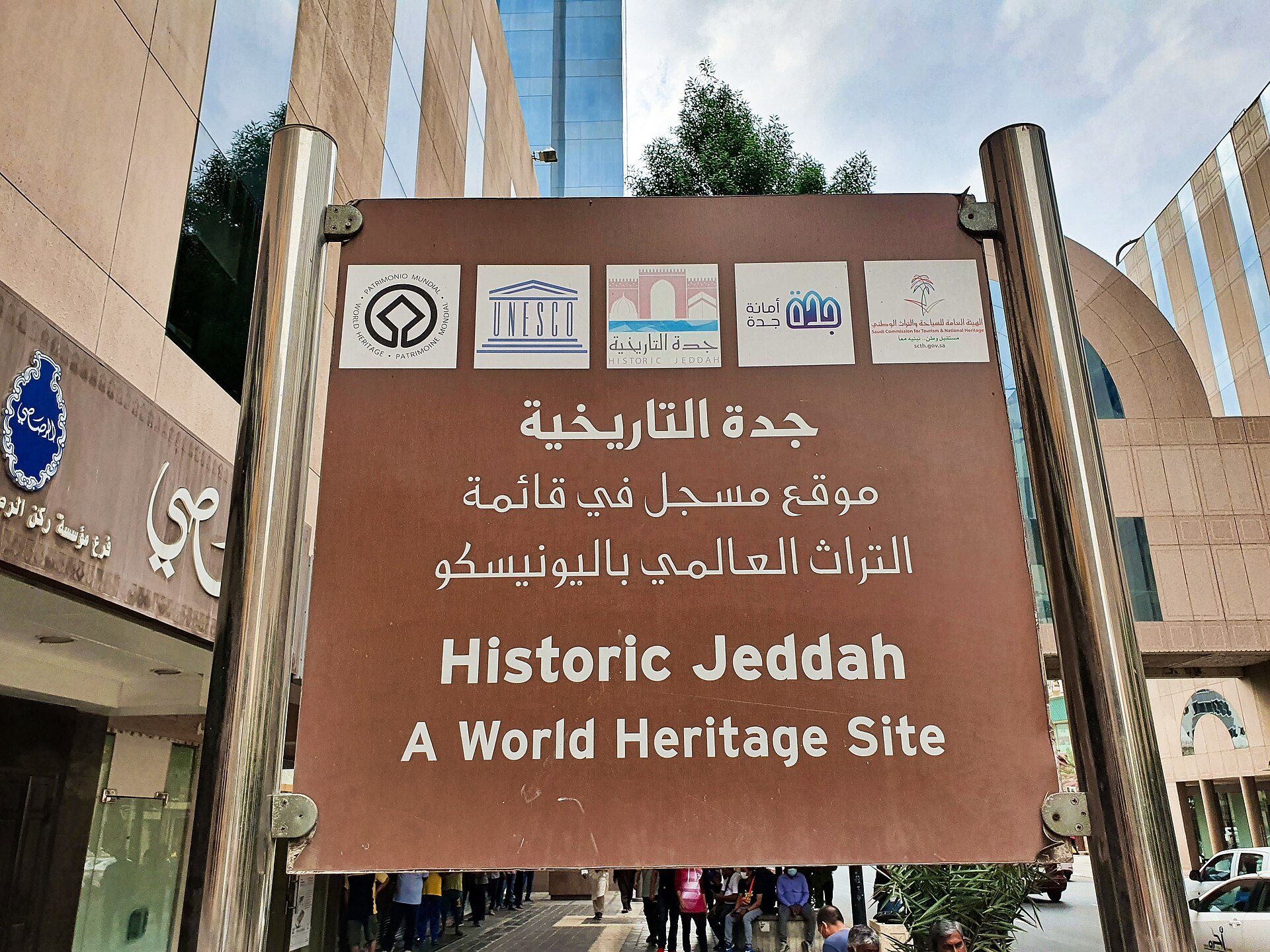
Al-Balad: Jeddah’s UNESCO World Heritage District
Historic Jeddah was inscribed as a UNESCO World Heritage Site in 2014 under the title “The Gate to Makkah,” recognising its role as the primary arrival point for Hajj pilgrims for over a millennium. The district is free to walk and explore. Key buildings include:
- Nasseef House — Built from coral limestone between 1872 and 1881 by Sheikh Omar Effendi Nassif, this mansion on Suq al-Alawi has approximately 900 square metres across four floors with 40 rooms. Known as “The House with the Tree” for its courtyard neem tree, it served as King Abdulaziz’s residence for about a decade after 1925. Now a museum and cultural centre with free entry, open Monday–Saturday 8:00 AM–11:55 PM.
- Sharbatly House — Located on Al-Bayaa Square, this four-storey building with fine Hejazi mashrabiyya balconies has been renovated into a cultural centre while preserving original brick walls and interiors.
- Noorwali House — In the Al-Yaman neighbourhood, notable for rare inscriptions and distinct construction details.
A major restoration programme under Vision 2030’s Jeddah Historic District initiative has reinforced or rescued 233 heritage buildings, fully restored 58, and converted three historic structures into boutique guest lodges. Archaeological excavations across four sites have uncovered more than 25,000 artefacts from the early Islamic period. The souqs of Al-Balad — particularly Suq al-Alawi and Suq al-Nada — remain active commercial markets and are the best way to experience the architecture at ground level.
Getting there: Al-Balad is in central Jeddah, easily reached by Uber or Careem from anywhere in the city. The best time to walk the district is late afternoon when the light catches the rawashin at a low angle. Combine with a visit to the Jeddah Waterfront and the city’s dining scene.
Asir Architecture: Painted Stone Towers of the Highlands
In the southwestern highlands of Asir Province, where monsoon rains reach Saudi Arabia and temperatures are cooler than anywhere else in the Kingdom, builders developed a distinct stone-and-slate construction method. Houses are built from courses of local basalt and schist, laid in thin horizontal bands and bonded with mud mortar. White quartz stones are set into the facades in geometric patterns, creating a striking visual contrast against the dark basalt. The multi-storey tower houses — some reaching eight floors — served dual purposes: the lower floors stored grain and livestock, the upper floors housed the family, and the rooftop served as a defensive lookout.
Al-Qatt Al-Asiri: UNESCO Intangible Cultural Heritage
What makes Asir architecture truly unique is what happens inside. Women of the region practise al-qatt al-asiri, a traditional art of interior wall decoration inscribed on UNESCO’s Representative List of Intangible Cultural Heritage of Humanity in 2017. Using a base of white gypsum, they paint bold geometric patterns in green, yellow, red and white — transforming guest rooms into vivid, abstract murals. The designs are renewed for special occasions and passed from mother to daughter. Some restored buildings in Abha and the Asir region display examples, though the tradition is primarily domestic and private.
Rijal Almaa Village
Rijal Almaa, located roughly 50 km west of Abha on a steep mountain road, is the finest surviving example of Asir architectural tradition. The village is more than 900 years old and contains around 60 multi-storey buildings made from local basalt adorned with white quartz facades and colourful wooden window shutters. Historically positioned along trade routes connecting Yemen and the Levant to Mecca and Medina, it functioned as both a market town and a defensive stronghold.
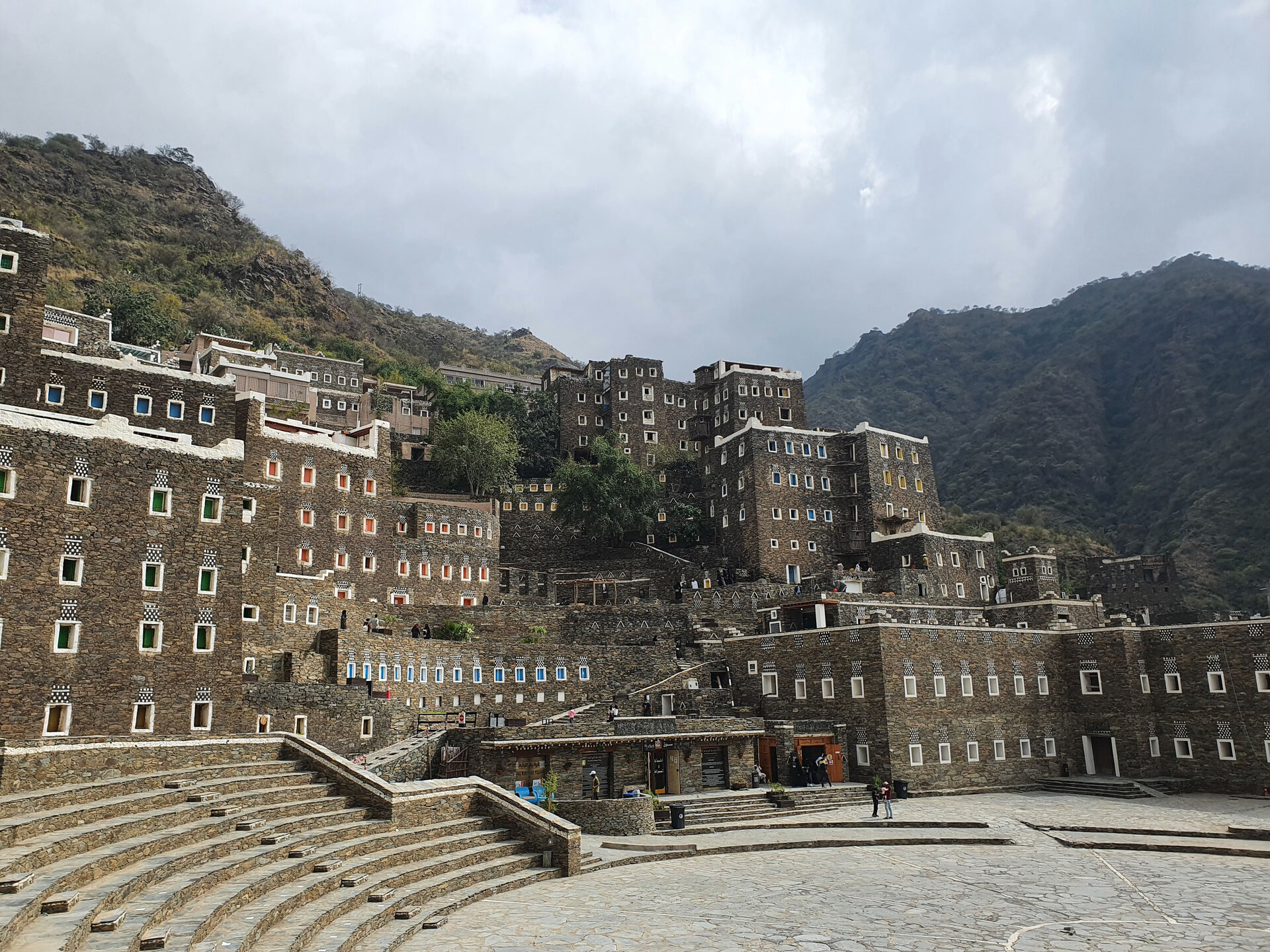
The Rijal Alma’a Heritage Museum, housed in the four-century-old Al Al-wan Palace, displays more than 2,000 antiquities and documents across 19 sections. Entry is 20 SAR. Rijal Almaa is on UNESCO’s Tentative World Heritage List and has been included in the “Soudah Peaks” tourism development initiative. There is no public transport — rent a car from Abha and allow 1–2 hours for the 45–50 km drive on steep mountain roads.
Wind Towers: Passive Cooling in the Eastern Province
The wind tower (Arabic: barjeel or burj al-hawwa; Persian: badgir) is one of the Gulf’s most elegant engineering solutions. A tall, open-sided tower rising above the roofline captures prevailing breezes at height and channels them downward through internal shafts into the living spaces below. Simultaneously, hot interior air rises and exits through the tower, creating continuous passive ventilation that can reduce indoor temperatures by up to 10 °C without any mechanical energy.
Wind towers are more commonly associated with Bahrain, Dubai and Iran, but examples exist in Saudi Arabia’s Eastern Province, particularly in the traditional quarters of Al-Ahsa and the Dammam-Khobar corridor. The Al-Ahsa Oasis — inscribed as a UNESCO World Heritage Site in 2018 as the world’s largest oasis with 2.5 million date palms — preserves courtyard-style houses with wind-catching elements. Qasr Ibrahim, an Ottoman-era fort built in 1555, covers 16,500 square metres and combines Islamic design with military architecture, featuring semi-circular arches, domes and a stone minaret with Turkish design influence. King Abdulaziz seized the fortress in 1913 during the unification of Saudi Arabia.
Jeddah’s Al-Balad also incorporates windcatcher principles into its rawashin design, where the projecting wooden balconies function as modified wind scoops oriented toward the sea breeze.
Ottoman Heritage: Hejaz Railway Stations
A distinct strand of Saudi Arabia’s architectural heritage comes from the Ottoman Empire. The Hejaz Railway, built under Sultan Abdul Hamid II from 1900 onwards, connected Damascus with the holy cities and facilitated the Hajj pilgrimage. The railway stations — built from cut stone in Ottoman provincial style with arched windows, pitched roofs and covered platforms — represent a European-influenced architectural tradition unique in the Arabian Peninsula.
- Medina Station (Hejaz Railway Museum) — The restored Ottoman terminus covers 90,000 square metres with 19 exhibition halls, a historic track stretch and original rolling stock. Free entry. Open daily 9:00 AM–10:00 PM (closed 4:00–5:00 PM; opens after 5:00 PM on Fridays). Note: verify current status as restoration work may affect access.
- Tabuk Station — Thirteen buildings across 80,000 square metres, now a museum with tools, documents and a refurbished locomotive. Free entry.
- Al Buwayr Station — Between Tabuk and Medina, features an almost-complete train with several carriages and remains of a station and fort — atmospheric and rarely visited.
The Hejaz Railway is on UNESCO’s Tentative List. For travellers exploring the northwest, the stations pair naturally with Tabuk and the AlUla region, where the Nabataean rock-cut tombs of Hegra represent yet another ancient building tradition carved directly into sandstone cliffs.
Saudi Arabia’s UNESCO Architectural Sites at a Glance
| Site | Location | Inscribed | Entry Fee | Architectural Style |
|---|---|---|---|---|
| At-Turaif District | Diriyah, near Riyadh | 2010 | 50 SAR (Diriyah Pass) | Najdi mud-brick palaces |
| Historic Jeddah (Al-Balad) | Central Jeddah | 2014 | Free | Coral stone, wooden rawashin |
| Hegra (Al-Hijr) | AlUla | 2008 | 95 SAR adult | Nabataean rock-cut tombs |
| Al-Ahsa Oasis | Eastern Province | 2018 | Free | Ottoman forts, oasis courtyards |
Practical Tips for Architecture Travellers
When to Go
October through March is the best window for heritage site visits across Saudi Arabia. Summer temperatures in Riyadh and the Eastern Province regularly exceed 45 °C, making extended outdoor exploration uncomfortable and potentially dangerous. The Asir highlands are an exception — Abha stays cooler year-round and can be visited in summer as a heat escape. AlUla’s visitor season typically runs October–May.
What to Wear
Heritage sites require modest dress. Comfortable walking shoes are essential — Ushaiger’s alleyways are unpaved, At-Turaif involves uneven ground, and Al-Balad’s streets are narrow and cobbled. Carry water and sun protection for open-air sites.
Getting Around
Riyadh and Jeddah sites are accessible by taxi apps and public transport. For Ushaiger, Rijal Almaa and the Hejaz Railway stations, a rental car is essential — there is no public transport to these locations. Domestic flights connect all major cities, and the Haramain High-Speed Railway links Jeddah and Medina.
Photography
Saudi Arabia’s heritage architecture is extraordinarily photogenic. Late afternoon light is best for mud-brick facades (warm tones) and Al-Balad’s rawashin (dramatic shadows). Drone regulations apply — check Saudi photography rules before flying. For serious photography, consider a dedicated photographer’s itinerary.
Visa and Entry
All heritage sites mentioned in this guide are open to holders of the Saudi tourist e-visa. See our Saudi Arabia visa guide for full details on eligibility, application and costs.
Vision 2030 and the Future of Saudi Heritage
Saudi Arabia is investing billions in heritage preservation and adaptive reuse under Vision 2030. The Diriyah Gate project ($63 billion) is transforming the area around At-Turaif into a mixed-use cultural quarter targeting 27 million visitors annually by 2030. The Jeddah Historic District programme has rescued 233 buildings and uncovered 25,000 archaeological artefacts. In AlUla, the Royal Commission for AlUla is developing the entire region as a heritage tourism destination, including plans to renovate the Hejaz Railway station into a visitor centre.
These projects mean that the visitor experience at Saudi Arabia’s architectural heritage sites is evolving rapidly. Sites that were difficult to access five years ago now have visitor centres, signage and guided tours. Check official websites for the latest opening information before you travel.
Explore More Saudi Arabia Travel Guides
- Saudi Arabia Travel Guide 2026 — The complete guide to visiting the Kingdom
- Diriyah: The Cradle of the Saudi State — Full history and visitor guide to At-Turaif and the First Saudi State
- Nabataean History in Saudi Arabia — Hegra, Dadan and the ancient trade routes of AlUla
- Best Museums in Saudi Arabia — Riyadh, Jeddah and beyond
- Saudi Arabian Handicrafts — Weaving, pottery and where to buy traditional crafts
- Al-Ahsa Oasis Palm Groves — UNESCO site and day trip guide
- Saudi Arabia Visa Guide — Every visa type explained