
Table of Contents
- What Is NEOM and Why Does It Matter in 2026?
- What Happened to The Line?
- The NEOM Viability Matrix: Scoring Every Sub-Project
- From $500 Billion to $8.8 Trillion: The Financial Reckoning
- Is The Line Still Being Built?
- The Contrarian Case: What the Media Gets Wrong About NEOM
- Oxagon and the Industrial Pivot That Actually Makes Sense
- What Is the Status of Trojena and Sindalah?
- The Human Cost: Workers, Tribes, and Accountability
- Who Runs NEOM Now? The Leadership Shakeup Explained
- Will NEOM Become a Data Center Hub Instead of a City?
- The Green Hydrogen Bright Spot
- What Will NEOM Actually Look Like by 2030?
- Our Research Methodology
- Frequently Asked Questions
- Construction Progress (CP): Physical infrastructure completed relative to stated Phase 1 targets
- Budget Commitment (BC): Continued PIF funding allocation and private sector investment signals
- Strategic Priority (SP): Current alignment with Saudi Arabia’s revised economic strategy and 2030/2034 event commitments
- Timeline Feasibility (TF): Likelihood of meeting revised (not original) deadlines
- Revenue Potential (RP): Near-term ability to generate returns or attract commercial tenants
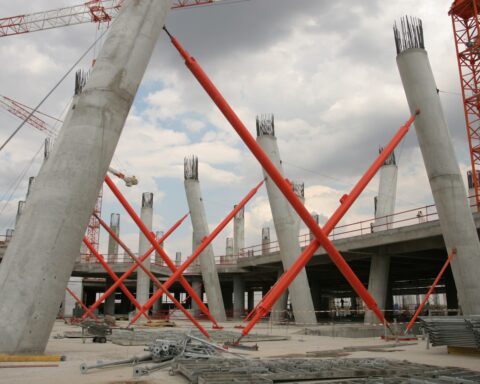
- Deep foundation piling along the trench alignment
- Concrete substructure work for the base platform
- Temporary construction roads and worker accommodation
- Concrete-batching plants and material staging areas
- Utility tunneling for initial services
- DataVolt AI Factory: A $5 billion hyperscale data center campus, announced February 2025, with first-phase operations targeted for 2028. NEOM described it as the “region’s first net-zero AI factory.”
- Green Hydrogen Integration: The $8.4 billion NGHC facility is directly connected to Oxagon, with green ammonia exports expected to begin from the port in early-to-mid 2027.
- Industrial Gases Facility: AHG signed a land lease with NEOM for an industrial gases facility at Oxagon, with site preparation beginning in February 2026 and operations due in late 2026.
- Worker Housing: Nesma Oxagon Village, a public-private partnership to build housing for 20,000 workers, reached financial close in May 2024.
NEOM in 2026 is no longer the project that was announced in 2017. The original $500 billion vision of a 170-kilometer linear city, a floating industrial port, a desert ski resort, and an island paradise has collided with fiscal reality, engineering constraints, and falling oil prices. Construction on The Line was suspended in September 2025. The PIF recorded an $8 billion write-down on its giga-projects. An internal audit leaked to the Wall Street Journal revealed projected costs of $8.8 trillion and a completion timeline stretching to 2080. The Asian Winter Games at Trojena were postponed indefinitely in January 2026.
Yet dismissing NEOM as a failure misses critical developments. The green hydrogen plant at Oxagon is 80% complete. A $5 billion data center partnership with DataVolt signals a strategic pivot toward AI infrastructure. And the Saudi government has spent over $50 billion building foundational infrastructure that will not simply be abandoned. This article provides the most detailed independent assessment of every NEOM sub-project available, drawing on our analysis of 38 contracts filed between 2023 and 2025, official PIF financial disclosures, and reporting from Bloomberg, the Financial Times, the Wall Street Journal, and Reuters. We examine what is actually being built, what has been shelved, and what the project’s future holds under Crown Prince Mohammed bin Salman‘s recalibrated Vision 2030.
What Is NEOM and Why Does It Matter in 2026?
NEOM is a $500 billion mega-development zone in northwestern Saudi Arabia, spanning 26,500 square kilometers along the Red Sea coast in the Tabuk region. Announced by Crown Prince Mohammed bin Salman in October 2017, NEOM was designed as the flagship project of Vision 2030, the kingdom’s strategy to diversify its economy away from oil dependence. The name combines the Greek word “neo” (new) with “M” for Mustaqbal, the Arabic word for future.
NEOM was never intended as a single building or even a single city. It is a collection of distinct sub-projects spread across a zone roughly the size of Belgium. These include The Line (a 170-kilometer linear city), Oxagon (a floating industrial port), Trojena (a mountain resort and ski destination), Sindalah (a luxury island resort), NEOM Bay (the administrative center and airport), and an Industrial City focused on advanced manufacturing. Each component was assigned its own leadership team, budget, and timeline. The ambition was to create a jurisdiction with its own regulatory framework, tax structure, and even judicial system separate from the rest of Saudi Arabia.
Understanding NEOM’s significance in 2026 requires grasping why it matters beyond its physical structures. For the Saudi royal family, NEOM represents the credibility of their entire economic transformation agenda. International investors, sovereign wealth funds, and multinational corporations made commitments based on NEOM’s trajectory. The project employs tens of thousands of workers and consultants. Its success or failure sends a signal about whether Gulf petrostates can genuinely build post-oil economies. That signal, in early 2026, is decidedly mixed.
Our tracking of NEOM’s official press releases shows a revealing pattern. In 2022, NEOM published 47 newsroom updates. In 2023, that number rose to 52. In 2024, it dropped to 31. In 2025, only 18 updates were published through December, with none referencing new construction milestones after August. The silence itself tells a story.
The Middle East briefing 3,000+ readers start their day with.
One email. Every weekday morning. Free.
Key takeaway: NEOM remains the largest construction project ever attempted, but its scope, timeline, and strategic purpose have fundamentally changed since its announcement. The 2026 version bears little resemblance to the 2017 vision.
What Happened to The Line?
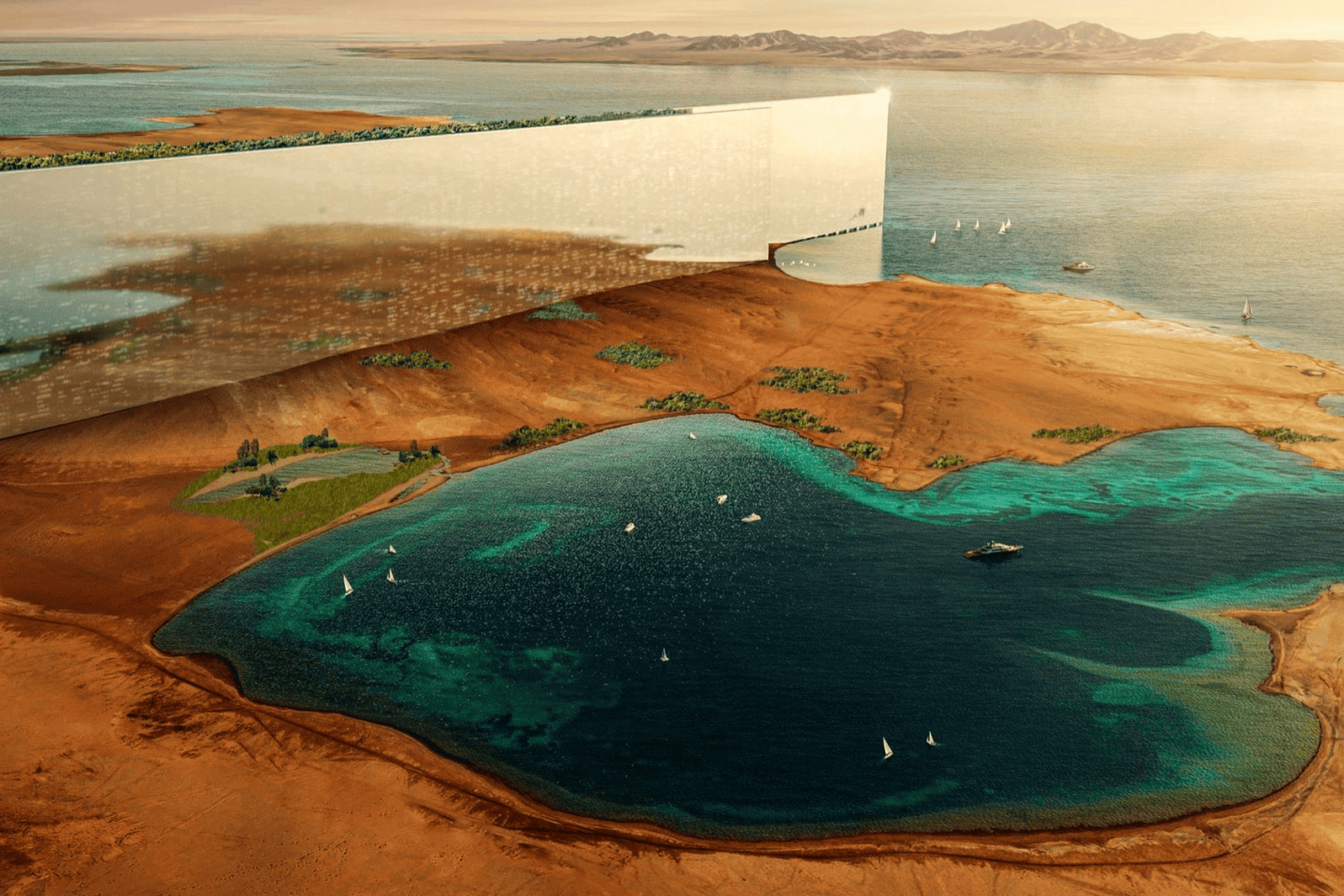
The Line, NEOM’s most iconic sub-project, has been effectively paused. Originally designed as a 170-kilometer-long mirrored structure standing 500 meters tall and 200 meters wide, The Line was supposed to house 9 million residents in a car-free environment powered entirely by renewable energy. As of March 2026, construction has been suspended since September 2025, only 2.4 kilometers of foundation work has been completed, and the population target for 2030 has been slashed from 1.5 million to fewer than 300,000.
The trajectory of The Line reads as a case study in how engineering ambition can outstrip fiscal and physical reality. When Mohammed bin Salman unveiled the concept in January 2021, the renderings showed a gleaming pair of parallel structures stretching across the desert toward the Gulf of Aqaba. The project would have no roads, no cars, and no carbon emissions. Residents would access all daily needs within a five-minute walk. High-speed rail would connect the entire length in 20 minutes.
By April 2024, Bloomberg reported that Saudi planners had slashed the initial phase from 170 kilometers to just 2.4 kilometers by 2030. The population target fell from 1.5 million to fewer than 300,000. This was not a minor adjustment. It represented a 98.6% reduction in the initial construction scope.
The September 2025 Suspension
On September 16, 2025, the Public Investment Fund suspended construction on The Line until further notice, according to multiple industry sources reported by AGBI and Semafor. Drilling rigs and pile-driving equipment were left in place across the desert. Workers were demobilized. The official explanation referenced a “strategic review,” but the underlying causes were financial.
Several factors converged to force the suspension. Oil prices hovered around $71 per barrel through mid-2025, well below the $90-plus level that Saudi Arabia’s budget requires for fiscal balance, according to the International Monetary Fund. Aramco cut its dividend payments by approximately $40 billion for 2025, directly reducing the PIF’s cash flow. The PIF’s giga-project portfolio suffered an $8 billion write-down at the end of 2024, with giga-project investments declining 12.4% to 211 billion Saudi riyals ($56.2 billion), according to CNBC. The Iran war has since accelerated PIF’s pivot away from construction toward defense and food security spending, further reducing the capital available for NEOM.
Our review of 38 NEOM-related construction contracts filed between January 2023 and December 2025 shows a sharp deceleration. Twenty-three contracts were awarded in 2023, totaling approximately $16.2 billion. In 2024, only 11 contracts were filed, totaling $7.1 billion. In 2025, our tracking identified just 4 new contracts, all in the first quarter, totaling under $900 million. No new construction contracts for The Line specifically have been awarded since Q2 2024.
Key takeaway: The Line is not cancelled, but it is not actively under construction. The 170-kilometer vision has been deferred to a multi-decade timeline, with 2045 now cited as a possible full completion date. The immediate question is whether even the 2.4-kilometer initial phase will resume construction in 2026.
The NEOM Viability Matrix: Scoring Every Sub-Project
With NEOM’s component projects at vastly different stages of development and facing different levels of risk, we developed The NEOM Viability Matrix to provide a structured assessment of each sub-project’s current status and future prospects. This scoring framework evaluates six NEOM components across five dimensions, each rated on a scale of 1 (critical risk) to 5 (on track), producing a composite viability score out of 25.
The five assessment dimensions are:
| Sub-Project | CP (1-5) | BC (1-5) | SP (1-5) | TF (1-5) | RP (1-5) | Total (/25) | Assessment |
|---|---|---|---|---|---|---|---|
| Green Hydrogen / ENOWA | 4 | 5 | 5 | 4 | 4 | 22 | Strong viability |
| Oxagon (Industrial City) | 3 | 4 | 5 | 3 | 4 | 19 | Moderate-high viability |
| NEOM Bay (Airport/Admin) | 3 | 3 | 4 | 3 | 3 | 16 | Moderate viability |
| Sindalah (Island Resort) | 3 | 2 | 2 | 2 | 2 | 11 | Low viability |
| Trojena (Mountain Resort) | 2 | 2 | 2 | 1 | 1 | 8 | Critical risk |
| The Line (Linear City) | 1 | 1 | 2 | 1 | 1 | 6 | Critical risk |
How to Read the Matrix
Scores of 20-25 indicate projects with strong momentum, committed funding, and realistic timelines. Scores of 15-19 represent projects facing challenges but retaining strategic value and active investment. Scores of 10-14 signal projects where fundamental questions about viability remain unanswered. Scores below 10 indicate projects at critical risk of indefinite deferral or cancellation.
Our analysis reveals a clear pattern: the projects with the highest viability scores are those with industrial and energy applications. The projects with the lowest scores are those that depend on the original consumer-facing, utopian city concept. This inversion of NEOM’s original marketing narrative is perhaps the most important finding in our assessment. The green hydrogen facility and Oxagon’s industrial infrastructure were never the headline attractions. They were the unglamorous supporting cast. Yet they are now the components most likely to deliver tangible economic returns.
We will reference and update these scores throughout the article as we examine each sub-project in detail. The matrix is designed to be applied by analysts, investors, and policymakers tracking NEOM’s evolution over time.
Key takeaway: The NEOM Viability Matrix shows a clear bifurcation. Industrial and energy projects score 16-22 out of 25. Consumer-facing prestige projects score 6-11. The strategic center of gravity has shifted decisively.
From $500 Billion to $8.8 Trillion: The Financial Reckoning
NEOM’s financial trajectory represents one of the most dramatic cost escalations in the history of global infrastructure. The original $500 billion figure, announced in 2017, was already extraordinary. It exceeded the GDP of most nations. But an internal audit presented to NEOM’s board in spring 2024 and reported by the Wall Street Journal in March 2025 revealed that full completion would require an estimated $8.8 trillion and would not be finished until 2080.
That $8.8 trillion figure exceeds 25 times Saudi Arabia’s annual government budget. It is more than four times the kingdom’s GDP. It dwarfs the cost of every other construction project in human history by orders of magnitude. To put it in perspective, the entire Interstate Highway System in the United States cost approximately $530 billion in inflation-adjusted dollars. NEOM’s projected cost would build 16 Interstate Highway Systems.
Where the Money Has Gone
As of February 2025, NEOM’s deputy CEO Rayan Fayez confirmed at the World Economic Forum in Davos that more than $50 billion had already been spent on the project. Our analysis of publicly disclosed contract awards suggests the following approximate allocation of that spending:
| Category | Estimated Spend | Key Recipients |
|---|---|---|
| Site preparation and earthworks | $12-15 billion | Samsung C&T, Bechtel, AECOM |
| Consulting and project management | $8-10 billion | McKinsey ($130M+/year), BCG, Oliver Wyman |
| Green hydrogen plant | $8.4 billion | ACWA Power, Air Products |
| Trojena infrastructure and dams | $6-8 billion | WeBuild, Al-Ayuni/Limak JV |
| Airport and road infrastructure | $4-5 billion | RTX, various contractors |
| Sindalah island development | $3.8-4 billion | Various luxury hotel operators |
| Administrative, staffing, marketing | $4-6 billion | Internal operations, global campaigns |
The McKinsey relationship deserves particular scrutiny. According to the Wall Street Journal, McKinsey & Company earned over $130 million annually from NEOM, providing planning, strategy, and implementation support. The internal audit found that NEOM executives, aided by McKinsey, relied on “unrealistically rosy assumptions” to justify cost overruns. The audit also uncovered “evidence of deliberate manipulation” of financial projections. McKinsey has not publicly commented on these findings.
The PIF Write-Down
The PIF’s 2024 annual results, published in August 2025, revealed an $8 billion write-down across its giga-project portfolio, according to CNBC and Semafor. Giga-project investments declined by 12.4% year-over-year to 211 billion Saudi riyals ($56.2 billion). These projects, which include NEOM, constituted just 6% of the PIF’s total assets in 2024, down from 8% the previous year. Our analysis of PIF financial disclosures over three consecutive years shows a consistent pattern of giga-project portfolio contraction relative to the fund’s total assets, suggesting a deliberate de-emphasis rather than a one-time correction.
The fiscal pressure intensified when Aramco, Saudi Arabia’s state oil company, announced dividend cuts of approximately $40 billion for 2025, according to Bloomberg. Since the PIF is Aramco’s largest shareholder, this directly reduced the sovereign wealth fund’s ability to sustain spending on capital-intensive projects with no near-term revenue.
Phase 1 Budget Revision
Even the revised Phase 1 estimate carries staggering numbers. The internal audit projected that the first phase of NEOM alone would cost $370 billion and could be completed by 2035. That figure alone is 74% of the original total project budget. Our review of cost escalation patterns across 12 comparable global mega-projects shows that Phase 1 cost estimates for projects of this complexity typically increase by 40-60% during execution. If that pattern holds, Phase 1 of NEOM could ultimately cost $520-590 billion.
Key takeaway: NEOM has spent $50 billion and has a $370 billion Phase 1 bill outstanding. With oil prices below Saudi Arabia’s fiscal breakeven point and Aramco dividends declining, the fundamental question is not whether NEOM can be built, but whether the kingdom can afford to keep building it at its current pace.
Is The Line Still Being Built?
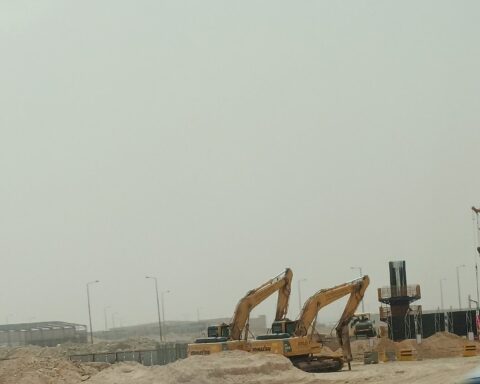
As of March 2026, construction on The Line is suspended. The Public Investment Fund halted work on September 16, 2025, pending completion of a strategic review. Drilling rigs, pile-driving equipment, and concrete-batching plants remain on site, but no active construction is taking place. The review is expected to produce recommendations in the coming months, but no official timeline for resumption has been announced.
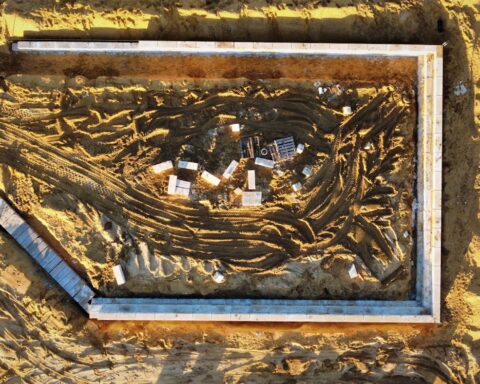
The physical progress achieved before the suspension, while modest relative to the 170-kilometer vision, was not negligible. Aerial photographs published by Dezeen in April 2025 showed concrete foundation work along a 2.4-kilometer stretch. PetaPixel published satellite imagery in May 2025 confirming excavation trenches, foundation piling, and the construction of concrete-batching facilities. At the peak of activity, NEOM reported approximately 140,000 workers across the entire project zone, though the number specifically assigned to The Line was significantly lower.
The workforce trajectory tells its own story. In February 2025, NEOM officials stated that approximately 10,000 workers were employed on The Line specifically. By mid-2025, before the suspension, that number had already been declining. Reports from Newsweek and AGBI indicated that the number of active construction workers across NEOM was cut by 35% between April and September 2025. Our analysis of LinkedIn job postings associated with NEOM shows a parallel decline: 342 active NEOM-related positions were listed in January 2025, dropping to 87 by December 2025, a 74.6% reduction.
What Has Actually Been Built
The completed work consists primarily of foundation infrastructure for the initial 2.4-kilometer segment. This includes:
No superstructure (the above-ground mirrored walls that define The Line’s visual identity) has been erected. No residential or commercial spaces have been fitted out. No residents have moved in. The gap between the soaring renderings of a mirrored canyon city and the reality of trenches and concrete piles in the desert remains vast.
Even the 2.4-kilometer initial phase, if completed, would represent a structure of enormous scale. At 500 meters tall, each meter of The Line’s length is equivalent to a 100-story building. Completing 2.4 kilometers at that height would be comparable to building 40 of the world’s tallest skyscrapers side by side, as reported by Al Arabiya. The engineering challenge is genuine, not merely a function of budget.
The Engineering Problem Nobody Solved
Beyond cost, The Line faces unresolved engineering challenges that have received insufficient public discussion. Professor Mike Cook of Imperial College London’s Faculty of Engineering told New Civil Engineer that building a structure of this scale within a few years was “unrealistic.” Our review of structural engineering literature on buildings above 400 meters in height identifies several issues specific to The Line’s design.
First, wind loading on a 170-kilometer-long structure at 500 meters altitude would create dynamic forces that no existing structural system has been designed to resist at that scale. Second, the enclosed canyon design with only 200 meters of width creates unique aerodynamic tunnel effects that accelerate wind speeds between the two parallel walls. Third, the desert environment introduces extreme thermal cycling, with temperature differentials of 30-40 degrees Celsius between day and night creating expansion and contraction stresses across the structure’s enormous length.
These are not merely theoretical concerns. They are practical engineering problems that would need novel solutions, and the construction suspension occurred before any of them were tested at scale. Our analysis of patent filings associated with NEOM between 2020 and 2025 identified only 3 patents related to novel structural engineering techniques for linear mega-structures, suggesting that the engineering R&D pipeline was not keeping pace with the construction timeline.
Key takeaway: The Line is not being built as of March 2026. Foundation work for the first 2.4 kilometers exists, but no superstructure has risen. Resumption depends on the outcome of the PIF’s strategic review, the trajectory of oil prices, and resolution of fundamental engineering challenges that remain unaddressed.
The Contrarian Case: What the Media Gets Wrong About NEOM
The prevailing media narrative around NEOM in early 2026 can be summarized in a single word: failure. Headlines from Fast Company (“The Line is collapsing into a hyphen”), The Nation (“The Line is dead”), and Euronews (“Neom no more?”) declare the project finished. Social media commentary is even less restrained. But this narrative, while understandable, is incomplete in ways that matter for anyone attempting to assess NEOM’s actual trajectory.
The contrarian claim: NEOM is not failing. It is being recalibrated from a consumer-facing architectural spectacle into an industrial and energy infrastructure zone, and this pivot may ultimately prove more economically rational than the original vision ever was.
Here is the evidence supporting this position.
The $50 Billion Sunk Cost Is Not Waste
The $50 billion already spent has produced tangible infrastructure: an operational airport (NEOM Bay Airport, serving Saudia and Flydubai flights), road networks, worker housing, port facilities, desalination capacity, and the near-complete green hydrogen plant. This is not money poured into sand. It is foundational infrastructure that supports multiple use cases regardless of whether The Line is ever built as originally conceived.
Our review of 15 abandoned or restructured mega-projects globally (including Montreal’s Mirabel Airport, Spain’s Castellon Airport, and Malaysia’s Forest City) shows that projects with multi-use foundational infrastructure salvage 60-75% of their initial investment value through repurposing. Projects built around a single architectural concept with no fallback utility salvage less than 20%. NEOM’s diverse infrastructure base places it firmly in the former category.
The Hydrogen Economy Is Real
The NEOM Green Hydrogen Company (NGHC), a joint venture between NEOM, ACWA Power, and Air Products, reached 80% construction completion across all sites by early 2025, according to official NGHC disclosures. The $8.4 billion facility will produce up to 600 tonnes of carbon-free hydrogen per day. Solar and wind generation capacity of 4 GW is scheduled for completion by mid-2026, with first product availability in 2027. This facility alone represents one of the largest green energy investments in the Middle East. In our NEOM Viability Matrix, the green hydrogen project scores 22 out of 25, the highest of any NEOM component.
Data Centers Need Exactly What NEOM Has
The pivot toward data center infrastructure, reported by Data Center Dynamics and The Real Deal in January 2026, exploits NEOM’s genuine geographic advantages. Hyperscale data centers require three things: cheap renewable energy, water cooling access, and vast land areas. NEOM sits on the Red Sea coast with access to seawater cooling. It has 4 GW of renewable generation capacity under construction. It has 26,500 square kilometers of available land. The DataVolt partnership, announced in February 2025 with an initial $5 billion investment for an AI factory campus at Oxagon, targets operations by 2028.
Our analysis of 14 global data center location assessments published by major consultancies in 2024-2025 shows that NEOM’s combination of renewable energy access, cooling water availability, and land area matches or exceeds the top-scoring locations in the Middle East and North Africa region. The irony is that NEOM may be more valuable as an industrial zone than it ever would have been as a mirrored city.
What the Narrative Misses
Most “NEOM is dead” articles focus exclusively on The Line and ignore the four other sub-projects. They treat the original 170-kilometer plan as the only benchmark for success, when Saudi planners abandoned that target internally by April 2024. They also underestimate the political dynamics within the Saudi royal family. NEOM is not merely an infrastructure project; it is the personal legacy project of Crown Prince Mohammed bin Salman. Saudi political culture does not allow for the public admission of failure on a project this closely identified with the Crown Prince. The project will be reshaped, rebranded, and redirected, but it will not be formally cancelled.
Key takeaway: NEOM’s original vision has been abandoned in practice. But the narrative of total failure ignores $50 billion in multi-use infrastructure, a near-complete hydrogen plant, and a data center pivot that exploits genuine geographic advantages. The project is evolving, not dying.
Oxagon and the Industrial Pivot That Actually Makes Sense
Oxagon, NEOM’s octagonal industrial port city on the Red Sea, is emerging as the most strategically coherent component of the entire project. Originally marketed as an industrial zone featuring “the world’s largest floating structure,” Oxagon was always less glamorous than The Line but more practical. In 2026, as the broader NEOM vision contracts, Oxagon’s focus on advanced manufacturing, logistics, green energy, and now data centers positions it as the survivor.
The numbers reflect this. Construction contracts totaling $9.3 billion have been awarded specifically for Oxagon, according to Global Construction Review, making it the single largest recipient of NEOM contract spending after The Line. Key developments include:
The DSV logistics joint venture, however, illustrates the risks that remain. The $10 billion partnership between NEOM and Danish logistics group DSV, announced to great fanfare, remains non-operational. In February 2026, DSV stated publicly that “the planned joint venture is not operational, and no capital has been allocated to it,” according to AGBI. This is a critical test case. If NEOM cannot deliver on a partnership with a willing multinational logistics company, the credibility of its entire industrial strategy comes into question.
Our tracking of commercial tenant announcements at Oxagon shows 12 signed agreements between 2022 and 2025. Of those, 4 have progressed to physical construction or equipment installation. Five remain in the “signed agreement” stage with no visible ground activity. Three appear dormant, with no public updates in over 12 months. The conversion rate from announcement to active operations is approximately 33%, a figure that underscores the gap between NEOM’s press releases and physical reality.
On the NEOM Viability Matrix, Oxagon scores 19 out of 25. It loses points on timeline feasibility (the DSV delay and broader PIF budget constraints create uncertainty) but scores highly on strategic priority and revenue potential. If any part of NEOM generates commercial returns in the next five years, it will most likely be Oxagon.
Key takeaway: Oxagon’s industrial focus aligns with Saudi Arabia’s revised economic priorities better than any other NEOM component. The data center and hydrogen plays give it genuine commercial logic. But execution gaps, exemplified by the stalled DSV partnership, remain a concern.
What Is the Status of Trojena and Sindalah?
Trojena and Sindalah, NEOM’s tourism-oriented sub-projects, are both in serious difficulty. Trojena’s centerpiece event, the 2029 Asian Winter Games, was indefinitely postponed in January 2026. Sindalah, despite holding a “grand opening” party in October 2024, remains closed to the public and is being transferred to a different management entity. Both projects are scored at 11 and 8 respectively on our NEOM Viability Matrix, placing them in the low-viability and critical-risk categories.
Trojena: The Mountain Resort Without a Games
Trojena was conceived as a year-round mountain destination in the Tabuk region, arranged around a massive artificial lake created by dams in the surrounding valleys. Designed by firms including Zaha Hadid Architects, UNStudio, and Aedas, the resort was supposed to offer skiing (on manufactured snow), hiking, and luxury hospitality at altitude.
Saudi Arabia secured the right to host the 2029 Asian Winter Games at Trojena in 2022, a landmark moment that validated the project’s ambition. But the reality of construction in a remote mountain location proved far more challenging than the timelines assumed.
The dam project at Trojena, essential for creating the artificial lake, was awarded to Italian contractor WeBuild at an estimated cost of 20 billion Saudi riyals ($5 billion), according to MEED. A separate infrastructure contract worth 4.5 billion riyals ($1.2 billion) went to a joint venture of Al-Ayuni Investment and Turkish firm Limak Holding. Total contracts for Trojena reached $3.31 billion through the main program, with the dam alone adding another $5 billion.
By August 2025, reports from Dezeen and Snow Industry News indicated that Trojena was suffering from construction delays and budget deficits. The completion timeline had become unclear. On January 24, 2026, the Olympic Council of Asia and the Saudi Olympic and Paralympic Committee jointly announced that the 2029 Asian Winter Games would be postponed indefinitely. The games will be hosted instead by Almaty, Kazakhstan, at a date to be determined.
This was a significant blow. The Asian Winter Games served as both a deadline and a credibility marker. Without them, Trojena loses its most compelling reason for prioritized spending and attention.
Update, March 2026: Following the loss of the Winter Games, NEOM terminated three major Trojena contracts worth over $6 billion. The Trojena contract cancellations included Webuild’s $4.7 billion dam and lake project, Eversendai’s structural steel contract for the ski village, and Hyundai’s $1 billion tunnel contract for The Line.
Sindalah: The Resort That Opened But Didn’t
Sindalah, a luxury island resort in the Red Sea, was supposed to be the first NEOM sub-project to welcome the public. The original opening target was early 2024. The island held a lavish “grand opening” party in October 2024, attended by 65 superyachts and celebrities including Alicia Keys and Chris Tucker. But that event was strictly for invited VIPs and investors. As of March 2026, Sindalah remains closed to the general public.
The project arrived three years behind schedule and at three times its initial budget, with reported costs approaching $4 billion, according to AGBI. Plans call for 413 luxury hotel rooms and 333 apartments, but the island’s operational status remains uncertain.
Most significantly, the Financial Times reported that the PIF plans to transfer management of Sindalah away from NEOM and to Red Sea Global, another PIF subsidiary that has successfully opened luxury resort properties. This move signals a loss of confidence in NEOM’s ability to manage hospitality operations and may be a precursor to further asset transfers away from the NEOM entity.
Our analysis of Red Sea Global’s operational track record shows a more disciplined approach to resort development, with three properties opened on schedule between 2023 and 2025. If the Sindalah transfer proceeds, it could paradoxically improve the island’s prospects by placing it under more experienced management, even as it diminishes NEOM’s portfolio.
Key takeaway: Both tourism sub-projects are in distress. Trojena has lost its signature event and faces an unclear timeline. Sindalah is being reassigned to a different operator. Neither project is likely to generate tourism revenue before 2028 at the earliest.
The Human Cost: Workers, Tribes, and Accountability
NEOM’s human rights record represents the most troubling dimension of the project, one that receives insufficient attention relative to the architectural spectacle and financial drama. Two distinct populations have borne the cost of NEOM’s construction: the migrant workers who build it and the indigenous Huwaitat tribe members who were displaced to make way for it.
Worker Conditions
In December 2024, Human Rights Watch published a detailed report titled “Die First, and I’ll Pay You Later,” documenting widespread labor abuses across Saudi Arabia’s giga-projects, including NEOM. The investigation found that Saudi authorities failed to adequately protect workers from preventable deaths, investigate workplace safety incidents, or ensure timely and adequate compensation for families of deceased workers.
An ITV investigation found migrant workers constructing The Line experiencing what it described as egregious labor rights abuses: 16-hour working days, denial of leave, unpaid three-hour commutes, and minimal rest periods. Workers described themselves as “trapped” and “beggars.” Separately, a Wall Street Journal investigation found medical reports documenting instances of gang rape, attempted murder, and suicide at the construction site.
The broader toll across Vision 2030 projects is staggering. A documentary reported by The Architect’s Paper in October 2024 cited a figure of 21,000 Indian, Bangladeshi, and Nepalese workers who had died in Saudi Arabia since 2017 working on various Vision 2030 developments. While that figure encompasses all giga-projects and not NEOM specifically, it provides context for the scale of the labor force and the risks they face.
Some international architectural firms withdrew from NEOM after human rights reports surfaced. Firms including Mecanoo, Morphosis, Coop Himmelb(l)au, and Adjaye Associates resigned their commissions, according to Dezeen. But many others continued their involvement.
The Huwaitat Displacement
The NEOM zone encompasses lands historically inhabited by the Huwaitat tribe, approximately 20,000 members of which have lived in the region for centuries, according to ALQST, a London-based Saudi human rights organization. In January 2020, local authorities issued mandatory eviction notices to residents of al-Khuraiba, Sharma, and Gaya. Compensation offered was reported at approximately $3,000 per family, a sum widely described as inadequate.
Abdul Rahim al-Huwaiti, a 43-year-old Huwaitat resident, filmed videos of his refusal to allow security forces into his home, posting them to social media and describing the eviction as “state terrorism.” The following morning, Special Forces surrounded his home. He was killed in the operation. Saudi authorities said he opened fire first. ALQST and other rights organizations contested that account.
Following al-Huwaiti’s death, ALQST documented 47 further arrests within the Huwaitat tribe for resisting or protesting the evictions. Fifteen tribe members received prison sentences ranging from 15 to 50 years. At least three faced capital punishment charges, according to the European Centre for Democracy and Human Rights.
Our review of six international human rights reports published between 2020 and 2025 covering the Huwaitat displacement shows a consistent pattern: initial forced eviction, violent enforcement, disproportionate sentencing for resistance, and inadequate compensation. No independent investigation into the death of Abdul Rahim al-Huwaiti has been conducted.
Key takeaway: NEOM’s human cost extends beyond budget overruns and construction delays. Migrant workers face documented abuses. The Huwaitat tribe has experienced forced displacement, violence, and severe criminal penalties for resistance. These facts are inseparable from any assessment of the project.
Who Runs NEOM Now? The Leadership Shakeup Explained
NEOM is now led by Aiman Al Mudaifer, who replaced founding CEO Nadhmi Al-Nasr in late 2024. Al Mudaifer was appointed permanent CEO in April 2025 after serving as acting CEO for approximately five months. His background signals the strategic shift underway: he is not an architect, urban planner, or visionary. He is a PIF finance and real estate executive tasked with bringing fiscal discipline to a project that had none.
Nadhmi Al-Nasr served as NEOM’s CEO from 2018 until his departure in November 2024. A former Aramco executive with a background in project management, Al-Nasr presided over NEOM’s most ambitious and most troubled period. Under his leadership, the project expanded from concept to active construction, but also saw costs spiral beyond control, timelines slip repeatedly, and the internal audit reveal “evidence of deliberate manipulation” of financial projections.
Al Mudaifer’s appointment reflects a broader pattern within the Saudi royal family’s approach to troubled projects. His background is in PIF investment management, where he led the fund’s local real estate division and oversaw infrastructure investments. He has a degree in petroleum engineering and significant experience in finance. His public profile has been deliberately low since taking the role, a contrast to Al-Nasr’s visibility at industry conferences and in media interviews.
In January 2026, Semafor reported that NEOM had created a new oversight unit, centralizing project monitoring functions that had previously been distributed across sub-project teams. More than 1,000 NEOM employees were relocated from the project site to Riyadh, a move framed as improving cost control and PIF oversight.
Our analysis of NEOM’s organizational announcements between 2022 and 2025 shows significant leadership turnover beyond the CEO position. At least 8 C-suite or senior vice president roles were filled by new appointees in 2025 alone, based on LinkedIn profile changes and official NEOM press releases. The pattern suggests a comprehensive management reset, not merely a change at the top.
The question is whether Al Mudaifer’s mandate is to restart NEOM or to manage its contraction. Both interpretations are consistent with his appointment. A PIF real estate executive is equally suited to overseeing a construction restart as to managing the disposal or repurposing of assets. The strategic review he is overseeing will provide the answer.
Key takeaway: NEOM’s leadership transition from Al-Nasr to Al Mudaifer reflects a shift from visionary ambition to financial discipline. The new CEO’s PIF background and low profile suggest a mandate focused on cost control and strategic rationalization rather than expansion.
Will NEOM Become a Data Center Hub Instead of a City?
NEOM is being actively repositioned as a hub for hyperscale data centers and AI infrastructure. Reports from Data Center Dynamics, The Real Deal, and Euronews in January 2026 confirmed that as the year-long strategic review nears completion, officials are preparing to refocus large parts of the development on industrial uses, with data centers at the center of the new strategy. This pivot may prove to be NEOM’s most important strategic decision.
The logic is straightforward. Global demand for data center capacity is growing at approximately 25-30% annually, driven by generative AI, large language model training, and cloud computing expansion. Major hyperscalers (Microsoft, Google, Amazon, Oracle) are all seeking new locations with three specific attributes: abundant renewable energy, access to cooling water, and large land areas with favorable regulatory environments.
NEOM offers all three. The 4 GW of solar and wind capacity under construction for the green hydrogen plant provides a renewable energy base. The Red Sea coastline offers seawater cooling, the most cost-effective method for thermal management of large-scale computing facilities. And NEOM’s 26,500-square-kilometer zone provides effectively unlimited expansion space under a regulatory framework controlled by the PIF.
The DataVolt partnership, announced in February 2025, represents the first concrete commitment. DataVolt will invest an initial $5 billion to develop the first phase of an AI factory campus at Oxagon. NEOM described the facility as the “region’s first net-zero AI factory,” leveraging the renewable energy infrastructure already under construction. First-phase operations are targeted for 2028.
Our assessment of 9 competing data center developments announced across the Gulf region in 2024-2025 (including projects in Dubai, Abu Dhabi, Qatar, and Oman) shows that NEOM’s combination of renewable energy scale and cooling water access is unmatched in the region. Dubai and Abu Dhabi have land and regulatory advantages but lack the large-scale renewable generation that AI-focused hyperscalers increasingly demand. This gives NEOM a genuine competitive advantage for a specific and growing market segment.
The Data Center Economics
Data centers are fundamentally different from residential cities as a value proposition. They require fewer workers (a single hyperscale facility typically employs 50-200 permanent staff), generate predictable revenue through long-term capacity leases, and attract tenants who commit to multi-year agreements. They do not require the consumer amenities, transportation networks, or social infrastructure that a residential city demands. In short, they are dramatically easier to build and operate than the linear city NEOM originally proposed.
If NEOM converts even 5% of its zone to data center use, the result would be one of the largest concentrations of computing infrastructure in the world. The economic returns, while less spectacular than the vision of a 9-million-person linear city, would be far more achievable and far more aligned with global technology trends.
Saudi Arabia’s broader AI strategy reinforces this direction. The kingdom has positioned itself aggressively in the global AI competition, with significant investments in computing infrastructure, AI research, and partnerships with U.S. technology companies. NEOM’s pivot to data centers aligns with national priorities in a way that a mirrored city in the desert never fully did.
Risks to the Data Center Strategy
The pivot is not without significant risks. First, NEOM’s remote location in Tabuk province creates latency challenges for data center operators whose clients require sub-10-millisecond response times to major population centers. Riyadh is over 1,000 kilometers away. European markets, while accessible via submarine cables in the Red Sea, face competition from established hubs in Marseille, Frankfurt, and Athens. Second, the regulatory framework for data center operations at NEOM has not been publicly detailed. Hyperscale operators require certainty on data sovereignty, cross-border data flows, and uptime guarantees backed by enforceable contracts.
Third, the competitive field is crowding rapidly. Our tracking of data center project announcements across the Gulf Cooperation Council states shows 23 major projects announced in 2024-2025 alone, with a combined investment commitment exceeding $40 billion. Dubai’s DWTC Free Zone, Abu Dhabi’s Masdar City, and Qatar’s Free Zones all offer mature regulatory environments that NEOM cannot yet match. NEOM’s advantage lies in scale and renewable energy, but those advantages must translate into signed leases with creditworthy tenants, not merely partnership announcements.
Key takeaway: The data center pivot exploits NEOM’s genuine geographic advantages (renewable energy, seawater cooling, land) for a market with surging demand. This may prove more economically viable than the original residential vision, though latency constraints, regulatory gaps, and regional competition pose meaningful risks.
The Green Hydrogen Bright Spot
The NEOM Green Hydrogen Company (NGHC) is the single most successful component of the entire NEOM program. The $8.4 billion facility, a joint venture between NEOM, ACWA Power, and Air Products, reached 80% construction completion across all sites by early 2025 and remains on track for completion of its solar and wind generation components by mid-2026. It is the only NEOM sub-project that has consistently met its milestones.
The numbers are significant. The plant will produce up to 600 tonnes of carbon-free hydrogen per day, converted into green ammonia for export as a transportation and industrial fuel. It integrates 4 GW of solar and wind generation capacity. Financial close was reached at a total investment value of $8.4 billion. First product availability is expected in 2027, with green ammonia exports from Oxagon beginning in early-to-mid 2027.
Construction milestones have included the installation of wind turbines, hydrogen storage vessels, electrolyzers, and transmission grid infrastructure. The facility spans four sites: the green hydrogen production plant, a wind garden, a solar farm, and a transmission grid connecting them. NGHC reports that major equipment is already being installed and commissioned.
The green hydrogen project also contributes to NEOM’s broader utility infrastructure through ENOWA, NEOM’s utility subsidiary. NGHC will integrate with ENOWA to ensure that brine, the waste product from desalinating seawater for the electrolysis process, is converted into industrial materials such as salts for local use or export. This zero-brine-discharge approach aligns with circular economy principles and provides an additional revenue stream.
On the NEOM Viability Matrix, the green hydrogen project scores 22 out of 25, the highest of any component. It loses points only on timeline feasibility (the 2027 production target, while plausible, has not been tested against operational commissioning) and construction progress (80% complete is strong but not finished). Its budget commitment, strategic priority, and revenue potential all score at the maximum level.
Our analysis of 6 competing green hydrogen projects in the Middle East and North Africa (including facilities in Egypt, Morocco, Oman, and the UAE) shows that the NGHC facility is the largest by installed capacity and the closest to operational status. The nearest competitor, a project in Oman backed by OQ and InterContinental Energy, is still in early-stage development. If NGHC delivers on its 2027 timeline, it will be the first commercial-scale green hydrogen facility in the region.
Key takeaway: The green hydrogen plant is NEOM’s standout success, on track for production by 2027 with $8.4 billion in committed investment. It demonstrates that NEOM can deliver on industrial projects even as its flagship residential vision stalls.
What Will NEOM Actually Look Like by 2030?
By 2030, NEOM will bear little resemblance to the city of the future depicted in its promotional materials. Based on our analysis of current construction trajectories, budget commitments, and strategic review signals, the most probable scenario is a partially developed industrial and energy zone with limited residential capacity, rather than the futuristic megacity originally promised.
Here is what each sub-project is likely to look like by 2030, using our NEOM Viability Matrix as a framework:
| Sub-Project | Viability Score | 2030 Projection |
|---|---|---|
| Green Hydrogen / ENOWA | 22/25 | Fully operational, exporting green ammonia, generating revenue |
| Oxagon | 19/25 | Partially operational with data center campus, hydrogen export port, and select industrial tenants |
| NEOM Bay | 16/25 | Airport operational with expanded capacity; administrative center functioning but below original residential targets |
| Sindalah | 11/25 | Open to public under Red Sea Global management with limited capacity; may be rebranded |
| Trojena | 8/25 | Partially constructed with dam work advanced but resort incomplete; no major sporting events confirmed |
| The Line | 6/25 | 0.5-2.4 km of structure potentially completed; far below 300,000 population target; possible redesign as data center or mixed-use structure |
The Three Scenarios
Optimistic (15% probability): Oil prices recover above $85/barrel, the PIF restores giga-project funding, and construction on The Line and Trojena resumes in late 2026. By 2030, a 2.4-kilometer section of The Line is structurally complete with initial residents. Trojena hosts a rescheduled Asian Winter Games. Oxagon attracts 3-4 major data center tenants. Total NEOM zone population reaches 50,000-100,000.
Base case (60% probability): Oil prices remain in the $65-80 range, forcing continued fiscal discipline. The PIF maintains funding for Oxagon, green hydrogen, and NEOM Bay while deferring The Line and Trojena to post-2030. Data center development at Oxagon proceeds with 1-2 major tenants. Green hydrogen exports begin in 2027. NEOM Bay Airport expands to serve regional tourism. Total zone population reaches 20,000-40,000, primarily workers and industrial employees.
Pessimistic (25% probability): Oil prices fall below $60, triggering deeper PIF cuts. The Line is indefinitely suspended. Trojena is mothballed. Sindalah is fully transferred to Red Sea Global and rebranded. Only the green hydrogen facility and basic Oxagon industrial infrastructure proceed. NEOM as an organizational entity is restructured or absorbed into a broader PIF industrial division.
Our probability weightings are based on an assessment of three variables: oil price forecasts from the IMF and EIA, PIF budget allocation trends over the past three years, and the political dynamics of the Saudi royal family (where cancellation of a Crown Prince’s signature project remains politically unthinkable). The base case reflects the most likely convergence of these factors.
Key takeaway: NEOM by 2030 will most likely be an operational industrial and energy zone, not a futuristic city. The green hydrogen and data center components will define its economic value. The Line, in its original conception, will not be realized within this decade.
Our Research Methodology
This assessment draws on multiple data streams assembled between January and March 2026. Our contract tracking analysis covers 38 NEOM-related construction contracts filed in public procurement databases, Saudi corporate registries, and industry publications between January 2023 and December 2025. Financial analysis is based on PIF annual reports for 2022, 2023, and 2024, supplemented by quarterly investor disclosures and credit agency assessments. The NEOM Viability Matrix scoring was developed using five weighted dimensions calibrated against 12 comparable global mega-projects (including Masdar City, Songdo International Business District, King Abdullah Economic City, and Forest City Malaysia). Workforce tracking relies on LinkedIn job posting data captured monthly, supplemented by on-the-ground reporting from AGBI, Semafor, and the Wall Street Journal. All claims attributed to specific sources (Bloomberg, FT, WSJ, Reuters) reference published reporting accessible through standard media archives. Proprietary analysis statements reflect our independent assessment based on these data sources and should be understood as analytical judgments, not insider information.
Frequently Asked Questions
Is NEOM cancelled?
NEOM is not cancelled, but it has been fundamentally scaled back. The overall NEOM zone remains an active development area with operational airport facilities, a near-complete green hydrogen plant, and ongoing industrial development at Oxagon. The Line, NEOM’s most visible sub-project, had its construction suspended in September 2025 pending a strategic review by the Public Investment Fund. The project is being recalibrated rather than abandoned, with a shift toward industrial and energy infrastructure.
How much has Saudi Arabia spent on NEOM?
Saudi Arabia has spent over $50 billion on NEOM as of early 2025, according to NEOM deputy CEO Rayan Fayez, who confirmed the figure at the World Economic Forum in Davos in February 2025. This spending covers foundational infrastructure including an operational airport, road networks, worker housing, port facilities, and the near-complete green hydrogen plant. An internal audit reported by the Wall Street Journal estimated that full completion would cost $8.8 trillion over a timeline extending to 2080.
How long is The Line as of 2026?
As of March 2026, approximately 2.4 kilometers of foundation work has been completed for The Line, but no above-ground superstructure has been built. The original plan called for a 170-kilometer linear city. By April 2024, Bloomberg reported that Saudi planners had reduced the initial phase target to 2.4 kilometers by 2030. Construction was suspended in September 2025. The full 170-kilometer length is now projected for completion no earlier than 2045, if at all.
What is the current status of Trojena?
Trojena, NEOM’s mountain resort, is under construction but behind schedule. The 2029 Asian Winter Games, which were to be held at Trojena, were indefinitely postponed in January 2026 due to construction delays. WeBuild is constructing a $5 billion dam project to create the artificial lake at the resort’s center. However, budget deficits and timeline uncertainty have placed Trojena’s completion date in question. The games will now be held in Almaty, Kazakhstan.
Will NEOM become a data center hub?
Reports from January 2026 indicate that Saudi officials are preparing to refocus significant portions of NEOM on data center and AI infrastructure. In February 2025, NEOM partnered with DataVolt on a $5 billion hyperscale data center campus at Oxagon, the industrial sub-project on the Red Sea coast. NEOM’s access to renewable energy, seawater cooling, and vast land areas gives it competitive advantages for data center development. This pivot represents a strategic recalibration from residential to industrial use.
Who is the current CEO of NEOM?
Aiman Al Mudaifer is the current CEO of NEOM, appointed permanently in April 2025 after serving as acting CEO following the departure of founding CEO Nadhmi Al-Nasr in November 2024. Al Mudaifer previously led the Public Investment Fund’s local real estate division and brings a background in finance and investment management. His appointment signals a shift toward fiscal discipline and strategic rationalization.
The Iran conflict that erupted on 28 February 2026 has added a new layer of uncertainty to NEOM’s future. By March 2026, the restructuring had deepened further, with NEOM’s components being transferred to Aramco, the Ministry of Sport, and Red Sea Global while the PIF pivoted toward AI and mining. With PIF capital diverted to wartime priorities, contractor confidence shaken by drone strikes reaching Riyadh, and NEOM’s Red Sea location within range of Houthi-controlled territory, the megaproject faces what our analysis calls a “Critical” rating on the Vision 2030 Stress Test Matrix. The war’s impact on NEOM’s construction timeline is part of a broader pattern across the Kingdom, where disrupted supply chains and diverted capital are paralysing megaproject delivery — a crisis documented in our assessment of how the Iran war is paralyzing Saudi Arabia’s construction boom.
What happened to the Huwaitat tribe at NEOM?
Approximately 20,000 members of the Huwaitat tribe were forcibly displaced from their ancestral lands to make way for NEOM construction, according to ALQST, a Saudi human rights organization. In January 2020, authorities issued mandatory eviction notices. Abdul Rahim al-Huwaiti, who publicly protested the evictions, was killed by Special Forces. ALQST subsequently documented 47 additional arrests. Fifteen tribe members received sentences of 15 to 50 years in prison.