
WASHINGTON — Five days into Operation Epic Fury, the United States military had conducted approximately 2,000 strikes across 24 of Iran’s 31 provinces. Supreme Leader Ali Khamenei was dead. So were Iran’s defense minister, the commander of the Islamic Revolutionary Guard Corps, and the army chief of staff. Two carrier strike groups — the USS Abraham Lincoln and the USS Gerald R. Ford — dominated the Persian Gulf with 16 warships and more than 120 combat aircraft, including F-22 Raptors and F-35C Lightning IIs. Iran’s air force had not managed to get a single modern fighter jet airborne. By every conventional military metric, the United States was winning.
And yet, by early March 2026, Iranian ballistic missiles had struck targets in nine countries. Six American soldiers were dead. Dubai International Airport had sustained damage. More than 150 commercial vessels sat anchored outside the Strait of Hormuz, unable to transit. Insurance underwriters had withdrawn coverage. Goldman Sachs projected oil could exceed $100 per barrel if the disruption lasted beyond five weeks. Protests were growing in American cities. And the question that had consumed the national security establishment since the first Tomahawk cruise missile left its tube remained stubbornly unanswered.
Can America actually win this war? The answer, as this analysis will demonstrate through extensive data, expert assessments, historical precedent, and original analytical frameworks, depends entirely on what you mean by winning.
Table of Contents
- The Military Balance Sheet: What Does American Dominance Actually Look Like?
- Air Superiority in Five Days: How Did Iran’s Defenses Collapse So Quickly?
- The Decapitation Paradox: What Happens When You Kill the Leadership but Not the Regime?
- Iran’s Missile Arsenal: A Rebuilt Threat With Chinese Characteristics
- The Hormuz Factor: Can the Global Economy Survive a Closed Strait?
- The Geography Problem: Why Iran Is Not Iraq, Libya, or Serbia
- What Millennium Challenge 2002 Still Teaches Us About Fighting Iran
- The Invisible Front: Cyber Operations and Electronic Warfare
- Regional Escalation: Is the Middle East Already in a Wider War?
- The Cost Calculus: From $34 Billion to $2 Trillion — Where Does This End?
- The Domestic Front: Does America Have the Political Will for Another Long War?
- What the Analysts Are Actually Saying
- The Victory Matrix: An Original Framework for Defining Success
- The Contrarian Case: Why Both Hawks and Doves Are Wrong
- Frequently Asked Questions
The Military Balance Sheet: What Does American Dominance Actually Look Like?
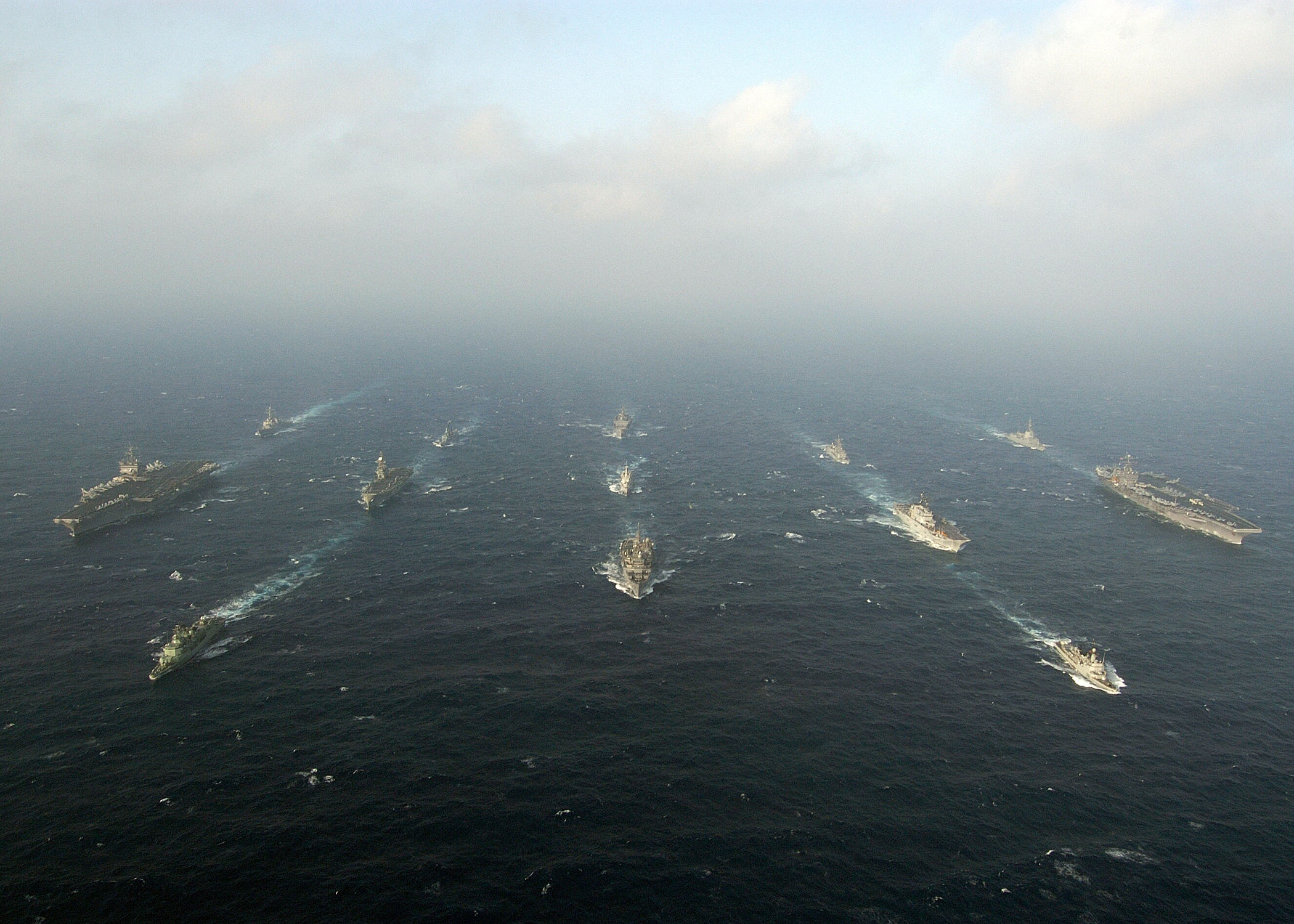
The force the United States assembled for Operation Epic Fury represents the largest American military deployment to the Middle East since the 2003 invasion of Iraq. Understanding its composition is essential to evaluating whether conventional military superiority translates into strategic victory.
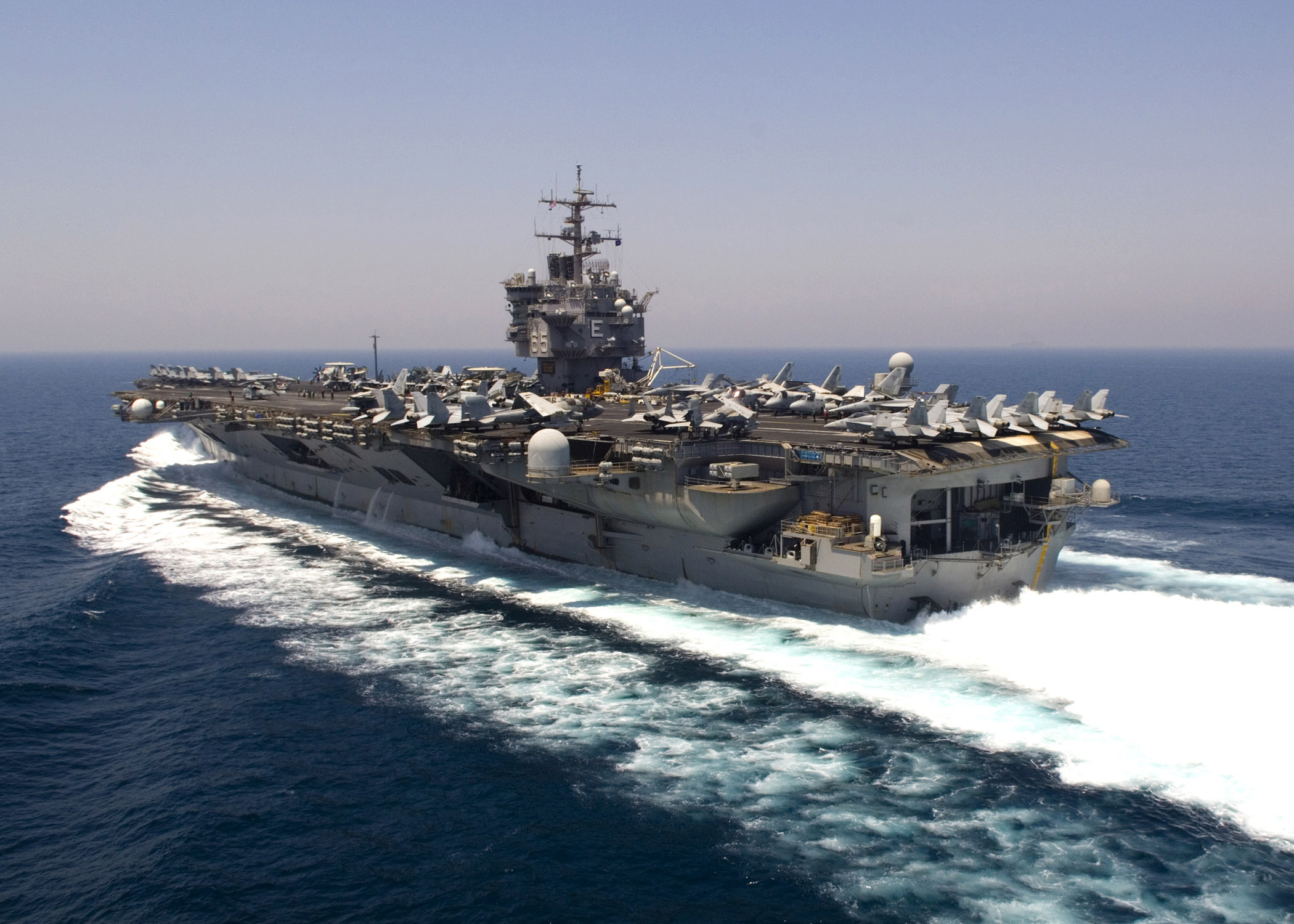
At the center of the deployment sit two carrier strike groups. The USS Abraham Lincoln (CVN-72), a Nimitz-class supercarrier, and the USS Gerald R. Ford (CVN-78), the Navy’s most advanced vessel, together carry more than 120 combat aircraft. These include F-35C Lightning II stealth fighters — their first combat deployment in a major theater operation — F/A-18E/F Super Hornets, EA-18G Growler electronic warfare aircraft, and E-2D Advanced Hawkeye early warning platforms. The carrier groups are escorted by 16 warships, including Arleigh Burke-class guided-missile destroyers equipped with the Aegis Combat System and Ticonderoga-class cruisers carrying Tomahawk land-attack cruise missiles.
The air component extends well beyond naval aviation. F-22 Raptors deployed to air bases in the Gulf region provide air superiority cover. F-15E Strike Eagles operate from bases in Qatar, the UAE, and potentially Saudi Arabia. B-2 Spirit stealth bombers have conducted long-range precision strikes from Diego Garcia and continental US bases. According to Military Times reporting, approximately 2,000 strike sorties were conducted in the first 72 hours of the operation, hitting targets across 24 of Iran’s 31 provinces — a tempo that exceeds the opening days of both Operation Iraqi Freedom and Operation Allied Force against Serbia.
The Middle East briefing 3,000+ readers start their day with.
One email. Every weekday morning. Free.
| Component | Epic Fury (2026) | Iraqi Freedom (2003) | Desert Storm (1991) | Allied Force (1999) |
|---|---|---|---|---|
| Carrier Strike Groups | 2 | 5 | 6 | 1 |
| Combat Aircraft (Approx.) | 120+ | 1,800+ | 2,780 | 1,000+ |
| Warships | 16 | 70+ | 100+ | 30+ |
| Strike Sorties (First 72 Hours) | ~2,000 | ~4,600 | ~4,700 | ~400 |
| Stealth Aircraft Types Deployed | 3 (F-22, F-35C, B-2) | 2 (F-117, B-2) | 1 (F-117) | 2 (F-117, B-2) |
| Ground Invasion Force | None | ~145,000 | ~540,000 | None |
The naval dimension deserves particular attention. By March 4, 2026, the US Navy had destroyed more than 20 Iranian naval vessels, including what the Pentagon described as Iran’s top submarine. The IRIS Dena, one of Iran’s most capable frigates, was sunk on March 4. Iran’s navy — a combination of the regular Islamic Republic of Iran Navy and the IRGC Navy’s fast-attack craft — has been functionally eliminated as a blue-water fighting force within the opening week of hostilities.
CSIS (Center for Strategic and International Studies) analysts have characterized the force as comparable to Operation Desert Fox in 1998 — a four-day punitive strike operation — rather than the full-scale invasion of Operation Desert Storm. This distinction matters enormously. Desert Fox destroyed Iraqi military infrastructure but did not topple Saddam Hussein. Desert Storm ejected Iraqi forces from Kuwait with half a million ground troops. Epic Fury has the firepower of the former and the ambition, rhetorically at least, of the latter.
Air Superiority in Five Days: How Did Iran’s Defenses Collapse So Quickly?
The speed with which the United States established complete air superiority over Iranian airspace ranks among the most decisive opening sequences in modern military history. To understand why, you need to examine three interlocking failures in Iran’s defensive posture — failures that did not begin in February 2026 but in June 2025.
During the Twelve-Day War of June 2025 — the intense Israeli-Iranian exchange that preceded the current conflict — Israel destroyed a significant portion of Iran’s Russian-supplied S-300PMU-2 surface-to-air missile batteries. These systems, delivered between 2016 and 2020 after years of diplomatic delay, represented the backbone of Iran’s integrated air defense system. Their destruction left gaps that Iran could not fill in the eight months between the Twelve-Day War and the start of Epic Fury.
Iran’s indigenous replacement, the Bavar-373, was supposed to fill those gaps. Developed domestically as a rough equivalent to the Russian S-300, the Bavar-373 had been displayed at military parades and touted by Iranian officials as proof of self-sufficiency in air defense. But according to analysis published by the Foreign Policy Research Institute (FPRI), the Bavar-373 proved catastrophically unstable under the electronic warfare conditions created by American EA-18G Growlers and F-35C sensor suites. The system’s radar was reportedly susceptible to jamming and spoofing techniques that degraded its targeting capability to the point of ineffectiveness.
The third failure was the most conspicuous. The Islamic Republic of Iran Air Force (IRIAF) — operating what defense analysts have long described as a flying museum of pre-1979 American aircraft — did not get jets airborne during either the June 2025 Twelve-Day War or the opening of Epic Fury. Iran’s combat aircraft inventory consists primarily of Grumman F-14A Tomcats (delivered before the 1979 revolution), McDonnell Douglas F-4 Phantom IIs, and Northrop F-5 Tiger IIs. These aircraft, even with Iranian modifications, are generations behind the F-22 and F-35. IRIAF commanders apparently concluded that launching them would result in immediate destruction without meaningful combat effect — a rational assessment that nonetheless represents a total abdication of contested airspace.
| System | Origin | Delivery Period | Status (March 2026) | Assessment |
|---|---|---|---|---|
| S-300PMU-2 | Russia | 2016-2020 | Destroyed (June 2025) | Eliminated by Israeli strikes during Twelve-Day War |
| Bavar-373 | Iran (indigenous) | 2019-present | Degraded/ineffective | Unstable under US electronic warfare (FPRI) |
| Tor-M1 (SA-15) | Russia | 2007 | Partially operational | Short-range point defense only; limited coverage |
| HAWK MIM-23 | United States (pre-1979) | 1970s | Largely obsolete | Iranian-modified variants; 50+ years old |
| F-14A Tomcat | United States (pre-1979) | 1976-1978 | Grounded/not deployed | Did not fly in either 2025 or 2026 conflicts |
| F-4 Phantom II | United States (pre-1979) | 1960s-1970s | Grounded/not deployed | 60+ year-old airframes; combat ineffective vs. 5th gen |
The June 2025 precedent is critical context. During the Twelve-Day War, Iran launched approximately 900 ballistic missiles and 1,000 drones at Israeli targets. According to FPRI analysis, only about 6% of ballistic missiles struck built-up areas — a performance that the institute characterized as a humiliation for Tehran. The combination of Israeli Arrow, David’s Sling, and Iron Dome interceptors, supplemented by US Navy Aegis destroyers and coalition fighter aircraft, demonstrated that Iran’s offensive missile capability, while numerically impressive, suffered from accuracy, reliability, and survivability problems that no amount of political rhetoric could obscure.
“Iran’s integrated air defense network did not fail in February 2026. It failed in June 2025, when Israeli precision strikes destroyed the S-300 backbone. What happened eight months later was a consequence, not a surprise.”
Foreign Policy Research Institute (FPRI), February 2026 assessment
The Decapitation Paradox: What Happens When You Kill the Leadership but Not the Regime?
Within the first 48 hours of Operation Epic Fury, American strikes killed Supreme Leader Ayatollah Ali Khamenei, Iran’s defense minister, the commanding general of the Islamic Revolutionary Guard Corps, and the army chief of staff. This represents the most comprehensive decapitation strike against a sovereign nation’s leadership since the United States targeted Saddam Hussein’s command infrastructure in March 2003 — strikes that failed to kill Hussein but succeeded in paralyzing Iraqi command and control for critical days.
The Epic Fury decapitation succeeded where the Iraqi precedent failed: the intended targets were killed. But Brookings Institution analysis published in the aftermath raises a question that American planners will be grappling with for months or years: decapitation has neither toppled the regime nor produced an immediate wave of popular opposition to it.
This outcome is consistent with historical patterns. The United States killed Admiral Isoroku Yamamoto in Operation Vengeance in 1943 without meaningfully altering Japanese strategic behavior. Israel assassinated Hamas leadership repeatedly without eliminating the organization. The US killed Qasem Soleimani in January 2020, and the IRGC’s Quds Force continued operations under his successor without missing a strategic beat. Decapitation strikes eliminate individuals. They do not, by themselves, eliminate institutions, ideologies, or the organizational infrastructure that sustains them.
Iran’s political system contains redundancies specifically designed to survive leadership losses. The Assembly of Experts, an 88-member body of senior clerics, is constitutionally empowered to select a new Supreme Leader. The IRGC operates with a degree of operational autonomy that does not depend on orders from Tehran in real time. Provincial IRGC commanders control their own logistics, intelligence, and militia networks. The Basij paramilitary organization, with an estimated 90,000 active members and several hundred thousand reservists, provides internal security and regime preservation capabilities at the local level.
The Brookings assessment identifies what might be called the decapitation paradox: killing the leadership creates a narrative of martyrdom that can strengthen regime cohesion in the short term, while removing the very individuals who might have had the authority to negotiate a ceasefire or surrender. Who does Washington negotiate with now? The question is not academic — it is operationally urgent.
Iran’s Missile Arsenal: A Rebuilt Threat With Chinese Characteristics
Despite the catastrophic failure of Iran’s air defenses and air force, its ballistic missile program has emerged as the most consequential military capability Tehran possesses — and the one that most complicates any straightforward narrative of American victory.
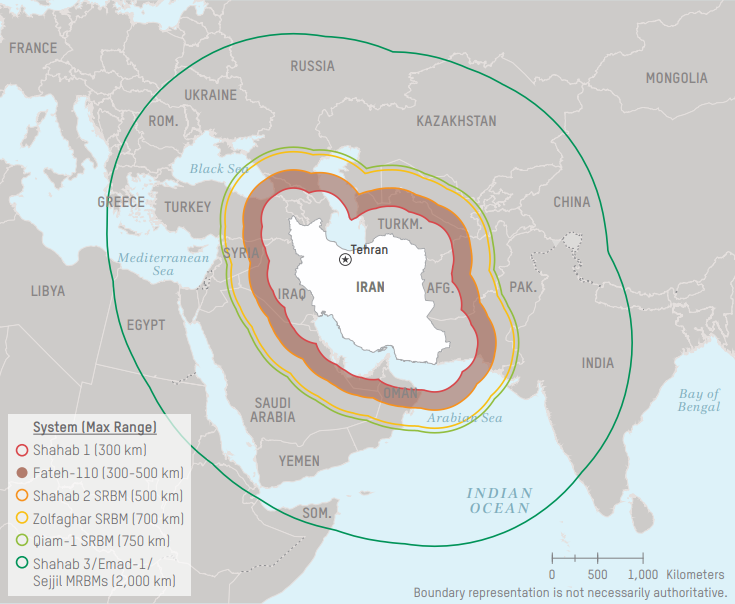
Iran rebuilt its ballistic missile stockpile to an estimated 2,500 missiles following the depletion caused by the June 2025 Twelve-Day War. This reconstruction was enabled in part by Chinese-supplied sodium perchlorate, a key oxidizer component for solid-fuel rocket propellant. The speed of this reconstitution — roughly eight months to rebuild a stockpile that took decades to accumulate — reflects both Iran’s deep missile industrial base and the continuing role of external suppliers in sustaining it.
The current arsenal includes several systems that represent genuine threats to US and allied forces:
| System | Type | Range (km) | Warhead (kg) | Fuel | Threat Assessment |
|---|---|---|---|---|---|
| Khorramshahr-4 | MRBM | 2,000 | 1,500 | Liquid | Largest warhead; targets across Gulf region |
| Sejjil-2 | MRBM | 2,000 | 750 | Solid | Faster launch cycle; harder to intercept pre-launch |
| Fattah | Hypersonic glide | 1,400 | ~500 | Solid (boost) | Maneuverable reentry; challenges terminal defense |
| Emad | MRBM | 1,700 | 750 | Liquid | GPS-guided; improved accuracy over Shahab-3 |
| Fateh-313 | SRBM | 500 | 450 | Solid | Theater-range; high accuracy |
| Dezful | SRBM | 1,000 | 450 | Solid | Extended Fateh variant; targets across Gulf |
Iran has launched ballistic missiles at targets in nine countries since the start of hostilities — an unprecedented geographic scope for a Middle Eastern conflict. The consequences have been real: nine Israeli civilians killed, six US soldiers killed, and damage to Dubai International Airport. While these numbers are small relative to the scale of the bombardment, they demonstrate that American and allied missile defense, while impressive, is not impermeable.
The Fattah hypersonic missile deserves particular analysis. Designated by Iran as a hypersonic glide vehicle, it uses a solid-fuel booster to reach high altitude before a maneuverable reentry vehicle glides toward its target at speeds claimed to exceed Mach 5. Whether the Fattah performs as advertised is debated — Janes Defence has expressed skepticism about Iranian accuracy claims — but even a partially effective hypersonic capability complicates the calculus for US missile defense planners who must now account for threats that maneuver unpredictably during terminal approach.
The Hormuz Factor: Can the Global Economy Survive a Closed Strait?
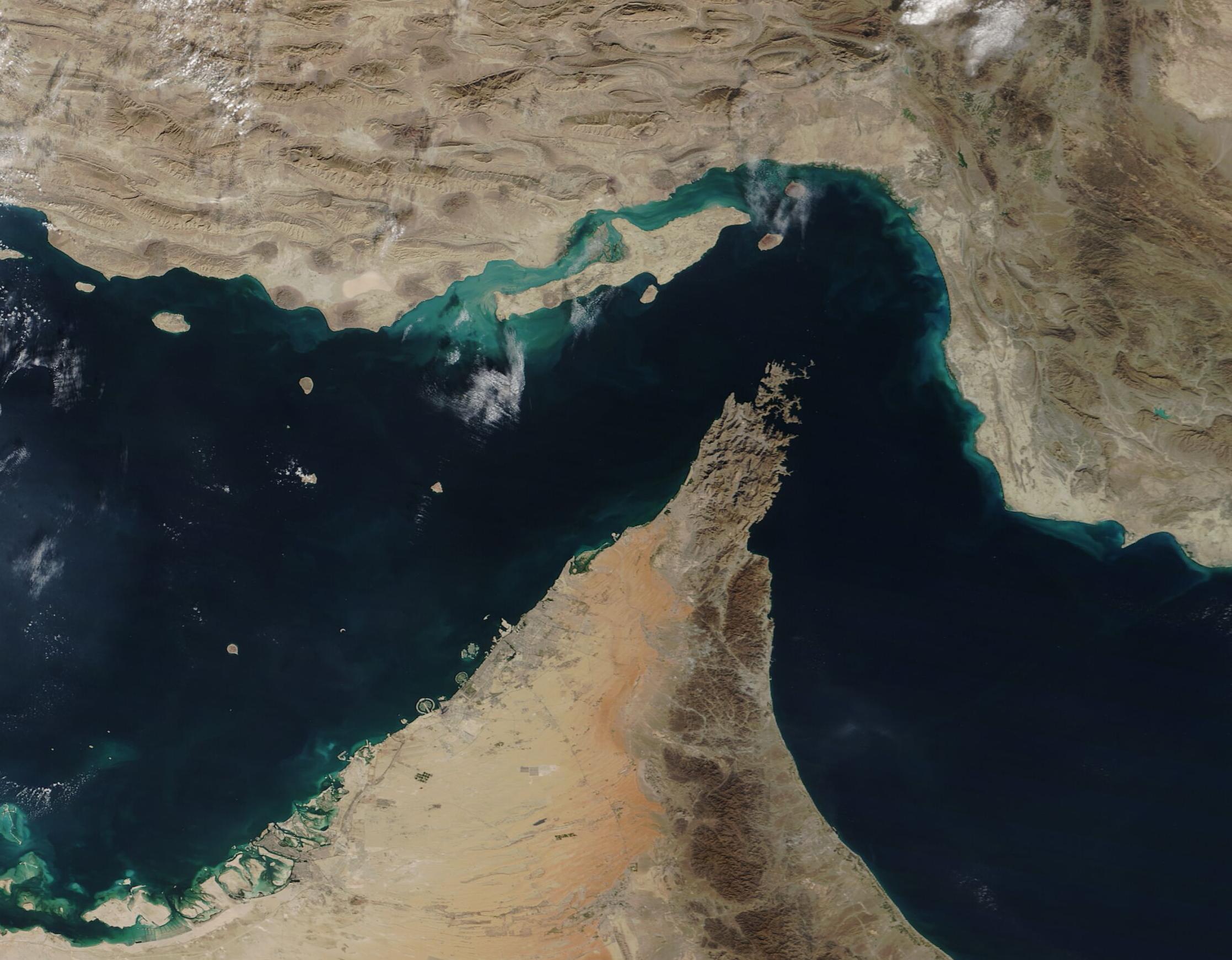
The Strait of Hormuz is 21 nautical miles wide at its narrowest point. Approximately 20% of global oil supply transits through this chokepoint daily — roughly 17-20 million barrels. The de facto closure of the strait since the start of hostilities represents what may be the most significant economic disruption caused by the conflict, and the one with the most far-reaching consequences for nations that are not parties to the fighting.
The closure is not the result of a physical blockade by either Iran or the United States. It is the result of insurance markets. Lloyd’s of London and other major maritime insurance underwriters withdrew coverage for commercial vessels transiting the strait within hours of the first missile launches. Without insurance, shipping companies cannot operate. According to Kpler maritime tracking data, more than 150 commercial vessels are anchored outside the strait, waiting for conditions that would allow insurers to restore coverage.
Goldman Sachs analysis projects that if the disruption continues beyond five weeks, oil prices will exceed $100 per barrel — a threshold that would trigger cascading economic effects including elevated fuel costs across transportation and logistics sectors, inflationary pressure on consumer goods in import-dependent economies, potential recession triggers in energy-vulnerable economies across South and Southeast Asia, and political pressure on governments worldwide to either support or oppose the American military campaign based on the economic pain it is causing their citizens.
| Duration of Disruption | Projected Oil Price (Goldman Sachs) | Global GDP Impact (Est.) | Most Affected Regions |
|---|---|---|---|
| 1-2 weeks | $85-90/bbl | -0.1% to -0.3% | South Asia, East Asia |
| 3-5 weeks | $90-100/bbl | -0.3% to -0.7% | South/SE Asia, Europe |
| 6-12 weeks | $100-120/bbl | -0.7% to -1.5% | Global impact; recession risk |
| 3-6 months | $120-150+/bbl | -1.5% to -3.0% | Systemic; 2008-level disruption possible |
For Saudi Arabia, the Hormuz disruption is existential in ways that transcend the geopolitical dimensions of the conflict. The Kingdom exports approximately 5 million barrels per day through the strait. While the East-West Pipeline (Petroline) connecting eastern oil fields to the Red Sea port of Yanbu provides some alternative capacity (approximately 5 million barrels per day), this pipeline was itself targeted during the 2019 Houthi attacks on Abqaiq and Khurais, demonstrating its vulnerability. Higher oil prices temporarily benefit Saudi revenue, but sustained disruption threatens the investment flows, tourism development, and international business confidence that underpin Vision 2030 — the Kingdom’s plan to diversify beyond hydrocarbon dependence. (For a detailed assessment of the war’s economic impact on the Kingdom, see Vision 2030 Under Fire: How the Iran War Is Destroying Saudi Arabia’s $3.3 Trillion Economic Dream.)
The Hormuz question exposes a fundamental tension in the American campaign. The United States has overwhelming naval superiority in the Persian Gulf. It has sunk more than 20 Iranian warships. But it cannot compel private insurance companies to cover commercial shipping through a war zone, and it cannot unilaterally guarantee the safety of every tanker in a strait where Iranian shore-launched anti-ship missiles, naval mines, and fast-attack boat remnants still pose threats. Military dominance does not automatically produce economic normalcy.
The Geography Problem: Why Iran Is Not Iraq, Libya, or Serbia
Every historical comparison to previous American air campaigns against authoritarian states must contend with a geographic reality that has no precedent in modern American military experience: Iran is enormous, mountainous, and populated at a scale that dwarfs every country the United States has bombed into submission.
Iran covers 1.648 million square kilometers — approximately four times the size of Iraq and nearly seven times the size of the United Kingdom. Its terrain is dominated by two major mountain ranges: the Zagros Mountains, running 1,500 kilometers from the northwest border with Turkey to the southeast coast near the Strait of Hormuz, with peaks reaching 4,409 meters (Zard Kuh); and the Alborz Mountains, stretching across the northern border with elevations exceeding 5,000 meters at Mount Damavand, the highest peak in the Middle East. Between these ranges sit the central desert plateaus — the Dasht-e Kavir and Dasht-e Lut — which provide vast distances for dispersal and concealment.
Iran’s population of 88 million is overwhelmingly urban (75%), concentrated in cities nestled within mountain valleys and along the narrow Caspian coastal plain. Tehran alone holds more than 9 million residents, with the greater metropolitan area approaching 16 million. This population density in urban terrain creates the conditions that military planners most dread: the inability to strike military targets without civilian casualties that erode international support and domestic political will.
| Country | Area (km²) | Population (at time of conflict) | Terrain | US Air Campaign Duration | Regime Change Achieved? |
|---|---|---|---|---|---|
| Iran (2026) | 1,648,195 | 88,000,000 | Mountains (4,400m+), desert, urban | Ongoing | No |
| Iraq (2003) | 438,317 | 26,000,000 | Flat desert, river valleys | 26 days (with ground invasion) | Yes (with 145K ground troops) |
| Libya (2011) | 1,759,540 | 6,400,000 | Flat desert, coastal | 7 months (NATO) | Yes (with rebel ground forces) |
| Serbia (1999) | 77,474 | 10,600,000 | River valleys, moderate hills | 78 days | Partial (Kosovo withdrawal only) |
| Afghanistan (2001) | 652,230 | 22,000,000 | Mountains (7,000m+), desert | Ongoing (2001-2021) | Initially yes; ultimately no |
Military analysts from multiple institutions have estimated that a ground invasion capable of occupying and holding Iranian territory would require between 500,000 and 1,000,000 troops — a force size the United States has not deployed since the 1991 Gulf War and could not assemble today without a general mobilization that would require congressional action and years of preparation. Supply lines from the nearest friendly ports in the Gulf states would stretch 700 to 1,000 kilometers through mountain passes that are eminently defensible. The logistical burden alone would exceed anything attempted since World War II.
The Atlantic Council has questioned whether regime change is achievable solely from the air. No air campaign in history has toppled a government without ground forces — whether those forces were indigenous rebels (Libya 2011), conventional armies (Iraq 2003, Germany 1945), or special operations forces supporting local allies (Afghanistan 2001). Epic Fury has none of these ground components.
What Millennium Challenge 2002 Still Teaches Us About Fighting Iran
In July 2002, the Pentagon conducted Millennium Challenge 2002, a $250 million war game that remains the most expensive and comprehensive military exercise in American history. The exercise was designed to test new concepts for rapid, decisive operations against a Middle Eastern adversary — widely understood to be modeled on Iran. What happened during the exercise has haunted military planners for nearly a quarter century and carries renewed urgency in 2026.
Lieutenant General Paul Van Riper, a decorated Marine Corps officer and Vietnam veteran, commanded the Red Team (the simulated Iranian force). Rather than play by the rules the Pentagon expected — engaging US forces symmetrically with conventional military assets — Van Riper employed asymmetric tactics that exploited American assumptions about how the enemy would fight.
Van Riper used motorcycle couriers instead of electronic communications, denying the Blue Team’s signals intelligence any useful intercepts. He launched a massive preemptive strike using a combination of cruise missiles, swarm attacks by fast boats laden with explosives, and shore-based anti-ship missiles. The results were devastating: the Red Team sank 16 US warships, including an aircraft carrier and two amphibious assault ships — casualties that in real terms would have equated to more than 20,000 American service members killed in a single engagement.
The Pentagon’s response was revealing. Exercise controllers suspended the war game, refloated the sunken ships, and imposed rules that prevented Van Riper from employing the tactics that had succeeded. Van Riper resigned from the exercise in protest, later telling reporters that the exercise had been rigged to produce the desired outcome. His critique was not that the US military was weak — it was that American planners consistently underestimated an adversary willing to fight on terms other than the ones Washington preferred.
The relevance to Epic Fury is direct. Iran’s IRGC Navy has long trained in exactly the asymmetric tactics Van Riper employed: swarm attacks by fast boats, shore-launched anti-ship missiles from concealed positions along the Iranian coastline, naval mining of chokepoints, and the use of civilian vessel camouflage. While the US Navy has sunk more than 20 Iranian warships in the current campaign, the question Millennium Challenge posed — what happens when you cannot predict how the enemy will attack — remains operationally live.
The Invisible Front: Cyber Operations and Electronic Warfare
The cyber dimension of the US-Iran conflict represents what may be the most asymmetric battlefield of the war — and the one where the balance of advantage is most contested.
On the American side, US Cyber Command achieved what CSIS described as a first-mover advantage in the cyber domain. Within hours of the start of hostilities, Iran’s national internet connectivity dropped to between 1% and 4% of normal capacity. The BadeSaba social media application — one of Iran’s government-approved platforms — was compromised. IRGC communications networks were targeted, degrading command and control at precisely the moment when Iranian forces needed coordination most. This cyber campaign appears to have been integrated with the kinetic strikes from the outset, suggesting a level of pre-planning that reflects years of operational preparation by US Cyber Command and the National Security Agency.
But Iran is not a cyber novice. The Islamic Republic has spent more than a decade developing offensive cyber capabilities, and its track record includes operations against some of the most hardened targets in the world. Iranian hackers associated with the IRGC conducted the Shamoon attacks against Saudi Aramco in 2012, destroying 35,000 computer workstations. They penetrated the control systems of the Bowman Avenue Dam in New York in 2013. They conducted sustained campaigns against US financial institutions between 2011 and 2013. More recently, Iranian cyber actors have already struck Amazon Web Services data centers in the UAE and Bahrain during the current conflict — a targeting choice that signals awareness of cloud infrastructure vulnerabilities and willingness to attack civilian economic targets.
The American cyber defense posture has its own vulnerability. The Cybersecurity and Infrastructure Security Agency (CISA), the federal body responsible for defending US critical infrastructure from cyberattack, has been operating at reduced capacity following furloughs associated with the Department of Government Efficiency (DOGE) restructuring. According to multiple reports, CISA staff reductions have degraded the agency’s ability to monitor threats, coordinate with private-sector partners, and respond to incidents at the speed required during active conflict. This creates a paradoxical situation: the US military dominates the offensive cyber domain while the civilian infrastructure it is sworn to protect faces degraded defensive capabilities.
Regional Escalation: Is the Middle East Already in a Wider War?
By any honest assessment, the US-Iran conflict is not a bilateral war. It is a regional conflagration involving direct or indirect hostilities across multiple countries, with casualties and infrastructure damage extending far beyond Iranian and American forces.
Lebanon has suffered 31 fatalities linked to the broader conflict, with Hezbollah — Iran’s most capable proxy — activating its military infrastructure despite the severe degradation it suffered during the 2024 Israel-Hezbollah war. Iraqi militias affiliated with Iran’s Popular Mobilization Forces have attacked US bases and personnel in Iraq, reopening a front that the United States had spent years trying to stabilize. Syria has deployed troops in alignment with Tehran, adding another layer of complexity to a country that already hosts Russian military forces, Turkish occupation zones, and US-backed Kurdish fighters.
Perhaps most remarkably, every member state of the Gulf Cooperation Council has been struck — a development that would have been considered inconceivable just five years ago. Qatar, which hosts the largest US air base in the Middle East at Al Udeid, shot down two Iranian Su-24 Fencer attack aircraft that entered Qatari airspace. NATO member Turkey was also targeted, raising questions about whether Article 5 of the NATO treaty — the collective defense provision — could be invoked by a member state that was attacked not by Russia but by Iran.
| Country | Nature of Involvement | Casualties (Reported) | Infrastructure Damage | Coalition Status |
|---|---|---|---|---|
| United States | Primary combatant; air/naval campaign | 6 soldiers KIA | N/A (domestic) | Lead coalition |
| Israel | Full combat partner; intelligence sharing | 9 civilians killed | Multiple sites struck | Full partner |
| Lebanon | Hezbollah attacks/IDF responses | 31 killed | Significant | Conflict zone |
| Iraq | Militia attacks on US bases | Multiple incidents | US base damage | Contested |
| Syria | Troop deployments pro-Iran | Unconfirmed | Ongoing strikes | Pro-Iran |
| UAE | Struck by Iranian missiles | Dubai airport damaged | Airport/infrastructure | Anti-Iran (shifting) |
| Qatar | Shot down 2 Iranian Su-24s | None reported | Minimal | Anti-Iran |
| Saudi Arabia | Potential base access; GCC member struck | Unconfirmed | Under assessment | Cautious alignment |
| Turkey | Struck by Iran; NATO Article 5 question | Under assessment | Under assessment | Uncertain |
The coalition forming around the US campaign is real but fragile. Israel is a full partner, providing intelligence, basing support, and likely direct strike capabilities. The United Kingdom has made bases available. Gulf states are shifting toward anti-Iran postures — but this shift is driven as much by self-preservation as by strategic alignment with Washington. None of these states signed up for a long war, and their support is conditional on the conflict remaining short and successful.
China and Russia, the two powers most capable of altering the strategic balance, have been conspicuously absent from the battlefield. Defense Secretary Pete Hegseth stated publicly that both powers are not really a factor in the conflict. Russia is overstretched by its ongoing war in Ukraine. China has offered diplomatic statements of concern but no material military support to Tehran. This non-intervention is significant — it means Iran is fighting alone, without the great-power backing that might have deterred or complicated US operations. But it also means that if the conflict drags on, the door for Russian or Chinese opportunism remains open.
The Cost Calculus: From $34 Billion to $2 Trillion — Where Does This End?
The financial dimensions of the US-Iran conflict offer perhaps the starkest illustration of the gap between tactical success and strategic sustainability. Through the first week of operations, the United States has spent an estimated $31-34 billion on Operation Epic Fury. This figure includes munitions expenditure (Tomahawk cruise missiles cost approximately $2 million each; JDAM precision-guided bombs approximately $25,000; JASSM-ER standoff missiles approximately $1.5 million), operational costs for carrier strike group deployments, fuel, personnel, and logistics, intelligence and surveillance operations including satellite retasking and cyber operations, and medical and support costs for forward-deployed forces.
Central estimates for the total cost of Epic Fury — assuming a campaign lasting the four to five weeks projected by President Trump — range from $40 billion to $95 billion, with a central estimate of approximately $65 billion. But these figures assume a clean conclusion. Historical precedent suggests otherwise.
| Operation | Duration | Initial Cost Estimate | Actual Cost (Inflation-Adjusted) | Ratio (Actual/Estimate) |
|---|---|---|---|---|
| Desert Storm (1991) | 43 days | $61B | $102B | 1.7x |
| Desert Fox (1998) | 4 days | N/A | ~$1B | N/A |
| Afghan War (2001-2021) | 20 years | “Weeks not months” | $2.3T | N/A |
| Iraq War (2003-2011) | 8 years | $50-60B (Rumsfeld) | $2.0T | 33-40x |
| Epic Fury (2026-?) | Ongoing (Week 1) | $40-95B | $31-34B (to date) | TBD |
The broader economic impact extends far beyond direct military expenditure. Fortune and CNBC analyses estimate total economic losses — including supply chain disruption, oil price impacts, reduced trade, insurance cost increases, and market volatility — at $50 billion to $210 billion, depending on duration. If the conflict extends beyond three months, these estimates could increase substantially.
For context: the Iraq War, which Defense Secretary Donald Rumsfeld estimated would cost $50-60 billion, ultimately cost approximately $2 trillion when veterans’ care, interest on war debt, and economic disruption are included. The Afghanistan War cost $2.3 trillion over two decades. No senior US official in 2003 or 2001 projected costs anywhere near these figures. The pattern of dramatic cost underestimation in Middle Eastern conflicts is not an anomaly — it is a feature of how these wars evolve from limited strikes into extended commitments.
The Domestic Front: Does America Have the Political Will for Another Long War?
A Quinnipiac University poll conducted in January 2026 — before the start of hostilities — found that 70% of Americans opposed military action against Iran. This figure is striking not just for its magnitude but for its timing: it predates the casualties, the economic disruption, and the images of destruction that typically erode public support as wars progress.
The domestic political environment around the Iran conflict is defined by three overlapping crises of legitimacy. First, there is no congressional authorization for the war. The Trump administration has invoked the 2002 Authorization for Use of Military Force (AUMF), originally passed to authorize the invasion of Iraq, as legal cover for operations against Iran — a legal interpretation that constitutional scholars across the political spectrum have challenged. Senators Tim Kaine and Rand Paul introduced a War Powers Resolution to compel the administration to seek congressional authorization or withdraw forces within 60 days. Senate Republicans blocked the resolution on procedural grounds, but the bipartisan nature of the challenge — a liberal Democrat and a libertarian Republican — signals the breadth of concern.
Second, protests have erupted in multiple American cities, drawing comparisons to the early stages of anti-Iraq War mobilization in 2003. While current protests remain smaller than the peak of that movement, the speed of their emergence — within days rather than months — reflects a public that has been conditioned by two decades of Middle Eastern wars to be skeptical of official timelines and optimistic projections.
Third, the administration’s own messaging has been contradictory in ways that undermine credibility. President Trump has stated the conflict will last four to five weeks and that operations are ahead of schedule. He has also floated the possibility of ending operations quickly and then potentially restarting them years later — a framing that raises more questions than it answers. Defense Secretary Hegseth has stated publicly that the campaign is not about regime change, while President Trump has separately called for regime change. The London School of Economics has identified vague deadlines, unclear victory goals and exit strategy, and no easy way to end the conflict — a description that might have been written about any American military engagement in the Middle East since 2001.
“Tactical victory is in sight. But the future is foggy. Vague deadlines, unclear victory goals and exit strategy, no easy way to end — these are the defining features of American wars in the Middle East.”
Composite assessment drawn from New Lines Institute and London School of Economics analyses, February-March 2026
What the Analysts Are Actually Saying
The most important feature of expert analysis on the US-Iran conflict is the near-universal consensus that tactical military success does not equal strategic victory — and the equally universal uncertainty about what comes next.
CSIS (Center for Strategic and International Studies) has characterized the Epic Fury force as comparable to Desert Fox (1998), noting that the deployment lacks Marines, special operations forces, and the logistics infrastructure needed for an extended air campaign. This assessment implicitly challenges the notion that the current campaign can achieve objectives beyond punitive destruction — the force is sized and structured for a short, sharp operation, not a war of transformation.
RAND Corporation analysis has projected a more protracted and destructive air war than official timelines suggest. RAND analysts note that Iran’s IRGC has argued internally that the US and Israel cannot sustain a longer campaign — a calculation based on political will rather than military capability. If Iran’s strategy is to absorb punishment and wait for American fatigue, the relevant variable is not aircraft carriers but congressional patience.
The Brookings Institution has focused on the aftermath of decapitation, noting that killing Khamenei has neither toppled the regime nor produced the immediate popular uprising that some in Washington hoped for. This finding echoes decades of scholarship on decapitation strikes, which consistently shows that killing leaders without destroying institutions produces instability without resolution.
The Atlantic Council has raised perhaps the most fundamental question: can regime change be achieved solely from the air? Their assessment notes generational implications for the conflict, suggesting that whatever happens in the next four to five weeks, the consequences will unfold over decades. The European Council on Foreign Relations (ECFR) has described the situation even more starkly as a war with no winners.
The New Lines Institute offered what may be the most precise summary of the current situation: tactical victory is in sight, but the future is foggy. This formulation captures the essential tension — the United States is winning every engagement while the outcome of the war remains profoundly uncertain.
| Institution | Key Assessment | Implied Prognosis |
|---|---|---|
| CSIS | Force comparable to Desert Fox, not Desert Storm; lacks ground component | Punitive, not transformative |
| RAND Corporation | More protracted air war likely; Iran banking on US political fatigue | Extended conflict probable |
| Brookings Institution | Decapitation succeeded but regime not toppled; no popular uprising | Political objectives unmet |
| Atlantic Council | Generational implications; regime change from air alone questionable | Long-term instability |
| ECFR | A war with no winners | Mutual damage, no resolution |
| New Lines Institute | Tactical victory in sight; future is foggy | Military success, strategic uncertainty |
| LSE | Vague deadlines, unclear goals, no exit strategy | Open-ended commitment risk |
| FPRI | Iran air defense catastrophically failed; June 2025 precedent decisive | Air superiority total but insufficient alone |
| FDD | Missile rebuilding with Chinese components; 2,500 missiles reconstituted | Sustained retaliatory capability |
| 19FortyFive | America would win the war; what happens after is the real problem | Tactical victory, strategic quagmire |
The Victory Matrix: An Original Framework for Defining Success
The central problem in answering whether America can win the Iran war is that the word winning has at least five distinct meanings, each with different timelines, metrics, and probabilities of success. The HOS Victory Matrix provides a structured framework for evaluating each definition against available evidence.
| Definition of Victory | Metric | Current Status (March 2026) | Probability of Achievement | Historical Precedent | Timeline |
|---|---|---|---|---|---|
| Air Superiority & Target Destruction | Destroyed military targets; unchallenged airspace | Achieved (Day 3-5) | 95%+ (already achieved) | Desert Storm, Allied Force | Days to weeks |
| Regime Decapitation & Leadership Elimination | Key leaders killed; command structure disrupted | Partially achieved | 70-80% (leaders killed; regime survives) | Iraq 2003 (Hussein survived initial strikes) | Days (strikes); months (effects) |
| Regime Change | Iranian government replaced by successor | Not achieved | 15-25% (without ground forces) | No precedent via air power alone | Months to years, if achievable |
| Nuclear Program Permanent Elimination | All nuclear infrastructure destroyed; no reconstitution | Unknown | 30-40% (facilities struck; knowledge persists) | Osirak (1981), Syrian reactor (2007) — delayed, not eliminated | Temporary: months; permanent: unlikely |
| Stable Post-War Order Favorable to US | Compliant successor government; regional stability; open Hormuz | Not achieved | 5-10% (no institutional precedent) | Iraq (failed), Libya (failed), Afghanistan (failed) | Years to decades, if achievable |
The Victory Matrix reveals a pattern that should be familiar to anyone who has studied American military interventions in the Middle East: the probability of success decreases dramatically as the ambition of the objective increases. The United States can destroy targets and establish air superiority with near-certainty — it has done so. It can kill leaders with high probability — it has done so. But achieving the political objectives that would make the military campaign strategically meaningful — regime change, permanent nuclear disarmament, a stable successor order — requires capabilities and commitments that the current force structure does not possess and that American political will may not sustain.
This framework suggests that the answer to the article’s title question is not a simple yes or no. It is a conditional: America can win the war it is currently fighting. It cannot, with the tools it has deployed, win the war it would need to fight to achieve its stated political objectives. The gap between these two wars — the war of destruction and the war of transformation — is the gap where forever wars are born.
The Contrarian Case: Why Both Hawks and Doves Are Wrong
The dominant narratives about the US-Iran conflict fall into two camps, both of which are analytically incomplete.
The hawkish narrative holds that American military dominance is so overwhelming that victory is inevitable if Washington maintains resolve. This view points to real evidence: the destruction of Iranian air defenses, the sinking of the Iranian navy, the killing of the supreme leader, the collapse of internet connectivity, and the absence of Chinese or Russian intervention. Hawks argue that skeptics are refighting the last war — that the mistakes of Iraq and Afghanistan were political and strategic, not military, and that a properly executed air campaign can achieve objectives that ground occupations could not.
The problem with the hawkish narrative is that it defines victory in purely military terms while the war’s objectives are political. Air superiority does not produce regime change. Killing leaders does not eliminate institutions. Destroying infrastructure does not build a successor order. Hawks point to military metrics because those are the metrics that favor their argument, while ignoring the metrics — political stability, economic normalcy, regional order — that would constitute actual strategic success.
The dovish narrative holds that the war is already lost — that Iran’s geography, population, missile capability, and asymmetric doctrine make military success impossible, and that the United States is sleepwalking into another Afghanistan. Doves point to the Hormuz disruption, the regional escalation, the domestic opposition, and the cost trajectory as evidence that the campaign is unsustainable.
The problem with the dovish narrative is that it underestimates the genuine military damage the United States has inflicted. Iran’s air force is non-functional. Its navy is largely destroyed. Its leadership structure has been decapitated. Its air defense network has been rendered ineffective. Its internet connectivity has been reduced to near-zero. These are not trivial accomplishments — they represent a catastrophic degradation of Iranian state capacity that will take years or decades to rebuild. Doves point to political and economic metrics because those are the metrics that favor their argument, while minimizing the military reality on the ground.
The truth lies in a space that neither camp occupies comfortably. The United States has achieved decisive tactical military victory against Iran in every domain — air, sea, cyber, and electromagnetic. Iran has been unable to meaningfully contest American military operations. Simultaneously, the United States has not achieved — and shows no clear path to achieving — the political objectives that would constitute strategic victory: regime change, permanent denuclearization, a stable post-war order, or even the secure reopening of the Strait of Hormuz. Both facts are true. Both matter. The tension between them is the defining characteristic of the conflict.
The contrarian synthesis is this: America has won the war it chose to fight and cannot win the war it needs to win. This is not a contradiction. It is the fundamental strategic reality of Operation Epic Fury, and recognizing it is the prerequisite for any honest conversation about what comes next.
Frequently Asked Questions
Has the United States achieved air superiority over Iran?
Yes. The US established complete air superiority within the first five days of Operation Epic Fury. Iran’s S-300 air defense systems were destroyed during the June 2025 Twelve-Day War, its indigenous Bavar-373 systems proved ineffective under electronic warfare conditions, and the IRIAF did not launch combat aircraft. US aircraft operate over Iranian airspace without meaningful contestation.
Is Iran’s nuclear program destroyed?
Strike assessments for nuclear facilities have not been fully disclosed. While the US has targeted known nuclear sites, the International Atomic Energy Agency has not yet conducted post-strike inspections. Historical precedent — Israel’s 1981 Osirak strike and 2007 Syrian reactor strike — suggests that air attacks can destroy physical facilities but cannot eliminate the scientific knowledge and expertise required to reconstitute a program. Permanent nuclear disarmament typically requires negotiated agreements with verification regimes, not military strikes alone.
Could this become another Afghanistan or Iraq?
If the United States avoids a ground invasion, the conflict will not replicate the Iraq or Afghanistan occupation models. However, extended air campaigns without clear political objectives can produce their own form of indefinite commitment — a pattern visible in the US air war against ISIS (2014-ongoing in various forms) and the NATO campaign in Libya (which lasted seven months rather than the projected weeks). The risk is not occupation but open-ended bombardment without a defined end state.
What is the impact on oil prices and the global economy?
The de facto closure of the Strait of Hormuz has disrupted approximately 20% of global oil supply. Goldman Sachs projects prices exceeding $100 per barrel if the disruption lasts beyond five weeks. Total economic costs — including direct military spending, supply chain disruption, and market impact — are estimated at $50-210 billion depending on duration. Saudi Arabia faces particular exposure given its reliance on Hormuz transit for oil exports and the potential impact on Vision 2030 investment flows.
Is there an exit strategy?
No clearly articulated exit strategy has been presented. President Trump has mentioned a four-to-five-week timeline and operations being ahead of schedule, while also suggesting the possibility of pausing and resuming operations over an extended period. Defense Secretary Hegseth’s statement that the campaign is not about regime change contradicts the President’s calls for regime change, creating strategic ambiguity about the campaign’s end state. The LSE has identified the absence of a clear exit strategy as one of the defining features of the conflict.
What role are China and Russia playing?
Neither China nor Russia has intervened militarily on Iran’s behalf. Russia is constrained by its ongoing war in Ukraine. China has limited its response to diplomatic statements. However, Chinese-supplied sodium perchlorate has been identified as a component in Iran’s reconstituted missile arsenal, suggesting economic and industrial support that falls below the threshold of direct military involvement. Defense Secretary Hegseth has stated both powers are not really a factor in the current conflict.
How many casualties has the conflict produced?
Verified figures include six US soldiers killed, nine Israeli civilians killed, and 31 killed in Lebanon. Iranian casualty figures have not been independently verified and are likely substantially higher given the scale of strikes across 24 provinces. Civilian casualty figures for Iran are unavailable from independent sources at this time. The full human cost of the conflict will not be known until post-conflict assessments are conducted.
What happens if Iran retaliates with unconventional attacks on the US homeland?
Iran has demonstrated cyber capabilities against US infrastructure over more than a decade. The current degradation of CISA’s capacity due to staffing reductions increases vulnerability to cyber retaliation against civilian infrastructure including power grids, financial systems, and communications networks. Physical attacks on the US homeland by Iranian agents or proxies, while not impossible, would represent an escalation that would dramatically alter the political calculus in Washington — likely strengthening rather than weakening support for military action.