RIYADH — Saudi Arabia has signed an initial contract for Ukrainian-made interceptor missiles and is negotiating a separate, larger arms deal with Kyiv that could be finalized as early as this week, according to sources within Ukraine’s defense industry cited by the Kyiv Independent. The agreement marks the most consequential shift in Gulf defense procurement in a generation, breaking a decades-long Western monopoly on weapons sales to the world’s largest arms-importing region at the precise moment that the Iran war has exposed the ruinous cost of defending against cheap drones with expensive American interceptors.
The deal’s significance extends far beyond the hardware involved. Saudi Arabia — which received 74 percent of its arms from the United States between 2020 and 2024, according to the Stockholm International Peace Research Institute — is now purchasing weapons from a country that has spent four years fighting Russia, Moscow’s partner in the OPEC+ oil cartel that underpins Riyadh’s entire fiscal strategy. The geopolitical contradiction is breathtaking, and it reveals something that no amount of diplomatic communiqués could: when survival is at stake, procurement pragmatism trumps every alliance.
Table of Contents
- What Did Saudi Arabia Buy From Ukraine?
- Why Did Riyadh Turn to Kyiv for Weapons?
- The Interceptor Economics That Broke Western Air Defense
- How Cheap Can a Drone Interceptor Actually Get?
- How Did Zelenskyy and MBS Reach This Deal?
- The OPEC+ Paradox — Buying From Russia’s Enemy
- Can Ukraine’s Defense Industry Deliver at Scale?
- Who Else Wants Ukrainian Weapons in the Gulf?
- Saudi Arabia’s Defense Procurement Transformation
- What This Means for American Defense Contractors
- Will the Saudi-Ukraine Defense Relationship Survive the Peace?
- Frequently Asked Questions
What Did Saudi Arabia Buy From Ukraine?
A Saudi Arabian arms company acting as a local intermediary has signed a contract for Ukrainian-made interceptor missiles, with sources telling the Kyiv Independent to expect a “huge deal” between Saudi Arabia and Ukraine as soon as March 11. The initial contract covers air defense interceptor systems — the precise category of weapon that Saudi Arabia has been consuming at an unsustainable rate since Iranian missiles and drones began striking Gulf territory on March 1.
The deal is understood to encompass several categories of Ukrainian defense technology. First, there are the interceptor missiles themselves — likely variants of Ukraine’s domestically produced air defense munitions that have been refined through four years of continuous combat against Russian cruise missiles and Iranian-designed Shahed drones. Second, the agreement reportedly includes provisions for Ukrainian drone interceptor systems, the low-cost unmanned aerial vehicles that Kyiv has pioneered to counter the mass drone attacks that have become the defining tactical challenge of both the Russia-Ukraine and Iran-Gulf conflicts.
The Kyiv Independent contacted the Saudi Foreign Affairs Ministry and the Saudi Embassy in Kyiv for comment but did not receive a response by the time of publication. The opacity is characteristic of Gulf defense procurement, where deals of this magnitude are routinely confirmed only after hardware has already been delivered.
What distinguishes this transaction from conventional arms sales is the buyer’s motivation. Saudi Arabia is not purchasing Ukrainian weapons because they represent the most advanced technology available. It is purchasing them because they represent the most relevant technology available — systems designed, built, and battle-tested against the exact threats that are now striking Riyadh, Dhahran, and Jeddah on a daily basis. No Western defense contractor can make that claim.
The Middle East briefing 3,000+ readers start their day with.
One email. Every weekday morning. Free.

Why Did Riyadh Turn to Kyiv for Weapons?
Three converging crises forced Saudi Arabia to look beyond its traditional suppliers. Each individually would have been manageable. Together, they created a procurement emergency that the existing Western defense industrial base could not resolve on any timeline compatible with an active war.
The scramble for non-American defense hardware extends beyond Ukraine. Pakistan has deployed LY-80 and FM-90 air defense systems to Saudi Arabia under the bilateral defense pact, adding Chinese-origin missile batteries to the Kingdom’s layered defense network alongside the incoming Ukrainian systems.
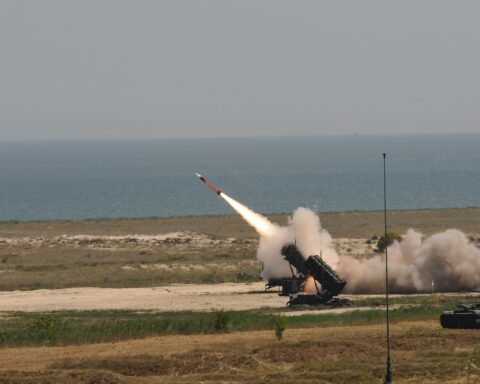
The first crisis is cost. Each PAC-3 Missile Segment Enhancement interceptor — the primary munition used by Saudi Arabia’s Patriot air defense batteries — costs between $4 million and $12 million per unit, with international buyers typically paying toward the higher end of that range. Iran’s Shahed-136 attack drones cost an estimated $20,000 to $50,000 each. The arithmetic is devastating: every dollar Iran spends on attack drones forces Saudi Arabia to spend between $80 and $600 on defense. Anadolu Agency analysis found that every $1 Iran spent on drone attacks prompted an estimated $15 to $35 in Gulf defense spending, a ratio that is militarily sustainable for Iran but fiscally catastrophic for the defending states.
The second crisis is supply. In January 2026, the United States approved a $9 billion Foreign Military Sale to provide Saudi Arabia with up to 730 PAC-3 MSE interceptors. That approval came seven weeks before the war began. Delivery timelines for Patriot interceptors typically run 18 to 36 months from contract signing, according to the Congressional Research Service. Saudi Arabia does not have 18 months. It is firing interceptors daily.
The third crisis is conceptual. The cost asymmetry between cheap attack drones and expensive interceptors is not a temporary wartime distortion. It is the permanent future of air warfare. Countering $35,000 drones with $4 million missiles is the military equivalent of burning banknotes to stay warm. Saudi defense planners concluded that the kingdom needs a fundamentally different tier of interceptor — one measured in thousands of dollars per round, not millions.
Ukraine builds exactly that tier of weapon. And unlike any prototype from a Western defense laboratory, Ukrainian interceptors have already destroyed thousands of targets in combat.
The Interceptor Economics That Broke Western Air Defense
The financial logic driving the Saudi-Ukraine deal becomes clear when interceptor systems are compared not by capability class but by cost-per-engagement against the specific threats Iran deploys. Defense procurement has historically been evaluated on specifications — range, altitude ceiling, probability of kill. The Iran war introduced a different metric: cost-per-intercept relative to the target’s value. By that measure, Western air defense systems are failing.
| System | Country of Origin | Unit Cost | Target Type | Cost Ratio (Interceptor:Target) | Rounds Per Engagement | Engagement Cost |
|---|---|---|---|---|---|---|
| PAC-3 MSE | United States | $4M-$12M | Ballistic missile | 1:1 to 3:1 | 2 | $8M-$24M |
| PAC-2 GEM-T | United States | $1M-$3M | Cruise missile | 2:1 to 6:1 | 2 | $2M-$6M |
| PAC-3 MSE vs drone | United States | $4M-$12M | Shahed drone ($35K) | 114:1 to 343:1 | 1-2 | $4M-$24M |
| Wild Hornets Sting | Ukraine | $2,100 | Shahed drone ($35K) | 0.06:1 | 1 | $2,100 |
| Skyfall P1-Sun | Ukraine | $1,000 | Shahed drone ($35K) | 0.03:1 | 1 | $1,000 |
| IRIS-T SLM | Germany | $430K | Cruise missile / drone | 12:1 vs drone | 1 | $430K |
| Gepard 35mm | Germany | $30/round | Low-altitude drone | 0.01:1 | 20-40 | $600-$1,200 |
The matrix reveals why Ukrainian systems are not merely competitive but existential for Gulf air defense. Against Iran’s mass drone attacks, the PAC-3 generates a cost ratio exceeding 100:1 in the attacker’s favor. Ukrainian interceptor drones flip that ratio entirely, generating a cost advantage for the defender for the first time in the modern air defense era. The kingdom’s missile defense architecture has a structural vulnerability that no amount of Patriot procurement can fix — it was never designed for this type of threat at this scale.
Ukraine’s expertise extends beyond aerial platforms. Kyiv’s maritime drones destroyed a third of Russia’s Black Sea Fleet — a precedent that Iran has now replicated in the Persian Gulf. The deployment of kamikaze drone boats against Gulf shipping underscores why Saudi Arabia needs Ukrainian unmanned systems expertise across all domains, not just in the air.
Saudi Arabia spent an estimated $75.8 billion on defense in 2024, according to official figures cited by SIPRI, making it the fifth-largest military spender on earth and the highest per capita. Defense expenditure rose from $53.9 billion in 2021 to $72.5 billion in 2025, reflecting a compound annual growth rate of 7.7 percent, according to ResearchAndMarkets. Even at that spending level, the interceptor cost asymmetry is unsustainable. A $78 billion defense budget sounds impregnable until it is being drained at $4 million per engagement against targets that cost $35,000 to build.
How Cheap Can a Drone Interceptor Actually Get?
Ukraine has answered that question in combat. The country’s defense industry has produced a generation of interceptor drones that cost between $1,000 and $2,500 per unit — roughly the price of a mid-range smartphone — and have destroyed thousands of Russian Shahed-136 drones over Ukrainian cities since 2022.
The Wild Hornets Sting, the most prolific Ukrainian interceptor drone, costs approximately $2,100 per unit. It uses a 3D-printed aerodynamic frame, four rotors, and a Kurbas thermal imaging camera from Odd Systems. It reaches flight speeds of 343 kilometers per hour, cruises at altitudes up to 3,000 meters, and has an engagement range of 25 kilometers. Wild Hornets produces over 10,000 units per month, making it the largest interceptor drone manufacturer in Ukraine by volume.
The Skyfall P1-Sun is even cheaper at approximately $1,000 per unit. Also 3D-printed, it flies at up to 300 kilometers per hour. The TAF Industries Octopus-100, developed jointly with the United Kingdom under the Build with Ukraine initiative announced in October 2025, represents the next generation of interceptor design. These are not developmental prototypes. They are mass-production weapons systems being manufactured at industrial scale.
The implications for Saudi Arabia are transformative. At current Iranian attack rates — the Saudi Defence Ministry has reported intercepting an average of 8 to 15 drones per day since March 1 — a fleet of Ukrainian interceptor drones could reduce the cost of drone defense from approximately $32 million to $80 million per day (using Patriot-class interceptors) to $8,000 to $37,500 per day (using Ukrainian drone interceptors). Over a month of sustained operations, the savings exceed $1 billion.
The technology is not a replacement for Patriot or THAAD systems against ballistic missiles. Iranian Emad and Shahab-3 ballistic missiles still require conventional interceptors. But against the mass drone attacks that constitute the majority of Iranian strikes on Gulf territory, Ukrainian systems offer a cost-appropriate response that Western arsenals simply do not contain.
How Did Zelenskyy and MBS Reach This Deal?
The diplomatic choreography began on March 2, when Ukrainian President Volodymyr Zelenskyy publicly offered Gulf states assistance in countering Iranian drones. “Ukrainians have been fighting against Shahed drones for years now, and everyone recognises that no other country in the world has this kind of experience. We are ready to help,” Zelenskyy said in a statement reported by Al Jazeera.
On March 7, Zelenskyy spoke directly with Crown Prince Mohammed bin Salman to discuss “the security situation in the Middle East and the Gulf region — the existing challenges and countering threats from the Iranian regime,” according to a readout posted by journalist Christopher Miller. The call represented the first direct engagement between the two leaders specifically focused on defense cooperation rather than peace mediation for the Russia-Ukraine conflict.
By March 9, Kyiv had dispatched three teams of military experts to the Middle East — one each to Qatar, the United Arab Emirates, and Saudi Arabia — to advise on counter-drone operations and assess requirements for Ukrainian defense equipment. Ukrainska Pravda reported that the teams included specialists in electronic warfare, drone operations, and air defense integration.
Zelenskyy also contacted the leaders of Bahrain, Jordan, Kuwait, Qatar, and the UAE, according to The Hill. The breadth of outreach signals that Kyiv views the Iran war not as a bilateral opportunity with Saudi Arabia but as a region-wide market opening for Ukrainian defense exports.
The quid pro quo is explicit. Bloomberg reported on March 2 that Zelenskyy offered drone defense assistance “in return for truce” — a reference to Kyiv’s hope that Gulf states with influence over the United States would support peace efforts in the Russia-Ukraine conflict. More concretely, Fortune reported that the United States and Gulf states have made repeated requests for Ukraine’s interceptor drones, and that Kyiv hopes to acquire PAC-2 and PAC-3 interceptors for its own Patriot air defenses in exchange. The deal is structured as a weapons swap: Ukrainian interceptor technology for Western conventional air defense systems that Kyiv desperately needs against Russian ballistic missiles.

The OPEC+ Paradox — Buying From Russia’s Enemy
The Saudi-Ukraine defense deal contains a geopolitical contradiction so brazen that neither side has attempted to explain it publicly. Saudi Arabia sits alongside Russia in the OPEC+ oil cartel — a partnership that has defined global energy markets since 2016 and survived every geopolitical disruption thrown at it, including the initial Russian invasion of Ukraine in 2022. Now Riyadh is purchasing weapons from the country that Russia has been trying to destroy for four years.
The conventional wisdom holds that Saudi Arabia has maintained studied neutrality in the Russia-Ukraine conflict, balancing its security relationship with Washington against its energy partnership with Moscow. The kingdom voted in favor of United Nations General Assembly resolutions condemning Russia’s invasion and annexation of Ukrainian territory. But it simultaneously refused to join Western sanctions, continued OPEC+ cooperation that critics — including the White House — accused of boosting Russian oil revenues, and hosted peace negotiations between Russian and American officials in Riyadh.
The Ukraine arms deal explodes that carefully maintained ambiguity. Buying weapons from Ukraine is not a neutral act. It is a direct financial contribution to the defense capacity of a nation at war with Russia. Every dollar Saudi Arabia spends on Ukrainian interceptors strengthens the very defense industrial base that produces weapons being fired at Russian forces in the Donbas and Crimea.
And yet Moscow’s response has been conspicuously muted. Russia cannot afford to alienate Saudi Arabia — not when OPEC+ cooperation remains the primary mechanism through which Moscow manages its oil revenues under Western sanctions, and not when the eight-member OPEC+ group agreed in March 2026 to resume unwinding 1.65 million barrels per day of voluntary production cuts. The Kremlin’s silence on the Saudi-Ukraine deal reflects a hierarchy of interests: energy revenue outranks wounded pride.
The deeper truth is that MBS’s three-front war — military, diplomatic, and economic — has given Riyadh leverage it did not possess before February 28. A country under daily missile attack has moral authority to purchase weapons from whoever will sell them. Russia understands this. More importantly, Russia understands that objecting would push Saudi Arabia closer to a comprehensive Western security alignment that Moscow has spent a decade trying to prevent.
Can Ukraine’s Defense Industry Deliver at Scale?
Ukraine’s defense production has undergone a wartime transformation that few outside the industry fully appreciate. In 2025, Ukrainian defense industry production reached $35 billion, according to United24 Media. The government estimates production potential could reach $50 to $55 billion in 2026. Ukraine manufactured between 2.5 million and 4 million drones in 2025, according to official figures, and aims to produce approximately 7 million drones of various types in 2026.
These are not aspirational targets from a peacetime think tank. They are wartime production figures from a country that has been manufacturing weapons under missile bombardment for four years. Ukrainian factories operate in dispersed, hardened facilities precisely because Russian strikes have targeted defense production sites since 2022. The resulting supply chain is resilient by design rather than by choice.
The export dimension is new. According to Mezha Media, the Ukrainian government authorized controlled weapons exports at the state level in 2025, and export licenses began to be issued in early 2026. In February, Zelenskyy announced the creation of ten Ukrainian defense export centers across Europe, signaling what the Atlantic Council described as Ukraine’s “pivot from a recipient of aid to a supplier of strategic capability.”
Arms exports could bring Ukraine up to $10 billion annually, according to government estimates cited by Mezha. The first export wave focuses on drone systems — aerial, ground, and maritime platforms — the technologies that have redefined modern warfare. Officials described the export strategy as a mechanism of “self-financing defense,” allowing factories to run at full capacity while generating foreign currency revenue.
For Saudi Arabia, the production scale matters as much as the unit cost. A country burning through interceptors at wartime rates needs a supplier that can manufacture thousands of units per month, not hundreds per year. Wild Hornets alone produces over 10,000 Sting interceptor drones monthly. That production rate exceeds the combined monthly output of PAC-3 interceptors by every Raytheon facility worldwide.
The urgency of alternative sourcing was underscored when Israel reported critically low interceptor stocks in mid-March, confirming that the shared U.S. supply chain serving both Tel Aviv and Riyadh cannot sustain two simultaneous high-intensity air defense campaigns.
| Metric | Ukraine (2026 est.) | United States | Germany |
|---|---|---|---|
| Total defense production | $50-55B | $400B+ | $12B |
| Drone production (annual) | 7 million (target) | ~50,000 | ~5,000 |
| Interceptor drone monthly output | 10,000+ (Wild Hornets alone) | N/A (no equivalent) | N/A |
| PAC-3/equivalent monthly output | N/A | ~40-60 | N/A |
| Combat-tested against Shahed | Yes (4 years) | No (advisory only) | Limited (IRIS-T in Ukraine) |
| Unit cost per drone interceptor | $1,000-$2,500 | N/A | N/A |

Who Else Wants Ukrainian Weapons in the Gulf?
Saudi Arabia is not the only Gulf state reaching out to Kyiv. The Kyiv Independent reported that Ukraine has also sent drone defense expert teams to Qatar and the United Arab Emirates. All six Gulf Cooperation Council members — Saudi Arabia, the UAE, Qatar, Kuwait, Bahrain, and Oman — have come under varying degrees of Iranian attack since March 1, creating region-wide demand for affordable counter-drone systems.
Qatar is a particularly significant potential customer. Iranian missiles were intercepted over Qatari airspace on March 7, according to Al Jazeera, marking the first direct Iranian military action against the emirate. Qatar hosts the largest US military base in the Middle East — Al Udeid Air Base — making it both a high-value target for Iran and a node in the American defense architecture that Washington is eager to protect. The combination of threat exposure and purchasing power makes Qatar a natural market for Ukrainian interceptor systems.
The UAE’s defense diversification is already more advanced than Saudi Arabia’s. Abu Dhabi has purchased Turkish Bayraktar TB2 drones, Chinese Wing Loong II armed drones, and South Korean surface-to-air missile systems, demonstrating a willingness to look beyond Western suppliers that predates the current conflict. The Korean systems have proven spectacularly effective: South Korea’s Cheongung-II air defense system scored a 96 percent intercept rate in its combat debut defending the UAE against Iranian missiles, a performance that prompted Saudi Arabia to commit $3.2 billion to the same platform. Ukrainian interceptors would fit naturally into an Emirati procurement philosophy that already prioritizes cost-effectiveness and supplier diversification.
Kuwait, which closed its airspace and cut oil production after Iranian strikes damaged its airport, represents urgent demand. Bahrain, the Gulf’s smallest and most exposed state, faces an air defense challenge that its current capabilities cannot sustain against mass drone attacks.
Fortune reported that the United States itself has made repeated requests for Ukraine’s interceptor drones — a remarkable admission that the world’s largest defense spender recognizes a capability gap in its own arsenal. The US does not produce a sub-$10,000 interceptor drone equivalent to the Wild Hornets Sting or Skyfall P1-Sun. That gap exists because the American defense procurement system was not designed for the mass attrition warfare that Ukraine and Iran have made the new global standard.
Saudi Arabia’s Defense Procurement Transformation
The Ukraine deal does not exist in isolation. It accelerates a defense procurement transformation that Saudi Arabia has been pursuing since Vision 2030 established a target of localizing 50 percent of military spending by the end of the decade. The General Authority for Military Industries, established in 2017, reported that defense localization rose from 4 percent in 2018 to 19.35 percent in 2024 — meaningful progress but still far short of the 50 percent goal.
Saudi Arabian Military Industries, a Public Investment Fund portfolio company, operates as the national champion entity with subsidiaries spanning aerospace, land systems, weapons and missiles, and defense electronics. SAMI’s partnerships with international suppliers — including Lockheed Martin, Boeing, and BAE Systems — typically include technology transfer requirements that mandate local manufacturing, knowledge transfer, and Saudi workforce development as conditions of contract award.
The Ukrainian deal represents a different model. Rather than purchasing finished weapons from a Western prime contractor and negotiating technology transfer over a multi-year implementation period, Saudi Arabia is acquiring relatively simple, mass-producible systems that could be manufactured domestically with minimal technology transfer complexity. A 3D-printed interceptor drone costing $1,000 to $2,500 is orders of magnitude less technologically complex to localize than a PAC-3 interceptor missile requiring semiconductor fabs and precision machining facilities. The same week, reports emerged that Saudi Arabia signed a $5 billion deal with China to build Wing Loong-3 combat drones in Jeddah, further demonstrating that Riyadh is sourcing military hardware from every available partner regardless of geopolitical alignment.
This aligns with a broader shift in Saudi defense industrial strategy that the Iran war has accelerated. The kingdom’s previous approach emphasized acquiring the most advanced Western systems available — Patriot, THAAD, F-15SA, Typhoon — and gradually building local capacity to maintain and eventually co-produce them. The war revealed that sophistication without scale is a vulnerability. What Saudi Arabia needs is not a small number of exquisite weapons but a large number of adequate ones. The pattern now emerging — Ukrainian interceptors, Chinese factories, Korean batteries — amounts to an arms race that will outlast the missiles themselves, structurally reshaping how Riyadh sources, builds, and stockpiles military hardware for a generation.
| Year | Localization Rate | Defense Budget | Key Milestone |
|---|---|---|---|
| 2018 | 4% | $56.7B | GAMI established, baseline measurement |
| 2020 | 8% | $57.5B | SAMI subsidiary launches begin |
| 2022 | 14% | $61.2B | First World Defense Show in Riyadh |
| 2024 | 19.35% | $75.8B | WDS 2024, local drone programs expand |
| 2025 | ~22% (est.) | $78B | WDS 2026, Ukraine deal initiated |
| 2030 target | 50% | $85-90B (proj.) | Full localization across key categories |
Ukrainian interceptor drones are ideal candidates for accelerated localization. The core components — 3D-printed airframes, commercial-grade motors, thermal imaging cameras, and GPS navigation — are available from multiple global suppliers. The manufacturing process is more analogous to consumer electronics assembly than traditional defense production. A Saudi factory producing Ukrainian-designed interceptor drones could be operational within 12 to 18 months of technology transfer, compared to the five-to-ten-year timelines typical for localizing Western missile systems.
What This Means for American Defense Contractors
The Saudi-Ukraine deal is not, in isolation, a financial threat to Raytheon, Lockheed Martin, or the other Western defense primes that have dominated Gulf procurement for decades. The dollar value of Ukrainian interceptor drones is a fraction of a single Patriot battery sale. But it represents something potentially more dangerous to Western defense companies than lost revenue: a proof of concept.
If Ukrainian drone interceptors perform successfully against Iranian Shaheds over Saudi territory — and there is no technical reason to doubt that systems which have destroyed thousands of identical drones over Ukraine would fail in the Gulf — then Saudi Arabia and its neighbors will have demonstrated that an entire tier of air defense can be sourced outside the Western defense industrial base at a fraction of the cost. That precedent opens the door not just for Ukraine but for Turkey, South Korea, China, India, and every other emerging defense exporter.
The US defense industry’s vulnerability is structural. American weapons manufacturers optimize for capability, not cost. The PAC-3 MSE is the most effective point-defense interceptor missile ever built. It is also perhaps the least cost-appropriate weapon ever fielded against a $35,000 drone. The US defense procurement system — shaped by decades of great-power competition planning — has no equivalent to a $2,000 interceptor drone because the requirement was never written.
Senator Lindsey Graham’s recent threat to kill the US-Saudi defense pact over Riyadh’s refusal to participate in strikes on Iran adds political risk to the commercial equation. If Washington conditions defense cooperation on strategic alignment, Saudi Arabia’s incentive to diversify suppliers intensifies. The Ukraine deal becomes not just a cost optimization but a hedge against American political volatility.
The $142 billion US-Saudi defense package announced during Trump’s visit to Riyadh is not in jeopardy. Saudi Arabia will continue to purchase F-15s, Patriot batteries, THAAD systems, and naval vessels from the United States for the foreseeable future. But the era in which Washington could assume that every Saudi defense dollar would flow through American contractors is over. The Iran war created the opening. Ukraine walked through it.
Will the Saudi-Ukraine Defense Relationship Survive the Peace?
Defense relationships forged in wartime frequently outlast the conflicts that created them. Saudi Arabia’s dependence on American weapons began during the Gulf War in 1990 and survived every subsequent shift in US-Saudi relations, including the Obama-era Iran nuclear deal and the Khashoggi crisis. The question is whether the Saudi-Ukraine defense relationship has the structural depth to endure beyond the immediate crisis.
Several factors favor permanence. The cost asymmetry problem is not war-specific — it is inherent to the global proliferation of cheap drone technology. Even after a ceasefire with Iran, Saudi Arabia will face drone threats from Houthi forces in Yemen, potential state and non-state actors in Iraq, and the general diffusion of armed drone capability to non-state groups across the Middle East. Demand for affordable interceptors will persist regardless of the Iran war’s outcome.
The localization potential creates institutional lock-in. If Saudi Arabia licenses Ukrainian interceptor drone designs and establishes domestic production facilities — the logical next step after initial purchases — the relationship transitions from a transactional weapons sale to a technology partnership. Changing suppliers after building factories is exponentially more costly than changing suppliers between purchase orders.
Ukraine’s own interest in the relationship is existential. Kyiv needs foreign currency revenue to sustain its defense production without perpetual Western aid. It needs diplomatic allies in the Gulf to support peace negotiations. And it needs customers for the defense export industry that officials have identified as a pillar of post-war economic recovery. Saudi Arabia — the world’s largest per capita defense spender — is the most valuable single customer that Ukraine’s nascent defense export industry could acquire.
The true cost of the Iran war to Saudi Arabia extends beyond destroyed interceptors and damaged infrastructure. It has permanently altered the kingdom’s threat calculus, its procurement priorities, and its willingness to challenge the Western defense monopoly. The Ukraine deal is not an aberration. It is the first contract in a new era of Gulf defense procurement where capability, cost, combat validation, and supply speed matter more than alliance politics.
The arms monopoly that American and European defense companies have held over the Gulf since the Cold War was never broken by a competitor. It was broken by a $35,000 drone.
Ukrainians have been fighting against Shahed drones for years now, and everyone recognises that no other country in the world has this kind of experience. We are ready to help.
Ukrainian President Volodymyr Zelenskyy, March 7, 2026
The long-term trajectory of Gulf defense procurement is now unmistakable. The Iran war did not merely create demand for cheaper interceptors. It discredited the assumption that defense spending should be concentrated on a small number of expensive, exquisite platforms. The lesson of March 2026 is that volume matters as much as capability, that cost-per-engagement matters as much as probability-of-kill, and that a supplier’s combat record matters more than its corporate lineage. By all three measures, Ukraine outperforms every Western defense prime in the specific category of weapons the Gulf needs most urgently.
For Saudi Arabia’s Vision 2030 architects, the Ukraine deal offers an unexpected dividend. Localizing the production of $2,000 interceptor drones is radically simpler than localizing $4 million missile systems. If GAMI can establish a domestic production line for Ukrainian-designed interceptors within 18 months — a realistic timeline given the technology’s relative simplicity — Saudi Arabia would simultaneously reduce its dependence on imported munitions, create high-value manufacturing jobs, and lower the per-unit cost of air defense by three orders of magnitude. The deal is not just a weapons purchase. It is an industrial strategy compressed by wartime urgency into a single contract.
Frequently Asked Questions
What weapons is Saudi Arabia buying from Ukraine?
Saudi Arabia has signed an initial contract for Ukrainian-made interceptor missiles through a Saudi intermediary company, with negotiations underway for a larger deal expected to include drone interceptor systems. The Kyiv Independent reported the deal could be finalized as soon as March 11, 2026. Ukrainian interceptor drones like the Wild Hornets Sting cost approximately $2,100 per unit and have been combat-tested against Iranian Shahed drones over Ukrainian cities for four years.
Why does Saudi Arabia need Ukrainian weapons when it has Patriot missiles?
Patriot PAC-3 interceptors cost $4 million to $12 million per round, while Iranian Shahed attack drones cost approximately $35,000 each. This creates a cost ratio exceeding 100:1 in Iran’s favor. Ukrainian interceptor drones costing $1,000 to $2,500 restore cost parity for the defender. The kingdom cannot sustain Patriot-level expenditure against mass drone attacks indefinitely, even with a $78 billion defense budget.
How does the deal affect Saudi Arabia’s relationship with Russia?
Saudi Arabia and Russia are partners in the OPEC+ oil cartel, making the purchase of Ukrainian weapons a significant geopolitical contradiction. Moscow has not publicly objected, likely because Russia cannot afford to alienate Saudi Arabia at a time when OPEC+ cooperation remains critical to managing Russian oil revenues under Western sanctions. The deal demonstrates that procurement pragmatism overrides alliance considerations during active conflict.
What is Ukraine getting in return for the weapons?
Bloomberg reported that Zelenskyy offered drone defense assistance “in return for truce” — diplomatic support for peace in the Russia-Ukraine conflict. Fortune reported that Kyiv hopes to acquire PAC-2 and PAC-3 interceptors for its own Patriot air defenses in exchange. Ukraine also gains foreign currency revenue and a marquee customer for its nascent defense export industry, which officials estimate could generate up to $10 billion annually.
Will Ukrainian interceptors replace Patriot systems in Saudi Arabia?
Ukrainian drone interceptors supplement rather than replace Patriot and THAAD systems. They are designed to counter low-cost threats like Shahed drones, which constitute the majority of Iranian attacks on Gulf territory. Ballistic missiles from Iran — including Emad and Shahab-3 variants — still require conventional interceptors. The layered approach allows Saudi Arabia to match the appropriate interceptor tier to each threat, dramatically reducing the cost of sustained air defense operations.
Can Ukraine produce enough weapons for both its own war and Gulf exports?
Ukraine manufactured between 2.5 million and 4 million drones in 2025, with a target of 7 million in 2026. Defense production reached $35 billion in 2025, with estimates of $50 to $55 billion for 2026. Wild Hornets alone produces over 10,000 interceptor drones per month. Officials described exports as a “self-financing defense” mechanism that sustains factory output while generating revenue, suggesting production capacity is sufficient for both domestic and export demand.