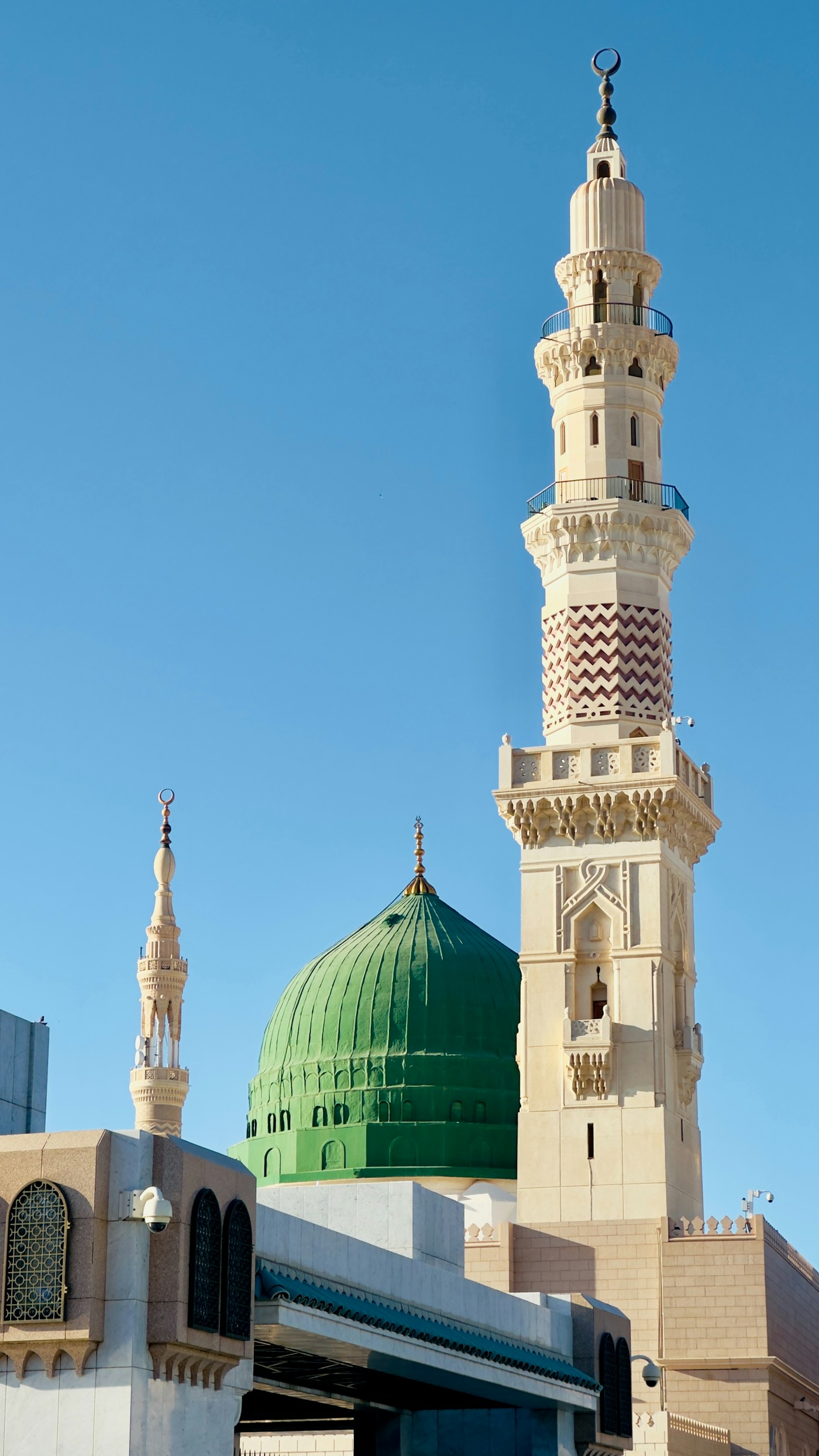

Medina — al-Madinah al-Munawwarah, the Radiant City — is the second holiest city in Islam and the final resting place of the Prophet Muhammad. Nestled in the Hejaz region of western Saudi Arabia, Medina was the destination of the Hijra in 622 CE, the migration that marks the beginning of the Islamic calendar, and it served as the political and spiritual capital of the early Muslim community. Today the city draws millions of visitors each year, from pilgrims completing their Umrah or Hajj journey to travellers drawn by its mosques, museums, date farms, and the profound sense of calm that distinguishes Medina from every other city on the Arabian Peninsula. This guide covers everything you need to plan a visit in 2026 — the Prophet’s Mosque and its protocols, sacred historical sites, hotels, transport, weather, food, and the practical details that will make your stay seamless.
- A Brief History of Medina
- The Prophet’s Mosque — Al-Masjid an-Nabawi
- Sacred and Historical Sites
- Quba Mosque — The First Mosque
- Mount Uhud and the Martyrs’ Cemetery
- Museums and Cultural Attractions
- Getting to Medina
- Getting Around the City
- Where to Stay — Hotels and Neighbourhoods
- Weather and When to Visit
- Food and Dining
- The Dates Market
- Parks and Gardens
- Shopping in Medina
- Practical Tips for Visitors
- Complete Guide to Medina: All Pages
- Masjid an-Nabawi Detailed Guide
- Prophet’s Mosque Visitor Guide
- Medina Visitor Essentials
- Umrah Guide
- Hajj 2026 Complete Guide
- Saudi Arabia Visa Guide
- Arabic Name: المدينة المنورة (al-Madinah al-Munawwarah)
- Province: Al Madinah Province
- Population: Approximately 1.5 million
- Elevation: 620 metres (2,034 ft) above sea level
- Airport: Prince Mohammad bin Abdulaziz International Airport (MED)
- Climate: Hot desert (BWh) — mild winters, very hot summers
- Best Months to Visit: October to March
- Entry Note: Non-Muslims may visit Medina but cannot enter the Haram (Prophet’s Mosque precinct)
- Time Zone: AST (UTC+3)
- Currency: Saudi Riyal (SAR)
A Brief History of Medina
Medina’s history stretches back thousands of years before the advent of Islam. The oasis settlement, originally known as Yathrib, was inhabited by Arab and Jewish tribes who cultivated dates and traded along the incense routes connecting Yemen to the Levant. The city’s transformation began in 622 CE when the Prophet Muhammad and his followers migrated from Mecca in the event known as the Hijra — the defining moment that marks Year One of the Islamic calendar.
Upon his arrival, the Prophet established the first Islamic community (ummah), drafted the Constitution of Medina (a pioneering pluralistic charter governing relations between Muslims, Jews, and pagan Arabs), and built the mosque that would become Al-Masjid an-Nabawi. Medina served as the capital of the rapidly expanding Muslim state for the entirety of the Prophet’s life and through the reigns of the first three Rashidun caliphs — Abu Bakr, Umar, and Uthman — before Ali moved the capital to Kufa in 656 CE.
Under the Umayyad dynasty, the political centre shifted to Damascus, but Medina retained its spiritual primacy. The Abbasids, Mamluks, and Ottomans each invested heavily in the city’s infrastructure and the expansion of the Prophet’s Mosque. The Hejaz Railway, completed in 1908, connected Medina to Damascus and brought a new era of accessibility, though the line was destroyed during the Arab Revolt of 1916–1918.
In 1925, Abdulaziz ibn Saud captured Medina, incorporating it into the nascent Kingdom of Saudi Arabia. Since then, successive Saudi monarchs have poured vast resources into expanding the Prophet’s Mosque and modernising the city. The most transformative project was King Fahd’s 1984–1994 expansion, which increased the mosque’s capacity tenfold. Today, Medina is a modern, well-planned city that seamlessly blends its ancient spiritual heritage with contemporary infrastructure designed to serve millions of annual visitors.
The Prophet’s Mosque — Al-Masjid an-Nabawi
Al-Masjid an-Nabawi is the second holiest mosque in Islam, built by the Prophet Muhammad himself in 622 CE after his arrival in Medina. What began as a simple open-air structure of palm trunks and mud brick has been expanded repeatedly over fourteen centuries and now covers more than 400,000 square metres with a capacity exceeding one million worshippers. The mosque is open 24 hours a day, seven days a week, and admission is free.
The Green Dome
The most recognisable feature of the Medina skyline is the Green Dome (al-Qubbah al-Khadra), which marks the burial chamber of the Prophet Muhammad. The dome also shelters the graves of the first two Rashidun caliphs, Abu Bakr al-Siddiq and Umar ibn al-Khattab. The chamber itself is enclosed behind gold-mesh screens and is not accessible to visitors, but pilgrims gather at the exterior to offer salutations (salaam) to the Prophet. The dome was originally unpainted when built in 1279 CE under the Mamluk Sultan Qalawun, and it was painted green for the first time in 1837 during the Ottoman period.
The Rawdah
The Rawdah (literally “garden”) is the area between the Prophet’s pulpit (minbar) and his burial chamber, marked by a distinctive green carpet that sets it apart from the rest of the mosque’s red-carpeted interior. A hadith describes this space as “a garden from the gardens of Paradise,” and it is the most sought-after prayer spot in the mosque. Visiting the Rawdah now requires a reservation through the official Nusuk app — you will receive a QR code and a designated time slot. Visits are typically limited to ten minutes per person to manage the enormous demand. For a detailed walkthrough of the reservation process, see our Prophet’s Mosque Visitor Guide.
The Retractable Umbrellas
One of the architectural marvels of the mosque is its 250 giant retractable umbrellas in the courtyard, each standing 15.3 metres tall. Designed by the German firm SL Rasch and installed in 2010, these umbrellas open at sunrise to shade worshippers from the desert sun and close again at night, revealing the starlit sky. The choreographed opening and closing has become one of Medina’s most photographed moments.
The Ten Minarets
The mosque features ten minarets, each rising 104 metres — among the tallest in the world. They were added during the massive expansion ordered by King Fahd in 1984–1994, which increased the mosque’s capacity from 16,500 to over 250,000 worshippers (and more than one million when the courtyards and roof are included).
Visitor Etiquette
Dress modestly — men in clean, loose clothing and women in full-length garments with a headscarf. Enter with your right foot and recite the du’a for entering a mosque. Keep your voice low, your phone silent, and move calmly. Photography is permitted in the courtyards but discouraged inside the prayer halls. For a full etiquette guide, read our mosque etiquette guide.
Sacred and Historical Sites
Medina’s significance extends far beyond the Prophet’s Mosque. The city and its surroundings contain dozens of sites connected to the earliest years of Islam, from battlefields and cemeteries to mosques that witnessed pivotal moments in the faith’s history. Many of these can be visited in a single day, and our Medina visitor essentials page includes a suggested walking route.
Quba Mosque — The First Mosque in Islam
Quba Mosque (Masjid Quba) holds the distinction of being the first mosque ever built in Islam. The Prophet Muhammad laid its foundation stone upon his arrival in Quba, on the outskirts of Medina, during the Hijra in 622 CE. The Quran itself references Quba in Surah At-Tawbah (9:108): “A mosque founded on righteousness from the first day is more worthy for you to stand in.” A hadith recorded in Sunan an-Nasa’i states that praying in Quba Mosque is equivalent in reward to performing an Umrah.
The mosque was extensively renovated under King Fahd and again in recent years. It is located approximately 3.5 kilometres south of the Prophet’s Mosque — about a 10-minute taxi ride or a pleasant 40-minute walk along King Fahd Road. In 2023, the Saudi government announced a major expansion project that will make Quba Mosque one of the largest in the world, with a capacity of 66,000 worshippers.
Mount Uhud and the Martyrs’ Cemetery
Mount Uhud rises approximately 1,077 metres above sea level on the northern outskirts of Medina. It is the site of the Battle of Uhud (625 CE), the second major military engagement in Islamic history, in which the Muslim forces were initially victorious but suffered a costly reverse after archers left their positions. The Prophet Muhammad was wounded in the battle, and his uncle Hamza ibn Abdul-Muttalib — the “Lion of God” — was killed.
At the foot of the mountain lies the Martyrs’ Cemetery (Shuhada Uhud), where Hamza and approximately 70 other companions who fell in the battle are buried. Visitors can walk among the graves and reflect on the sacrifice. A hadith recorded by al-Bukhari quotes the Prophet as saying: “Uhud is a mountain that loves us and we love it.”
The site is about 5 kilometres north of the Prophet’s Mosque. Taxis and ride-hailing apps make the trip in under 15 minutes. There is no entry fee.
Masjid al-Qiblatain — The Mosque of Two Qiblas
Masjid al-Qiblatain is where the Prophet Muhammad received the divine revelation to change the direction of prayer (qibla) from Jerusalem to the Kaaba in Mecca. This momentous event, described in Surah Al-Baqarah (2:144), occurred approximately 16 months after the Hijra. The mosque originally contained two mihrabs — one facing Jerusalem and one facing Mecca — though the Jerusalem-facing mihrab has since been removed during renovations. The mosque sits in the northwestern part of Medina, about 4 kilometres from the Prophet’s Mosque.
Al-Baqi Cemetery (Jannat al-Baqi)
Jannat al-Baqi, adjacent to the Prophet’s Mosque, is the main cemetery of Medina and the burial place of many of the Prophet’s companions, family members, and prominent early Muslims. Among those interred here are Uthman ibn Affan (the third caliph), several of the Prophet’s wives, his daughter Fatimah (according to some accounts), and his grandson Hasan ibn Ali. The cemetery is open to male visitors after the Fajr and Dhuhr prayers. Women may view the cemetery from the perimeter.
Masjid al-Jumu’ah (Friday Mosque)
Also known as Masjid al-Wadi or Masjid Atikah, this small mosque marks the spot where the Prophet Muhammad led the first Friday prayer (Jumu’ah) in Islam, during his journey from Quba to Medina in 622 CE. The mosque is located in the Ranuna Valley, between Quba and the Prophet’s Mosque.
The Seven Mosques (Sab’u Masajid)
A cluster of small, historically significant mosques on the western edge of Mount Sal’, near the site of the Battle of the Trench (al-Khandaq, 627 CE). The mosques are named after companions who prayed at those spots during the siege: Masjid al-Fath (the largest), Masjid Salman al-Farisi, Masjid Abu Bakr, Masjid Umar, Masjid Ali, and Masjid Fatimah. Together they form a compact walking circuit that takes about 30 minutes.
Museums and Cultural Attractions
Hejaz Railway Museum
Housed in the beautifully restored Ottoman-era Medina railway station, the Hejaz Railway Museum tells the story of the ambitious 1,300-kilometre railway line that once connected Damascus to Medina between 1908 and 1920. The museum displays original locomotives, carriages, maps, photographs, and Ottoman-era artefacts. The station building itself — with its stone arches and shaded courtyards — is one of the finest examples of Ottoman architecture in the Hejaz. Open daily from 9 AM to 10 PM (closed 4–5 PM; opens at 5 PM on Fridays). Admission is free.
Dar al-Madinah Museum
Dar al-Madinah is the first and largest museum dedicated to the history of Medina. Its permanent collection spans the pre-Islamic period through to the modern Saudi state, with galleries covering the city’s geography, agriculture, architecture, and religious heritage. Notable exhibits include scale models of the Prophet’s Mosque at various stages of its expansion and a collection of manuscripts and calligraphy. The museum is located on King Abdulaziz Road, about 3 kilometres southwest of the Prophet’s Mosque.
Medina Museum (Al Hejaz Exhibition)
Located within the Hejaz Railway complex, this exhibition focuses on the urban development of Medina from the Ottoman period to the present day, with a particular emphasis on the transformation under Saudi rule. Interactive displays and historical photographs chart the city’s evolution.
Getting to Medina
By Air
Prince Mohammad bin Abdulaziz International Airport (MED) is Medina’s international airport, located approximately 15 kilometres northeast of the city centre. It serves direct flights from across the Middle East, South Asia, Southeast Asia, Africa, and Europe. Saudia, flynas, and flyadeal operate the most domestic routes, connecting Medina with Riyadh, Jeddah, Dammam, and Abha among others. During Hajj and Ramadan seasons, dozens of additional international carriers operate charter and scheduled services.
From the airport, taxis and ride-hailing apps (Uber, Careem, Jeeny) are readily available. A shuttle service also runs between the airport and the Prophet’s Mosque area. The journey to the city centre takes approximately 20–30 minutes.
By Train — Haramain High-Speed Railway
The Haramain High-Speed Railway is the fastest and most comfortable way to travel between Medina and Mecca, with intermediate stops at King Abdullah Economic City (KAEC) and Jeddah. Trains reach speeds of up to 300 km/h, and the full Medina-to-Mecca journey takes approximately 2 hours and 30 minutes. The Medina station is located at the Knowledge Economic City, about 10 kilometres from the city centre.
Tickets can be booked through the Saudi Railway Company (SAR) app or website. Economy class fares between Medina and Mecca start at approximately SAR 150 (about $40). Business class offers wider seats, meals, and lounge access. During peak pilgrimage seasons, trains fill up quickly — book at least a week in advance.
By Road
Medina is connected to the national motorway network. The main routes include:
- From Mecca: Highway 15, approximately 420 km (4–4.5 hours by car)
- From Jeddah: Highway 60, approximately 420 km (4 hours)
- From Riyadh: Highway 60, approximately 900 km (8–9 hours)
- From Yanbu: Highway 340, approximately 240 km (2.5 hours)
SAPTCO operates intercity bus services from major Saudi cities. Car rental agencies are available at the airport and in the city centre. Note that non-Muslims cannot enter the Haram district of Medina — road checkpoints enforce this restriction on the approaches to the central mosque area.
Getting Around Medina
Within Medina, the most practical options for visitors are:
- Ride-hailing apps: Uber, Careem, and Jeeny operate throughout the city. Fares are affordable — most trips within the urban area cost SAR 10–30.
- Taxis: Metered taxis are available, though ride-hailing apps generally offer better price transparency.
- Walking: The area immediately around the Prophet’s Mosque is highly walkable, with wide pedestrian zones, shaded arcades, and air-conditioned tunnels connecting major hotel clusters to the mosque entrances.
- Free shuttle buses: During peak seasons (Hajj, Ramadan), the authorities operate free shuttle routes between major hotels, the mosque, and satellite parking areas.
- Hotel shuttles: Many hotels within 2–5 kilometres of the Haram provide complimentary shuttle services to the mosque.
There is no metro system in Medina as of 2026, though a public bus rapid transit (BRT) network has been in planning stages.
Where to Stay — Hotels and Neighbourhoods
Medina offers accommodation at every price point, from five-star hotels overlooking the Prophet’s Mosque to budget aparthotels in quieter residential districts. Location relative to the Haram is the single most important factor for most visitors.
Central Haram District
Hotels directly adjacent to the Prophet’s Mosque command the highest prices but offer unmatched convenience — some are connected to the mosque by air-conditioned walkways. Top properties include the Dar Al Taqwa Intercontinental, Crowne Plaza Madinah, Pullman Zamzam Madina, and the Madinah Hilton. Expect to pay SAR 800–3,000+ per night during peak seasons, with rates dropping significantly outside Hajj and Ramadan periods.
An Naqa and Al Aridh
These neighbourhoods sit within 1–2 kilometres of the Haram and offer a strong balance of proximity and value. The Madinah Marriott and Le Méridien Medina are among the well-known properties here. Three-star hotels and serviced apartments are plentiful, with rates starting around SAR 200–500 per night.
Quba Area
The area around Quba Mosque, approximately 3.5 kilometres south of the Prophet’s Mosque, is quieter and more affordable. It is a good base for visitors who want to combine mosque visits with trips to King Fahd Park and the southern outskirts. Budget hotels and furnished apartments are widely available, starting from SAR 100–250 per night.
Airport Area
For travellers with early flights or late arrivals, hotels near Prince Mohammad bin Abdulaziz Airport offer convenience. The Millennium Madinah Airport is the standout option. Rates are generally SAR 250–500 per night.
Booking Tips
- Book early for Hajj season (Dhul Hijjah), Ramadan, and school holidays — prices surge and availability disappears.
- Many hotels offer Umrah packages that bundle accommodation, transport, and guided Ziyarat tours.
- For longer stays, serviced apartments offer kitchens and laundry facilities at lower nightly rates.
- Check whether your hotel provides a free mosque shuttle — this can save significant time and money.
Weather and When to Visit
Medina has a hot desert climate (Köppen BWh) with long, extremely hot summers and mild, pleasant winters. At 620 metres elevation, it is slightly cooler than the Red Sea coast cities like Jeddah but still experiences intense summer heat.
Seasonal Breakdown
- Winter (December–February): The best season for visiting. Daytime highs of 22–27°C (72–81°F) and cool nights around 10–14°C (50–57°F). Rainfall is rare but possible — Medina receives only about 44 mm of precipitation annually.
- Spring (March–April): Warm and dry, with temperatures climbing from 28°C to 35°C. An excellent shoulder season with fewer crowds outside Ramadan.
- Summer (May–September): Daytime temperatures regularly exceed 40°C (104°F) and can reach 44–45°C in July and August. Humidity is relatively low, but the heat is punishing for outdoor sightseeing. If you visit in summer, plan mosque visits and outdoor excursions for early morning or after sunset.
- Autumn (October–November): Temperatures moderate to 30–35°C, making this another comfortable window. October is one of the best months for combining Medina with an AlUla side trip.
For more detail on seasonal planning, see our Saudi Arabia weather guide.
What to Pack
- Lightweight, breathable, modest clothing in all seasons
- A warm layer for winter evenings
- Comfortable walking shoes — you will cover significant distances around the mosque
- High-SPF sunscreen and a hat for any outdoor excursions
- A refillable water bottle — Zamzam water stations are available inside the mosque, but carry water for trips to Uhud and other outdoor sites
For pilgrimage-specific packing, see our Umrah packing list.
Food and Dining
Medina’s culinary scene reflects its character as a city of pilgrimage — generous, communal, and rooted in Hejazi tradition. The cuisine of the Madinah region is built on rice, lamb, chicken, and the extraordinary dates for which the city is famous worldwide.
Signature Dishes
- Kabsa: The national dish of Saudi Arabia — fragrant rice with meat (lamb, chicken, or camel), tomatoes, and a blend of cardamom, cinnamon, cloves, and black lime. Available everywhere from street stalls to fine-dining restaurants.
- Harees: A slow-cooked porridge of wheat and meat, especially popular during Ramadan. Medina’s version is often richer than those found in the Gulf.
- Mutabbaq: A stuffed savoury pancake filled with minced meat, egg, and vegetables — a beloved Hejazi street food.
- Madfoon: Lamb or goat slow-cooked underground in a pit, yielding extraordinarily tender meat. A celebratory dish often served at gatherings.
- Saleeg: A Hejazi comfort dish of creamy rice cooked in milk and broth, typically topped with roast chicken.
Where to Eat
The streets surrounding the Prophet’s Mosque are lined with restaurants at every price point. For traditional Saudi cuisine, look for restaurants along Abu Bakr al-Siddiq Road and King Faisal Road. International chains and fast-food outlets cluster around Al Noor Mall and the major hotel lobbies.
For a local experience, the small restaurants in the older neighbourhoods south of the Haram serve family-style Hejazi meals — heaped platters of kabsa and mandi meant for sharing. Prices are remarkably reasonable, with a full meal typically costing SAR 25–60 per person.
Dining During Ramadan
During Ramadan, restaurants close during daylight fasting hours but come alive at iftar (sunset). Many hotels and restaurants offer special Ramadan buffets. The Prophet’s Mosque itself organises massive communal iftar meals in the courtyards, where thousands of worshippers break their fast together — an unforgettable experience.
The Dates Market — A Medina Essential
Medina has been celebrated for its dates since pre-Islamic times, and the city remains one of the world’s premier date-producing regions. The International Dates Market (Souq al-Tamoor), located in the central district near the Haram, is the largest dates market in the Hejaz and an essential stop for any visitor.
The market is open daily from approximately 8 AM to 10 PM and stocks dozens of varieties, including:
- Ajwa: The most prized variety, dark and soft, with a connection to Prophetic tradition. A hadith states that eating seven Ajwa dates in the morning protects against poison and magic. Ajwa commands the highest prices — SAR 200–400 per kilogram for premium grade.
- Sukkari: Golden-brown, intensely sweet, and one of the most popular varieties in Saudi Arabia.
- Safawi: Dark, semi-dry, mildly sweet, and more affordable than Ajwa.
- Mabroom: Elongated with a chewy texture and caramel flavour.
- Amber: Large, soft, and golden — a Medina speciality.
Vendors offer samples freely, and bargaining is expected for bulk purchases. Dates make excellent gifts and can be vacuum-sealed for travel.
Parks and Gardens
King Fahd Park (King Fahd Central Park)
The largest green space in Medina, covering approximately 4.3 square kilometres along the Second Ring Road in the Quba area, about 5 kilometres south of the Prophet’s Mosque. The park features wide landscaped gardens, pedestrian pathways, scenic lakes with fountains, children’s play zones, and family picnic areas. It is a popular evening retreat for families, particularly during the cooler months. Free entry.
Prince Mohammed bin Abdulaziz Park
A well-maintained urban park closer to the city centre, with walking tracks, green lawns, and seating areas. Quieter than King Fahd Park and a good spot for a morning walk.
Al Hukair FunCity
Located within Al Noor Mall, this family entertainment centre offers rides, arcade games, and activities for children. A good option for families with young children who need a break from sightseeing.
Shopping in Medina
Beyond the famous Dates Market, Medina offers a range of shopping experiences for visitors looking to bring home souvenirs and gifts.
Souqs and Traditional Markets
The streets around the Prophet’s Mosque are lined with shops selling prayer rugs, rosaries (misbaha), Islamic calligraphy, attar (traditional perfume oils), oud wood and incense, and copies of the Quran in every size and binding. Prices are negotiable at smaller shops, and quality varies — for genuine oud and attar, seek out established merchants rather than pavement stalls. The Al Manakhah area, south of the mosque, is one of the oldest commercial districts and a good hunting ground for traditional goods.
Modern Malls
Al Noor Mall is the largest shopping centre close to the Haram, with a mix of international and local brands, a food court, bowling alley, and children’s entertainment area. Al Rashid Mega Mall and Taibah Commercial Centre offer additional options for clothing, electronics, and household goods. Malls are air-conditioned and open from approximately 9 AM to 11 PM (hours vary during Ramadan).
What to Buy
- Ajwa dates — Medina’s most iconic product, available in every grade from everyday to gift-boxed premium
- Attar and oud — traditional Arabian perfume oils, far more affordable here than in Western markets
- Prayer rugs — from simple Turkish designs to handwoven silk pieces
- Zamzam water — available in sealed containers for travellers (check airline regulations for transport)
- Islamic books and calligraphy — Qurans, hadith collections, and decorative art
- Kohl (ithmid) — traditional eye cosmetic, considered sunnah in Islamic tradition
Practical Tips for Visitors
Visa and Entry
Most visitors arrive on an Umrah visa, a tourist visa (e-visa available for 50+ nationalities), or a Hajj visa. Umrah visas are now available year-round. Tourist visa holders can visit Medina freely, though non-Muslims cannot enter the Haram precinct.
Language
Arabic is the official language, but English is widely understood in hotels, restaurants near the Haram, and tourist-facing businesses. Signage in the mosque area is bilingual (Arabic/English). During pilgrimage seasons, you will hear Urdu, Bahasa, Turkish, French, and dozens of other languages.
Money
The Saudi Riyal (SAR) is pegged to the US dollar at approximately SAR 3.75 = $1. ATMs are abundant. Credit and debit cards (Visa, Mastercard) are accepted at most hotels, restaurants, and larger shops. The Dates Market and smaller vendors may prefer cash.
Connectivity
STC, Mobily, and Zain offer prepaid SIM cards with data packages available at the airport, malls, and phone shops throughout the city. Free Wi-Fi is available in the Prophet’s Mosque courtyards (though it can be slow during peak times) and in most hotels.
Health
Saudi Arabia may require proof of meningitis (ACWY) vaccination for Umrah and Hajj visa holders — check the latest requirements on the Saudi Ministry of Health website before travelling. Carry a small first-aid kit, any prescription medications, and oral rehydration salts (heat-related dehydration is a real risk in summer). Hospitals and clinics are readily available, including facilities specifically set up for pilgrims near the Haram.
Nusuk App
The Nusuk app is essential for pilgrims visiting in 2026. It manages Rawdah visit reservations, Umrah permits, and other mosque services. Download and register before you travel.
Photography
Photography is permitted in the outdoor courtyards of the Prophet’s Mosque, in public spaces, and at historical sites. Inside the prayer halls, photography is discouraged. At Al-Baqi cemetery, photography is not permitted. Always ask permission before photographing individuals.
Respectful Conduct
Medina is a city of profound religious significance. Dress modestly at all times (not just inside the mosque), keep noise to a minimum in the Haram district, and be considerate of worshippers. During prayer times, many shops and restaurants close briefly — this is normal. For more on cultural norms, see our mosque etiquette guide.
Day Trips from Medina
Wadi al-Jinn (Wadi Baida)
Approximately 40 kilometres northwest of Medina, this valley is famous for the optical illusion of vehicles appearing to roll uphill when in neutral gear. The phenomenon is caused by the surrounding terrain creating a visual slope opposite to the actual gradient. It is a popular short excursion, best combined with a drive through the volcanic lava fields (harrat) north of the city. The dramatic black basalt landscapes of the Harrat Rahat lava field — one of the largest in the Arabian Peninsula, stretching over 20,000 square kilometres — offer stark, otherworldly scenery and excellent photography opportunities.
Yanbu
The Red Sea port city of Yanbu is approximately 240 kilometres west of Medina (2.5 hours by car) and offers a welcome contrast to Medina’s desert setting. Yanbu’s coral reefs are among the healthiest in the Red Sea, with excellent diving and snorkelling accessible from shore. The old town (Yanbu al-Bahr) retains its Hejazi coral-stone architecture and was once the supply port for T. E. Lawrence during the Arab Revolt. It makes a worthwhile overnight trip for visitors who want to combine their Medina pilgrimage with a beach break.
AlUla
The ancient oasis city of AlUla, home to the UNESCO World Heritage Site of Hegra (Mada’in Salih), is approximately 300 kilometres north of Medina. Hegra was the southern capital of the Nabataean Kingdom, the same civilisation that built Petra in Jordan, and its 111 monumental rock-cut tombs are among the most spectacular archaeological sites in the Middle East. Beyond Hegra, AlUla offers the Dadan ruins, the open-air library of Jabal Ikmah, Elephant Rock, and a growing luxury hospitality scene centred on the Ashar Resort by Banyan Tree. While it requires at least two days to do justice, it is one of the most rewarding side trips in Saudi Arabia. Direct flights operate between Medina and AlUla, and the drive takes approximately 3–3.5 hours.
Khaybar
The ancient oasis of Khaybar, approximately 150 kilometres north of Medina, is one of the oldest continuously cultivated areas in the Arabian Peninsula. Famous in Islamic history for the Battle of Khaybar (628 CE), the oasis is surrounded by dramatic volcanic terrain and still produces some of the finest dates in the region. Recent archaeological excavations have uncovered pre-Islamic structures and the oasis has been developed for cultural tourism, with restored fortifications and a visitor centre.
Medina for Non-Muslim Visitors
Until recently, Medina was entirely off-limits to non-Muslims. Under Saudi Arabia’s Vision 2030 tourism reforms, non-Muslim visitors can now enter the city of Medina and visit many of its cultural and historical attractions, including the Hejaz Railway Museum, Dar al-Madinah Museum, King Fahd Park, the Dates Market, and the areas around Mount Uhud. However, the Haram precinct — the area immediately surrounding the Prophet’s Mosque — remains restricted to Muslims only. Checkpoints on the approaches enforce this boundary. Non-Muslim visitors should carry identification and be prepared for occasional document checks.
Complete Guide to Medina: All Pages
The Prophet’s Mosque & Worship
- Masjid an-Nabawi — Complete Visitor Guide — everything you need to know about visiting the Prophet’s Mosque
- Prophet’s Mosque Practical Guide — Rawdah reservations, prayer times, entry gates, and etiquette
- Mosque Etiquette in Saudi Arabia — dress code, behaviour, and cultural norms for visiting mosques
Pilgrimage Guides
- Umrah Guide — complete step-by-step guide to performing Umrah
- Hajj 2026 Complete Guide — rites, logistics, and planning for the 2026 Hajj season
- Umrah for First-Timers — beginner-friendly guide for your first pilgrimage
- Umrah Packing List — what to bring for your pilgrimage
- Umrah Costs — budgeting and cost breakdown
- Umrah Visa Guide — visa types, application process, and requirements
Medina Essentials & Planning
- Medina Visitor Essentials — quick-reference guide for first-time visitors to the city
- Saudi Arabia Visa Guide — tourist visas, e-visas, and entry requirements
- Saudi Arabia Weather Guide — when to visit each region
Mecca & Other Destinations
- Mecca Travel Guide — the holiest city in Islam
- Masjid al-Haram Guide — visiting the Grand Mosque in Mecca
- Mecca for Muslim Visitors — spiritual and practical guidance
- Jeddah Travel Guide — gateway city to the Hejaz
- AlUla Travel Guide — ancient oasis and UNESCO World Heritage Site
- Riyadh Travel Guide — the capital city