
The Rub al Khali — known in English as the Empty Quarter — is the largest contiguous sand desert on Earth, spanning roughly 650,000 square kilometres across the southern third of the Arabian Peninsula. Most of it falls within Saudi Arabia, covering parts of the Eastern Province, Najran Province, and the southern reaches of Riyadh Province. For travellers exploring the Kingdom as part of a wider Saudi Arabia travel itinerary, the Empty Quarter offers something no other destination can: absolute silence, dunes that rise over 250 metres, skies without a trace of light pollution, and one of the last genuinely wild landscapes on the planet. Yes, you can visit — and this guide explains exactly how.
Best Time to Visit: October to March (daytime highs 18–28°C)
Getting There: Fly to Wadi al-Dawasir, Sharurah, or Najran; drive south from Riyadh (550 km)
Visa Required: Yes — tourist e-visa available for 66+ nationalities
Budget: USD 60–175/day (guided safari); multi-day expeditions from USD 500+
Must-See: ‘Uruq Bani Ma’arid UNESCO Reserve, star dune fields near Shaybah, overnight desert camping
Avoid: May–September (temperatures exceed 50°C); never enter the desert without an experienced guide
Can You Actually Visit the Rub al Khali?
Yes. Since Saudi Arabia launched its tourist e-visa system under Vision 2030, citizens of more than 66 countries can obtain a one-year, multiple-entry visa online at visa.visitsaudi.com. The visa allows stays of up to 90 days per visit — more than enough to explore the Empty Quarter.
However, visiting the Rub al Khali is not like visiting Riyadh or AlUla. There are no paved roads into the interior, no hotels, no mobile phone coverage, and no emergency services. Most of the desert requires permits from Saudi Arabia’s National Centre for Wildlife, which accredited tour operators handle on your behalf. Independent desert travel is possible for experienced 4×4 drivers with satellite communication equipment, but every source — from the Saudi Tourism Authority to veteran desert guides — strongly advises against entering alone.
The practical reality: book with a licensed tour operator, travel in a convoy of at least two vehicles, carry all your own water and fuel, and tell someone your itinerary before you leave.
Geography and Scale
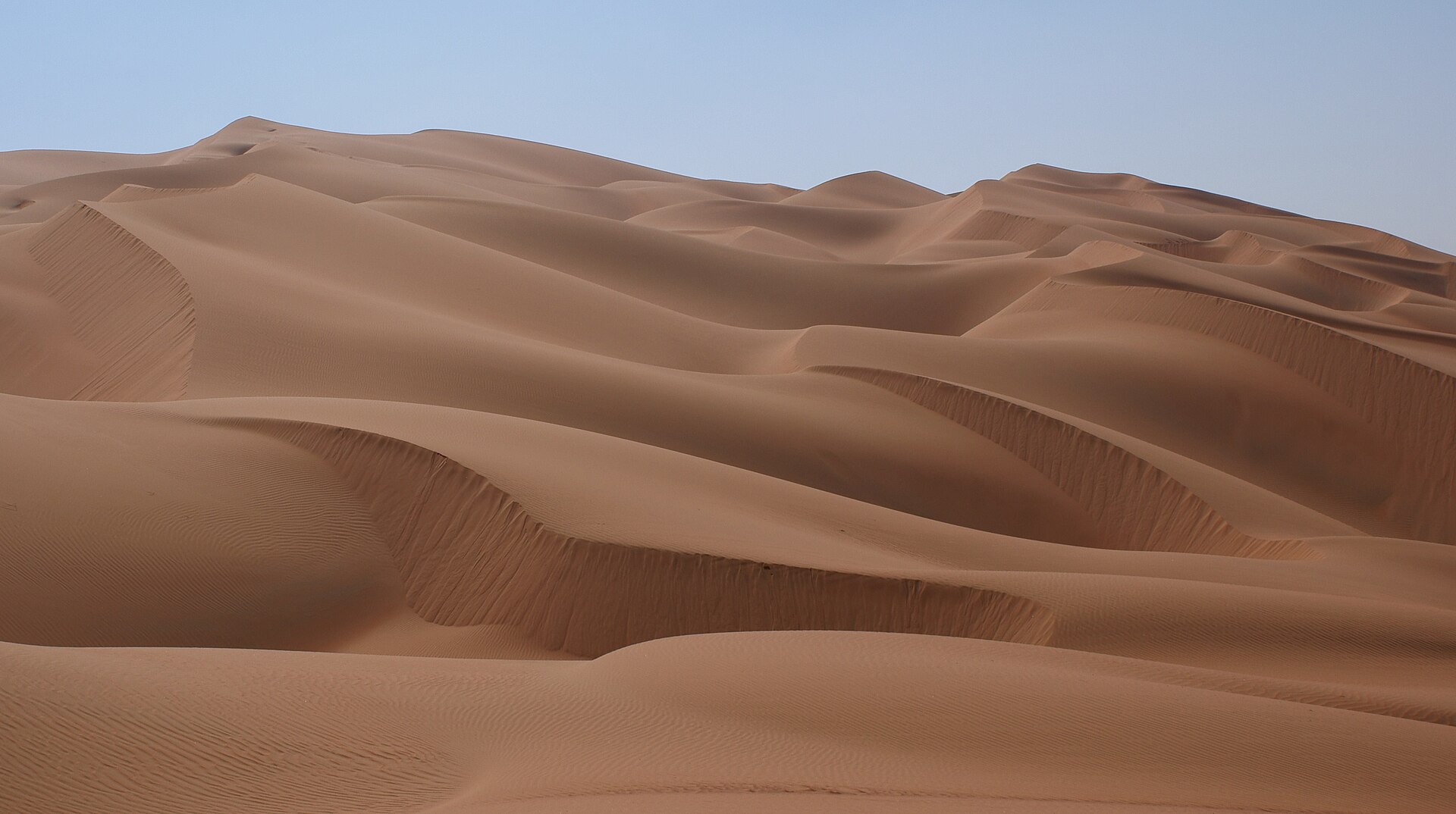
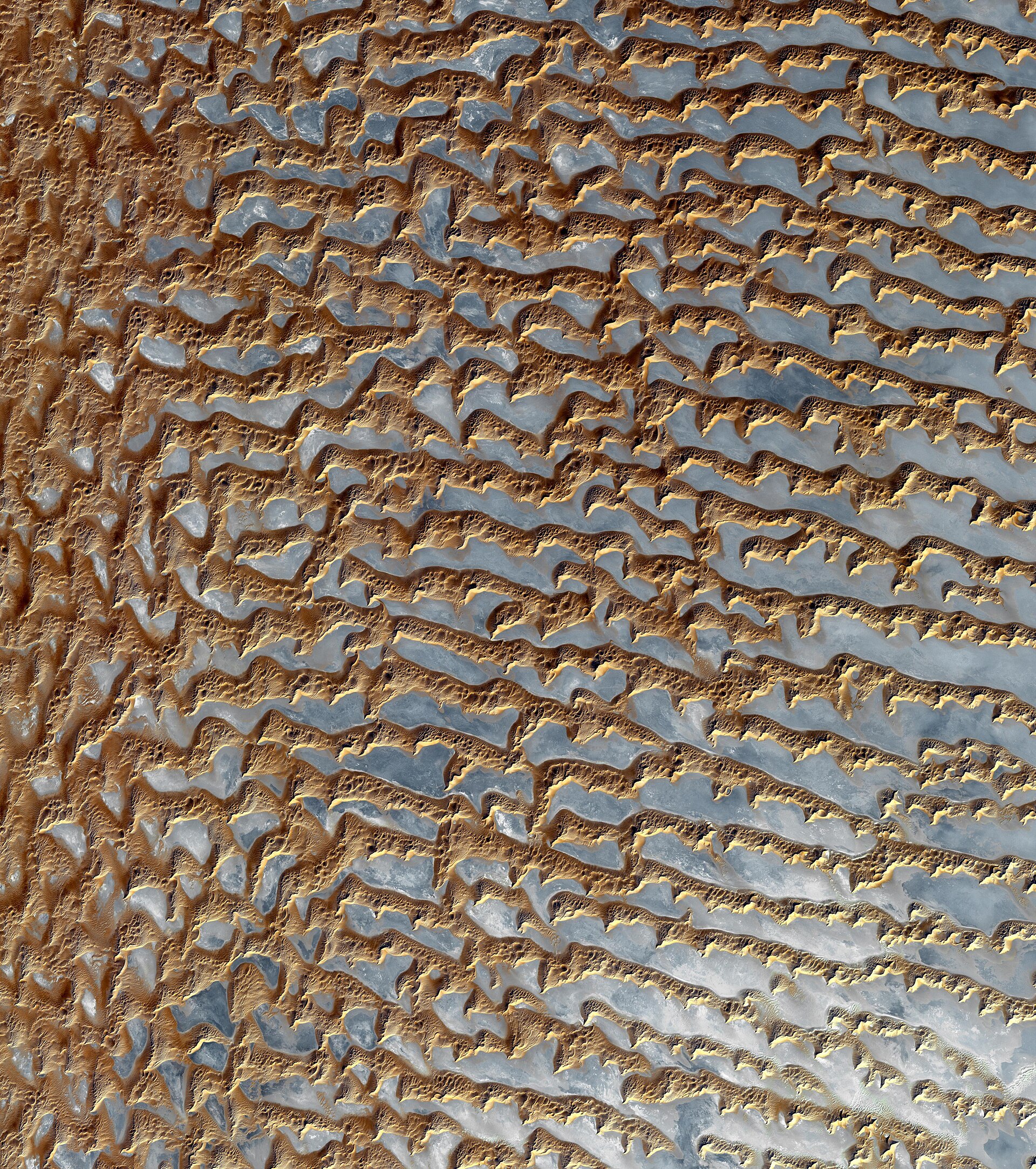
Numbers help convey the Empty Quarter’s scale, but they still fall short. The Rub al Khali measures roughly 1,000 kilometres from end to end and 500 kilometres across, covering an area larger than France. Within Saudi Arabia alone, it spans approximately 430,000 square kilometres — about 65% in the Eastern Province, 25% in Najran Province, and the remainder in southern Riyadh Province. The desert also extends into Oman, the United Arab Emirates, and Yemen.
The terrain varies dramatically. In the southwest, the surface elevation reaches 800 metres above sea level, while the northeast sinks almost to sea level. Between these extremes lie star dunes, longitudinal dune ridges, crescent-shaped barchans, flat gravel plains, gypsum flats, and brackish salt marshes known as sabkhas. Ancient dried lake beds — evidence of wetter periods between 6,000 and 2,000 years ago — are scattered through the interior, their calcium carbonate deposits still yielding chipped flint tools from early human inhabitants.
Best Time to Visit
The only viable season for visiting the Empty Quarter runs from October through March. During these winter months, daytime temperatures sit between 18°C and 28°C — warm enough to be comfortable, cool enough to move around safely. Nights can drop to 10–12°C, and frost is possible in January and February, so bring warm layers for desert camping.
From May through September, the Rub al Khali becomes one of the hottest places on Earth. Average daily highs reach 47°C, with recorded extremes above 51°C. Relative humidity drops to around 15%. These conditions are genuinely dangerous — even seasoned Bedouin communities historically avoided deep desert travel in summer.
Tip: Even in winter, plan your activities for early morning and late afternoon. Midday sun in the open desert is significantly more intense than in urban Saudi Arabia. Carry at least 5 litres of water per person per day.
How to Get There
Gateway Cities and Airports
The Empty Quarter has no airports or paved entry roads of its own. Instead, you approach from gateway towns on its edges:
| Gateway | Province | Airport | Edge of Desert | Best For |
|---|---|---|---|---|
| Wadi al-Dawasir / As Sulayyil | Riyadh | WAE (domestic) | Northwest | Most popular entry; closest to dune fields |
| Sharurah | Najran | SHW (domestic) | South | Deep desert expeditions; ‘Uruq Bani Ma’arid |
| Najran | Najran | EAM (domestic) | Southwest | Archaeological sites; cultural heritage |
| Al-Ahsa | Eastern | Via Dammam (DMM) | Northeast | Combine with Al-Ahsa UNESCO oasis |
All three domestic airports — Wadi al-Dawasir, Sharurah, and Najran — are served by Saudia flights from Riyadh and Jeddah. If you are flying into the Kingdom, see our Saudi Arabia visa guide for the latest entry requirements.
Driving Routes
The most common driving approach is from Riyadh south along Highway 10 to Wadi al-Dawasir and As Sulayyil — approximately 550 kilometres on good tarmac. From Wadi al-Dawasir, the paved road continues roughly 394 kilometres southeast to Sharurah. A newer highway completed in September 2021 now connects Oman’s Ibri to Al-Ahsa through the eastern Empty Quarter — a 700–800 kilometre route that has opened cross-border desert access. If you are planning a longer road trip, our guides to 4×4 off-roading in Saudi Arabia and dune bashing cover vehicle preparation and route planning in detail.
What to Do in the Empty Quarter
Overnight Desert Camping
Camping under the stars is the quintessential Empty Quarter experience. With zero light pollution across hundreds of kilometres, the night sky here is extraordinary — the Milky Way is fully visible to the naked eye, and shooting stars are frequent. Most tour operators offer overnight safari packages that include Bedouin-style camps with traditional Arabic coffee, campfire-cooked dinner, and basic tent accommodation. For those seeking more comfort, glamping operators now offer luxury desert camps with proper beds and facilities on the desert fringes. See our full desert camping guide for packing lists and practical tips.
Stargazing
The Rub al Khali is arguably the best stargazing location in the entire Arabian Peninsula. The combination of zero artificial light, minimal humidity in winter, and high elevation in the southwestern reaches creates near-perfect astronomical conditions. Several operators run dedicated stargazing camps with telescopes and guides. No equipment is needed for the naked-eye experience — the sky does the work.
Dune Bashing and Sandboarding
The Rub al Khali’s massive dune fields make it one of the world’s premier destinations for dune bashing — high-speed 4×4 driving over sand ridges. Operators use modified Land Cruisers and Nissan Patrols with deflated tyres, roll cages, and recovery equipment. Sandboarding is offered on steeper dune faces, particularly near the edges accessible from Wadi al-Dawasir. Both activities are typically bundled into safari day-trip or overnight packages.
Camel Trekking
For a slower pace, camel trekking follows traditional Bedouin routes along the desert fringes. These excursions range from two-hour sunset rides to multi-day expeditions retracing sections of historic caravan paths. The rhythm of camel travel gives you time to absorb the scale of the landscape in a way that a 4×4 never can.
‘Uruq Bani Ma’arid — Saudi Arabia’s First Natural UNESCO World Heritage Site
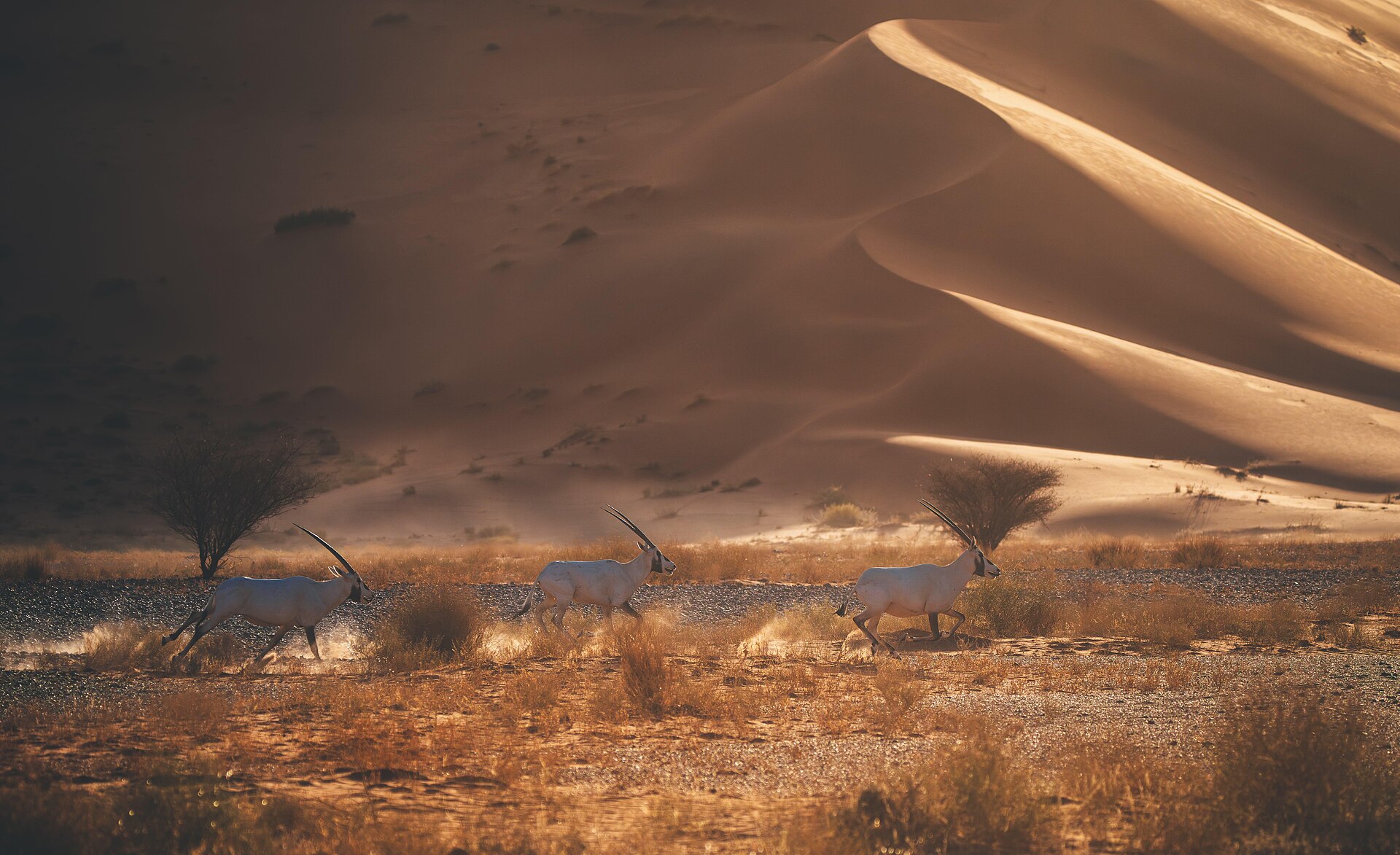
Inscribed by UNESCO in September 2023, the ‘Uruq Bani Ma’arid Protected Area sits on the western edge of the Empty Quarter and covers 12,658 square kilometres. It is the only place on Earth where Arabian oryx live in the wild in an unfenced reserve.
The oryx were reintroduced here beginning in 1995 after the species was hunted to extinction in the wild by the early 1970s. As of 2024, the reserve supports approximately 116 Arabian oryx alongside reintroduced sand gazelles, mountain gazelles, red-necked ostriches, and houbara bustards. In total, 526 species have been recorded within the reserve, including 118 plant species — a remarkable figure for a hyper-arid environment.
Access to ‘Uruq Bani Ma’arid is managed by the National Centre for Wildlife. Tour operators based in Sharurah can arrange permitted visits. The reserve is a major pillar of Saudi Arabia’s Vision 2030 conservation-tourism strategy and one of the most compelling reasons to visit the Empty Quarter.
Wildlife of the Empty Quarter
Despite its name, the Empty Quarter is far from empty. The desert supports a surprising range of life, adapted over millennia to extreme heat, minimal water, and vast distances between resources. For a deeper look at desert fauna across the Kingdom, see our guide to desert wildlife in Saudi Arabia.
Mammals
Beyond the Arabian oryx, the Rub al Khali is home to the sand cat (Felis margarita) — a small, elusive, nocturnal hunter with fur-covered paws adapted for walking on hot sand. The Arabian red fox and the smaller Rüppell’s fox are more commonly spotted. The Arabian wolf, a small desert-adapted subspecies, survives in the peripheral areas. Sand gazelles and mountain gazelles are present in the protected western reaches. Various rodent species — jerboas, gerbils, and spiny mice — emerge after dark and form the base of the desert food chain.
Reptiles and Invertebrates
The Arabian horned viper (Cerastes gasperettii) moves across sand using distinctive sidewinding locomotion. The spiny-tailed lizard or dhub (Uromastyx aegyptia) — a vegetarian reptile that can reach 75 centimetres in length — is widespread and hibernates during the hottest months. Fringe-toed lizards and various desert geckos are common. Among invertebrates, the deathstalker scorpion (Leiurus quinquestriatus) demands respect — always shake out shoes and clothing left on the ground overnight.
Birds
A 2006 Saudi Geological Survey expedition documented 24 bird species in the deep interior, including the desert lark, cream-coloured courser, brown-necked raven, and pharaoh eagle-owl. The ‘Uruq Bani Ma’arid reserve has boosted bird diversity on the western edge with reintroduced houbara bustards and red-necked ostriches.
Flora
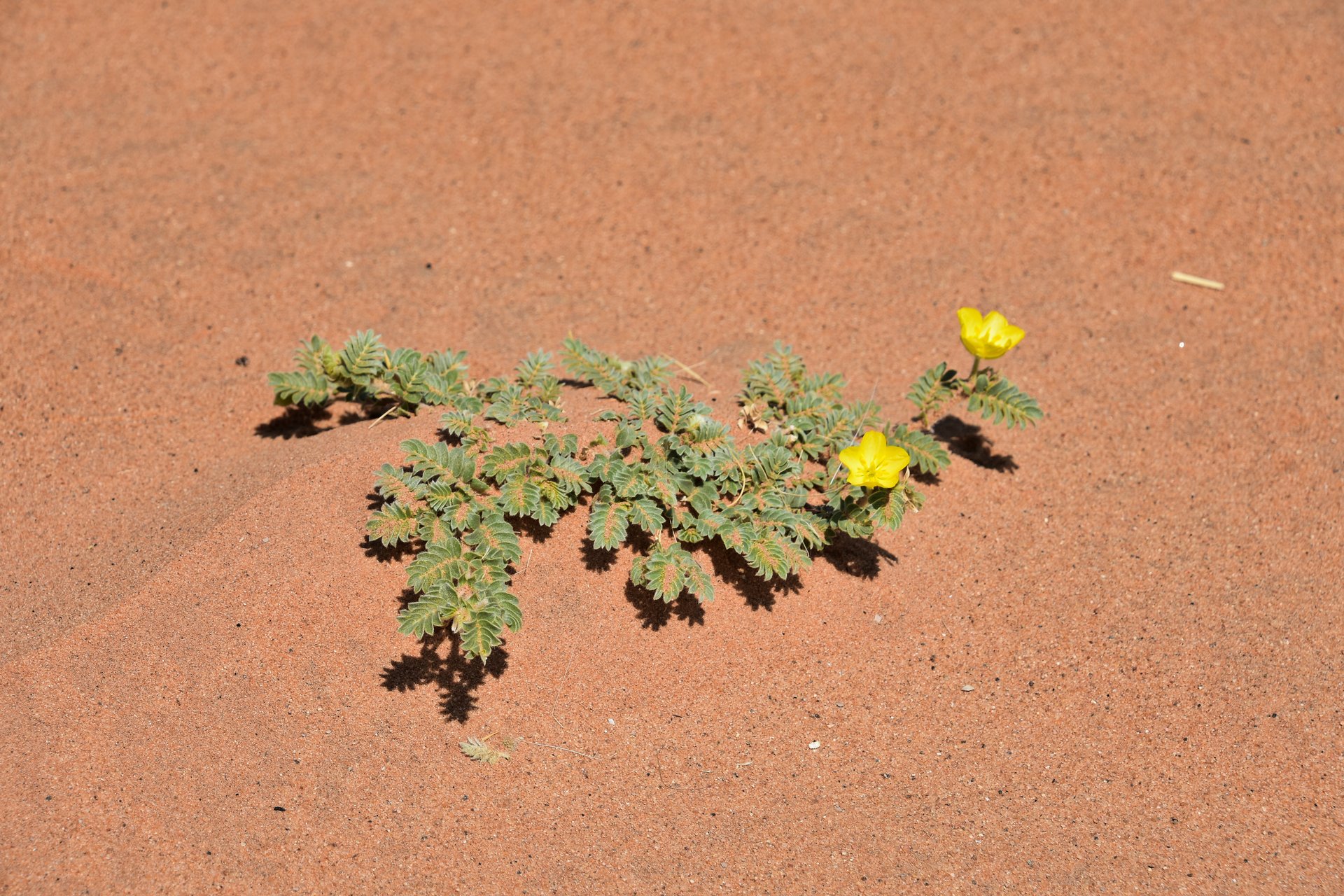
The interior supports roughly 37 species of flowering plants, though some appear only along the periphery. There are virtually no trees. Dwarf shrubs such as Calligonum crinitum and saltbush (Atriplex) dominate. After the rare rainfall — the annual average is under 50 millimetres — ephemeral grasses and wildflowers briefly transform patches of sand into green. A 2006 expedition discovered 31 previously unknown plant species and varieties, suggesting the Empty Quarter’s botany is still incompletely catalogued.
Historic Crossings and Exploration
The Rub al Khali has drawn explorers for centuries. The first documented European crossing was completed by Bertram Thomas between December 1930 and February 1931, travelling from Salalah to Doha in 59 days. Harry St. John Philby followed in 1932, covering 2,700 kilometres in 90 days with 14 men and 32 camels — he had converted to Islam partly to gain the trust needed for passage.
The most famous explorer of the Empty Quarter remains Wilfred Thesiger, whose two crossings in 1946–48 were documented in his classic 1959 book Arabian Sands. Travelling with Rashidi tribesmen — including his companions bin Kabina and Muhammad al Auf — Thesiger crossed from Oman’s Mughshin to the Liwa Oasis via the towering ‘Uruq ash Shaybah dunes. On his second crossing, Saudi authorities briefly imprisoned him at Sulayil, underscoring how recently the deep desert was considered sovereign territory rather than a tourist destination.
Modern expeditions continue. In 2025, Gavin Booth and Adam Wilton completed the first self-sufficient foot crossing — 780 kilometres from As Sulayyil to Haradh in 22 days, pulling carts loaded with all their water and supplies.
Bedouin Heritage
The Empty Quarter has been home to Bedouin communities for millennia. The Al Murrah tribe holds the largest territorial claim within the Saudi portion, ranging between Al-Ahsa in the northeast and Najran in the southwest. Known as “nomads of the nomads,” the Al Murrah were renowned for their camel herding, desert tracking skills, and seasonal migrations covering over 3,000 miles annually.
In modern Saudi Arabia, many Al Murrah families have settled near traditional watering points, herding sheep and goats and serving in the Saudi National Guard. But Bedouin hospitality customs — the ritual preparation of Arabic coffee, the sharing of dates, the open-tent welcome to strangers — remain central to the Empty Quarter experience. Most tour operators incorporate elements of Bedouin culture into their desert camps, and encountering herders with their camel flocks on the desert fringes is still common.
Tour Operators and Costs
Several licensed operators run Empty Quarter trips from the Saudi side:
- 365 Adventures (Riyadh-based) — offer 5-day Empty Quarter expeditions including the Umm Quroon Well and Um Athla dune fields. Listed on GetYourGuide and TripAdvisor.
- WadiTrip — Saudi operator running guided journeys from Najran into the southern Empty Quarter.
- Saudi Arabia Travel and Tours (Abha-based, License No. 400008093) — 4-day/3-night all-inclusive expeditions departing from Wadi al-Dawasir.
- EQRUN Exploration — multi-day deep desert expeditions with private camp accommodation.
Budget Guide
| Experience | Duration | Approximate Cost |
|---|---|---|
| Guided day safari (dune bashing, lunch) | 1 day | SAR 225–400 / USD 60–107 |
| Overnight safari (camp, dinner, breakfast) | 1 night | SAR 649+ / USD 173+ |
| Multi-day expedition (all-inclusive) | 3–5 days | SAR 1,900–6,500 / USD 500–1,730 |
| Luxury deep desert expedition | 7–10 days | USD 6,700–25,000 |
| Desert glamping (per night) | 1 night | SAR 1,000+ / USD 267+ |
Budget tip: Group tours sharing a 4×4 between 4–6 people bring per-person costs down significantly. Most operators quote per-vehicle rather than per-person for private expeditions.
What to Pack
The Empty Quarter has no shops, no fuel stations, and no water sources. Everything you need must come with you.
- Water: Minimum 5 litres per person per day; your operator should provide bulk supplies, but carry personal reserves
- Sun protection: High-SPF sunscreen, wide-brimmed hat, UV-blocking sunglasses, lightweight long-sleeved clothing
- Warm layers: Desert nights drop below 10°C in winter — a fleece or down jacket is essential
- Footwear: Closed hiking boots for walking on sand and protection from scorpions; sandals for camp only
- Navigation: GPS device or satellite communicator (there is no mobile coverage in the interior)
- First aid kit: Including antihistamines for scorpion stings
- Camera equipment: Dust protection bags or covers are essential — fine sand penetrates everything
- Torch/headlamp: With spare batteries for nighttime camp movement
If you are driving independently, add: full fuel for the round trip plus 30% reserve, at least two spare tyres per vehicle, tyre deflation and inflation equipment, tow rope, sand ladders, and a satellite phone.
Safety Considerations
The Rub al Khali is genuine wilderness. Treat it with respect:
- Never travel solo. Always move in a convoy of at least two 4×4 vehicles with experienced drivers.
- Heat is the primary danger. Even in winter, midday temperatures in direct sun can cause heat exhaustion. Rest in shade during the hottest hours.
- Border awareness: The borders with Oman and Yemen within the desert are largely unmarked. Crossing an international boundary accidentally creates serious legal problems. Your guide should carry GPS coordinates of border zones.
- Wildlife hazards: Scorpions and vipers are present throughout. Shake out shoes, clothing, and sleeping bags before use. Keep tent flaps closed at night.
- Vehicle breakdowns: A mechanical failure in the deep desert with no phone signal is a survival situation. This is why convoy travel and satellite communication are non-negotiable.
- Leave no trace: The Empty Quarter’s ecosystem is fragile. Carry out all waste and avoid driving over vegetated areas.
Nearby Attractions Worth Combining
Al-Ahsa Oasis
On the northeastern edge of the Empty Quarter, the Al-Ahsa Oasis is a UNESCO World Heritage Site and the largest oasis in the world — over 20,000 hectares of date palm groves fed by natural springs. The Al Asfar Lake, with its crystal-clear waters surrounded by palm trees, is a surreal contrast after days in the deep desert. Al-Ahsa is accessible from Dammam and Al Khobar in the Eastern Province.
Najran
The southwestern gateway to the Empty Quarter, Najran is one of Saudi Arabia’s most historically rich cities. The Al Okhdood archaeological site features rock art and petroglyphs dating from 800 BCE to 600 CE. Traditional mud-brick architecture, a vibrant souq, and proximity to both the Asir highlands and the desert edge make Najran an excellent base for a multi-day itinerary combining mountain hiking with desert exploration.
Wadi al-Dawasir
The most popular staging town for Empty Quarter trips, Wadi al-Dawasir sits in a fertile valley watered by seasonal floods. The surrounding area features agricultural circles visible from the air — a striking geometric contrast with the dune fields just to the south. Several wildlife watching opportunities exist in the transition zone between farmland and desert.
Explore More Saudi Arabia Travel Guides
- Saudi Arabia Travel Guide 2026 — The complete guide to visiting the Kingdom
- Desert Safari Guide — Dune bashing, camping, and the Empty Quarter
- Saudi Arabia Nature Reserves — Protected areas across the Kingdom
- Desert Wildlife in Saudi Arabia — Oryx, sand cats, and more
- Stargazing in Saudi Arabia — Best dark sky locations
- Saudi Arabia Visa Guide — Every visa type explained