
AlUla is home to one of the richest archaeological landscapes on Earth. Within a single desert valley in northwestern Saudi Arabia, three ancient sites span more than 2,500 years of human history: Hegra, the Nabataean city of rock-cut tombs and Saudi Arabia’s first UNESCO World Heritage Site; Dadan, capital of a powerful pre-Islamic kingdom that controlled the incense trade; and Jabal Ikmah, an open-air library of hundreds of ancient inscriptions carved into sandstone cliffs. This guide explains what each site contains, why it matters, and how to visit all three as part of a wider AlUla travel itinerary. Whether you are planning your first trip to the Kingdom or returning for a deeper dive into its pre-Islamic heritage, AlUla’s archaeology offers something no other destination in the Saudi Arabia travel circuit can match.
Best Time to Visit: October to March (peak season November to February)
Getting There: Direct flights to AlUla (ULH) from Riyadh (~2 hours) and Jeddah (~1 hour 20 minutes); 3-hour drive from Medina
Visa Required: Yes — tourist e-visa available online
Budget: SAR 60–150 per site tour ($16–$40 USD); full-day archaeology from $60–$80 per person
Must-See: Qasr al-Farid at Hegra, Lion Tombs at Dadan, Jabal Ikmah inscriptions
Avoid: Visiting June to September — extreme heat and reduced site access
Why AlUla’s Archaeology Matters
Most visitors to Saudi Arabia encounter the Kingdom’s Islamic heritage first: the mosques of Medina, the souks of Jeddah, the mudbrick districts of Riyadh. AlUla takes the timeline back much further. The archaeological sites here predate Islam by more than a millennium and document civilisations that most Western travellers have never heard of — the Dadanites, the Lihyanites, and the southern Nabataeans who built a second capital to rival Petra.
What makes AlUla exceptional is concentration. Hegra, Dadan, and Jabal Ikmah sit within a few kilometres of each other in the same valley, connected by a landscape of red sandstone formations that has barely changed since the caravans of the Incense Route passed through. The Royal Commission for AlUla (RCU), chaired by Crown Prince Mohammed bin Salman and supported by a French archaeological partnership through AFALULA, has invested heavily in conservation and controlled access since 2017. The result is a destination where ancient sites are presented with the care of a world-class museum but experienced in the open desert air.
If you have visited Petra in Jordan and wondered what else the Nabataeans built, Hegra is the answer. If you are interested in the Nabataean trade networks that connected Arabia to Rome, Dadan and Jabal Ikmah fill in the earlier chapters of that story.
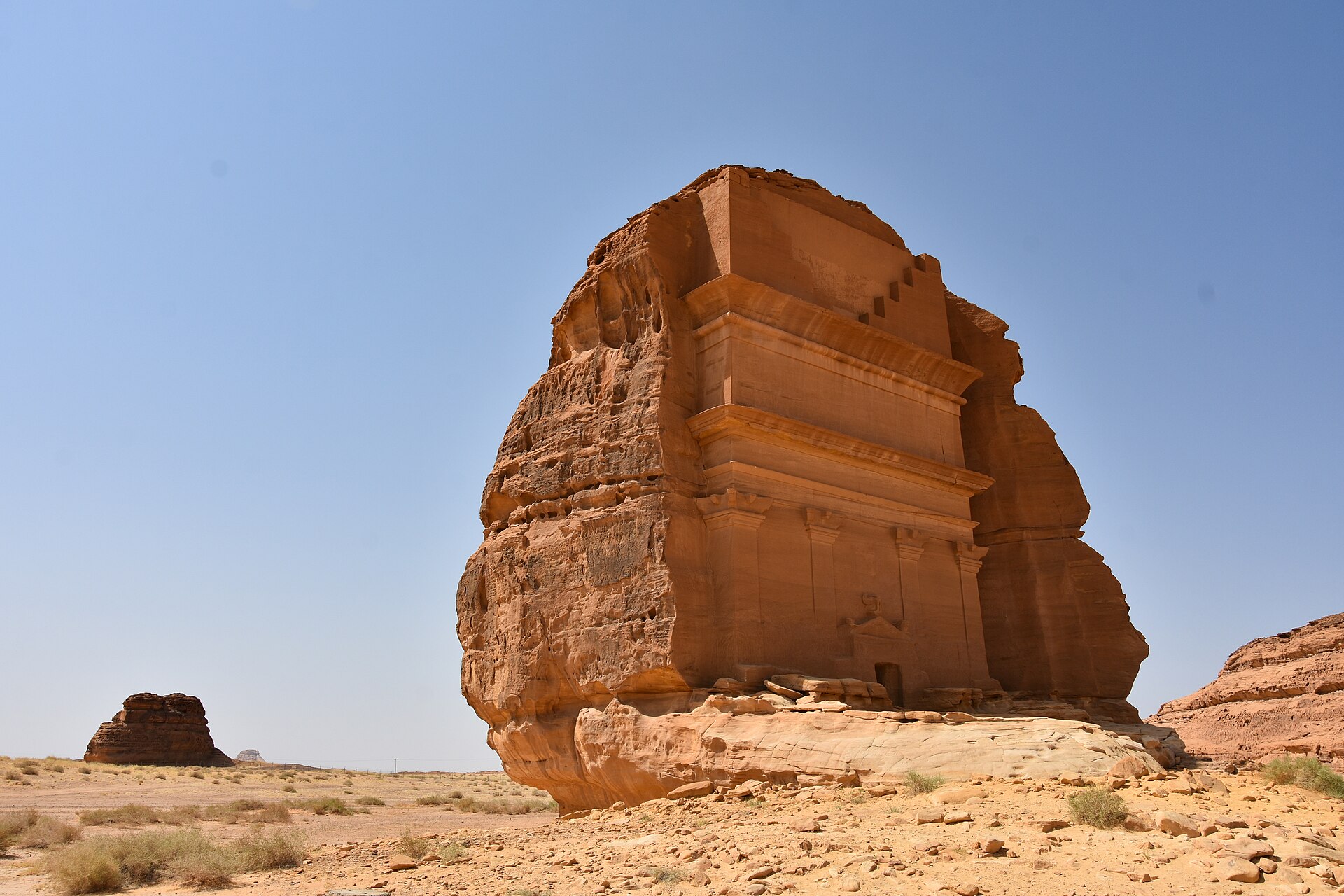
Hegra (Madain Salih): Saudi Arabia’s First UNESCO World Heritage Site
Hegra was inscribed as a UNESCO World Heritage Site in 2008, making it Saudi Arabia’s first entry on the list. The site covers 13.4 square kilometres and contains more than 110 monumental rock-cut tombs, 94 of which feature elaborately carved facades. Beyond the tombs, approximately 2,000 non-monumental burial sites, a Nabataean residential quarter, water infrastructure, and religious sanctuaries make this one of the most complete ancient cities in the Arabian Peninsula.
Historical Background
Hegra served as the Nabataean kingdom’s second capital, after Petra roughly 500 kilometres to the northwest. The Nabataeans were originally nomadic Arab traders who settled and built an empire controlling the Incense Route — the overland trade network carrying frankincense, myrrh, and spices from southern Arabia to the Mediterranean world. Hegra’s strategic position made it a vital staging post on this route.
The decorated tomb facades date from the 1st century BC to the 1st century AD, with the most intensive building period under King Aretas IV (reigned 9 BC to 40 AD). In 106 AD, the Roman Emperor Trajan annexed the Nabataean kingdom, and Hegra became part of the Roman province of Arabia. A Latin inscription dated 175–177 AD, dedicated to Emperor Marcus Aurelius, records the presence of the Legio III Cyrenaica at the site. Civilian occupation continued into the 6th century.
Key Tombs to See
Qasr al-Farid (Tomb IGN 110) is the single most photographed monument in AlUla. A solitary tomb carved into a freestanding rock dome in open desert, its facade exceeds 20 metres in height and features four pilasters rather than the standard two. The tomb is famously unfinished — the lower third was never completed, which reveals that Nabataean masons carved downward from the top. The inscription identifies the tomb owner as “Hayyan son of Kuzza.”
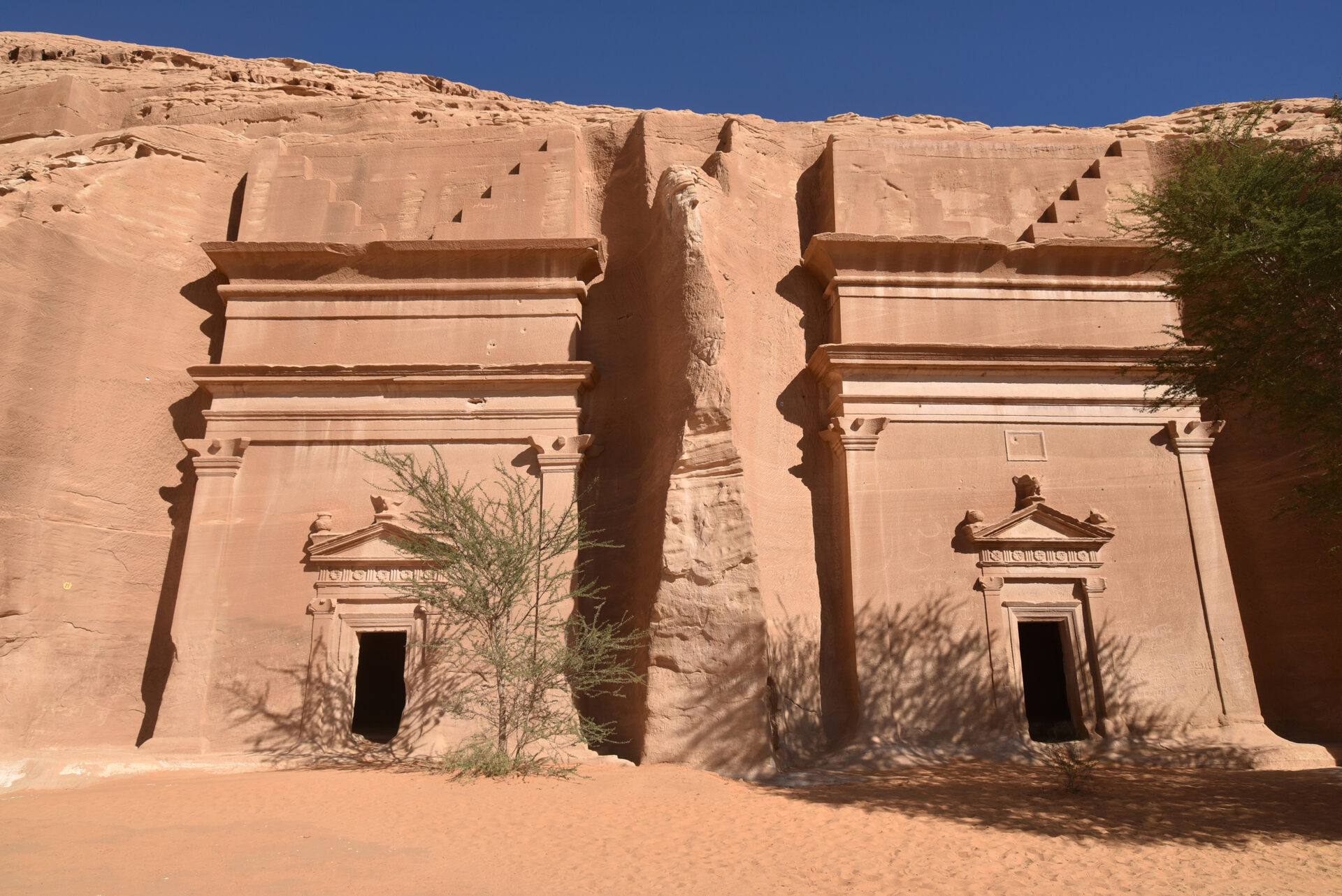
Qasr al-Bint (“Palace of the Maiden”) is the largest tomb facade at Hegra, standing 16 metres tall. The Qasr al-Bint necropolis contains 31 tombs dating from 1 to 58 AD. An inscription above the main doorway (Tomb IGN 39) records that it was carved by the sculptor Hoor ibn Ahi for the family of Hani ibn Tafsy in the 40th year of King Aretas IV’s reign, dating it to approximately 31 AD. Decorative motifs include eagles, mythological creatures, and human faces.
Jabal Ithlib is not a tomb but a sacred precinct east of the main city. A natural fault in the rock creates a narrow passage through Jabal Ithlib, where sanctuaries, ritual niches, and rock-cut altars once housed sacred stones (baetyl) representing the Nabataean deity Dushara. Over 100 inscriptions in multiple languages have been found here.
The Diwan is a Nabataean banquet hall carved into the rock at the entrance to Jabal Ithlib. Featuring three stone benches arranged in the style of a Roman triclinium, it was used for communal dining, religious ceremonies, or civic meetings — similar to examples found at Petra.
Hegra vs Petra
Visitors who have seen Petra often ask how Hegra compares. Hegra is smaller in scale — roughly 110 monumental tombs versus Petra’s 800-plus — but its tombs are generally better preserved because the site was less exposed to later reuse and weathering. The architectural style is closely related, with stepped motifs symbolising the soul’s ascent, but Hegra shows distinct local variations. For a detailed comparison, see our AlUla vs Petra guide.
Visiting Hegra: Practical Details
All visits to Hegra require a guided tour booked through Experience AlUla. Self-driving within the site is not permitted.
| Tour Type | Price (per person) | Duration | Format |
|---|---|---|---|
| Hegra Tour (guided) | From SAR 95 (~$25 USD) | ~2 hours | Coach with guided stops |
| Hegra Hop-On Hop-Off | From SAR 150 (~$40 USD) | Flexible | Multiple stops, explore at your own pace |
| Premium Private Tour | From SAR 1,000/vehicle (~$267 USD) | ~2 hours | Private 4×4 with dedicated guide |
Tip: Tours run every 10 minutes from 08:00 to 17:00 during peak season (November to February). Book at least 48 hours in advance through experiencealula.com — same-day availability is not guaranteed. Children aged 4 and under enter free.
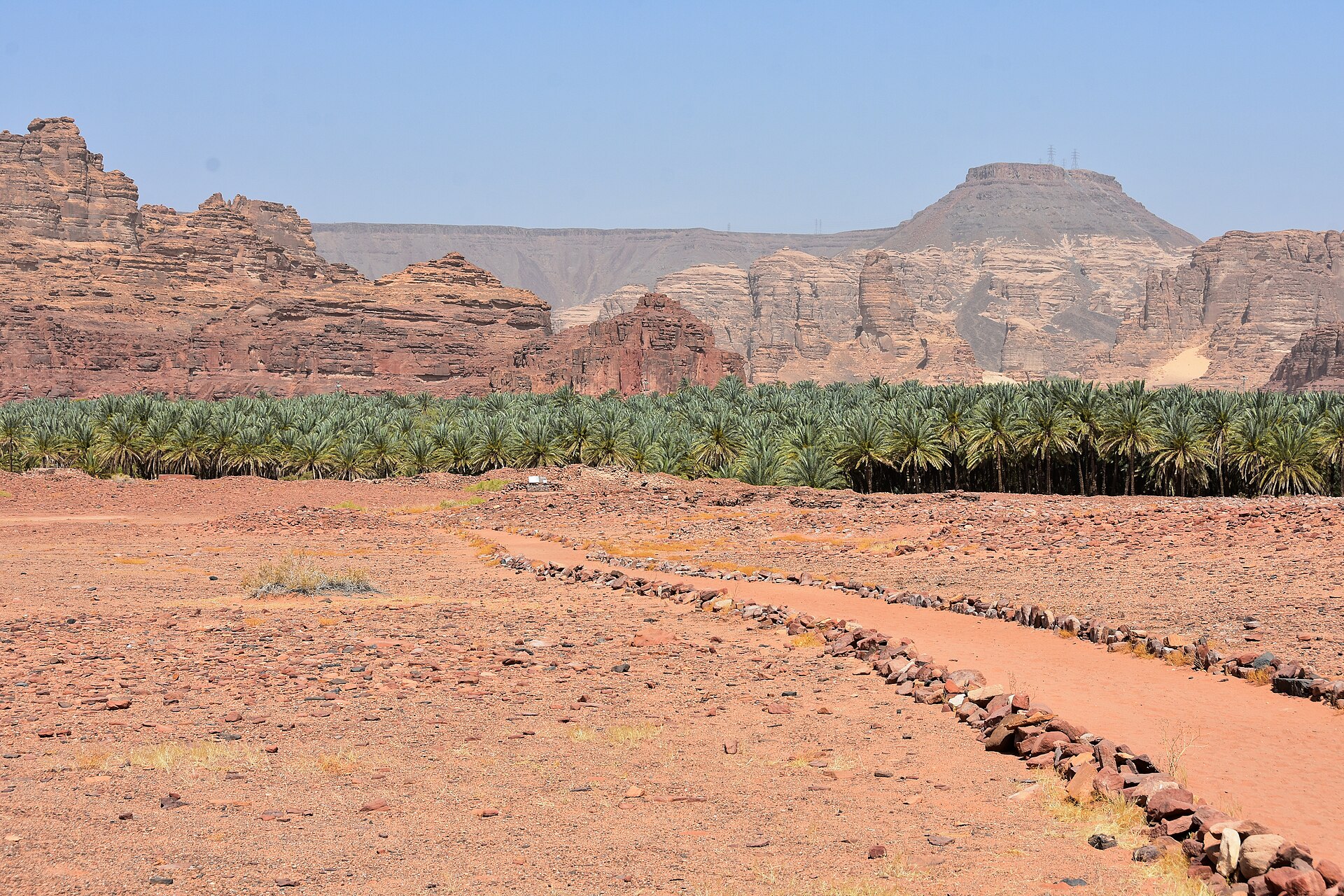
Dadan: Capital of a Forgotten Kingdom
Before the Nabataeans arrived, the AlUla valley was already the centre of a powerful civilisation. Dadan — located at the base of dramatic red sandstone cliffs a short distance from modern AlUla town — was the capital of the Dadanite kingdom from approximately the 9th century BC. By around 600 BC, it was a wealthy city-state fuelled by intensive agriculture, irrigation, and control of the long-distance incense trade.
Around the 5th century BC, control passed to the Lihyanite dynasty, a tribal confederation that ruled for several centuries. The kingdom is referenced in the Hebrew Bible (as “Dedan”) and maintained its own writing system (Dadanitic script), its own gods, and mountaintop sanctuaries. For a deeper look at the site, see our Dadan archaeological site guide.
The Lion Tombs
Dadan’s most striking feature is a row of tombs carved nearly 50 metres up a sheer sandstone cliff face, flanked by reliefs of seated lions. These Lion Tombs date to approximately the 5th century BC and are believed to belong to elite members of Dadanite or early Lihyanite society, possibly royalty. The lions likely served as divine guardians protecting the deceased.
The cliff-face tombs beyond the Lion Tombs are equally impressive — “neatly and skilfully cut into the red rock” with a precision that speaks to a sophisticated building culture predating the Nabataeans by centuries.
What Has Been Excavated
Archaeologists estimate that less than 5 per cent of Dadan has been excavated. A Saudi-French archaeological mission has been working at the site for years, with significant results presented at the December 2025 reopening of the Dadan site — highlighting five years of discoveries including more than 100 newly revealed artefacts. Rock art at the site includes hunting scenes, camels, ostriches, and abstract human figures. The site also reveals evidence of Babylonian contact: King Nabonidus of Babylon spent time in the AlUla region in the mid-6th century BC.
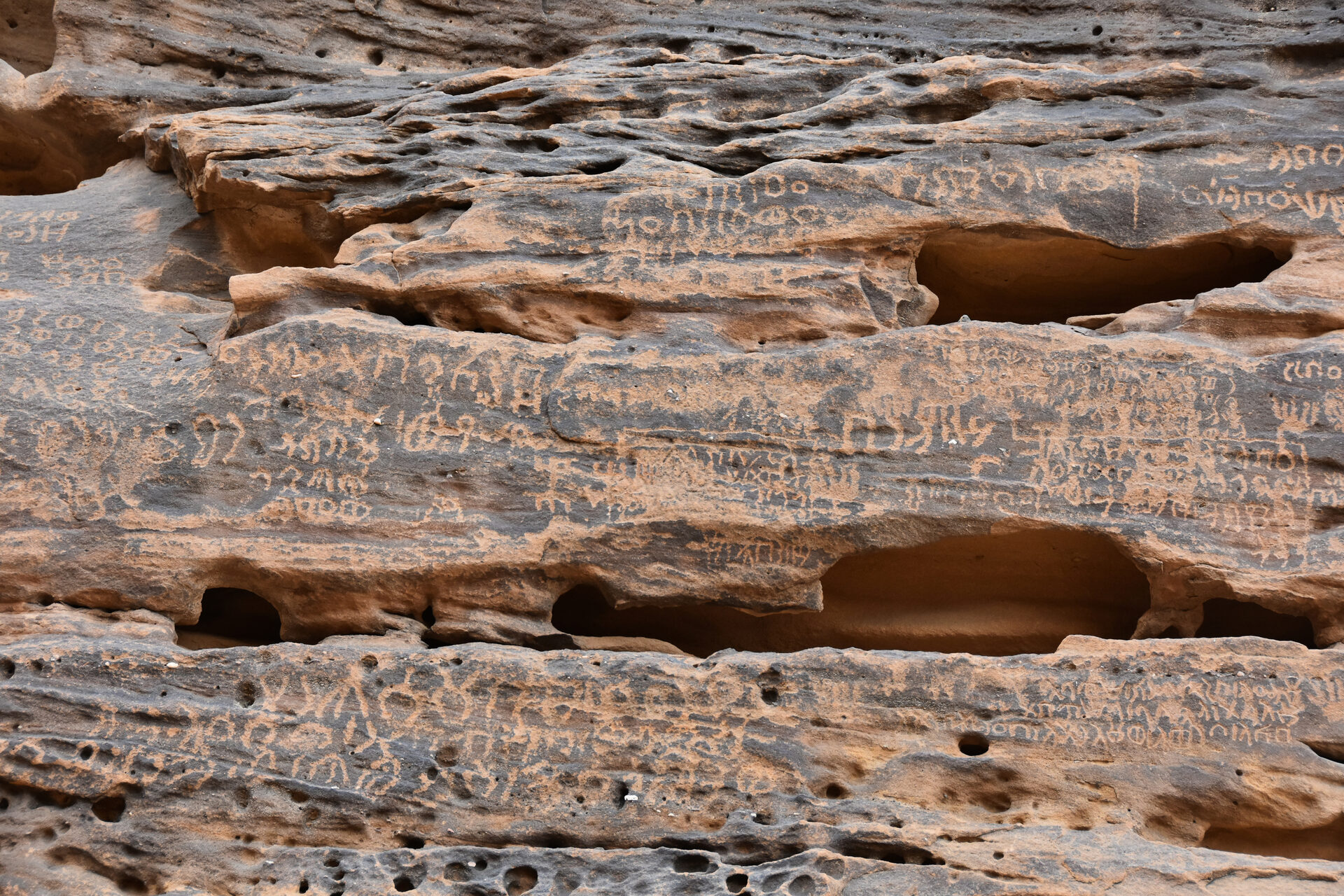
Jabal Ikmah: The World’s Oldest Open Library
Approximately five kilometres north of AlUla town, in the Ashar Valley, Jabal Ikmah contains the largest concentration of well-preserved Dadanitic and Lihyanite inscriptions anywhere in the world. In May 2023, UNESCO’s Executive Board unanimously added Jabal Ikmah to the Memory of the World International Register, recognising its documentary heritage as globally significant.
What the Inscriptions Tell Us
More than 450 early Arabic inscriptions cover the rock faces at Jabal Ikmah, written in multiple languages and scripts: Dadanitic, Lihyanite, Thamudic, Nabataean, Minaean, Aramaic, Greek, Latin, and Arabic. Some were incised, others painted, and some carved in relief. The oldest date to the 1st millennium BC; one of the newest is an early Islamic inscription from 24 AH (644 AD).
The inscriptions record journeys and pilgrimages, religious offerings and dedications, scenes of daily life, musical instruments, and animals. They document the roles of women in Dadanite society — as property owners, agricultural landholders, and participants in religious rituals. For travellers on the ancient Incense Route, Jabal Ikmah was a crossroads: people stopped, carved their names and stories, and moved on. Over centuries, this created a cumulative documentary record of trade and movement across the ancient world.
Visiting Jabal Ikmah
Jabal Ikmah is visited on the same guided tour as Dadan — about a 10-minute drive separates the two sites. The combined Dadan and Jabal Ikmah Tour costs from SAR 60 per person (~$16 USD) and lasts approximately two hours. A premium private tour by 4×4 costs SAR 1,000 per vehicle. Photography is permitted, but touching inscriptions or removing artefacts is strictly prohibited.
Tip: Visit Jabal Ikmah in the morning when the low sun angle makes the inscriptions easier to read against the rock face. Bring a zoom lens or binoculars — some carvings are high on the cliff.
Other Archaeological Sites in AlUla
AlUla Old Town
The densely built Islamic-era settlement at the heart of AlUla features narrow winding streets, mudbrick houses, and a historic mosque. Archaeological investigations through the MUDUD project (operational since 2021) have revealed occupation spanning from pre-Islamic times to the modern era. A self-guided walking tour is free and provides context for how the valley’s inhabitants lived in more recent centuries. For details, see our guide to AlUla’s Old Town and wider attractions.
Harrat Uwayrid
A volcanic lava field near AlUla containing significant Neolithic evidence. A 2024 study published in the journal Levant examined 431 standing stone circles at sites across the Harrat, with excavations revealing circular dwellings supported by wooden poles, arrowheads matching types found in southern Jordan, and Red Sea seashells — evidence of trade networks operating over 120 kilometres more than 7,000 years ago.
The Incense Route Connection
AlUla sat at the heart of the overland incense trade that connected southern Arabia’s frankincense-producing regions to the Mediterranean. The Dadanite and Lihyanite kingdoms owed their wealth to controlling this route, and the Nabataeans inherited and expanded it. Walking through Hegra’s necropolis, you are standing at a logistics hub that once handled some of the ancient world’s most valuable commodities.
Recent Discoveries
Archaeological work in AlUla continues to produce significant finds. In 2023, researchers discovered what has been described as the largest stone axe ever found in the world, with an estimated age of 200,000 years. The RCU’s 2025–2026 Archaeology Season has Saudi and international teams conducting fieldwork across AlUla and nearby Khaybar, with the Saudi-French mission at Dadan presenting five years of results at the site’s December 2025 reopening.
Planning Your Archaeological Visit
Suggested Itinerary: Two-Day Archaeology Focus
Day 1 — Hegra: Book the morning Hegra Tour (2 hours) or the Hop-On Hop-Off for more flexibility. Spend the afternoon at Elephant Rock and AlUla Old Town.
Day 2 — Dadan and Jabal Ikmah: Take the morning Dadan and Jabal Ikmah Tour (2 hours). Use the afternoon for the Harrat Uwayrid viewpoint, a hot-air balloon flight, or exploring AlUla’s cafes and restaurants.
If you have a third day, consider a visit during the Hegra Season festival or the AlUla Winter Season for cultural events alongside the archaeology.
Getting to AlUla
By air: AlUla International Airport (ULH) receives direct flights from Riyadh (Saudia, daily, ~2 hours) and Jeddah (Saudia daily + flynas five times weekly, ~1 hour 20 minutes). Fares on flynas start from SAR 260 (~$69 USD). Five airlines now serve AlUla.
By road: AlUla is a 3-hour drive from Medina and a 3-hour drive from Tabuk, making it combinable with a wider northwestern Saudi road trip. For those coming from further afield, check our Saudi Arabia visa guide before booking.
Best Time to Visit
The peak season runs from October to March, with average temperatures around 25 degrees Celsius from November to February. All heritage sites operate full schedules during this period. Summer months (June to September) bring extreme heat and reduced site access — avoid if archaeology is your priority. The AlUla Winter Season (typically December to March) adds cultural events, concerts, and art installations to the archaeological offering.
Where to Stay
AlUla’s accommodation ranges from ultra-luxury to budget-friendly:
- Ultra-luxury: Banyan Tree AlUla; Sharaan Resort by Jean Nouvel (38 suites carved into 500-million-year-old rock, opening 2026)
- Luxury: The Chedi Hegra, Our Habitas AlUla, Ashar Tented Resort
- Mid-range: Dar Tantora The House Hotel, Shaden Resort, Cloud7 Residence
- Budget: Caravan by Habitas
For detailed reviews and booking advice, see our best hotels in AlUla guide and AlUla desert camp guide.
Photography and Etiquette
Personal photography is permitted at all heritage sites. Commercial photography and videography require a Saudi film permit. Drone use by tourists is not permitted anywhere in Saudi Arabia. Do not touch, climb on, or remove any inscriptions or artefacts. Do not photograph people — especially women in traditional dress — without explicit consent; fines of SAR 1,000 apply.
What to bring: Sun protection (hat, sunscreen, sunglasses), comfortable walking shoes with good grip, at least 1.5 litres of water per person, and a zoom lens or binoculars for reading high inscriptions at Dadan and Jabal Ikmah. Tours provide bottled water but carrying extra is wise.
The Royal Commission for AlUla and Conservation
The Royal Commission for AlUla (RCU), established in July 2017, oversees archaeological preservation and tourism development across a 22,561-square-kilometre area. The commission is chaired by Crown Prince Mohammed bin Salman, with Prince Badr bin Abdullah bin Farhan Al Saud (also Minister of Culture) serving as Governor.
A landmark intergovernmental agreement signed in April 2018 between Saudi Arabia and France created AFALULA, the French Agency for AlUla Development. This partnership has facilitated the Sorbonne’s involvement in archaeological research, Thales security systems protecting heritage sites, and the Sharaan Resort project by Pritzker Prize-winning architect Jean Nouvel. The Centre Pompidou has also signed an agreement to develop a contemporary art museum in AlUla.
The RCU’s scholarship programme sends Saudi students to universities in the USA, UK, France, and Australia to study archaeology, heritage management, hospitality, and tourism — building long-term local expertise to steward these sites for future generations.
Explore More Saudi Arabia Travel Guides
- AlUla Travel Guide 2026 — The complete guide to AlUla: Hegra, Elephant Rock, desert camps, and ancient Arabia
- Hegra (Madain Saleh) Complete Guide — In-depth guide to Saudi Arabia’s Petra and first UNESCO World Heritage Site
- Dadan Archaeological Site — Everything you need to know about visiting the Dadanite and Lihyanite capital
- Elephant Rock AlUla — How to visit, best time to go, and what to expect
- AlUla vs Petra — Which Nabataean city is worth the trip?
- Nabataean History in Saudi Arabia — Hegra, Dadan, and the ancient trade routes explained
- Saudi Arabia Travel Guide 2026 — The complete guide to visiting the Kingdom
- Saudi Arabia Visa Guide — Every visa type explained