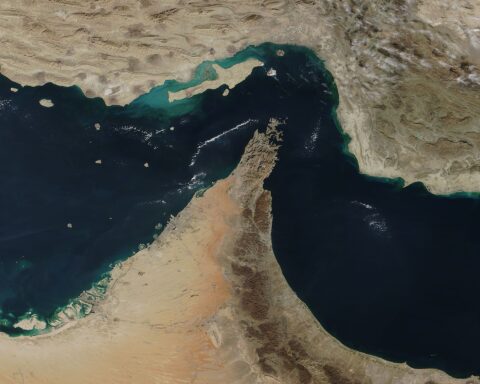
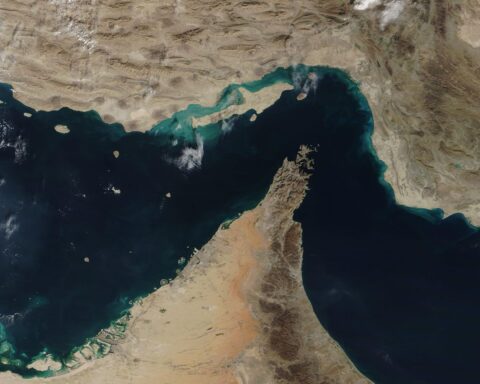
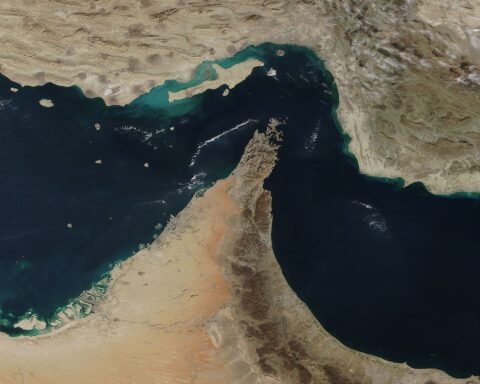
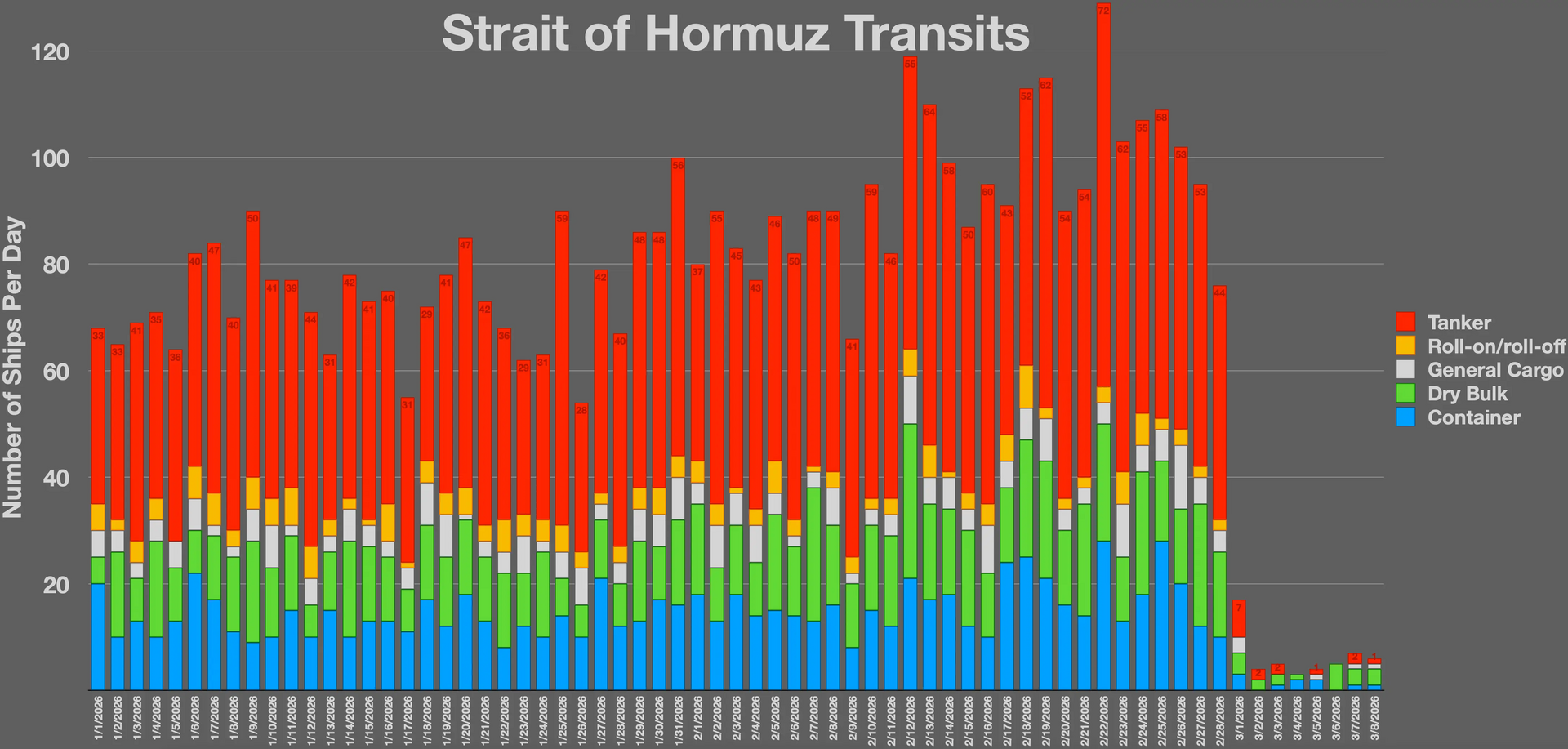
DUBAI — The CMA CGM Kribi, a Malta-flagged container ship operated by France’s CMA CGM, passed through the Strait of Hormuz on April 3, 2026 — the first vessel linked to Western Europe to transit the waterway since the war between the United States, Israel, and Iran began on February 28. Hours later, Japan’s Mitsui OSK Lines confirmed that the Sohar LNG, a Panama-registered tanker it part-owns, also crossed, making it the first liquefied natural gas carrier to navigate the strait since hostilities shut down roughly 90 percent of its traffic.
The two transits did not signal a reopening of the strait. They signaled the opposite: a working fee-collection system run by Iran’s Islamic Revolutionary Guard Corps, one that accepts payment in Chinese yuan and cryptocurrency stablecoins, routes ships through Iranian territorial waters under armed escort, and operates outside the US dollar system entirely. Iran is not losing control of the Hormuz chokepoint. It is charging admission.
Two Ships, Two Payments, One New System
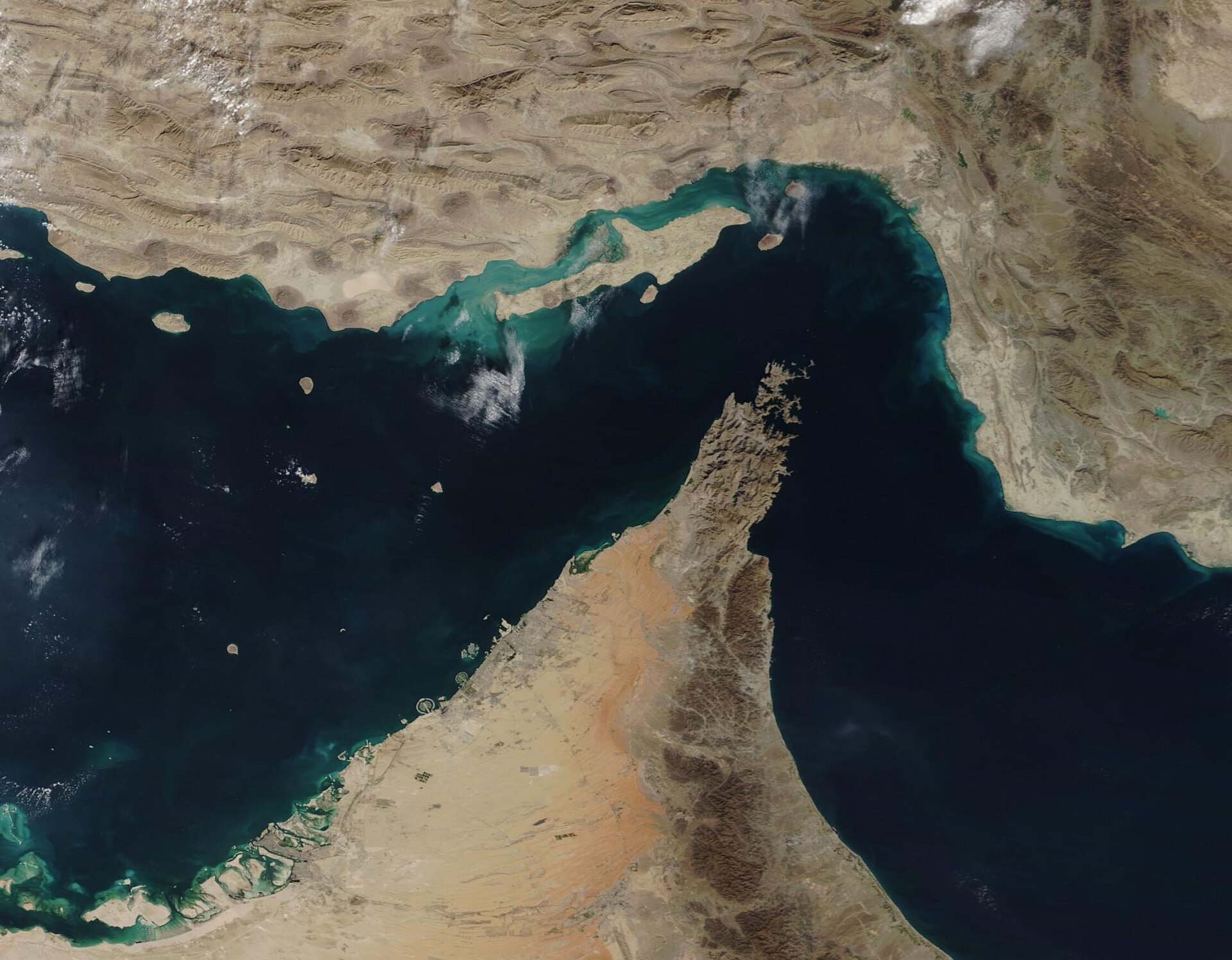
The CMA CGM Kribi sailed eastbound from waters off Dubai, through the channel between Qeshm and Larak islands, bound for Pointe Noire in the Republic of Congo, according to Bloomberg and Euronews. CMA CGM is the world’s third-largest container shipping line. The company declined to comment on the transit arrangements or any fees paid, according to gCaptain.
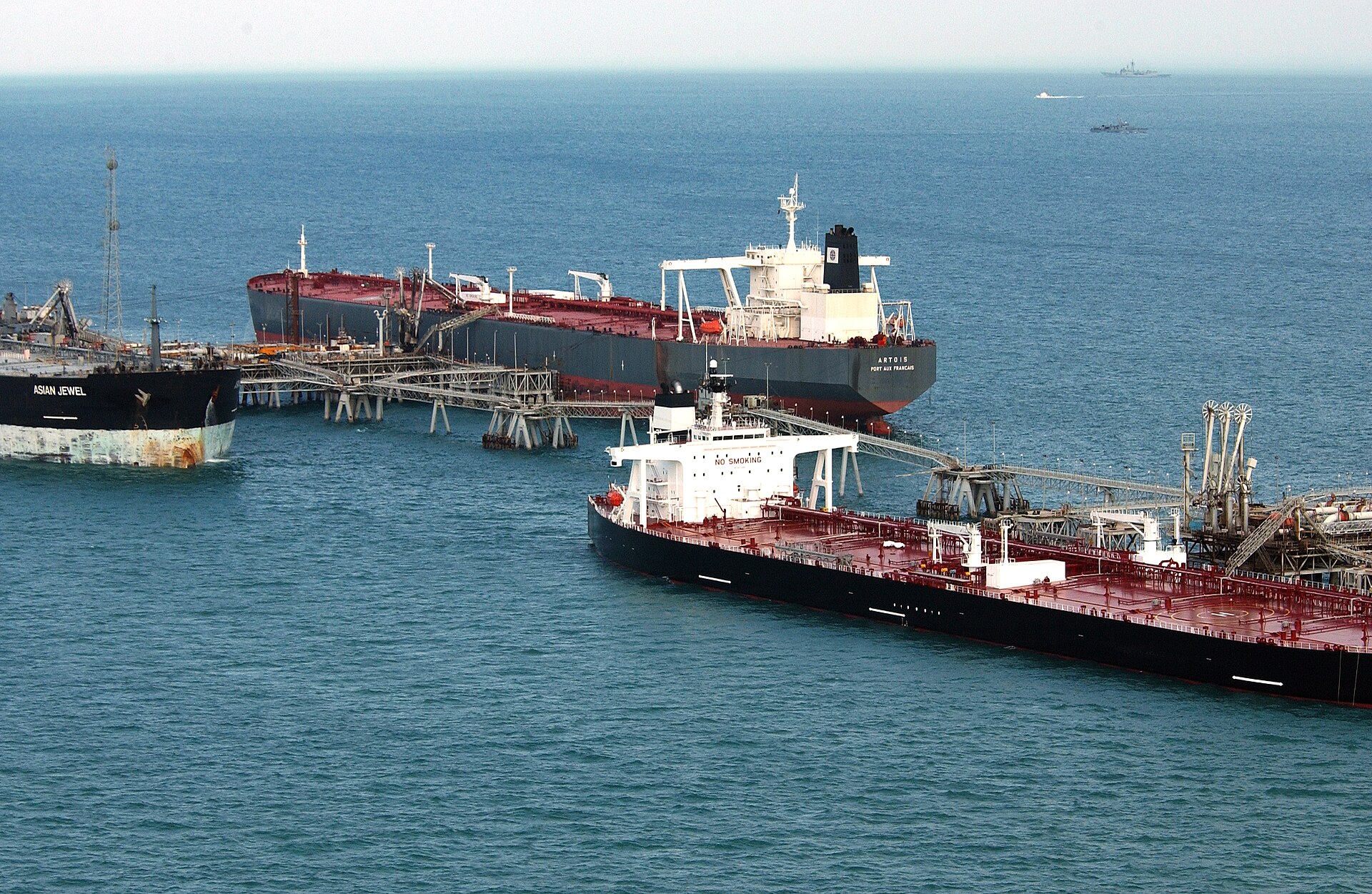
The Sohar LNG, a 72,000 deadweight-ton tanker built in 2001, moved eastward toward the Qalhat LNG export terminal in Oman. The vessel was not carrying cargo at the time. Mitsui OSK Lines also declined to discuss payment details, gCaptain reported.
Both France and Japan had publicly called for a ceasefire earlier in the same week, gCaptain noted — a diplomatic posture that may have facilitated IRGC approval for the transits.
The crossings brought the total number of Western-linked vessels that have used the IRGC’s pre-approval corridor to at least 28 since it became operational around March 13. In all of March, roughly 77 ships crossed Hormuz, according to TRT World — down from the thousands per month that transited before the war began.
How Does Iran’s Toll Corridor Actually Work?
The process is bureaucratic, thorough, and military. Vessel operators must submit full documentation to IRGC-linked intermediaries: IMO number, cargo manifest, complete crew names, ownership structure, and final destination, according to reporting by Al Jazeera and Lloyd’s List. Once cleared, ships receive a VHF-broadcast route code. IRGC commanders hail vessels on approach to verify the code, then dispatch a pilot boat to escort each ship through Iranian territorial waters around Larak Island.
The routing itself is deliberate. By channeling vessels through territorial waters rather than international waters in the strait’s traffic separation scheme, Iran anchors the toll’s legal justification to a zone where its authority under international law is uncontested, according to USNI News.
Bridget Diakun, senior risk and compliance analyst at Lloyd’s List Intelligence, estimated that 63 ships had used the IRGC corridor in its first two weeks of operation. She documented “at least two cases of shippers paying Iran for permission to pass,” with others gaining passage through “diplomatic negotiations.” Diakun also observed that “over half of the tankers and gas carriers going through are shadow fleets — these ships are really used to disruptions.”
The IRGC toll system allows the Iranian leadership to project a level of power into the Gulf and into the strait.
Arran Kennedy, Associate Analyst, Control Risks
The system structurally mirrors the Houthi “safe passage” corridor that operated in the Red Sea: submit documentation, receive a clearance code, accept escort, pay a fee, as NPR reported on April 3. It is a tested template applied to a far more consequential waterway.
Yuan, Stablecoins, and the Dollar’s Absence
Iran has formulated a fee structure of approximately $1 per barrel for tankers, payable in Chinese yuan or stablecoins, with ad-hoc fees for other vessel types reaching up to $2 million per transit, according to Bloomberg and Cryptopolitan. At least two vessels had already paid in yuan as of April 1, Bloomberg reported.
Iranian lawmaker Alaeddin Boroujerdi confirmed the upper end of the fee range. “Iran charges some vessels $2 million to pass through,” he told Al Jazeera.
The acceptance of stablecoins extends an existing Iranian financial infrastructure. Iran legalized Bitcoin mining in 2019 as part of its sanctions-evasion architecture, and the IRGC’s adoption of crypto payments for strait transit fees builds on that foundation, Bloomberg reported.
Alisha Chhangani, associate director for the future of money at the Atlantic Council’s GeoEconomics Center, published an analysis on March 30 titled “Inside Tehran’s toll booth.” She described how Iran uses formal, semi-formal, and informal channels to avoid US sanctions and sell oil to China, framing the Hormuz payment architecture as an anti-dollar infrastructure project. The Atlantic Council estimated that selective enforcement of the toll system could generate between $500 million and $1 billion annually for Iran.
Oil flowing through the yuan payment circuit already commands a $3 to $8 per barrel discount versus dollar-circuit oil, according to Middle East Insider, reflecting sanctions risk premiums and limited refinery compatibility. The Hormuz toll system adds another layer of non-dollar transaction infrastructure to a parallel market that has been growing since Western sanctions intensified in 2022.
The IRGC-Parliament Split
Iran’s parliament has moved to formalize what the IRGC built without waiting for legislative authority. On March 30, the parliamentary security committee approved a Hormuz toll management plan. The following day, the full parliament advanced legislation codifying transit fees, asserting Iranian sovereignty over the waterway, and granting explicit authority to deny passage to ships linked to “hostile nations” — principally the United States and Israel, according to The Week India and Anadolu Agency. The bill still requires a full parliamentary vote, Guardian Council review, and a presidential signature before becoming law.
But the bill contains a divergence that reveals the internal power dynamics at work. The parliamentary legislation stipulates that fees be paid in Iranian rials, according to Anadolu Agency. The IRGC’s operational system already accepts yuan and stablecoins, as Bloomberg reported on April 1. The parliament is drafting legal cover for a system the IRGC designed, built, and began operating weeks before the legislature acted. The bill is retroactive authorization, not operational authority.
On April 2, Iranian Deputy Foreign Minister Kazem Gharibabadi announced that Iran and Oman are in “final stages” of drafting a post-war protocol for navigation in the Strait of Hormuz, requiring vessels to obtain advance permits from both countries. Iran’s push to bring Oman into a co-administration framework predates the parliamentary bill.
Gharibabadi framed the protocol in service-oriented language. Tanker traffic “should be supervised and coordinated” with Iran and Oman, he told IRNA. The protocol “will not mean restrictions, but rather to facilitate and ensure safe passage and provide better services to ships that pass through this route.”
Oman has issued no public confirmation of the protocol. Every public statement on the joint arrangement has come from Iranian officials exclusively, according to reporting from CNBC and Tasnim News Agency.
Who Gets Through the Strait — and Who Doesn’t?
Iran operates a nation “friendliness ranking” on a 1-to-5 scale for vessel vetting, according to Al Jazeera. Confirmed allowed nations include China, Russia, India, Iraq, Pakistan, Malaysia, and Egypt. Vessels linked to the United States and Israel are blocked entirely.
India occupies a distinct category. Indian ships have transited the strait without payment, according to NPR — implying a diplomatic passage arrangement separate from the commercial toll system. The exemption reflects India’s careful positioning between its energy dependence on Gulf oil and its relationships with both Washington and Tehran.
Saudi Aramco tankers operate under back-channel arrangements that nominally exempt them from the toll system, according to Middle East Insider. But the exemption is largely academic: Aramco has shut down four supergiant offshore oil fields as Gulf rigs went dark, and has lost access to its primary Gulf export terminals at Ras Tanura and Jubail. Saudi Arabia now relies on its East-West Pipeline to move crude to Red Sea terminals — a route that bypasses Hormuz entirely but cannot replace the volume the strait once carried.
| Category | Nations / Entities | Fee Status | Source |
|---|---|---|---|
| Free passage (diplomatic) | India | No fee reported | NPR, April 3 |
| Allowed (allied) | China, Russia, Iraq, Pakistan, Malaysia, Egypt | Reduced or waived | Al Jazeera, March 26 |
| Allowed (commercial toll) | Western-linked vessels (case-by-case) | Up to $2M per transit or ~$1/bbl | Bloomberg; Al Jazeera |
| Back-channel arrangement | Saudi Aramco tankers | Nominally exempt | Middle East Insider |
| Blocked | US-linked, Israel-linked vessels | Denied passage | Anadolu Agency, March 31 |
The system creates a tiered access structure where geopolitical alignment determines the cost of moving cargo through the world’s most consequential maritime chokepoint. Martin Kelly of the EOS Risk Group told NPR that Iran seeks international recognition of sovereignty over the waterway, comparing its ambitions to Egyptian control of the Suez Canal — though Kelly and other experts noted the comparison does not hold under international law, since the Suez is an artificial canal through sovereign Egyptian territory, not a natural international strait.
Can Pipelines Replace the Strait?
Saudi Arabia’s East-West Pipeline — the 1,200-kilometer Petroline running from eastern oil fields to Yanbu on the Red Sea — hit its maximum capacity of 7 million barrels per day in late March after Aramco redirected exports, according to Bloomberg and Fortune. The UAE’s Abu Dhabi Crude Oil Pipeline adds approximately 1.5 million barrels per day of additional bypass capacity, per Al Jazeera.
Combined, the two pipelines can move roughly 8.5 million barrels per day around the strait. Pre-war, Hormuz carried approximately 20 million barrels per day. The structural gap is 11.5 million barrels per day — a deficit no combination of existing infrastructure can close.
The math defines the problem. Even with pipeline maximums, Gulf producers cannot move the majority of their output without Hormuz. Iran’s toll system does not need to process pre-war volumes to generate revenue or exert control. It needs only to remain the sole alternative to a permanent supply shortfall.
Brent crude futures stood at $109 per barrel on April 2, while physical spot prices reached $141.36 per barrel, according to CNBC. The Dallas Federal Reserve has estimated that a closed Hormuz would reduce global GDP by 2.9 percentage points on an annualized basis per quarter of closure. The IRGC-linked oil revenue during the blockade period has been estimated at $139 million per day, according to Seoul Economic Daily and TankerTrackers.
The Legal Battle Over Transit Fees
No state has ever successfully imposed transit fees on an international strait recognized under the United Nations Convention on the Law of the Sea. UNCLOS Article 44 explicitly bars strait states from charging fees for passage. The closest historical parallel — the Suez Crisis of 1956 — reaffirmed freedom of navigation as a governing principle, according to Shipping and Freight Resource.
Iran signed UNCLOS in 1982 but never ratified it, and claims it is therefore not bound by the convention’s transit passage regime. Maritime law experts dispute this position, arguing that transit passage rights have achieved the status of customary international law, which binds all states regardless of treaty ratification.
Stopping all commercial traffic or charging transit fees exceeds the bounds of self-defence and becomes illegal economic warfare.
Jason Chuah, Maritime Law Professor
US Secretary of State Marco Rubio called Iran’s transit fees “unacceptable not only to us but to the entire world,” warning that the system would set a precedent for individual nations to claim and control international waters, according to the Washington Times. Sultan Al Jaber, the UAE’s energy minister and ADNOC chief, described the Hormuz blockade as “global economic extortion,” Gulf News reported.
A coalition of 41 nations has called for reopening the strait, while the UN Security Council has struggled to advance a resolution with enforcement power. The gap between diplomatic language and operational reality widens each week the toll system functions. Iran’s position — that sovereignty over the strait is a precondition for any ceasefire — makes the fee structure not merely a revenue tool but a bargaining chip that Tehran has no incentive to surrender at the negotiating table.
President Trump has publicly told allies to “take” the strait themselves — a statement that has not produced a coordinated military response.
Background and Context
The April 3 transits by the CMA CGM Kribi and the Sohar LNG represent a new phase. Prior IRGC-approved crossings involved ships from nations within Iran’s friendly tier — China, Russia, India, and others. The French and Japanese vessels are the first from nations aligned with the Western coalition, suggesting the IRGC is willing to extend toll access beyond its geopolitical allies when the price is right and the diplomatic conditions are favorable.
Full closure of the strait was always the most extreme and least sustainable option for Iran. A permanent blockade invites military escalation, accelerates pipeline alternatives, and alienates potential mediators. A selective toll system that generates revenue, reinforces sovereignty claims, and operates outside the dollar creates a structure Iran can maintain indefinitely — during the war and, potentially, after it.
Frequently Asked Questions
How much revenue could Iran generate from the Hormuz toll system?
Estimates vary widely depending on traffic volumes. The Atlantic Council’s conservative projection, based on selective enforcement at current reduced traffic, is $500 million to $1 billion per year. Current IRGC-linked oil revenue during the blockade period runs at approximately $139 million per day from all sources, according to Seoul Economic Daily and TankerTrackers. The actual toll revenue is a fraction of this, since only 77 ships crossed in all of March and many transited under diplomatic or allied-nation exemptions.
What happens to ships that try to transit without IRGC approval?
No vessel has been publicly reported attempting an unauthorized transit since the toll corridor became operational in mid-March. The IRGC has deployed fast-attack craft, coastal missile batteries, and aerial surveillance across the strait’s narrowest points, according to USNI News. The corridor’s routing through Iranian territorial waters around Larak Island means any unauthorized transit would pass within range of shore-based weapons systems. Lloyd’s List Intelligence has reported that insurers have effectively withdrawn war-risk coverage for vessels transiting without IRGC clearance, making unapproved passage financially prohibitive even before factoring in the physical risk.
Why did France and Japan get access before other Western nations?
Both nations had publicly advocated for a ceasefire in the days immediately before the April 3 transits, according to gCaptain. Neither France nor Japan has military forces directly engaged in the conflict. France’s CMA CGM has extensive operations across the Middle East and Africa, giving it commercial relationships that may facilitate back-channel negotiations. Japan’s acute dependence on LNG imports through the strait — Japan is the world’s largest LNG importer — creates a strong economic incentive for Tokyo to engage diplomatically with Tehran, and Iran has an interest in demonstrating that its system can serve major economies.
Could the US Navy reopen the strait by force?
The US Fifth Fleet is based in Bahrain, and the US maintains substantial naval assets in the region. However, forcibly reopening the strait would require sustained minesweeping operations, suppression of Iran’s coastal anti-ship missile batteries, and continuous naval escort for commercial vessels — a commitment that military analysts estimate would take weeks to establish and months to sustain. The Trump administration has thus far signaled that allies should bear the burden of reopening, rather than committing US forces to a unilateral naval operation. No coalition minesweeping or escort mission has been announced as of April 3.
Is the Iran-Oman joint navigation protocol likely to take effect?
Iranian Deputy Foreign Minister Gharibabadi announced on April 2 that the protocol is in “final stages,” but Oman has not publicly confirmed participation. Oman has historically maintained a neutral diplomatic position between Iran and the Gulf Arab states, and publicly co-signing a navigation protocol that effectively legitimizes Iran’s toll system would represent a substantial shift in Omani foreign policy. Oman’s silence may reflect ongoing negotiations, domestic reluctance, or a preference to avoid public alignment with either side while the war continues.