
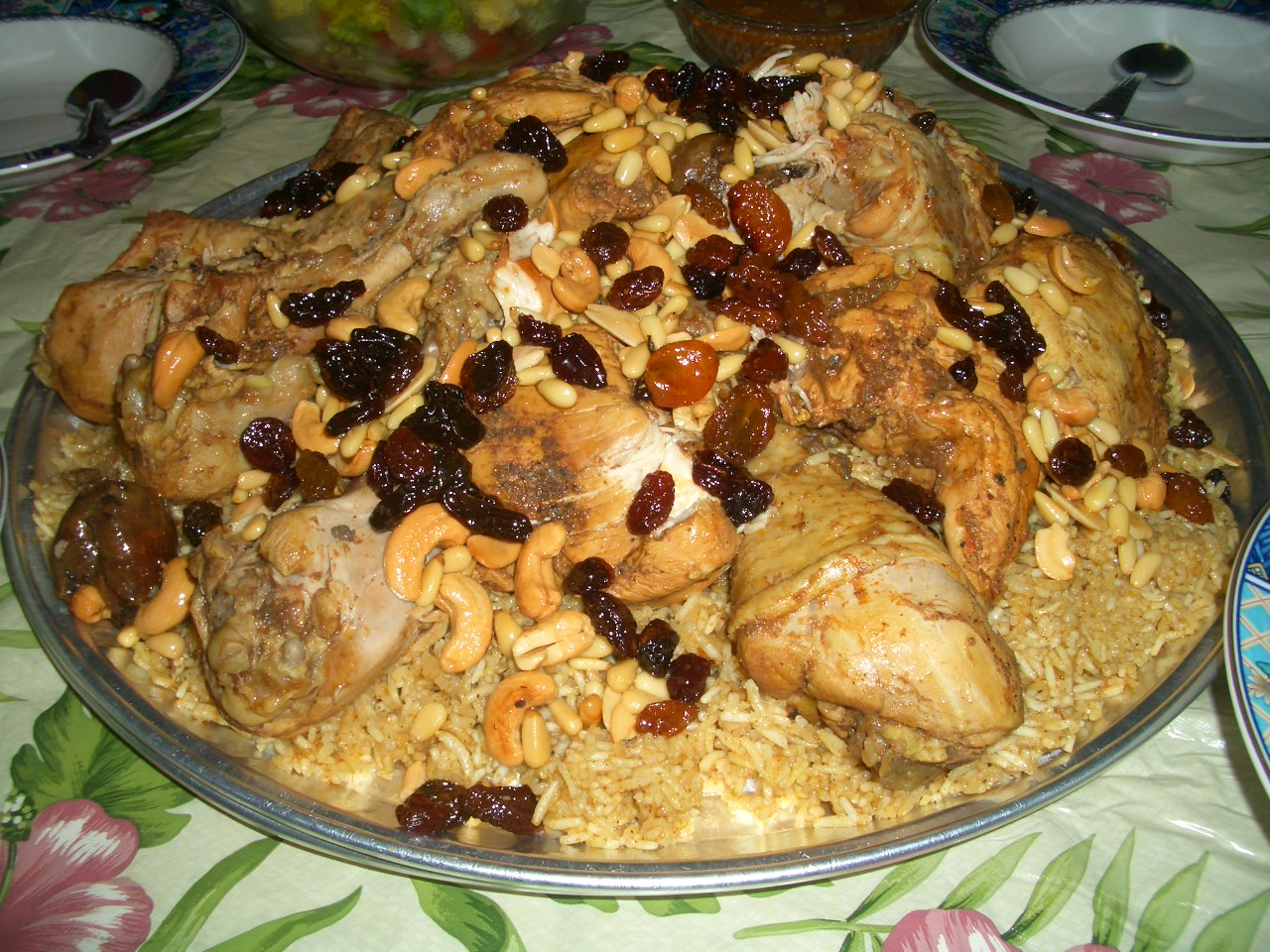
If you only try one dish in Saudi Arabia, it should be kabsa — a spiced rice and meat dish that functions as both a national emblem and a Friday-lunch ritual in millions of Saudi homes. A mound of fragrant basmati rice, stained amber by tomato and saffron, is heaped onto a communal platter with a bronzed chicken, lamb shoulder, or whole baby goat resting on top. Dried limes perfume the pot; toasted almonds and raisins decorate the crown. This guide is for travellers who want to eat kabsa the right way, understand what makes the Hijazi, Najdi, and Hasawi versions taste different, and know which restaurants in Riyadh and Jeddah serve the real thing. It is part of our wider Saudi Arabia food and dining guide and sits alongside practical pages on Saudi cooking classes and Saudi food tours.
Best Time to Try: Friday lunch (the traditional kabsa day); year-round on most menus
Where: Riyadh, Jeddah, Dammam — every city; best at family-style traditional restaurants
Visa Required: Yes — tourist e-visa
Typical Price: SAR 35–95 (USD 9–25) per person at a mid-range traditional restaurant; SAR 150+ at upscale venues
Must-Try Version: Lamb kabsa at Najd Village (Riyadh); chicken kabsa from a Hijazi kitchen in Jeddah’s Al Balad
Avoid: Eating with your left hand when sharing the communal platter — it’s considered deeply impolite
What Kabsa Actually Is
Kabsa (كبسة) is an Arab mixed-rice dish built on three elements: long-grain basmati rice, a single large piece of meat — usually chicken, lamb, goat, camel, or occasionally shrimp and fish — and a tomato-based broth heavy with warming spices. Every element is cooked in one pot, in sequence: meat first, then rice in the resulting stock. The word itself comes from the Arabic root k-b-s, meaning to press, squeeze or compress — a reference to the technique of layering and pressing all ingredients into a single vessel.
It is the national dish of Saudi Arabia and is recognised as such across the Gulf Cooperation Council. Variants of the same dish appear under different names in Bahrain (machboos), Qatar (majboos), the UAE (machbous), and Oman (kabsa with local spin). Each country claims a distinctive take; within Saudi Arabia alone, there are at least three major regional styles, which we explain in detail below.
If you are used to Indian biryani or Iranian tahdig, kabsa will feel both familiar and subtly different. It is less heavily spiced than biryani, less buttery than pulao, and relies on the slow concentration of a meat broth rather than layered steaming.
Why it matters to Saudis
Kabsa is not just food. It is the default dish of Saudi hospitality: if someone invites you to their home for lunch, they are almost certainly serving kabsa. It is the centrepiece of weddings, Eid al-Fitr and Eid al-Adha feasts, Ramadan iftars, and the weekly Friday family gathering. In 2021, Saudi Arabia’s Ministry of Culture included kabsa in a national initiative to protect and promote traditional dishes as part of the Vision 2030 cultural agenda, alongside jareesh, saleeg, and madhruba.
The History and Origins of Kabsa
The origin of kabsa is genuinely contested. The most widely accepted theory traces it to the Bedouin tribes of the Arabian Peninsula, who relied on ingredients that travelled well — dried meat, long-keeping rice, storable spices, and the distinctive dried black limes known as loomi. A single pot, a low fire, and a long cook transformed these staples into a feast big enough to share.
A second theory links kabsa to the Yemeni dish mandi, where meat and rice are cooked together in an underground pit. A third, more fringe theory suggests Spanish paella as an ancestor, which would imply a transmission via Andalusian Arab traders. Most Saudi food historians reject the paella link and treat kabsa as indigenous to the peninsula, with Yemeni influence acknowledged but the central-Arabian Najdi identity dominant.
Rice itself arrived in the Arabian Peninsula through trade routes long before refrigeration, and basmati from South Asia became the preferred variety because it held its shape after a long absorption cook. The modern Saudi kabsa — tomato-based, loomi-forward, with the distinctive kabsa spice blend — crystallised in the mid-twentieth century, when cities like Riyadh and Jeddah codified a previously fluid home recipe into the restaurant standard travellers recognise today.
The Ingredients: What Goes Into the Pot
A traditional kabsa is built from a short, specific list. If any of these are missing, a Saudi cook will tell you it is not quite kabsa.
The rice
Long-grain basmati is the gold standard. It soaks up the tomato broth without turning mushy and keeps each grain separate — essential for the dish’s presentation. Some Hijazi cooks use Egyptian short-grain rice for a softer, stickier result; Eastern Province kitchens sometimes use Hasawi red rice, a nuttier native grain grown in Al Ahsa that produces a denser, earthier dish.
The meat
Chicken is the everyday choice; a whole bird is spatchcocked and browned before being nested into the rice. For weekends, celebrations, and guests, lamb takes over — typically a shoulder or a whole leg, slow-simmered until the meat slides off the bone. Goat kabsa is common in the south and in pastoralist households. Camel kabsa appears at high-status gatherings and at a handful of traditional restaurants in Riyadh; it has a deeper, gamier flavour than beef and is considered a mark of true Najdi hospitality. Coastal variants in Jeddah, Yanbu, and Jazan swap meat for shrimp or reef fish.
The spice blend
The core of kabsa’s flavour is a warming seven-to-eight spice blend, sometimes sold pre-mixed as bharat kabsa or kabsa baharat:
- Black pepper — the base heat
- Cardamom (green pods) — fragrance, often crushed with the pot
- Cloves — depth and warmth
- Cinnamon — usually one or two whole sticks
- Dried black lime (loomi) — the single most distinctive kabsa flavour
- Saffron — for colour and aroma in the rice finish
- Nutmeg — a light note
- Bay leaves — in the simmering stage
Some cooks add white pepper, coriander seed, cumin, or paprika. The proportions vary by household, and a Saudi grandmother’s kabsa spice ratio is often a closely guarded matter of pride.
Loomi — the signature ingredient
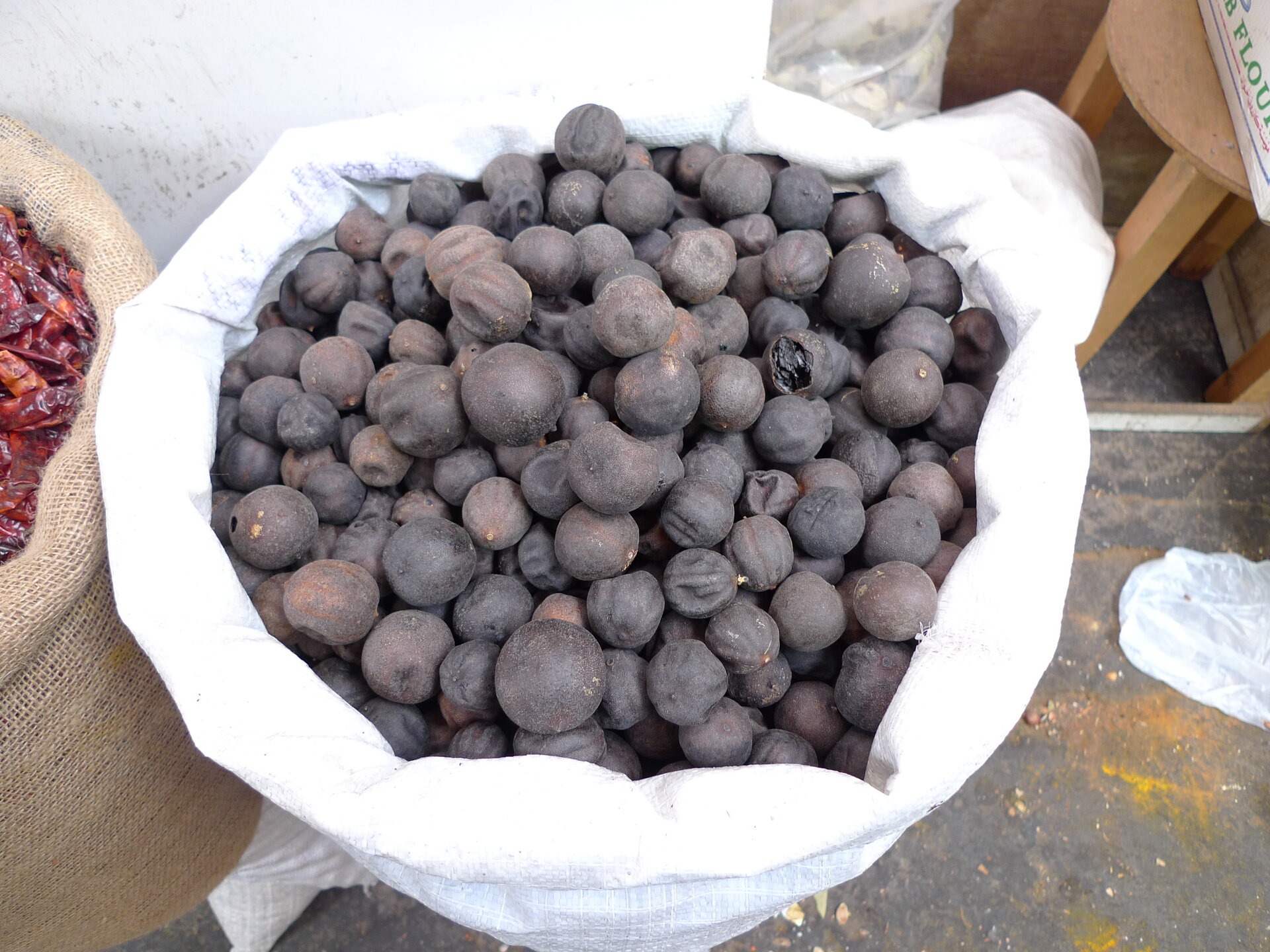
If there is one ingredient that defines kabsa more than any other, it is loomi: a whole lime that has been boiled in salt water and sun-dried until it turns nearly black, its pulp shrunk and concentrated inside a brittle shell. Cooks pierce two or three loomi with a knife and drop them whole into the broth. As the water simmers, the dried lime rehydrates and slowly releases a flavour that is sour, earthy, and almost smoky — nothing else tastes like it.
Fresh lime juice is not a substitute. If you buy a kabsa spice kit at a souk to take home, make sure loomi is in the bag or jar. You can find good loomi in the spice sections of the Olaya district in Riyadh’s Olaya, in the old markets of Jeddah’s Al Balad, and at every spice stall in Al Ahsa’s Qaisariya Souk.
The toppings
No kabsa plate is complete without a garnish of fried or roasted nuts — sliced almonds, pine nuts, cashews — plus golden raisins or sultanas softened in the cooking broth. Some cooks add slow-fried onions on top for a caramelised sweetness. In Hijazi kitchens you may also see quail eggs, cherry tomatoes, or a dusting of fresh parsley.
Regional Variations: Najdi, Hijazi, Hasawi
Saudi Arabia is large and regionally distinct. Each of the three main culinary zones produces a visibly and noticeably different kabsa.
Najdi kabsa (central Saudi Arabia)
The most traditional and widely replicated version. Najdi kabsa, from the heartland around Riyadh, uses lamb, goat, or camel cooked slowly until the meat yields with a spoon. The spicing is bold but not fiery — heavy on loomi, cinnamon and cloves, light on tomato. The rice is dry and fluffy rather than oily. This is the kabsa you will be served at formal Saudi hospitality events and at traditional Riyadh restaurants like Najd Village and Al Romansiah.
Hijazi kabsa (Red Sea / western region)
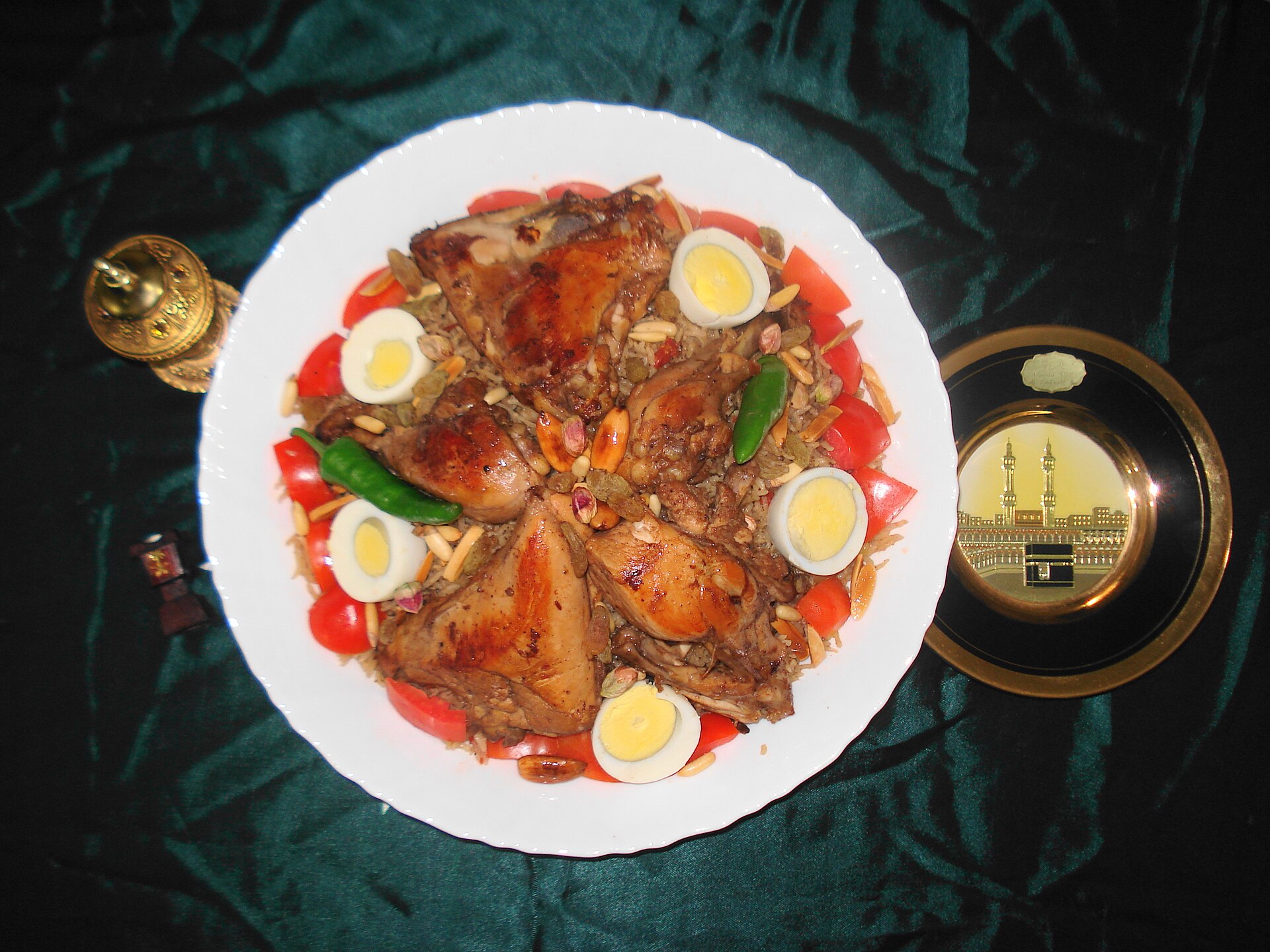
The western Hijaz region, historically the Kingdom’s most cosmopolitan zone because of centuries of pilgrim traffic through Mecca and Medina, produces a more colourful, more elaborate kabsa. Expect visible tomato, added raisins, more fried onions, and sometimes the addition of aromatics from East Africa and South Asia picked up during the Hajj-trade era. Jeddah chefs may finish the dish with chopped herbs or a sprinkle of sumac. This is the kabsa to try in Al Balad restaurants and at Hijazi-specialist venues on the Jeddah Corniche.
Hasawi and coastal kabsa (Eastern Province)
In Al Ahsa, Dammam, Al Khobar, and along the Gulf coast, kabsa is often made with Hasawi red rice, a deep-red native grain that produces a nuttier, denser dish. Seafood kabsa — shrimp from the Gulf, kingfish from coastal landings — is far more common here than inland. The spicing is slightly lighter, sometimes brightened with lemon, giving a fresher finish. You can eat this version at Hasawi restaurants in the Eastern Province’s cities.
Southern and Asir variations
In Abha and the Asir highlands, kabsa sometimes incorporates local highland herbs and, in a few kitchens, a little smoked chilli. The meat is more likely to be goat than lamb, because goat is the dominant livestock in the mountains.
How Kabsa Is Cooked
The method is simple in outline, exacting in execution. A Saudi cook makes kabsa in three phases, all in the same deep pot:
Phase 1 — build the broth. Large cubes of onion and whole garlic are softened in oil or ghee. Whole cinnamon, cardamom, cloves, bay leaves, and pierced loomi go in. The meat — a whole spatchcocked chicken, or pieces of lamb — is added and browned, then tomato paste and chopped tomato are stirred in. Water covers the lot, and the pot simmers until the meat is tender, often an hour for chicken and two to three hours for lamb or camel.
Phase 2 — cook the rice. The meat is lifted out and set aside. Soaked basmati is added to the still-hot spiced broth and cooked uncovered over medium heat until most of the liquid is absorbed. The pot is then covered, heat dropped to the lowest possible setting, and the rice steams to fluffy perfection for another 15–20 minutes.
Phase 3 — finish the meat. The reserved meat is brushed with a spice-butter glaze and finished under a hot broiler or in a tandoor oven to crisp the skin and add caramelisation. It is placed on top of the rice on a large round platter, garnished with fried nuts and raisins, and brought to the table.
Tip: At better restaurants, ask if the kabsa is cooked talban (on demand) or jahiz (pre-cooked and held). Talban means a 30–45 minute wait but a freshly broiled bird. It is worth it.
How to Eat Kabsa Like a Saudi
Sharing a platter of kabsa is a ritual, not a meal. Getting the etiquette right signals respect; getting it wrong quietly embarrasses everyone. The rules are simple and strictly observed.
The right-hand rule
Eat only with your right hand. The left hand, in traditional Islamic etiquette, is considered impure; using it to take food from a shared platter is an insult, however unintentional. Pass dishes, receive bread, and shape rice balls only with the right. If you are left-handed, adapt — everyone does.
Your zone on the platter
You eat only from the portion of the platter directly in front of you. Reaching across to a more tempting piece of chicken is frowned upon. The host will usually tear off a chunk of meat and push it toward each guest — this is your cue that the larger piece in the middle is fair game once the meat is portioned.
Rolling the rice
The traditional technique is to press a small handful of rice against the fingers of your right hand, combine it with a bit of meat, and roll it into a small ball before lifting it to your mouth. Cutlery is provided at virtually all restaurants today, and no one will blink if you use a spoon. But try the hand technique at least once — there is a reason Saudis say it tastes different.
Hierarchy and timing
The oldest or most senior person at the table eats first. Wait for them to start. In a large family gathering, the host will personally ensure everyone is served before eating. Finish what is in front of you; heavy leftovers on a shared dish are considered slightly wasteful.
After the meal
Do not linger long after eating. In Saudi homes, the meal is usually followed immediately by Arabic coffee (qahwa) flavoured with cardamom and served in tiny handleless cups, plus dates. Accept the first cup; shake the empty cup side-to-side when you have had enough (usually after two or three). This is covered in more detail in our Saudi customs and etiquette guide.
Where to Eat Kabsa in Saudi Arabia
Every Saudi city has kabsa restaurants at every price point — from the SAR 25 takeaway box to the SAR 300 whole-lamb presentation. The list below is biased toward traditional, well-known venues where travellers will get a genuine version and feel comfortable.
In Riyadh
Najd Village (مطعم القرية النجدية) — The best-known traditional Saudi restaurant in the capital, themed on a Najdi village with mud-walled private rooms, low seating on carpets, and a menu that reads like a Saudi home cook’s repertoire. Branches on Abu Bakr As Siddiq Road, in Olaya on Takhssusi Street, and in Al Yasmin. Choose between chicken, lamb, shrimp, and camel kabsa. Expect SAR 80–180 per person.
Al Romansiah (الرمانسية) — A large, family-friendly traditional chain, easy to book, good for a first Saudi meal. Their lamb kabsa is reliably excellent and portions are huge. SAR 40–90.
Shawaya House — Known for shawaya (grilled meat) but the kabsa is a strong secondary order. Popular with Saudi families on Friday lunch.
NOMAS — A modern, design-forward take on Saudi cuisine. Their Najdi lamb shoulder with Hasawi rice is a contemporary-Saudi signature dish and a fine-dining counterpoint to the traditional venues above. In Riyadh’s Diplomatic Quarter area.
For more Riyadh options, see our Riyadh street food guide.
In Jeddah
Al Jazeera Mandi — Strictly speaking a mandi specialist, but the kabsa on its menu is an excellent Hijazi interpretation. Go for lunch.
Al Saddah — A Jeddah old-school traditional restaurant serving well-priced Hijazi kabsa and Saudi staples.
Hashi Basha — Famous for camel-meat dishes, including a rare camel kabsa worth ordering once. A Jeddah favourite for curious travellers.
Our Jeddah street food guide has more on Hijazi speciality spots in Al Balad.
In Dammam, Al Khobar, and the Eastern Province
The east is the place for seafood kabsa and Hasawi red-rice versions. Look for restaurants in Dammam’s corniche district and Al Khobar’s seafront that advertise “rozz ahmar hasawi” on the menu. Budget SAR 50–120 for a seafood kabsa that is almost impossible to find inland.
At home with a local
The single best kabsa you will eat in Saudi Arabia will not be in a restaurant. If a Saudi colleague, friend, or Airbnb host invites you for a home-cooked Friday lunch — accept without hesitation. The dish made in a Saudi home kitchen, with a family’s personal spice ratio, is a different experience from the restaurant version.
Kabsa vs Mandi vs Biryani: Know the Difference
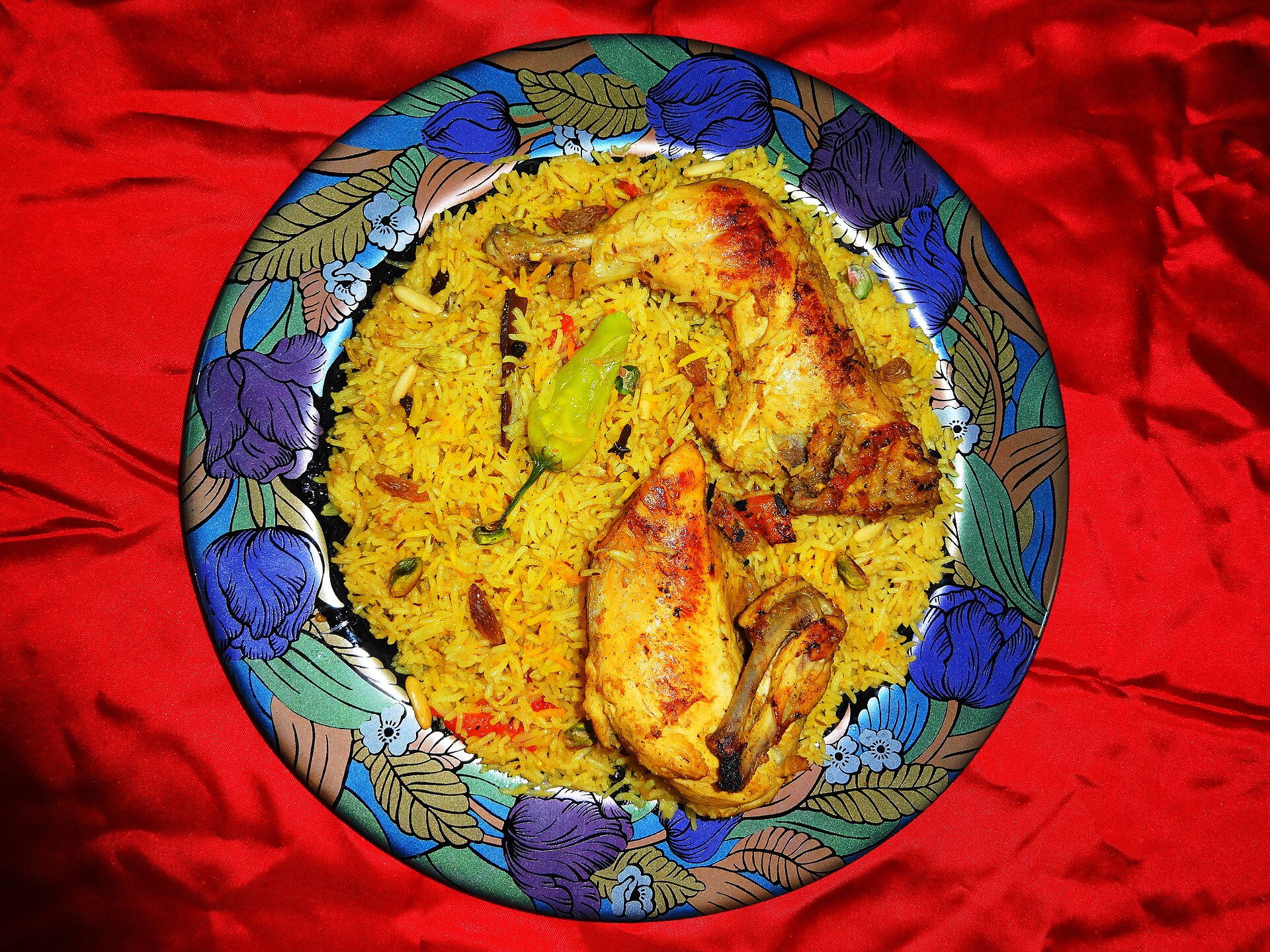
Saudi restaurant menus often list kabsa, mandi, madhbi, biryani, and madhruba in the same section. They are distinct dishes, and Saudis can tell them apart instantly.
| Dish | Origin | Cooking Method | Spice Profile | Distinguishing Feature |
|---|---|---|---|---|
| Kabsa | Saudi / Gulf | One-pot, meat then rice in broth | Loomi-forward, warming spice blend | Tomato-tinted rice, dried-lime aroma |
| Mandi | Yemen (Hadhramaut) | Meat hung in a clay pit oven above rice | Lighter, smokier | Smoky flavour from pit cooking; rice usually yellow, not reddish |
| Madhbi | Yemen / south | Meat grilled on hot stones, served with rice | Char-forward, simpler | Visible charring; meat cooked separately from rice |
| Biryani | South Asian | Layered steam, rice and meat cooked separately then combined | Heavy garam masala, often ghee-rich | Coloured layers, much more spice complexity |
| Madhruba | Gulf (esp. Ramadan) | Meat and rice cooked together until broken down | Milder | Porridge-like texture; the word means “beaten” |
If you want to taste the difference in one sitting, a Saudi food tour in Riyadh or Jeddah is the efficient option — most operators will sequence kabsa, mandi, and madhbi in a single evening.
Learning to Cook Kabsa
Saudi Arabia has a growing cooking-class industry aimed at tourists and expatriates. Several Riyadh and Jeddah operators run hands-on half-day classes where you will buy spices at a local souk, return to a home kitchen or teaching venue, and cook a full kabsa from scratch with a Saudi host. Budget around SAR 300–600 per person. Our dedicated Saudi cooking classes guide lists specific operators and what to expect.
If you would rather cook at home, buy the following at a Saudi spice souk to take back with you:
- A small bag of whole loomi — dried black limes
- A jar of pre-mixed kabsa baharat (check loomi is in the blend)
- Whole green cardamom pods — always fresher than pre-ground
- A good quality saffron, if your budget stretches — Saudi shops sell Iranian saffron at fair prices
- Hasawi red rice, available at Al Ahsa markets and some Riyadh and Dammam supermarkets
These items travel well and, declared as dried food or spices, are allowed in most countries’ customs — check your home country’s rules before you fly. The visa formalities themselves are explained in our Saudi Arabia visa guide.
Kabsa and Saudi Hospitality: The Cultural Frame
To understand why kabsa matters, it helps to understand karam — Arabic for generosity, but in the Saudi context it is closer to a social obligation. A Saudi host is expected to feed guests to the point of surfeit; a guest who leaves still hungry is a host’s quiet shame. Kabsa, because it is one-pot and scales easily from a family of four to a wedding of two hundred, is the perfect vehicle for this.
Traditionally, a Najdi host kept an unused set of kabsa pots, copper trays, and a coffee dallah ready at all times, in case a guest arrived unexpectedly from across the desert. Today that manifests in the standing Friday invitation: if you know a Saudi family well enough to drop by on a Friday afternoon, you will be fed kabsa. It is considered a minor social crime to show up and leave without eating.
During Ramadan, kabsa often appears at the iftar table — either as the main dish or as one of several meat-and-rice options. Eid al-Adha, the Festival of Sacrifice, is kabsa’s peak: households that can afford it slaughter a sheep and spend the day cooking variations of kabsa for extended family, neighbours, and the poor.
Practical Tips for Travellers Eating Kabsa
Plan kabsa for lunch, not dinner. Saudis eat their biggest meal at lunch, traditionally 1:30–3:30 pm. Restaurants serving freshly cooked kabsa are at their best then. Evening service often uses held or reheated pots.
Friday is peak kabsa day. The best traditional restaurants are fullest after Friday noon prayers (around 1 pm). Book or arrive early; walk-ins at 2:30 pm may face a wait.
Portions are enormous. A “single” kabsa plate at a traditional restaurant is typically enough for two. Split one portion between two people on your first attempt.
Spiciness. Kabsa is warmly spiced, not hot. If a restaurant offers shatta (a red chilli sauce) on the side, that is the Saudi way to add heat — do not expect the rice itself to be spicy.
Dress code at traditional restaurants. Modest clothing — shoulders covered, knees covered — is expected. Some venues have separate family and singles sections, a holdover from an earlier dining culture now being quietly phased out.
Payment. Most traditional kabsa venues accept mada card, Apple Pay, and increasingly STC Pay. Carry some Saudi riyal cash for tipping and for smaller neighbourhood spots.
A Short Glossary
- Kabsa (كبسة) — the dish; also sometimes spelled “kapsa”
- Loomi (لومي) — dried black lime; sometimes “noomi” or “lumi”
- Baharat (بهارات) — spice blend; bharat kabsa is the specific kabsa mix
- Qahwa (قهوة) — Arabic coffee; light-roast, cardamom-perfumed, served after kabsa
- Dallah (دلة) — the long-spouted coffee pot in which qahwa is served
- Shawaya (شواية) — grilled meat, a common kabsa companion
- Mandi (مندي) — pit-cooked Yemeni-origin rice dish
- Madhruba (مضروبة) — a porridge-like Ramadan rice-and-meat dish
- Karam (كرم) — generosity; the cultural frame of Saudi hospitality
Saudi cuisine rewards curiosity. Once you have eaten kabsa at a traditional Riyadh venue, try a Hijazi version in Jeddah’s Al Balad, a seafood variant in Al Khobar, and — if you are lucky — a home-cooked lamb kabsa from a family kitchen. Each will be recognisably the same dish and quietly, noticeably different. That range of flavour inside a single national dish is the Kingdom in one plate.
Explore More Saudi Arabia Travel Guides
- Saudi Arabia Food and Dining Guide — The complete guide to what to eat and where across the Kingdom
- Saudi Cooking Classes — Hands-on classes to learn kabsa, mandi, jareesh and more from Saudi hosts
- Saudi Arabia Food Tours — City-by-city culinary tours in Riyadh, Jeddah and beyond
- Jeddah Street Food Guide — Hijazi kabsa, mutabbaq and the Red Sea coast’s best street eats
- Riyadh Street Food Guide — Where Najdi traditional cooking meets modern street food
- Saudi Arabia Customs and Etiquette — Dining etiquette, dress code, and cultural rules for visitors
- Saudi Arabia Travel Guide 2026 — The complete guide to visiting the Kingdom
- Saudi Arabia Visa Guide — Every visa type explained