
Saudi Arabia is home to six UNESCO World Heritage Sites, thousands of years of rock art, Nabataean tombs rivalling Petra, and the mud-brick citadel where the modern Kingdom was born. For travellers who care about the deep past — not just luxury hotels and mega-projects — the Arabian Peninsula is one of the most under-explored archaeological landscapes on Earth. This guide covers every major historical site worth visiting, from the 10,000-year-old petroglyphs at Jubbah to the Ottoman Hejaz Railway stations of the First World War, as part of our wider Saudi Arabia travel guide. Whether you are a serious ancient-history enthusiast or simply want to understand the layers of civilisation beneath the modern Kingdom, these are the places that matter.
Best Time to Visit: October–March (cooler temperatures, all heritage sites open)
Getting There: International flights to Riyadh (RUH), Jeddah (JED); domestic connections to AlUla (ULH), Ha’il (HAS), Tabuk (TBU)
Visa Required: Yes — tourist e-visa available online for 49+ nationalities
Budget: $80–200/day depending on accommodation tier
Must-See: Hegra (Mada’in Salih), Diriyah At-Turaif, Historic Jeddah (Al-Balad)
Avoid: Visiting desert sites in summer (June–August temperatures exceed 45°C)
Six UNESCO World Heritage Sites
Saudi Arabia’s six inscribed UNESCO sites span roughly 10,000 years of human history. Three of them — Hegra, At-Turaif, and Al-Balad — are fully set up for tourism with guides, signage, and visitor centres. The other three reward more adventurous travellers willing to reach remote locations. All six are genuine archaeological treasures, not recreations.
| Site | Inscribed | Period | Location | Ease of Access |
|---|---|---|---|---|
| Hegra (Mada’in Salih) | 2008 | 1st century BCE–1st century CE | AlUla, Medina Province | Easy — guided tours |
| At-Turaif District, Diriyah | 2010 | 18th–19th century | Riyadh outskirts | Easy — open daily |
| Historic Jeddah (Al-Balad) | 2014 | 7th–19th century | Jeddah city centre | Easy — walk-in |
| Rock Art, Hail Region | 2015 | c. 8000 BCE–1000 CE | Jubbah and Shuwaymis, Ha’il | Moderate (Jubbah) / Hard (Shuwaymis) |
| Al-Ahsa Oasis | 2018 | 5,000+ years continuous | Eastern Province | Easy — open |
| Hima Cultural Area | 2021 | c. 5000 BCE onward | Najran Province | Remote — check advisories |
Hegra and the AlUla Heritage Landscape
The AlUla valley in northwestern Saudi Arabia is the single most important archaeological zone in the Kingdom and the place every history-minded traveller should prioritise. Within a 30-kilometre stretch of desert canyon, you can walk through the remains of three distinct civilisations spanning more than a thousand years — the Dadanites, the Lihyanites, and the Nabataeans — all of whom grew wealthy by controlling the overland incense trade between southern Arabia and the Mediterranean.
Hegra (Mada’in Salih)
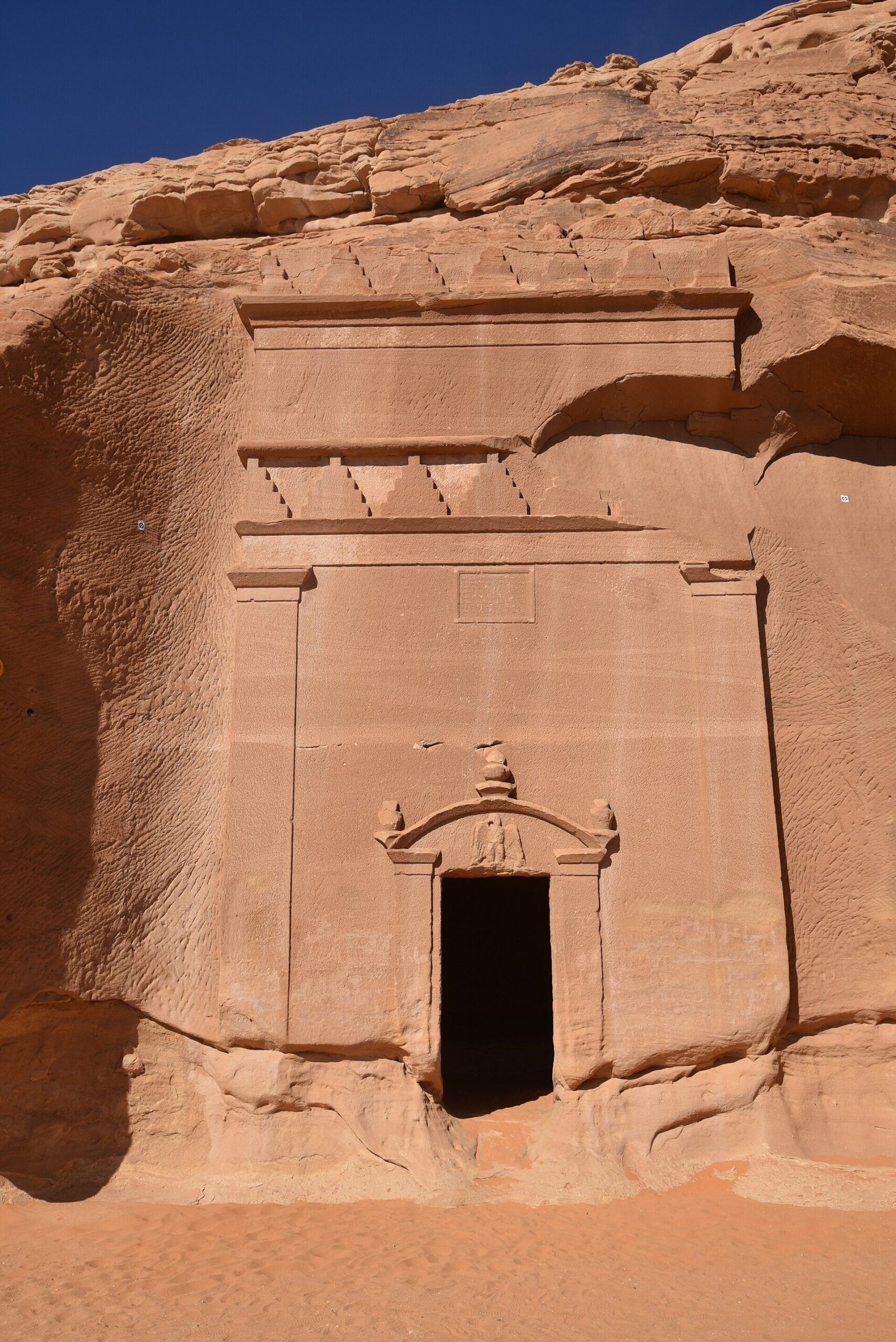
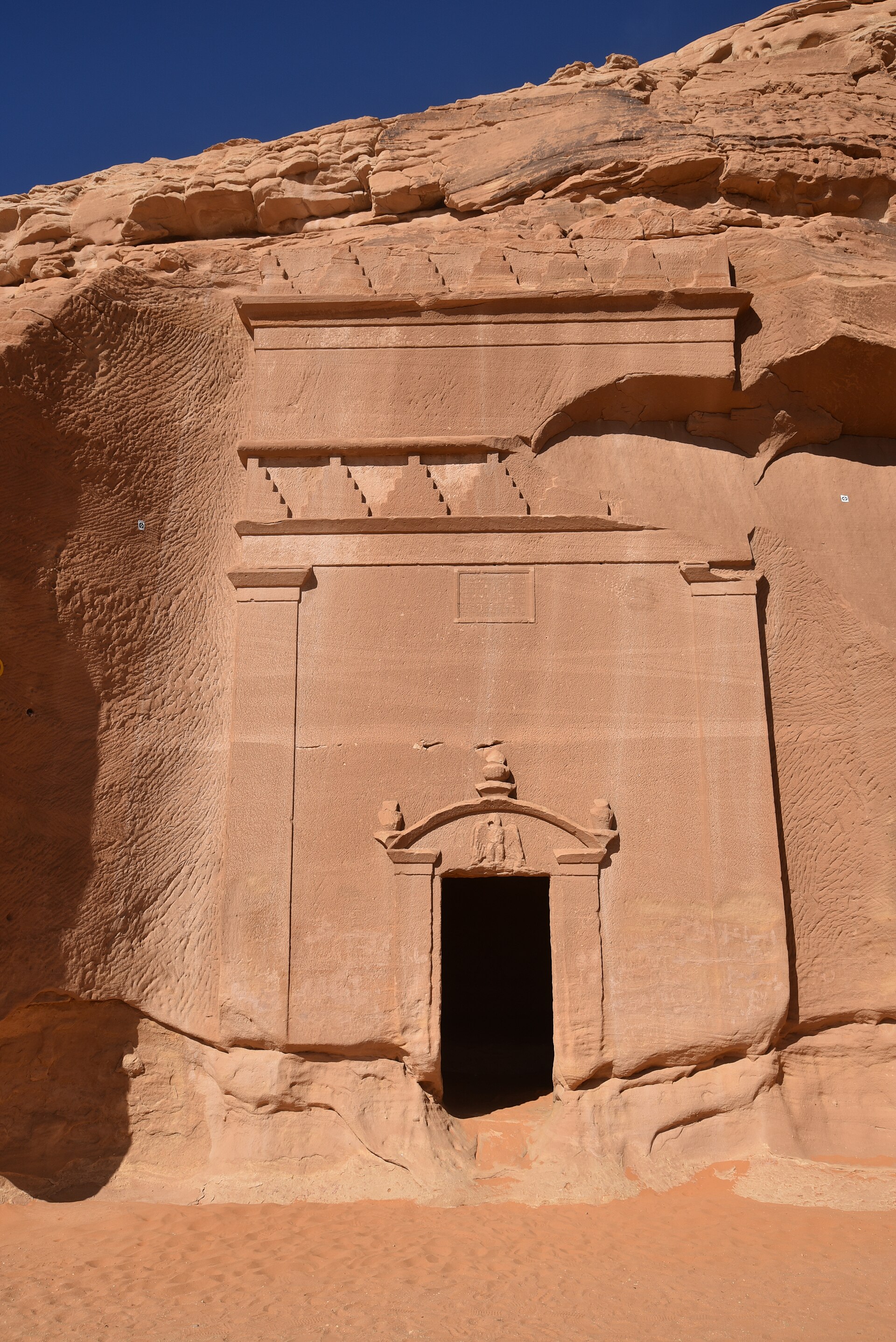
Saudi Arabia’s first UNESCO World Heritage Site (inscribed 2008) was the Nabataean Kingdom’s second city after Petra in Jordan. The site contains 111 monumental rock-cut tombs spread across 52 hectares, their sandstone facades carved with eagles, sphinxes, and inscriptions that date each tomb precisely — the earliest to 1 BCE, the latest to 75 CE. The most photographed monument is Qasr al-Farid (the Lonely Castle), a single unfinished tomb carved from an isolated rock outcrop that stands alone in the desert.
Beyond the tombs, Hegra preserves the Nabataeans’ extraordinary hydraulic engineering: rock-cut channels, cisterns, and wells that sustained a trading city in one of the driest landscapes on Earth. The Diwan, a triclinium (dining hall) carved into rock at Jabal Ithlib, was likely used for religious banquets. Nearby, the restored Ottoman Hejaz Railway station (1907) houses original locomotive rolling stock from the line that once carried Hajj pilgrims from Damascus to Medina — and was sabotaged during the Arab Revolt.
Practical tip: All Hegra visits are by guided tour only — no independent access. Book through experiencealula.com well in advance, especially for the October–April peak season. Standard tours run mornings and late afternoons (approximately 07:00–10:00 and 15:00–18:00). Tickets cost 95–150 SAR ($25–40). Premium sunset and vintage Land Rover tours are available at higher prices. If you are also visiting Hegra during festival season, book accommodation months ahead.
Dadan — Capital of the Incense Kingdoms
Ten kilometres from AlUla town, the ancient city of Dadan was the capital of the Dadanite Kingdom (c. 9th–5th century BCE) and later the Lihyanite Kingdom (c. 5th–2nd century BCE). These were the middlemen of the ancient world’s most valuable trade route: frankincense and myrrh moving north from Yemen and Oman to Egypt, Mesopotamia, and Rome. The site preserves rock-cut tombs guarded by carved lion sculptures — a motif unique to this region — along with monumental inscriptions in Dadanite script and the remains of a large temple.
French-Saudi archaeological excavations have been running since 2004, with significant new finds announced regularly. Fragments of colossal Lihyanite statues — some originally over three metres tall — confirm that Dadan was a major political and religious centre, not merely a caravan stop.
Jabal Ikmah — The Open-Air Library
A narrow canyon near Dadan, Jabal Ikmah contains the densest concentration of pre-Arabic inscriptions in Saudi Arabia — hundreds of texts in Dadanite, Lihyanite, Minaic, Thamudic, and Nabataean scripts spanning roughly a thousand years. Dubbed the “open-air library of Arabia,” the inscriptions include religious dedications, personal names, trade records, and prayers. Walking or cycling tours thread through the canyon. Tickets are available through Experience AlUla for 50–95 SAR ($13–25).
AlUla Old Town
The medieval mud-brick town in the AlUla valley centre is being progressively restored by the Royal Commission for AlUla (RCU), with traditional buildings converted into cultural spaces, artisan workshops, and cafes. Walking tours provide context for how the oasis settlement evolved from the ancient Dadanite period through Islamic centuries to the 20th century, when residents finally relocated to the modern town.
Getting to AlUla: Fly to AlUla airport (ULH) — direct flights from Riyadh (1.5 hours) and Jeddah (1 hour) via Saudia and flynas. Also reachable by road from Medina (approximately 300 km, 3–4 hours). Accommodation ranges from the luxury Banyan Tree AlUla and Habitas AlUla eco-resort to mid-range hotels in town and desert glamping experiences.
Diriyah — Where the Kingdom Began
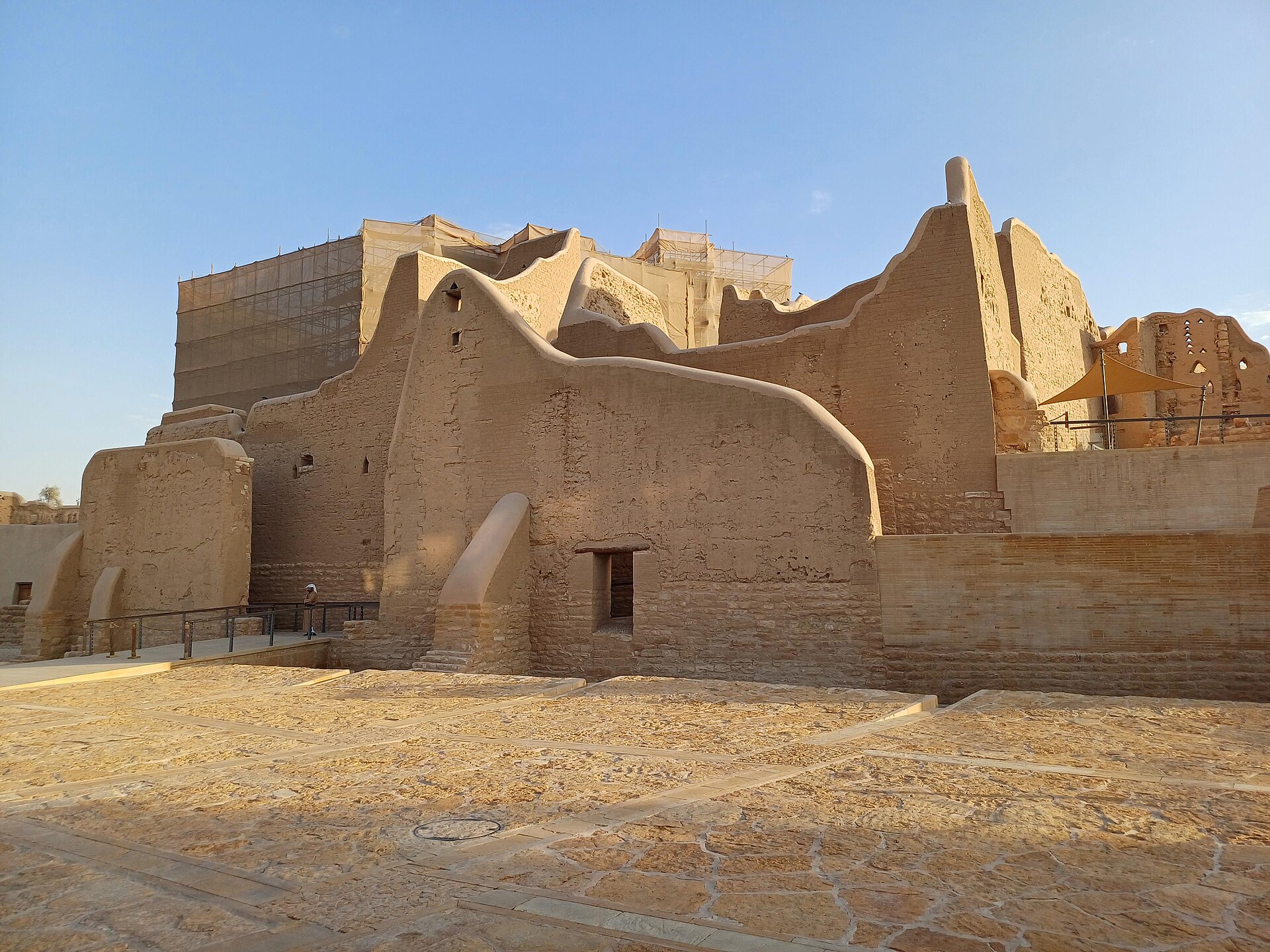
On the northwestern outskirts of Riyadh, the At-Turaif District in Diriyah is where Saudi national history begins. This mud-brick citadel perched above Wadi Hanifa was the capital of the First Saudi State from 1727 until its destruction by Ottoman-Egyptian forces under Ibrahim Pasha in 1818. The site includes Salwa Palace (the largest structure), the Imam Mohammed bin Saud Mosque, and several palatial residences built in the distinctive Najdi architectural style — thick earthen walls, geometric decoration, narrow defensive passages.
The alliance forged here in 1744 between Muhammad ibn Saud and the religious scholar Muhammad ibn Abd al-Wahhab is the founding political-religious compact of the modern Kingdom. Understanding that history transforms a visitor’s reading of everything else in Saudi Arabia.
The Diriyah Gate Development Authority (DGDA) is overseeing a $20 billion restoration and tourism mega-project. The Bujairi Terrace, which opened in December 2022 across the wadi from At-Turaif, is now an established dining and cultural destination with upscale restaurants overlooking the UNESCO ruins. Parts of At-Turaif have opened for guided heritage walks, with further museum and gallery spaces under development. Entry to the heritage areas is free or nominal; Bujairi Terrace is freely accessible. Open daily, typically 09:00–21:00. Easily reached from central Riyadh — about 15–20 minutes by car or taxi.
While in Riyadh, history-focused visitors should also see Masmak Fortress, the mud-brick fort where Abdulaziz ibn Saud recaptured Riyadh in 1902, launching the campaign that unified the modern Kingdom. It now operates as a free museum (Sunday–Thursday 08:00–21:00, Friday 16:00–21:00). The National Museum in the King Abdulaziz Historical Center is one of the best in the Gulf region, with galleries spanning from pre-history through the Islamic era to the Saudi unification. Entry is approximately 10 SAR. For a broader Riyadh itinerary, see our first-time visitor guide.
Historic Jeddah — Al-Balad
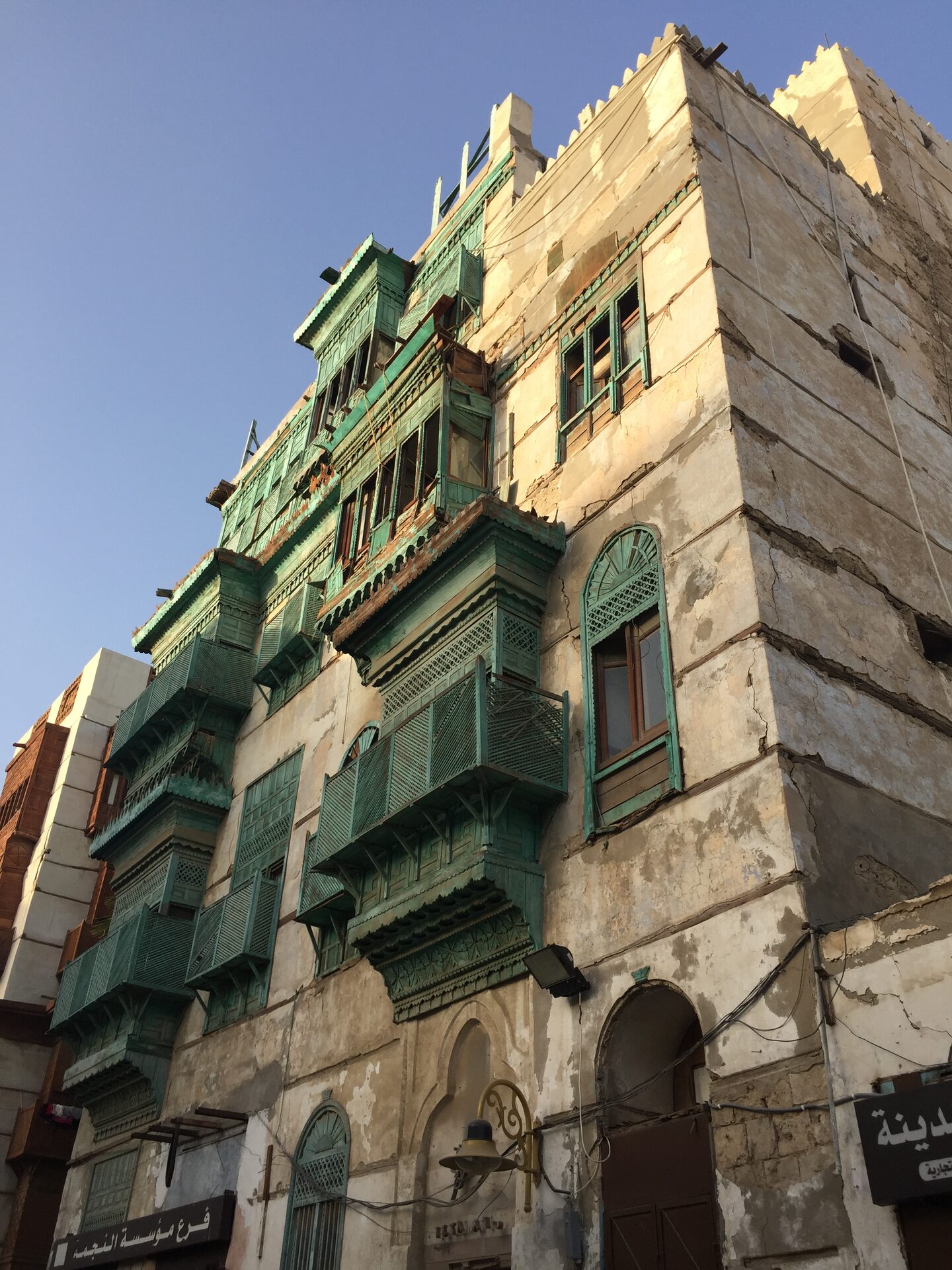
The old walled city of Jeddah served as the primary arrival port for Hajj pilgrims arriving by sea for over 1,300 years, and its architecture reflects centuries of cosmopolitan commerce. The coral-stone tower houses of Al-Balad — some rising seven storeys — are built from blocks quarried from Red Sea reefs and adorned with ornate wooden mashrabiya (latticed projecting balconies) and rawashin (screened windows). The architectural influences are diverse: Egyptian, Indian, Ottoman, and Malay, reflecting the pilgrim traffic that flowed through for centuries.
Key buildings include Nassif House (now a free museum, open Saturday–Thursday approximately 08:00–17:00), Sharbatly House, and Noor Wali House. The Al-Alawi and Al-Khaskiyah souks remain active markets where you can buy spices, textiles, and incense much as traders did centuries ago. The Jeddah Historic District Program (part of the Ministry of Culture) has been restoring buildings and adding interpretive signage, galleries, and cafes throughout the district.
Practical tip: Al-Balad is best visited in the evening when temperatures drop and the atmosphere comes alive. No ticket is required — simply walk in. The district is in central Jeddah, reachable by taxi or ride-hail. Combine with the broader Jeddah itinerary if time allows.
The Incense Road — Arabia’s Ancient Trade Network
The story connecting many of Saudi Arabia’s archaeological sites is the incense trade: the overland route that carried frankincense and myrrh from southern Arabia (modern Yemen and Oman’s Dhofar region) north to the Mediterranean, Mesopotamia, and Egypt. At its peak from roughly the 7th century BCE to the 2nd century CE, frankincense was literally worth its weight in gold in Roman markets.
The route entered modern Saudi Arabia through Najran in the south, then ran north through a chain of oasis settlements — each one providing water, camels, and security in exchange for transit fees. Dadan and later Hegra in the AlUla valley were the critical waypoints before the road continued to Petra in Jordan and then branched toward Gaza (for Mediterranean trade) and Damascus.
A parallel eastern route ran from Yemen and Oman via the Gulf coast to Gerrha — possibly the ancient city of Thaj in the Eastern Province — carrying not only incense but pearls from the Gulf and spices transshipped from India. The kingdoms of Dadan, Lihyan, and the Nabataeans grew wealthy by controlling these chokepoints, a pattern of trade-route leverage that echoes across Saudi history right up to the present.
The incense trade declined after Roman navigators discovered monsoon wind patterns enabling direct sea routes from Egypt’s Red Sea coast to India, bypassing Arabia entirely. The adoption of Christianity across the Roman Empire also reduced demand for incense in pagan temple rituals.
Today, the best place to see the incense route’s physical evidence is the AlUla valley — Dadan, Jabal Ikmah, and Hegra collectively represent the most complete surviving section of the overland route. In the south, the Hima Cultural Area near Najran (UNESCO-inscribed 2021) preserves rock art and thousands of inscriptions along another segment of the route, with ancient wells at Bi’r Hima still functioning.
Pre-Islamic Civilisations You Can Still See
Saudi Arabia’s archaeological record extends far deeper than the Islamic period. For history enthusiasts, these pre-Islamic civilisations — accessible through their surviving rock art, tombs, inscriptions, and ruins — are the Kingdom’s most remarkable story.
Neolithic Rock Art — Jubbah and Shuwaymis
The Hail Region rock art sites (UNESCO 2015) contain thousands of petroglyphs spanning approximately 10,000 years. At Jubbah, on the edge of the Nefud Desert about 100 km northwest of Ha’il city, human figures, ibex, ostriches, lions, and hunting scenes are carved into sandstone outcrops — some dating to the Neolithic, when the Arabian Peninsula was far wetter and greener than today. At Shuwaymis (about 250 km southwest of Ha’il), rare images of cattle-herding suggest a pastoral phase in Arabia’s deep history.
Jubbah is the more accessible site, with a visitor centre and paved road access from Ha’il (airport code HAS, domestic flights available). Entry is free. Shuwaymis requires 4WD and a local guide — there is no formal tourism infrastructure. Best visited October–March.
The Nabataeans (4th century BCE – 106 CE)
Originally nomadic Arab traders who settled and built a commercial empire controlling the incense trade, the Nabataeans are best known for Petra in Jordan — but their southern capital at Hegra is their second-greatest surviving achievement. Their hallmarks: extraordinary rock-cut architecture, sophisticated hydraulic engineering (water channels, cisterns, and dams in the desert), and distinctive thin-walled painted pottery. The Nabataean kingdom was annexed by Rome under Emperor Trajan in 106 CE. At Hegra, dated tomb inscriptions allow a precise chronology of occupation from 1 BCE to 75 CE.
The Dadanites and Lihyanites
Predating the Nabataeans in the AlUla valley, the Dadanite Kingdom (c. 9th–5th century BCE) and its successor the Lihyanite Kingdom (c. 5th–2nd century BCE) were the original incense-trade middlemen. Their remains at Dadan include lion-guarded tombs, monumental inscriptions, and fragments of colossal statues. Jabal Ikmah preserves their written records in multiple ancient scripts. These are civilisations most visitors have never heard of — and that is precisely why they are worth seeing.
Dilmun and the Eastern Province
The eastern coast of Saudi Arabia was part of the ancient Dilmun civilisation (c. 3000–800 BCE), centred on Bahrain but extending along the Gulf shore. Tarout Island, connected to the mainland by causeway near Qatif, is one of the oldest continuously inhabited places on the peninsula — settlement evidence goes back over 5,000 years. Tarout Castle (Portuguese-era, 16th century, built on far older foundations) sits atop an ancient tell. The famous Tarout bust — a Sumerian-style chlorite figure from approximately 2500 BCE — is now in the National Museum in Riyadh.
Further inland, the walled city of Thaj (approximately 95 km from Jubail) is believed by some scholars to be ancient Gerrha, the legendary trading city described by Strabo and Pliny as fabulously wealthy. The site covers roughly 1.5 square kilometres with visible walls, gates, and burial mounds. Gold funerary masks found here are now displayed in the National Museum. Thaj is on UNESCO’s Tentative List but remains remote — 4WD access, no formal ticket system. For travellers based in the Eastern Province, it is a worthwhile day expedition.
Al Rajajil — Arabia’s Standing Stones
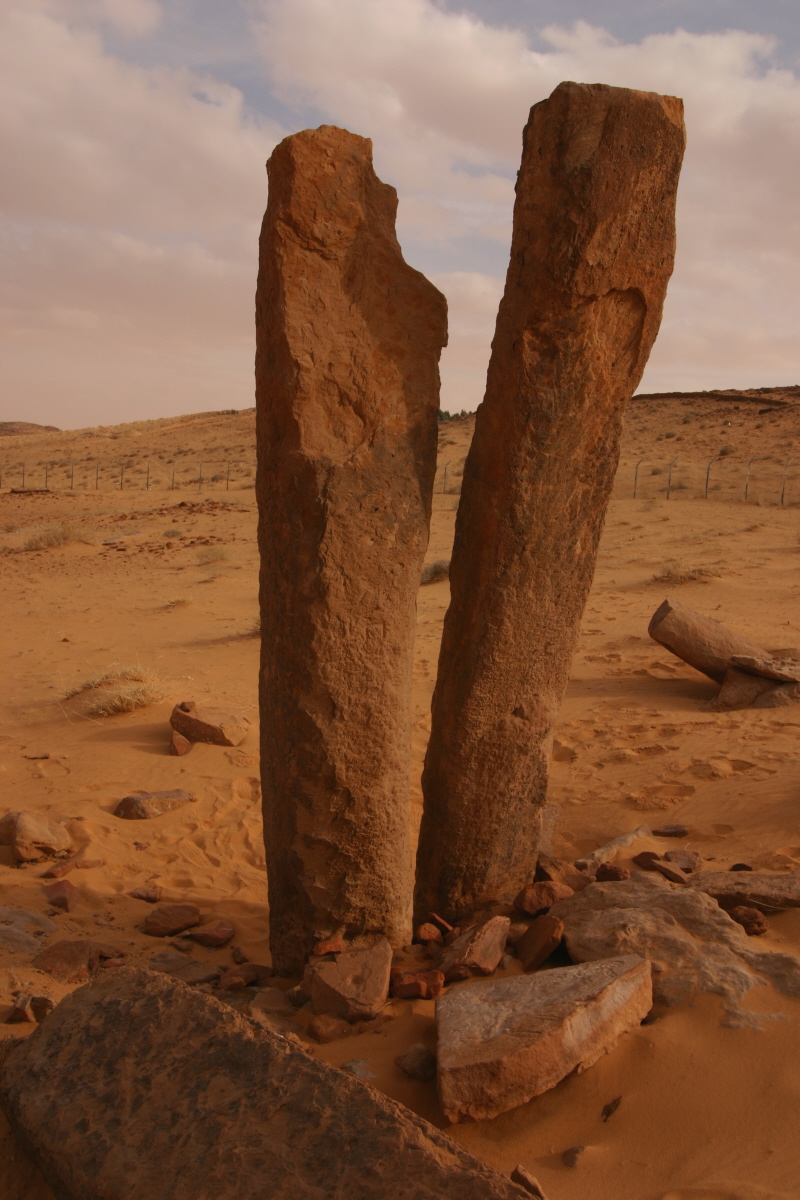
Near Sakaka in Al-Jawf Province, the Al Rajajil site consists of approximately 50 groups of standing stone pillars — each group containing three to seven pillars up to three metres tall — dating to roughly 4000–3000 BCE. Their purpose is debated: funerary markers, astronomical alignments, or territorial boundaries. Whatever their function, they are among the oldest known man-made structures on the Arabian Peninsula and draw inevitable (if imprecise) comparisons to European megalithic sites.
Al Rajajil is an open site, freely accessible, about 20 km south of Sakaka. There is no formal visitor centre, though the Saudi Heritage Commission has placed interpretive signage. Combine with a visit to Dumat al-Jandal, about 50 km away.
Dumat al-Jandal — Crossroads of Empires
One of the oldest continuously inhabited cities on the peninsula, Dumat al-Jandal appears in Assyrian records from the 8th century BCE as Adummatu. It sat at the junction of ancient trade routes connecting Mesopotamia, the Levant, and the Hejaz. Two monuments stand out:
- Marid Castle — a massive stone fortress with pre-Islamic origins, expanded and rebuilt across multiple periods. Its commanding position above the old town gives views across the oasis and desert.
- Mosque of Omar — traditionally attributed to a visit by Caliph Omar ibn al-Khattab, this stone mosque features what may be the oldest surviving minaret in the world. Even if the attribution is debated, the structure is certainly among the earliest Islamic-era buildings in northern Arabia.
- Mada’in Salih station (near Hegra) — beautifully restored, with original locomotive and rolling stock. One of the most photogenic heritage railway sites in the Middle East. Visitable as part of AlUla heritage tours.
- Tabuk station — restored Ottoman station in Tabuk city housing a small museum. Free entry.
- Medina station — the original terminus, now the Hejaz Railway Museum in central Medina. Note: non-Muslims cannot enter the central Haram area of Medina, but the railway station is outside this zone.
- Sun protection — hat, sunscreen, and sunglasses are essential at desert sites year-round
- Sturdy walking shoes — uneven terrain at Hegra, Dadan, Jubbah, and Al Rajajil
- Water — carry at least 2 litres per person for site visits outside cities
- Modest clothing — shoulders and knees covered at religious and heritage sites; women do not need to wear an abaya in most public places since 2019 reforms, but modest dress is expected
- A good guidebook or offline maps — phone signal can be weak at remote sites
- Saudi Arabia Travel Guide 2026 — The complete guide to visiting the Kingdom
- First Time in Saudi Arabia — Everything you need to know before your first trip
- Hegra Season AlUla — The annual heritage festival explained
- Photographer Guide to Saudi Arabia — Best locations and tips for capturing the Kingdom
- Budget Travel in Saudi Arabia — How to explore the Kingdom for under $50 a day
- Saudi Arabia Visa Guide — Every visa type explained
Both are free to enter. Al-Jawf is served by Sakaka’s regional airport (domestic flights). The combination of Al Rajajil and Dumat al-Jandal makes a compelling 1–2 day excursion for history-focused travellers. Those continuing south might consider the route via Ha’il to see the Jubbah rock art as well.
Islamic-Era Heritage
The Hejaz Railway
Built between 1900 and 1908 by the Ottoman Empire to carry Hajj pilgrims from Damascus to Medina (1,300 km), the Hejaz Railway was an engineering marvel of its era. It was never completed to Mecca, and much of the line was destroyed during the Arab Revolt (1916–1918) when T. E. Lawrence and Hashemite forces systematically sabotaged tracks, bridges, and stations.
In Saudi Arabia, three stations are worth visiting:
Al-Ahsa Oasis (UNESCO 2018)
The Al-Ahsa Oasis in the Eastern Province — UNESCO World Heritage since 2018 — is one of the largest oases in the world, with approximately 2.5 million date palms. It has been continuously cultivated for thousands of years, with evidence of Dilmun-era agriculture. The oasis complex includes Ibrahim Palace (a 16th-century Ottoman fortress), historic mosques, traditional souks, and the layered archaeological record of a settlement that has been a crossroads since the Bronze Age.
Masmak Fortress, Riyadh
The Masmak Fortress is where modern Saudi history truly begins. On the night of 15 January 1902, the 21-year-old Abdulaziz ibn Saud led a small raiding party over the fortress walls, killed the Ottoman-appointed governor, and seized Riyadh — the opening act of a three-decade campaign to unify the Arabian Peninsula. The spear-tip mark on the fortress gate from the raid is still visible. Now a free museum (Sunday–Thursday 08:00–21:00, Friday 16:00–21:00), it provides essential context for understanding how the modern Kingdom came to exist.
Practical Planning for a History-Focused Trip
Recommended Itinerary (10–14 Days)
| Days | Location | Key Sites |
|---|---|---|
| 1–3 | Riyadh | National Museum, Masmak Fortress, Diriyah At-Turaif, Bujairi Terrace |
| 4–7 | AlUla | Hegra, Dadan, Jabal Ikmah, Old Town, Hejaz Railway station, Elephant Rock |
| 8–9 | Ha’il | Jubbah rock art, A’arif Fort |
| 10–11 | Al-Jawf | Al Rajajil standing stones, Dumat al-Jandal (Marid Castle, Mosque of Omar) |
| 12–14 | Jeddah | Al-Balad historic district, souks, Red Sea coast |
Travellers with fewer days should prioritise Riyadh (Diriyah + National Museum) and AlUla (Hegra + Dadan) — these two stops alone cover the most significant sites. Adding Jeddah’s Al-Balad makes a strong 7-day itinerary.
Entry Requirements
Citizens of 49+ countries (including the US, UK, EU, Canada, and Australia) can obtain a tourist e-visa online within minutes. The visa costs approximately 535 SAR (~$142 including insurance), is valid for one year with multiple entries, and allows stays of up to 90 days. Apply at visa.visitsaudi.com before departure.
Getting Around
Domestic flights connect all major heritage regions: Saudia and flynas serve Riyadh, Jeddah, AlUla, Ha’il, Tabuk, and Dammam. Budget travellers can use the SAPTCO bus network for longer overland routes, though journey times are significant (Riyadh to Ha’il is approximately 6 hours by road). Car rental is available at all airports and is the most flexible option for reaching remote sites like Thaj, Shuwaymis, or Al Rajajil. Driving is on the right; international driving permits are accepted.
What to Pack
Guided Tours vs Independent Travel
Hegra requires a guided tour (no independent access). Dadan and Jabal Ikmah are best experienced with guides who can explain the inscriptions. Most other sites — Diriyah, Al-Balad, Masmak, Jubbah, Al Rajajil, Dumat al-Jandal — can be visited independently. For a comprehensive archaeology-focused itinerary covering multiple regions, several international operators now offer Saudi heritage tours, though the Kingdom’s tourism infrastructure is developing rapidly enough that independent planning is straightforward for experienced travellers.
Budget
Heritage site entry fees in Saudi Arabia are remarkably affordable: most are free or under 100 SAR ($27). The main expense is accommodation and domestic flights. Budget travellers can manage on $80–100/day using mid-range hotels and public transport. Mid-range travellers spending $150–200/day will have comfortable hotels, rental cars, and restaurant meals. Luxury options — particularly in AlUla with properties like Banyan Tree — push costs significantly higher. See our budget travel guide for detailed breakdowns.
Vision 2030 and the Heritage Boom
Saudi Arabia’s Vision 2030 economic diversification plan has placed heritage tourism at the centre of the Kingdom’s post-oil strategy, targeting 150 million annual visits (domestic and international) by 2030. For history travellers, this means two things: more sites are opening, and infrastructure is improving fast.
The Royal Commission for AlUla (RCU), established in 2017 with a budget exceeding $15 billion, is the most ambitious single heritage project. Working with the French Agency for AlUla Development (AFALULA), the RCU is building museums, cultural venues, luxury resorts, and a performing arts centre. The Maraya concert hall — the world’s largest mirrored building — already hosts regular cultural events in the desert.
The Saudi Heritage Commission is conducting the largest archaeological survey in the country’s history, with dozens of international teams working across the Kingdom. New sites are being identified, catalogued, and opened to visitors at an accelerating pace. The Hima Cultural Area inscription in 2021 and the ongoing excavations at Thaj and Al-Faw suggest more UNESCO nominations are coming.
For photographers, the current moment is ideal: many sites are accessible but not yet crowded, and the desert light at places like Hegra and Al Rajajil is extraordinary.