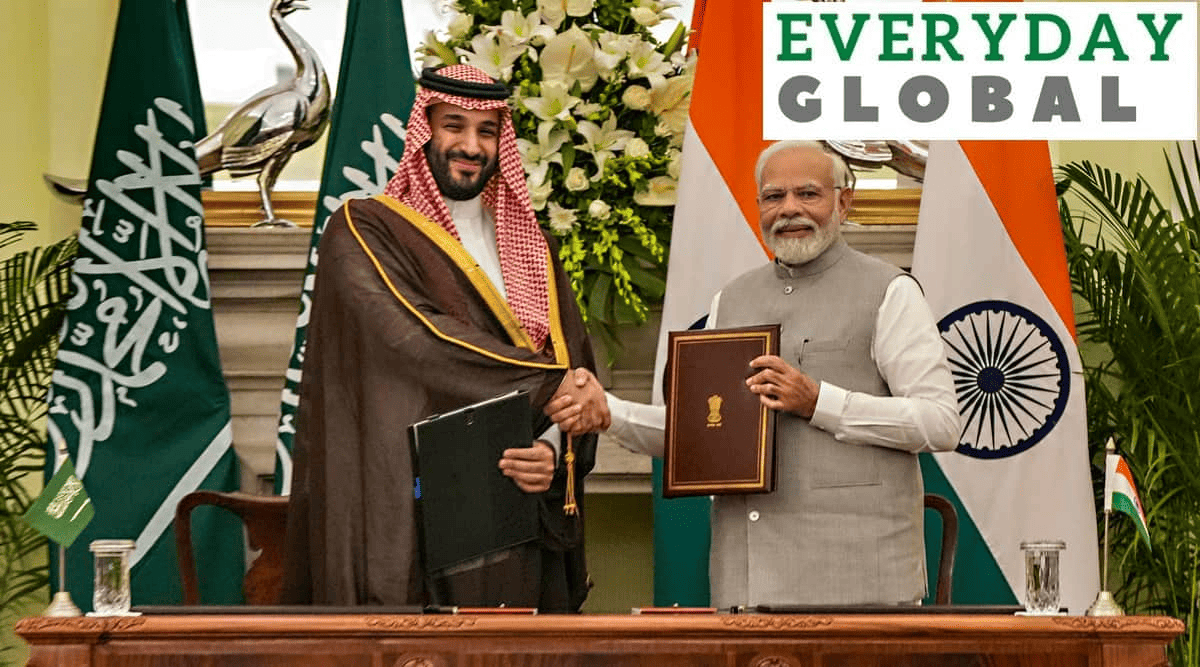

Saudi Arabia’s Crown Prince Mohammed bin Salman Al Saud and Prime Minister Narendra Modi have held extensive talks, highlighting their commitment to expanding trade and security ties. The leaders came together to co-chair the first summit-level meeting of the India-Saudi Arabia Strategic Partnership Council (SPC).
This important gathering follows the recently concluded G20 summit in New Delhi, where the announcement of the India–Middle East–Europe Economic Corridor (IMEC) was made. Currently on a daylong State Visit to India post the G20 Summit, the Saudi Crown Prince, often referred to as MBS, and the Prime Minister aim to strengthen the economic and diplomatic relationship between their nations.
Established in 2019, the India-Saudi Arabia Strategic Partnership Council is a significant achievement that makes India the fourth country, after the UK, France, and China, to form such a partnership with Riyadh.
So, what exactly is the purpose of the India-Saudi Arabia Strategic Partnership Council and why is it so important?
The SPC was created through an agreement signed during PM Modi’s visit to Saudi Arabia in October 2019, his second visit to the country in three years. The primary goal of the Strategic Partnership Council, according to a statement from the Ministry of External Affairs (MEA), is to “establish a high-level council to steer the Indo-Saudi relationship.”
PM Modi expressed his optimism about the SPC, stating that it would “usher in a new era of cooperation across sectors.” Recognizing the robustness and depth of ties between India and Saudi Arabia in trade, investment, security, and defense cooperation, the Prime Minister believes that this partnership will further solidify their relationship.
The Middle East briefing 3,000+ readers start their day with.
One email. Every weekday morning. Free.
The SPC consists of two main pillars: the Committee on Political, Security, Social and Cultural Cooperation, and the Committee on Economy and Investments.
These sub-committees operate at four functional levels: Summit level, Ministerial-level, Senior Officials’ Meetings, and Joint Working Groups (JWGs).
The Political committee has four JWGs: Political & Consular; Legal & Security; Social & Cultural; and Joint Committee on Defence Cooperation.
Similarly, the Economic committee has four JWGs as well: Agriculture & Food Security; Energy; Technology & Information Technology; and Industry and Infrastructure.
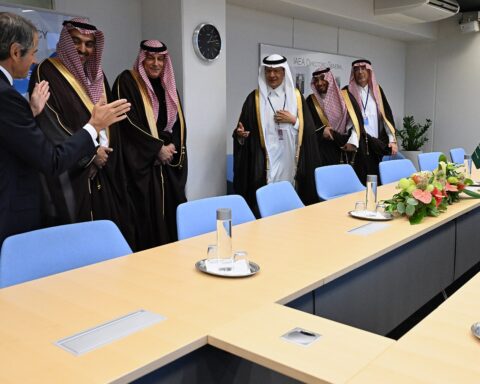
In September 2022, Union Minister of Commerce and Industry Piyush Goyal attended the Ministerial meeting of the SPC during his visit to Saudi Arabia. The meeting, co-chaired by the Saudi Minister for Energy, Prince Abdulaziz bin Salman Al-Saud, focused on streamlining efforts to fulfill the $100 billion worth of investments promised by Mohammad Bin Salman during his visit to India in February 2019.
The meeting also endorsed 41 areas of cooperation identified by technical teams under four broad domains: Agriculture & Food Security, Energy, Technology & IT, and Industry & Infrastructure, as stated in a Press Information Bureau (PIB) statement.
During the talks held on Monday, the two leaders expedited the implementation of the $50-billion West Coast refinery project and identified energy, defense, semiconductor, and space as areas for intensified cooperation. They signed eight agreements to strengthen collaboration in various sectors, including digitization and investment.
The West Coast refinery project, headed by Indian Oil Corporation (IOC), Bharat Petroleum Corporation Ltd (BPCL), Hindustan Petroleum Corp Ltd (HPCL) from India, and Saudi Arabian Oil Co (Saudi Aramco) and Abu Dhabi National Oil Co (Adnoc), is set to be a 60 million tonnes refinery-cum-petrochemical complex located on the coast of Maharashtra.
At a media briefing, Ausaf Sayeed, secretary (overseas Indian affairs) in the External Affairs Ministry, highlighted the areas of cooperation discussed by the leaders, which include energy, defense, security, education, technology, transportation, healthcare, tourism, and culture. Additionally, they explored potential collaboration in power grid, gas grid, optical grids, and fiber networks.
The India-Saudi Arabia Strategic Partnership Council and the discussions held during this summit-level meeting signify the commitment of both nations to strengthen their bilateral ties across various sectors. As India and Saudi Arabia jointly navigate the challenges and opportunities of the global landscape, this partnership sets the stage for a robust and mutually beneficial relationship for years to come.