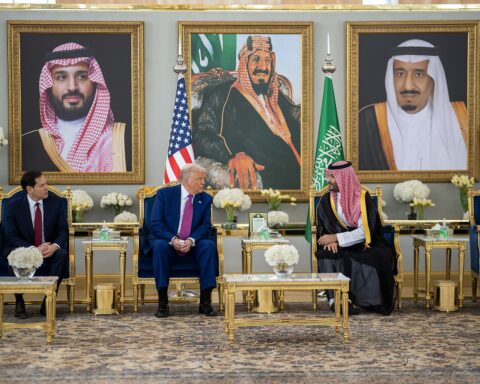
A stern warning emanated from Saudi Crown Prince Mohammed bin Salman on Wednesday concerning a potential escalation in nuclear arms development in the Middle East. Should Iran successfully procure nuclear weapons, evidence suggests that Saudi Arabia would not hesitate to follow suit – according to a recent utterance from its monarchy. This declaration from the Crown Prince serves as a stark testament to the Kingdom’s intent to prevent a power imbalance amid Iran’s nuclear aspirations.
The candid statement originated from an interview with Fox News that saw MBS divulge details concerning a multitude of topics, one of which being the still on-going normalization talks between Saudi Arabia and Israel.
Meticulously crafted, the interview – MBS’s first presented in the English language – sought to appeal to western demographics, emphasizing a clear narrative surrounding Israel and Iran. With Riyadh’s quest for security assurances from Washington acting as a catalyst towards an agreement with Israel, it’s clear that MBS and his Kingdom aren’t seeking reconciliation without stipulations. Some of these demands include the establishment of a domestic civilian nuclear program, most notably uranium enrichment. Furthermore, an agreement for mutual defense from the United States coupled with a sizeable arms deal is on the table.
Despite the persisting regional rivalries, Iran and Saudi Arabia sought to bridge the gap and normalize relations earlier this year in March. Yet, the Crown Prince emphasized that there has to be progress on resolving the plight of the Palestinians to facilitate normalization with Israel, outlining the issue’s importance to the Kingdom. While he remained non-specific on the details, he expressed hope for a solution that improves the living conditions for Palestinians and establishes Israel as a participant in Middle Eastern affairs.
The potent consequences of nuclear weapons were evoked as well during the interview by the Crown Prince. Despite the uneasy acceptance that such weapons might become necessary for the sake of regional equilibrium and protection, he expressed a distinct reluctance to see such a development. When confronted about a potential Saudi reaction to Iran’s acquisition of nuclear weaponry, he responded with a tense, “If they get one, we have to get one.”
Denying prevailing rumors of suspended negotiations with the U.S. for the normalization of Israeli-Saudi ties, MBS assured that this was not the case and that progress was indeed being made daily.
The Middle East briefing 3,000+ readers start their day with.
One email. Every weekday morning. Free.
Of notable interest are the allegations of “sportswashing” against the Gulf kingdom, accused of leveraging sports and high-profile events to enhance its global standing amidst human rights concerns. MBS disregarded the criticism, contending that if such actions provide a boost to the nation’s GDP, then they’ll continue unabated.
The tragic 9/11 attacks were another focus of the interview, where majority of the perpetrators were Saudi citizens. The Crown Prince displayed empathy towards the victims and reiterated the shared enemy between the U.S. and Saudi Arabia – Osama bin Laden.
The murder of journalist Jamal Khashoggi in 2018 was also addressed, with MBS maintaining that all parties involved are facing judicial repercussions. He characterized the incident as regrettable, assured of steps taken to overhaul the Kingdom’s security system and emphasized the need for safety.
Regarding the extended cut in Saudi Arabia’s oil output to stabilize the markets, MBS refrained from linking the decision to Russia’s conflict with Ukraine. Serving as the mediator between Russia and Ukraine while balancing a cordial relationship with both, Riyadh hosted discussions in Jeddah aiming towards ending the war.
MBS was positive about the Kingdom’s liaison with US President Joe Biden, expressing optimism about cooperation with other nations as part of the recent India-Middle East-Europe Economic Corridor initiative.
MBS’s remarks, made on the heels of an optimistic conversation between Israeli PM Benjamin Netanyahu and President Biden about an imminent Saudi-Israeli pact, illuminate the intricate dimensions of Middle East politics in play. Concurrently, reports suggest Israeli officials in cooperation with the Biden administration are outlining a plan that enables Saudi Arabia to launch its civilian nuclear program.
In regards to the possibility of Saudi Arabia developing a civil nuclear program, former diplomat Nimrod Barkan underscores the role of the U.S. in defining the terms. As Barkan suggests, Israel could agree to a power plant concentrating on electricity production, which is difficult to convert into a plutonium-production plant. However, if the prospect of a nuclear-weapon material producing reactor arises, Israel would dissent, giving grounds to the complex, loaded chessboard of Middle East politics.