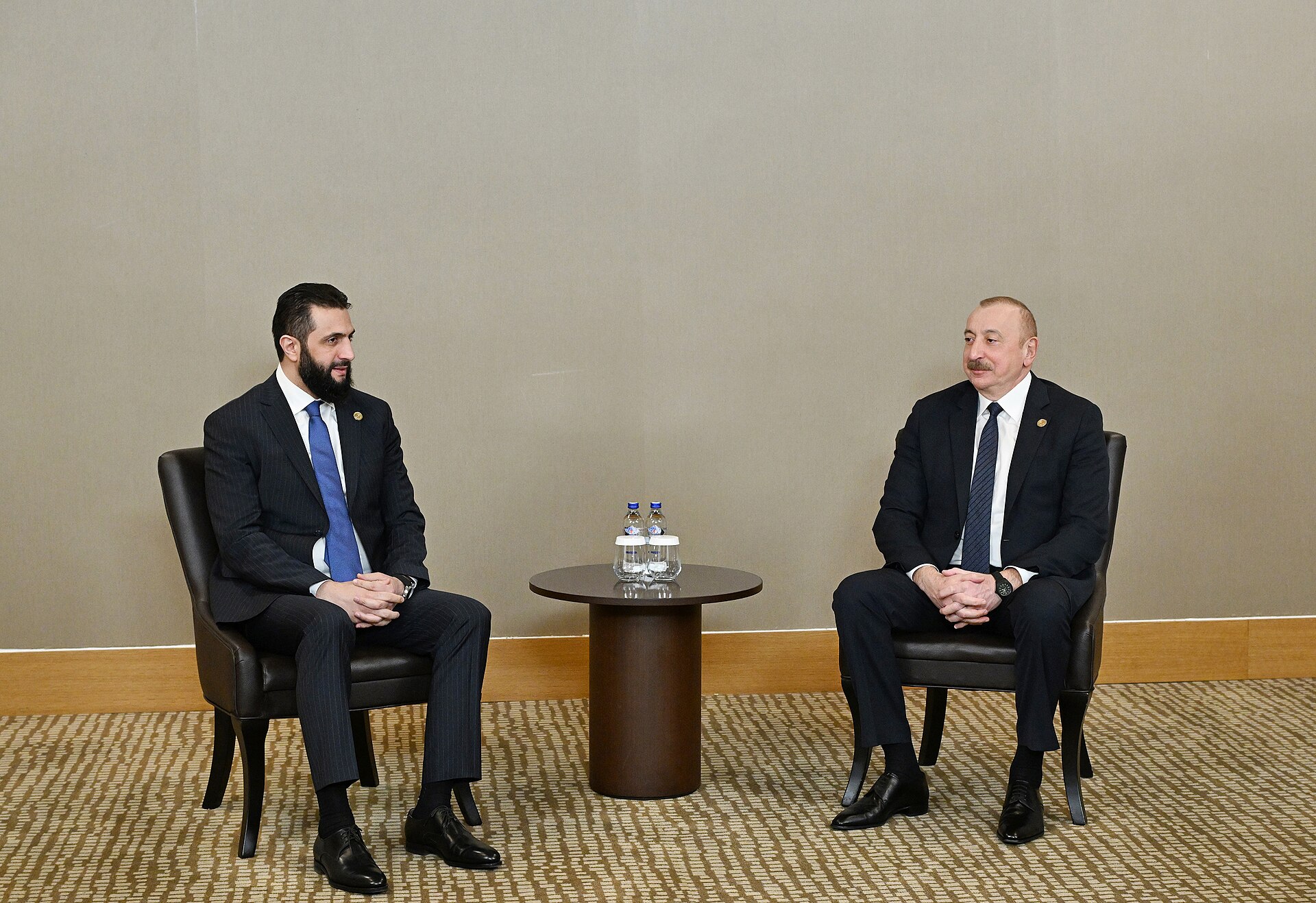
JEDDAH — Syrian President Ahmed al-Sharaa landed in Jeddah on April 21 for his second Saudi visit in four months, sitting down with Crown Prince Mohammed bin Salman while Iran — the power that propped up the man al-Sharaa replaced — fights a war 56 days old and counting. The meeting produced no new deals, because it didn’t need to: Saudi Arabia has already committed $13.1 billion to Syrian reconstruction since December 2024, more than any other single country, and the Jeddah session was a political ratification of a relationship that is quietly redrawing the Levant’s post-war map.
Al-Sharaa then flew to Qatar and the UAE on April 22, completing a Gulf tour whose sequencing was itself a message. Riyadh first, Doha second, Abu Dhabi third — a deliberate hierarchy statement at a moment when Tehran cannot contest it. The Iran war has created a diplomatic vacuum across the northern Arab tier, and MBS is filling it with chequebooks, fibre-optic cables, and desalination plants before Turkey, Qatar, or a post-war Iran can reassert influence over Damascus.
Table of Contents
What Happened in Jeddah
The Syrian Arab News Agency reported that al-Sharaa and MBS discussed “economic and investment ties and regional connectivity projects” along with “regional and international developments affecting security and stability.” The language was diplomatic boilerplate, but the context was not. This was al-Sharaa’s second visit to Saudi Arabia as president — Riyadh was also his first foreign destination after taking office in early 2025 — and it came while Iran’s ability to project influence into the Levant has collapsed to near zero.
“We discussed ways to enhance cooperation and expand economic and investment partnerships,” al-Sharaa told SANA after the meeting. “We also explored developments in regional and international situations and their impact on the region’s security and stability.” The next day, Saudi Foreign Minister Prince Faisal bin Farhan met Syrian FM Asaad al-Shaibani on the sidelines. Al-Shaibani was more direct: “Syria and Saudi Arabia are entering a strong phase of joint investment and economic cooperation,” he told Asharq Al-Awsat on April 22.
Al-Sharaa also used the Gulf tour to do something Damascus could not have done eighteen months ago. He condemned Iran’s attacks on Gulf states as “a breach of sovereignty and international law” and reaffirmed Syrian solidarity with the countries under fire — a public alignment with Riyadh’s war posture from a capital that spent the previous decade as Tehran’s client state. Syria declared neutrality in March 2026, but neutrality and alignment are not mutually exclusive when your largest investor is also the war’s primary target.
The $13.1 Billion Architecture
The Jeddah meeting ratified a cumulative investment architecture that Saudi Arabia has been assembling since Assad’s fall on December 8, 2024. The running total now exceeds $13.1 billion in pledges, built across three major tranches. In July 2025, a 130-strong Saudi business delegation led by Investment Minister Khalid al-Falih descended on Damascus for a forum that produced $6.4 billion in commitments across 47 agreements spanning energy, telecommunications, finance, and infrastructure. In September 2025, Riyadh pledged $1.4 billion in humanitarian projects. Then in February 2026, the headline package arrived: $5.3 billion — SR20 billion — in reconstruction financing, reported by MEED.
The Middle East briefing 3,000+ readers start their day with.
One email. Every weekday morning. Free.
The February package reveals the strategic architecture more clearly than any diplomatic communiqué. It includes a joint airline — Flynas Syria, structured 51 percent Syrian and 49 percent Flynas, targeting a Q4 2026 launch — that would give Saudi Arabia a direct commercial air corridor into Damascus and Aleppo. A $2 billion Elaf fund will develop two Aleppo airports. STC’s SilkLink project will lay 4,500 kilometres of fibre-optic cable across Syria at a cost of $1 billion, effectively wiring the country’s digital backbone to a Saudi telecom operator. And ACWA Power signed on for a seawater desalination project with 1.2 million cubic metres per day of capacity, addressing one of Syria’s most acute infrastructure deficits.
These are not aid packages. They are equity positions in a country whose total reconstruction bill the World Bank estimated at $216 billion in October 2025, with physical damage alone accounting for $108 billion. Saudi Arabia and Qatar jointly cleared Syria’s $15.5 million World Bank debt in early 2025 to unlock new development lending after a 14-year freeze, a move that the Washington Institute’s Simon Henderson characterised as “confirming political support” for al-Sharaa rather than a hard economic commitment — a distinction that applies to much of the $13.1 billion total, which represents signed agreements and pledges, not disbursements.
Why Is Saudi Arabia Moving on Syria During an Iran War?
The timing is not coincidental. Day 56 of the Iran war has produced a geopolitical environment that may not recur: Tehran is fighting for its own survival, its proxy network across the Levant has been dismantled, and the Syrian government that once served as Iran’s land bridge to Hezbollah is now publicly condemning Iranian aggression against Gulf states. John Calabrese at the Arab Gulf States Institute in Washington framed it precisely: “Saudi Arabia views Syria’s transition not simply as regime change but as a geopolitical reset — a chance to entrench Gulf leadership across the northern Arab tier.”
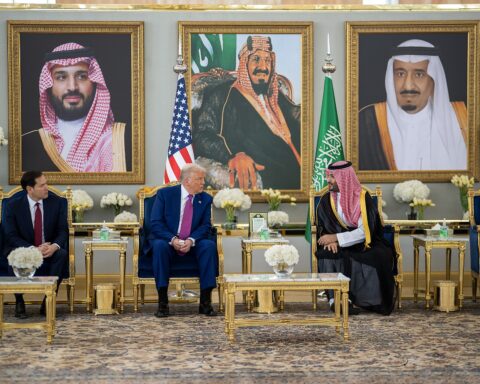
Calabrese described the Saudi approach as a “preemptive strategy to shape conditions before rival actors can fill the vacuum.” That assessment tracks with the pattern. MBS hosted the Trump-al-Sharaa meeting in Riyadh in May 2025, positioning Saudi Arabia as the political legitimiser of the new Syrian government at the moment when al-Sharaa’s jihadist past — he founded al-Nusra Front, al-Qaeda’s Syrian affiliate, in 2012 before rebranding as HTS — still made Western capitals uncomfortable. The US terror designation on HTS was lifted only after Assad’s fall. Norman Roule at the Hoover Institution has described MBS’s relationship with al-Sharaa as “one of Syria’s most important and impactful” regional relationships, with Riyadh likely to “remain in the forefront of GCC integration efforts.”
Henry Rogers at the New Lines Institute put it in terms of institutional memory. Saudi Arabia was “hesitant to fill the void” in Yemen and Iraq after earlier upheavals, allowing Iranian influence to flourish in both countries — a strategic mistake Riyadh spent years and billions trying to reverse. “Competition from Qatar and Turkey is likely driving even greater commitment to Syria’s reconstruction,” Rogers wrote, framing the current push as a conscious correction of past passivity. The northern rail corridor that Saudi Arabia is developing doubles as wartime bypass infrastructure and a future commercial link toward the Levant — physical connectivity backing up the financial commitments. The pipeline dimension of that investment — Saudi Arabia’s strategic bet that Syria can eventually serve as a Hormuz bypass corridor — is set out in Saudi Arabia’s $13 Billion Syria Bet Is Really a Hormuz Bypass.
Who Is Competing for Syria’s Reconstruction?
Saudi Arabia is the largest single-country investor, but it is not operating unchallenged. Qatar secured the biggest individual energy deal — a $7 billion power sector commitment (reported by MEED) that outpaces anything Riyadh has signed in Syrian energy — and funds $29 million per month in Syrian public sector salaries, per the UN Office for the Coordination of Humanitarian Affairs, buying goodwill at the ground level where Saudi capital has yet to reach. The Qatar-Turkey-Azerbaijan gas pipeline, inaugurated in August 2025 and delivering 3.4 million cubic metres per day through Syrian territory, gives Doha and Ankara a structural energy position that no amount of Saudi investment can easily replicate.
Turkey’s advantages are more fundamental. Ankara shares a 900-kilometre border with Syria — Saudi Arabia shares none, a handicap Simon Henderson flagged explicitly. Turkish construction firms are already operating inside Syria, Turkish military advisors remain on the ground, and Turkey has reportedly negotiated access to the T4 (Tiyas) air base, according to Dr. Ido Yahel at the Moshe Dayan Center. Turkey provides military cover and logistical capacity; Saudi Arabia provides finance and political legitimacy. These are complementary roles, but in a reconstruction scramble, the country with boots on the ground and a shared border tends to capture the contracting pipeline.
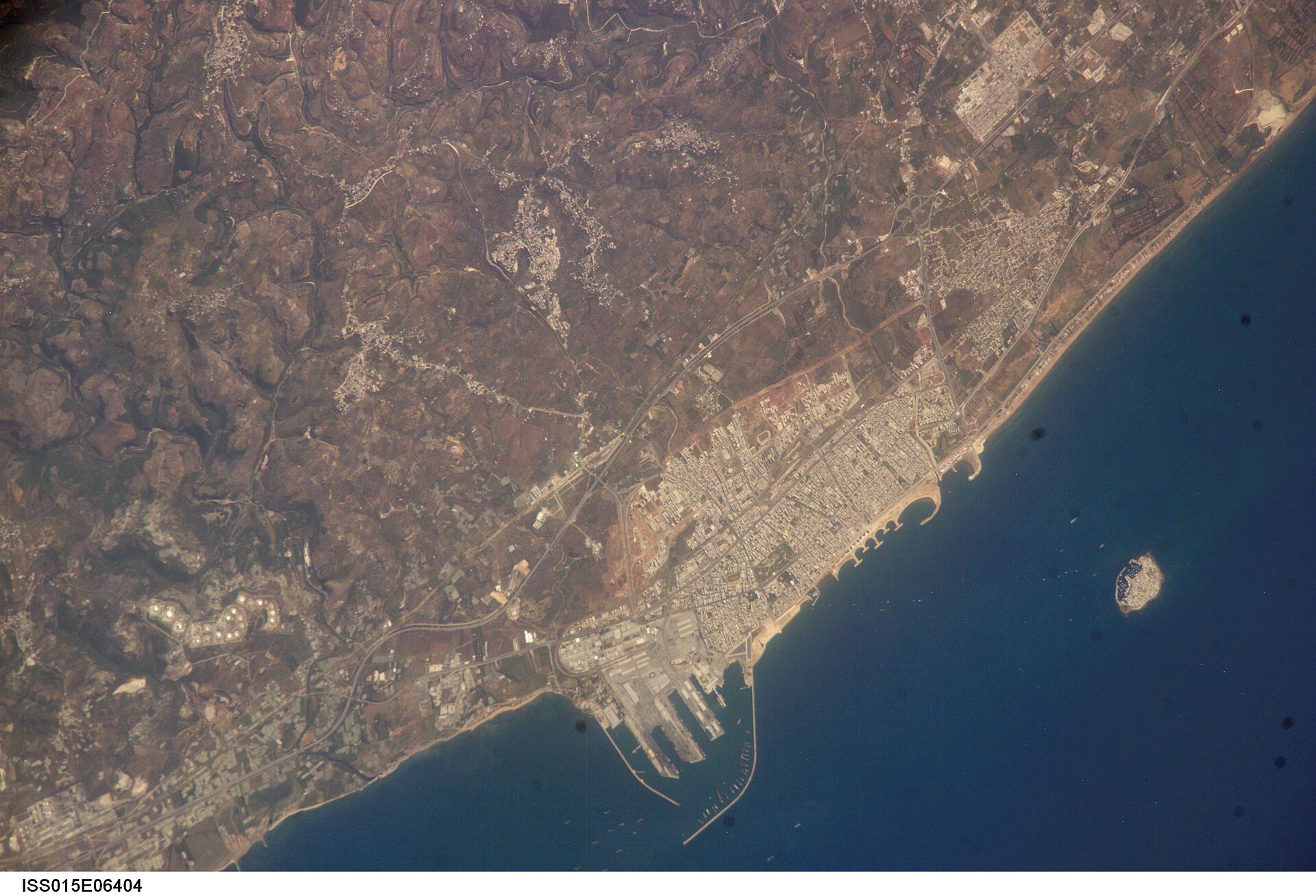
Yahel frames the competition as a contest between an “interventionist bloc” — Turkey and Qatar, oriented toward neo-Ottoman and Islamist expansion — and a “conservative bloc” led by Saudi Arabia, the UAE, and Jordan, focused on sovereignty restoration and counterterrorism. The UAE has its own play: an $800 million port development at Tartous, per the Arab Gulf States Institute, that gives Abu Dhabi a Mediterranean logistics position. The Gulf tour’s sequencing — Saudi Arabia first, Qatar second, UAE third — was al-Sharaa’s way of signalling where the political centre of gravity sits, even if the economic competition remains genuinely contested.
Tehran’s Eviction
The most striking feature of Syria’s new geopolitical orientation is how completely Iran has been excluded. After December 2024, the al-Sharaa government banned Iranian nationals from entering Syria, intercepted what SANA described as “dozens of instances” of Iranian smuggling attempts across the border, and — during this Gulf tour — publicly condemned Iranian attacks on Gulf states as breaches of sovereignty and international law. Natalie Triche and Amr Hamzawy at the Carnegie Endowment noted that the HTS-led government confirmed Gulf hopes by “issuing the decree banning Iranians from traveling to Syria,” a move that would have been unthinkable under Assad.
Iran has been reduced from Syria’s dominant external patron to a state seeking Gulf intermediaries merely to maintain dialogue with Damascus. The Iran war has accelerated this eviction. Al-Sharaa told a Chatham House audience in late March 2026: “Unless Syria is targeted by any party, Syria will remain outside any conflict. We had enough war. We paid a large bill. We are not ready for another war experience.” That neutrality declaration served two purposes — it insulated Syria from the conflict and it signalled to Riyadh that Damascus would not become a vector for Iranian retaliation against the Gulf, the scenario that has defined Saudi threat calculations since February 28.
Triche and Hamzawy identified four motivations driving Saudi and Emirati engagement with the post-Assad government: countering Iran, learning from mistakes in Iraq and Yemen, constraining Turkish neo-Ottoman ambitions, and projecting regional assertiveness. The first motive has been achieved almost by default. The remaining three require sustained investment — and that is precisely what the $13.1 billion architecture is designed to deliver.
Can Saudi Arabia Hold a Country It Cannot Touch?
The strategic question is whether financial dominance can compensate for geographic absence. Henderson’s observation about the lack of a common border is not trivial — it means Saudi Arabia cannot move goods, construction materials, or security personnel into Syria without transiting Jordan, Iraq, or using air and sea routes that other powers control. Turkey’s 900-kilometre border gives Ankara a structural logistics advantage that no investment package can neutralise. When Syrian reconstruction shifts from pledges to pouring concrete, proximity will matter as much as capital.
Al-Sharaa appears to understand the dynamic and is managing it through deliberate multi-alignment. “We want Syria to have ideal relationships with the entire region — with Lebanon, Iraq, Turkey, Saudi Arabia — and world powers like the UK, France, Germany and the US,” he said at Chatham House. “I think that Syria is qualified to start a strategic relationship network.” That language — “strategic relationship network” — is not a man pledging exclusive loyalty to Riyadh. It is a leader who knows his country’s $216 billion reconstruction bill requires multiple patrons, and who is calibrating his diplomatic sequencing to maximise leverage with each one.
The risk for Saudi Arabia is that its investment architecture remains what Henderson called “preliminary” — pledges rather than disbursements, memoranda rather than operational projects. Qatar is already paying Syrian civil servants’ salaries every month. Turkey is already building. The SilkLink fibre-optic network and Flynas Syria joint airline exist on paper; the Qatar-Turkey-Azerbaijan gas pipeline is already delivering 3.4 million cubic metres per day through Syrian territory. MBS has bought position, but converting that position into durable influence requires a pace of execution that Saudi megaproject delivery — from NEOM to the Red Sea development — has not always sustained.
Background
Saudi Arabia severed ties with Assad’s government in 2012, a year after Syria’s Arab League membership was suspended. The UAE moved to normalise relations with Damascus as early as 2018; Riyadh held out until the broader Arab rapprochement culminated in Syria’s readmission to the Arab League on May 7, 2023, and Assad’s attendance at the Saudi-hosted Jeddah Arab Summit on May 19, 2023 — an event Qatar boycotted, a rift that shapes the current competition for Damascus. Assad fell on December 8, 2024, at the end of an 11-day HTS-led offensive. Al-Sharaa — born in Riyadh to a Syrian family from the Daraa governorate near the Golan Heights — was named interim president on January 29, 2025, completing one of the most dramatic political rehabilitations in modern Middle Eastern history.
The Iran war, which began on February 28, 2026, has fundamentally altered the regional environment in which Syria’s reconstruction is unfolding. With Iran’s proxy networks dismantled, its economy under wartime pressure, and its military engaged in direct conflict, the competitive field for Syrian influence has narrowed to an intra-Gulf and Gulf-versus-Turkey contest — a configuration that favours Saudi Arabia’s financial weight over Iran’s traditional tools of militia patronage and political subversion.
FAQ
How much has Saudi Arabia actually disbursed versus pledged?
The $13.1 billion figure represents cumulative pledges and signed agreements, not disbursements. Simon Henderson at the Washington Institute has cautioned that many deals from the July 2025 Damascus Investment Forum remain preliminary. The February 2026 package included specific project commitments — Flynas Syria, SilkLink, ACWA Power desalination — but operational timelines extend into late 2026 and beyond. By contrast, Qatar’s $29 million monthly salary payments to Syrian public sector workers represent actual cash transfers already flowing.
What is al-Sharaa’s relationship with Saudi Arabia before becoming president?
Al-Sharaa was born in Riyadh to a Syrian family originally from the Daraa governorate, giving him a personal connection to the kingdom that predates his political career. After founding al-Nusra Front in 2012 and rebranding as HTS in 2017, he spent years building an autonomous governance structure in Idlib. His decision to make Saudi Arabia his first foreign visit as president in early 2025 was widely interpreted as a signal of strategic alignment, though he has been careful to maintain parallel relationships with Turkey, Qatar, and Western powers.
Has Qatar’s energy position in Syria ever created direct tensions with Riyadh?
Qatar boycotted the May 2023 Jeddah Arab Summit at which Saudi Arabia readmitted Assad to the Arab League, reflecting a fundamental divergence over whether to rehabilitate Assad before he fell. That fault line persists: Qatar’s $7 billion power sector deal and its monthly salary payments to Syrian civil servants give Doha leverage at the operational level that Saudi Arabia’s larger but slower-disbursing portfolio cannot match. The two countries are not in open competition — both back al-Sharaa — but Henderson’s “pledge-vs-disbursement” framing applies precisely here: Qatar’s money is already working.
How does Turkey’s military presence in Syria affect the Saudi investment strategy?
Turkey maintains military advisors on the ground, has reportedly secured access to the T4 air base, and its construction firms are already active in Syrian reconstruction. Saudi Arabia has no military footprint in Syria and no shared border. This creates a division of labour — Riyadh provides capital and political legitimacy, Ankara provides security and logistics — but also a potential tension if Turkish and Saudi priorities diverge on questions like Kurdish autonomy, the pace of elections, or the structure of Syria’s post-transition security forces.
Why did al-Sharaa visit Saudi Arabia before Qatar, given Qatar’s larger energy commitments?
Diplomatic sequencing in Gulf politics carries deliberate meaning. By visiting Riyadh first, al-Sharaa signalled that Saudi Arabia occupies the top of the political hierarchy in Syria’s external relationships — a recognition of MBS’s role as political legitimiser and largest cumulative investor. Qatar’s $7 billion power sector deal is larger than any single Saudi energy commitment, but Saudi Arabia’s $13.1 billion total across multiple sectors establishes a broader portfolio. Visiting Qatar and UAE on the same day (April 22) placed both a tier below Riyadh in the diplomatic choreography.