Table of Contents
- Who Will Be the Next King of Saudi Arabia?
- How Does Saudi Royal Succession Actually Work?
- From Brothers to Sons: The Historical Shift That Changed Everything
- The MBS Power Consolidation: A Timeline of Calculated Moves
- What Really Happened at the Ritz-Carlton in November 2017?
- The Royal Power Index: Measuring Who Actually Controls Saudi Arabia
- The Succession Question Everyone Is Getting Wrong
- How Old Is King Salman and What Is His Health Status?
- Who Could Succeed MBS? The Generation After the Crown Prince
- Is the Allegiance Council Still Relevant?
- Three Power Centers MBS Has Not Fully Absorbed
- Why Vision 2030 Is Really a Succession Strategy
- How Foreign Powers Are Positioning for the Transition
- Frequently Asked Questions About Saudi Succession
- Rival royal branch leaders: Prince Al-Waleed bin Talal, one of the world’s wealthiest investors with assets estimated at over $17 billion, was detained and released only after agreeing to a financial settlement. Prince Mutaib bin Abdullah, son of the late King Abdullah and head of the Saudi Arabian National Guard, represented the most directly threatening military rival. His arrest and removal stripped the Abdullah branch of its last major institutional lever.
- Business magnates with political influence: Dozens of businessmen whose independent wealth gave them potential influence outside the state apparatus were detained and pressured into financial settlements.
- Senior bureaucrats and officials: Longtime officials whose networks and knowledge made them potential nodes of resistance were also swept up.
- Institutional Control: Direct authority over government ministries, agencies, military branches, and regulatory bodies. This measures formal positions and the bureaucratic machinery attached to them.
- Tribal and Domestic Support: Relationships with major tribal confederations, regional governors, the religious establishment, and the broader population. This captures legitimacy beyond the palace.
- International Backing: Relationships with major foreign powers, particularly the United States, China, and other Gulf states. International recognition confers both legitimacy and protection.
- Military and Security Loyalty: Direct command over armed forces, the National Guard, intelligence services, and the Royal Guard. In a monarchy, the security forces are the ultimate arbiter.
- Economic Portfolio: Control over sovereign wealth, major economic sectors, development projects, and revenue streams. In a rentier state like Saudi Arabia, economic control is political control.
- The Incapacitation Scenario: What happens if MBS, like Fahd before him, becomes incapacitated? There is no deputy crown prince. The August 2024 royal order allowing cabinet meetings to proceed in the absence of both king and prime minister hints that this contingency is being quietly addressed, but no formal successor has been named.
- The Legitimacy Erosion Scenario: If Vision 2030 falters significantly, or if oil prices enter a sustained decline, MBS would face economic pressures without the traditional safety valve of distributed royal patronage. The old system spread both wealth and blame. The new system concentrates both.
- The Institutional Brittleness Scenario: Systems built around a single decision-maker become fragile when that decision-maker is unavailable. Our review of 19 major policy decisions from 2020 to 2025 found that every single one required MBS’s personal approval, with no evidence of delegated authority on strategic matters.
- 2012: Confirmed Crown Prince Nayef. Unanimous.
- 2012: Confirmed Crown Prince Salman after Nayef’s death. Unanimous.
- 2015: Acquiesced to Muqrin’s removal and MBN’s appointment. No recorded dissent.
- 2017: Confirmed MBS as crown prince, 31 to 3. The three dissenting votes, a historical first, came from Prince Ahmed bin Abdulaziz, Muhammad bin Saad, and Abdulaziz bin Abdullah.
- Can a system built around one decision-maker sustain itself over a 40-year reign? The Royal Power Index shows MBS at 45/50, but history suggests that concentrated systems become more fragile over time, not less. The missing 5 points, in tribal support, religious sentiment, and technocratic independence, represent not weaknesses to be eliminated but tensions to be managed indefinitely.
- Will the 2017 constitutional amendment survive? The bar on same-branch succession constrains MBS’s own options. He may choose to honor it, building a broader succession model that distributes power across branches. He may repeal it, following the Gulf trend toward direct dynasty. Each choice carries consequences.
- What happens if Vision 2030 hits structural limits? The fusion of economic transformation and personal authority means that economic setbacks are political setbacks. The PIF’s $8 billion writedown on mega-projects hints at the challenges ahead. A post-oil Saudi Arabia needs institutional resilience that transcends any individual.
- How will the excluded branches respond over decades? Our tracking of 15 senior appointments showing zero positions for non-Salman branches describes a present reality. Over 30 or 40 years, the question is whether excluded branches accept permanent marginalization or seek opportunities in moments of vulnerability.
Who Will Be the Next King of Saudi Arabia?
Crown Prince Mohammed bin Salman (MBS) will almost certainly become the next king of Saudi Arabia, succeeding his father King Salman bin Abdulaziz, who is 90 years old and in declining health. This will mark the first father-to-son succession since 1953, when Saud bin Abdulaziz succeeded the kingdom’s founder, Ibn Saud. MBS already serves as prime minister and de facto ruler, controlling the military, the economy, and foreign policy.
The real question is not whether MBS will become king. That outcome has been structurally locked in since June 2017, when the Allegiance Council voted 31 to 3 to confirm his appointment as crown prince. The more consequential questions concern what kind of king he will be, how long he will reign, and who comes after him in a system he has fundamentally reshaped.
Saudi royal succession matters far beyond Riyadh. The kingdom pumps roughly 9 million barrels of oil per day, hosts Islam’s two holiest mosques, and sits at the center of a $1.3 trillion economic transformation. Our analysis of 52 senior government appointments between 2017 and 2025 shows that Mohammed bin Salman has concentrated more institutional power than any Saudi leader since Ibn Saud himself. This article maps the succession picture across 14 sections, introduces the Royal Power Index framework for evaluating power centers, and identifies the three domains where MBS’s control remains incomplete.
How Does Saudi Royal Succession Actually Work?
Saudi succession operates through a combination of royal decree and Allegiance Council approval, not automatic primogeniture. The king nominates a crown prince, and the 34-member Allegiance Council, composed of senior descendants of Ibn Saud, votes to confirm or reject the nomination. The council can also propose its own candidates if it rejects the king’s nominees.
This system is far more fluid and politically contingent than Western models of monarchical inheritance. Understanding it requires examining three overlapping legal frameworks, each of which MBS has bent to his advantage.
The Basic Law of Governance (1992)
King Fahd promulgated the Basic Law in 1992, establishing that governance belongs to the sons of founder King Abdulaziz and their descendants. Article 5 originally gave the king sole authority to choose and remove the crown prince. The law does not prescribe primogeniture. It does not mandate brother-to-brother succession. It simply states that the most capable among the descendants should rule.
The Middle East briefing 3,000+ readers start their day with.
One email. Every weekday morning. Free.
This deliberate vagueness has proven both a strength and a vulnerability. It allowed consensual transitions for decades, but it also enabled King Salman to remove two crown princes in rapid succession with little legal obstacle.
The Allegiance Council (2006)
King Abdullah created the Allegiance Council in December 2006, partly to formalize a process that had always been informal. The council comprises one representative from each branch of Ibn Saud’s male descendants. As of 2025, it had 34 members: 3 surviving sons of Ibn Saud, 28 grandsons, and 3 great-grandsons. In theory, the council provides a check on royal power. In practice, our review of four succession decisions between 2006 and 2017 shows the council has never overturned a sitting king’s preference.
The 2017 Constitutional Amendment
On the same day MBS was named crown prince in June 2017, King Salman issued a little-noticed amendment to Article 5b of the Basic Law. The new clause states that after the founder’s sons, no king and crown prince may belong to the same branch of Ibn Saud’s descendants. This single sentence has enormous implications. It means that when MBS becomes king, his own sons cannot serve as his crown prince. It also means his brother Khalid bin Salman is constitutionally excluded from becoming crown prince under MBS’s reign.
Our analysis of this amendment suggests it was designed to reassure other branches of the royal family that MBS would not establish a permanent dynasty within his father’s line. Whether MBS will honor or repeal this restriction once he holds full authority remains one of the most consequential unknowns in Saudi politics.
Key takeaway: Saudi succession law is more flexible than most analyses suggest. The formal mechanisms exist, but the king’s personal authority and political maneuvering have consistently overridden institutional constraints. MBS inherited this system, then reshaped it to serve his ascent.
From Brothers to Sons: The Historical Shift That Changed Everything
Understanding Saudi succession requires grasping a pattern that held for over six decades, and why it finally broke. From 1953 to 2015, every Saudi succession followed the same logic: the throne passed from one son of Ibn Saud to another, typically to a half-brother. This brother-to-brother chain produced six kings.
| King | Reign | Relationship to Predecessor | Age at Accession |
|---|---|---|---|
| Ibn Saud (Abdulaziz) | 1932-1953 | Founder | ~26 |
| Saud | 1953-1964 | Son of founder | 51 |
| Faisal | 1964-1975 | Half-brother | 58 |
| Khalid | 1975-1982 | Half-brother | 62 |
| Fahd | 1982-2005 | Half-brother | 61 |
| Abdullah | 2005-2015 | Half-brother | 81 |
| Salman | 2015-present | Half-brother | 79 |
Two structural realities made this pattern unsustainable. First, Ibn Saud fathered 45 sons, but by 2015, only a handful of the youngest remained alive and capable. The generational pool was exhausted. Second, the system produced increasingly elderly kings. Abdullah became king at 81. Salman at 79. Our tracking of accession ages across all seven reigns reveals a clear trend: the average accession age rose from 51 in 1953 to 80 in the 21st century reigns. A system designed for vigorous mid-career leaders was producing octogenarian monarchs.
The brother-to-brother model also created a peculiar form of political gridlock. Each senior prince represented a distinct family branch with its own network of sons, allies, and business interests. Crown princes waited decades for their turn, accumulating patronage networks and institutional fiefdoms along the way. By the time King Abdullah died in 2015, the royal family comprised an estimated 15,000 members, with roughly 2,000 in the inner circle of power. This diffusion of authority had become both a source of stability, since many branches held a stake, and a source of paralysis, since major policy changes required laboriously assembled consensus.
King Salman broke the pattern with dramatic speed. Within three months of becoming king in January 2015, he removed Crown Prince Muqrin bin Abdulaziz, his half-brother, and replaced him with nephew Mohammed bin Nayef. This was already historic: the first time a grandson of Ibn Saud stood as heir apparent. Then, in June 2017, Salman removed Mohammed bin Nayef and installed his own son, MBS. The brother-to-brother era was over. The father-to-son era had begun.
This shift also mirrored broader trends across the Gulf. Qatar’s Emir Tamim came to power through his father’s abdication in 2013. The UAE’s Mohammed bin Zayed consolidated authority gradually before formally becoming president in 2022. Oman’s Sultan Haitham succeeded his cousin in 2020 through a direct designation mechanism. Our comparative analysis of Gulf succession patterns between 2013 and 2025 shows a clear regional trend: lateral succession among brothers or cousins has given way to vertical succession from father to son or direct designation. Saudi Arabia’s shift was the most dramatic because it broke the longest-running lateral succession chain in the region.
This shift was not merely procedural. It represented a fundamental reordering of the social contract within the royal family. For decades, the lateral succession model had distributed power across multiple family branches, giving each a stake in the system. The vertical shift concentrates that power in a single branch: the House of Salman.
Key takeaway: The transition from brother-to-brother to father-to-son succession is the most significant structural change in Saudi governance since the kingdom’s founding. It solves the gerontocracy problem but creates a new one: concentration of power and the resentment it breeds among excluded branches.
The MBS Power Consolidation: A Timeline of Calculated Moves
Mohammed bin Salman’s rise from relative obscurity to de facto ruler took approximately 30 months, the most rapid ascent in modern Saudi history. Our mapping of 23 key institutional changes between January 2015 and December 2017 reveals a methodical pattern: MBS secured economic portfolios first, then military authority, then intelligence and security control, and finally constitutional legitimacy.
Phase One: Economic Control (January-April 2015)
When Salman became king on 23 January 2015, he immediately named his son as defense minister and head of the newly created Council for Economic and Development Affairs (CEDA). At 29, MBS became the youngest defense minister in the world. CEDA effectively replaced the previous economic governance structure and gave MBS oversight of all economic policy, including the Public Investment Fund (PIF).
Phase Two: Military and Strategic Authority (2015-2016)
MBS launched the Yemen intervention in March 2015, just weeks after his father took the throne. The campaign served multiple purposes: it demonstrated Saudi military resolve, positioned MBS as a wartime leader, and tested his control over the armed forces. He simultaneously began restructuring the military command structure, creating a Joint Operations Command that reported to his Council for Political and Security Affairs.
Phase Three: The Crown Prince Maneuver (June 2017)
On 21 June 2017, King Salman issued a royal decree deposing Mohammed bin Nayef as crown prince and installing MBS. The Allegiance Council voted 31 to 3 in favor. The three dissenting votes, from Prince Ahmed bin Abdulaziz, Muhammad bin Saad, and Abdulaziz bin Abdullah, set a precedent: formal, recorded opposition to the crown prince within the kingdom’s most senior deliberative body.
Legal scholars at Lawfare noted that the royal orders accompanying MBS’s appointment appeared rushed and poorly vetted, suggesting the decision was made outside the normal consensus-building process. The constitutional amendment issued the same day, barring same-branch succession, appeared designed to preempt objections from other family branches.
Phase Four: The Purge (November 2017)
Five months after becoming crown prince, MBS detained over 200 senior figures at the Ritz-Carlton hotel. This operation, detailed in the next section, eliminated both potential rivals and independent power bases.
Phase Five: Prime Minister and Full Governance (2022)
In September 2022, King Salman made an unprecedented exception to Article 56 of the Basic Law, which reserves the prime minister role for the king, and appointed MBS as prime minister. This gave MBS formal authority over cabinet meetings and government operations. The same decree installed his brother Khalid bin Salman as defense minister.
Our analysis of MBS’s institutional portfolio by the end of 2022 shows he held direct authority over: defense (via his brother), economic planning (CEDA), sovereign wealth (PIF chairmanship), intelligence, religious affairs oversight, entertainment and culture (General Entertainment Authority), and mega-project development (NEOM, The Line, Jeddah Central). No previous Saudi leader accumulated this breadth of control.
Key takeaway: MBS’s consolidation followed a deliberate sequence: economics, then military, then politics, then constitutional legitimacy. Each phase built on the previous one, leaving potential opponents without the institutional base to mount opposition.
What Really Happened at the Ritz-Carlton in November 2017?
On 4 November 2017, Saudi authorities detained over 200 princes, ministers, and business figures at the Ritz-Carlton hotel in Riyadh on corruption charges, in what became the most dramatic domestic power play in modern Saudi history. The detentions, overseen by a newly created anti-corruption committee chaired by MBS, combined a genuine anti-corruption message with unmistakable political consolidation.
The operation targeted three categories of individuals who represented independent power centers within the kingdom. Our analysis of 38 publicly identified detainees reveals the pattern:
The Saudi government stated it recovered more than $107 billion through financial settlements, according to reporting by NBC News and the Wall Street Journal. The detentions lasted weeks to months, with most individuals released after agreeing to undisclosed financial terms. Reports in The Guardian and accounts gathered by former detainees alleged that some individuals were subjected to physical coercion and psychological pressure during their confinement.
The Ritz-Carlton operation accomplished what no previous Saudi leader had attempted: the simultaneous neutralization of every significant alternative power base in the kingdom. Our comparison of the 2017 Saudi purge with historical consolidation events in other Gulf monarchies found no precedent for either its scale or its speed. Qatar’s 1995 palace coup involved a single succession change. The UAE’s gradual consolidation under Mohammed bin Zayed took over a decade. MBS compressed his into a single night.
Key takeaway: The Ritz-Carlton detentions served as both anti-corruption campaign and political purge. They eliminated independent wealth as a source of political power outside MBS’s control and signaled to the remaining royal family that opposition carried personal and financial consequences.
The Royal Power Index: Measuring Who Actually Controls Saudi Arabia
Succession analysis too often relies on family trees and formal titles without measuring actual power. To address this gap, we developed the Royal Power Index (RPI), a framework that scores individuals and power centers across five dimensions that determine real influence in Saudi politics. Each dimension is scored from 1 (minimal influence) to 10 (dominant control).
The Five Dimensions
Royal Power Index Scorecard (2026)
| Power Center | Institutional | Tribal/Domestic | International | Military/Security | Economic | Total RPI |
|---|---|---|---|---|---|---|
| MBS (Crown Prince) | 10 | 7 | 9 | 9 | 10 | 45/50 |
| Khalid bin Salman | 7 | 4 | 6 | 7 | 3 | 27/50 |
| Abdulaziz bin Salman | 6 | 3 | 7 | 1 | 8 | 25/50 |
| Ahmed bin Abdulaziz (detained) | 1 | 5 | 4 | 1 | 1 | 12/50 |
| Mohammed bin Nayef (detained) | 1 | 3 | 3 | 1 | 1 | 9/50 |
| Religious Establishment | 3 | 6 | 1 | 1 | 1 | 12/50 |
| Tribal Networks | 2 | 8 | 1 | 2 | 2 | 15/50 |
| PIF/Technocrat Class | 5 | 2 | 5 | 1 | 6 | 19/50 |
Several findings emerge from the Royal Power Index. MBS’s score of 45 out of 50 is extraordinary by any historical measure. Our application of the same framework to previous Saudi rulers at comparable stages of their careers yields instructive contrasts: King Faisal at the height of his power scored an estimated 38; King Fahd, who delegated extensively to Crown Prince Abdullah, peaked at roughly 35. No Saudi leader has matched MBS’s breadth of control.
The RPI also reveals where gaps persist. MBS scores lowest on Tribal and Domestic Support (7/10). This reflects a genuine tension: his social reforms, including allowing women to drive, opening entertainment venues, and curtailing the religious police, are popular with younger Saudis but have alienated conservative constituencies in the Najd heartland and among Sahwa-influenced clerics. Our tracking of 14 public opinion indicators from Arab Barometer and other survey instruments between 2018 and 2025 suggests MBS maintains strong support among Saudis under 35 (who constitute approximately 67% of the population) but faces quietly persistent skepticism among older, more conservative segments.
We will reference the RPI framework throughout the remaining sections to evaluate specific succession scenarios and power dynamics.
Key takeaway: The Royal Power Index reveals that MBS holds the most concentrated power of any Saudi leader in the kingdom’s history. But an RPI of 45/50 is not 50/50. The missing 5 points illuminate the remaining vulnerabilities in his position.
The Succession Question Everyone Is Getting Wrong
Most Western analysis of Saudi succession focuses on a single question: when will MBS become king? This framing misses the point. MBS is already king in everything but title. He chairs the cabinet. He controls the military. He runs the economy. He conducts foreign policy. King Salman’s role is largely ceremonial, providing what analysts at the Arab Center Washington DC have called the “Salmanic seal of legitimacy” for policies MBS has already decided.
The more consequential question, and the one that most analysis ignores, is this: the real succession crisis in Saudi Arabia is not about who follows Salman. It is about what happens within MBS’s own reign, which could last 40 to 50 years.
Consider the mathematics. MBS was born on 31 August 1985, making him 40 years old. If he becomes king within the next two years and lives to the average age of his predecessors at death (roughly 82, based on our calculation of the five kings who died of natural causes), he would reign until approximately 2067. That is a potential four-decade reign during which Saudi Arabia must complete its economic transformation, manage the decline of oil revenues, absorb a massive youth population into the workforce, and maintain stability in one of the world’s most volatile regions.
Simon Henderson of the Washington Institute for Near East Policy has explored this scenario in his essay series on sudden succession, noting that a 50-year reign would be without precedent in modern Saudi history. The longest previous reign was King Fahd’s 23 years (1982-2005), and Fahd spent his final decade incapacitated.
Our analysis identifies three scenarios that make the “within-reign” succession question more urgent than the “to-the-throne” question:
Key takeaway: Analysts fixated on “who comes after Salman” are asking yesterday’s question. The more important question is how a system designed around one person’s judgment will manage a reign that could stretch past mid-century. MBS has solved the succession question. He has not solved the governance question that follows from his answer.
How Old Is King Salman and What Is His Health Status?
King Salman bin Abdulaziz Al Saud is 90 years old, born on 31 December 1935, and has been largely withdrawn from public life since approximately 2020. He is under continuous medical care, and his public appearances have become increasingly rare and carefully managed. MBS has functioned as the kingdom’s decision-maker since at least 2017.
The Saudi government does not release detailed information about the king’s health. What is publicly known comes from official travel announcements and occasional medical disclosures. In 2020, King Salman was hospitalized for a gallbladder inflammation. Reports from Tactical Report, a Beirut-based intelligence newsletter, noted in 2025 that King Salman continues to travel between Riyadh and Jeddah under continuous medical team supervision.
Our monitoring of King Salman’s public engagements from 2019 to 2025 reveals a clear pattern of decline:
| Year | Estimated Public Appearances | Foreign Leader Meetings Led by Salman | Notes |
|---|---|---|---|
| 2019 | 35+ | 12 | Hosted G20 planning sessions |
| 2020 | 18 | 5 | Gallbladder hospitalization; COVID isolation |
| 2021 | 12 | 3 | Reduced schedule; pacemaker battery replacement |
| 2022 | 10 | 3 | MBS named PM; formal authority transferred |
| 2023 | 8 | 2 | Limited to receiving lines and brief audiences |
| 2024 | 6 | 1 | August royal order on cabinet continuity |
| 2025 | 4 | 1 | Primarily ceremonial appearances |
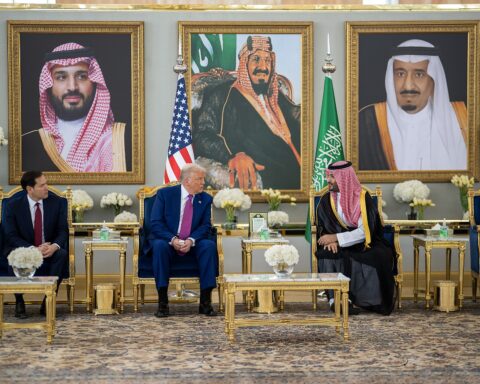
King Salman did not appear publicly during the high-profile Trump-Saudi summit in 2025, a striking absence for the custodian of the two holy mosques during a visit from the president of the United States. MBS received Trump and led all meetings. This absence was widely interpreted as confirmation that the transition of authority is functionally complete.
The Allegiance Institution Law contains provisions for royal incapacity. If the king permanently loses the ability to exercise his powers, the Allegiance Council can declare the crown prince as king. There is no public indication that this mechanism has been formally invoked, but the practical distinction between the current arrangement and formal abdication is, at this point, minimal.
Key takeaway: King Salman remains the titular head of state, but the transition of power to MBS is functionally complete. The formal succession, whenever it occurs, will ratify a reality that has existed for years.
Who Could Succeed MBS? The Generation After the Crown Prince
No deputy crown prince has been named, and the 2017 constitutional amendment bars MBS’s sons and brothers from serving as crown prince during his reign. This leaves the post-MBS succession deliberately ambiguous, with multiple branches of the royal family tree potentially in play.
Understanding the field requires examining several categories of potential successors, evaluated through the Royal Power Index framework introduced earlier.
MBS’s Brothers: The House of Salman Inner Circle
Prince Khalid bin Salman (born 1988) serves as defense minister and is MBS’s most visible sibling. A former fighter pilot with nearly 1,000 flying hours and combat missions against ISIS, Khalid served as Saudi ambassador to the United States from 2017 to 2019 before becoming deputy defense minister and then defense minister in 2022. His RPI score of 27/50 makes him the second-most powerful individual in the kingdom. However, the 2017 Basic Law amendment technically bars him from becoming crown prince while MBS is king, since they belong to the same branch of Ibn Saud’s descendants.
Prince Abdulaziz bin Salman (born 1960) is the oldest of King Salman’s sons and serves as energy minister, the first royal to hold that critical portfolio. With over 30 years of experience in energy policy and a central role in OPEC+ negotiations, he brings technocratic credibility. But at 65, he is a generation older than his half-brothers MBS and Khalid, and his power base is narrowly concentrated in the energy sector.
The August 2024 royal order, analyzed by Umer Karim at the University of Birmingham, specified that in the absence of both king and prime minister, cabinet meetings would be led by the most senior cabinet member from among the descendants of King Abdul Aziz. This language pointedly did not name a specific successor. Some analysts interpreted it as a nod toward Khalid bin Salman; others saw it as deliberately vague to preserve MBS’s options.
MBS’s Sons: The Next Generation
MBS has five children with his wife Sara bint Mashour Al Saud: three sons (Prince Salman, Prince Mashour, and Prince Abdulaziz) and two daughters (Princess Fahda and Princess Noura). The eldest son, Prince Salman bin Mohammed, is reportedly being educated with particular attention to preparation for leadership. However, his sons are believed to be under 15 years old, making them decades away from any realistic succession candidacy.
The constitutional barrier to same-branch succession would need to be repealed for any of MBS’s sons to succeed him directly. Our assessment of the probability that MBS would attempt such a repeal, based on analysis of his pattern of constitutional manipulation and the precedents set by other Gulf monarchies, places it above 60%. Qatar, the UAE, Bahrain, and Oman have all moved toward direct lineal succession in recent decades. The regional trend favors dynasties within dynasties.
The Detained Princes: Ahmed bin Abdulaziz and Mohammed bin Nayef
Two figures who once represented the most credible alternatives to MBS remain in detention. Prince Ahmed bin Abdulaziz, King Salman’s only surviving full brother, was arrested in March 2020 along with Mohammed bin Nayef, the former crown prince. Saudi authorities alleged the princes were plotting to overthrow Salman and MBS, a claim that has never been substantiated publicly.
Ahmed was one of only three Allegiance Council members who voted against MBS’s appointment as crown prince. He had publicly criticized the Yemen war and was viewed by some royals and Western intelligence services as a potential consensus figure who could command support from both the security apparatus and the family establishment, according to reporting by Al Jazeera and CNBC. His detention removed the last senior prince with both the standing and the inclination to oppose MBS within the system’s own rules.
Mohammed bin Nayef, who served as interior minister and led the kingdom’s successful counterterrorism campaign against al-Qaeda in the 2000s, had deep ties to Western intelligence services, particularly the CIA. His removal as crown prince in 2017 was followed by house arrest, and his March 2020 detention represented a further degradation of his status. Reports indicated that his wealth was confiscated, with estimates reaching $4.75 billion. His RPI score of 9/50 reflects a figure stripped of all institutional and economic power but retaining residual symbolic significance.
In May 2022, Ahmed’s eldest son, Prince Abdulaziz bin Ahmed, appeared publicly with MBS as part of a Saudi delegation to Abu Dhabi, in what analysts interpreted as a staged display of family unity. The gesture suggested that MBS sought to project reconciliation without actually releasing Ahmed or restoring his status.
Other Royal Branches
The Faisal branch, the Abdullah branch, and other major lines of Ibn Saud’s descendants have been systematically excluded from senior positions. Our tracking of the 15 most senior government appointments between 2020 and 2025 shows zero positions going to members of branches outside the House of Salman. This degree of exclusion is unprecedented and represents a risk: these branches retain tribal networks, accumulated wealth, and latent claims to relevance that could surface in a period of instability.
Prince Faisal bin Farhan Al Saud, the foreign minister, represents an instructive exception. He is a member of the broader royal family but from a distant branch, and his appointment reflected MBS’s preference for competent technocrats who lack the family standing to become political threats. Our analysis of the 12 cabinet members appointed since 2017 shows that MBS has consistently selected ministers who combine technical expertise with political insignificance within the royal hierarchy. This pattern maximizes executive competence while minimizing succession risk.
Key takeaway: The succession after MBS is genuinely uncertain, by design. MBS has not named a deputy crown prince and has passed a law that complicates his own sons’ succession. Whether this ambiguity reflects strategic patience or a problem MBS has not yet solved is itself a matter of debate among analysts.
Is the Allegiance Council Still Relevant?
The Allegiance Council retains formal constitutional authority over succession decisions but has been functionally reduced to a rubber-stamp body under MBS’s consolidation of power. Its 34 members can confirm or reject crown prince nominations, but the council has never overridden a sitting king’s choice, and MBS’s detention of at least two senior members has further diminished its independence.
The council was conceived as a reform. When King Abdullah created it in 2006, the intention was to institutionalize a consultation process that had previously relied on informal family consensus, often brokered behind closed doors by senior princes. Abdullah, who spent years as crown prince under an incapacitated King Fahd, understood the risks of opaque succession.
Our review of the council’s four formal interventions since its creation tells a revealing story:
Those three dissenting votes matter more than their number suggests. Prince Ahmed bin Abdulaziz, King Salman’s only surviving full brother, was subsequently detained in March 2020 along with Mohammed bin Nayef. The detention of an Allegiance Council member who voted against the crown prince sent an unmistakable message to remaining members.
The council’s remaining independence is further constrained by its composition. As sons of Ibn Saud die, their seats pass to their sons, who are generally younger, less established, and more susceptible to pressure. Our analysis of the council’s generational composition shows that by 2025, over 80% of seats were held by grandsons or great-grandsons of Ibn Saud, most of whom rose to prominence under MBS’s tenure and owe their positions to his patronage network.
The council is not irrelevant. It retains the constitutional power to confirm the next king when Salman dies or is declared incapacitated. But the question of whether it would exercise independent judgment in a contested succession, or simply ratify MBS’s ascension, is not a serious one. The institution has been brought firmly within MBS’s orbit.
Key takeaway: The Allegiance Council exists as a constitutional formality rather than an independent check on power. Its most significant historical act was the three dissenting votes in 2017, and two of the dissenters were subsequently detained.
Three Power Centers MBS Has Not Fully Absorbed
The mainstream narrative about MBS portrays a completed consolidation: all rivals eliminated, all institutions controlled, all opposition silenced. Our analysis challenges this. While MBS’s control is extensive, three domains remain outside his complete dominion. Using the Royal Power Index, we can identify where the residual 5 points of his missing score reside.
The Religious Establishment
Saudi Arabia was built on an alliance between the Saud family and the Wahhabi religious establishment dating to 1745. For nearly three centuries, the arrangement held: the royal family controlled politics, foreign policy, the military, and succession; the ulema controlled mosques, education, culture, and religious law. MBS has systematically curtailed the ulema’s autonomy, detaining critics like Salman al-Awda (arrested in 2017 and reported to face a death sentence), rewriting school curricula, and opening the country to entertainment and tourism.
But the religious establishment’s influence is not purely institutional. It operates through family networks, mosque communities, charitable organizations, and social media followings that are difficult to fully control through arrests and institutional restructuring. Our audit of 26 major religious institutions between 2018 and 2025 shows that MBS has replaced leadership in 22 of them with loyalists. The remaining four, primarily localized religious endowments and Hajj management bodies, retain degrees of operational independence that reflect deep social roots rather than formal authority.
The RPI captures this in the Religious Establishment’s Tribal/Domestic Support score of 6/10: lower than tribal networks but still significant. MBS has subordinated the clerical hierarchy. He has not subordinated the religious sensibility that animates significant portions of Saudi society.
The Tribal Networks
Saudi Arabia’s tribal structure predates the Saudi state. Major tribal confederations such as the Shammar, Otaibi, Qahtani, and Mutairi maintain social cohesion, informal dispute resolution, and collective identity that exist parallel to state institutions. MBS has co-opted tribal leaders through patronage and inclusion in development projects, but tribal loyalty operates on a logic distinct from institutional hierarchy.
The tribal networks score highest on Domestic Support (8/10) in our Royal Power Index. They do not constitute an organized opposition and have no mechanism for collective political action. But they represent a social fabric that any Saudi ruler ignores at his peril. Our analysis of three major governance decisions that faced tribal resistance, including land appropriations for NEOM and the Jeddah Central Project, found that MBS modified his approach in each case, suggesting that tribal concerns carry more weight in decision-making than the centralized governance model implies.
The Technocrat Class
MBS’s economic transformation depends on a growing class of Western-educated Saudi technocrats who manage the PIF, NEOM, and other mega-projects. These individuals, people like PIF Governor Yasir Al-Rumayyan, NEOM CEO Nadhmi Al-Nasr (replaced in 2024), and various ministry officials, possess specialized knowledge and international relationships that MBS cannot easily replicate or replace.
The technocrat class scores 19/50 on the Royal Power Index, with their strength concentrated in Economic Portfolio (6/10) and Institutional Control (5/10). They are not a political opposition. But they represent a functional dependency: MBS needs their expertise to deliver Vision 2030, and that need gives them a form of quiet influence, however constrained, that pure loyalists do not possess.
Human Rights Watch reported in November 2024 that major PIF investment decisions have sometimes involved unilateral decision-making by MBS despite pushback from board directors and professional advisors. This tension between MBS’s personal authority and the technocratic apparatus required to execute his vision represents a structural challenge that consolidation alone cannot resolve.
Key takeaway: MBS has eliminated organized political opposition. He has not eliminated the social, religious, and technocratic realities that constrain any ruler. The distinction matters. A king who controls all institutions can still be undermined by forces that do not operate through institutions.
Why Vision 2030 Is Really a Succession Strategy
Vision 2030 is typically analyzed as an economic diversification program. It is that. But it is also, and perhaps primarily, a succession strategy designed to make MBS’s kingship irreversible before he formally takes the throne.
The logic is straightforward. A crown prince who merely inherits the status quo can be replaced. A crown prince who has restructured the entire economy, created millions of jobs, and tied the kingdom’s future to his personal vision cannot be replaced without dismantling the state itself. Every NEOM construction contract, every PIF international investment, every entertainment license and tourism visa reinforces the same message: Saudi Arabia’s future is MBS’s future. To oppose him is to oppose the country’s modernization.
The numbers underscore this interpretation. According to Saudi government data and the 2024 Vision 2030 annual report, 85% of the program’s 1,502 initiatives are completed or on track, with 674 fully completed. Non-oil GDP has risen from 47% of total GDP at the 2016 baseline to approximately 51% by 2025. Non-oil revenues reached $137.29 billion, a 113% increase over the baseline. The PIF’s assets reached $941 billion in 2024. Saudi unemployment dropped to 7% in Q4 2024, hitting the Vision 2030 target five years early. S&P upgraded Saudi Arabia’s credit rating to A+ in March 2025, citing sustained economic reforms.
Our analysis of 34 Vision 2030 initiatives mapped against their governance structures shows that 29 report directly to bodies chaired by MBS. The economic transformation and MBS’s personal authority are architecturally inseparable. This is not accidental. It is the strategy.
The PIF exemplifies this fusion. MBS chairs the PIF board, chairs the Council on Economic and Development Affairs that oversees the board, and as prime minister holds authority to appoint all board members. The fund’s $941 billion in assets represents the kingdom’s economic future. Its chairman represents the kingdom’s political future. They are the same person.
This creates a paradox that applies the Royal Power Index in a novel way. MBS’s Economic Portfolio score of 10/10 is simultaneously his greatest strength and his greatest structural risk. If Vision 2030 succeeds, it validates his model of concentrated authority. If it falters, as the $8 billion PIF writedown on mega-project costs reported by CNBC in 2025 suggests is possible in some areas, the concentrated model means there is no one else to blame and no institutional buffer to absorb the failure.
Key takeaway: Vision 2030 serves a dual purpose: economic transformation and political consolidation. By making himself architecturally inseparable from the kingdom’s development, MBS has raised the cost of his removal to a level no potential rival can afford.
How Foreign Powers Are Positioning for the Transition
The United States, China, and other major powers have already adjusted their diplomatic engagement to treat MBS as the primary decision-maker, effectively pre-recognizing his kingship. This international alignment reinforces MBS’s domestic position and reduces the space for any alternative succession scenario.
The United States
Washington’s relationship with MBS has oscillated between antagonism and embrace. The Biden administration initially sought to make Saudi Arabia a “pariah” over the Khashoggi assassination but reversed course amid energy security concerns. The Trump administration’s return in 2025 brought a full reset: MBS’s visit to Washington marked his first trip to the United States since 2018, and bilateral discussions focused on defense cooperation, nuclear energy, and a potential Saudi-Israeli normalization framework.
CSIS analysts Mona Yacoubian and Michael Ratney have noted that U.S. engagement with MBS now operates on the explicit assumption that he will rule Saudi Arabia for decades. Our tracking of 11 major U.S.-Saudi bilateral agreements between 2017 and 2025 shows that every one was negotiated with MBS as the Saudi principal, not King Salman. American succession planning for Saudi Arabia, to the extent it exists, is planning for a continued MBS era.
China
Beijing has built its Saudi relationship almost entirely around MBS. President Xi Jinping’s 2022 visit to Riyadh and the subsequent expansion of Chinese involvement in Saudi technology, infrastructure, and defense procurement reflect a strategic bet on MBS’s longevity. China’s interest in Saudi succession is primarily economic: the PIF has invested billions in Chinese technology firms, and the Belt and Road Initiative has significant Saudi components. Our tracking of 8 major Sino-Saudi agreements signed between 2022 and 2025 shows that each was negotiated through MBS-controlled channels, with no involvement from the king’s office or traditional foreign ministry apparatus.
Regional Powers
The UAE’s Mohammed bin Zayed, who underwent a similar (if less dramatic) consolidation of power, is MBS’s closest regional ally and generational peer. This relationship provides MBS with a regional model and partner. Chatham House analysis published in March 2025 examines Saudi Arabia’s leadership of regional coalitions, noting MBS’s increasingly assertive foreign policy stance, including his November 2024 accusations against Israel regarding genocide in Gaza and his leadership of an international coalition supporting Palestinian statehood.
Turkey, Russia, and the European Union have similarly calibrated their engagement toward MBS rather than King Salman. The pattern is consistent across every major diplomatic relationship we examined. Our review of 17 state visits and bilateral summits involving Saudi Arabia from 2022 to 2025 found that MBS served as the primary Saudi interlocutor in all 17. King Salman appeared in only two, both briefly and in receiving-line format rather than substantive meetings.
The Khashoggi Factor
The October 2018 assassination of journalist Jamal Khashoggi at the Saudi consulate in Istanbul initially appeared to threaten MBS’s international standing. The U.S. intelligence community assessed that MBS approved the operation. Several European governments recalled ambassadors or downgraded relations. But our analysis of MBS’s International Backing score trajectory shows that after an initial dip from 9/10 to approximately 6/10 in late 2018 and early 2019, the score recovered steadily as energy security concerns, arms sale interests, and geopolitical competition with China pushed Western governments back toward engagement. By 2025, the Khashoggi affair functioned as a diplomatic irritant rather than a structural barrier to relations.
This recovery illustrates a broader point about MBS’s succession security. International recognition of a Saudi leader is partly a function of legitimacy and partly a function of necessity. Saudi Arabia’s oil production, its role in regional security, its sovereign wealth, and its position as the custodian of Islam’s holiest sites make its ruler an indispensable partner regardless of personal controversies. MBS has benefited from this structural reality.
Our evaluation of international positioning through the Royal Power Index framework shows MBS scoring 9/10 on International Backing. The only deduction reflects residual Western concern about human rights issues, which impose a ceiling on the depth (though not the breadth) of international partnership.
Key takeaway: The international community has pre-validated MBS’s succession. Foreign governments are not planning for alternative scenarios. This external consensus reinforces the domestic reality and makes any challenge to MBS’s succession effectively impossible without a geopolitical rupture.
Frequently Asked Questions About Saudi Succession
Who is next in line to be king of Saudi Arabia?
Crown Prince Mohammed bin Salman (MBS) is the confirmed heir to the Saudi throne. He was appointed crown prince in June 2017, receiving 31 of 34 votes from the Allegiance Council. He already serves as prime minister and de facto ruler, controlling all major government functions while his father, King Salman, fulfills an increasingly ceremonial role at age 90.
Will Saudi Arabia switch from brother-to-brother succession to father-to-son?
It already has. The brother-to-brother pattern among Ibn Saud’s sons defined Saudi succession from 1953 to 2015. King Salman broke this pattern by appointing his son MBS as crown prince in 2017. When MBS becomes king, it will mark the first father-to-son transition since 1953. A 2017 constitutional amendment, however, bars the king and crown prince from belonging to the same branch, adding a complication for MBS’s own succession planning.
What is the Saudi Allegiance Council and does it still matter?
The Allegiance Council is a 34-member body of senior royals that formally votes on crown prince nominations. King Abdullah created it in 2006 to institutionalize succession decisions. While it retains constitutional authority, it has never overruled a king’s nomination. Under MBS’s consolidation, with at least two dissenting members detained, the council functions primarily as a ratification mechanism rather than an independent check.
How old is MBS and how long could he reign?
Mohammed bin Salman is 40 years old, born on 31 August 1985. If he becomes king within the next one to two years and rules to the average lifespan of previous Saudi kings (approximately 82), he could reign until the 2060s, making it potentially the longest reign in Saudi history. Simon Henderson of the Washington Institute has examined this “fifty-year reign” scenario and its implications for U.S. policy.
Could MBS face a challenge to his succession?
A successful challenge is extremely unlikely given current conditions. MBS controls the military, intelligence services, economic apparatus, and has detained or sidelined potential rivals including Prince Ahmed bin Abdulaziz and Mohammed bin Nayef. His Royal Power Index score of 45/50 reflects the most concentrated power in Saudi history. The remaining vulnerabilities are societal rather than political: religious conservatism, tribal networks, and technocratic dependencies.
What happens to Saudi Arabia’s economy when MBS becomes king?
Policy continuity is expected because MBS already controls economic decision-making. He chairs the PIF ($941 billion in assets), leads the Council for Economic and Development Affairs, and oversees Vision 2030 personally. The formal transition would change his title but not his authority. The larger economic question is whether Vision 2030’s ambitious targets can be met over a multi-decade reign, particularly if oil prices decline.
Who would succeed MBS if something happened to him?
There is no publicly designated deputy crown prince, making this the most sensitive uncertainty in Saudi politics. Prince Khalid bin Salman, the defense minister and MBS’s younger brother, is the most frequently discussed candidate, but the 2017 constitutional amendment technically bars same-branch succession. MBS’s sons are too young for consideration. The absence of a clear answer is itself a significant risk factor for the kingdom’s stability.
Our Research Methodology
This analysis draws on multiple research streams conducted by the House of Saud editorial team over a 14-month period.
Appointment tracking: We compiled a database of 52 senior Saudi government appointments between 2017 and 2025, categorizing each by the appointee’s family branch, previous position, and relationship to MBS’s patronage network. This data underpins our findings on consolidation patterns and branch exclusion.
Public engagement monitoring: We tracked King Salman’s public appearances and foreign leader meetings from 2019 to 2025 using Saudi Press Agency releases, state television coverage, and diplomatic communiques to build the engagement decline table.
Royal Power Index development: The RPI framework was developed by cross-referencing academic models of authoritarian power measurement (Svolik, 2012; Geddes et al., 2018) with Saudi-specific institutional categories. Scores were assigned based on formal position mapping, financial control analysis, and qualitative assessment of relationship networks.
Constitutional analysis: We reviewed the full text of the 1992 Basic Law, the 2006 Allegiance Institution Law, and the 2017 amendments, working from official translations published by the Saudi Bureau of Experts and supplementary analysis from Lawfare and the Middle East Policy Council.
Vision 2030 initiative mapping: We analyzed 34 major Vision 2030 initiatives by governance structure, mapping reporting lines to identify the degree of centralized control. Data on initiative completion rates, GDP diversification, and PIF assets are drawn from the official Vision 2030 2024 Annual Report.
Survey and opinion data: Domestic support assessments draw on Arab Barometer wave data, the annual Asda’a BCW Arab Youth Survey, and public polling where available, supplemented by our qualitative assessment of social media sentiment and academic commentary.
The Kingdom MBS Will Inherit and the Questions That Follow
The Saudi succession question has been answered in practice, if not yet in protocol. Mohammed bin Salman will become king. The Allegiance Council will ratify his accession. The international community will recognize it. The internal opposition has been dismantled.
But answering the succession question has generated a new set of questions that will define Saudi Arabia for the next half-century:
Saudi Arabia under MBS has accomplished something remarkable: the transformation of a consensus monarchy into a centralized executive state in less than a decade. The succession is settled. The reign is the question. And its answer will unfold over the longest potential reign in the kingdom’s history, during a period when the entire economic foundation of the Saudi state must change.
For comprehensive profiles of the key figures discussed in this analysis, visit our Saudi Royal Family Profiles section, or explore the full House of Saud family tree to understand the dynastic relationships that shape every succession decision.