
ANKARA — On March 4, 2026, a NATO air defense battery intercepted an Iranian ballistic missile over Turkish airspace. Six days earlier, Turkey had refused to grant the United States access to its airspace, land, or maritime space for operations against Iran. Both facts are simultaneously true, and together they define the most consequential foreign policy crisis in modern Turkish history. Erdogan told the world he found US-Israeli strikes on Iran deeply troubling, then told Iran its retaliatory campaign against Arab civilians was unacceptable. Turkish Foreign Minister Hakan Fidan flew between Washington, Tehran, and the Gulf capitals pushing for a ceasefire, while back home the Interior Ministry quietly drafted three contingency plans for an Iranian refugee surge. Turkey is NATO’s second-largest military power, shares a 500-kilometer border with Iran, gets 14 percent of its natural gas from Tehran, controls the straits that connect the Black Sea to the Mediterranean, and hosts the Incirlik Air Base that projects American power across the region. The war that began on February 28, 2026, with US and Israeli strikes that killed Ayatollah Khamenei, has placed all of these realities into direct, violent tension with one another. No other country in the world faces a more precisely engineered version of Ankara’s predicament.
Contents
- Why Is Turkey Refusing to Pick a Side in the Iran War?
- What Happened When an Iranian Missile Entered Turkish Airspace?
- How Does Turkey’s Geographic Position Shape the Conflict?
- Has the Erdogan-MBS Rapprochement Survived the War?
- Could Turkey Invoke NATO Article 5 Against Iran?
- The Energy Equation — What Happens to Turkish-Iranian Gas?
- Turkey’s Military Balance Sheet
- The Bosphorus Card — Turkey’s Most Powerful Pressure Point
- Is Turkey Building a Third Path Between NATO and Tehran?
- What Does the Iran War Mean for Turkey’s Kurdish Question?
- The Ankara Calculus — A Decision Framework
- Why the “Turkey Must Choose” Narrative Is Wrong
- Frequently Asked Questions
Why Is Turkey Refusing to Pick a Side in the Iran War?
Turkey is refusing to pick a side because picking a side would cost it everything it has spent the last decade building. Erdogan has constructed a foreign policy architecture premised on strategic autonomy — the idea that Turkey can extract value from multiple competing great powers simultaneously. The Iran war tests that architecture to its limits, but abandoning it would mean surrendering the strategic weight that makes Turkey matter.
The geometry of Turkey’s refusal is precise. Erdogan expressed “deep sorrow and concern” over US and Israeli strikes on Iran and declared they “clearly violate Iran’s sovereignty.” That language was not diplomatic boilerplate. It was a direct signal to Tehran that Ankara did not sanction the campaign. At the same time, Erdogan condemned Iran’s retaliatory strikes on Gulf Arab states as “unacceptable, regardless of the reason.” The same week, Turkey formally denied American requests for access to Turkish airspace, land, and maritime space for offensive operations against Iran.
Foreign Minister Hakan Fidan added further texture. He called Iran’s indiscriminate bombing of Arab countries “an incredibly wrong strategy,” which placed Turkey closer to the Gulf Arab position than the language Erdogan used about US strikes might suggest. Fidan also told Washington directly that military action should be limited to degrading Iran’s military capabilities and should not aim at regime change. That framing served multiple audiences simultaneously: it gave the Americans a face-saving rationale for limiting the conflict, gave Iran a signal that Turkey opposed regime change, and positioned Ankara as a reasonable mediator rather than a passive bystander.
The domestic logic reinforces the external calculation. Turkey has a large Kurdish population with complex relationships to Iranian-backed Kurdish networks. It has a conservative Islamist political base that regards the killing of an Ayatollah as a civilizational affront, regardless of Tehran’s foreign policy choices. And it has a secular nationalist opposition that would savage any perception of Erdogan bowing to Washington. The refusal to pick a side is not weakness. It is a multi-audience political performance with structural incentives behind every line.
The Middle East briefing 3,000+ readers start their day with.
One email. Every weekday morning. Free.
Erdogan’s political survival instincts are also a factor. He has governed Turkey since 2003 — first as prime minister, then as president under a presidential system he redesigned around his own authority. Every major foreign policy decision has been tested against the question of whether it strengthens or weakens his domestic position. A choice that alienated the Islamist base would be as politically dangerous as a choice that alienated the military establishment. The Iran war’s domestic political geometry thus reinforces the external case for ambiguity.
There is also a precedent calculus. Turkey has executed this playbook before. During the 2022 Ukraine invasion, Ankara condemned Russian aggression while refusing to join Western sanctions, sold Bayraktar drones to Ukraine, and simultaneously maintained TurkStream gas imports from Russia. The result was that Turkey emerged from year one of that conflict as an indispensable mediator — hosting the Kyiv-Moscow grain deal talks, facilitating prisoner exchanges, and extracting economic benefits from both sides. Erdogan watched that outcome and drew a clear lesson about the value of principled equidistance in the era of great power conflict.
What Happened When an Iranian Missile Entered Turkish Airspace?
The March 4 intercept was the first time NATO territory received incoming fire from Iran, and it created a constitutional crisis inside the alliance before anyone publicly admitted there was one. An Iranian ballistic missile transited Iraqi and Syrian airspace before crossing into Turkish territory. NATO air and missile defense assets tracked it, engaged it, and destroyed it over the Eastern Mediterranean. The alliance had, for the first time in its history, shot down a projectile launched by a state that was not the Soviet Union or Russia.
Iran’s response was immediate and categorical. Tehran denied firing any missile at Turkey and issued a statement saying it “respects the sovereignty of Turkiye.” The denial was diplomatically significant: it gave both sides an exit ramp. Turkey could say the missile was a stray rather than an intentional provocation. Iran could avoid the consequences of having struck a NATO member. The fiction benefited everyone except the people who had to write the incident reports.
NATO Secretary-General Mark Rutte was careful with his language. “Nobody’s talking about Article 5,” he said publicly, closing off the most dangerous escalatory pathway before journalists could open it. US Defense Secretary Pete Hegseth echoed the position, saying there was “no sense Article 5 would be triggered.” Erdogan acknowledged the intercept with characteristic firmness, saying Turkey was “taking all necessary precautions” and issuing “warnings in the clearest terms” — without specifying to whom those warnings were directed.
The episode exposed a structural tension the alliance had not previously been forced to confront. Article 5 — NATO’s collective defense clause — requires member states to treat an attack on one as an attack on all. But it does not define what constitutes an “attack.” A ballistic missile traversing Turkish airspace and being shot down by NATO assets could be characterized as an attack, an accident, or a spillover incident depending on the political needs of the moment. Alliance leadership chose the third characterization, which was diplomatically sensible but legally untidy.
Erdogan did not invoke Article 5 because doing so would have forced a collective NATO response that Turkey could not fully control and did not want. It would have ended the balancing act before it produced any diplomatic dividend. The missile intercept, counterintuitively, may have strengthened Turkey’s hand. It demonstrated that NATO’s defense infrastructure works, gave Erdogan a concrete grievance against Iran without requiring him to declare war, and positioned Turkey as a victim rather than a combatant — a status that carries significant diplomatic utility in the ceasefire conversations Fidan is conducting.
The trajectory of the missile is worth examining carefully. A ballistic missile that transits Iraqi and Syrian airspace before entering Turkey raises questions about targeting. Iranian missiles aimed at Gulf targets do not need to pass through Turkish airspace. The most plausible explanation is that this was a missile fired at targets in southern Turkey or that suffered a guidance malfunction, though Iran’s denial makes verification impossible. A deliberate Iranian strike on NATO territory would represent a political decision of enormous consequence — and Iran, whatever else it has done during this conflict, has not shown a desire to add NATO to the list of its active military adversaries.
The incident also tested NATO’s technical coordination under real-world conditions for the first time against an Iranian system. The intercept was successful, which carries reassurance value for the alliance’s eastern members — particularly Romania, Bulgaria, and the Baltic states — who have wondered how the allied air defense network would perform against advanced ballistic threats. The performance of the Patriot-based system under combat conditions in Turkish airspace is now part of the institutional knowledge of the alliance.
How Does Turkey’s Geographic Position Shape the Conflict?
Turkey sits at the intersection of three strategic theaters that the Iran war has simultaneously activated. Its southern border with Syria and Iraq places it adjacent to the corridors through which Iranian missiles traveled. Its eastern border with Iran, stretching 500 kilometers, has become a humanitarian and military frontier. Its western straits — the Bosphorus and Dardanelles — control the only naval passage between the Black Sea and the Mediterranean. No other NATO member occupies this combination of geographic positions simultaneously in an active conflict.
The 500-kilometer Turkish-Iranian border became an active crisis point within days of the war’s start. Turkey suspended day-trip border crossings on March 2, 2026, four days after the first US and Israeli strikes. Commercial cargo continued in a controlled manner, but civilian movement stopped. Iranian civilians had already begun moving toward Turkey, according to NPR’s reporting from the border region. The Turkish Interior Ministry was not caught off-guard. It had drawn up three contingency plans for a potential Iranian refugee exodus, with the first plan designed to manage movement on the Iranian side before it reached Turkish territory — a pre-emptive approach that reflects years of planning experience from the Syrian refugee crisis.
That planning detail matters. Turkey currently hosts the world’s largest refugee population — approximately 3.6 million registered Syrian refugees according to the United Nations High Commissioner for Refugees, plus an estimated additional million undocumented Syrians. Adding an Iranian refugee surge to that burden would create domestic political pressure that Erdogan can ill afford. The Interior Ministry’s three-tier response plan, with the first tier designed to contain movement on the Iranian side of the border, reflects a determination to prevent a repeat of 2015-2016, when Syrian refugee flows became an unmanageable political crisis that Turkey ultimately monetized through the EU-Turkey migration deal. This time, Ankara is trying to get ahead of the movement rather than react to it.

Turkey’s control of the Bosphorus and Dardanelles has taken on new significance as the Strait of Hormuz has effectively closed. The Hormuz blockade has disrupted global energy markets in ways not seen since the 1973 oil shock. The Bosphorus does not carry oil from the Gulf, but it carries oil from the Caspian basin — from Azerbaijan, Kazakhstan, and the Russian terminals at Novorossiysk. As Hormuz closed and global buyers scrambled for alternative supply, the value of Black Sea oil routes increased dramatically. Turkey controls access to those routes, and that control now commands a premium it did not carry a week ago.
The Incirlik Air Base in southern Turkey adds a fourth geographic dimension. The base houses US nuclear weapons under NATO’s nuclear sharing arrangements and has historically served as a staging ground for US military operations across the Middle East. Turkey did not grant the United States permission to use Incirlik for offensive operations against Iran, and Ankara has used the threat of restricting base access as a bargaining instrument before — most notably after the attempted 2016 coup, when Turkey briefly cut power to the base. That threat remains live. The base’s continued operation, even without offensive permission, provides the US with significant logistical value in a region where basing options are limited. Turkey’s refusal of offensive use while maintaining routine operations is itself a calibrated position — denying the US a specific capability while avoiding the nuclear option of base closure.
Geography also shapes the humanitarian calculus in ways that outsiders often underappreciate. The 500-kilometer Iranian border runs through mountainous terrain that is cold, remote, and historically porous. The Turkish customs posts at Gürbulak and Kapıköy handle significant commercial traffic under normal conditions. Closing civilian crossings while maintaining commercial flows requires physical infrastructure — additional personnel, vehicle screening, crowd management — that Turkey began deploying immediately. The logistics of border management at this scale, in this terrain, in winter, represent a genuine operational challenge that the Interior Ministry has been treating with appropriate seriousness.
Has the Erdogan-MBS Rapprochement Survived the War?
The rapprochement between Erdogan and Mohammed bin Salman is one of the most consequential diplomatic reversals of the past decade, and the Iran war is its most severe stress test. The two leaders spent years in open hostility — the Khashoggi assassination of 2018 placed them on opposite sides of a mortal confrontation, and the subsequent economic cold war between Turkey and Saudi Arabia cost both countries real money. The reconciliation, formalized through a series of high-level visits beginning in 2023, represented a strategic realignment that surprised most regional analysts.
Erdogan visited Riyadh on February 3, 2026 — exactly 25 days before the war started. The timing was not prescient but it was consequential. The visit produced agreements on 5 gigawatts of solar energy projects in Turkey, advanced free trade agreement negotiations between Turkey and the Gulf Cooperation Council, and joint statements on Somalia, Sudan, Gaza, and Syria. The Khashoggi case transfer from Turkish jurisdiction to Saudi Arabia — widely understood as the price Turkey paid for normalization — had already been completed in 2023. The February visit was therefore not a first step but a consolidation of a relationship that had already been rebuilt at considerable political cost to Erdogan.
When the war began on February 28, Erdogan and Fidan faced an immediate test. Could Turkey maintain its Saudi relationship while also maintaining its Iran relationship and its NATO obligations, condemning US strikes, calling for a ceasefire, and refusing to grant airspace access? The answer appears to be yes — but only barely, and only because the Saudis need a diplomatic back-channel to Tehran that only Ankara can credibly provide.
The war has placed MBS in a generational gamble. Saudi Arabia has raised its military readiness to full alert and MBS has authorized military retaliation against Iran. The Saudi air defense network is operating at maximum intensity to intercept the Iranian drone and missile barrages that began hitting Gulf targets after Khamenei’s death. Riyadh needs Turkey to stay neutral enough to talk to Tehran, while being aligned enough with Gulf interests to refuse Iran the operational support it might otherwise seek.
Turkey is threading that needle. Fidan called Iran’s campaign against Arab countries “an incredibly wrong strategy” — language that Riyadh found reassuring. Turkey denied Iran-bound logistical corridors to any party, but also denied the US the airspace and bases it requested. The net effect is that Turkey has not materially helped Iran prosecute its military campaign, while also not materially helping the US-Israeli coalition expand it. From Riyadh’s perspective, that is acceptable, if not ideal.
The GCC free trade talks add economic urgency to the diplomatic calculation. A free trade agreement between Turkey and the GCC would be transformative for the Turkish economy, which has suffered from high inflation, currency depreciation, and energy cost shocks since 2021. The Turkish lira lost more than 40 percent of its value between 2021 and 2024, and the central bank has raised interest rates to painful levels in response. A GCC trade deal would open a large, wealthy, hydrocarbon-rich market to Turkish manufactured goods and services — a structural economic lifeline that Erdogan cannot afford to forfeit by appearing to tilt toward Iran. Torpedoing that prospect would be a serious self-inflicted wound, and Erdogan is too shrewd a political survivor to allow it.
The Houthi conflict in Yemen adds another dimension to the Erdogan-MBS dynamic. Saudi Arabia spent years and billions fighting Houthi forces backed by Iranian weapons and training. Turkey maintained a nominally neutral position on Yemen throughout that conflict, carefully avoiding anything that could be read as support for the Houthi cause while also not joining the Saudi-led coalition. MBS remembered that Turkish neutrality and drew his own conclusions about its meaning. The Iran war is a much larger version of the same dynamic: Turkey staying out of a war that directly affects Saudi Arabia, while condemning the most egregious Iranian actions and pursuing mediation. MBS has seen this movie before, and he has a clear sense of what Turkey’s behavior is worth and what it costs.
Could Turkey Invoke NATO Article 5 Against Iran?
Turkey could invoke Article 5, and the alliance leadership has made clear it hopes Turkey does not. The distinction matters. The legal threshold for Article 5 is not high — an armed attack on a member state. A ballistic missile traversing Turkish airspace, whatever Iran’s intentions, satisfies a reasonable reading of that threshold. But Article 5 does not automatically trigger collective military action. It requires member states to take “such action as it deems necessary.” Alliance leaders have carefully positioned the March 4 intercept as not meeting the political threshold for invocation.
The gap between legal possibility and political reality reflects NATO’s institutional character. The alliance is a consensus-based organization. Every member state has a veto over collective action. If Turkey invoked Article 5, it would force every NATO government to publicly declare whether it was prepared to treat the Iranian ballistic missile program as an attack on the alliance. Most European governments would find that declaration politically catastrophic domestically, and several — particularly Hungary under Viktor Orban — would likely refuse. An Article 5 invocation that failed to produce consensus would damage the alliance more severely than not invoking it. The gap between a unanimous declaration and a solo Turkish assertion would expose the alliance’s internal divisions in the most dangerous possible context.
Erdogan understands this calculus better than most NATO leaders. He has spent years exploiting the alliance’s consensus requirement to extract concessions — on F-16 sales, on Sweden’s NATO accession, on Incirlik access arrangements. Not invoking Article 5 while loudly noting that a missile entered Turkish airspace gives him exactly the bargaining position he wants without forcing a test of alliance solidarity he might lose. The missile intercept is more valuable to Erdogan as a permanent grievance than as a trigger for collective action he cannot control.
The American position, articulated by Hegseth, is that the intercept does not rise to Article 5 level. That position is simultaneously reassuring to Tehran (no collective NATO war), reassuring to European allies (no forced choice), and mildly insulting to Ankara (your airspace violation does not justify collective defense). Erdogan has absorbed the insult while using the incident as a bargaining chip. Turkey is “taking all necessary precautions” and issuing “warnings in the clearest terms” — language that leaves Article 5 visibly on the table without anyone having to touch it.
The GCC states have been watching Turkey’s Article 5 non-invocation closely. Gulf Arab countries are not NATO members and have no functioning collective defense treaty equivalent, though bilateral defense agreements with the United States fill some of that gap. The contrast between NATO’s hedged response to a missile in Turkish airspace and the direct military involvement the US accepted in defense of Gulf states is not lost on Riyadh or Abu Dhabi. It raises a pointed question about the hierarchy of American alliance obligations — one that Turkey’s leadership is aware of and is filing away for future diplomatic use.
Article 5’s history provides useful context. The clause has been invoked exactly once — after the September 11, 2001 attacks, when the United States was the victim. European NATO members invoked it on America’s behalf. The invocation led to military deployments to Afghanistan that lasted two decades. That precedent demonstrates that Article 5 is both legally real and politically managed: the clause creates an obligation to act, but the definition of “act” is entirely subject to member state discretion. Turkey’s failure to invoke Article 5 after the March 4 intercept is consistent with how the clause has historically been treated — as a political instrument as much as a legal obligation.

The Energy Equation — What Happens to Turkish-Iranian Gas?
Iran supplies approximately 14 percent of Turkey’s natural gas under a contract set at 9.6 billion cubic meters per year. That contract expires on July 31, 2026 — five months after the war began. The expiration date is not a coincidence that anyone is comfortable with. It transforms what might otherwise be a pure geopolitical calculation into an energy procurement emergency, because the war has disrupted the negotiating environment in which Turkey was already trying to exit its Iranian gas dependency.
The pre-war negotiation had already stalled. Iran wanted to increase volumes under any extension. Turkey wanted price discounts that reflected the shift in market conditions since the contract was first signed. Neither side moved. Turkey had already begun diversifying aggressively: new long-term liquefied natural gas deals with ExxonMobil and Shell were signed in 2025, and domestic production from the Sakarya field in the Black Sea was scaling up — from 1.8 billion cubic meters in 2024 toward a target of 14.6 billion cubic meters by 2028. The structural trajectory was clear before the war started. Turkey was reducing its Iranian gas dependency on its own timeline and had little incentive to offer Iran generous extension terms.
The war accelerates that timeline. In 2024, Turkey imported 52 billion cubic meters of total gas: Russia supplied 42 percent, Azerbaijan 22 percent, and Iran 14 percent. Russia’s share has been politically fraught since the 2022 Ukraine invasion, creating additional incentive for Turkey to diversify away from Moscow as well as Tehran. The combination of the Ukraine war, the Iran war, and the expiring Iranian contract is pushing Turkey toward a Western-aligned energy posture faster than any deliberate policy choice could have achieved. The war is doing Ankara’s energy diversification homework for it.
The immediate war effect on gas flows is less clear than the long-term trajectory. Iranian gas transits through a pipeline system that runs through eastern Turkey before distribution into the national network. Physical disruption of that pipeline infrastructure from missile strikes or sabotage would affect Turkey directly, creating a domestic supply crisis during late winter — a politically catastrophic scenario. This gives Ankara a concrete economic interest in Iranian infrastructure preservation that supplements the political arguments for restraint. Turkey does not want Iranian pipelines destroyed, even as it declines to oppose the strikes on Iranian military targets. That distinction between infrastructure targets and military targets has shaped Fidan’s messaging to Washington in ways that are rarely reported.
The Hormuz closure has created an energy market shock that affects Turkey through oil prices rather than gas volumes. Turkey imports essentially all of its oil. A sustained closure of Hormuz, which handles roughly 21 million barrels per day of global oil trade, pushes global prices upward and hammers Turkey’s import bill. Turkey’s current account deficit, already a chronic weakness of the Turkish economy, widens with every additional dollar on the oil price. Bloomberg Economics estimated in early March that a three-month Hormuz closure could add $15-20 billion to Turkey’s annual energy import bill at a moment when the lira remains vulnerable. The war is costing Turkey money in real time, which creates a political incentive for Erdogan to push hard for a ceasefire — not only as a regional peacemaker but as a domestic economic necessity.
| Supplier | Share (%) | Volume (bcm) | Contract Status | War Risk Assessment |
|---|---|---|---|---|
| Russia | 42 | 21.8 | Active (TurkStream pipeline) | Medium — Ukraine war sanctions pressure; pipeline intact |
| Azerbaijan | 22 | 11.4 | Active (TANAP pipeline) | Low — stable bilateral relationship |
| Iran | 14 | 7.3 | Expires July 31, 2026 | High — active war + stalled renegotiation + pipeline strike risk |
| LNG (Western suppliers) | 22 | 11.4 | New long-term ExxonMobil / Shell deals (2025) | Low — market availability; regasification capacity sufficient |
| Black Sea (Sakarya field) | Scaling rapidly | 1.8 (2024) → 14.6 (2028 target) | Domestic production; no import dependency | Zero — domestic supply immune to external disruption |
The energy table reveals an uncomfortable truth for Tehran. Turkey’s gas dependency on Iran is already the smallest of its three major external suppliers, it is structurally declining, and the contract governing it expires in five months. Iran’s energy grip on Turkey is weaker today than at any point in the past decade. The war has eliminated whatever negotiating weight Tehran had left in the gas talks. Turkey will exit the Iranian gas relationship either because the contract lapses, because the war physically disrupts the pipeline, or because Ankara decides the political cost of continuing is no longer worth the supply benefit. All three pathways lead to the same destination.
Turkey’s Military Balance Sheet
Turkey’s military power is the central fact that makes its balancing act possible. Without real military weight, strategic ambiguity would be mere weakness. With it, ambiguity becomes bargaining power. NATO’s second-largest army by active personnel — approximately 400,000 soldiers — gives Erdogan the credibility to say no to Washington in ways that smaller allies cannot. The military balance sheet also reveals exactly where Turkey’s vulnerabilities lie and why they reinforce the case for continued ambiguity rather than alignment.
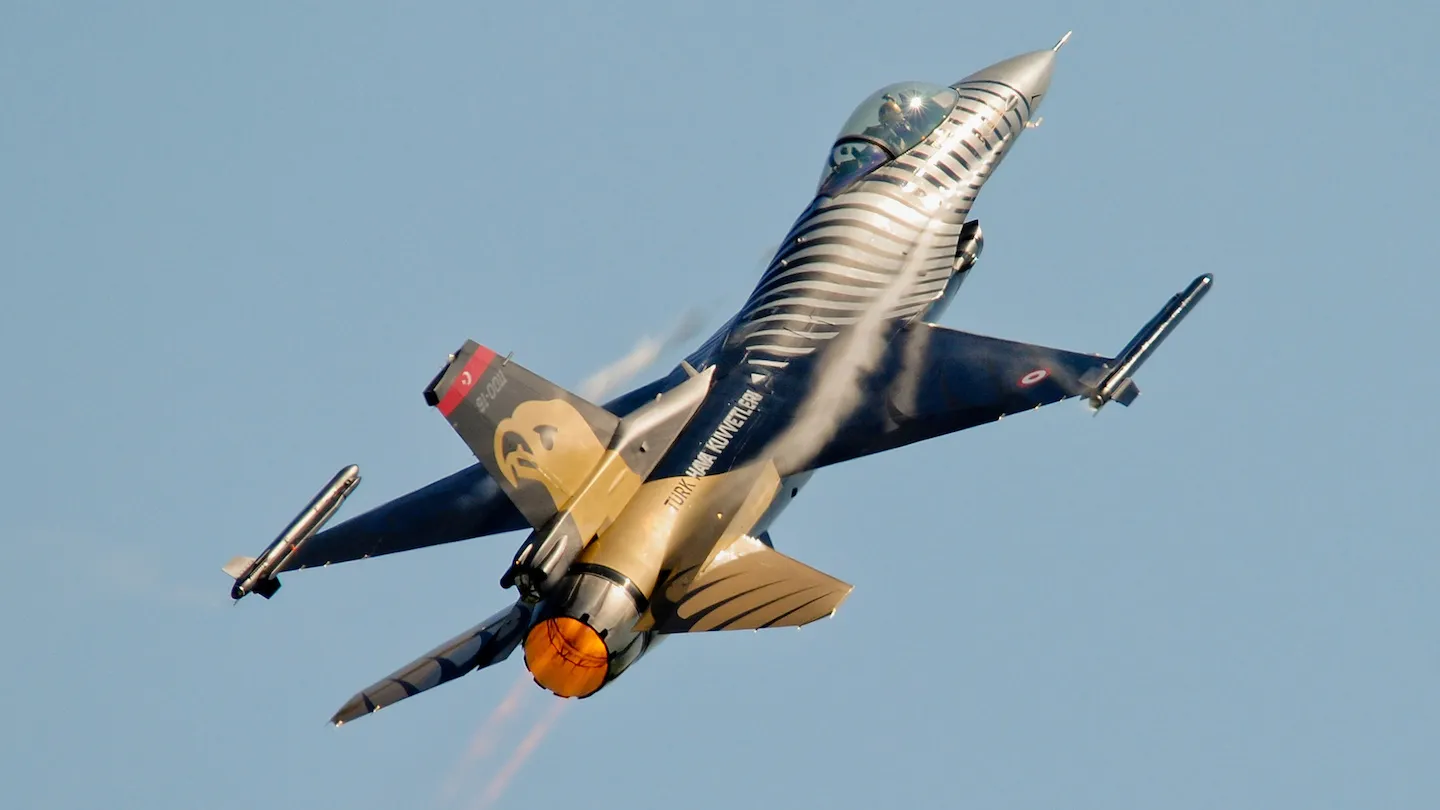
The F-16 story captures Turkey’s military predicament in one aircraft. Turkey operates approximately 240 F-16 Fighting Falcons — the largest F-16 fleet outside the United States. That capability is real, modern, and NATO-interoperable. But it comes with a shadow. Turkey was excluded from the F-35 Joint Strike Fighter program in 2019 after purchasing the Russian S-400 surface-to-air missile system. A $60 billion deal — Turkey’s prospective share of the most advanced fighter program in history — was cancelled because Erdogan refused to abandon the S-400. The S-400 purchase was itself a demonstration of strategic autonomy, the same posture that now shapes Turkey’s Iran war response. The F-35 exclusion is the price Ankara paid for that autonomy, and it remains a source of friction with Washington every time the two governments discuss advanced weapons cooperation.
The S-400 acquisition created a lasting tension with the United States that has never fully resolved. The US argues that operating Russian and American air defense systems in the same military creates intelligence vulnerabilities that compromise NATO’s entire air defense architecture — specifically, that Russian technicians with access to S-400 systems in Turkey could collect data on NATO aircraft signatures. Turkey argues the S-400 is sovereign property and that NATO’s failure to offer comparable systems at acceptable prices drove it to Moscow. Both arguments have merit. The underlying reality is that Turkey made a choice that permanently complicated its relationship with its most important alliance partner, and that relationship now defines the context in which the Iran war plays out.
| Capability | Scale / Number | NATO Ranking | Iran War Relevance |
|---|---|---|---|
| Active military personnel | ~400,000 | 2nd largest (after US) | Border defense capacity, deterrence against spillover |
| F-16 Fighting Falcons | ~240 | Largest fleet outside US | Air defense interception, potential strike capability |
| S-400 air defense system | 1 regiment | Non-NATO system | Point defense for key assets; ongoing NATO tensions |
| Incirlik Air Base | 1 major base | Critical US/NATO strategic asset | Primary pressure card over Washington |
| Bosphorus/Dardanelles control | 2 straits | Unique Montreux Convention authority | Naval access lever for all belligerents |
| Bayraktar TB2 / Akinci drones | Hundreds deployed | Leading NATO-adjacent drone exporter | Border surveillance, anti-infiltration operations |
| Defense budget | ~$40 billion (2025) | Top 5 NATO spenders by absolute value | Sustained independent operations; no US approval needed |
| Defense industry (ROKETSAN, ASELSAN) | Domestic missile / electronics production | Emerging tier-2 defense exporter | Reduces dependency on allied arms transfers |
Turkey’s domestic defense industry — built deliberately over the past fifteen years under programs coordinated by the Presidency of Defence Industries (SSB) — adds a dimension that was not present in any previous Turkey-NATO crisis. Turkey is now a defense exporter, with Bayraktar TB2 drones deployed by Ukraine, Azerbaijan, Ethiopia, Morocco, and various other states. The Akinci heavy armed drone, with longer range and greater payload, has entered service. Turkish defense companies ROKETSAN and ASELSAN produce missiles, radar systems, and electronics that reduce Turkish dependency on allied arms transfers. That export capability gives Ankara independent military standing that does not depend on US weapons sales or alliance good standing. Turkey can arm itself, arm its partners, and sustain extended border operations without American permission in ways it could not a decade ago.
The 500-kilometer Iranian border is also a military calculation of the first order. Iran’s ballistic missile inventory is one of the largest in the region — the same missiles that are currently hitting Saudi Arabia and Gulf targets could reach Turkish cities including Ankara and Istanbul with flight times of under ten minutes. The Turkish military’s active preparation for that scenario — reflected in the NATO intercept and Erdogan’s “all necessary precautions” language — suggests Ankara is treating the conflict’s potential expansion to its own territory as a real operational scenario requiring concrete defense preparations, not merely diplomatic contingency planning.
The Bosphorus Card — Turkey’s Most Powerful Pressure Point
The 1936 Montreux Convention gives Turkey unique legal authority over naval transit through the Bosphorus and Dardanelles straits. In peacetime, commercial vessels of all nations pass freely. In wartime, Turkey can bar warships of belligerent nations from transit. Turkey invoked this authority in February 2022, blocking Russian warships from reinforcing the Black Sea fleet after the Ukraine invasion. The precedent is recent, the legal basis is solid, and the diplomatic weight it creates is enormous relative to Turkey’s size.
The Iran war has not yet required Turkey to make a formal Montreux determination, because neither the United States nor Iran has sought to move major naval assets through the Turkish straits in direct connection with the conflict. But the possibility sits in the background of every diplomatic conversation Fidan is conducting. If the war expands — if Iran attempts to move naval assets toward the Eastern Mediterranean, or if the US seeks to reposition Black Sea-based assets southward through the straits — Turkey’s Montreux authority becomes a decisive card. Both parties to the conflict understand this, which is part of why both parties are treating Turkey with more diplomatic care than its ambiguity might otherwise warrant.
The Bosphorus card has gained additional value as a complement to the Hormuz closure. With Hormuz effectively shut by the insurance-driven withdrawal of tanker coverage, the Bosphorus has become one of the few remaining maritime corridors through which substantial hydrocarbon trade can move. Caspian oil from Azerbaijan and Kazakhstan — routed through Russian and Turkish export terminals — must pass through the Turkish straits to reach Mediterranean and Atlantic markets. Turkey’s ability to facilitate or impede that trade gives it diplomatic weight over energy-importing countries across Europe and Asia that is entirely separate from its Iran relationship. European governments that might otherwise pressure Ankara on its NATO alignment now have a concrete economic interest in maintaining good relations with Turkey.
The emergency rerouting of Saudi Aramco shipments around the Arabian Peninsula, bypassing Hormuz through the Red Sea and around Africa, has placed additional premium on any functional maritime corridor that continues to operate normally. Turkey’s straits cannot substitute for Hormuz — they carry different types of trade from different producing regions — but they demonstrate the general principle that whoever controls maritime chokepoints controls the conversation in a world where the primary chokepoint is closed. Erdogan, who has made chokepoint diplomacy a signature of his foreign policy across multiple conflicts, understands this dynamic better than any current leader who is discussing the crisis.
Russia’s position adds a further complication to the Bosphorus calculus. Russia uses the Turkish straits for commercial shipping from its Black Sea ports and has a direct economic interest in their remaining open regardless of the political context. Moscow has been making public statements of restraint about the Iran war that partly reflect this interest. If Turkey were to tighten Bosphorus access as part of an anti-Iran posture, it would incidentally damage Russian economic interests. If Turkey were to use Bosphorus access as pressure against the West, it would strengthen Moscow’s relative position in the Black Sea. The geometry of Bosphorus politics runs in multiple directions simultaneously, which is precisely why Turkey’s control of the straits is such a durable and flexible source of diplomatic power — it operates across all alliance lines.
The silence of Russia and China on the Iran conflict has been notable and has indirectly benefited Turkey’s Bosphorus position. Neither Moscow nor Beijing has openly supported Iran’s military retaliation, which means Turkey’s Bosphorus neutrality is not being read as pro-Russian or pro-Chinese accommodation. It is simply Turkish — a position that both the Western alliance and the emerging non-Western bloc can live with, even if neither particularly wants it.
Is Turkey Building a Third Path Between NATO and Tehran?
Turkey has established itself as the primary diplomatic back-channel between the warring parties. Fidan has traveled to Washington, Tehran, Riyadh, and other Gulf capitals. Turkey’s position as a country with credible relationships on multiple sides makes it the only major power capable of carrying messages that both parties will actually take seriously — not just receive politely. This is not an accident. It is the product of a decade of deliberate relationship maintenance that Erdogan pursued precisely because he anticipated moments like this one, when Turkey’s indispensability as a mediator would translate into concrete political and economic benefits.
The third path has specific operational content that distinguishes it from mere neutrality. Turkey has allowed humanitarian corridors along its border with Iran while blocking military logistics. It has continued commercial gas imports from Iran — because halting them would constitute an act of economic warfare with immediate domestic energy consequences — while denying the US offensive military access. It has condemned Iranian strikes on civilian targets while also condemning US regime-change rhetoric. Each of these positions is simultaneously coherent and infuriating to every party in the conflict, which is precisely the point. Turkey is maximizing its exposure to both sides while minimizing its commitment to either.
The humanitarian corridor dimension is significant and systematically underreported in Western coverage of the crisis. Iranian civilians are already fleeing to Turkey, according to NPR’s coverage of the border region. Turkey’s three-tier contingency plan for managing a refugee surge reflects a determination to maintain functional border infrastructure even as military movement is restricted. That combination — open to refugees, closed to military — is a third-path policy expressed in physical border management. It signals to Tehran that Turkey is not an enemy (it is accepting Iranian civilians seeking safety) while signaling to NATO that it is not a conduit for Iranian military operations or weapons flows.
Turkey’s refusal to grant airspace access while quietly allowing humanitarian corridors represents a deliberate third path that strengthens Ankara’s position regardless of which side prevails in the Iran war.
Editorial assessment, March 2026
Pakistan faces a structurally similar dilemma — a Muslim-majority country with deep ties to both Gulf Arab states and Iran, caught between its economic dependence on Gulf remittances and its Iranian border realities. Islamabad’s impossible choice and Ankara’s impossible choice share a family resemblance, though Turkey’s NATO membership and military weight give it far more capacity to sustain ambiguity over a prolonged period. Pakistan has fewer cards to play and less institutional cover for its hedging. Islamabad is genuinely trapped; Ankara is positioning.
The silence of Russia and China creates additional space for Turkey’s third path. Both Moscow and Beijing have refrained from openly supporting Iran’s military campaign, which removes the risk that Turkey’s neutrality would be read as alignment with a Sino-Russian bloc against the West. If Russia were actively supporting Iran, Turkey’s refusal to grant NATO military access would look like complicity in Iranian aggression. With Russia also hedging, Turkey’s position is normalized as part of a broader pattern of non-Western restraint rather than as a distinctive pro-Iran stance. The multilateral hedging of the non-Western world paradoxically makes Turkey’s bilateral hedging more sustainable.

What Does the Iran War Mean for Turkey’s Kurdish Question?
The Kurdish question is the dimension of the Iran war that receives the least international attention and carries the most long-term consequence for Turkish domestic stability. Iran and Turkey share a complicated relationship with their respective Kurdish populations, and that relationship has historically been weaponized — each country has supported Kurdish groups that destabilize the other when the bilateral relationship deteriorates. The Iran war has introduced a new level of uncertainty into that dynamic that Ankara is managing with genuine strategic concern.
Iran-backed Kurdish networks, operating primarily in northern Iraq and Syria, have been part of the broader Iranian proxy ecosystem that US and Israeli strikes are designed to dismantle. That ecosystem is now under severe pressure. The disruption of Iranian command and control, the killing of Khamenei, and the operational chaos created by the wider military campaign have created unpredictable dynamics among Kurdish groups that Ankara is watching with intense concern. Kurdish factions that were previously coordinated by Iranian Revolutionary Guard Corps officers may now be operating without strategic guidance, which could mean anything from reduced activity to opportunistic territorial expansion to retaliatory attacks on Turkish targets.
Turkey has been conducting military operations against the PKK (Kurdistan Workers’ Party) in northern Iraq and Syria under operations including Pençe-Kartal, Pençe-Simsek, and various follow-on campaigns. Those operations have occasionally overlapped with Iranian interests in complex ways — Iran has at times provided intelligence to Turkish forces about PKK movements, and Turkey has occasionally tolerated Iranian influence in northern Iraq in exchange for Iranian cooperation on Kurdish containment. The war disrupts this tacit arrangement. If Iranian state capacity degrades significantly, the coordinated suppression of Kurdish armed groups across the Iraq-Syria-Turkey-Iran quadrant becomes harder to maintain without a new bilateral framework.
Turkey’s military operations in northern Syria — Operation Olive Branch in 2018, Operation Peace Spring in 2019, and subsequent campaigns — established a significant Turkish military presence along the Syrian border. That presence positions Turkey to intervene rapidly if Kurdish groups attempt to exploit the war’s chaos to expand their territorial control. The Turkish military maintains forward operating bases in northern Syria and northern Iraq from which it can conduct rapid responses. Erdogan’s “all necessary precautions” language, in its fullest reading, may refer to this contingency as much as to the threat of Iranian missiles targeting Turkish cities.
The Syrian dimension adds another layer of complexity. Turkey’s relationship with the post-Assad Syrian government — which came to power partly through Turkish-backed rebel groups — gives Ankara influence in the territory through which the March 4 ballistic missile transited. Syrian airspace was the corridor the missile used after leaving Iraqi airspace. Turkey’s influence in Damascus is potentially relevant to whether that corridor remains open for future Iranian missiles, but exercising it would require a level of public diplomatic engagement with Damascus that Ankara has so far avoided. The new Syrian government is itself still consolidating power and has limited ability to control its airspace against advanced ballistic threats even if it wanted to.
The domestic political consequence of the Kurdish question is also worth noting. Turkey’s main Kurdish political movement — represented by the DEM Party (previously HDP) — has historically been associated with positions that are skeptical of Turkish military operations and more sympathetic to Iran’s geopolitical position than mainstream Turkish parties. That creates a domestic political dynamic in which Erdogan must balance his response to the Iran war against the political messaging it sends to Kurdish voters, who constitute roughly 15-20 percent of Turkey’s electorate and whose support for Erdogan’s coalition has been variable.
The Ankara Calculus — A Decision Framework
Five specific policy choices define Turkey’s current strategic options. Each carries distinct risks and benefits across multiple dimensions that Ankara’s strategic planners are weighing in real time, without the luxury of perfect information or unlimited decision time. The framework below represents the tradeoffs as they appear from the inside of Erdogan’s foreign policy architecture.
| Policy Choice | Risk to NATO Standing | Risk to Iran Relationship | Impact on Saudi Relations | Domestic Political Cost | Strategic Benefit |
|---|---|---|---|---|---|
| Deny US airspace / mediate actively (current posture) | Medium — friction but within alliance precedent norms | Low — signals Turkish non-hostility and good faith | Neutral to positive — Riyadh values ceasefire pathway | Low — popular with all domestic constituencies | Very High — preserves mediator role, Iran relationship, and energy flows |
| Grant US full airspace and basing access | Low — strengthens Washington relationship | Very High — Iran views Turkey as active co-belligerent | Positive — aligns Turkey with Gulf coalition | Very High — alienates Islamist base, Kurdish voters | Low — Turkey becomes another US base and loses all mediator utility |
| Invoke NATO Article 5 against Iran | Low — asserts alliance rights | Very High — triggers formal military confrontation | Positive — demonstrates anti-Iran alignment | High — escalation risk deeply unpopular; draft fears | Low — alliance consensus fractures; Turkey loses control of response |
| Halt Iranian gas imports before contract expiry | Low — strengthens Western alignment optics | High — economic warfare signal with no offsetting benefit | Positive — signals Gulf solidarity | Very High — energy costs spike; domestic supply disruption in winter | Very Low — contract expires July 31 regardless; no strategic gain |
| Close Bosphorus to US or NATO naval assets | Very High — triggers alliance crisis at existential level | Low — signals accommodation of anti-Western posture | Negative — undermines anti-Iran military coalition | Medium — nationalist wing supports; NATO wing and military oppose | Very Low — burns maximum pressure card for minimum diplomatic return |
| Formally join US-Israeli coalition against Iran | Very Low — maximum alliance standing | Very High — permanent rupture with Tehran | Positive — full alignment with Gulf states | Very High — potential civil unrest; Kurdish mobilization risk | Low — Turkey gains nothing NATO has not already committed; loses all diplomatic room |
The matrix reveals why Turkey’s current posture — denying US airspace while pursuing active diplomatic mediation — dominates across most dimensions. It is the only combination that simultaneously preserves the mediator role, keeps domestic politics manageable, avoids triggering an energy crisis, and prevents Turkey from being drawn into direct military confrontation. The costs are real: friction with Washington, incomplete alignment with the Gulf coalition, and the constant risk that a stray missile or an Iranian miscalculation forces a crisis that cannot be managed through ambiguity alone. But those costs are demonstrably lower than every alternative the matrix presents.
The one dimension where the current posture carries significant and growing risk is the NATO relationship. If Washington decides that Turkey’s airspace denial is a serious enough defection to warrant consequences — restricted future weapons transfers, exclusion from sensitive planning processes, pressure on Turkish access to IMF standby facilities — Erdogan’s balancing act becomes much harder to sustain. So far, the signals from Washington suggest irritation rather than strategic rupture. The Trump administration’s transactional approach to alliance management means it is likely to tolerate Turkish defection on airspace access as long as Incirlik remains operationally functional and Turkey continues contributing to NATO’s eastern flank deterrence against Russia.
The matrix also shows that the worst options are the maximalist ones on both sides. Formally joining the coalition against Iran or formally blocking NATO in support of Iran both produce very low strategic benefit while creating very high costs on multiple dimensions. Turkey’s interest lies in the middle ground — which happens to be exactly where Erdogan has positioned himself. That alignment between strategic logic and current policy is not a coincidence.
Why the “Turkey Must Choose” Narrative Is Wrong
The dominant Western media framing of Turkey’s position holds that Erdogan must eventually pick a side — that the pressures of the Iran war will force a binary choice between NATO alignment and accommodation of Tehran. This framing misunderstands both Turkish strategic culture and the specific incentive structure the war has created. The evidence points in the opposite direction. Turkey has already made its choice, and the choice is neither side.
The “must choose” argument rests on the premise that binary alignment is the natural equilibrium of Middle Eastern geopolitics, and that Turkey’s ambiguity is a temporary holding pattern rather than a stable strategy. But Turkey’s behavior since 2016 tells a different story. Ankara maintained working relationships with Russia while remaining in NATO. It purchased the S-400 while operating F-16s. It negotiated with Assad while supporting opposition groups in Syria. It sustained relations with Hamas while simultaneously normalizing with Israel in 2022. Ankara has refined strategic ambiguity into a durable foreign policy doctrine, not a stopgap position that eventually collapses under pressure.
The structural case for the third path is stronger in 2026 than it was at any previous point. Turkey’s energy diversification trajectory means its dependency on Iran will naturally dissolve over the next two years regardless of the war’s outcome. The Sakarya field will replace Iranian gas volumes by 2028. LNG deals with ExxonMobil and Shell are already signed and cannot be cancelled for geopolitical reasons. Turkey does not need to pay a political price to exit the Iranian energy relationship because the exit is happening on its own commercial schedule. This means Ankara can afford to be politically less accommodating to Tehran without triggering a formal break — the gas dependency that gave Iran its residual hold over Turkish behavior is dissolving without anyone having to make a deliberate decision to end it.
The conventional wisdom holds that Turkey must choose between NATO and Iran. The evidence suggests Ankara has already chosen — and the choice is neither, deliberately and with full strategic intent.
Editorial assessment, March 2026
On the NATO side, the “must choose” argument assumes that continued Turkish airspace denial constitutes a serious defection from alliance obligations. But NATO’s own response to the March 4 missile intercept — Secretary-General Rutte explicitly stating that nobody was talking about Article 5 — demonstrates that the alliance itself is not demanding a Turkish choice. NATO leadership understands that forcing Turkey to fully align against Iran would eliminate Ankara’s mediating function without providing meaningful military benefit, since US forces have alternative basing arrangements across the region including in Qatar, Bahrain, the UAE, and Jordan. The marginal military value of Turkish airspace to the US-Israeli campaign does not justify the diplomatic cost of forcing Turkey’s hand.
The Khalid bin Salman dimension of the Saudi war effort reinforces this reading. Saudi Defense Minister Khalid bin Salman has been coordinating the military campaign against Iranian forces with professional precision. Saudi Arabia has explicitly expressed, through multiple back-channels, a preference for a negotiated outcome over a prolonged military campaign that risks further civilian casualties and broader regional destabilization. A Turkey that is actively mediating and carrying Saudi messages to Tehran is more valuable to Riyadh than a Turkey that has formally declared itself a co-belligerent and lost its ability to conduct back-channel diplomacy. The Saudis, in other words, are among the parties who benefit from Turkey’s refusal to pick a side.
The historical record provides an additional data point that the “must choose” narrative ignores. Turkey has previously used strategic ambiguity to exit multiple crises with its relationships largely intact and often strengthened. After the 2016 coup attempt — which Erdogan blamed partly on US-connected actors associated with the Gulen movement — Turkey temporarily restricted Incirlik access and explored alternative alignments with Russia, but ultimately remained in NATO and restored the base to full operation. After the S-400 crisis, Turkey absorbed the F-35 exclusion, rebuilt its defense relationship with the United States through the eventual F-16 upgrade approval, and continued functioning as a NATO member. The pattern is consistent: Turkey provokes, absorbs the consequences, and stabilizes at a new equilibrium that is somewhat more autonomous than the previous one. The Iran war is likely to produce the same arc, at a larger scale and with higher stakes.
The counterargument worth taking seriously is that the scale of this crisis genuinely differs from previous episodes. The killing of Khamenei, the effective closure of Hormuz, the direct impact on Turkish airspace, the potential for an Iranian refugee exodus into Turkey — these are not routine regional turbulences that strategic ambiguity can absorb without cost. They represent a structural transformation of the Middle Eastern order that will outlast any particular Turkish diplomatic initiative. Turkey will emerge from this crisis in a fundamentally different regional environment regardless of its choices, and the “neither side” strategy may face genuine strain in a transformed regional order where Iran is either militarily defeated or has permanently damaged Turkey’s economic infrastructure in retaliation for its perceived alignment with the Western bloc.
That scenario is real but not the base case. Iran’s strategic logic — even under the extreme stress of Khamenei’s death, the degradation of its military capability, and the ongoing campaign against its proxy networks — has consistently prioritized deterrence over suicidal escalation. Tehran has every incentive to keep Turkey neutral. Attacking Turkey, or allowing attacks on Turkish territory or infrastructure through Iranian proxies, would be the fastest possible way to convert a potential mediator into an active adversary. The March 4 denial of having fired the missile that entered Turkish airspace was Iran’s clearest signal that it understands this dynamic and intends to preserve it.
Frequently Asked Questions
The following questions address the most frequently searched aspects of Turkey’s position in the Iran war, reflecting the policy debates dominating regional security discussions as of early March 2026.
Is Turkey helping Iran in the war?
Turkey is not helping Iran prosecute its military campaign. Ankara has denied US airspace access for offensive operations but has not provided Iran with military logistics, weapons, or intelligence support. Turkey continues importing Iranian natural gas under a contract predating the war — a commercial obligation rather than a political choice. The diplomatic activity Fidan is conducting serves Turkish interests in achieving a ceasefire, not Iranian interests in military victory. Turkey’s public condemnation of Iranian strikes on Arab civilian targets has been explicit, substantive, and consistent from the first days of the conflict.
Could Turkey leave NATO over the Iran war?
Turkey leaving NATO is not a realistic near-term scenario regardless of how the Iran war develops. NATO membership provides Turkey with Article 5 security guarantees, access to allied intelligence networks, and the political credibility of Western institutional alignment — all of which have tangible strategic and economic value that no alternative arrangement could replicate. Erdogan has used the threat of reduced NATO cooperation as a bargaining instrument many times without executing on the threat. The Iran war has created the most serious stress on the alliance relationship in recent memory but has not altered the fundamental cost-benefit calculus that makes NATO membership valuable to Ankara.
Is Turkey going to close its border with Iran completely?
Turkey has suspended day-trip civilian crossings since March 2, 2026, while maintaining commercial cargo flows under controlled inspection conditions. A complete closure is possible if the security situation deteriorates significantly or if Iranian refugee flows reach scales that overwhelm the Interior Ministry’s contingency management plans. Turkey and Iran share a 500-kilometer border running through mountainous terrain that is practically impossible to hermetically seal, and Turkey has strong economic reasons to keep commercial and humanitarian corridors functional. The three-tier contingency plan focuses on managing flows on the Iranian side before they reach Turkish territory.
What happens to Turkish energy supplies if the Iran war continues?
Turkey’s Iranian gas contract expires July 31, 2026, and negotiations to extend it had already failed before the war began. The war accelerates Turkey’s transition to Western LNG and domestic Sakarya field production. In the short term, a physical disruption to Iranian pipeline infrastructure from missile strikes would create immediate supply stress during late winter. Turkey’s LNG import capacity and Azerbaijani pipeline flows through TANAP provide backup, but at higher cost. By 2028, Sakarya field domestic production is projected to reach 14.6 billion cubic meters annually, effectively replacing Iranian import volumes entirely without requiring a political decision to end the relationship.
Did the Iranian missile over Turkey trigger NATO Article 5?
The Iranian ballistic missile intercepted over Turkish airspace on March 4, 2026 did not trigger Article 5. NATO Secretary-General Mark Rutte explicitly stated that Article 5 was not under discussion, and US Defense Secretary Pete Hegseth confirmed there was no expectation it would be invoked. Erdogan chose not to invoke it, calculating that maintaining Turkey’s mediator role was more valuable than forcing an alliance-wide collective response to a missile Iran formally denied having fired. The incident remains legally ambiguous — satisfying the technical threshold for an armed attack — but politically managed through mutual agreement to treat it as a spillover incident.
Is Turkey’s ceasefire effort credible?
Turkey’s ceasefire diplomacy has more structural credibility than any other current mediating initiative. Ankara maintains working relationships with Washington, Tehran, Riyadh, and other Gulf capitals simultaneously — a diplomatic combination that no other single actor in the world currently possesses. Fidan’s active shuttle diplomacy reflects genuine strategic interest: Turkey bears direct economic costs from the war through surging oil prices and potential Iranian gas supply disruption, and faces a real humanitarian crisis on its eastern border. The mediation is not altruistic diplomacy. It is self-interest expressed through diplomatic channels, which makes it more durable than goodwill-based initiatives.
Turkey’s position as of March 6, 2026 represents a high-wire act with no obvious exit ramp and no comfortable landing zone. Every path forward carries costs that Erdogan is managing in real time, with incomplete information, in a conflict that began six days ago and has already produced a missile interception over Turkish soil, a border closure, an energy procurement emergency, and a ceasefire initiative that has not yet produced a ceasefire. The strategic coherence of Ankara’s response — denying airspace, accepting refugees, condemning both sides selectively, mediating actively, keeping energy flows intact — reflects decades of institutional learning about how to survive as a medium power in a neighborhood of relentless great power collisions. Whether that learning is sufficient for what the Iran war has set in motion remains the defining foreign policy question for Turkey in 2026 and beyond.
Since this analysis was published, the situation has escalated significantly. On March 13, sirens sounded at Incirlik Air Base after a third Iranian missile approached the facility housing 50 American nuclear weapons, raising the stakes for Turkey and the entire NATO alliance.