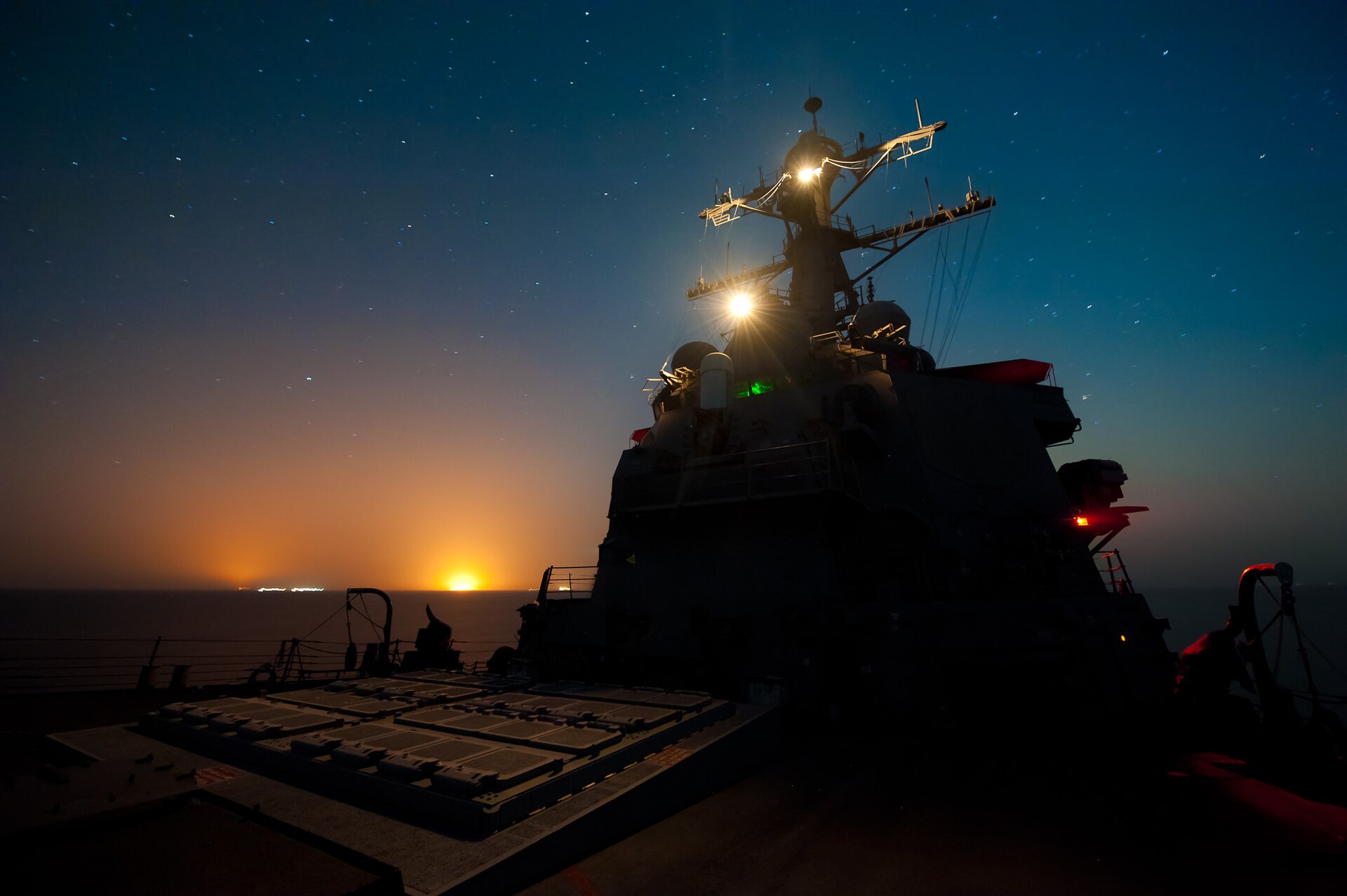

MANAMA — The United States military destroyed 16 Iranian minelaying vessels near the Strait of Hormuz on Tuesday, U.S. Central Command confirmed, marking the most significant naval engagement of the 11-day war and escalating the battle for the world’s most critical energy chokepoint. The strikes came hours after CNN and CBS reported that Iran had begun laying mines in the narrow waterway through which roughly 20 percent of global oil consumption transits each day, a development that threatens to extend the Hormuz crisis well beyond the current conflict and complicates Saudi Arabia’s efforts to keep crude flowing to Asian and European buyers.
CENTCOM released video footage of the operation, stating that U.S. forces “eliminated multiple Iranian naval vessels, including 16 minelayers near the Strait of Hormuz” during operations on March 10. A senior U.S. official told Axios the strikes were a preemptive measure based on intelligence about Iran’s operational plans. President Donald Trump, speaking from the White House, said ten vessels had been destroyed “with more to follow” before the Pentagon confirmed the higher figure of 16.
For Saudi Arabia, the mine threat represents a more insidious danger than the missile and drone barrages that have dominated the first 11 days of the conflict. Mines are cheap, indiscriminate, and extraordinarily difficult to clear. Iran is estimated to possess a stockpile of up to 6,000 sea mines, according to the Strauss Center for International Security, and even a few dozen scattered across the Strait’s shipping lanes can shut commercial traffic for weeks or months. The Kingdom’s East-West pipeline to Yanbu offers a partial bypass, but its effective capacity of roughly 4 million barrels per day falls far short of the 7 million barrels Saudi Arabia typically exports through the Gulf.
Table of Contents
- What Happened in the Strait of Hormuz on March 10?
- How Many Mines Has Iran Laid in the Strait of Hormuz?
- Trump Threatens Iran With Unprecedented Military Consequences
- The 1988 Precedent That Haunts the Persian Gulf
- What Does the Mine Threat Mean for Saudi Oil Exports?
- Shipping Insurance Rates and the Cost of War
- Can the U.S. Navy Clear the Strait Fast Enough?
- Iran’s Mine Arsenal and Remaining Capability
- Frequently Asked Questions
What Happened in the Strait of Hormuz on March 10?
U.S. Central Command destroyed 16 Iranian minelaying vessels near the Strait of Hormuz on Tuesday, March 10, 2026, in what military officials described as a preemptive operation to prevent Iran from deploying additional mines in the world’s most important maritime energy corridor. The strikes targeted small craft capable of carrying two to three mines each, according to intelligence assessments cited by U.S. officials.
The operation unfolded against a backdrop of rapidly deteriorating maritime security in the Persian Gulf. CENTCOM’s statement, posted alongside video of the strikes, confirmed that U.S. forces had “eliminated multiple Iranian naval vessels, including 16 minelayers.” Defense Secretary Pete Hegseth, who earlier that morning had warned that Tuesday would be “the most intense day of strikes inside Iran,” called the minelaying vessel destruction a critical component of the broader campaign to degrade Tehran’s ability to disrupt global energy supplies.
Joint Chiefs Chairman Dan Caine told reporters that U.S. forces had struck more than 5,000 targets across Iran since the campaign began, and that the next phase of Operation Epic Fury would focus on Iran’s military-industrial complex, including facilities used to produce drones, missiles, and naval mines. The Pentagon reported that U.S. strikes have reduced Iranian ballistic missile attacks by approximately 90 percent and drone launches by roughly 83 percent compared to the opening days of the conflict, according to CENTCOM data released on March 10.
The Middle East briefing 3,000+ readers start their day with.
One email. Every weekday morning. Free.
The naval engagement was the most direct confrontation between U.S. and Iranian forces in the waterway since the 1988 Tanker War, when the U.S. Navy launched Operation Praying Mantis after the frigate USS Samuel B. Roberts struck an Iranian mine. That operation destroyed or damaged half of Iran’s operational navy in a single day. Even with the mine threat reduced, however, the maritime insurance crisis continues to keep commercial shipping out of the Gulf. The IRGC demonstrated why on March 11 when it attacked three cargo ships attempting to transit the Strait of Hormuz, striking the Mayuree Naree, One Majesty, and Star Gwyneth with projectiles and leaving crew members unaccounted for.
How Many Mines Has Iran Laid in the Strait of Hormuz?
Iran has deployed “a few dozen” naval mines in the Strait of Hormuz as of March 10, 2026, according to CNN, citing multiple U.S. intelligence sources. CBS News independently confirmed the assessment, adding that Iran’s Islamic Revolutionary Guard Corps Navy and the regular Iranian navy are both involved in the mining operation. The mining is not yet extensive, but U.S. officials warned that Iran retains 80 to 90 percent of its small boats and minelaying capability, meaning hundreds of additional mines could be deployed rapidly.
The mines reportedly include a mix of contact mines, which detonate when struck by a vessel’s hull, and more sophisticated influence mines triggered by magnetic, acoustic, or pressure signatures. Iran’s mine inventory is estimated at between 2,000 and 6,000 devices, according to the Strauss Center for International Security and Law at the University of Texas at Austin. Many were produced domestically or acquired from China and Russia over several decades.
Even a small number of mines can paralyze commercial shipping. During the 1980s Tanker War, fewer than 200 Iranian mines caused significant disruption to Persian Gulf commerce, damaged multiple tankers, and struck the USS Samuel B. Roberts. The psychological effect of mines extends far beyond their physical destruction. Once mines are confirmed in a waterway, insurers raise premiums, ship operators reroute or refuse to transit, and the effective closure of the strait becomes self-reinforcing even without additional mine deployment.
| Mine Type | Estimated Quantity | Origin | Capability |
|---|---|---|---|
| Contact mines (moored) | 1,500-2,500 | Iran, China, Russia | Detonates on hull contact, effective in shallow waters |
| Influence mines (bottom) | 500-1,000 | Iran, Russia | Triggered by magnetic/acoustic/pressure signatures |
| Limpet mines (diver-placed) | Unknown | Iran | Attached directly to vessel hulls by IRGC frogmen |
| EM-52 rocket-propelled mines | Unknown | China | Fires upward from seabed when ship passes overhead |
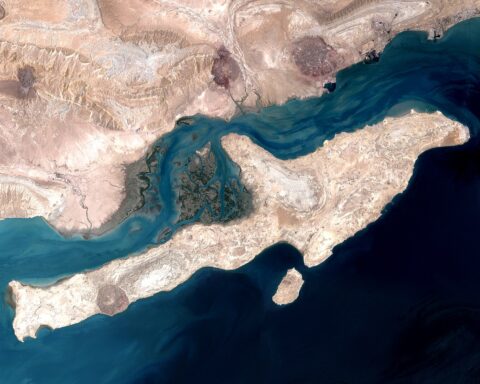
The Strait of Hormuz is roughly 33 kilometres wide at its narrowest point, but the navigable shipping lanes are far narrower. Inbound and outbound traffic lanes are each approximately 3 kilometres wide, separated by a 3-kilometre buffer zone. This geographic bottleneck makes the strait uniquely vulnerable to mine warfare. Approximately 100 vessels transit the corridor daily, according to the U.S. Energy Information Administration, carrying roughly 17 million barrels of crude oil and 4 billion cubic feet of liquefied natural gas.
Trump Threatens Iran With Unprecedented Military Consequences
President Trump issued his most forceful warning to Tehran yet on Tuesday, threatening “military consequences at a level never seen before” if Iran did not immediately remove mines from the Strait of Hormuz. “If for any reason mines were placed, and they are not removed forthwith, the military consequences to Iran will be at a level never seen before,” Trump said in a statement released through the White House.
In separate remarks, Trump warned that the United States would hit Iran “twenty times harder” than it already has if Tehran persisted in blocking oil flows. “We will take out easily destroyable targets that will make it virtually impossible for Iran to ever be built back as a nation again,” he said, according to Time magazine.
Iran’s security chief Ali Larijani rejected the ultimatum, warning Trump to be careful “not to be eliminated” and declaring that the Islamic Republic was not afraid of his “empty threats.” Tehran has vowed that “not one liter of oil” will leave the Middle East through the Strait of Hormuz while U.S. and Israeli attacks on Iran continue, according to state media reports. The threat, if carried out fully, would shut off not just Iranian exports but the entire flow of Gulf crude, devastating Asian economies dependent on Gulf oil.
The rhetorical escalation reflected a war entering its most dangerous phase. While U.S. airstrikes have degraded Iran’s missile and drone capabilities significantly, the mine threat operates on a different timeline. Mines do not require sophisticated guidance systems, satellite communications, or launchers. A small fishing boat with a few crew members can deploy them under cover of darkness, making them nearly impossible to prevent entirely through air power alone.
The 1988 Precedent That Haunts the Persian Gulf
The current mine crisis echoes the 1987-1988 Tanker War, when Iran mined the Persian Gulf’s shipping lanes during the Iran-Iraq War and the United States responded with the largest surface naval engagement since World War II. That precedent offers both reassurance and warning for Saudi Arabia and its Gulf neighbours.
On April 14, 1988, the guided-missile frigate USS Samuel B. Roberts struck an Iranian M-08 contact mine while on patrol in the central Persian Gulf. The blast blew a 15-foot hole in the ship’s hull, flooded the engine room, and cracked the keel. The crew fought fires and flooding for five hours to save the vessel. Four days later, on April 18, 1988, the U.S. Navy launched Operation Praying Mantis, sinking one Iranian frigate, severely damaging another, and destroying two armed oil platforms and multiple small boats. The operation destroyed or damaged roughly half of Iran’s operational surface fleet in a single day, according to the U.S. Naval History and Heritage Command.

The parallels to the current situation are striking. Iran used small speedboats and commercial vessels to deploy mines covertly in 1987-1988, just as it is reportedly using small craft today. The mining campaign was cheap and effective, disrupting billions of dollars in commerce with devices that cost a few thousand dollars each. But the U.S. response then was swift and devastating, establishing a deterrent that held for nearly four decades.
The critical difference in 2026 is scale. Iran’s mine stockpile is estimated to be many times larger than the approximately 200 mines it deployed during the Tanker War. Its delivery systems include faster boats, submersible drones, and the option to deploy mines from its broader military infrastructure rather than just naval assets. The Strait itself carries far more traffic and far more economic value than it did in 1988, when global oil markets were less dependent on Gulf crude.
What Does the Mine Threat Mean for Saudi Oil Exports?
The mine threat strikes at the heart of Saudi Arabia’s economic lifeline. The Kingdom exports approximately 7 million barrels of crude oil per day, the majority of which normally transits the Strait of Hormuz from loading terminals at Ras Tanura, Ju’aymah, and other facilities on the Persian Gulf coast. With Ras Tanura already offline following Iranian drone strikes in the opening days of the war, and the Strait now mined, Saudi Arabia faces an unprecedented double disruption to its export infrastructure.
Aramco has activated its East-West pipeline to Yanbu on the Red Sea coast, the Kingdom’s primary bypass route for the Strait of Hormuz. The pipeline stretches 1,200 kilometres across the Arabian Peninsula from the eastern oil fields to King Fahd Industrial Port at Yanbu. Aramco’s chief executive has stated that the system has a theoretical capacity of 7 million barrels per day, according to Argus Media reporting. However, the Yanbu port’s loading infrastructure can effectively handle roughly 4 million barrels per day across its two terminals, creating a significant bottleneck.
| Route | Normal Capacity (bpd) | Current Status | Constraint |
|---|---|---|---|
| Strait of Hormuz (Gulf terminals) | ~7 million | Effectively closed — mines, war risk | Minefield, insurance voided, no tanker traffic |
| East-West Pipeline to Yanbu (Red Sea) | ~4 million (effective) | Operating at maximum | Port loading capacity, pipeline throughput |
| Net export shortfall | ~3 million | Lost capacity | No alternative route available |
The 3-million-barrel daily shortfall represents roughly $270 million per day in lost export revenue at current prices above $90 per barrel, according to OPEC basket pricing data for March 2026. Over a month, that amounts to more than $8 billion in foregone income. The Kingdom’s sovereign wealth fund, the Public Investment Fund, holds over $700 billion in assets, providing a substantial buffer, but the fiscal impact compounds rapidly if the Hormuz blockade persists.
Saudi Arabia has already cut oil output in response to the Hormuz crisis, according to OilPrice.com, as domestic storage reaches capacity with nowhere to ship the crude. The Kingdom’s wartime balance sheet depends on maintaining export volumes even as prices rise. Higher prices with lower volumes can still produce a net revenue decline, particularly when the cost of military operations, air defence replenishment, and economic disruption are factored in.

Shipping Insurance Rates and the Cost of War
The mine reports triggered an immediate and severe response from the global maritime insurance market. War risk premiums for vessels entering the Persian Gulf have surged to 1 percent of a ship’s hull replacement value, renewable every seven days, up from 0.25 percent before the conflict, according to the Insurance Journal and Caixin Global. For a very large crude carrier worth $100 million, the premium for a single week’s transit jumped from approximately $250,000 to $1 million. The crisis prompted Washington to unveil a $20 billion government-backed reinsurance program with Chubb as lead underwriter on March 11.
The International Group of Protection and Indemnity Clubs announced that existing war risk coverage for the Persian Gulf became void at midnight on March 5, 2026, according to Al Jazeera, requiring vessel operators to obtain new special coverage before entering the zone. Several major underwriters have refused to offer any coverage at all, effectively making it uninsurable for some operators to send tankers through the Strait.
Freight rates for very large crude carriers have hit all-time highs, with the benchmark VLCC rate reaching $423,736 per day on March 10, according to CNBC. That figure represents a roughly fivefold increase from pre-war levels. Supertanker rates more broadly have reached approximately $800,000 per day, according to industry data, as the few operators willing to accept the risk demand premium compensation.
The insurance and freight cost increases cascade through the entire global energy supply chain. Even oil that bypasses Hormuz through Saudi Arabia’s Red Sea route faces elevated costs, because the overall reduction in available tanker capacity pushes up charter rates globally. Japanese and South Korean refiners, who import the majority of their crude from the Gulf, face the sharpest cost increases, according to reporting by analysts tracking Asian energy markets.
The sensitivity of oil markets to any development involving Hormuz was starkly illustrated when a false claim by U.S. Energy Secretary Chris Wright about tanker escorts through the strait crashed oil prices by 17 percent within minutes, erasing billions in Saudi revenue before the statement was retracted. The incident underscored how the mine threat and insurance withdrawal have transformed Hormuz into the most volatility-prone variable in global energy pricing.
Can the U.S. Navy Clear the Strait Fast Enough?
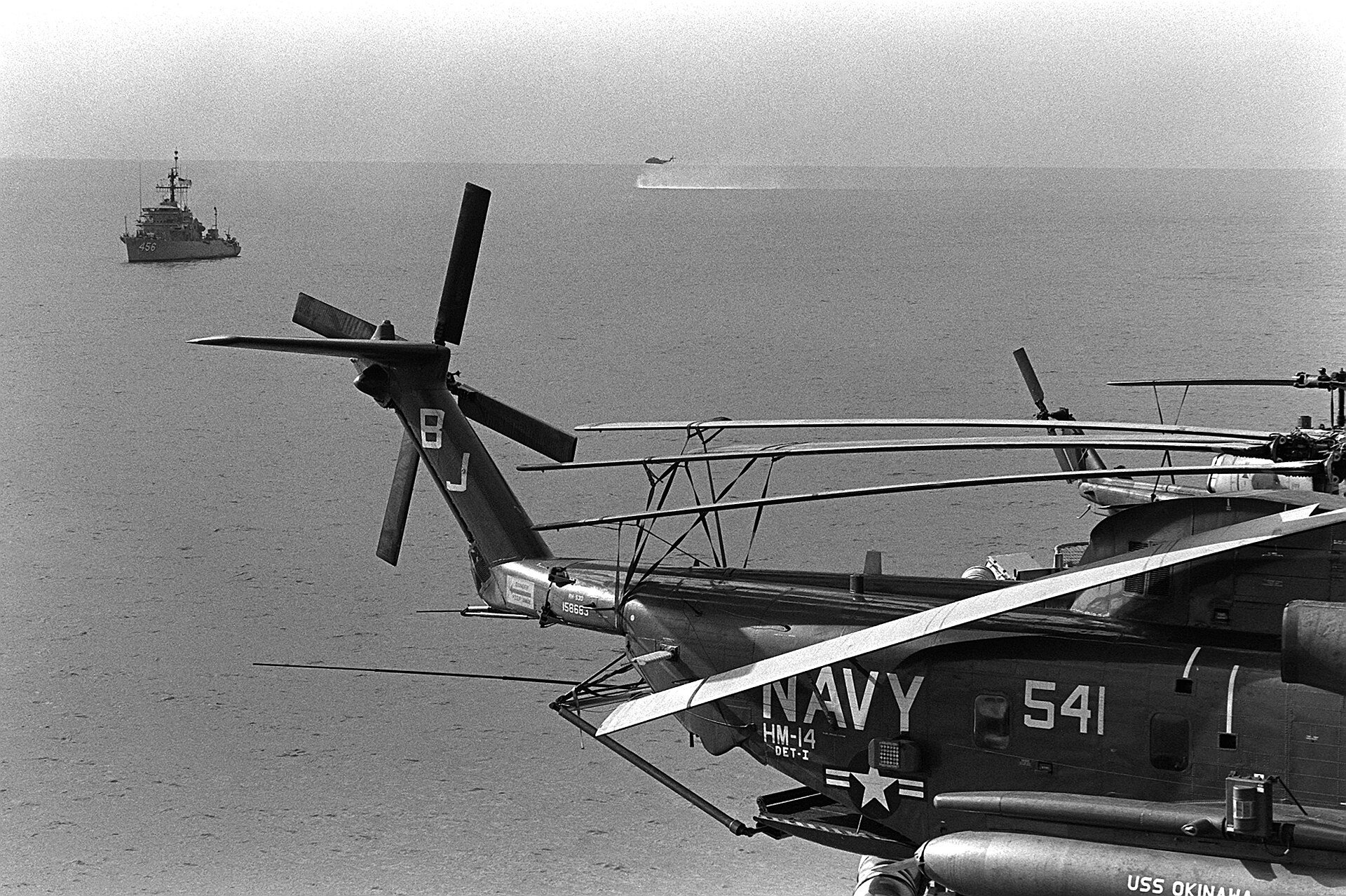
Mine clearance is among the most dangerous and time-consuming operations in naval warfare. The U.S. Navy’s mine countermeasures fleet is based at Naval Support Activity Bahrain, home to the U.S. Fifth Fleet and Destroyer Squadron 50. The fleet includes Avenger-class mine countermeasures ships and MH-53E Sea Dragon helicopters equipped with magnetic and acoustic sweeping gear, along with unmanned underwater vehicles designed to locate and neutralise individual mines.
However, mine countermeasures experts have long warned that the U.S. Navy’s mine warfare capability has atrophied relative to the threat. The Navy operates just 11 Avenger-class ships, several of which have been decommissioned or are unavailable for deployment, according to Navy Times reporting. The service has invested in the Littoral Combat Ship’s mine countermeasures mission package as a replacement, but the system has faced persistent developmental challenges.
Clearing a mined waterway typically proceeds at a rate of a few square kilometres per day under ideal conditions, according to naval mine warfare doctrine. The navigable portion of the Strait of Hormuz covers approximately 200 square kilometres. Even with multiple ships working simultaneously, clearing confirmed mines from the full transit corridor could take weeks to months, depending on the density and sophistication of the mines deployed.
The 1991 Gulf War illustrated the challenge. Iraq deployed approximately 1,300 naval mines in the northern Persian Gulf, and the subsequent clearance operation required six months and the participation of mine countermeasures ships from six nations. Two U.S. Navy ships, the helicopter carrier USS Tripoli and the Aegis cruiser USS Princeton, struck Iraqi mines during the conflict, demonstrating that even modern warships are vulnerable. The broader history of mine warfare in the Gulf suggests that the weapons’ psychological and economic effects far outlast their physical presence.
Iran’s Mine Arsenal and Remaining Capability
Despite the destruction of 16 minelaying vessels, Iran retains the vast majority of its mine warfare capability, according to U.S. intelligence assessments. Iran possesses 80 to 90 percent of its small boats and minelayers, CNN reported, meaning hundreds of additional craft remain available for mine deployment. The vessels destroyed on March 10 represent a fraction of Iran’s total naval mine delivery capacity.
Iran’s mine stockpile includes devices ranging from simple moored contact mines, based on designs dating to World War I, to sophisticated bottom-mounted influence mines that can discriminate between different vessel types based on their magnetic, acoustic, and pressure signatures. The EM-52, a Chinese-designed rocket-propelled mine that fires upward from the seabed when a ship passes overhead, is among the most dangerous weapons in Iran’s inventory. These weapons can be deployed in deeper waters where traditional moored mines are ineffective.
The Islamic Revolutionary Guard Corps Navy, which operates independently from Iran’s conventional navy, has trained extensively in mine warfare and asymmetric naval tactics. IRGC naval forces use fast attack craft, midget submarines, and even modified fishing vessels to deploy mines covertly. The IRGC conducted a large-scale exercise simulating the mining of the Strait of Hormuz in 2024, practicing rapid deployment of hundreds of mines across the waterway’s shipping lanes, according to the U.S. Naval Institute.
| Factor | U.S./Coalition | Iran |
|---|---|---|
| Minelaying vessels destroyed | 16 (CENTCOM confirmed) | Hundreds remaining |
| Mines deployed to date | N/A | ~24-36 (CNN estimate, “a few dozen”) |
| Mine stockpile | N/A | 2,000-6,000 estimated |
| Mine countermeasures ships | 4-6 deployed (Avenger-class) | N/A |
| MCM helicopters | MH-53E Sea Dragons | N/A |
| Clearance rate (est.) | ~2-5 sq km/day | Deployment far faster than clearance |
The asymmetry is stark: a single mine costs as little as $1,500 for a basic contact device, while the cost of finding and neutralising it can exceed $50,000 per mine, according to naval warfare analysts. Iran can deploy mines faster than the U.S. Navy can clear them, creating a persistent threat that air power alone cannot eliminate. This cost disparity mirrors the broader asymmetric challenge facing Saudi Arabia’s air defence network, where $35,000 Iranian drones are intercepted by $4 million Patriot missiles.
CENTCOM spokesman General Dan Caine indicated that U.S. forces would continue to hunt mine storage facilities and minelaying vessels, but acknowledged that completely eliminating the mine threat would require sustained operations. “We are going after Iran’s ability to lay sea mines and build drones,” Caine told reporters, describing the mine warfare campaign as an integral component of the broader effort to degrade Iran’s military infrastructure.
Despite these strikes, the challenge of clearing mines already on the seafloor and reopening the strait to commercial traffic remains the most complex operation of the war, with analysts estimating the process could take weeks to months even after a ceasefire.
Frequently Asked Questions
How many Iranian minelaying vessels did the U.S. destroy?
U.S. Central Command confirmed the destruction of 16 Iranian minelaying vessels near the Strait of Hormuz on March 10, 2026. President Trump initially stated that ten had been destroyed “with more to follow” before the Pentagon confirmed the higher figure. The strikes were described as a preemptive measure based on intelligence about Iran’s plans to mine the Strait.
How many mines has Iran laid in the Strait of Hormuz?
CNN reported on March 10 that Iran has deployed “a few dozen” mines in the Strait of Hormuz, using small craft carrying two to three mines each. The mining is not yet extensive, but Iran retains 80 to 90 percent of its minelaying capability and possesses a stockpile estimated between 2,000 and 6,000 mines, meaning the threat could escalate rapidly.
Can Saudi oil still be exported with mines in the Strait?
Saudi Arabia’s East-West pipeline to the Red Sea port of Yanbu provides an alternative export route that bypasses the Strait of Hormuz. However, Yanbu’s effective loading capacity is approximately 4 million barrels per day, compared to the 7 million barrels Saudi Arabia typically exports. The resulting shortfall of roughly 3 million barrels per day represents significant lost revenue and constrains global oil supply.
What happened the last time Iran mined the Strait of Hormuz?
During the 1987-1988 Tanker War, Iranian mines damaged multiple commercial vessels and struck the USS Samuel B. Roberts. The United States retaliated with Operation Praying Mantis on April 18, 1988, destroying or damaging approximately half of Iran’s operational surface fleet in a single day. The 2026 mine threat is potentially more severe, given Iran’s much larger mine stockpile and more sophisticated delivery systems.
How long would it take to clear mines from the Strait of Hormuz?
Mine clearance in the Strait of Hormuz could take weeks to months depending on the density of mines deployed. The navigable shipping corridor covers approximately 200 square kilometres, and clearance operations typically proceed at 2 to 5 square kilometres per day. During the 1991 Gulf War, clearing approximately 1,300 Iraqi mines from the northern Persian Gulf required six months and the participation of six nations.