
RIYADH — Saudi Arabia and the United Arab Emirates have taken concrete steps toward becoming active participants in the war against Iran, the Wall Street Journal reported on Monday, citing multiple people familiar with the matter. Crown Prince Mohammed bin Salman has granted the United States military access to King Fahd Air Base in the western city of Taif, while Abu Dhabi has shut down every Iranian-run institution in Dubai, including hospitals, schools, and a cultural club that served as a key node in Tehran’s regional influence network. This base access decision represents one dimension of a broader reversal of Saudi Arabia’s fifty-year dependency on Western powers. Granting base access raises complex questions about Saudi Arabia’s legal status under international law, potentially transforming the Kingdom from a neutral state into a co-belligerent.
The moves, reported by Bloomberg and confirmed by multiple Western and Gulf officials, mark the most significant escalation in the Gulf states’ posture since the US-Israeli war on Iran began on 28 February. A source close to Saudi decision-making told the Journal that Mohammed bin Salman is “close to a decision to join the attacks,” adding that “it is only a matter of time before the kingdom enters the war.” Neither Riyadh nor Abu Dhabi has deployed military forces in an offensive role, but the trajectory has shifted from reluctant hosts to something approaching co-belligerents. The New York Times subsequently reported that MBS privately urged Trump to deploy ground troops inside Iran and seize energy infrastructure for regime change.
The Gulf calculus was further complicated by Tehran’s appointment of IRGC veteran Mohammad Bagher Zolghadr as the new head of its Supreme National Security Council, replacing the assassinated Ali Larijani and signalling that Iran was consolidating its wartime command rather than preparing for an off-ramp.
Table of Contents
- What Did the Wall Street Journal Report?
- Why King Fahd Air Base Changes the Calculus
- UAE Shuts Down Iranian Institutions Across Dubai
- How Close Is MBS to Ordering Saudi Forces Into the Fight?
- Prince Sultan Air Base and the Cost of Staying Passive
- What Military Assets Can Saudi Arabia and the UAE Bring?
- The Diplomatic Escalation Leading to This Moment
- What Are the Risks of Becoming Co-Belligerents?
-
The escalation continued on March 24, when Iran fired on five nations simultaneously despite Trump claiming peace talks were progressing, further complicating the question of whether Saudi Arabia and the UAE would formally enter the war.
Frequently Asked Questions
What Did the Wall Street Journal Report?
The Wall Street Journal published a detailed account on 24 March 2026 documenting a series of actions by Saudi Arabia and the UAE that bring both nations closer to formal participation in the war against Iran. Bloomberg subsequently confirmed the report and amplified its central finding: the Gulf’s two largest military powers have moved beyond passive support for the US-led campaign and are now preparing for the possibility of direct engagement.
According to the Journal’s reporting, which cited people familiar with the matter, Saudi Arabia agreed to give the US military access to King Fahd Air Base in the western city of Taif. The decision represents a reversal of Riyadh’s earlier position that its bases could not be used for offensive operations against Iran. Separately, the UAE ordered the closure of an Iranian-owned hospital, schools, and a social club in Dubai, removing institutions that served as critical support infrastructure for Tehran’s presence in the Emirates.
The Middle East briefing 3,000+ readers start their day with.
One email. Every weekday morning. Free.
The Journal quoted a source with knowledge of Saudi planning who said Crown Prince Mohammed bin Salman is “close to a decision to join the attacks.” A second source was more direct, telling the paper: “It is only a matter of time before the kingdom enters the war.” Neither Saudi nor Emirati officials commented publicly on the report. Turkey has since launched an intensive diplomatic campaign urging Gulf states not to join the war, with Foreign Minister Fidan touring Riyadh, Doha, and Abu Dhabi.
Anadolu Agency, Turkey’s state news agency, reported that US allies in the Middle East are “edging toward joining” the conflict, framing the developments as potentially signalling the most dramatic expansion of the war since its opening strikes on 28 February. Business Standard and Gulf Insider published similar assessments, noting that the steps fall short of deploying military forces in an offensive capacity but nonetheless represent a qualitative shift in the region’s posture.
Why King Fahd Air Base Changes the Calculus
The decision to open King Fahd Air Base to American forces carries strategic significance that extends beyond the immediate operational advantages. Located in Taif, in the mountainous Hejaz region of western Saudi Arabia, the base sits roughly 1,200 kilometres from the Iranian border, placing it well outside the effective range of most Iranian ballistic missiles and substantially reducing the vulnerability that has plagued US operations at Prince Sultan Air Base near Al Kharj.
Prince Sultan Air Base, the primary American military facility in Saudi Arabia, has absorbed sustained Iranian bombardment since the war began. An Iranian missile strike damaged five US Air Force KC-135 Stratotanker refueling aircraft on the flight line, according to the Military Times. Sgt. Benjamin N. Pennington died on 8 March after sustaining wounds in a 1 March Iranian attack on the base, the Pentagon confirmed. The base’s proximity to Iran’s eastern launch sites, roughly 700 kilometres from Iranian territory at its closest approach, has made it a consistent target.
King Fahd Air Base offers the US Air Force a dispersal option that reduces the risk of concentrated losses. Western military analysts told Iran International that the base’s location in western Saudi Arabia places it farther from Iranian drone and missile threats, allowing tanker aircraft and support infrastructure to operate with greater security. The base is also closer to Red Sea operational corridors, which have become increasingly important after Iran’s de facto blockade of the Strait of Hormuz disrupted Gulf shipping routes.
Middle East Eye reported that Saudi Arabia appears to be allowing US and Israeli fighters and bombers to refuel in Saudi airspace before striking Iranian targets, though Riyadh has not confirmed this. The provision of aerial refueling represents a level of operational support that international legal scholars describe as making a state a co-belligerent, even without the deployment of its own combat forces.
UAE Shuts Down Iranian Institutions Across Dubai
The UAE’s actions against Iranian institutions in Dubai represent the most comprehensive dismantling of Iran’s civilian infrastructure in a Gulf state since the war began. According to WANA and multiple regional news outlets, Abu Dhabi has ordered the closure of the Iranian Hospital in Dubai, Iranian-run schools, and the Iranian Club, a cultural and social centre that had operated in the emirate since 1990.
The Iranian Hospital, which had served the UAE for more than five decades, employed more than 700 people and was administered by the Iranian Red Crescent Society, according to Vanguard News. The Times of Israel, citing sources familiar with the order, reported that the hospital was shut on security grounds after the UAE determined it could serve as a potential intelligence or logistics node for Iranian interests.
At least four Iranian schools have been shuttered in Dubai, according to members of the Iranian community cited by Ya Libnan. The Iranian Club, which included a hotel, restaurant, sports amenities, a theatre, and educational programmes, ceased all operations. Every government-dispatched Iranian staff member was ordered to leave the country, and the Iranian consulate was directed to reduce operations to locally hired staff only, according to accounts circulated by UAE-based journalists.
The closures follow more than 2,000 Iranian attacks on UAE territory since the war began on 28 February, Reuters reported. Abu Dhabi recalled its ambassador to Iran and closed its diplomatic mission earlier in March. An Iranian drone strike set Abu Dhabi’s Shah gas field ablaze on 17 March, and further strikes have targeted Ras al-Khaimah and the Fujairah oil terminal. The institutional closures signal that the UAE has moved from diplomatic protest to systematic elimination of Iranian presence within its borders.
How Close Is MBS to Ordering Saudi Forces Into the Fight?
The Wall Street Journal’s characterisation of Crown Prince Mohammed bin Salman as “close to a decision to join the attacks” represents a marked shift from the posture Riyadh maintained in the first week of the conflict. Saudi Arabia initially sought to position itself as a host nation providing logistical support rather than an active combatant, a distinction that carried both legal and strategic significance.
That position eroded rapidly. Saudi Arabia expelled Iran’s military attaché and four embassy staff on 21 March, giving them 24 hours to leave the kingdom due to “repeated Iranian attacks” on Saudi territory, according to Al Jazeera. The expulsion followed the severing of Riyadh’s last diplomatic line to Tehran and came three days after MBS and Egyptian President Abdel Fattah al-Sisi jointly warned that Iranian attacks on the Gulf “threaten regional stability,” Al Arabiya reported.
MBS has been speaking regularly with US President Donald Trump, according to the New York Times, and has urged him to continue attacking Iran. The Jerusalem Post reported that the Saudi Crown Prince “urged Trump to keep hitting Iran,” a departure from Riyadh’s traditional preference for behind-the-scenes diplomacy. Pakistan’s Prime Minister Shehbaz Sharif travelled to Jeddah on 12 March to meet MBS, with the visit focusing on coordinating responses to Iran’s attacks, Al Arabiya reported.
The decision to move from restraint to potential offensive action appears driven by the cumulative weight of Iranian strikes on Saudi territory. Iran has launched at least 44 ballistic and seven cruise missiles, along with more than 600 drones, toward Saudi Arabia since the war began, according to the Saudi Ministry of Defence. On 23 March, two ballistic missiles were launched toward Riyadh, with one intercepted and the other landing in an uninhabited area, EADaily reported. On the same day, seven Iranian drones targeting the Eastern and Northern Border provinces were intercepted and destroyed.
Prince Sultan Air Base and the Cost of Staying Passive
The damage sustained at Prince Sultan Air Base has underscored the risks of Saudi Arabia’s position as a non-combatant host nation. Iran has repeatedly targeted the facility, which houses US personnel and aircraft, arguing that any base used to launch strikes against Iran is a legitimate military target under international law.
The Military Times reported that an Iranian missile strike damaged five KC-135 Stratotanker refueling aircraft on the flight line at Prince Sultan Air Base. President Trump subsequently claimed that four of the five tankers suffered “virtually no damage” and had returned to service, while one sustained more serious damage. The Pentagon identified Sgt. Pennington as the first American soldier killed by an Iranian attack on Saudi soil, bringing the total number of US deaths in the region to at least seven.
A separate incident saw two KC-135s collide during operations, resulting in one aircraft crashing in western Iraq. All six crew members aboard the downed aircraft were killed. The combined losses of aircraft and personnel have strained US air refueling capacity in the theatre, which is critical for sustained strike operations against targets deep inside Iran.
The Saudi Ministry of Defence announced on 22 March that its forces shot down at least 60 drones in the eastern region, including three ballistic missiles targeting Riyadh. Major General Turki Al Malki stated that air defences had also intercepted and destroyed 10 additional drones in a concentrated barrage of 38 drones within three hours on 21 March, according to the Qatar News Agency. The asymmetric cost calculus of these engagements, where inexpensive Iranian drones are intercepted by missiles costing orders of magnitude more, has become a central concern for Saudi military planners.
What Military Assets Can Saudi Arabia and the UAE Bring?
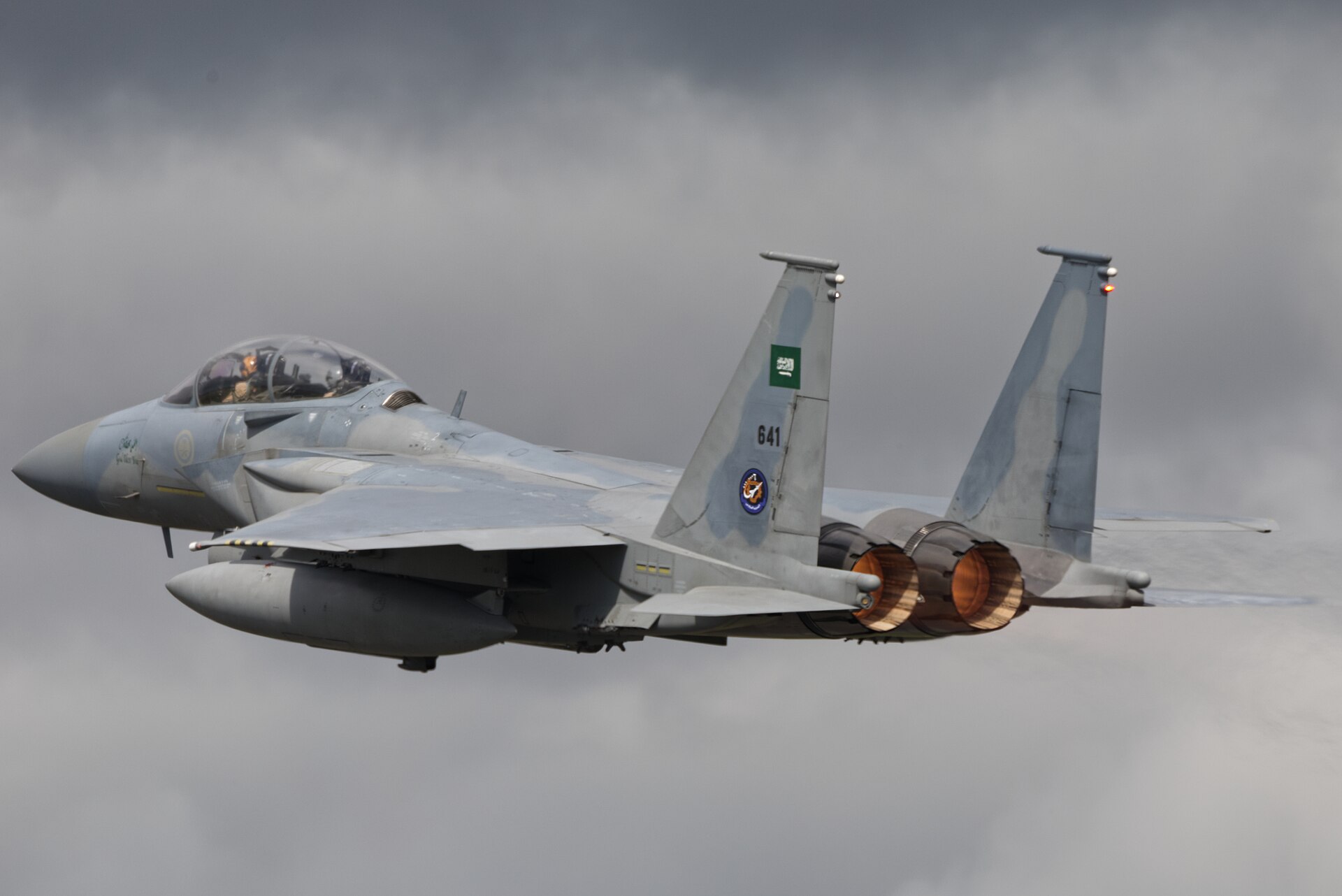
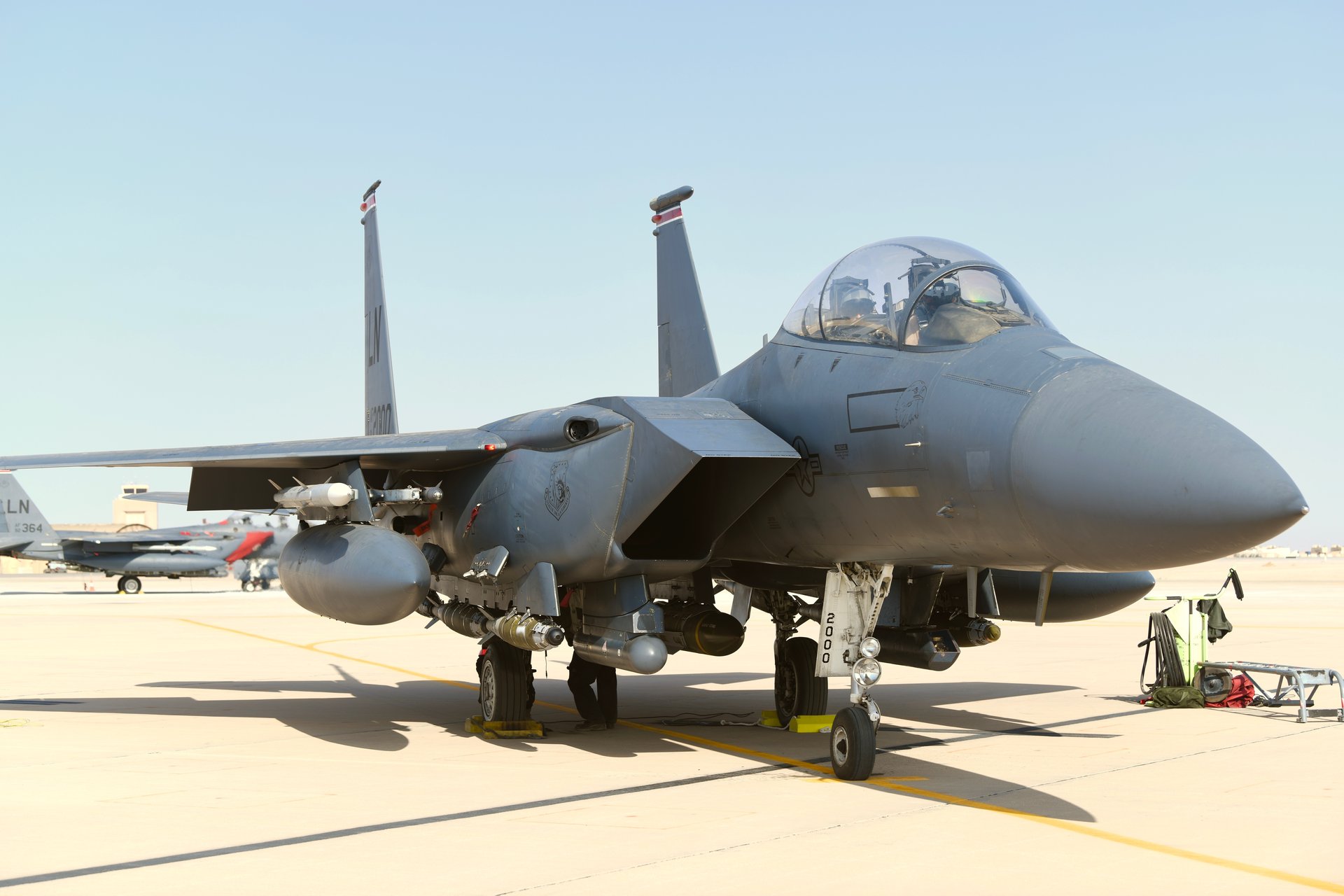
If Saudi Arabia transitions from a support role to active offensive operations, it would deploy one of the largest and most heavily equipped air forces in the Middle East. The Royal Saudi Air Force operates approximately 914 active military aircraft, according to Global Military assessments. The backbone of the fleet consists of roughly 210 F-15 fighters of various variants, making it the second-largest F-15 fleet in the world after the United States Air Force.
The most capable variant, the F-15SA (Saudi Advanced), entered service following a 2010 agreement valued at $29.4 billion that covered 84 new-build aircraft and upgrade kits for approximately 70 older F-15S models, Army Recognition reported. The RSAF demonstrated combat-ready F-15SA capabilities at the World Defense Show in February 2026, just weeks before the Iran war began. The US approved a $3 billion sustainment programme for Saudi F-15s in late 2025, according to the Defense Security Cooperation Agency.
The RSAF also operates Eurofighter Typhoon multi-role fighters, which have been deployed for air defence since the war started. The Kingdom’s ground-based air defence network includes Patriot PAC-3 batteries, which have been responsible for the majority of ballistic missile interceptions over Riyadh and the Eastern Province.
The UAE, for its part, operates one of the most technologically advanced air forces in the Gulf. Its fleet includes 79 F-16E/F Block 60 Desert Falcon fighters, which carry an advanced sensor suite not available to most other F-16 operators. The UAE also fields 12 Dassault Mirage 2000-9 fighters and has placed orders for 80 Dassault Rafale multi-role fighters, though deliveries are not expected to be complete until the late 2020s. Saudi Arabia is also pursuing Rafale acquisitions as part of a deepening France-Saudi defense partnership that saw Prince Khalid bin Salman and French Defense Minister Vautrin agree to expanded cooperation in Riyadh on 25 March, including an $8 billion deal that would make the Kingdom a second major Gulf operator of the French fighter. The Emirati Air Force has significant combat experience from the Yemen campaign, where it conducted strike operations between 2015 and 2019.
| Platform | Saudi Arabia | UAE | Combined Total |
|---|---|---|---|
| F-15 variants | ~210 (F-15C/D, F-15S, F-15SA) | 0 | ~210 |
| F-16 variants | 0 | 79 (F-16E/F Block 60) | 79 |
| Eurofighter Typhoon | 72 | 0 | 72 |
| Mirage 2000 | 0 | 12 | 12 |
| Total combat aircraft (approx.) | ~280+ | ~91 | ~370+ |
The Diplomatic Escalation Leading to This Moment
The trajectory toward potential Gulf co-belligerency follows a series of escalatory steps over the 24-day war. Saudi Arabia’s initial response to the US-Israeli strikes on Iran, which began on 28 February, was carefully calibrated. Riyadh expressed concern about regional stability, allowed existing US forces to operate from Saudi bases, and maintained diplomatic channels with Tehran.
That approach began to fracture almost immediately. On 1 March, Iran launched its first retaliatory strikes against Gulf states, targeting energy infrastructure and military bases across Saudi Arabia, the UAE, Bahrain, Kuwait, and Qatar. MBS spoke by phone with Trump, who told the Crown Prince that “the US stands with Saudi Arabia,” according to Al Arabiya. In the first week, MBS also conferred with the leaders of the UAE, Qatar, Kuwait, Bahrain, and Jordan to coordinate the Gulf response. Of all the GCC states, Bahrain has since crossed the furthest line, with missiles reportedly launched from its territory toward Iran.
By 7 March, Ukrainian President Volodymyr Zelenskyy contacted MBS to offer Ukraine’s expertise in countering Iranian drones, a proposal born from Kyiv’s extensive experience intercepting Iranian-made Shahed drones deployed by Russia, Al Jazeera reported. The same day, MBS received a call from Kuwait’s Crown Prince as Iranian attacks on GCC nations intensified.
The diplomatic break accelerated on 21 March when Saudi Arabia expelled Iran’s military attaché and four embassy staff, giving them 24 hours to leave the kingdom. The expulsion came after a drone strike on the Red Sea port of Yanbu, Saudi Arabia’s primary oil export outlet, which Iran targeted after its de facto blockade of the Strait of Hormuz forced Riyadh to route crude exports through the western pipeline network.
Saudi Arabia has simultaneously stayed on the margins of peace negotiations. Pakistan has emerged as a potential mediator, with Prime Minister Sharif meeting MBS in Jeddah before preparing to host direct US-Iran talks in Islamabad. Riyadh’s absence from the negotiating table, combined with its military preparations, suggests the kingdom has concluded that deterrence, not diplomacy, offers the most reliable path to ending Iranian attacks on its territory.
What Are the Risks of Becoming Co-Belligerents?
The transition from host nation to active combatant carries substantial risks that Saudi and Emirati planners are weighing against the escalating cost of passivity. Middle East Eye reported that experts warn joining offensive operations against Iran “opens a can of worms” for Gulf states, potentially exposing civilian infrastructure and economic assets to a level of targeting that has so far been limited by Iran’s own strategic calculations.
Iran has demonstrated the capacity to strike across the entire Gulf region. Tehran has launched more than 2,000 attacks on the UAE alone since 28 February, along with hundreds of missile and drone strikes on Saudi territory. The UK Maritime Trade Operations has classified the threat level across the Gulf, Strait of Hormuz, and Gulf of Oman as “critical,” citing 21 confirmed attacks on commercial vessels and offshore infrastructure since 1 March. Britain has since deployed Rapid Sentry air defense systems and distributed missiles to Saudi Arabia, Kuwait, and Bahrain. Whether Saudi Arabia can sustain this posture depends on closing the gap between its massive defense budget and its actual operational capability.
The humanitarian cost of the air campaign inside Iran compounds the strategic calculation. Coalition strikes have reduced more than 82,000 Iranian civilian structures to rubble in twenty-five days, including hospitals, schools, and entire residential blocks. If Saudi Arabia formally enters the war, it would become directly associated with that destruction in the eyes of the broader Muslim world — a reputational risk that no amount of military success can offset.
For Saudi Arabia, the most acute risk is to its energy infrastructure. Iran has already targeted the eastern provinces, where the majority of Saudi oil production and processing facilities are concentrated. A shift to co-belligerent status could invite intensified strikes on facilities like Abqaiq and Ras Tanura, which together handle roughly 60 percent of Saudi crude output. The 2019 Abqaiq-Khurais attack, which temporarily cut Saudi production by 5.7 million barrels per day, demonstrated the vulnerability of these assets.
The UAE faces parallel concerns. Dubai’s position as a regional business hub depends on its reputation for stability and security. The closure of Iranian institutions represents an economic as well as security calculation: an estimated 400,000 Iranian nationals live and work in the UAE, according to demographic studies, and the disruption of commercial ties with Iran carries costs for Dubai’s trade-dependent economy. The broader economic shock of the war has already pushed oil above $100 per barrel and disrupted global shipping.
Against these risks, both nations face the reality that remaining passive has not prevented Iranian attacks. Saudi Arabia has absorbed more than 600 drones and 50 missiles since the war began. The UAE has endured sustained bombardment of energy facilities and civilian airports. Kuwait International Airport alone has been struck five times, with drones hitting passenger terminals, radar systems, and fuel storage tanks. Iranian-backed militias in Iraq have struck US bases 21 times in a single 24-hour period, straining the defensive shield that covers Saudi and Emirati territory. For Gulf leaders, the question appears to have shifted from whether the risks of joining outweigh the risks of staying out, to when and how to escalate.
The escalation calculus, however, must be understood within a broader strategic context. Whether Saudi Arabia formally joins the war or continues its current posture of active non-belligerence, the conflict has already delivered much of what MBS sought. As a companion analysis details, MBS has already won the peace through a combination of a US defense pact, nuclear concessions, a weakened Iran, and consolidated OPEC leverage — gains that no level of military escalation could have secured faster.
That calculus shifted further on March 24, when Trump ordered 2,000 soldiers from the 82nd Airborne Division to deploy to the Gulf, with Saudi Arabia positioned as the primary staging ground for potential ground operations against Iran.
The military steps Saudi Arabia and the UAE have taken also deepen an often-unacknowledged dimension of the conflict: the growing operational alignment between Gulf Arab states and Israel through the CENTCOM command architecture. Both sides share radar data, intelligence, and airspace coordination through American intermediaries, creating what amounts to a Saudi-Israeli alliance that neither side will publicly acknowledge.
Israel’s intensified campaign may ultimately answer the question for Riyadh. Netanyahu has ordered a final 48-hour blitz on Iran’s remaining arms factories, with CENTCOM confirming that two-thirds of Iran’s military-industrial capacity has already been destroyed across 10,000 strikes.
Frequently Asked Questions
Have Saudi Arabia and the UAE officially declared war on Iran?
Neither Saudi Arabia nor the United Arab Emirates has formally declared war on Iran as of 24 March 2026. According to the Wall Street Journal, both nations have taken steps that bring them closer to active participation, including Saudi Arabia’s provision of King Fahd Air Base to US forces and the UAE’s closure of all Iranian institutions in Dubai. However, neither country has deployed military forces in an offensive capacity against Iranian targets.
What is King Fahd Air Base and why does it matter?
King Fahd Air Base is a Royal Saudi Air Force facility located near Taif in western Saudi Arabia. Its strategic significance lies in its distance from the Iranian border, roughly 1,200 kilometres, which places it beyond the effective range of most Iranian ballistic missiles and many drone systems. The base offers a safer alternative to Prince Sultan Air Base near Al Kharj, which has sustained repeated Iranian strikes, including one that damaged five US Air Force KC-135 tanker aircraft.
What Iranian institutions did the UAE close in Dubai?
The UAE ordered the closure of the Iranian Hospital in Dubai, which had operated for more than 50 years and employed over 700 people. Authorities also shut down at least four Iranian-run schools, the Iranian Club, and directed all government-dispatched Iranian staff to leave the country. The Iranian consulate was instructed to reduce its operations to locally hired staff only. The closures followed more than 2,000 Iranian attacks on UAE territory since the war began.
How many Iranian attacks has Saudi Arabia intercepted?
Saudi Arabia has intercepted or engaged at least 44 ballistic missiles, seven cruise missiles, and more than 600 drones launched by Iran since the war started on 28 February 2026, according to the Saudi Ministry of Defence. On 22 March alone, Saudi forces shot down 60 drones and intercepted three ballistic missiles targeting Riyadh. The vast majority of incoming threats have been neutralised, though a small number have struck targets including areas near Prince Sultan Air Base and the port city of Yanbu.
What would Saudi Arabia’s military contribute if it joins the war?
The Royal Saudi Air Force is one of the largest in the Middle East, operating approximately 914 active military aircraft. Its combat fleet includes roughly 210 F-15 fighters, making it the second-largest F-15 operator in the world after the United States. The force also operates 72 Eurofighter Typhoons. Combined with the UAE’s 79 F-16E/F Desert Falcons, the two nations could add more than 370 combat aircraft to the coalition, significantly expanding strike capacity against Iranian targets.
The case for Saudi and Emirati military intervention grew stronger on March 25, when Iran rejected Trump’s ceasefire plan and demanded sovereignty over the Strait of Hormuz — a condition Gulf states called an existential threat to their security and economic survival.