
RIYADH — Twenty-four days into the Iran war, the conflict’s most reliable winner is not sitting in the Pentagon’s situation room or the royal court in Riyadh. It is sitting on the trading floors of lower Manhattan. Since the first Tomahawk cruise missiles hit Iranian targets on 28 February 2026, the combined market capitalisation of America’s five largest defence contractors has surged by more than $200 billion. RTX Corporation, the parent of Raytheon, hit an all-time high of $214.50 on 3 March. Lockheed Martin is up 35 per cent this year. Northrop Grumman closed the quarter with a record $95.7 billion backlog. For every interceptor Saudi Arabia fires over Riyadh at a cost of $4 million, for every Tomahawk the Pentagon launches at $2 million a unit, and for every Shahed drone Iran builds for $20,000, a defence industry shareholder somewhere collects a dividend.
Table of Contents
- How Much Have Defence Stocks Gained Since the Iran War Began?
- Which Companies Are Profiting Most From the Iran War?
- The Interceptor Trap — When Every Shot Costs More Than Every Target
- What Is the Pentagon’s $200 Billion War Budget?
- Are Members of Congress Trading Defence Stocks While Voting for War?
- The War Dividend Scorecard
- Saudi Arabia Spent Decades Buying Weapons It Now Burns Through in Hours
- Can Saudi Arabia Build Its Own Defence Industry Before the Next War?
- The Contrarian Case — This War Is Destroying the Arsenal It Claims to Build
- What Does the Iran War Mean for the Next Global Arms Race?
- Frequently Asked Questions
How Much Have Defence Stocks Gained Since the Iran War Began?
Defence stocks surged on the first trading day after Operation Epic Fury began. RTX gained 4.7 per cent in a single session. Northrop Grumman jumped 6 per cent. Lockheed Martin climbed 3.4 per cent. The iShares US Aerospace & Defence ETF has risen 14 per cent since January 2026, according to Bloomberg data, with the acceleration sharpest after 28 February. In a broader market sell-off driven by oil price chaos and supply chain disruption, the defence sector has been one of the only reliable gainers.
The numbers are striking in isolation. They are extraordinary in context. RTX’s market capitalisation reached $285 billion in early March, up 68 per cent over the prior twelve months. Lockheed Martin trades at roughly $660 per share, a gain of approximately 35 per cent year-to-date. General Dynamics has climbed 33 per cent to a market cap of $94.75 billion. Even Boeing, which entered 2026 under a cloud of safety scandals and production delays, has risen 5 per cent on the strength of its defence division alone.
The pattern is not new, though the scale is unprecedented — the Iran war has triggered the largest global rearmament since the Cold War, with over $400 billion in new defense commitments worldwide. Defence stocks rose after the 11 September 2001 attacks, after the 2003 invasion of Iraq, and after Russia’s full-scale invasion of Ukraine in 2022. What distinguishes the 2026 rally is its speed and its direct correlation with munition expenditure. The United States fired more than 800 Patriot interceptors in the war’s first five days alone, according to Defence Express. That is not an investment thesis. It is a consumption rate — and Wall Street is pricing in years of restocking.
The historical comparison is instructive. After the 2003 invasion of Iraq, Lockheed Martin’s stock rose approximately 25 per cent over the following twelve months. After Russia invaded Ukraine in February 2022, the iShares US Aerospace & Defence ETF gained roughly 18 per cent in six months. The 2026 Iran war has produced larger gains in a shorter period — a reflection of the war’s unprecedented intensity and munition throughput. The first Gulf War in 1991 was fought with unguided bombs and relatively cheap ordnance. The Iran war is fought with precision-guided munitions that cost millions per unit, making each engagement a significantly larger revenue event for the manufacturer.
Morgan Stanley’s defence sector analyst noted in a 10 March research note that the war had created “the most favourable demand environment for precision munitions since the inception of the guided weapons era.” Goldman Sachs upgraded its price targets for RTX, Lockheed Martin, and Northrop Grumman within the first week of hostilities. The analyst consensus is that war-driven demand will sustain elevated revenue for the defence sector through at least 2030 — the year Lockheed aims to reach peak PAC-3 MSE production and the year SAMI targets its position among the top 25 defence firms globally.
The Middle East briefing 3,000+ readers start their day with.
One email. Every weekday morning. Free.
Which Companies Are Profiting Most From the Iran War?
Five American defence contractors dominate the war economy. Together they manufacture the missiles, aircraft, radar systems, and munitions that the Pentagon, Saudi Arabia, Israel, and their allies are consuming at a rate unseen since the Second World War. The war has turned their order books into conveyor belts.
| Company | Ticker | YTD Gain | Market Cap | Key War-Linked Products | Backlog |
|---|---|---|---|---|---|
| RTX Corporation | RTX | +62%* | $268B | Patriot PAC-3, Tomahawk, StingerNASAMS | $213B |
| Lockheed Martin | LMT | +35% | $176B | F-35, THAAD, PAC-3 MSE, JASSM | $166B |
| Northrop Grumman | NOC | +29% | $96B | B-21 Raider, Sentinel ICBM, ammunition | $95.7B |
| General Dynamics | GD | +33% | $94.75B | Abrams tanks, Stryker, 155mm shells | $91B |
| L3Harris Technologies | LHX | +20% | $68B | Electronic warfare, ISR, communications | $32B |
*RTX 62 per cent gain reflects one-year performance; year-to-date 2026 gain is approximately 18 per cent.
RTX, formed from the 2020 merger of Raytheon and United Technologies, is the war’s single largest corporate beneficiary. Its Raytheon subsidiary produces the Patriot air defence system, the Tomahawk cruise missile, the AIM-120 air-to-air missile, and the Stinger shoulder-launched system. Every major category of munition being consumed in the Iran war carries a Raytheon nameplate. The company’s all-time stock price high of $214.50, reached on 3 March 2026, came five days after the war began, according to MacroTrends data.
Lockheed Martin occupies the second tier. Its F-35 fighters are flying combat missions from Saudi air bases and carriers in the Arabian Sea. Its PAC-3 MSE interceptors — the upgraded variant of the Patriot — are the primary missile killing Iranian ballistic threats over Riyadh, Dhahran, and the Eastern Province. In January 2026, the Pentagon and Lockheed announced a landmark deal to triple PAC-3 MSE production from 600 to 2,000 units per year by 2030, a $9.8 billion contract that represents the largest in the history of Lockheed’s Missiles and Fire Control division, according to Breaking Defense.
European contractors are profiting too. BAE Systems, headquartered in London, saw its stock jump 6 per cent on the first day of war trading and is up 23 per cent year-to-date — its all-time high on the FTSE 100. Germany’s Hensoldt, which makes radar and sensor systems, was among the top performers on the Stoxx 600. Israel’s Elbit Systems has surged 45 per cent since January 2026, becoming Israel’s most valuable listed company with an order backlog of $28.1 billion. The war has not only enriched American firms. It has triggered a global re-arming cycle.
The scale of munition consumption explains why. Analysis by the Foreign Policy Research Institute found that the United States and its allies fired 5,197 munitions across 35 different weapon types in the war’s first 96 hours alone. That figure includes 943 PAC-3 Patriot rounds — consuming roughly 18 months of Lockheed Martin’s entire annual production in four days. The Pentagon fired 319 Tomahawk cruise missiles in the war’s opening weeks, approximately 10 per cent of America’s total Tomahawk stockpile, according to 19FortyFive. More than 150 THAAD interceptors were expended in the first twelve days, accounting for an estimated 25 per cent of the total US THAAD inventory. Each of these numbers represents a line item on a defence contractor’s future order book.

The Interceptor Trap — When Every Shot Costs More Than Every Target
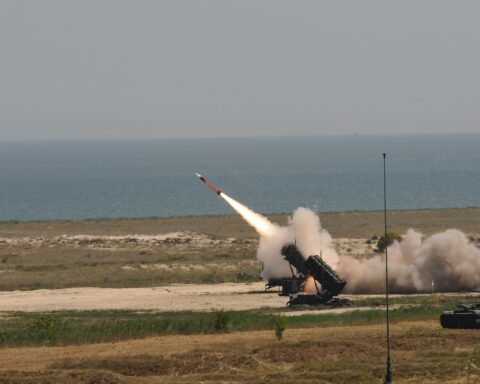
The Iran war has exposed the most uncomfortable truth in modern defence economics: the weapons designed to defend against low-cost threats cost orders of magnitude more than the threats themselves. A single PAC-3 MSE interceptor costs the US Army approximately $3.9 million, according to the Congressional Budget Office. Saudi Arabia pays approximately $12 million per interceptor through Foreign Military Sales, a markup that includes logistics, training, and support contracts. A THAAD interceptor, built by Lockheed Martin, costs $12.77 million per round.
Iran’s Shahed-136 drone costs between $4,000 and $35,000 to manufacture, depending on the production source and configuration, according to CNBC analysis. The cost ratio between a single Patriot intercept and a single Shahed drone ranges from 100:1 to nearly 1,000:1. Iran can produce an estimated 3,000 Shahed-series drones per month, based on observed Russian deployment rates of the Geran-2 variant, according to open-source intelligence trackers.
| System | Manufacturer | Unit Cost | Target Type | Target Cost | Cost Ratio |
|---|---|---|---|---|---|
| PAC-3 MSE | Lockheed Martin | $3.9M (US) / $12M (export) | Ballistic missile | $300K-$1M | 4:1 to 40:1 |
| THAAD | Lockheed Martin | $12.77M | Ballistic missile | $300K-$1M | 13:1 to 43:1 |
| PAC-3 MSE | Lockheed Martin | $3.9M | Shahed-136 drone | $20K-$35K | 111:1 to 195:1 |
| Patriot PAC-2 GEM-T | RTX/Raytheon | $1-$2M | Cruise missile | $100K-$300K | 3:1 to 20:1 |
Saudi Arabia has intercepted or engaged at least 44 ballistic missiles, seven cruise missiles, and more than 600 drones since 28 February, according to its Ministry of Defence. The United States burned through over $2.4 billion worth of Patriot interceptors in just five days, Military Watch Magazine reported. At these expenditure rates, the war’s air defence bill alone could exceed $20 billion by the end of its first quarter. For RTX and Lockheed Martin, every interception is a revenue event. For Saudi Arabia and its allies, every interception is a cheque written to a firm in Tucson or Grand Prairie, Texas.
The asymmetry creates a structural advantage for the attacker and a structural windfall for the manufacturer. Iran does not need to overwhelm Gulf air defences to win the economic war. It needs only to drain the interceptor stockpile faster than Lockheed and Raytheon can replenish it. The longer the war continues, the more interceptors are consumed, the more contracts are signed, and the higher defence stocks climb. The incentive structure is self-reinforcing.
What Is the Pentagon’s $200 Billion War Budget?
The Pentagon has asked the White House to approve a supplemental budget request of more than $200 billion to fund ongoing operations in and around Iran, the Washington Post reported on 18 March. The figure, confirmed by a senior administration official, reflects the staggering pace of expenditure: approximately $1 billion per day since the war began, with the first six days alone costing $11.3 billion according to Pentagon estimates.
Defence Secretary Pete Hegseth defended the request at a press briefing on 19 March. Asked to confirm the $200 billion figure, Hegseth replied that it “could move” but added bluntly: “It takes money to kill bad guys.” The comment, reported by CNBC, captured the transactional nature of modern warfighting. Every dollar in that supplemental request flows to a defence contractor. Every Tomahawk missile that hits an Iranian target costs approximately $2 million and must be replaced. Every PAC-3 interceptor that destroys an incoming drone costs $3.9 million and must be reordered.
Congressional resistance has been muted but not absent. TIME reported on 20 March that lawmakers from both parties voiced concern over the scale of the request, with several Republicans questioning the lack of a clear timeline for ending operations. The White House had not yet formally submitted the request to Congress as of that date. But the dynamic is familiar: wartime supplemental requests rarely face serious opposition. The 2003 Iraq War supplementals passed with overwhelming bipartisan support. The defence industry’s lobbying apparatus ensures that the contracts attached to such requests flow into districts and states where they create or sustain jobs.
The Pentagon’s $200 billion request is not a budget. It is a purchase order — with Lockheed Martin, RTX, and Northrop Grumman as the primary vendors.
Analysis based on Pentagon supplemental structure, March 2026
The possibility that Saudi Arabia and the UAE may formally join the war only increases the spending trajectory. Secretary of State Marco Rubio has already bypassed standard Congressional review to rush $16 billion in arms to Gulf allies, according to reporting from multiple outlets. A full economic balance sheet of the Iran war after 26 days puts the combined cost across all belligerents and affected economies at between $590 billion and $3.5 trillion — a figure that makes the defence stock rally look less like market exuberance and more like rational pricing of permanent conflict. A separate $9 billion Foreign Military Sale approved in January 2026 will supply Saudi Arabia with up to 730 PAC-3 MSE interceptors, launcher conversion kits, and associated support — nearly all of which will be manufactured by Lockheed Martin in Alabama and Texas.
Are Members of Congress Trading Defence Stocks While Voting for War?
At least 37 US lawmakers traded up to $113 million in defence stocks during 2025, according to financial disclosure data compiled by Truthout. Across reported transactions, buys heavily outnumbered sells, with many of the larger or earlier purchases in companies like Howmet Aerospace, GE Aerospace, RTX, L3Harris, and Lockheed Martin seeing average appreciation of 50 to 100 per cent or more by early March 2026, according to Capitol Trades analysis.
The defence sector is not the only corner of the financial markets profiting from the conflict. Maritime insurance underwriters have seen premiums surge by more than 2,000 per cent for Strait of Hormuz transits, a dynamic that has effectively transformed London’s insurance market into the most powerful enforcement arm of the Hormuz blockade.
Representative Kelly Morrison, a Democrat from Minnesota, purchased stock in Saronic Technologies — a company that builds autonomous warships — nine days after the war began, NOTUS reported. Morrison’s office stated that her portfolio is managed by an investment adviser and that she had no prior knowledge of the transaction. House Foreign Affairs Committee Chair Michael McCaul, a Republican from Texas who has long championed robust military support for Israel, was particularly active in 2025, adding significantly to GE Aerospace positions, according to Capitol Trades data.
No public evidence has surfaced proving that any of these trades relied on non-public information about war planning. But the optics are damaging. Members of Congress receive classified intelligence briefings on military operations. They vote on defence appropriations and supplemental war funding. And they hold personal financial stakes in the companies that receive those appropriations. Richard Painter, the former chief ethics lawyer for the George W. Bush White House, told Common Dreams that lawmakers with access to confidential information about war and government contracts “should not be allowed to play on the stock market.”
The STOCK Act of 2012 requires members of Congress to disclose trades within 45 days, but enforcement has been lax. A Brennan Center for Justice analysis found that violations are routine and penalties are negligible — typically a $200 fine. Representative Lisa McClain, a Republican from Michigan, added to positions in Northrop Grumman, BWX Technologies, and Curtiss-Wright late in 2025, with several transactions potentially violating STOCK Act filing requirements, Capitol Trades data shows. Representative Gilbert Cisneros, a Democrat from California who serves on the House Armed Services Committee, purchased shares in nine major defence companies including General Dynamics, RTX, and Lockheed Martin since September 2025.
William Hartung, a senior research fellow at the Quincy Institute for Responsible Statecraft, described the dynamic bluntly: “Our elected officials are almost de facto lobbyists for this industry because they benefit from campaign contributions, for catering to contractors in their states.” Hartung also noted that defence firms have historically “prioritised enriching shareholders over expanding production” — a point underscored by Lockheed Martin’s return of $6.8 billion to shareholders in 2024 through dividends and buybacks, even as its own production lines struggled to meet demand. Trump signed an executive order on 7 January 2026 barring defence companies from paying dividends or repurchasing stock until they produce “superior product, on time and on budget.” The order has yet to alter the fundamental incentive structure.
The think tank ecosystem amplifies the conflict. According to the Quincy Institute’s funding tracker, top Washington think tanks received over $25 million from foreign governments and $7 million from Pentagon contractors in 2024. Seventy-nine per cent of think tank witnesses testifying before Congress represent organisations that accept donations from the top 100 Pentagon contractors. The revolving door between the defence industry, Congressional committees, and the think tanks that advise them creates an ecosystem in which war spending faces remarkably little institutional opposition.
The War Dividend Scorecard
Not all defence companies benefit equally from armed conflict. The Iran war, with its distinctive combination of air defence consumption, precision strike operations, naval deployments, and electronic warfare, creates winners and relative losers even within the defence sector. Five factors determine which firms capture the largest share of wartime revenue.
| Factor | Weight | RTX | Lockheed Martin | Northrop Grumman | General Dynamics | L3Harris |
|---|---|---|---|---|---|---|
| Munitions Consumption Rate | 30% | 10/10 | 9/10 | 5/10 | 7/10 | 3/10 |
| Restocking Contract Value | 25% | 9/10 | 10/10 | 6/10 | 7/10 | 5/10 |
| Export/FMS Pipeline | 20% | 9/10 | 9/10 | 4/10 | 6/10 | 5/10 |
| Production Scalability | 15% | 7/10 | 8/10 | 7/10 | 8/10 | 6/10 |
| Post-War Demand Durability | 10% | 8/10 | 9/10 | 9/10 | 7/10 | 7/10 |
| Weighted Score | 8.95 | 9.15 | 5.80 | 7.05 | 4.85 |
The first factor — munitions consumption rate — measures how quickly the war depletes a company’s products. RTX scores highest because its Patriot interceptors, Tomahawks, and Stinger missiles are being expended daily. The US fired over 800 Patriot rounds in five days. Hundreds of Tomahawks have struck Iranian targets. Each expended round triggers a replacement order.
The second factor — restocking contract value — captures the scale of replenishment deals. Lockheed Martin leads here thanks to its $9.8 billion PAC-3 MSE production deal and the $9 billion Saudi FMS package. These are multi-year contracts with guaranteed revenue streams that extend well beyond the war itself.
The third factor — export and Foreign Military Sales pipeline — reflects the reality that this war will trigger an arms-buying frenzy across the Middle East, Asia, and Europe. Saudi Arabia, the UAE, Japan, South Korea, Taiwan, and NATO members are all expected to accelerate procurement. RTX and Lockheed dominate this pipeline. Northrop Grumman, which focuses on classified programmes and nuclear modernisation, has a smaller international footprint.
The fourth and fifth factors — production scalability and post-war demand durability — distinguish companies that can rapidly increase output from those constrained by specialised manufacturing. General Dynamics, which produces 155mm artillery shells and Abrams tanks, scores well on scalability because shell production can be ramped faster than precision-guided missiles. Lockheed and Northrop score highest on durability because their programmes — F-35, B-21 Raider, Sentinel ICBM — are generational investments that will continue regardless of whether the Iran war ends tomorrow.
Saudi Arabia Spent Decades Buying Weapons It Now Burns Through in Hours
Saudi Arabia built one of the most expensive military forces in the world over four decades of sustained procurement. Between 2015 and 2019, the Kingdom was the world’s largest arms importer, according to SIPRI data. In the 2020-2024 period, it fell to fourth — behind Ukraine, India, and Qatar — as imports declined 41 per cent, partly due to the cyclical nature of procurement after major delivery waves. But the Kingdom’s dependence on American-made systems remained absolute: 74 per cent of Saudi arms imports in 2020-2024 came from the United States, SIPRI reported, with Spain (10 per cent) and France (6.2 per cent) as distant secondary suppliers.
The Iran war has compressed decades of theoretical contingency planning into three weeks of operational reality. Saudi Arabia’s 18 to 25 Patriot batteries — the precise number is classified but estimated by the International Institute for Strategic Studies — have been firing continuously since 28 February. The Kingdom has intercepted or engaged more than 650 incoming threats, including 44 ballistic missiles and over 600 drones. On 22 March alone, Saudi forces shot down 60 drones and three ballistic missiles, the Ministry of Defence reported.
Each of those engagements cost money that flows directly to American defence firms. The January 2026 Foreign Military Sale of 730 PAC-3 MSE interceptors for $9 billion means Saudi Arabia is paying approximately $12.3 million per missile — more than three times what the US Army pays for the same round. The markup covers logistics chains, training packages, technical support, and the Foreign Military Sales administrative fee. It also represents a structural disadvantage: Saudi Arabia cannot negotiate the same price as the customer who also happens to be the manufacturer’s primary shareholder.
| Deal | Value | Supplier | Systems | Date |
|---|---|---|---|---|
| PAC-3 MSE Interceptors | $9.0B | Lockheed Martin (FMS) | 730 interceptors, launcher kits | January 2026 |
| F-15 Sustainment | Undisclosed (DSCA approved) | Boeing | F-15SA fleet maintenance | 2025 |
| Emergency Arms Package | $16.0B | Multiple US contractors | Mixed munitions, sensors | March 2026 (Rubio bypass) |
| THAAD Battery & Interceptors | $5.4B (est.) | Lockheed Martin | Additional THAAD battery | 2025 |
The total Saudi defence procurement pipeline for the 2025-2026 period exceeds $30 billion. The war premium on Saudi oil exports — driven by the Strait of Hormuz closure and global supply disruption — partially offsets this cost. But the structural reality remains: Saudi Arabia is transferring tens of billions of dollars to American defence contractors in exchange for munitions it is consuming in real time.
Can Saudi Arabia Build Its Own Defence Industry Before the Next War?
Saudi Arabian Military Industries, known as SAMI, was established in 2017 with a mandate that reads like a declaration of industrial independence: localise 50 per cent of military spending by 2030. The PIF-backed conglomerate reported revenues of $900 million in 2022, secured a position among the world’s top 100 defence companies for the second consecutive year, and rose nineteen places in global rankings, according to Arab News.
The General Authority for Military Industries, or GAMI, regulates the sector and reported that the Kingdom spent $1.4 billion in incentives to develop its domestic military industrial base in 2021 and 2022. SAMI’s Saudisation rate reached 57.7 per cent, suggesting that more than half the workforce in its facilities is Saudi. The company’s stated ambition is to become an original equipment manufacturer ranking among the top 25 defence companies globally by 2030.
These are significant achievements for a country that manufactured virtually nothing military a decade ago. But the war has exposed the gap between ambition and capability. SAMI does not produce interceptor missiles. It does not manufacture radar systems. It does not build the integrated battle management software that connects Patriot batteries to THAAD launchers to Aegis destroyers. The systems defending Saudi airspace right now are American-made, American-maintained, and in many cases operated with American technical assistance.
Saudi Arabia’s defence industrialisation programme was designed for a peacetime timeline. The Iran war has imposed a wartime schedule on a Vision 2030 objective that was never meant to be tested this soon.
Gulf International Forum analysis, 2026
The irony is acute. The war MBS did not want may accelerate the economy he did — including defence industrialisation. South Korea’s defence industry was born from the Korean War. Israel’s grew from existential threat. Turkey’s expanded after arms embargoes. The historical pattern suggests that countries develop sovereign defence capabilities only when dependency becomes intolerable. Saudi Arabia may be reaching that threshold. But building a Patriot missile equivalent takes a decade. The war will not wait.
The gap between SAMI’s current capabilities and the weapons the Kingdom actually needs is measured in technological generations. SAMI’s portfolio includes armoured vehicles, small arms, ammunition, and basic electronic systems — the components of a mid-tier military industrial base. The systems that matter in this war — phased-array radar, hit-to-kill kinetic interceptors, satellite-guided precision munitions, and integrated battle management software — remain the exclusive domain of a handful of American and European firms. Closing that gap would require not just investment but the transfer of classified technologies that Washington has historically refused to share with any ally except the United Kingdom, and even then with restrictions.
Crown Prince Mohammed bin Salman’s calculus may be shifting. Before the war, defence localisation was a long-term industrial policy goal — ambitious but patient. After three weeks of burning through American-made interceptors at $12 million per round, with replenishment timelines stretching to 2028 and beyond, the case for sovereign production capability has moved from strategic preference to operational necessity. The question is whether Saudi Arabia will invest in the slow work of building genuine manufacturing capability or settle for licensed assembly — the latter creating a facade of independence while maintaining the underlying dependency.
The Contrarian Case — This War Is Destroying the Arsenal It Claims to Build
The consensus on Wall Street is straightforward: wars consume munitions, munitions need replacing, replacement orders enrich defence contractors, defence stocks rise. The thesis is correct in the short term. It may be catastrophically wrong in the medium term.
The Iran war is draining global interceptor stockpiles at a rate that cannot be replenished for years. The United States fired over 800 Patriot rounds in five days. Lockheed Martin currently produces 620 PAC-3 MSE interceptors per year. Even with the new $9.8 billion contract to triple production to 2,000 per year, that target will not be reached until 2030. The arithmetic is simple: the war is consuming interceptors faster than the entire Western industrial base can manufacture them.
This is not an academic concern. Every interceptor fired over Riyadh is one fewer available for Taipei, for Seoul, for NATO’s eastern flank. The Pentagon’s own assessments, reported across multiple outlets, acknowledge that Taiwan contingency planning depends on available Patriot and THAAD stockpiles — stockpiles that are being consumed in the Persian Gulf. A Chinese military analyst quoted by the South China Morning Post observed that the Iran war is providing Beijing with “an unprecedented real-time audit of American missile defence capacity and depletion rates.”
The defence stocks that are rising today are pricing in restocking orders that will take half a decade to fulfil. If a second crisis erupts before those orders are delivered — in the Taiwan Strait, on the Korean peninsula, or along NATO’s Article 5 boundary — the stocks that surged on war spending will collapse on the revelation that the arsenal is hollow. The companies will still have their backlog. The military will not have its missiles.
| System | Consumed (First 3 Weeks) | Annual Production Rate | Years to Replace | New Target Rate (by 2030) |
|---|---|---|---|---|
| PAC-3 MSE | ~943+ | 620/year | 1.5 | 2,000/year |
| THAAD Interceptor | ~150+ | 96/year | 1.6 | 400/year |
| Tomahawk | ~319 | ~100/year | 3.2 | ~1,000/year |
The numbers in the table above tell the story. At current production rates, it would take 1.5 years to replace the PAC-3 missiles consumed in three weeks. For Tomahawks, the replacement timeline stretches past three years. Even at the new accelerated production targets — which will not be reached until 2030 — the arithmetic barely closes. A war lasting six months would consume interceptors faster than even the expanded production lines could deliver them. The defence companies will have revenue for years. The military will have empty launchers for months.
There is a second contrarian dimension.
The Iran war is proving the economic unsustainability of precision-guided air defence against mass drone warfare. Each $3.9 million Patriot interceptor that destroys a $20,000 Shahed drone represents a 195:1 cost disadvantage. Defence companies profit from this asymmetry in the short term because governments have no alternative. But the asymmetry is accelerating investment in counter-drone technologies — directed-energy weapons, electronic warfare systems, and AI-guided interceptor swarms — that could render the current generation of multi-million-dollar missiles obsolete within a decade. The companies profiting most from today’s war are selling the last generation of weapons. The next war will be fought with systems that do not yet exist.
What Does the Iran War Mean for the Next Global Arms Race?
The war’s most durable legacy may not be measured in territory gained or diplomatic agreements signed. It may be measured in defence budgets approved and procurement contracts signed in capitals from Tokyo to Stockholm in the months and years following the conflict.
Global military expenditure reached a record $2.7 trillion in 2024, according to SIPRI data released in early 2025, rising for the tenth consecutive year at a rate of 9.4 per cent — the fastest growth in nearly four decades. The United States alone accounted for $997 billion, or 37 per cent of the global total. Spending was already trending sharply upward before the Iran war. European defence spending surged after Russia’s invasion of Ukraine, with Germany committing to a $113 billion special defence fund. Japan announced its largest military build-up since the Second World War. Australia signed the AUKUS nuclear submarine deal. The Iran war adds another accelerant to a cycle that was already self-reinforcing.
The specific lessons being absorbed by military planners worldwide will shape procurement for a generation. Three stand out.
First, air defence is existential. Saudi Arabia’s Patriot batteries are the only thing standing between Iranian missiles and critical infrastructure worth hundreds of billions of dollars. Every country with adversaries capable of producing ballistic missiles or mass drones will now prioritise integrated air and missile defence. Poland, Japan, South Korea, Taiwan, and the Baltic states are all expected to accelerate orders.
Second, munition depth matters more than platform sophistication. The war has demonstrated that even the wealthiest nations can exhaust precision-guided munitions in weeks. Stockpile depth — the ability to sustain combat operations for months rather than days — is emerging as the defining metric of military credibility. This favours contractors like General Dynamics and Northrop Grumman, which produce ammunition and ordnance at scale.
Third, the drone revolution is real and irreversible. Iran’s ability to threaten the world’s most expensive military infrastructure with weapons costing less than a family car has rewritten the calculus of asymmetric warfare. Every defence ministry on earth is now racing to develop both offensive drone capabilities and effective counter-drone systems. The market for autonomous systems, electronic warfare, and directed-energy weapons will expand by orders of magnitude.
The White House meeting in early March 2026, attended by the chief executives of RTX, Lockheed Martin, Boeing, Northrop Grumman, BAE Systems, L3Harris, and Honeywell Aerospace, resulted in an agreement to “quadruple production” of what officials described as “exquisite class” weaponry, according to multiple reports. The word “exquisite” is Pentagon jargon for the most advanced and expensive precision-guided munitions. The commitment signals that the defence industrial base is gearing up not for months but for years of sustained high-tempo production — production that will outlast the Iran war itself.
Frequently Asked Questions
Which defence stock has gained the most from the Iran war?
RTX Corporation (formerly Raytheon) has been the largest beneficiary, with its stock reaching an all-time high of $214.50 on 3 March 2026. The company’s market capitalisation reached approximately $285 billion, reflecting a 68 per cent gain over the prior twelve months. RTX manufactures the Patriot air defence system, Tomahawk cruise missiles, and Stinger missiles — all of which are being consumed at unprecedented rates in the Iran conflict.
How much does it cost to intercept one Iranian drone?
Intercepting a single Iranian Shahed-136 drone with a Patriot PAC-3 MSE missile costs approximately $3.9 million for the US military and up to $12 million for Saudi Arabia through Foreign Military Sales, according to Congressional Budget Office and DSCA data. The Shahed drone itself costs between $4,000 and $35,000 to produce. This creates a cost ratio of between 111:1 and nearly 1,000:1 in favour of the attacker, making sustained air defence operations economically unsustainable over extended conflicts.
How much has the Iran war cost the United States?
The Pentagon has spent approximately $1 billion per day since the war began on 28 February 2026, with the first six days costing $11.3 billion according to official estimates reported by multiple outlets. The Pentagon has submitted a $200 billion supplemental budget request to the White House to fund ongoing operations, though Congress has not yet approved it. The total cost through 24 March 2026 is estimated at approximately $24 billion.
Are defence contractors increasing weapons production because of the Iran war?
Defence contractors have announced major production increases. Lockheed Martin signed a $9.8 billion contract to triple PAC-3 MSE interceptor production from 620 to 2,000 units per year by 2030. THAAD interceptor production is increasing from 96 to 400 per year. Raytheon is increasing Tomahawk cruise missile production rates by two to four times existing levels. CEOs of the six largest US defence firms agreed to “quadruple production” of precision-guided munitions at a White House meeting in March 2026.
How much does Saudi Arabia spend on weapons imports?
Saudi Arabia was the world’s largest arms importer between 2015 and 2019 and fell to fourth largest in 2020-2024, with imports declining 41 per cent according to SIPRI data. However, the Iran war has triggered a massive new procurement cycle. Saudi Arabia’s 2025-2026 arms procurement pipeline exceeds $30 billion, including a $9 billion PAC-3 MSE interceptor deal, a $16 billion emergency arms package, and additional THAAD and sustainment contracts. The United States supplies 74 per cent of Saudi arms imports.
Is the defence industry lobby influencing Iran war policy?
The five largest US defence contractors spent a combined $60 million on lobbying in 2025, according to OpenSecrets data. At least 37 members of Congress traded up to $113 million in defence stocks during 2025, with buys heavily outnumbering sells. While no direct evidence links these trades to non-public information about war planning, ethics experts have called the structural conflict of interest between war authorisation and personal financial gain “an obvious conflict of interest,” as Common Dreams reported.