
Tayma is one of the oldest continuously inhabited settlements in the Arabian Peninsula — a vast desert oasis where Babylonian kings once ruled, Assyrian caravans rested, and inscriptions in half a dozen ancient scripts still line the rocks. Sitting on the western edge of the Nafud desert in Tabuk Province, roughly equidistant between AlUla and the city of Tabuk, Tayma rewards the traveller who ventures beyond Saudi Arabia’s headline destinations. The site is part of Saudi Arabia’s “Ancient Walled Oases of Northern Arabia” nomination on the UNESCO Tentative List, and since 2022 it has been managed by the Royal Commission for AlUla (RCU), which has opened it to tourists with guided heritage tours, live performances, and a restored museum. If you are planning a wider journey through the northwest, this page fits alongside our complete Saudi Arabia travel guide and should be read in conjunction with the Tabuk travel guide, which covers the surrounding province.
Best Time to Visit: October to March (daytime highs 18–28 °C; summer temperatures exceed 42 °C)
Getting There: Drive from Tabuk (264 km, ~3 hours) or from AlUla (230 km, ~3 hours); organised day trips depart from AlUla via Experience AlUla
Visa Required: Yes — tourist e-visa available for 63 nationalities
Budget: USD 50–120 per day (accommodation, meals, local transport; day-trip packages from AlUla start at 95 SAR / ~USD 25)
Must-See: Bir Haddaj well, Qasr al-Hamra palace, Al Naslaa rock formation
Avoid: Visiting in July or August — temperatures routinely hit 45 °C, and many heritage sites reduce hours
Why Visit Tayma?
While Hegra and Elephant Rock in nearby AlUla have become flagship destinations for Saudi tourism, Tayma remains genuinely off the beaten path. Fewer than a handful of international tour operators include it, and on any given day you are likely to share the ancient ruins with local school groups rather than busloads of tourists. That is precisely the appeal.
Tayma offers something rare: a 4,000-year archaeological narrative you can walk through in a single day. The oasis was a key node on the incense and spice trade routes linking southern Arabia to Mesopotamia, Egypt, and the Levant. It was important enough to be mentioned in Assyrian royal records from the ninth century BCE, referenced in the Hebrew Bible (Isaiah 21:14 and Job 6:19), and chosen by the last king of Babylon as his home-in-exile for a decade. From Bronze Age fortifications to an Abbasid-era Islamic palace, the layers of history here are stacked on top of one another in a way that is difficult to find anywhere else on the peninsula.
A Brief History of Tayma
Understanding Tayma’s history enriches any visit enormously. The oasis sits at the junction of several ancient trade routes and has been continuously occupied for at least five millennia.
Bronze Age Origins (3rd–2nd Millennium BCE)
Archaeological evidence — principally radiocarbon dating of mudbrick construction and pottery analysis by the Saudi-German joint excavation team — places permanent settlement at Tayma as early as the middle of the third millennium BCE. The most impressive survivor from this era is the outer city wall, an 18.2-kilometre fortification enclosing roughly 1,000 hectares. OSL dating of sand dunes accumulated against the wall suggests it was begun in the third millennium BCE and expanded during the early second millennium BCE, making it one of the largest Bronze Age urban fortifications in Arabia. A separate 3.2-kilometre retaining wall in the north of the settlement divided the palm gardens from the sabkha salt flat, protecting agricultural land from saline erosion.
Iron Age and the Incense Routes (1st Millennium BCE)
By the first millennium BCE, Tayma was a major way-station on the frankincense trade routes. Assyrian records from the mid-eighth century BCE mention a caravan arriving from Tayma and tribute paid to king Tiglath-Pileser III. Aramaic, Taymanitic (sometimes called “Thamudic”), and Dadanitic inscriptions from this period attest to the cosmopolitan character of the oasis, which traded with Dadan (modern al-Ula), Mesopotamia, and Egypt simultaneously.
Nabonidus and the Babylonian Decade (552–543 BCE)
The most dramatic chapter in Tayma’s history begins in 552 BCE, when Nabonidus, the last king of the Neo-Babylonian Empire, left Babylon and took up residence in Tayma for approximately ten years. He appointed his son Belshazzar as co-regent in Babylon and relocated to the oasis, where he built or expanded palatial structures. The reasons for this extraordinary move remain debated — religious reform (Nabonidus elevated the moon god Sin above Marduk, antagonising the Babylonian priesthood), trade control, and possible political exile have all been proposed. A 2,550-year-old basalt stele discovered in the region bears a cuneiform inscription of 26 lines — the longest cuneiform text found in Saudi Arabia — depicting Nabonidus holding a sceptre beneath symbols of the crescent moon, sun, snake, and flower. Imperial Aramaic inscriptions from the same period, dated by the reigns of Lihyanite kings based at Dadan, confirm that Tayma was also under Lihyanite influence during the second half of the first millennium BCE.
Nabataean and Roman Periods
After the fall of Babylon to Cyrus the Great in 539 BCE, Tayma continued as an oasis trading town. During the Nabataean period (roughly 4th century BCE to 1st century CE), a religious building complex was constructed or transformed in the settlement, reflecting the same cultural currents visible at Hegra to the south. The Nabataeans, who controlled the incense trade from their capital at Petra, maintained Tayma as a caravan station on the overland route across the Nafud.
Islamic Period and the Hajj Road
After the advent of Islam, Tayma became a station on the Hajj pilgrimage road connecting the Levant and Iraq to Mecca and Medina. Qasr al-Bajidi, a square-shaped palace with circular corner towers bearing Arabic inscriptions, dates to the Abbasid era (8th–13th centuries CE) and is the first confirmed Islamic-period palace excavated at the site. Tayma remained an active oasis settlement through to the modern Saudi state.
What to See in Tayma
Tayma’s sites are spread across the oasis and surrounding desert. A full day allows you to see everything at a comfortable pace; a half-day tour covers the core sites. Below are the key attractions.
Bir Haddaj (Haddaj Well)
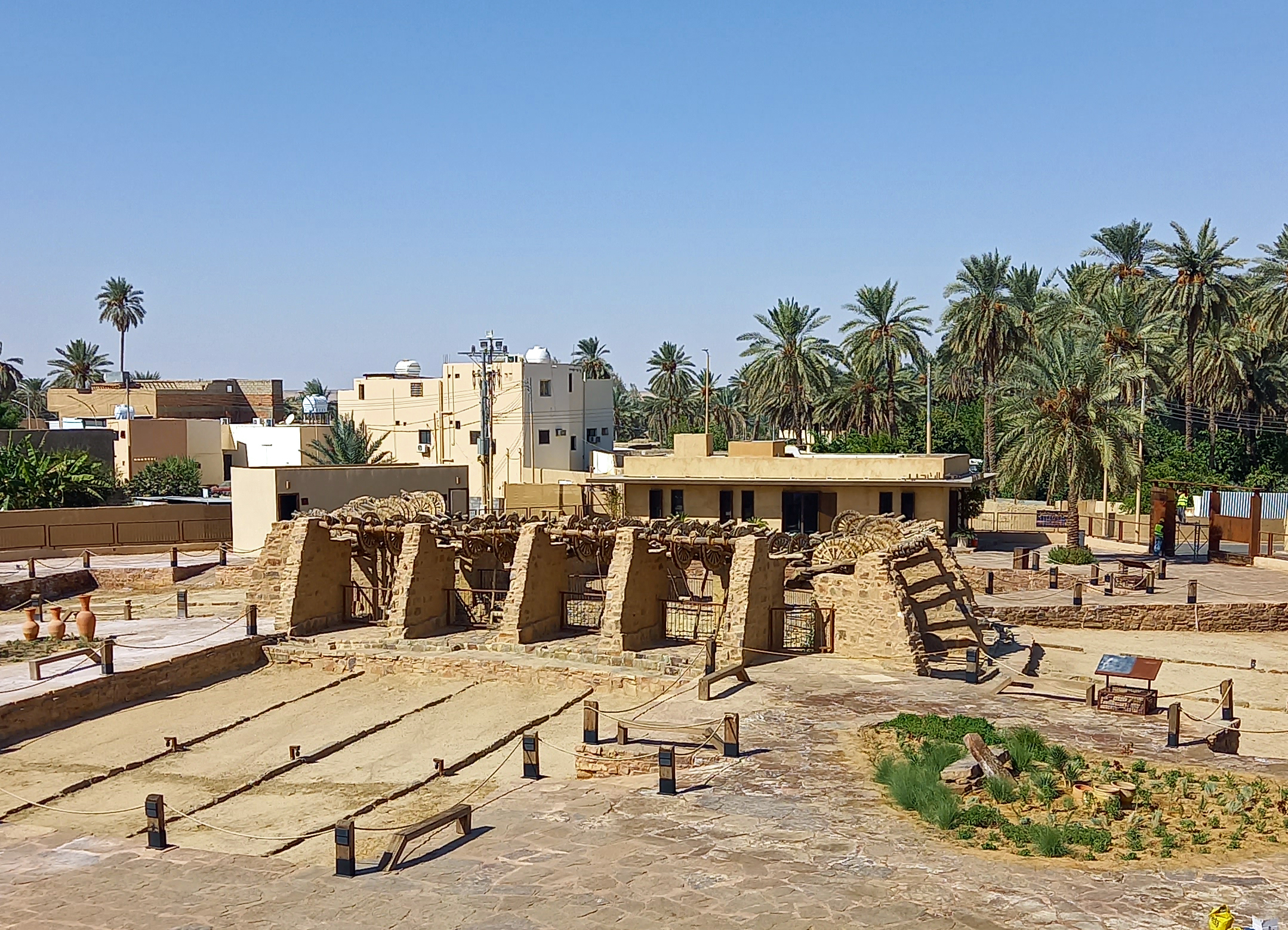
The single most iconic landmark in Tayma is Bir Haddaj, a monumental ancient well at the heart of the oasis. Dating to approximately the sixth century BCE, the well is roughly 18 metres in diameter and 13 metres deep — making it one of the largest historical wells in the Arabian Peninsula. For millennia, camel caravans stopped here to water their animals, and the well’s output sustained the oasis’s date palm agriculture. In 1954, King Saud ordered the installation of four modern pumps to increase water distribution to surrounding farms. Today the well is enclosed within a landscaped heritage park, and every Wednesday the “Tayma LIVE!” performance recreates the traditional water-drawing process with rope, pulley, and camel, accompanied by storytelling and music.
Tip: Time your visit for a Wednesday if possible. The Tayma LIVE! water-drawing demonstration at Bir Haddaj runs weekly and gives a vivid sense of the well’s practical importance over the centuries.
Qasr al-Hamra (The Red Palace)
Situated on a low rocky ridge overlooking the bed of an ancient lake to the north of the oasis, Qasr al-Hamra is a stone-built palace dating to approximately the seventh or sixth century BCE. Pottery found on-site suggests it may have been in use during the period of Nabonidus’s residence. The palace is divided into three sections: one used for worship and two for the residential and administrative needs of its occupants. Excavated by the Saudi Deputy Ministry of Antiquities and Museums from the late 1970s to the mid-1980s, and further investigated by the Saudi-German archaeological mission, it has been prepared for visitor access.
Qasr al-Radm
Located in the al-Mubbayat area of Tayma, Qasr al-Radm is a sixth-century-BCE palatial structure probably built under Nabonidus. It is rectangular, measuring approximately 34 by 25 metres, with walls up to 3.5 metres high and 2 metres thick. The sheer massiveness of the construction testifies to the resources Tayma commanded during the Babylonian period. Like Qasr al-Hamra, it was excavated in the 1970s and 1980s and is accessible to visitors today.
The Ancient Temple of Salm
Tayma’s pre-Islamic religious life centred on the worship of Salm, a deity attested in numerous Aramaic and Taymanitic inscriptions. The temple dedicated to Salm is one of the stops on the official Tayma Heritage Tour. An Aramaic stele discovered at the site — now housed in the Louvre — depicts the deity and provides one of the most important epigraphic sources for understanding pre-Islamic Arabian religion.
Al Naslaa Rock Formation
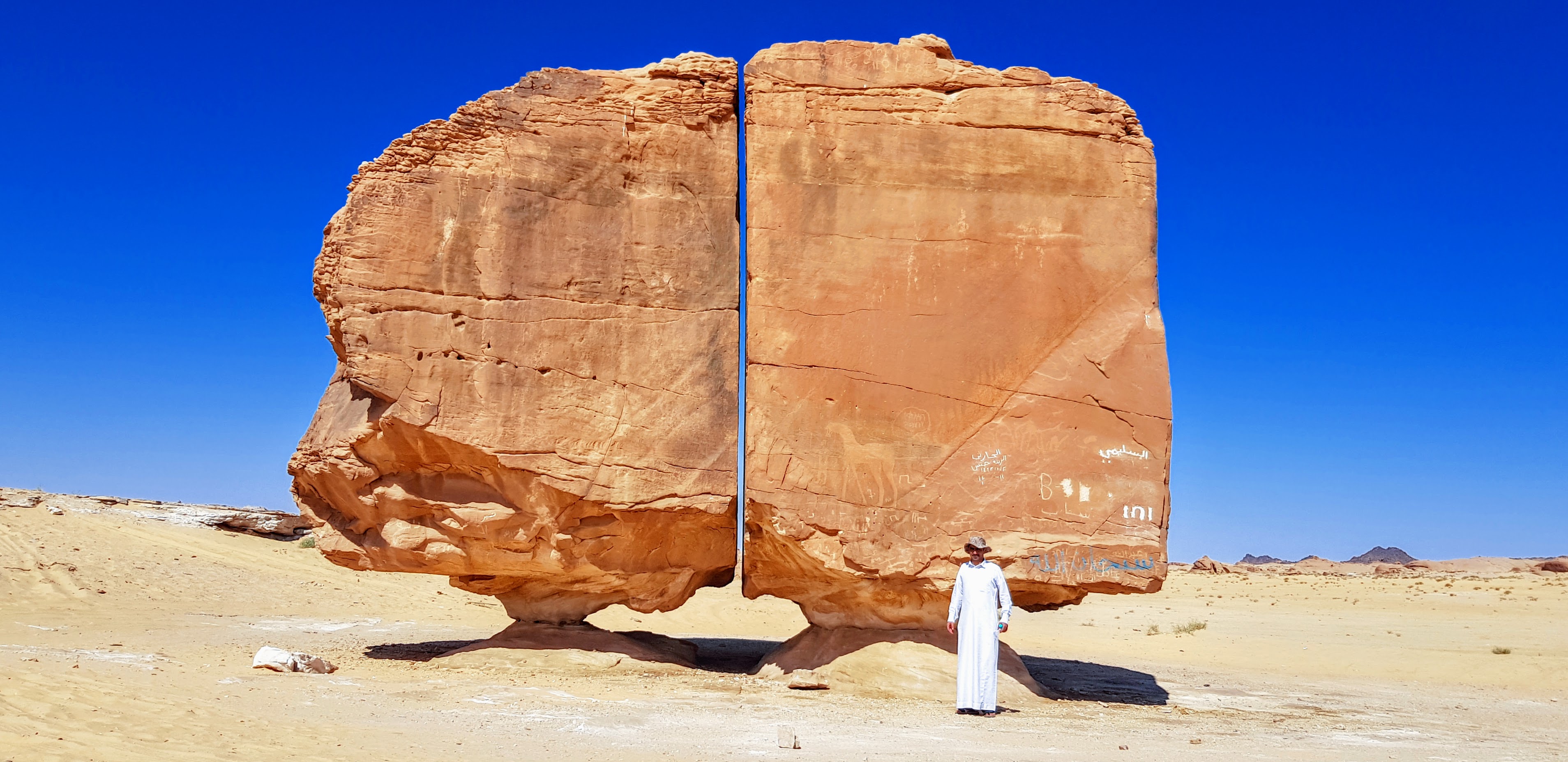
About 50 kilometres south of Tayma’s town centre, Al Naslaa is one of the most photographed geological curiosities in Saudi Arabia. It consists of two sandstone boulders, each roughly 6 metres high and together about 9 metres wide, balanced on narrow natural pedestals and separated by a perfectly straight vertical gap that looks as if it were cut by a laser. The split is entirely natural — geologists attribute it to a combination of tectonic stress along a fault line and millennia of freeze-thaw weathering and wind erosion. The southeast face of the rock is covered in petroglyphs depicting Arabian horses, ibexes, and human figures, believed to be thousands of years old. No visit to the Tayma area is complete without seeing Al Naslaa.
Note: Al Naslaa is located outside the main oasis and requires a vehicle to reach. If you are on the organised Experience AlUla day trip, check whether the itinerary includes a stop here — not all tours do.
Qasr al-Bajidi (Abbasid Palace)
The first confirmed Islamic-period palace excavated at Tayma, Qasr al-Bajidi dates to the Abbasid era. It is square in plan with circular towers at each corner, and sections of its walls bear Arabic inscriptions that document its historical period. It provides a fascinating contrast to the pre-Islamic palaces and demonstrates that Tayma remained a settlement of political and administrative importance well into the Islamic centuries.
Qasr Ibn Rumman
For a more recent layer of history, Qasr Ibn Rumman is a castle that served as the residence and administrative centre of the governor of Tayma. The core structure dates to the seventeenth century, with major additions between 1916 and 1919. King Saud visited the palace in 1954. In 2022, the Heritage Commission registered it as one of 37 new urban heritage sites in Tabuk Province on the National Register of Architectural Heritage. While the interior is not currently open to visitors, the external walls and towers are impressive and the castle is only a short walk from Bir Haddaj. On weekends, the “Palace Guest” live performance offers an immersive show about the history of the building.
Tayma Museum
The regional museum covers every period of human occupation at the oasis, from Paleolithic stone tools through Bronze Age ceramics, Babylonian artefacts, Nabataean pottery, Islamic manuscripts, and objects from the early Saudi state. Exhibits provide geological context for the oasis’s formation and explain its role in the wider Arabian trade network. The museum was renovated as part of the Saudi government’s Ninth Development Plan for regional museums.
Al-Najm Heritage Souq
Adjacent to Bir Haddaj, the Al-Najm Heritage Souq is a restored traditional marketplace where local artisans sell crafts, textiles, and food. It is the most atmospheric place in Tayma to buy a souvenir or sample local cuisine. On tour days, the souq is incorporated into the heritage circuit.
Rock Art: Jebel Ghunaim and Jebel Habib
The desert around Tayma is rich in rock art. At the summit of Jebel Ghunaim, 14 kilometres southeast of the oasis, archaeologists have documented figures of ibexes and domestic cattle alongside Taymanitic inscriptions. Jebel Habib, a half-dome rock with a large flat surface, features extensive petroglyphs in a dramatic setting where wind-blown sand drifts against the rock face like frozen waves. These sites are best accessed with a 4WD vehicle and a local guide.
The Tayma City Wall
Although much of the original 18.2-kilometre wall has eroded or been built over, substantial sections remain visible on the southern and western edges of the oasis. Walking or driving alongside the remnants gives a visceral sense of the scale of the Bronze Age settlement. Interpretive panels have been installed at key points along the surviving stretches.
How to Get to Tayma
Tayma does not have its own airport or railway station. Access is by road, either independently or via an organised tour from AlUla.
From Tabuk
Tayma is 264 kilometres southeast of Tabuk city, a drive of approximately three hours on Route 375. Tabuk has a domestic and limited international airport (TUU) with flights from Riyadh, Jeddah, and other Saudi cities on Saudia and flynas. From Tabuk airport, you can rent a car — the road to Tayma is well-maintained and fully paved. This is the most practical option if you are also visiting Wadi Disah or NEOM in Tabuk Province.
From AlUla
Tayma is approximately 230 kilometres northeast of AlUla, about three hours by road. This is the most popular tourist route because the Royal Commission for AlUla runs organised Tayma Heritage Tour packages that include return transport in a luxury coach, a local expert guide, and access to all six heritage highlights. Tickets can be booked through tickets.experiencealula.com or the Experience AlUla website. Day-trip packages start at 95 SAR (approximately USD 25) for a self-drive entry ticket, or 395 SAR (approximately USD 105) including return coach transport from AlUla. If you are already visiting Hegra, Elephant Rock, or Dadan, adding Tayma as a day trip is highly recommended.
From Medina
Tayma is approximately 400 kilometres north of Medina. The drive takes roughly four hours via Route 375. This route is viable if you are on a road trip from Medina to Tabuk or AlUla and want to stop en route.
From Hail
The city of Hail lies about 400 kilometres to the east. Travellers combining a visit to Hail’s Jubbah rock art (a UNESCO World Heritage Site) with Tayma can do so in a multi-day road trip across the northern Nafud.
Visa note: All visitors to Saudi Arabia require a visa. Citizens of 63 countries can obtain a tourist e-visa online in minutes. See our Saudi Arabia visa guide for full details, fees, and processing times.
Getting Around Tayma
Public transport within Tayma is extremely limited. The practical options are:
- Rental car: The most flexible option. Roads within and around the oasis are paved, though reaching some rock-art sites (Al Naslaa, Jebel Ghunaim) may require a 4WD or at least a vehicle with good clearance.
- Organised tour: The Experience AlUla heritage tour provides a guide and transport between the main sites within Tayma. This is the easiest option for those without a car.
- Taxi / ride-hail: Local taxis exist but are not always easy to find. Ride-hailing apps such as Careem and Uber have limited coverage in Tayma.
- Amali Serviced Apartments (Tayma): Air-conditioned apartments with free WiFi and private parking. A solid budget choice, centrally located.
- Fndk Bit Alamana Aparthotel: Seven rooms, located 4.3 km from Bir Haddaj. Basic but clean.
- Johra Alamakn Tayma: Within a 10-minute drive of Bir Haddaj. Offers luggage storage and basic amenities.
- Al-Najm Heritage Souq: The best place to try local specialities during tour days. Vendors sell fresh dates, Arabic coffee, and traditional breads.
- Local restaurants: Several small restaurants in the town centre serve kabsa (spiced rice with chicken or lamb), mutabbaq (stuffed flatbread), and grilled meats. Prices are very reasonable — a full meal typically costs 20–40 SAR (USD 5–11).
- Tayma dates: The oasis is famous for its date palms. Khalas and Sukkari varieties from Tayma are prized across Saudi Arabia. Buy them fresh from the souq or from roadside stalls.
- Tayma LIVE! (Wednesdays): A demonstration of traditional water-drawing from Bir Haddaj using ropes, pulleys, and camels, accompanied by storytelling, poetry, and music.
- The Palace Guest (weekends): An immersive live show at Qasr Ibn Rumman, offering insight into the castle’s history through dramatic re-enactment.
- King Nabonidus’ Parade (weekends): A colourful procession celebrating the Babylonian king’s decade in Tayma, with costumes, music, and theatrical narration.
- Dress code: Saudi Arabia’s dress code for tourists is relaxed but modest. In Tayma, lightweight long trousers and a loose-fitting shirt are ideal for both cultural respect and sun protection. Women do not need to wear an abaya but should cover shoulders and knees.
- Sun protection: Even in winter, the desert sun is fierce. Bring a wide-brimmed hat, sunglasses, and high-SPF sunscreen. Carry at least two litres of water per person if you plan to walk between sites.
- Photography: Tayma is exceptionally photogenic. The best light for ruins photography is the golden hour (first and last hour of sunlight). Al Naslaa is best photographed in the morning, when the sun illuminates the southeast petroglyph face.
- Cash: Some vendors in the souq may not accept cards. Carry Saudi riyals in small denominations. For more on money in Saudi Arabia, see our currency guide.
- Mobile coverage: 4G coverage is available in Tayma town via STC and Mobily. Remote rock-art sites may have weak or no signal. See our SIM card guide for advice on getting connected.
- Respect the sites: Do not climb on ruins, touch petroglyphs, or remove any objects. Saudi Arabia enforces strict heritage-protection laws with heavy fines.
- Day 1–3: AlUla — Hegra, Elephant Rock, Dadan, Jabal Ikmah, AlUla Old Town
- Day 4: Day trip to Tayma from AlUla (or drive to Tayma and overnight)
- Day 5: Drive from Tayma to Tabuk
- Day 6: Wadi Disah day trip from Tabuk
- Day 7: NEOM or flight out from Tabuk
- Tabuk Travel Guide — Gateway to NEOM, Wadi Disah, and northwest Saudi Arabia
- AlUla Travel Guide 2026 — Hegra, Elephant Rock, desert camps, and ancient Arabia
- Hegra (Madain Saleh) Guide — Saudi Arabia’s Petra and first UNESCO World Heritage Site
- Dadan Archaeological Site — The ancient Lihyanite capital near AlUla
- Hail Region Guide — Desert heritage, Jubbah rock art, and traditional hospitality
- Saudi Arabia Travel Guide 2026 — The complete guide to visiting the Kingdom
- Saudi Arabia Visa Guide — Every visa type explained
Best Time to Visit Tayma
Tayma has a subtropical desert climate (Köppen BWh) with very hot summers and mild winters. Annual rainfall averages only 65 mm, falling mostly between November and March.
| Season | Months | Daytime High | Notes |
|---|---|---|---|
| Peak (best) | November – February | 18–24 °C | Ideal for walking archaeological sites; cool evenings require a jacket |
| Shoulder | March – April, October | 25–32 °C | Warm but manageable; fewer visitors than peak months |
| Off-season | May – September | 38–45 °C | Extreme heat; most outdoor sites uncomfortable; some tours suspended |
Tip: If you are visiting during AlUla’s winter season (October to March), Tayma tours are most reliably available and the weather is at its best. The live performances (Tayma LIVE!, Palace Guest, King Nabonidus’ Parade) typically run during this period.
Where to Stay
Tayma is not yet a major hotel destination. Accommodation is limited to a handful of budget and mid-range options:
Prices start at approximately 180–250 SAR (USD 48–67) per night. Booking in advance is advisable, particularly during the winter tourism season. For a wider range of hotels, many visitors choose to base themselves in AlUla — which has luxury resorts, boutique hotels, and desert camps — and visit Tayma as a day trip. Alternatively, Tabuk city has international-standard hotels and is a three-hour drive away. For a general overview of accommodation across the Kingdom, see our Saudi Arabia hotels guide.
Food and Dining
Tayma’s dining scene is simple and authentic. Expect local Saudi and Levantine food rather than international restaurants.
If you are on the organised day trip from AlUla, lunch is typically included in the package. For more on Saudi cuisine, see our Saudi Arabia food guide.
Live Performances and Cultural Events
The Royal Commission for AlUla has introduced a programme of live performances that bring Tayma’s history to life. As of the 2025–2026 winter season, these include:
These performances run during the AlUla winter season. Check the Experience AlUla website for the current schedule and any booking requirements.
Tayma and UNESCO
In 2023, Saudi Arabia submitted “The Ancient Walled Oases of Northern Arabia” to the UNESCO Tentative List. This serial nomination includes four sites: Tayma, Qurayyah, Dumat al-Jandal, and al-Ha’it (ancient Fadak). The nomination recognises the sites as “exceptionally long-standing sedentary settlements which are a testimony to the legacies of successive civilisations from the Bronze and Iron Ages through to the Classical and Islamic periods.” Two of the four — Tayma and Qurayyah — predate the domestication of the camel, demonstrating that permanent oasis settlement in Arabia was not dependent on camel transport. Full UNESCO inscription could come within the next few years and would place Tayma alongside Hegra and Saudi Arabia’s other World Heritage Sites.
Practical Tips
Suggested Itinerary: One Day in Tayma
The following itinerary assumes you have your own vehicle or are on the organised heritage tour.
| Time | Activity | Duration |
|---|---|---|
| 08:00 | Arrive at Tayma Museum — orient yourself with the history | 45–60 min |
| 09:00 | Bir Haddaj well and Al-Najm Heritage Souq | 45 min |
| 10:00 | Walk to Qasr Ibn Rumman (exterior view) | 30 min |
| 10:30 | Drive to Qasr al-Hamra | 45 min |
| 11:30 | Qasr al-Radm and the Ancient Temple of Salm | 60 min |
| 12:30 | Lunch at a local restaurant or the souq | 60 min |
| 13:30 | Drive to the Tayma city wall (southern sections) | 30 min |
| 14:00 | Drive to Al Naslaa rock formation | 90 min (including drive time) |
| 15:30 | Return to Tayma or onward travel to AlUla / Tabuk | — |
If you have two days: Add the Jebel Ghunaim and Jebel Habib rock-art sites on day two (ideally with a local guide and a 4WD). Spend the extra evening exploring the oasis on foot, visiting local date farms if the season is right (August–October for the harvest).
Tayma in Context: Combining with AlUla and Tabuk
Tayma sits almost exactly between AlUla and Tabuk, making it a natural stop on a road trip through northwest Saudi Arabia. A recommended multi-day circuit might look like:
For a full multi-day plan across the Kingdom, see our Saudi Arabia itinerary guide.