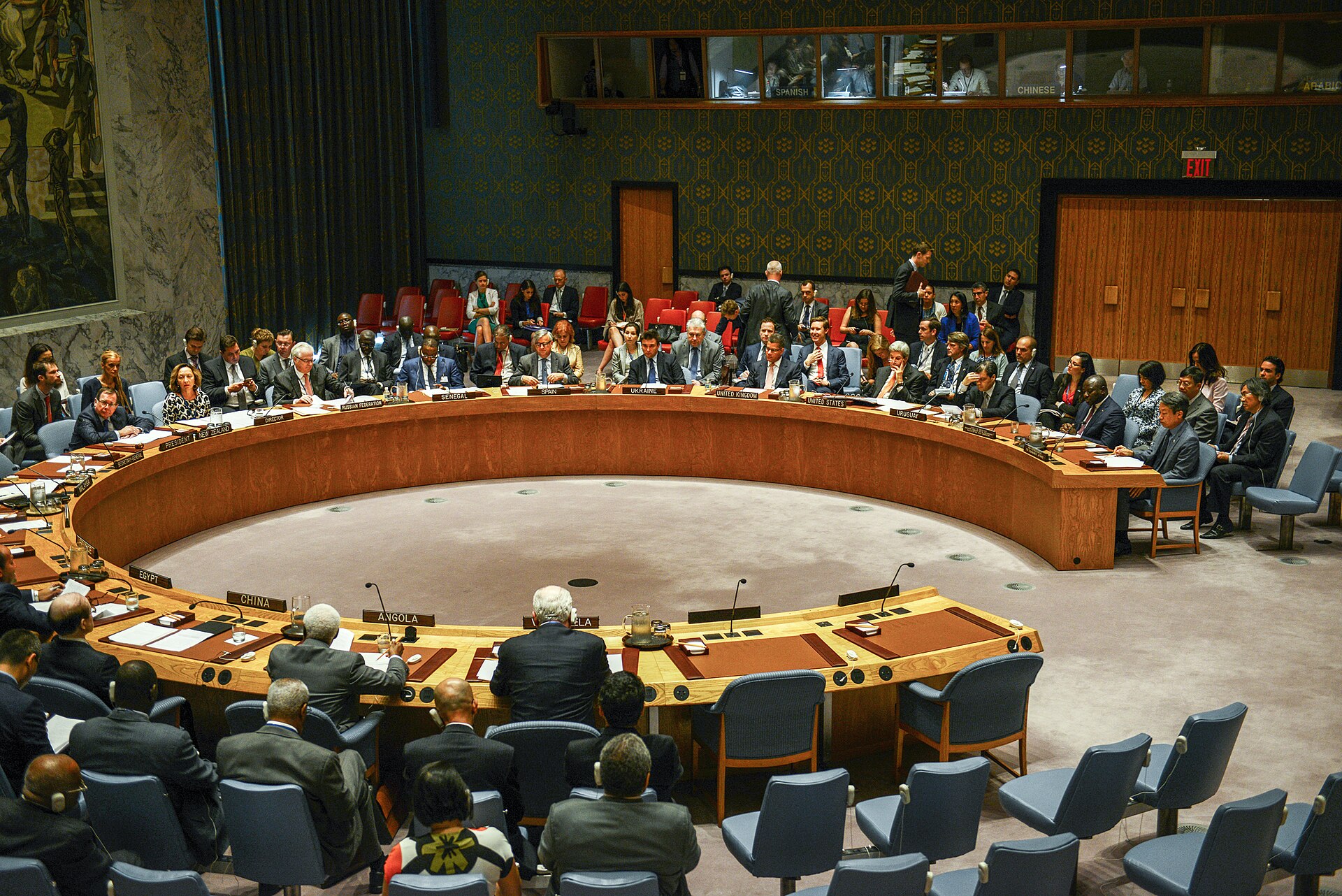
UNITED NATIONS — Russia and China vetoed the United Nations Security Council resolution on the Strait of Hormuz on April 7, killing the last multilateral mechanism available to the Gulf states before President Trump’s 8pm ET deadline. The vote was 11–2, with Colombia and Pakistan abstaining. The resolution — six drafts removed from its original Chapter VII language authorizing “all necessary means” — had been reduced to a non-binding text that merely “strongly encourages” defensive coordination. Moscow and Beijing blocked it anyway.
For Saudi Arabia, the result is not a diplomatic failure. It is the structural precondition Riyadh spent fifteen days engineering: the formal exhaustion of every peaceful remedy under international law, completing the legal architecture required to act under Article 51 of the UN Charter without the Security Council’s blessing or constraint.
The veto landed nine hours before the Trump deadline. Within that compressed window, the Gulf states’ legal position shifted from aspirational to operative. Three frameworks now stack: UNSCR 2817 condemning Iranian attacks, passed 13–0 on March 11; the six-nation Article 51 joint declaration filed March 26–27; and the confirmed inability of the Security Council to act, sealed by the April 7 veto. Together, these satisfy every doctrinal prerequisite for collective self-defense under the UN Charter.
Table of Contents
- The Vote: 11–2–2
- How Six Drafts Stripped a Resolution to Its Skeleton
- Why Was the Veto Better for Saudi Arabia Than Passage?
- The Legal Trivet: Three Frameworks That Stack
- What Does Article 51 Actually Permit After the Veto?
- What Did Russia and China Gain by Vetoing?
- The Taif Question: Hosting Rights and Plausible Deniability
- Oman’s Bilateral Track as Iran’s Mirror Liability Transfer
- The Nine-Hour Gap
- Frequently Asked Questions
The Vote: 11–2–2
The eleven affirmative votes came from the United States, France, the United Kingdom, Bahrain (the lead drafter), the Democratic Republic of the Congo, Denmark, Greece, Latvia, Liberia, Panama, and Somalia. Russia and China voted against. Colombia and Pakistan abstained. The margin — eleven of fifteen members in favor — would have been sufficient to pass any resolution not subject to a permanent-member veto.
US Ambassador to the UN Mike Waltz said after the vote: “I commend Bahrain and everyone who voted with this resolution for saying enough is enough.” He accused Moscow and Beijing of backing “a regime that seeks to intimidate the Gulf into submission.” Russian Ambassador Vassily Nebenzia responded that the United States and Israel bore responsibility for “starting the war and sparking an expanding global crisis,” and that “the most urgent priority now is to end military operations immediately” rather than authorize naval force.
Chinese Ambassador Fu Cong framed the veto in broader terms. “Under the current circumstances, authorizing member states to use force would essentially legitimize the illegal and abusive use of force, which would inevitably lead to further escalation of the situation and cause serious consequences,” he told the chamber. The final text did not authorize force. It “strongly encouraged” defensive coordination. Fu’s objection was to the text’s existence, not its operative clauses.
The Middle East briefing 3,000+ readers start their day with.
One email. Every weekday morning. Free.
Pakistan’s abstention carried its own signal. Islamabad had brokered the Islamabad Accord — a separate, immediate ceasefire MOU with a 15–20 day timeline — and Iran rejected that framework alongside the Witkoff 45-day phased plan. By abstaining rather than voting yes, Pakistan preserved its mediator status with Tehran at the cost of alignment with its Gulf financial patrons. Colombia’s abstention followed a similar logic: Bogotá had no equities in the Gulf but maintained diplomatic relations with Iran and avoided taking a position it could not operationally support.
How Six Drafts Stripped a Resolution to Its Skeleton
Bahrain circulated the zero draft on March 21, four days after UNSCR 2817 passed with thirteen votes condemning Iranian attacks across six Gulf states and Jordan. The original text invoked Chapter VII of the UN Charter and authorized member states “to use all necessary means in and around the Strait of Hormuz to secure transit passage and repress, neutralise, and deter attempts to close, obstruct, or otherwise interfere with international navigation.” The language was modeled on Resolution 678, the 1990 authorization for the Gulf War.
Six revisions followed over fifteen days. France requested closed consultations on April 1 and co-drafted parallel language emphasizing strictly defensive parameters. Two silence procedures were broken — meaning at least one Council member formally objected to adoption without a vote — forcing each revision back to negotiation.
| Draft | Date | Key Operative Language | Legal Basis |
|---|---|---|---|
| Zero draft | March 21 | “all necessary means… to secure transit passage and repress, neutralise, and deter” | Chapter VII |
| Revision 2 | Late March | “all necessary means commensurate with circumstances” | Chapter VII removed; self-defense reference retained |
| Revision 4 | Early April | “all defensive means necessary” | Non-binding; defensive qualifier added |
| Final text (blue) | April 6 | “strongly encourages… coordinate efforts, defensive in nature, commensurate to the circumstances, to ensure freedom of navigation” | Non-binding; no Chapter VII; no authorization of force |
The final text reaffirmed the rights of member states “to defend their vessels from attacks and provocations, in accordance with international law,” and demanded Iran “immediately halt attacks on merchant and commercial vessels.” It contained no enforcement mechanism, no sanctions trigger, and no authorization for any member state to do anything it could not already do under existing international law. Russia and China vetoed it regardless.
The degradation was not a failure of Bahraini diplomacy. It was the documented record of exhaustion — each step-down preserved in the Security Council’s procedural archive, each concession rejected, each attempt to find language Moscow and Beijing could accept met with objection. That archive is now part of the legal foundation for what comes next.
Why Was the Veto Better for Saudi Arabia Than Passage?
Had the final text passed, it would have established a functioning — if toothless — Security Council framework for Hormuz. A non-binding resolution “strongly encouraging” defensive coordination would have signaled that the UN system was still engaged, still producing outputs, still nominally responsible for international peace and security in the strait. Under those conditions, any Gulf state invoking Article 51 for collective self-defense would have faced the argument that the Security Council had already “taken the measures necessary to maintain international peace and security” — the precise language in Article 51 that limits the right of self-defense.
The veto eliminates that argument. Article 51 states: “Nothing in the present Charter shall impair the inherent right of individual or collective self-defence if an armed attack occurs against a Member of the United Nations, until the Security Council has taken the measures necessary to maintain international peace and security.” The operative word is “until.” The Security Council has now demonstrated, on the record, that it cannot take those measures. The P5 veto is the mechanism by which the “until” clause ceases to apply.
Daniel Forti of the International Crisis Group had flagged this dynamic before the vote. “It is hard to see them supporting a resolution that treats stability in the strait exclusively as a security issue, instead of one that also grapples with the need for a durable political end to the hostilities,” he said of Russia and China’s position. The framing was accurate as diplomatic analysis. As legal consequence, the refusal to treat Hormuz as a security issue is what freed the Gulf states to treat it as one themselves.
The Legal Trivet: Three Frameworks That Stack
The Gulf states’ legal position now rests on three independent and mutually reinforcing instruments, each addressing a different doctrinal requirement for the lawful use of force in self-defense.
UNSCR 2817, passed March 11, provides the first leg. It passed 13–0 with Russia and China abstaining (not vetoing) and 134 co-sponsors. The resolution condemned Iran’s “egregious attacks” against Bahrain, Kuwait, Oman, Qatar, Saudi Arabia, the UAE, and Jordan. It established the factual predicate — that armed attacks had occurred against UN member states — without ambiguity. Russia and China’s choice to abstain rather than veto on March 11, and then veto on April 7, is itself a data point: they accepted the factual record of Iranian aggression but refused any collective response to it.
The six-nation Article 51 joint declaration of March 26–27 provides the second. Saudi Arabia, the UAE, Kuwait, Bahrain, Qatar, and Jordan formally invoked the inherent right of individual and collective self-defense under Article 51. All six states had been struck by Iranian missiles or drones since February 28. The declaration was filed with the Security Council, satisfying the Charter’s requirement of immediate reporting. It established the collective nature of the invocation — not six individual claims, but a coordinated, mutual-defense framework.
The confirmed P5 veto on April 7 provides the third. The Security Council’s inability to act, caused by the vetoes of two permanent members, formally exhausts the multilateral track. The “until” clause in Article 51 — “until the Security Council has taken the measures necessary” — no longer constrains the timeline of self-defense action, because the Council has proven unable to take any measures at all.
The GCC’s own institutional architecture reinforces the third leg. Article 4 of the GCC Joint Defence Agreement (2000) commits member states to “proceed promptly to assist any State or States within the Gulf Cooperation Council that suffer aggression… by taking any necessary action, including the use of military force” — explicitly grounded in Article 51. The GCC 50th Extraordinary Ministerial Council on March 1 affirmed that any aggression against one member constitutes aggression against all under the GCC Charter. The regional and international legal instruments now point in the same direction.
What Does Article 51 Actually Permit After the Veto?
Article 51 permits the use of armed force in collective self-defense against an ongoing armed attack, subject to three constraints: proportionality, military necessity, and immediate notification to the Security Council. The veto does not waive these requirements. It removes the temporal limitation — the “until” clause — that would otherwise require Gulf states to defer to Council action. It opens the legal door. It does not eliminate the rules inside the room.
Proportionality means the response must be commensurate with the threat. Saudi Arabia has intercepted 799 drones and 95 ballistic missiles — 894 objects total since March 3 — at an implied cost of $3.49 billion in PAC-3 MSE rounds alone. Iran’s attacks have struck Ras Tanura, triggered a SABIC fire at Jubail, and put the King Fahd Causeway on the IRGC’s published counter-target list. The proportionality baseline is not hypothetical. It is documented in satellite imagery and force majeure declarations.
Military necessity requires that any action be directed at a legitimate military objective. The IRGC’s declaration on April 7 that “restraint is removed” — issued through Tasnim News Agency after severing all diplomatic channels — provides the adversary’s own statement of intent. The IRGC has pre-committed to retaliating against Gulf energy infrastructure in the event of further strikes on Iranian territory. The military objectives available under necessity doctrine are defined, in part, by Iran’s own public targeting posture.
Immediate notification to the Security Council is procedural, not substantive. The six-nation Article 51 declaration already filed in late March satisfies the reporting requirement’s spirit; any subsequent action would require a supplementary notification, which can be filed simultaneously with or immediately after the operation. The Kosovo precedent is instructive: NATO’s 78-day campaign against Yugoslavia in 1999 proceeded without UNSC authorization after Russia threatened a veto. The Independent International Commission on Kosovo termed the intervention “illegal but legitimate.” The Gulf states’ position in April 2026 is stronger — they have a filed Article 51 invocation, a confirmed (not merely threatened) veto, and a prior UNSC resolution establishing the factual predicate of armed attack.
What Did Russia and China Gain by Vetoing?
Russia’s oil and LNG export earnings have averaged 510 million euros per day — approximately $588 million — during the conflict, roughly 14 percent above pre-war levels in February 2026. Brent crude at approximately $109.77 per barrel has delivered a windfall to Moscow that dwarfs the cost of a diplomatic confrontation with the Gulf states at the Security Council. Russia’s veto preserved the conditions under which that windfall continues: sustained conflict, constrained Gulf exports, and elevated global energy prices.
Nebenzia’s post-vote statement — that the priority was to “end military operations immediately” rather than authorize naval force — was consistent with a power that benefits from the war’s continuation while advocating for its cessation. The Russian position requires no cynicism to decode. It is arithmetically visible in IEA export data.
China’s calculus is more layered. CNPC holds a 27-year, 4-million-tonne-per-year LNG contract with QatarEnergy and a 5 percent equity stake in North Field East Train 1. Sinopec holds a near-identical contract and equity position in a second NFE train. Together, these represent 8 million tonnes per year of contracted Chinese LNG that must transit Hormuz. Beijing brokered the passage of Qatar’s Al Daayen LNG carrier through the strait on April 6 — the first laden LNG exit since the war began — using CNPC/Sinopec’s contracted offtake as structural motivation. China is simultaneously protecting its LNG supply chain through bilateral deals with Iran and blocking the multilateral framework that would formalize safe passage for everyone.
Fu Cong’s argument — that the resolution would “legitimize the illegal and abusive use of force” — was applied to a text that authorized no force. The final draft “strongly encouraged” defensive coordination. Beijing’s objection was not to the resolution’s content but to its existence as a precedent: any UNSC text addressing Hormuz, however weak, would have established the Council’s jurisdiction over the strait, constraining China’s preferred model of bilateral, Beijing-intermediated transit arrangements.
The Libya 2011 comparison clarifies the choice. On Resolution 1973 — which did authorize “all necessary means” — Russia and China abstained. They allowed the text to pass, then spent a decade arguing NATO had exceeded its mandate. In 2026, facing a text orders of magnitude weaker, they vetoed. The escalation from abstention to veto was not proportional to the text’s content. It was proportional to the geopolitical stakes: in 2011, Libya’s oil output was 1.6 million barrels per day. Hormuz carries 20 million.
The Taif Question: Hosting Rights and Plausible Deniability
Saudi Arabia authorized US access to King Fahd Air Base at Taif — approximately 900 kilometers from Iran’s nearest border — around March 23, abandoning decades of strategic ambiguity on hosting offensive operations against a regional power. The timing is relevant: the UNSC process was still live. Riyadh opened Taif while Bahrain was still circulating revised drafts, before the sixth revision was put in blue, before the vote was scheduled.
The question the veto sharpens is not whether Saudi Arabia has legal permission to act. The three-part legal architecture addresses that. The question is the mode of action. Two paths are available and they are not mutually exclusive.
Under the first path, the GCC acts as a collective under Article 4 of the Joint Defence Agreement, committing members to any necessary action, including the use of military force. This would be a Gulf-led operation with the six Article 51 declarants as co-belligerents, drawing on what Saudi Foreign Minister Prince Faisal bin Farhan described as “very significant capacities and capabilities that they could bring to bear should they choose to do so.” Trust in Iran, he added, had been “shattered.”
Under the second path, US forces operate from Taif and other Gulf-hosted bases under the existing bilateral security framework, while the Gulf states maintain a posture of defensive interception — Saudi Arabia’s documented air defense record — without conducting offensive strikes themselves. This preserves Riyadh’s position as a hosting partner rather than a striking party, a distinction that matters for post-war diplomatic reconstruction with Tehran and for Gulf states’ relationships with non-aligned powers.
The two paths are not sequential choices but simultaneous options. Saudi Arabia can host US offensive operations from Taif while conducting GCC collective defense operations under Article 51 and the Joint Defence Agreement. The legal instruments support both. The political question — how much direct Saudi military involvement is visible — is a calibration decision that Riyadh retains the ability to make on a day-by-day, operation-by-operation basis.
Oman’s Bilateral Track as Iran’s Mirror Liability Transfer
While the UNSC process played out in New York, Oman and Iran held talks at foreign ministry undersecretary level on April 4–5, negotiating bilateral Hormuz passage options. The Omani track operates outside the UN framework entirely. Iran’s willingness to discuss bilateral permits — country-by-country, vessel-by-vessel — while rejecting multilateral governance of the strait is itself a legal position: Tehran asserts sovereign control over Hormuz transit and offers bilateral concessions as an alternative to international law.
The bilateral permit model is a mirror image of the UNSC resolution’s liability structure, but inverted. Under a UNSC-authorized framework, the Security Council bears institutional responsibility for passage — attacks on vessels transiting under Council authority would constitute defiance of the UN system. Under the bilateral model, the permitting state (Iran) and the receiving state (Oman, or any Gulf state that negotiates individually) bear bilateral responsibility. If a permitted vessel is attacked by an IRGC unit operating under decentralized command — a scenario the IRGC’s fractured authorization structure makes plausible — the liability falls on the bilateral parties, not the international community.
Abdulaziz Sager, chairman of the Gulf Research Center, assessed the post-veto environment directly: “Any ceasefire would need to address Iran’s missile strike capabilities and control over the strait.” With the UNSC resolution blocked, “the future of Hormuz remains uncertain with prolonged instability.” The bilateral track does not resolve that instability. It privatizes it.
The Nine-Hour Gap
The UNSC vote concluded in the late morning of April 7, New York time. Trump’s deadline expires at 8pm ET — 00:00 GMT April 8. The gap between the vote and the deadline was approximately nine hours.
Within that window, the operational picture shifted on several axes simultaneously. Iran severed all remaining diplomatic channels on April 7. The IRGC declared through Tasnim that “restraint is removed.”
The 45-day ceasefire framework — brokered by Pakistan, Egypt, and Turkey, with Witkoff and Araghchi communicating by text — had already been rejected. The Islamabad Accord’s immediate ceasefire MOU was dead. The bilateral Oman-Iran passage talks had produced no public outcome. Every diplomatic offramp available before the vote remained closed after it.
The United States struck Kharg Island for the second time on April 7, hitting 50-plus military targets — air defenses, a naval base, radar installations, a helicopter hangar — while leaving the oil terminals operational. TankerTrackers confirmed the export infrastructure remained “fully operational.” The pattern of oil-sparing strikes — destroying military capacity while preserving revenue-generating infrastructure — is consistent with a coercive posture that treats Iran’s oil exports as a future bargaining chip rather than a current military target.
Saudi Arabia’s position as a potential ceasefire co-guarantor has not been formally abandoned. But the instruments available to Riyadh after 8pm ET on April 7 are different in kind from those available at 8am. The legal architecture is complete. The diplomatic track is exhausted. The PAC-3 MSE stockpile is down to approximately 400 rounds from an estimated 2,800, with Camden, Arkansas producing 620 per year — a replenishment rate that cannot sustain the current interception tempo. The defensive posture that has defined Saudi Arabia’s war since March 3 has a material expiration date independent of any political decision.
The veto did not create Saudi Arabia’s options. It documented, on the Security Council’s own record, that no other options remained.
Frequently Asked Questions
Did any previous UNSC resolution address Hormuz specifically before this vote?
No. UNSCR 2817, passed March 11, condemned Iranian attacks on six Gulf states and Jordan but did not mention Hormuz by name or address freedom of navigation in the strait. The vetoed April 7 resolution was the first text to place Hormuz transit directly before the Security Council for an operative vote. Previous references to Hormuz in Council proceedings appeared only in presidential statements and open debate transcripts, none of which carry binding or even recommendatory legal weight. The absence of any prior Hormuz-specific resolution means the April 7 veto cannot be characterized as blocking an update to existing authority — it blocked the creation of any UN framework for the strait for the first time.
Can Russia or China face consequences for vetoing?
Under current UN rules, no. General Assembly Resolution 76/262, adopted in April 2022, requires P5 members that cast a veto to explain their reasoning in a General Assembly session within ten working days. Russia and China will each be required to deliver such an explanation. The mechanism is procedural, not punitive — it carries no sanctions, no loss of voting rights, and no enforcement pathway. The United States has cast 46 vetoes on Middle East–related resolutions since 1972, more than any other P5 member on any single regional file. The structural immunity of the veto power is symmetrical across all permanent members.
Does the veto affect insurance and shipping rates through Hormuz?
War-risk insurance premiums for Hormuz transit were already at 2–5 percent of hull value before the vote, up from a pre-war baseline of 0.02–0.05 percent — a 100-fold increase. The veto removes the possibility that a UNSC-authorized naval escort framework could have provided insurers with a basis for rate reduction. Lloyd’s of London Joint War Committee had listed the entire Persian Gulf as a high-risk zone since March 4, 2026. Without a UN framework, that designation — and the associated premiums — will remain until either a ceasefire or a bilateral insurance guarantee (such as the Chinese-intermediated arrangements covering CNPC/Sinopec cargoes) replaces multilateral authority as the underwriting basis.
What is the difference between Article 51 and Chapter VII authorization?
Chapter VII authorization is granted by the Security Council and permits member states to use force on behalf of the international community to restore peace and security. Article 51 is an inherent right that exists independent of Council authorization — it permits member states to use force in self-defense until the Council acts. The practical difference after the April 7 veto: a Chapter VII resolution would have provided international legal cover, shared operational responsibility across the UN membership, and potentially included rules of engagement, geographic limits, and sunset clauses. Article 51 self-defense provides legal permission but no institutional framework — the acting states bear full responsibility for proportionality, targeting, and consequences. States acting under Article 51 after a veto operate in a legal grey zone that the Kosovo precedent (1999) established but never fully resolved: legitimate by necessity, contested by design.
Has Saudi Arabia ever invoked Article 51 before?
Saudi Arabia participated in the coalition response to Iraq’s invasion of Kuwait in 1990–91, which operated under both Chapter VII authorization (UNSCR 678) and Article 51 — Kuwait’s inherent right of self-defense and Saudi Arabia’s collective self-defense as a neighboring state under direct threat. The March 2026 invocation is the first time Saudi Arabia has filed an Article 51 declaration with the Security Council as a directly attacked party rather than as a coalition partner defending a neighbor. The six-nation joint declaration of March 26–27 is also the first collective Article 51 invocation by GCC member states acting as a bloc under the Joint Defence Agreement’s Article 4, which was adopted in 2000 but never previously activated for its intended purpose. The parallel NATO track has proven equally unactionable: Washington asked NATO allies for written Hormuz mine-clearance plans within days, but the alliance has no mine countermeasure vessels in theater to execute them.