
MBS joined a seven-nation call urging Trump to accept. The terms include Iranian enrichment rights Riyadh does not possess, a Hormuz reopening timeline Riyadh does not control, and sanctions relief that recapitalises the force that built the toll regime Saudi Arabia needs dismantled. The crown prince was demonstrating how little influence Saudi Arabia has left to exercise.
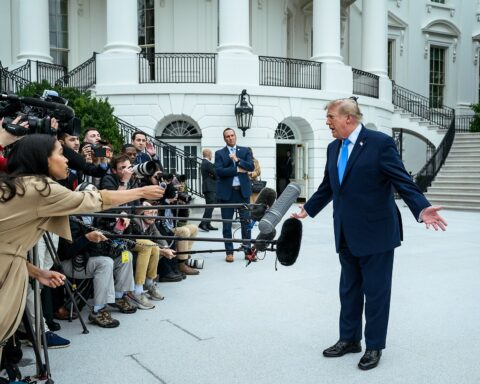
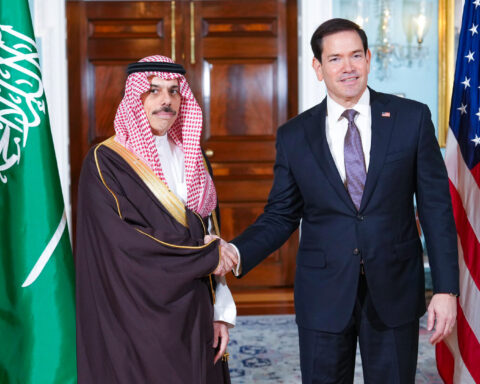
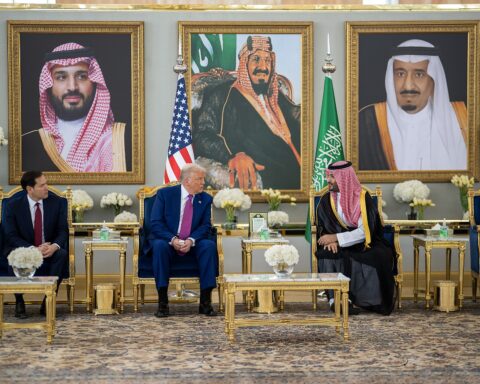
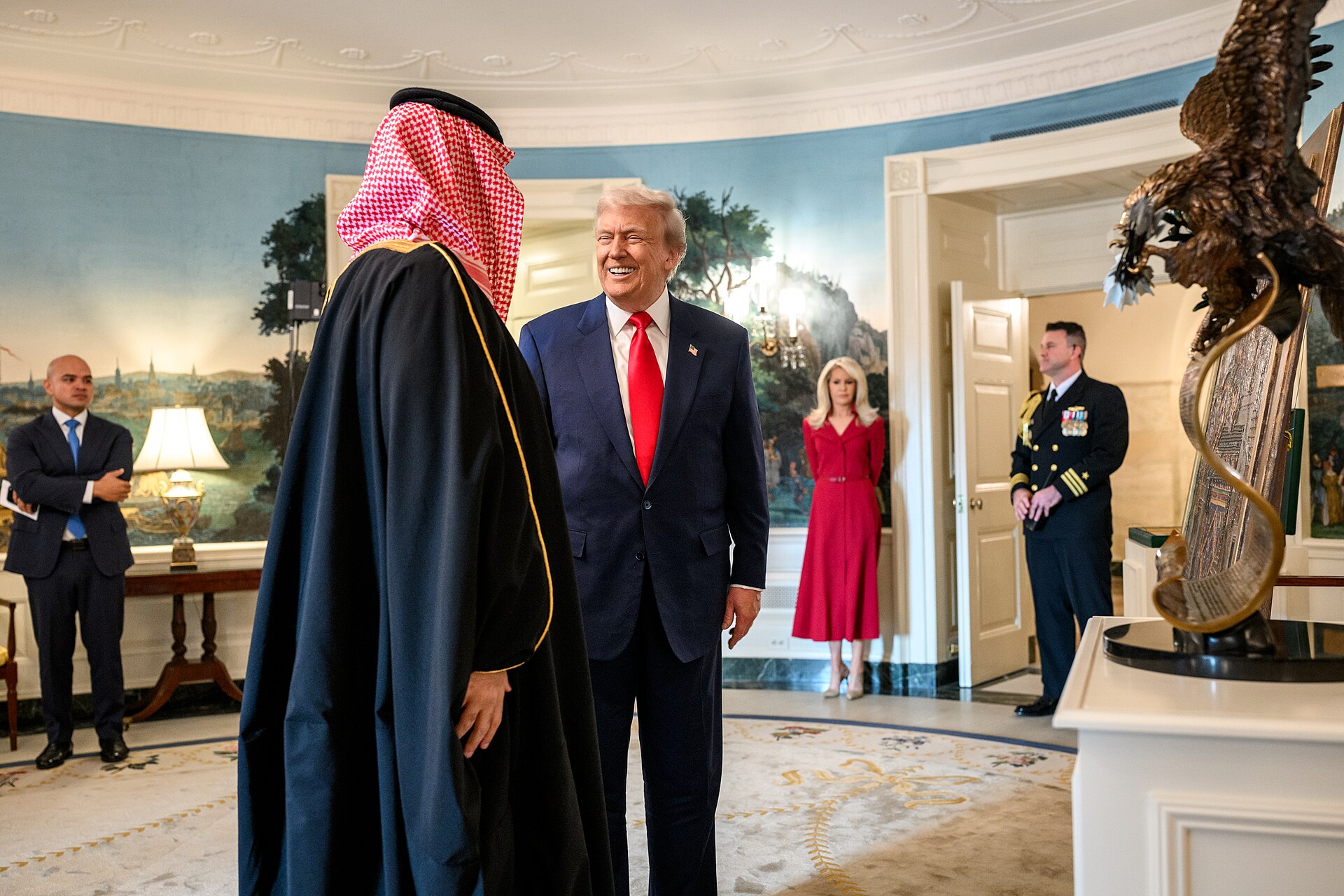
RIYADH — On Saturday afternoon, Mohammed bin Salman joined a conference call with the leaders of the UAE, Qatar, Egypt, Jordan, Turkey, and Pakistan. The purpose, according to Axios, was to urge Donald Trump to accept the Iran deal. A source briefed on the call described the collective message as straightforward: “Please stop the war for the benefit of the whole region.” Pakistani Prime Minister Shehbaz Sharif later identified MBS by name as having “prodded” Trump to suspend military operations in the waterway. Trump, who had cancelled weekend plans and skipped his son’s wedding to remain at the White House, told Axios it was a “solid 50/50” as to whether he would make a “good deal” or “blow them to kingdom come.” He set Sunday as his likely decision deadline.
The call was not unusual in format. Multi-leader calls between Gulf heads of state and the American president have precedent stretching back to the Obama administration. What made this one structurally different was the position from which Saudi Arabia was calling. Every prior Saudi intervention in the Iran crisis — the PSAB basing block in early May, the Bin Farhan endorsement of Trump’s strike cancellation on May 20, the co-sponsorship of the UN Security Council resolution Russia and China vetoed — could be read as defensive positioning. Riyadh was reacting to events, managing exposure, buying time. The May 23 call was qualitatively different. Saudi Arabia was no longer shielding itself from the consequences of a deal it did not negotiate. It was actively lobbying for one.
That distinction matters because the deal on the table, as described by the Financial Times, CNBC, and multiple diplomatic sources, contains provisions that damage Saudi Arabia’s strategic position on at least three axes: enrichment, oil revenue, and Hormuz governance. The question is not whether MBS should have made the call. Given the alternatives — resumed US strikes that risk Iranian retaliation against Saudi economic infrastructure, a prolonged Hormuz closure that compounds an acute fiscal crisis — the call was arguably the least bad option. The question is what the call reveals about where Saudi Arabia now sits in a negotiation it has spent 106 days trying to influence and has consistently failed to shape. The enrichment asymmetry embedded in those terms — and what the phrase “largely negotiated” specifically costs Saudi Arabia on three structural axes — is examined in detail here.
Netanyahu’s May 24 call to Trump raised a specific objection to the framework’s Lebanon clause — a second front on which Saudi Arabia has no channel, no leverage, and no seat. The Lebanon clause has no dedicated resolution mechanism and adds a veto that neither Riyadh’s lobbying nor the MOU’s structure can remove. The fiscal sequencing that results — Saudi Arabia’s $80 billion deficit waiting on a 60-day Hormuz pause, then a Track 2 nuclear negotiation Iran has already declared deadlocked — is examined in full here.
Table of Contents
- The Framework Saudi Arabia Is Endorsing
- The Enrichment Asymmetry MBS Cannot Escape
- The Fiscal Trap at the End of the Ceasefire
- The Hormuz Question Tehran Decoupled
- What MBS Refused Before He Lobbied
- The JCPOA Precedent, Compounded
- The Signal Tehran Received
- What Saudi Arabia Is Actually Getting
- The Crown Prince and the 50/50
- Frequently Asked Questions
The Framework Saudi Arabia Is Endorsing
The deal MBS urged Trump to accept is not a final agreement. Mediators describe it as a 60-day ceasefire extension with a nuclear framework commitment, gradual Hormuz reopening, eased sanctions, and phased unfreezing of Tehran’s overseas assets. A diplomat briefed on the talks told the FT: “The deal seems to be going in the right direction. It’s with the Americans now for review.” Iran’s Foreign Ministry spokesman Esmaeil Baghaei confirmed the broad structure — a 14-clause memorandum of understanding as an initial agreement, with details to be negotiated within 30 to 60 days — while specifying that nuclear issues are “not part of the initial framework.” The Washington Times reported that a draft proposal was agreed early Saturday and was expected to be announced within 24 hours, having been approved by Ghalibaf, Vance, Witkoff, and Kushner before being sent to both leaders for final sign-off.
The Middle East briefing 3,000+ readers start their day with.
One email. Every weekday morning. Free.
This framework contains at least three elements that work against Saudi interests, and Saudi Arabia shaped none of them. First, the enrichment moratorium — the gap between Iran’s proposed five years, the Axios MOU framework’s 12-15 years, and the original US demand of 20 years — is converging somewhere around 12, according to three sources who spoke to Axios. Whatever the final number, the moratorium preserves Iran’s enrichment rights in principle. Araghchi has stated repeatedly, including at the Round 5 Rome talks, that enrichment is “not negotiable.” Khamenei has directed that approximately 440 kilograms of uranium enriched to 60 per cent must remain in Iran. The deal MBS endorsed by joining the call does not eliminate Iranian enrichment. It pauses it.
Second, the “gradual” Hormuz reopening has no fixed timeline that any Saudi source has confirmed influencing. Baker Hughes told CNBC in April that the strait may not fully reopen until the second half of 2026 even under a deal. The IRGC’s Persian Gulf Security Authority, which has been collecting tolls of up to $2 million per VLCC since May 18, is not mentioned in any public description of the framework as an entity to be dissolved. It is described, at most, as something whose operations would be suspended. Third, the sanctions relief and phased asset unfreezing — Al Jazeera reported total Iranian frozen assets above $100 billion, with the Trump administration considering unfreezing $20 billion — would recapitalise an Iranian state whose principal instrument of Hormuz control is an IRGC-designated Foreign Terrorist Organisation that Saudi Arabia’s own GCC partners have asked the International Maritime Organisation to condemn.
The Enrichment Asymmetry MBS Cannot Escape
The enrichment dimension of this deal is where Saudi Arabia’s position becomes most difficult to defend as a rational act of self-interest. The Trump administration informed Congress in late November 2025 of a nuclear cooperation agreement with Saudi Arabia — the so-called 123 agreement — that does not expressly prohibit Saudi uranium enrichment. The Arms Control Association reported in March 2026 that the agreement “opens the door to some type of Saudi uranium enrichment programme” and does not require the IAEA Additional Protocol, a departure from the “gold standard” the UAE accepted in its own 2009 123 agreement. Congressional pushback followed immediately. Fifty-two senators and 177 House members demanded that any Iran deal include zero-enrichment provisions, a position structurally incompatible with the 123 framework being offered to Riyadh.
The asymmetry is not subtle. If the Iran deal converges at a 12-15 year moratorium with Iran’s enrichment rights intact — including 3.67 per cent LEU capacity at the moratorium’s end — then Saudi Arabia will have actively lobbied for an agreement that codifies Iran’s enrichment legitimacy while its own enrichment rights remain ambiguous, unguaranteed, and dependent on a US Congress that has already signalled opposition. The Stimson Centre captured this structural tension in its 2026 assessment: “Arab states have been expected to accept strict safeguards and forgo enrichment rights, while Israel maintained a nuclear arsenal outside the NPT, deepening a long-standing perception of regional double standards.” The Saudi 123 agreement was supposed to begin correcting that asymmetry. By lobbying for a deal that locks in Iranian enrichment before Saudi enrichment is secured, MBS has inverted the sequence.
This is not a theoretical concern. The same fortnight in which Saudi Arabia joined a multi-leader call to endorse the Iran framework is the fortnight in which the 123 agreement remains under Congressional review. The two instruments are being evaluated simultaneously by the same legislative body. Every senator who votes to approve a 12-year Iranian enrichment moratorium will face the question of why Saudi Arabia should receive enrichment rights that Iran retains under an agreement Riyadh itself endorsed. The answer, from a nonproliferation standpoint, will be that it should not. MBS has handed the Congressional opponents of Saudi enrichment their strongest argument: if Riyadh is willing to accept Iranian enrichment in exchange for a ceasefire, the urgency of Saudi enrichment rights diminishes.
The Fiscal Trap at the End of the Ceasefire
The oil price consequences of the deal MBS is lobbying for are not speculative. They are the explicit forecasts of institutions whose projections Saudi fiscal planning relies upon. The EIA’s May 2026 Short-Term Energy Outlook projects Brent crude falling to $89 per barrel in Q4 2026 and averaging $79 per barrel in 2027 as Middle East production normalises post-Hormuz. The IMF’s Saudi fiscal breakeven sits above $90 per barrel. Goldman Sachs estimates the full-year 2026 Saudi deficit at $80-90 billion, or 6.6 per cent of GDP. The Q1 2026 deficit — $33.5 billion — consumed 194 per cent of the full-year budget target in ninety days, a pace that, if sustained, would produce a deficit exceeding $130 billion.
A ceasefire that extends 60 days, reopens Hormuz gradually, and eases sanctions on Iranian oil exports is a direct mechanism for accelerating the price decline the EIA has forecast. Iran’s pre-war exports were approximately 1.5 million barrels per day. Sanctions relief, even partial, would add supply to a market already contending with the 2.53 million barrels per day that Saudi Arabia’s OPEC+ June quota demands but that Hormuz prevents it from delivering. The June 7 JMMC meeting — the next hard catalyst for oil price direction — arrives in the middle of the proposed 60-day ceasefire extension. If Hormuz begins reopening in that window, Saudi Arabia will face simultaneous pressures: a quota it cannot fill until the strait is open, an oil price falling toward its fiscal breakeven as supply surges, and Iranian barrels re-entering the market with the legal cover of sanctions relief that Riyadh lobbied to provide.
The $79 barrel is not a worst case. It is the EIA’s base case for 2027 under the scenario MBS urged Trump to accept. At that price, the Saudi deficit trajectory does not stabilise; it compounds. PIF’s cash position — approximately $15 billion, or 1.6 per cent of assets under management, the lowest since 2020 — leaves no buffer for the kind of counter-cyclical spending that would cushion the domestic economy against a revenue shock. The $7 billion PIF raised in bond markets this month, at wartime spreads and on a sovereign guarantee Fitch rated as “virtually certain,” was supplemental financing for an entity whose primary revenue source is about to be repriced downward by the deal its ultimate shareholder is lobbying to finalise.
The Hormuz Question Tehran Decoupled
Iran has been explicit, through multiple channels, that the Hormuz and nuclear tracks are separate. Baghaei stated on May 21 that Iran decouples the PGSA question from nuclear talks. Al Jazeera reported on April 27 that Iran offered a “Hormuz deal without nuclear talks” — a framework in which navigation governance is settled bilaterally between Iran and Oman, independent of the enrichment moratorium timeline. The deal MBS endorsed appears to accept this decoupling. The FT framework describes “gradual” Hormuz reopening as a component of the ceasefire extension, not as a condition tied to nuclear concessions. Sanctions relief and enrichment discussions are deferred to subsequent phases. Hormuz reopening is front-loaded. Nuclear resolution is back-loaded. For Saudi Arabia, this sequencing is the worst possible arrangement.
The reason is structural. Saudi Arabia’s only potential leverage in the nuclear negotiation — however indirect — is the economic pain the Hormuz closure inflicts on parties that benefit from Iranian compliance. If Hormuz reopens before enrichment terms are finalised, the urgency driving nuclear concessions evaporates. Iran can pocket the ceasefire extension, resume limited oil exports through a gradually reopening strait, collect PGSA toll revenue from non-exempt vessels, and negotiate enrichment terms from a position of diminished pressure. The PGSA itself, which has processed only 45 transits since April 8 against a pre-war baseline of approximately 95 ships per day, does not need high volume to function as a revenue instrument. It needs institutional permanence, which a deal that leaves its legal architecture intact provides.
Iran and Oman are already negotiating a permanent toll system, according to Bloomberg. Iranian Ambassador Amin-Nejad stated that “Iran and Oman must mobilise all their resources” to formalise the arrangement. The Chatham House assessment — that Saudi Arabia has no bilateral Hormuz channel outside Oman — means Riyadh has no mechanism to influence the governance architecture that will determine transit conditions after the ceasefire. Oman, a GCC member state, was absent from the five-nation IMO letter protesting Iran’s jurisdiction claims and is actively co-drafting the rules Saudi Arabia’s oil exports will be subject to. A deal that normalises the PGSA as a bilateral Iran-Oman governance body, even in dormant form, leaves Saudi Arabia permanently subject to a toll regime it has no legal standing to challenge and no diplomatic channel through which to renegotiate.
What MBS Refused Before He Lobbied
The call must be understood against what preceded it. On May 15, Bloomberg reported that MBZ contacted MBS requesting a coordinated military response to the PGSA’s establishment. Saudi Arabia refused. That refusal — examined previously in the context of Saudi Arabia’s UN Security Council strategy — foreclosed the military option before the diplomatic one had produced terms. Eight days later, Saudi Arabia joined a multi-leader call endorsing the diplomatic framework. The sequence is important: MBS declined to act when action might have altered the PGSA’s trajectory, then endorsed a deal that leaves the PGSA’s institutional structure intact.
The CSIS assessment by Michael Ratney, a former US Ambassador to Saudi Arabia, provides the analytical frame for this sequence. Saudi Arabia, Ratney wrote, has “extraordinarily low risk tolerance” for military involvement because it invites Iranian retaliation against vulnerable economic targets. The kingdom’s “bigger enemy is instability.” This risk calculus is defensible on its own terms. Saudi Arabia’s critical infrastructure — Aramco facilities, desalination plants, the east coast oil export terminals that handle the majority of output Hormuz does not block — is within Iranian missile range. The Khurais field, which lost 300,000 barrels per day in the war’s opening strikes, has no public restoration timeline. Ratney’s conclusion is stark: Saudi Arabia will be “left to manage a relationship with a broken Iran” marked by “deep distrust,” regardless of what deal emerges.
But risk aversion and deal endorsement are not the same posture. Declining to participate in a coordinated military response is a decision to avoid escalation. Actively calling the president of the United States to urge acceptance of a specific framework is a decision to accelerate a particular outcome. MBS did not merely refrain from blocking the deal. He lobbied for it. The difference is that lobbying carries an implicit endorsement of terms. When the deal is finalised, and its consequences for Saudi enrichment rights, oil revenue, and Hormuz governance become operational, the record will show that the crown prince did not merely accept those consequences. He requested them.
The JCPOA Precedent, Compounded
Saudi Arabia was excluded from the 2015 JCPOA negotiations. King Salman and his advisors complained publicly, demanded direct involvement, and were denied. The current exclusion is structurally identical but carries larger consequences for three reasons the 2015 iteration did not. First, the PGSA did not exist in 2015. Iran had no operational toll architecture on the Strait of Hormuz, no domestic statute codifying jurisdiction claims, no bilateral governance arrangement with a GCC member state. The pre-JCPOA strategic environment was one in which Hormuz transit was uncontested in practice. Whatever the JCPOA’s nuclear provisions meant for Saudi Arabia’s security calculus, they did not directly affect the kingdom’s ability to export oil through its primary maritime chokepoint.
Second, the 123 enrichment asymmetry was not live in 2015. The Saudi 123 agreement did not exist. The question of whether Iran’s enrichment rights under a deal would exceed Saudi Arabia’s enrichment rights under a bilateral US framework was not yet a question anyone could ask, because the bilateral framework had not been proposed. It has now been proposed, it is under Congressional review, and the Iran deal MBS endorsed will be evaluated by the same Congress evaluating Saudi enrichment. The two instruments are no longer parallel tracks. They are competing claims on the same nonproliferation logic, and the Iran deal will be adjudicated first.
Third, the Saudi fiscal position in 2015 was not comparable. Oil prices were low — Brent averaged $52 per barrel that year — but Saudi foreign reserves were above $600 billion and PIF was in its pre-Vision 2030 configuration, before the sovereign wealth fund became the primary vehicle for economic diversification. The current fiscal position — a Q1 deficit of $33.5 billion, PIF cash at $15 billion, construction awards collapsing from $71 billion to $30 billion, Goldman Sachs projecting a full-year deficit of $80-90 billion — means the oil price consequences of a deal are not absorbable in the way they might have been a decade ago. Saudi Arabia in 2015 could afford to be excluded from a deal that did not affect its oil exports. Saudi Arabia in 2026 cannot afford to lobby for one that does.
The Signal Tehran Received
The analytical question embedded in the May 23 call is not what MBS said to Trump. No transcript has been released, and no individual leader’s comments have been attributed in any sourcing. The question is what Tehran heard. When the country most harmed by the PGSA — the country whose oil exports are constrained, whose fiscal position is deteriorating, whose enrichment rights are ambiguous — publicly endorses a deal framework before it is finalised, the signal to Tehran is unambiguous: Saudi Arabia will accept whatever emerges. The urgency is on Riyadh’s side, not Tehran’s.
Iran’s negotiating behaviour in the hours surrounding the call confirms this reading. Ghalibaf, meeting with Pakistan’s Munir on the same day, warned that Iran’s armed forces had “rebuilt themselves during the ceasefire” and would respond “more crushingly and more bitterly” if Trump “acts foolishly and restarts the war.” He characterised the United States as “not an honest party” that Iran could not trust. Araghchi held parallel calls with Turkish, Iraqi, Qatari, and Omani counterparts and with UN Secretary-General Guterres, maintaining Iran’s position that enrichment is non-negotiable and that the HEU question has been “postponed.” Iran’s UN mission accused Washington of “excessive demands” pushing talks toward collapse. None of these statements reflect a party that feels pressured by Saudi lobbying. They reflect a party that has already discounted Saudi Arabia’s position and is negotiating exclusively with the United States.
Carnegie’s Leber and Worby identified this dynamic in April: “The GCC has no seat at the table, despite its entreaties, for negotiations that will shape the bloc’s economic and security environment for years to come.” The May 23 call did not alter that structural reality. It confirmed it. Saudi Arabia’s entreaty was public, collective, and directed at the only party whose decision matters — Trump. Tehran did not need to respond to MBS because MBS was not talking to Tehran. He was talking to the man who told Axios it was “50/50,” and whose decision framework is binary: a deal or resumed strikes. Saudi Arabia has no third option to offer, no alternative framework to propose, and no leverage to condition either outcome. The call was not diplomacy. It was an appeal.
What Saudi Arabia Is Actually Getting
The honest accounting of what Saudi Arabia gains from the deal it is lobbying for requires separating immediate relief from medium-term consequences. The immediate relief is real: a 60-day ceasefire extension reduces the probability of resumed US-Iran hostilities that could trigger Iranian strikes on Saudi infrastructure. The gradual Hormuz reopening, however partial, begins restoring the export route that four-plus million barrels per day of Saudi production capacity currently cannot access. The cessation of the acute war footing — Hajj begins in three days, with the Day of Arafah on May 26 — removes the operational nightmare of managing 1.8 million pilgrims during an active conflict in which Iran has demonstrated the capacity and willingness to strike Gulf Arab territory.
These are not trivial gains. A Hajj season disrupted by resumed hostilities would carry religious, political, and economic costs that no fiscal model adequately captures. The preservation of Saudi critical infrastructure from the kind of escalation that could follow a collapsed negotiation is worth lobbying for. The CSIS assessment is correct that Saudi risk tolerance for direct Iranian retaliation is “extraordinarily low,” and the call can be understood as a rational act of risk management within those constraints.
But the medium-term ledger is where the call’s consequences accumulate. If the moratorium converges at 12 years and the deal preserves Iranian enrichment rights in principle, Saudi Arabia will have lobbied for an agreement that makes its own 123 enrichment ambitions harder to defend in Congress. If Hormuz reopens gradually under a framework that does not dismantle the PGSA’s institutional architecture, Saudi Arabia will have lobbied for an arrangement that normalises a toll regime it will have no mechanism to reverse. If sanctions relief unfreezes that $20 billion in Iranian assets and eases restrictions on Iranian oil exports, Saudi Arabia will have lobbied for the recapitalisation of an Iranian state whose military wing built the chokepoint architecture Riyadh needs dismantled, at the cost of additional oil supply entering a market already forecast to push prices below Saudi fiscal breakeven.
The alternative — the one implicit in Trump’s “blow them to kingdom come” framing — carries its own costs. Resumed strikes risk Iranian retaliation against Saudi territory. A prolonged war compounds the Hormuz closure, deepens the fiscal crisis, and delays any prospect of oil market normalisation. Senator Roger Wicker, chairman of the Senate Armed Services Committee, called the rumoured 60-day ceasefire “a disaster,” warning that “everything accomplished by Operation Epic Fury would be for naught.” Netanyahu convened Israeli coalition party leaders and security chiefs, characterising the reported deal terms as “very bad” for Israel. The hawkish position has advocates, and Saudi Arabia’s decision not to join them is a strategic choice with its own logic.
The Crown Prince and the 50/50
The difficulty with framing MBS’s call as shrewd diplomacy — an acceleration of a deal that reopens Hormuz and avoids escalation — is that the shrewdness depends on conditions Riyadh does not control. A shrewd deal would include a timeline for PGSA dissolution, not merely suspension. It would condition sanctions relief on Hormuz governance arrangements that protect Saudi transit rights independently of Oman’s bilateral negotiations with Iran. It would sequence the 123 agreement’s Congressional review after the Iran deal’s enrichment provisions are finalised, ensuring Saudi enrichment rights are evaluated independently of Iranian enrichment concessions. None of these conditions appear in any description of the framework MBS endorsed.
Trump’s “50/50” formulation is itself revealing. The president of the United States described the decision as a coin flip between a deal and renewed military action, and identified Sunday as his likely decision point. MBS called to push the coin toward the deal side. But a leader who frames a geopolitical decision as a coin flip is not a leader who is weighing Saudi Arabia’s enrichment rights, fiscal trajectory, or Hormuz governance preferences in the balance. He is weighing domestic political considerations, the advice of Witkoff and Kushner, the pressure from Netanyahu on one side and Gulf leaders on the other, and his own instincts about whether the deal makes him look strong. Saudi Arabia’s interests are inputs to that calculus, not determinants of it. The call gave MBS the appearance of influence over a decision whose variables he does not control and whose consequences he will absorb disproportionately.
The Stimson Centre’s assessment that “Saudi Arabia’s nuclear path will not depend on Iran or the war’s outcome” may prove optimistic. If the Iran deal passes Congress and the 123 agreement does not, Saudi Arabia will have lobbied for the institutional framework that blocked its own nuclear ambitions. If the deal reopens Hormuz on terms that leave the PGSA’s legal architecture intact, Saudi Arabia will have lobbied for the normalisation of a toll regime that constrains its sovereign capacity to export oil. If sanctions relief pushes Brent toward $79 per barrel while Saudi Arabia runs a deficit of $80-90 billion, the crown prince will have lobbied for the fiscal compression that forces the next round of Vision 2030 deferrals, PIF asset sales, and sovereign borrowing at wartime spreads. Saudi Arabia’s predicament is not that MBS made the call. Every available option damages the kingdom, and the one he chose damages it on terms set by Washington and Tehran without Riyadh in the room where those terms were written.
Frequently Asked Questions
What is a “123 agreement” and why does it matter for Saudi Arabia?
Named after Section 123 of the US Atomic Energy Act of 1954, a 123 agreement is the legal prerequisite for any significant nuclear cooperation between the United States and a foreign country. It governs the transfer of technology, materials, equipment, and technical assistance for civilian nuclear programmes. The “gold standard” version — accepted by the UAE in its 2009 agreement — requires the partner country to forgo domestic uranium enrichment and reprocessing. Saudi Arabia’s 2025-26 agreement omits that prohibition, making it a weaker nonproliferation instrument than the one Washington required of Abu Dhabi.
What were the specific terms of the 2015 JCPOA that Saudi Arabia objected to?
Under the Joint Comprehensive Plan of Action, Iran agreed to cap enrichment at 3.67 per cent, reduce its operating centrifuges from approximately 19,000 to 6,104, and limit its enriched uranium stockpile to 300 kilograms from roughly 10,000 kilograms. Saudi Arabia’s primary objections were the 15-year sunset clause — after which restrictions lapsed automatically — and the JCPOA’s complete silence on Iran’s ballistic missile programme and regional proxy networks, neither of which were subject to the agreement’s restrictions.
What is the PGSA, and who has the legal authority to dissolve it?
The Persian Gulf Security Authority is an IRGC-affiliated body created by Iran to administer commercial transit fees in the Strait of Hormuz. Its statutory basis is a 12-article domestic Iranian law drafted by an Iranian parliamentary committee in April 2026, with full chamber passage pending as of publication. Because the PGSA derives its authority from Iranian domestic law rather than any international treaty or bilateral agreement, no foreign government or international body has standing to compel its dissolution; it can only be suspended or wound down by Iran’s own legislative process.
What sanctions relief is Iran seeking beyond the proposed $20 billion asset unfreeze?
Iran’s broader sanctions demands include the removal of US oil export restrictions that have suppressed Iranian crude sales to Asian buyers, restoration of Iranian access to the SWIFT international banking messaging system — cut off since 2012 — and the removal of secondary sanctions that penalise third-country firms doing business with Tehran. Frozen Iranian assets are held across multiple jurisdictions, including South Korea (approximately $7 billion), Iraq, and European financial institutions, and the full global total is disputed, with estimates ranging from $100 billion to upward of $130 billion depending on which assets are counted.
Has Saudi Arabia signed any prior nuclear safeguards agreement with international bodies?
Saudi Arabia signed the IAEA’s Small Quantities Protocol in 2009, which limits the scope of IAEA inspections on the grounds that the kingdom’s nuclear activity is too modest to warrant comprehensive oversight. Riyadh has not ratified the IAEA Additional Protocol, which authorises more intrusive short-notice inspections and broader declaration requirements. The UAE, by contrast, ratified the Additional Protocol as part of its “gold standard” 123 agreement. Saudi Arabia’s failure to adopt the Additional Protocol was a point of Congressional concern before the 2025-26 123 agreement was notified to Congress.
The nuclear exclusion has a direct consequence: Saudi Arabia cannot independently verify whether the US-Iran deal includes binding written commitments on uranium disposal. On May 25, the White House claimed such written assurances exist; Iran’s SNSC denied it. The evidentiary dispute — and what it means for a country that was never in the room — is documented in the written-assurances contradiction at the core of the deal.