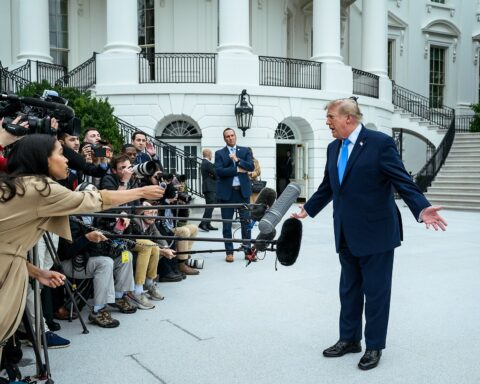
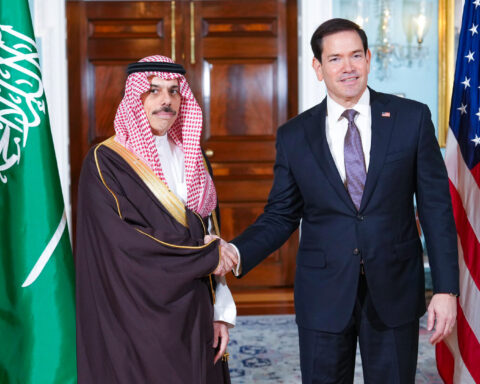
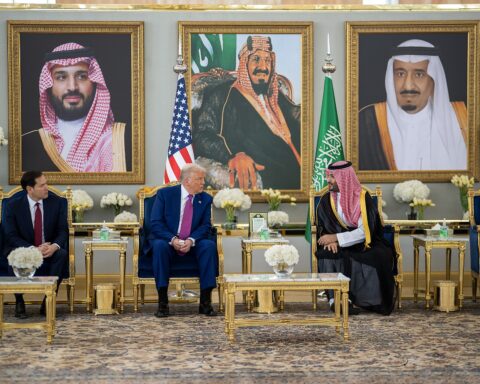
RIYADH — Donald Trump declared an agreement with Iran “largely negotiated” on Friday, confirming a framework that extends the ceasefire, reopens the Strait of Hormuz, and eases sanctions — without once mentioning Iran’s nuclear program, its 440.9 kilograms of uranium enriched to 60%, or the enrichment moratorium that five rounds of talks have failed to resolve. The deal that Saudi Arabia lobbied hardest to secure — MBS personally urging Trump on a multi-leader call this week alongside the leaders of the UAE, Qatar, Egypt, Jordan, Turkey, and Pakistan — is, in its reported structure, the deal that formalizes the enrichment asymmetry as a starting position rather than a problem to be solved.
Washington and Tehran have agreed on a sequencing that places ceasefire dividends first and nuclear terms second, in a process Riyadh cannot join, on a timeline its fiscal position cannot sustain, under conditions that improve Iran’s bargaining position before the negotiation that matters most to Saudi Arabia even begins. The 123 nuclear cooperation agreement the same Trump administration signed with Riyadh — opening the door to Saudi enrichment — depends on the resolution of Iranian enrichment rights that this deal explicitly defers.
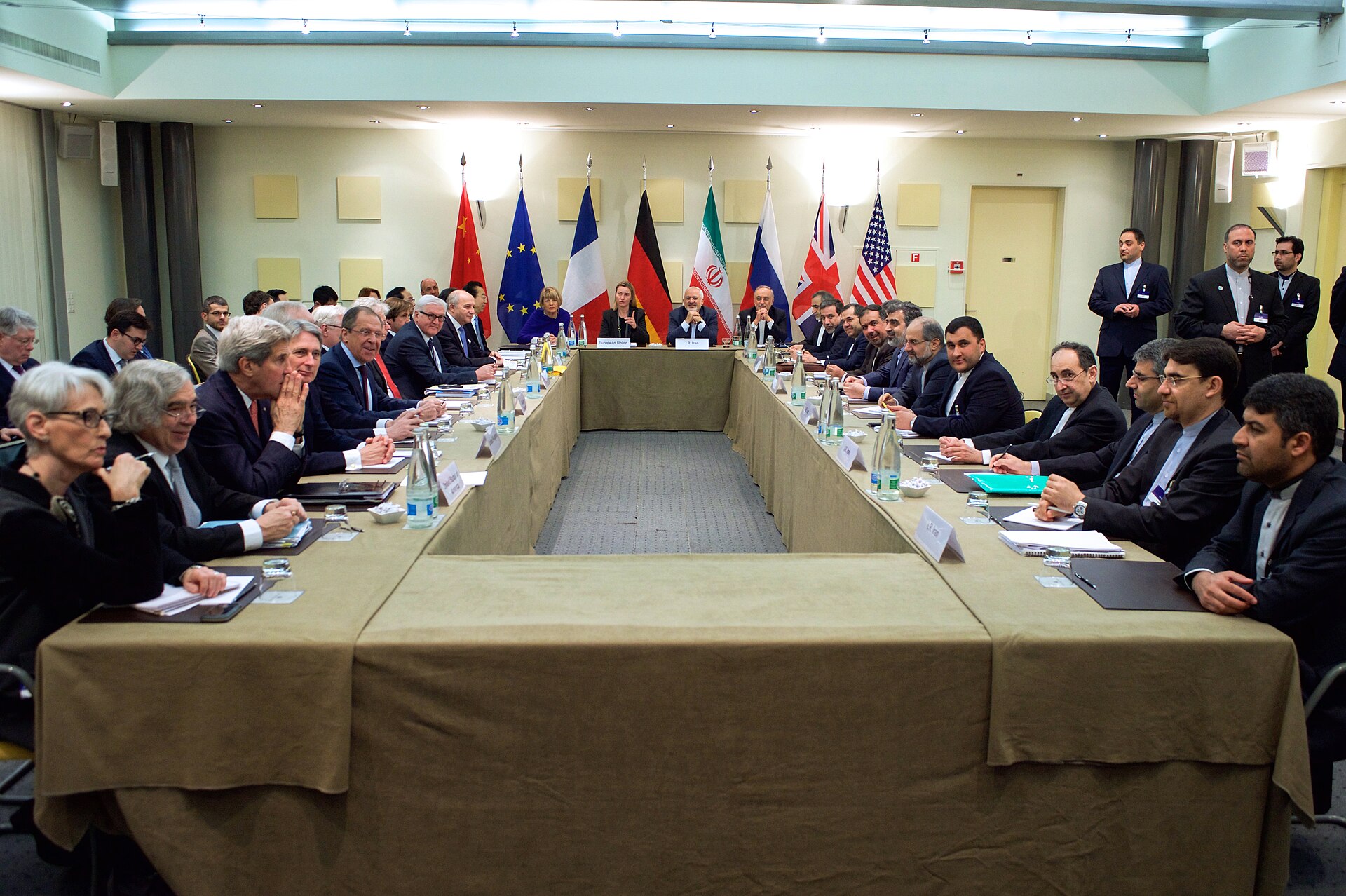
Table of Contents
- What Does “Largely Negotiated” Actually Mean?
- The Sequencing Trap: Ceasefire First, Nuclear Later
- Why Does the 123 Agreement Make the Deferral Dangerous for Saudi Arabia?
- Five Rounds, Zero Saudi Seats
- How Does Iran’s Negotiating Position Change After Hormuz Reopens?
- The JCPOA Was a Single Package — The 2026 Framework Is Not
- Can Track 2 Close the Moratorium Gap?
- The Fiscal Clock Saudi Arabia Cannot Stop
- Frequently Asked Questions
What Does “Largely Negotiated” Actually Mean?
The phrase means a framework has been agreed in which the United States and Iran end active hostilities, extend the ceasefire by 60 days, gradually reopen the Strait of Hormuz, ease sanctions, and begin phased unfreezing of Iranian overseas assets — with nuclear terms relegated to a separate, downstream negotiation track. Trump’s Truth Social post on May 23 confirmed the agreement was “subject to finalization between the United States of America, the Islamic Republic of Iran, and the various other Countries” and that the Strait of Hormuz would open as part of it, but made zero reference to enrichment, to Iran’s HEU stockpile, or to the moratorium duration that has defined the central impasse across every round of talks.
The Financial Times and CNBC reported that mediators were nearing a deal to extend the ceasefire by 60 days and establish a “framework for nuclear talks” — the word “framework” doing the work that “resolution” was supposed to do. The Washington Times, citing officials briefed on the draft, reported that a proposal had been approved early Saturday by Ghalibaf, Vance, Witkoff, and Kushner, with a moratorium landing at “at least 12 years, possibly 15.” That moratorium, however, is not in the deal that was declared “largely negotiated” — it is in the track that comes after, the track that has not yet begun, the track in which Saudi Arabia has no seat and no mechanism to acquire one.
“Zero nuclear weapons = we DO have a deal. Zero enrichment = we do NOT have a deal. Time to decide…”
— Seyed Abbas Araghchi, Iranian Foreign Minister, X/Twitter, May 23 2026
The HOS Daily BriefThe Middle East briefing 3,000+ readers start their day with.
One email. Every weekday morning. Free.
Araghchi tweeted those words hours before Rome Round 5, describing enrichment as “unequivocally non-negotiable” and a source of “national pride achieved at great cost.” After Round 5 at the Omani Embassy in Rome, both sides described the discussions as “very complicated,” and Omani Foreign Minister Busaidi characterised the outcome as “some but not conclusive progress.” The distance between “largely negotiated” and “not conclusive” is not a contradiction in the usual diplomatic sense; it is a description of two different deals — one that addresses the war and the strait, and one that addresses the nuclear file — with only the first approaching completion.
The Sequencing Trap: Ceasefire First, Nuclear Later
Iran has pursued an explicit sequencing strategy throughout these negotiations — ceasefire and Hormuz first, nuclear later — and the “largely negotiated” framework delivers precisely that structure. Tasnim, the Iranian news agency with the closest access to the negotiating team, reported on May 23 that “an agreement will only be signed when all issues are resolved” but that the focus was “on securing an end to the war, before other matters are dealt with.” The phrase “other matters” — dropped with the studied casualness of a delegation that knows its sequencing has prevailed — encompasses Iran’s enriched uranium stockpile, its centrifuge infrastructure, and the moratorium duration that Washington has spent five rounds, two cities, and approximately 86 days of active conflict failing to extract.
The HEU disposal question that the “largely negotiated” phrase left unaddressed became a flashpoint on May 24: a White House official publicly claimed Iran had agreed in principle to dispose of its stockpile, while Tasnim issued an all-capitals rebuttal within hours. ‘Under No Circumstances’: Iran Denies HEU Agreement the White House Says Already Exists traces the contradiction and what it signals about the Track 2 window before which Saudi Arabia waits.
This sequencing is not without precedent in Iran’s negotiating repertoire. It mirrors the treatment of disarmament in every ceasefire framework Tehran has shaped or influenced — from the 2006 Lebanon ceasefire that left Hezbollah’s arsenal intact and growing, to the 2023 Gaza ceasefire that deferred Hamas’s military infrastructure to a “Phase 2” that never materialised in any operationally meaningful form. The pattern is consistent and, by now, legible to anyone paying attention: separate the immediate pressure (hostilities, economic pain, blockade) from the structural concession (disarmament, enrichment surrender), relieve the former through a ceasefire agreement, and negotiate the latter from a position of renewed strength once the coercive architecture has been partially dismantled.
The Times of Israel’s security correspondent confirmed what this sequencing means for outside parties: an interim deal would extend the ceasefire, reopen Hormuz, and ease economic pressure on Iran “without touching the nuclear file altogether.” Al-Arabiya’s own leaked “final draft” on May 22 contained eight operative points — ceasefire, freedom of navigation, a seven-day window for outstanding issues — and none of them addressed nuclear terms, a silence that becomes more telling when you consider that Al-Arabiya is Saudi-owned and the editorial choice to publish a nuclear-free draft was itself a diplomatic signal. For Israel, the nuclear deferral is a security concern with specific military implications. For Saudi Arabia, it is a structural one — because Saudi Arabia’s nuclear cooperation pathway is the one that depends on the nuclear file being resolved before enrichment rights become the new, unchallenged baseline.
Why Does the 123 Agreement Make the Deferral Dangerous for Saudi Arabia?
The U.S.-Saudi 123 nuclear cooperation agreement, announced in November 2025, opens the door to a Saudi domestic uranium enrichment program — but its political viability depends entirely on how the Iranian enrichment question is resolved. The Arms Control Association’s assessment in March 2026 was unambiguous: the agreement “will open the door to some type of Saudi uranium enrichment program” and would not require the more intrusive IAEA monitoring arrangement that the UAE accepted under its own nuclear cooperation deal. Kelsey Davenport, ACA’s Director for Nonproliferation Policy, stated that it would “open the door for Saudi Arabia to acquire uranium enrichment technology or capabilities — possibly even from the United States.” The agreement’s own text references “additional safeguards and verification measures” for enrichment, conversion, and fuel fabrication — language that opens a pathway rather than closes one.
The problem is not the 123 agreement in isolation — it is the 123 agreement running in parallel with a deal that defers Iranian nuclear terms to a track with no timeline, no locked-in moratorium duration, and no mechanism for Saudi input. The same Trump administration that signed the 123 deal with Riyadh, creating a pathway to Saudi enrichment, is now the same administration agreeing to a framework that parks Iranian enrichment in Track 2. Washington has assembled a two-tier nuclear architecture in which enrichment functions as a sovereign prerogative when extended to Saudi Arabia and as a condition of surrender when demanded of Iran — and has then deferred the surrender while activating the prerogative, all within the same diplomatic fortnight.
The Congressional dimension compounds the exposure. The UAE accepted what arms control specialists call the “Gold Standard” in its nuclear cooperation agreement: forswear enrichment, forswear reprocessing, accept the Additional Protocol for IAEA inspections. Saudi Arabia did not accept the Gold Standard — a decision that drew bipartisan opposition from 52 senators and 177 House members who insisted on the same terms for Riyadh. The Trump administration appears to have conceded a weaker framework, but the political sustainability of that concession depends on Iran’s enrichment being constrained through a deal that has binding verification mechanisms. If Track 2 stalls, or produces a moratorium shorter than the 12 years the Washington Times reports as the floor, or collapses altogether because Araghchi’s “non-negotiable” turns out to be exactly that, the Congressional coalition that reluctantly accepted the Saudi 123 deal faces a question it cannot avoid: why is Saudi Arabia being granted enrichment rights that Iran is being asked to surrender, when Iran has not actually surrendered them?
Five Rounds, Zero Saudi Seats
Saudi Arabia has been excluded from all five rounds of US-Iran negotiations — the Islamabad talks in April that collapsed after 21 hours, the cancelled second round, and Rounds 3 through 5 conducted between Rome and Muscat. The most recent, at the Omani Embassy in Rome on May 23, lasted approximately 2.5 hours with Witkoff and National Security Adviser Anton representing the United States, Araghchi representing Iran, and Busaidi mediating on behalf of Oman. Riyadh was not in the room, was not consulted during the session, and learned the outcome — “some but not conclusive progress” — the same way the rest of the world did.
“The GCC has no seat at the table, despite its entreaties, for negotiations that will shape the bloc’s economic and security environment for years to come.”
— Andrew Leber and Sam Worby, Carnegie Endowment for International Peace, April 2026
The exclusion is not a procedural oversight — it is a structural feature of the negotiation’s architecture, and the bridging efforts that Saudi Arabia has endorsed confirm rather than mitigate it. Pakistan — simultaneously Riyadh’s bilateral defence treaty partner under the SMDA signed in September 2025 — and Qatar drafted a revised memo to bridge remaining US-Iran gaps; Saudi Arabia, Turkey, and Egypt were described by Axios as supporting “the effort,” a formulation that distinguishes between the countries doing the drafting and the countries waving from the sidelines. The nuclear terms were excluded from the memo’s operative text, meaning the bridging document that Saudi Arabia endorsed contained no mechanism for the issue on which its own nuclear pathway depends.
Netanyahu subsequently raised a specific objection to the framework’s Lebanon clause directly with Trump on May 24, calling it “a very big problem” for Israel — introducing a second veto front Saudi Arabia cannot influence. The Lebanon clause, like the enrichment moratorium, sits outside any forum in which Riyadh has a seat.
RUSI’s assessment adds a dimension that makes the exclusion more consequential than the Carnegie framing alone suggests: Saudi Arabia’s red lines in these negotiations “were never primarily about the bomb” — missiles, proxies, and regional destabilisation are the issues Riyadh cares about most viscerally, and none are on the negotiating table. The nuclear file is therefore the one axis on which Saudi Arabia possesses a US-constructed mechanism (the 123 agreement) that is directly undermined by the deal’s structure, and it is precisely the axis Saudi Arabia cannot influence because it has never occupied a seat at the table where nuclear terms will eventually be decided. Bin Farhan publicly praised Trump’s firmness on May 20 — five days after Trump told Hannity that removing enriched uranium was “not necessary except public relations.” The praise came after the concession, the lobbying came after the exclusion, and the deal arrived without the protection Saudi Arabia needed most.
How Does Iran’s Negotiating Position Change After Hormuz Reopens?
Iran enters Track 2 nuclear negotiations — whenever they begin — having already secured the three outcomes it needed most: an end to active hostilities, the easing of sanctions that have compressed its economy since April, and the gradual reopening of the Strait of Hormuz through which its oil revenues must eventually flow. The specific operational cost of that front-loading — including the mine-clearance clause and the US MCM capability gap that shaped Phase 1’s terms — is a detail the ‘largely negotiated’ framing leaves entirely unexamined. The coercive architecture that was supposed to produce nuclear concessions — the military campaign, the economic blockade, the diplomatic isolation enforced by US secondary sanctions — will have been partially dismantled before the nuclear negotiation starts. A 60-day ceasefire extension, in this structure, is not a pause in which both sides regroup on equal terms; it is a transfer of leverage from the party that imposed costs to the party that absorbed them and survived.
The PGSA — the toll regime that Iran established on May 18, five days before Rome Round 5 — complicates the picture further. The FT/CNBC framework describes Hormuz reopening as “gradual,” and the deal framework suspends the toll architecture rather than dissolving it, which means the 12-article domestic law underpinning the PGSA remains available as leverage throughout Track 2. Bloomberg reported on May 21 that Iran and Oman are actively negotiating a “permanent toll system” for the Strait, a negotiation that proceeds on a parallel track to the nuclear talks and that Saudi Arabia has no channel to influence outside of Muscat — where Oman is simultaneously the mediator and Iran’s co-drafter.
The temporal asymmetry is what makes the sequencing lethal for Saudi interests. Iran can afford to negotiate slowly on nuclear terms — extending the moratorium debate across months of Track 2 discussions, insisting on its five-year ceiling, walking away from sessions and returning weeks later — because time is not Iran’s enemy in this structure. Saudi Arabia’s depleted fiscal reserves, its widening deficit, and its dependence on Hormuz-routed oil revenue mean that every week of unresolved nuclear terms extends a period of strategic uncertainty that suppresses investment confidence and forces the kingdom deeper into sovereign-backed borrowing. Iran negotiates with a toll booth that can be reactivated; Saudi Arabia negotiates from a treasury that cannot be refilled at current oil prices. The distinction between PGSA suspension and dissolution — and what that difference costs Saudi Arabia across the 60-day pause and the Track 2 window that follows — is the subject of a separate analysis.
The JCPOA Was a Single Package — The 2026 Framework Is Not
The 2015 Joint Comprehensive Plan of Action was constructed as a single integrated package: all nuclear restrictions and all sanctions relief came into effect simultaneously on Implementation Day, January 16, 2016. Iran accepted a 3.67% enrichment ceiling, shipped out 98% of its enriched uranium stockpile, disabled thousands of centrifuges, and accepted intrusive IAEA verification — all before a single dollar of frozen assets was released. The P5+1 achieved this because they held the entire sanctions architecture as a unified source of leverage, released only upon verified compliance across every nuclear commitment simultaneously.
The 2026 framework inverts this structure with a precision that benefits one side comprehensively. Relief is front-loaded — war-ending, ceasefire extension, Hormuz reopening, sanctions easing, phased asset unfreezing — and nuclear terms are back-loaded into a Track 2 process that begins, per the Axios MOU framework, 30 days after the war-ending agreement is signed. For outside parties like Saudi Arabia, which had no leverage over JCPOA terms in 2015 and has less now, the structural difference is the difference between negotiating before concessions are made and negotiating after they have been pocketed — and pocketed concessions are not, in any historical precedent involving Iran, returned to the table.
| Dimension | JCPOA (2015) | 2026 Framework | Saudi Exposure |
|---|---|---|---|
| Nuclear-sanctions sequencing | Simultaneous (Implementation Day, Jan 16, 2016) | Sequential: ceasefire and Hormuz first, nuclear Track 2 | Relief flows before nuclear terms are locked |
| Saudi foreign reserves | $600B+ | ~$15B PIF cash (1.6% of AUM) | Cannot sustain extended uncertainty |
| 123 nuclear cooperation agreement | Did not exist | Signed November 2025 | Enrichment pathway depends on unresolved Iran terms |
| Hormuz toll architecture | Did not exist | PGSA operational May 18, 2026 | Suspended, not dissolved — reactivation leverage intact |
| Saudi seat at negotiations | None | None | Same exclusion, weaker fiscal and strategic position |
| Iran enrichment framing | Capped at 3.67%, stockpile shipped out | Deferred to Track 2 (moratorium gap: 5–20 years) | Asymmetry formalised as baseline |
Saudi Arabia’s position was stronger in 2015 on every measurable axis — reserves exceeded $600 billion, the 123 agreement did not exist, and the PGSA did not exist — and the kingdom opposed JCPOA anyway. The 123 agreement’s absence meant there was no Saudi enrichment pathway whose political viability depended on Iranian enrichment being resolved; the PGSA’s absence meant there was no toll architecture that could be suspended and reactivated as mid-negotiation leverage. In 2026, all three conditions are reversed simultaneously: reserves are depleted, the 123 agreement is live, and the PGSA is operational. Saudi Arabia opposed JCPOA primarily because sanctions relief would fund Iranian proxies — a concern that proved well-founded over the following eight years — and the 2026 framework offers the same sanctions relief with fewer nuclear constraints upfront, and Saudi Arabia is endorsing it.
Can Track 2 Close the Moratorium Gap?
The moratorium gap — the distance between Iran’s offer, America’s demand, and Congress’s red line on how long Iran must suspend enrichment — is the single most consequential variable in the negotiation, and Track 2 inherits it unresolved. Iran’s position is five years or less; Araghchi’s language signals a ceiling on concessions, not a floor. The Axios 14-point MOU framework settled on 12 to 15 years with a 3.67% enrichment cap — the same ceiling as JCPOA, which Iran exceeded within months of the deal’s collapse. The United States opened negotiations demanding 20 years, and Congressional demand runs to zero — a position that has not softened.
| Party | Moratorium Position | Source |
|---|---|---|
| Iran | 5 years or less | Araghchi / Iranian media, May 2026 |
| Axios MOU framework | 12–15 years (3.67% cap) | Axios, May 2026 |
| Washington Times draft | At least 12, possibly 15 years | Officials briefed on draft, May 23 |
| United States (opening position) | 20 years | US negotiating position, April 2026 |
| US Congress (bipartisan) | Zero enrichment | 52 senators + 177 House members |
The 440.9 kilograms of uranium enriched to 60% is the physical manifestation of the gap. Trump, who repeatedly insisted during the war that Iran must relinquish this stockpile, made no mention of it in his “largely negotiated” post. Rubio, speaking from New Delhi on the first day of his India visit, said the operation in Iran was “over” but that nuclear material “has to be addressed” — the future tense doing the work that the present tense was supposed to do. Khamenei’s directive — that Iran’s 440 kilograms enriched to 60% must stay in the country — has not been publicly walked back or qualified by any Iranian official at any point in the negotiations.
For Saudi Arabia, the moratorium duration determines whether the 123 agreement is a viable enrichment pathway or a political orphan. A 12-year moratorium — the lower bound of the Washington Times range — means Iran retains enrichment rights that resume in 2038, which gives Saudi Arabia a window to build domestic enrichment capability before the asymmetry reasserts itself, but only if the 123 agreement survives Congressional scrutiny during a period when Iran’s “non-negotiable” enrichment rights are merely paused rather than surrendered. A five-year moratorium, Iran’s preferred outcome, would mean Iranian enrichment resumption by 2031 — years before Saudi Arabia’s nuclear infrastructure could plausibly be operational. In either scenario, Track 2 produces a countdown timer on Saudi Arabia’s enrichment window, and the duration of that timer is being negotiated in rooms that Riyadh has never entered.
The Fiscal Clock Saudi Arabia Cannot Stop
Saudi Arabia cannot wait out a protracted Track 2 process. The kingdom’s Q1 2026 deficit reached $33.5 billion — consuming 194% of its full-year deficit target in three months. Goldman Sachs projects the full 2026 deficit at $80 to $90 billion, or 6.6% of GDP, a figure that reflects both the Hormuz disruption to export revenues and the construction drawdown that has seen $8.45 billion in megaproject terminations since March. The IMF calculates Saudi Arabia’s fiscal breakeven oil price at over $90 per barrel; the EIA projects Brent averaging $79 per barrel in 2027 — a gap that cannot be closed by borrowing alone, and which PIF’s approximately $15 billion in cash (1.6% of assets under management) does nothing to bridge, even after a $7 billion bond sale in May that attracted a $23.8 billion orderbook.
Iran, whose economy has operated under varying degrees of sanctions since 1979 and whose institutions were built for survival under economic pressure rather than growth under oil abundance, is structurally adapted to the kind of extended negotiation that Track 2 would produce. Tehran can stretch nuclear talks across months or years, cycling through proposals and counter-proposals on moratorium duration, insisting that five years is the ceiling, walking out of sessions in Rome or Muscat and returning six weeks later, because time compounds Iran’s position rather than degrading it. Saudi Arabia’s fiscal architecture — Vision 2030’s remaining infrastructure pipeline, PIF’s portfolio commitments, Aramco’s $124 billion annual dividend obligation — was built for sustained $90 oil and uninterrupted Hormuz access, neither of which the “largely negotiated” framework guarantees beyond a 60-day window.
Senator Cotton’s May 22 letter demanding sanctions on the PGSA and Oman — the first legislative action targeting the deal’s Hormuz architecture — arrived the day before Trump’s “largely negotiated” announcement, a sequencing that suggests Congress is already positioning to constrain the executive framework from outside. Brent closed at $103.94 on May 22, down more than 6% for the week on deal optimism, with the market pricing in Hormuz reopening before nuclear terms are settled — which is precisely what the framework delivers. The 123 agreement sits between Washington and Riyadh, its political viability dependent on a resolution of Iranian enrichment that the deal Saudi Arabia lobbied hardest to secure has just deferred to a Track 2 process with no deadline, no Saudi seat, and no guarantee of an outcome that makes Saudi enrichment politically sustainable.
Frequently Asked Questions
Does Israel have a veto over the Iran deal framework?
No, though Israel retains influence over Track 2 nuclear terms through Congressional allies. Netanyahu convened his security cabinet on May 23, and senior GOP senators described the emerging deal as a “nightmare for Israel,” but Trump said his call with Netanyahu went “very well” — language that typically signals disagreement was aired and overridden rather than accommodated. The initial framework operates as an executive agreement, not a treaty requiring Senate ratification. Israel’s leverage concentrates on Track 2, where Congressional allies can condition any enrichment moratorium on verifiable Israeli security assurances — a dynamic that mirrors Israel’s failed campaign against JCPOA in 2015, which did not prevent the deal but did influence the snapback mechanism that contributed to its eventual collapse under Trump’s first term.
Could Congress block the initial ceasefire-and-Hormuz framework?
The initial framework — ceasefire extension, Hormuz reopening, sanctions easing — operates under executive authority in its reported structure and does not appear to require Congressional approval. Track 2 nuclear terms are where Congressional power concentrates, particularly if a formal agreement requires implementing legislation or sanctions modifications that must pass both chambers. The 52 senators and 177 House members who demanded zero enrichment have direct leverage over the moratorium duration. The PSAB access episode in early May demonstrated that Congress is willing to use base-access leverage against the administration’s Middle East framework, and Cotton’s solo letter — sent without co-signatories — suggests initial positioning rather than a coordinated blocking effort.
What happens to the PGSA toll if the Strait of Hormuz reopens under the deal?
The FT/CNBC framework describes Hormuz reopening as “gradual,” and the PGSA is suspended rather than dissolved under the reported deal structure. The distinction is consequential: the PGSA statute is a 12-article piece of Iranian domestic law whose committee was established on April 21, with parliamentary ratification pending, meaning the legal architecture survives any diplomatic suspension. Bloomberg reported on May 21 that Iran and Oman are actively negotiating a “permanent toll system” for the Strait, and Baker Hughes projects that full H2 2026 reopening remains the realistic timeline even under a successful deal. Senator Cotton’s letter explicitly targeted this distinction, demanding Treasury treat the PGSA as a sanctionable entity regardless of ceasefire status — a position that, if adopted, would undermine the gradual-reopening mechanism the deal depends on.
When would Track 2 nuclear negotiations begin?
The Axios MOU framework specifies a 30-day formal negotiation period for nuclear terms, beginning after the war-ending framework is signed. Islamabad is under consideration as a post-Hajj venue for the next round, according to Shafaqna Pakistan, though this remains unconfirmed. The immediate calendar creates a natural buffer: the Day of Arafah falls on May 26, and Iran’s delegation leadership is unlikely to engage in substantive nuclear negotiations during Hajj observances, meaning the earliest realistic start for Track 2 is late May or early June. The gap between the initial framework’s implementation and Track 2’s commencement is the period during which ceasefire dividends flow, sanctions ease, and Iran’s negotiating leverage quietly improves — all before the nuclear discussion that determines the 123 agreement’s viability has formally opened.
That leverage asymmetry is compounded by a new evidentiary dispute: on May 25, a senior White House official stated Iran had committed in writing to the “disposal” of enriched uranium; Iran’s Supreme National Security Council stated no such commitment was made. The disposal versus down-blending distinction — and what it means for the Track 2 nuclear window — is examined in the nuclear text Saudi Arabia cannot read.