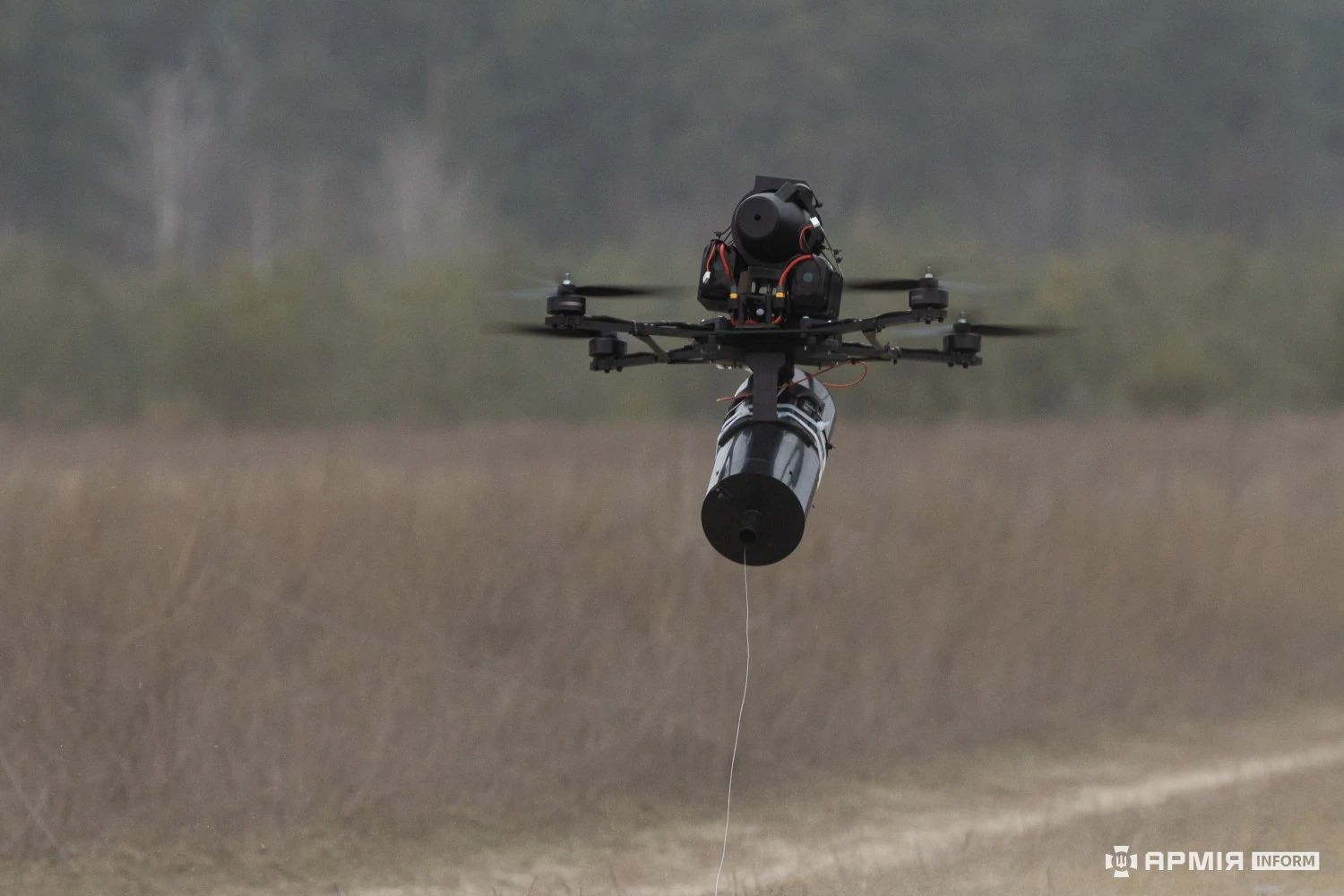

KUWAIT CITY — Two fiber-optic wire-guided explosive drones launched from Iraqi territory struck two of Kuwait’s northern land border posts on April 24, five days after President Trump extended the ceasefire indefinitely — an attack that confirmed the activation of a threat corridor the Gulf’s entire air defense architecture was not designed to face. The Kuwait Ministry of Defence confirmed material damage at both sites, no casualties, and described the strike as a “criminal aggressive attack” involving weapons that are, by design, immune to every electronic countermeasure in the GCC inventory.
The drones were not jammed because they cannot be jammed. Fiber-optic guidance transmits flight commands through a physical cable unspooling behind the airframe, eliminating the radio-frequency link that electronic warfare systems exist to disrupt. The technology, adapted from Iranian-designed first-person-view suicide drones with ranges exceeding 20 kilometers according to SouthFront analysis, means the launch point was well inside Iraqi territory — likely in or near Basra province, where Kata’ib Hezbollah maintains force concentrations adjacent to the Iraq-Kuwait-Saudi tripoint. No group claimed the border post attack, but Saraya Awliya al-Dam, an Iraq-based Iran-backed militia operating under the “Islamic Resistance in Iraq” umbrella, had publicly claimed 136 attacks across Saudi Arabia, Kuwait, Jordan, and Syria in the preceding 22 days alone.
In this article:
- The Ceasefire’s Structural Blind Spot
- Why Fiber-Optic Drones Defeat Gulf Air Defenses
- The Northern Proxy Corridor: From Basra to the Saudi Border
- Does Saudi Arabia’s Northern Border Have Air Defense Coverage?
- What Did the GCC Summit Actually Commit To?
- Baghdad’s Impossible Position
- Frequently Asked Questions
The Ceasefire’s Structural Blind Spot
The April 24 strike exposed a problem that no ceasefire extension can fix: the Iran-US ceasefire framework contains no mechanism to constrain non-state proxy actors operating from Iraqi soil. Iran’s Foreign Minister Araghchi was traveling to Islamabad for ceasefire talks on the same day the drones hit Kuwait’s border posts, a scheduling coincidence that illustrates Tehran’s structural advantage. The Iranian government can point to sub-state actors in Iraq while preserving the ceasefire framework intact, because the framework was never designed to reach them.
This is not a loophole; it is the architecture. The “Islamic Resistance in Iraq” — an umbrella comprising Kata’ib Hezbollah, Asaib Ahl al-Haq, Harakat Hezbollah al-Nujaba, Kata’ib Sayyid al-Shuhada, and smaller front groups including Saraya Awliya al-Dam — operates with what House of Saud previously reported as autonomous strike authority granted by Tehran before the ceasefire expired. Both Kata’ib Hezbollah and Harakat al-Nujaba are directly subordinate to the IRGC-Quds Force, according to the Meir Amit Intelligence and Terrorism Information Center. But subordination in command does not mean subordination to ceasefire terms that the IRGC itself never signed.
The operational tempo tells the story. Kata’ib Sarkhat al-Quds, a front militia of Harakat Hezbollah al-Nujaba, announced attacks on American targets using drones across northern Iraq, Kuwait, and Bahrain during the March 4–18 period, per the Meir Amit center. Saraya Awliya al-Dam alone claimed 136 attacks across Saudi Arabia, Kuwait, Jordan, and Syria in the 22 days preceding the border post strike, according to the Jihad and Terrorism Threat Monitor. Up to half of approximately 1,000 drone attacks on Saudi Arabia during the war’s first five weeks originated from Iraqi territory, carried out by Iran-backed militias led by Kata’ib Hezbollah and Asaib Ahl al-Haq with combined personnel of approximately 250,000, according to the Wall Street Journal. The ceasefire paused Iranian state launches. It did not pause the Iraqi corridor.
The Middle East briefing 3,000+ readers start their day with.
One email. Every weekday morning. Free.
Why Fiber-Optic Drones Defeat Gulf Air Defenses
Col. Saud Abdulaziz Al-Otaibi, the Kuwait Ministry of Defence spokesman, specified that the April 24 attack involved “two explosive-laden drones guided via fiber-optic cables that entered Kuwaiti territory from Iraq.” The detail matters more than the damage. Fiber-optic guidance represents a class of threat that renders the electronic warfare layer of Gulf air defense — the layer designed to defeat cheap drones before they reach kinetic interceptors — operationally irrelevant against these specific systems.
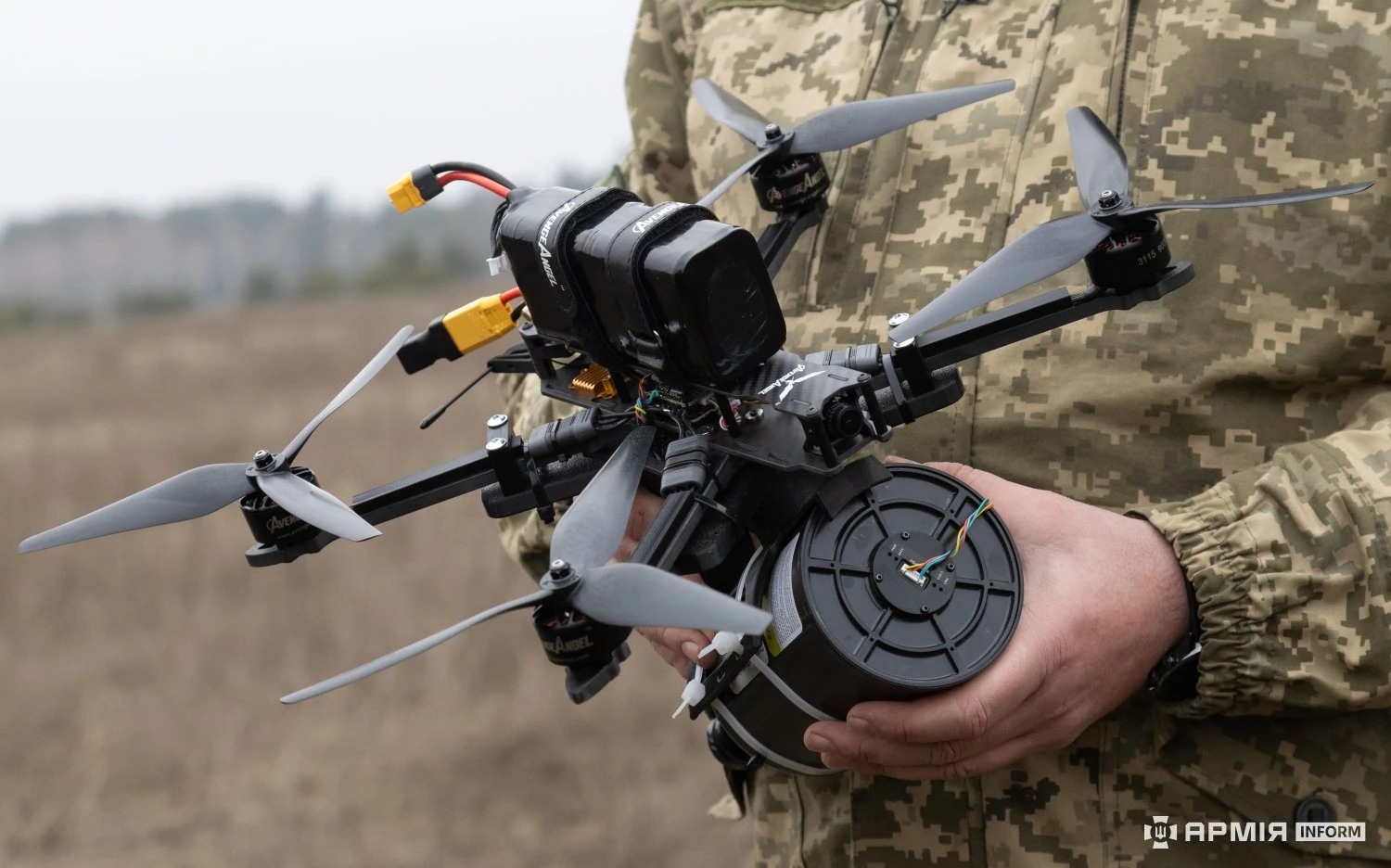
Conventional drone jamming works by overwhelming or spoofing the radio-frequency link between the operator and the aircraft. GPS denial, signal hijacking, and directional RF interference are the standard tools deployed around Gulf military installations and critical infrastructure. A fiber-optic guided drone has no RF link to attack. The operator flies the drone in first-person view through a camera feed transmitted along a hair-thin glass cable that unspools from the airframe as it flies, with ranges potentially exceeding 20 kilometers according to SouthFront analysis published April 25. The only countermeasure is kinetic interception — shooting it down — which requires detection systems calibrated for small, low-altitude, slow-moving targets in terrain-following flight profiles.
The September 2019 Abqaiq and Khurais attacks demonstrated that Saudi air defenses had gaps against low-altitude, terrain-following threats — gaps described as partially addressed but not eliminated six years later. PAC-3 and THAAD batteries are designed to intercept ballistic missiles and high-altitude threats, not fiber-optic FPV drones flying at treetop height across a desert border. The interception problem is not one of capability at the high end but of coverage at the low end — precisely where the northern border is most exposed.
The Northern Proxy Corridor: From Basra to the Saudi Border
The April 24 border strike was not an isolated escalation but the latest activation of a corridor that Iran-backed militias have used operationally since at least May 2019, when Kata’ib Hezbollah launched drone attacks from Jurf as-Sakr — a militia-controlled base in Babil province south of Baghdad — hitting two Saudi East-West pipeline pumping stations, according to the FDD Long War Journal and Counter Extremism Project. That attack established the principle: Iraq-based proxy forces can reach Saudi energy infrastructure without crossing a land border and without routing through the Strait of Hormuz.
The corridor has since expanded in both volume and geographic scope. Saudi Arabia summoned Iraq’s ambassador after sustained drone attacks from Iraqi territory during the current war. Kuwait’s total attack exposure from February 28 through April 9 reached 1,221 systems — 852 drones and 369 missiles — striking Kuwait International Airport, Ali al-Salem Air Base, Mina al-Ahmadi refinery, and desalination plants, according to the FDD Long War Journal. Up to 500 of approximately 1,000 drone attacks on Saudi Arabia during the same period originated from Iraqi territory, per the Wall Street Journal.
The attack also followed a dangerous escalation cycle at the border itself. On April 8, rockets reportedly launched from Kuwait struck a house near Basra, killing three Iraqi civilians. Protesters waving PMF and Kata’ib Hezbollah flags stormed the Kuwaiti consulate in Basra, and Kuwait denied involvement, as reported by The National and Al Jazeera. Thirteen days before the border post attack, Kuwait arrested 24 citizens including five former lawmakers for financing terrorist entities with Iran connections — organizers had collected funds under religious pretexts and transferred them on instructions from outside the country, according to Khaleej Times reporting on April 11. The internal financing network and the external drone strike represent two ends of the same operational chain.
On March 9, two Kuwaiti border guards were killed in a direct attack — the war’s first confirmed lethal strike on Kuwaiti border security personnel. Abu Ali al-Askari, the Kata’ib Hezbollah security chief, had warned publicly that “if the energy war starts, the world will lose 12 million barrels of oil per day,” according to the Washington Institute for Near East Policy. Nadhim al-Saeedi, executive head of Harakat Hezbollah al-Nujaba, stated the “Iraqi resistance will strike energy centers if Iranian oil facilities are bombed,” according to the Washington Institute for Near East Policy. These are not rhetorical threats; they are operational declarations from commanders whose forces have already demonstrated the capability to execute them.
“If the energy war starts, the world will lose 12 million barrels of oil per day.” — Abu Ali al-Askari, Kata’ib Hezbollah security chief, via Washington Institute for Near East Policy
Does Saudi Arabia’s Northern Border Have Air Defense Coverage?
Saudi Arabia’s 814-kilometer northern border with Iraq runs through largely unmonitored desert. The Northern Border Barrier — comprising 50 radars, 78 monitoring towers, 8 command centers, 10 mobile surveillance vehicles, 38 night-vision-equipped gates, 32 rapid-response centers, and 3 rapid-intervention squads linked by fiber-optic communications, according to Gulf News — was engineered to stop infantry infiltration and smuggling. It was not designed to detect or intercept drone swarms or standoff weapons launched from 20 kilometers inside Iraqi territory.
The air defense picture is thinner. Saudi Arabia has “vast stretches” of its territory including the northern border region with limited or no air defense coverage, according to House of Saud’s previous air defense analysis. Four of seven planned THAAD sites are now operational, but the King Khalid Military City site in the north — the installation closest to the Iraqi and Kuwaiti borders at approximately 150 kilometers — is a planned site with completion expected later in 2026, according to the Missile Defense Advocacy Alliance. The PAC-3 stockpile stands at approximately 400 rounds remaining, representing 86 percent depletion, with coverage concentrated on the Eastern Province and Riyadh rather than the northern frontier.
KKMC is the headquarters of the GCC’s Peninsula Shield Force, approximately 60 kilometers from Hafar al-Batin and 150 kilometers from both the Iraqi and Kuwaiti borders. During the 1991 Gulf War, a Patriot battery from Task Force 2-43 ADA intercepted three Iraqi Scud missiles there on February 21, according to GlobalSecurity.org. But the current US military presence at KKMC is described as “minimal,” and the Peninsula Shield Force’s peacetime strength of approximately 10,000 troops — a mechanized infantry and artillery formation — has no documented rapid-reaction posture against drone or missile attacks originating from inside Iraq. That force faces a PMF apparatus with combined personnel of 250,000 across the border.
What Did the GCC Summit Actually Commit To?
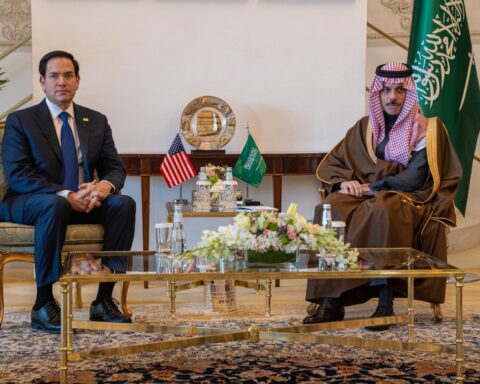
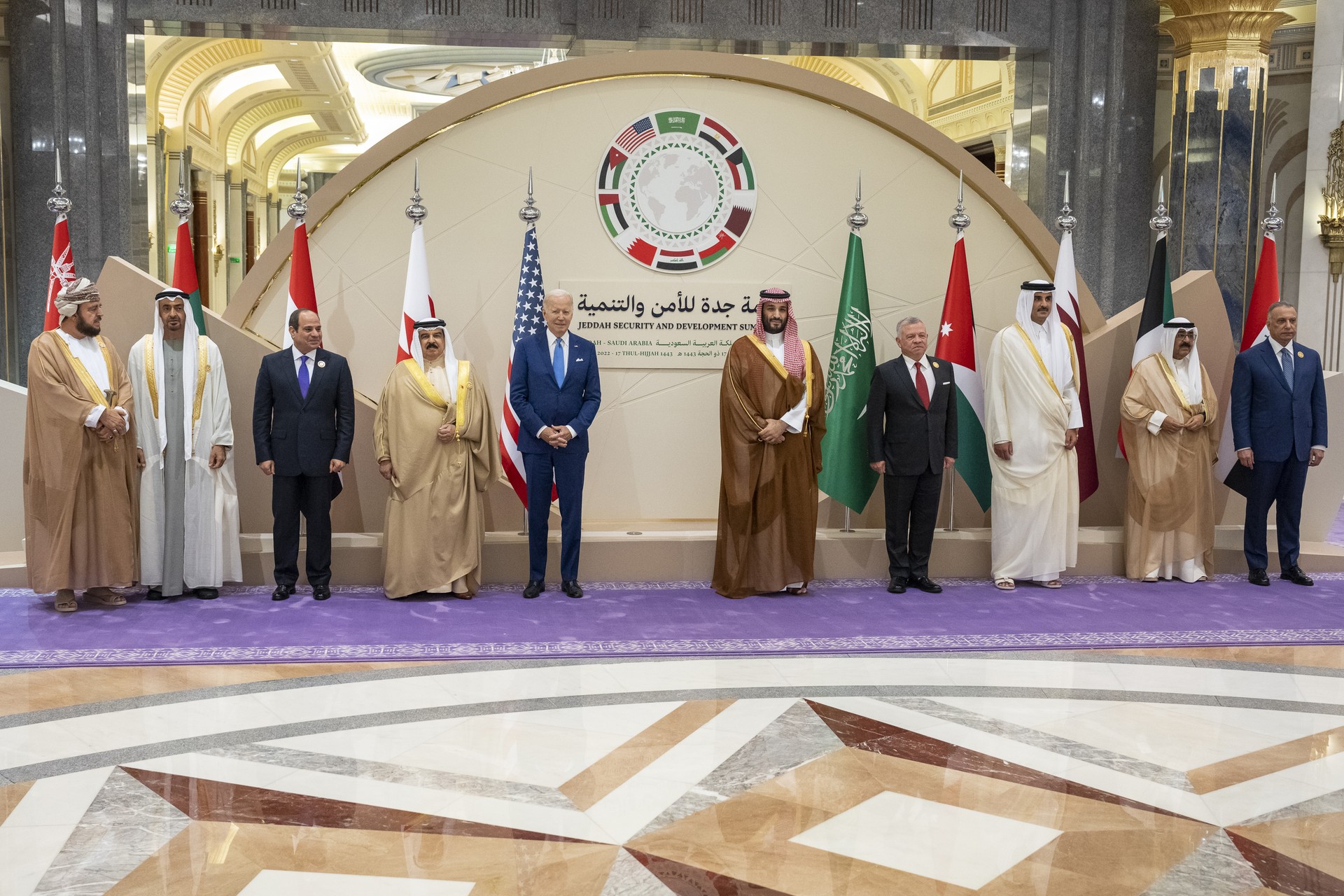
Four days after the Kuwait border attack, the six GCC heads of state convened in Jeddah on April 28 for the first in-person summit since Day 1 of the war. Chaired by Crown Prince Mohammed bin Salman, the session was described by Gulf media as the “Decisiveness Summit” — but the UAE’s President Sheikh Mohamed bin Zayed did not attend, sending Foreign Minister Sheikh Abdullah bin Zayed in his place, as reported by Gulf News and Arab News.
The communique affirmed that “any attack on one member state is an attack on all, in line with the Joint Defence Agreement,” citing Article 51 of the UN Charter, according to reporting by Times Kuwait. The language echoed NATO’s Article 5. But the GCC Joint Defence Agreement of 2000, while modeled on that precedent, lacks the enforcement mechanisms that give Article 5 operational meaning. No unified command structure exists. No automatic military response is triggered. Retired Major General Mohammed Saleh Al-Harbi told Alhurra that GCC collective defense activation “remains contingent on the political decision of each state.” Security researcher Khaled Ibrahim Al-Sallal confirmed to the same outlet that “Gulf defense agreements do not include automatic enforcement mechanisms for military action.”
The gap between the communique’s language and its operational content is the gap between deterrence and declaration. The summit affirmed collective defense in the abstract while committing nothing operationally binding against non-state actor attacks from Iraqi territory — which is precisely the attack vector that struck Kuwait four days earlier. Danielle Pletka of the American Enterprise Institute warned that internal GCC disagreements could impair “sharing of early-warning or radar data,” a concern underscored by the UAE president’s absence from the summit itself. As House of Saud reported, the first wartime summit exposed divisions as much as it projected unity.
Baghdad’s Impossible Position
Iraq’s Interior Minister Abdel Amir al-Shammari denounced the April 24 attack, saying it “damage[s] the reputation of fraternal relations between the two countries,” according to Arab Times Online and Al-Arabiya. The Saudi Ministry of Foreign Affairs condemned “in the strongest terms the targeting of two sites at the northern land border posts” of Kuwait and called on “the Government of the Republic of Iraq to deal responsibly with these threats to the Gulf states,” per the Saudi Press Agency. The UAE Ministry of Foreign Affairs issued parallel condemnation, expressing “full solidarity with Kuwait.”
Baghdad’s response was diplomatically adequate and operationally meaningless. The PMF factions responsible for the cross-border campaign are formally embedded within Iraq’s own security apparatus — the Popular Mobilization Forces were integrated into the Iraqi state after the anti-ISIS campaign, giving their component militias legal standing, government salaries, and institutional protection. Shammari’s denunciation asked Iraq to confront organizations that sit inside its own chain of command. The Wall Street Journal described the dynamic as a “covert war” in which Riyadh presses Baghdad while Baghdad lacks both the will and the capacity to act against militias that constitute a major share of the country’s armed forces.
The structural impossibility is compounded by the PMF’s political posture. The April 8 consulate storming was a public display of the faction’s willingness to use Kuwait-Iraq tension as a mobilizing frame. The PMF officially suspended operations during the ceasefire, but the Islamic Resistance in Iraq umbrella maintains attack campaigns through front groups like Saraya Awliya al-Dam, which provide Tehran deniability while preserving operational continuity. Iraq cannot disarm the corridor without disarming itself.
Frequently Asked Questions
What is the Islamic Resistance in Iraq?
The Islamic Resistance in Iraq (IRI) is an operational umbrella comprising multiple Iran-backed militias including Kata’ib Hezbollah (led by Ahmad al-Hamidawi), Asaib Ahl al-Haq (Qais Khazali), Harakat Hezbollah al-Nujaba (Akram al-Kaabi), Kata’ib Sayyid al-Shuhada, and smaller front groups such as Saraya Awliya al-Dam and Ashab al-Kahf. The umbrella branding allows individual factions to claim attacks while providing Tehran and the broader PMF structure with plausible deniability. Both Kata’ib Hezbollah and Harakat al-Nujaba are directly subordinate to the IRGC-Quds Force, according to the Meir Amit Intelligence and Terrorism Information Center.
Has any GCC member ever invoked the Joint Defence Agreement in response to a non-state actor attack?
No. The GCC Joint Defence Agreement of 2000 has never been formally invoked in response to an attack by a non-state actor operating from a neighboring state’s territory. The agreement’s language addresses “aggression or the threat thereof” but its triggering mechanisms are undefined, and activation remains contingent on individual state political decisions, according to Retired Major General Mohammed Saleh Al-Harbi. The 2011 Peninsula Shield Force deployment to Bahrain — when approximately 1,200 Saudi SANG troops crossed the King Fahd Causeway — was the only substantial GCC collective military action, and it addressed an internal security situation rather than a cross-border non-state actor threat.
What counter-drone systems does Saudi Arabia operate on its northern border?
Saudi Arabia’s Northern Border Barrier was designed for ground-level surveillance against infantry infiltration and smuggling, not aerial threats. The kingdom has procured short-range air defense systems including the German-made Skyguard and the South Korean KM-SAM, but their deployment has been concentrated around high-value targets in the Eastern Province and Riyadh. The KKMC THAAD site, which would provide the northern region’s primary ballistic missile defense coverage, is a planned installation not yet confirmed as operational. No publicly documented counter-drone network equivalent to the layered systems protecting Ras Tanura or Abqaiq exists along the 814-kilometer Iraqi frontier.
How did Kuwait respond to the financing network uncovered before the border attack?
On April 11, thirteen days before the border post strike, Kuwait arrested 24 citizens including five former lawmakers on charges of “financing terrorist entities” with connections to Iran, according to Khaleej Times. Authorities said the organizers collected funds under religious pretexts and transferred them on instructions from outside the country. The arrests represented Kuwait’s most aggressive internal security action against Iran-linked networks during the war, but the border attack that followed demonstrated that disrupting the financing chain did not disrupt the operational chain — the drones that struck on April 24 were launched from Iraqi territory, outside Kuwait’s enforcement reach.
Can Iraq legally be held responsible for attacks launched by PMF factions from its territory?
Under international law, a state bears responsibility for attacks launched from its territory when it exercises effective control over the actors or fails to exercise due diligence in preventing cross-border attacks. The complication in Iraq’s case is that PMF factions are formally integrated into the Iraqi state security apparatus — they receive government salaries and have legal standing — while simultaneously operating under IRGC-Quds Force command. This dual subordination creates a legal grey zone in which Baghdad is simultaneously responsible for the PMF as state actors and unable to control them as Iranian proxies. Saudi Arabia’s call for Iraq to “deal responsibly” implicitly acknowledged this gap without proposing a mechanism to close it.