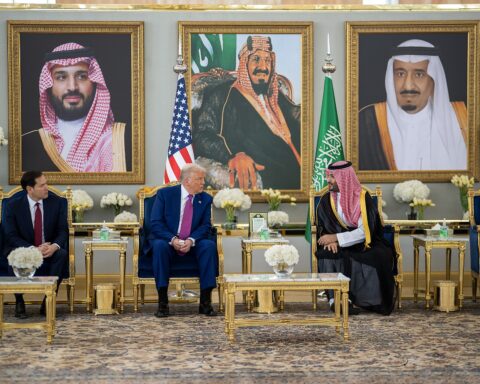
JEDDAH — Leaders of all six Gulf Cooperation Council states convened an extraordinary consultative summit in Jeddah on Monday, April 28, 2026 — the first formal GCC heads-of-state session since Iran launched coordinated missile and drone strikes across the Gulf on February 28, marking Day 60 of the widest sustained conflict in the region since the 1980-88 Tanker War.
The summit opened less than 24 hours after U.S. Secretary of State Marco Rubio publicly rejected Iran’s “Hormuz-first” ceasefire proposal, and hours after Iranian Foreign Minister Hossein Amir-Abdollahian met Russian President Vladimir Putin in St. Petersburg with Russia’s military intelligence chief in the room. Saudi Arabia, which chairs the session, must now produce communiqué language that holds together a six-member bloc with divergent threat perceptions. The range runs from Bahrain, which revoked citizenship from 69 people tied to Iranian war support on April 27, to Oman, whose foreign minister declared the same day he was “confident peace deal is within our reach.”
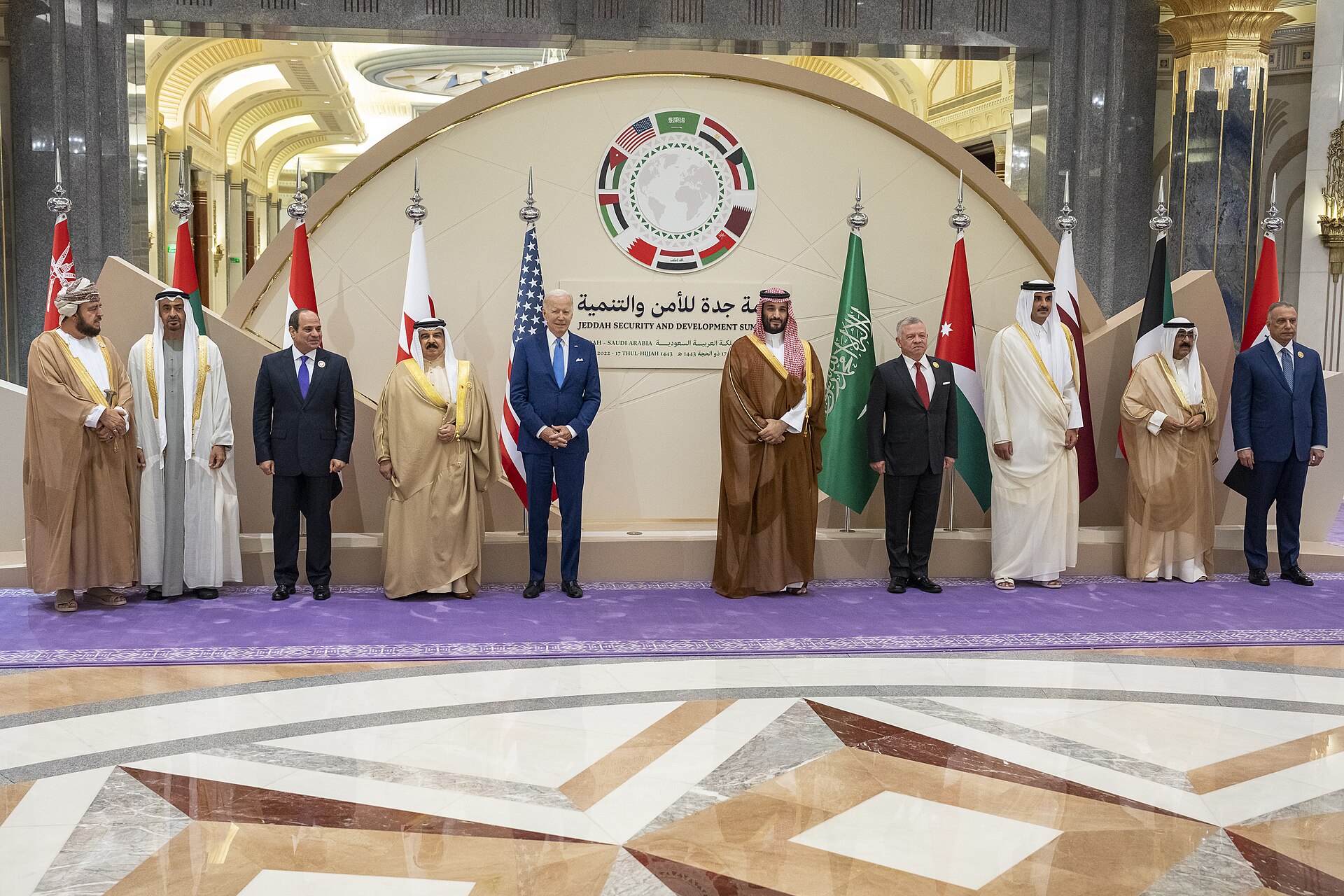
Table of Contents
- What the Summit Is Being Asked to Decide
- Faisal’s 48-Hour Phone Blitz and Iran’s Deliberate Sequencing
- Rubio’s Rejection and the Nuclear Red Line
- Can the GCC Agree on Iran When It Never Has?
- Kuwait’s 1,266 and Bahrain’s 69: Internal Security as War Measure
- Does the Hajj Deadline Force the Communiqué’s Hand?
- Background: From March 1 to April 28
- Frequently Asked Questions
What the Summit Is Being Asked to Decide
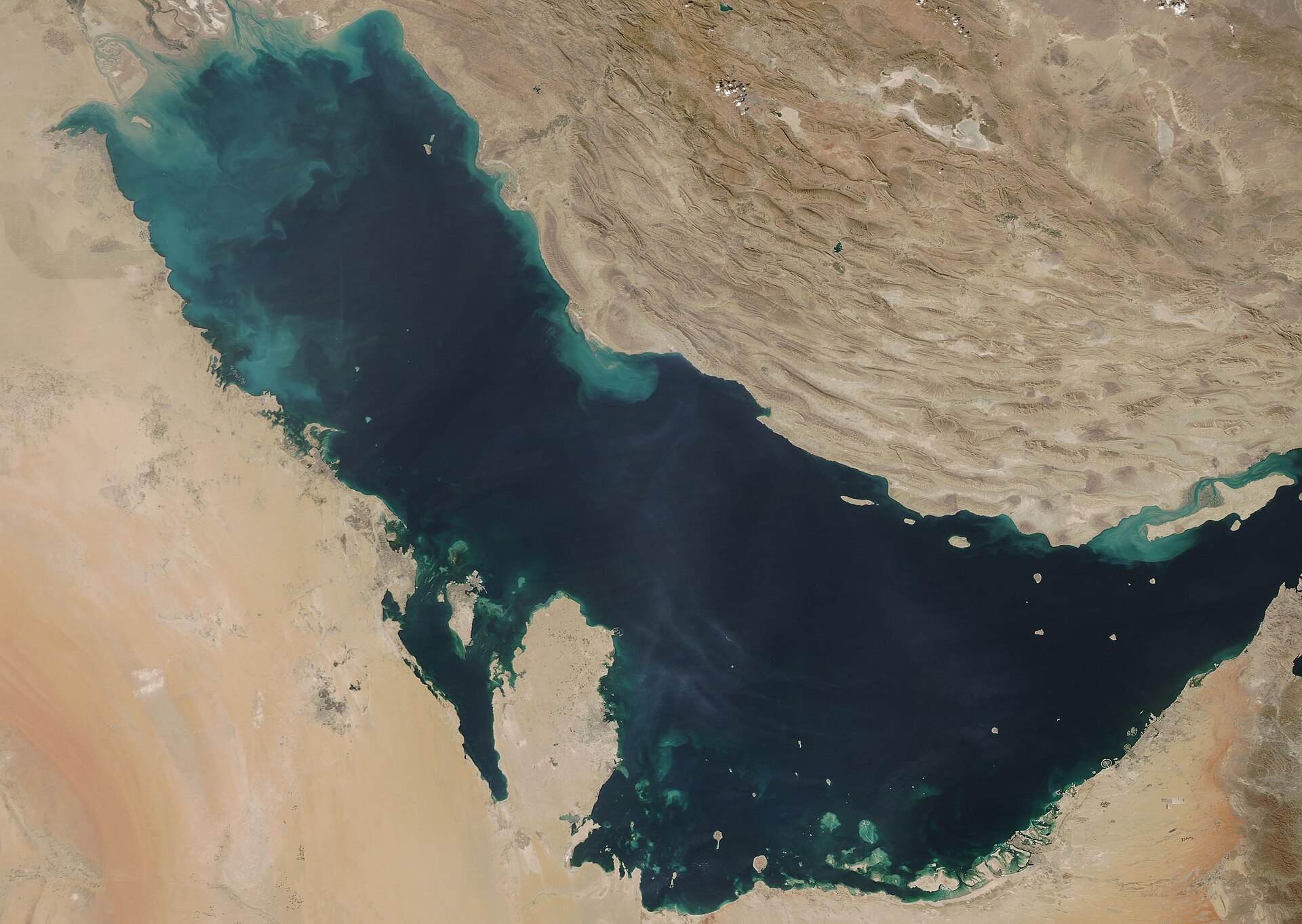
The formal agenda, according to Al Arabiya and Middle East Online, covers four items: coordinated response to Iranian attacks on GCC infrastructure, maritime security and Strait of Hormuz disruption, strengthening GCC foreign policy coordination toward Iran, and review of Pakistani-led mediation efforts. No final communiqué text had been publicly released as of this writing.
The underlying question is narrower and harder. Saudi Arabia must draft language that satisfies three audiences simultaneously: GCC members demanding collective defense solidarity — principally the UAE and Bahrain — without closing the diplomatic channel Foreign Minister Prince Faisal bin Farhan spent April 26-27 building, and without explicitly endorsing Washington’s insistence that Iran’s nuclear program be addressed in any first-phase deal.
The GCC’s March 1 extraordinary ministerial — the body’s 50th such session since its founding in 1981 — already invoked Article 51 of the UN Charter, affirming that “GCC countries reserve their legal right to respond, in accordance with Article 51 of the UN Charter, which guarantees the right of self-defence, individually and collectively.” Any April 28 communiqué that merely reaffirms that language without escalating it is, by institutional precedent, a deescalation signal — one Tehran, Washington, and Islamabad will all parse closely.
Faisal’s 48-Hour Phone Blitz and Iran’s Deliberate Sequencing
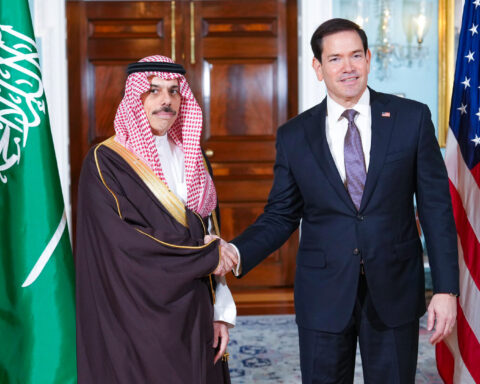
The summit did not arrive in a diplomatic vacuum. Between April 26 and 27, Prince Faisal conducted concentrated calls with his Iranian counterpart Araghchi, Bahrain’s foreign minister, Qatar’s Prime Minister and Foreign Minister Sheikh Mohammed bin Abdulrahman Al Thani, Oman’s Sayyid Badr Al Busaidi, Egypt’s Badr Abdelatty, and counterparts in Baghdad, Amman, Ankara, and Madrid, according to Asharq Al-Awsat and Arab News.
The Middle East briefing 3,000+ readers start their day with.
One email. Every weekday morning. Free.
The sequencing matters. Iran submitted its Hormuz-first proposal through Pakistan on April 27, but Araghchi briefed Faisal before the proposal reached Washington — a deliberate choice. Tehran wanted GCC states, and Saudi Arabia in particular, to understand the proposal on Iranian terms before Rubio’s rejection could frame it. That Iran routed the diplomatic preview through Riyadh rather than through Muscat (the traditional channel) or Islamabad (the formal mediator) suggests Tehran reads Saudi Arabia as the actor whose positioning will determine whether the proposal survives American opposition.
Putin reinforced this reading hours later. Meeting Araghchi in St. Petersburg on April 27 — with Foreign Minister Sergei Lavrov, presidential aide Yuri Ushakov, and Admiral Igor Kostyukov, the head of Russian military intelligence (GRU), per the Kremlin’s official readout — Putin told the Iranian delegation: “We see how courageously and heroically the Iranian people are fighting for their independence and sovereignty… we will do everything that serves your interests so that peace can be achieved as soon as possible.” Kostyukov’s presence elevated the meeting beyond diplomatic courtesy.
Rubio’s Rejection and the Nuclear Red Line
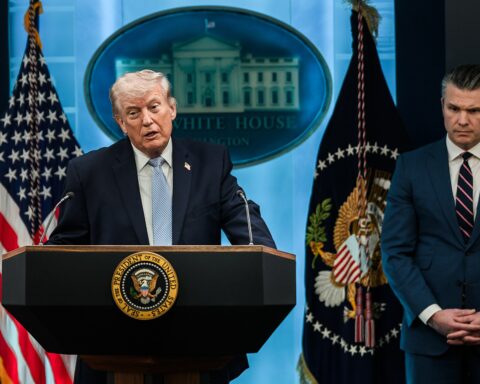
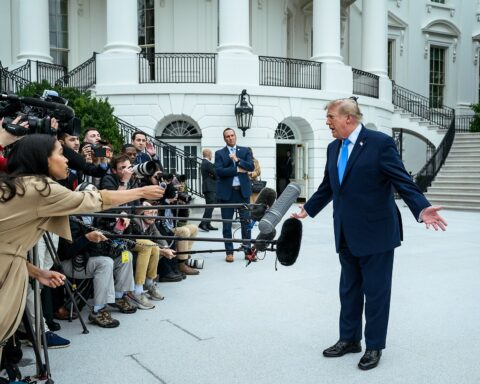
Rubio’s April 27 statement, delivered to Bloomberg and subsequently carried by CNBC and the Times of Israel, was the sharpest public American rejection of Iran’s negotiating framework since the war began.
“If what they mean by opening the straits is, ‘yes, the straits are opened, as long as you coordinate with Iran, get our permission, or we will blow you up and you pay us’ — that’s not opening the straits. They cannot normalize — nor can we tolerate them trying to normalize — a system in which the Iranians decide who gets to use an international waterway and how much you have to pay them to use it.”Marco Rubio, U.S. Secretary of State, Bloomberg, April 27, 2026
Rubio also closed the door on any interim deal that defers the nuclear question: “We have to ensure that any deal that is made, any agreement that is made, is one that definitively prevents them from sprinting towards a nuclear weapon at any point.” Iran holds an estimated 440.9 kilograms of uranium enriched to 60 percent, per the last available IAEA data from June 2025 — enough, by multiple Western intelligence estimates, for approximately 25 days of further enrichment to weapons-grade material using an IR-6 cascade. The IAEA has been unable to verify Iranian stockpiles since Tehran terminated access on February 28.
President Trump reviewed Iran’s proposal with senior aides in the Situation Room on April 27, according to CNBC. The White House has not issued a separate statement.
For Jeddah, the Rubio statement creates a specific drafting problem. If the communiqué endorses Washington’s position that nuclear deferral is unacceptable, it effectively kills Iran’s proposal before Pakistan can present a counter-framework — and closes the diplomatic channel Faisal spent two days constructing. If it avoids the nuclear question entirely, it risks being read in Washington as Gulf hedging at a moment when three American carrier strike groups are deployed in the region.
Can the GCC Agree on Iran When It Never Has?
The institutional record is not encouraging. The Middle East Council on Global Affairs, in an analysis published during the current conflict, concluded: “The GCC has never operated as a unified actor in its approach toward Iran, and it is unlikely to do so after the conflict ends… Even as missiles and drones crossed into the skies of all six GCC states, they have not converged around a single view of Iran, a shared reading of the war, or a common preferred outcome.”
Analysts at Italy’s ISPI reached a parallel conclusion, noting that GCC states have been “united in action” in the war but “haven’t been displaying the same positions on how to deal with the Iran threat.” Separately, Andrew Leber and Sam Worby of the Carnegie Endowment for International Peace identified incremental coordination improvement at best as “the most likely scenario” for GCC cooperation — describing it as “the ceiling of new cooperation” given the bloc’s historical record.
The fault lines are visible in real time. Oman is the only GCC state that directly criticized US and Israeli strikes on Iran and publicly welcomed the selection of Mojtaba Khamenei as Supreme Leader. Chatham House assessed that Muscat “will likely seek to maintain a middle road between Iran, the US and the Arab Gulf.” The UAE’s ambassador to the United States stated publicly that “a simple cease-fire isn’t enough” — language that aligns with Rubio’s insistence on nuclear guarantees rather than with the Hormuz-first sequencing Tehran proposed.
Bahrain’s position has hardened visibly. The 69 citizenship revocations on April 27 — targeting individuals Manama linked to Iranian war support — came one day after Kuwait revoked 1,266 citizenships in what Middle East Eye described as an unprecedented security action. Neither Oman nor Qatar has announced comparable domestic measures.
The Arabian Gulf Strategic Institute framed the GCC’s dilemma in structural terms: “For Riyadh, Abu Dhabi, and Doha, the calculation is stark: The alliance that was supposed to provide strategic insurance has itself become a source of hugely consequential strategic liability.” The reference is to the US security umbrella — three carrier strike groups are deployed in theater as of April 23, according to CENTCOM.
Kuwait’s 1,266 and Bahrain’s 69: Internal Security as War Measure
Kuwait’s Crown Prince traveled personally to Jeddah for the summit — a departure from the practice of sending lower-ranking delegates to consultative sessions. Kuwait Times quoted him describing the timing as coinciding with “accelerated exceptional regional challenges.”
The 1,266 Kuwaiti citizenship revocations announced April 26 included, according to multiple Gulf media reports, celebrated public figures including professional footballers. The domestic security measures came two days after fiber-optic drones launched from Iraq struck two Kuwaiti northern border posts on April 24 — the attack that activated the GCC’s northern threat corridor for the first time in the current conflict. The legal basis and specific accusations were not fully detailed in public statements. Bahrain’s 69 revocations the following day were explicitly linked to Iranian war support. Together, the two announcements in 48 hours represent the largest coordinated citizenship-stripping action in GCC history outside the 2017 Qatar blockade — and unlike the 2017 measures, which targeted a fellow GCC member, these target domestic populations.
The measures establish a domestic security baseline ahead of whatever the communiqué produces. States that have already acted against internal networks linked to Iran have stronger standing to demand collective enforcement language. Kuwait’s historically moderate foreign policy posture — it mediated the 2017-2021 Qatar blockade alongside Oman — makes the Crown Prince’s personal attendance and the scale of the revocations a signal that Kuwait’s center of gravity has shifted.
Does the Hajj Deadline Force the Communiqué’s Hand?
The Hajj begins May 24-29, 2026 — 27 days from the summit. Between 1.2 and 1.5 million pilgrims are expected. Zero will be Iranian; Tehran’s pilgrims have been barred from travel. Indonesia’s first departure contingent of 221,000 is scheduled for April 22-onward, and Pakistan’s 119,000 are already arriving.
Saudi Arabia’s air defense inventory has been depleted sharply. PAC-3 MSE interceptor stocks stand at approximately 400 rounds — 14 percent of the pre-war inventory, according to defense analysts tracking Saudi procurement filings. There is no publicly announced emergency resupply agreement, and the five-layer defense architecture over Makkah and Madinah (THAAD, PAC-3, KM-SAM, laser systems, and Skyguard short-range air defense) depends on interceptor depth that 59 days of war have eroded.
The Hajj creates a hard deadline for the communiqué’s security provisions. King Salman holds the Custodian of the Two Holy Mosques title — adopted by King Fahd on October 27, 1986, as a direct answer to the 1979 Grand Mosque seizure and Khomeini’s campaign to delegitimize Saudi guardianship. That title now attaches to a threat environment that did not exist at the March 1 session. Language that merely reaffirms the March 1 collective defense posture without addressing interceptor resupply, air defense coordination through the “Belt of Cooperation” (Hizam Al-Taawun) joint framework, or operational burden-sharing during the pilgrimage window leaves those obligations exposed.
The 1987 Hajj massacre, in which 402 people died during Iranian-organized protests in Makkah, led to an 87 percent quota reduction for Iranian pilgrims and a three-year boycott. That precedent operates in reverse in 2026: Iran has no pilgrims at risk, removing a traditional deterrent against escalation during the pilgrimage window.
Background: From March 1 to April 28
The path from the GCC’s first wartime response to this summit spans 58 days of institutional and diplomatic evolution.
On March 1, 2026, the GCC Ministerial Council held its 50th extraordinary session within 24 hours of Iran’s opening strikes — which hit infrastructure in all six member states. The statement condemned the attacks and invoked Article 51 collective self-defense rights. It did not activate the Peninsula Shield Force (established 1984, with structural limitations exposed during Iraq’s 1990 invasion of Kuwait) or announce joint military operations.
The broader mediator architecture took shape through April. The Antalya Diplomacy Forum (April 17-19) produced a quad meeting of Turkey, Pakistan, Saudi Arabia, and Egypt — the first formal multilateral diplomatic framework since the war began. Pakistan’s role as lead mediator was consolidated through April, with the Islamabad talks producing a near-agreement that collapsed when, according to Iranian President Masoud Pezeshkian’s own public accusation, IRGC-linked officials Vahidi and Abdollahi deviated from the delegation’s mandate.
The Hormuz double blockade — with the US controlling Arabian Sea entry since April 13 and the IRGC controlling Gulf of Oman exit since March 4 — has reduced Strait transits to 45 since the April 8 ceasefire, 3.6 percent of the pre-war baseline. IEA Director Fatih Birol has called the resulting 13 million barrels per day of offline supply “the biggest energy security threat in history.”
The GCC also worked European channels to influence the negotiations. As House of Saud reported, Gulf states used European diplomatic frameworks to harden terms that Washington appeared ready to soften — a pattern that may repeat if the April 28 communiqué is calibrated to set a floor under Western negotiating positions.
The IRGC Navy’s declaration of “full authority” over Hormuz, issued first on April 5 and repeated April 10 while Araghchi was in Islamabad, remains unreversed. The IRGC Navy’s commander, Admiral Alireza Tangsiri, was killed on March 30. No named successor has been announced — the command structure that Iran claims has “full authority” over an international waterway has been headless for 29 days.
Frequently Asked Questions
Has the GCC ever invoked collective military action against an external threat?
The GCC does not have a NATO-style Article 5 mutual defense clause. The closest precedent is the Peninsula Shield Force deployment during Iraq’s 1990 invasion of Kuwait, which exposed structural limitations — coordination failures, incompatible equipment, and command disputes. In 2011, Saudi Arabia and the UAE deployed approximately 1,200 Saudi SANG troops via the King Fahd Causeway into Bahrain under the Peninsula Shield banner, but that was an internal security operation against protests, not a response to external state aggression. The March 1, 2026 statement’s invocation of Article 51 of the UN Charter — individual and collective self-defense — represented the strongest legal framing the GCC has ever adopted against a named external aggressor.
Why is Oman’s position different from the other five members?
Oman has maintained diplomatic relations with Iran continuously since the Islamic Revolution, including through the 1980-88 Iran-Iraq war when other Gulf states backed Baghdad. Sultan Haitham bin Tariq inherited from Sultan Qaboos a foreign policy doctrine of active neutrality. Muscat hosted secret US-Iran backchannel talks that led to the 2015 JCPOA and has served as the primary intermediary for British and other Western hostage negotiations with Tehran. In the current conflict, Oman is the only GCC state to publicly criticize US and Israeli military operations against Iran and to welcome Mojtaba Khamenei’s accession as Supreme Leader. Al Busaidi’s confidence in a near-term peace deal positions Muscat as the consensus-seeking voice in Jeddah — and likely the primary obstacle to confrontational communiqué language.
What happens if the summit produces only a reaffirmation of the March 1 statement?
A reaffirmation without escalation would send three signals. To Tehran: the GCC is not closing the diplomatic track, and Faisal’s phone blitz was authorized at the leadership level. To Washington: Gulf states are not endorsing Rubio’s nuclear-first sequencing as a precondition for engagement. To Islamabad: Pakistan’s mediator role remains the GCC’s preferred framework. The risk for Saudi Arabia is that Washington reads reaffirmation-only as insufficient solidarity — at a moment when three carrier strike groups are deployed in defense of Gulf shipping lanes that Gulf states themselves are no longer fully controlling.
How does the 2017 Qatar blockade affect today’s summit dynamics?
The 2017-2021 blockade — during which Saudi Arabia, the UAE, Bahrain, and Egypt severed diplomatic and economic ties with Qatar — was resolved at the Al-Ula summit on January 5, 2021, with Kuwait and Oman mediating throughout. The episode demonstrated that the GCC can fracture over Iran policy (Qatar maintained ties with Tehran throughout the blockade) and that repair takes years. Qatar’s current positioning — its prime minister took Faisal’s call on April 27 — suggests Doha is inside the tent for now, but the institutional memory of blockade cuts both ways: it disciplines members against defection, and it reminds them that Saudi-led consensus can be coercive.
What military coordination mechanisms does the GCC actually have?
Three primary structures exist. The Peninsula Shield Force, headquartered at Hafar Al-Batin in northern Saudi Arabia, was established in 1984 with a nominal strength of approximately 40,000 troops — though actual deployable capacity has never been independently verified. The “Belt of Cooperation” (Hizam Al-Taawun) provides a framework for joint air defense coordination, including integrated early warning systems, but does not pool interceptor stocks or mandate burden-sharing during active conflict. The GCC Joint Military Command, formalized after the 2014 summit, has a coordination role but no independent operational authority. None of these mechanisms has been tested against a sustained state-on-state conventional and ballistic missile campaign of the scale Iran has conducted since February 28.
When the summit did produce results — the GCC’s Decisiveness Summit collective-defence declaration, the Gulf Strategic Reserve directive, and the formal invocation of UN Charter Article 51 — the gap between the communiqué and MBZ’s empty chair defined the outcome.
The summit convened hours after the UAE announced its formal OPEC and OPEC+ withdrawal effective May 1, 2026 — a decision that reframed the gathering from a diplomatic coordination meeting into an emergency response to an open rupture in Gulf economic solidarity. Full coverage: UAE Quits OPEC After 59 Years, Citing Gulf Solidarity Failure in Iran War. The decision’s diplomatic context — why Abu Dhabi moved without notifying Riyadh, and what the FM substitution signals about GCC cohesion — is analysed in The UAE Did Not Consult Saudi Arabia.
The GCC summit communiqué’s collective-defence language provided the political mandate that Saudi Arabia needed the following morning: Prince Faisal’s April 29 call to Guterres used the six-nation declaration to legitimize the Faisal-Guterres call that opened the good-offices channel, converting the Secretary-General’s mediation offer from a suggestion into a politically mandated Hormuz diplomacy track.