ISLAMABAD — On the same day JD Vance departed Washington for Islamabad to negotiate a ceasefire Pakistan is hosting, two Pakistani Air Force Il-78MP tankers and three C-130H transports landed at King Abdulaziz Air Base in Saudi Arabia — the operational activation of a mutual defence pact that legally obligates Pakistan to treat Iranian attacks on Saudi Arabia as attacks on itself. Pakistan is now simultaneously Iran’s ceasefire guarantor in Islamabad and Saudi Arabia’s activated military partner in the Eastern Gulf, a dual role that is not ambiguous but structurally impossible.
At least one of those tankers was airborne over the eastern Gulf near Bahrain on April 10, assessed as actively refuelling Pakistani fighter jets flying combat air patrols. The deployment was first reported by EGYOSINT and confirmed by multiple regional defence outlets. It is the most visible military expression of the Saudi-Pakistan Mutual Defence Agreement since its invocation on March 7, and it arrived at the worst possible diplomatic moment — hours before Iran’s delegation was due in the same country that signed the pact.
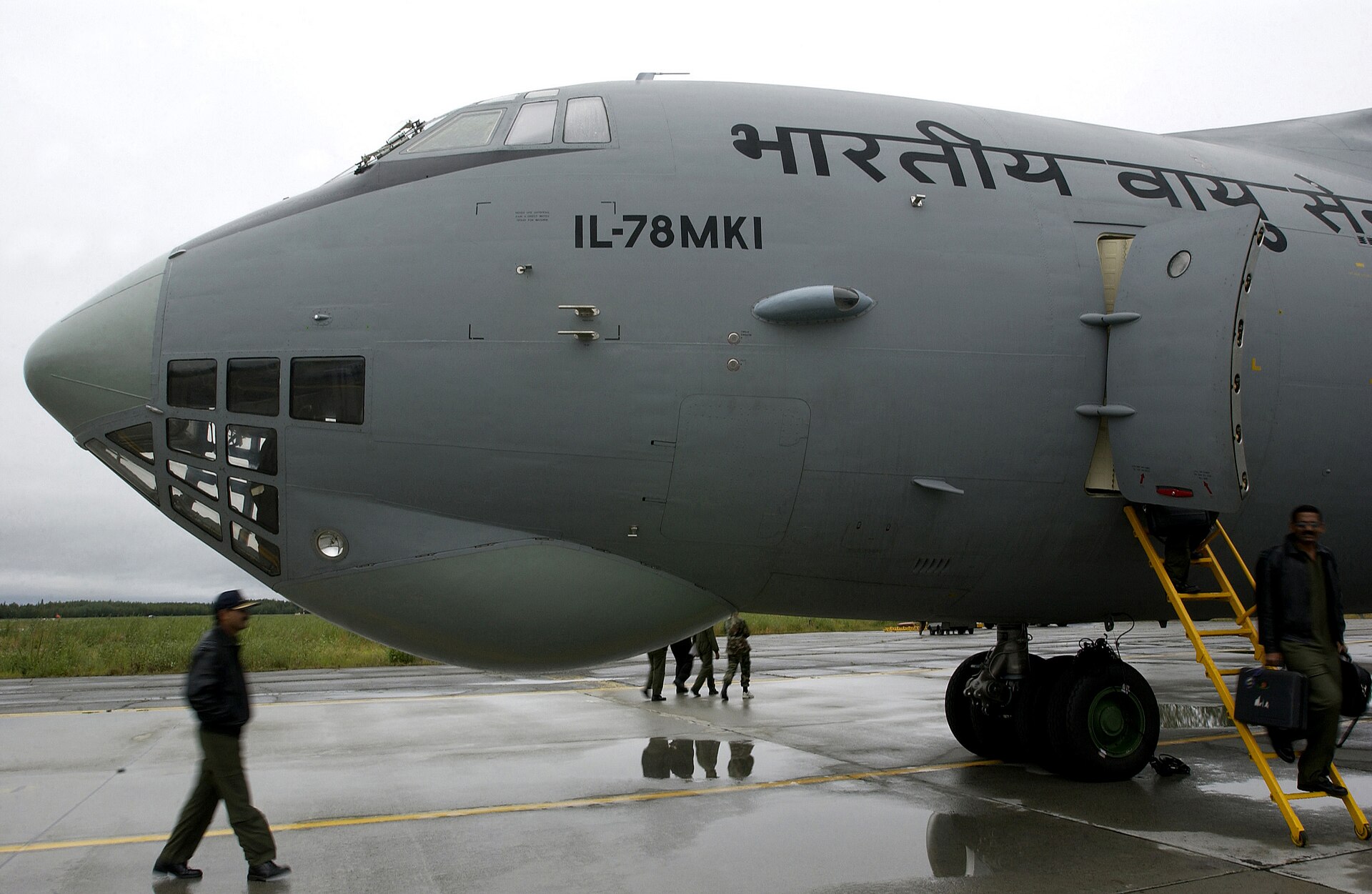
Table of Contents
- The SMDA Moves From Paper to Tarmac
- What Does Deploying Two of Four Tankers Mean?
- How Ishaq Dar Spent Pakistan’s Strategic Ambiguity
- Iran’s Protecting Power Is Now Iran’s Adversary’s Air Wing
- The Munir Architecture: Who Decides in Islamabad?
- Pakistan’s SAM Grid and the PAC-3 Arithmetic
- Did Pakistan Escort Ghalibaf and Arm Saudi Arabia on the Same Day?
- The $12 Billion Lock
- 1973, 2015, and the Precedents That Don’t Quite Fit
- What Tehran Sees From Islamabad
- FAQ
The SMDA Moves From Paper to Tarmac
The Saudi-Pakistan Mutual Defence Agreement was signed on September 17, 2025. Its core clause mirrors NATO’s Article 5: “any aggression against either country shall be considered an aggression against both.” But unlike Article 5, the SMDA has no consultation mechanism, no joint command structure, no published text, and no defined threshold for what constitutes the triggering aggression. Pakistan’s role as ceasefire broker has already strained both commitments; now it is activating the defence pact it never defined.
Saudi Arabia formally invoked the agreement on March 7, 2026 — thirty-seven days into the Iran-US war — following Iranian strikes on Ras Tanura and Prince Sultan Air Base. What followed was a phased deployment that began quietly and has now become unmistakable. Pakistan moved LY-80 surface-to-air missile batteries (40-kilometre range), FM-90 point-defence systems (15-kilometre range), and Anza Mk-III man-portable systems into Saudi territory, all under Pakistani command. Two Il-78MP aerial refuelling tankers were pre-positioned from Nur Khan Air Base in Rawalpindi to Masroor Air Base in Karachi on March 1 — six days before the formal invocation — suggesting Rawalpindi anticipated the Saudi request before it arrived.
Between 1,500 and 2,000 Pakistani troops were already in Saudi Arabia under pre-existing bilateral arrangements, according to a 2025 CSIS assessment. The SMDA activation expanded this into something qualitatively different: not training cadres or advisory detachments but forward-deployed combat enablers operating from a Saudi air base within range of the war’s primary theatre. General Raheel Sharif, Pakistan’s former army chief who leads the 43-nation Islamic Military Counter Terrorism Coalition headquartered in Riyadh, is reported to be supervising the deployment.
Chatham House assessed the SMDA in September 2025 as setting “a precedent for extended deterrence” by a nuclear-armed state outside the Non-Proliferation Treaty. That assessment was theoretical. As of April 10, it is operational.
The Middle East briefing 3,000+ readers start their day with.
One email. Every weekday morning. Free.

What Does Deploying Two of Four Tankers Mean?
Pakistan’s Il-78MP fleet totals four aircraft, all delivered between 2009 and 2011 from Ukrainian surplus stocks. As of February 2026, IDRW.org assessed only approximately one as fully operational, with the remaining three suffering from chronic spare-parts shortages exacerbated by the collapse of Ukrainian defence supply chains since 2022. That two tankers reached King Abdulaziz Air Base means either Pakistan has quietly restored additional airframes — or it has deployed nearly every functional aerial refuelling asset it possesses to a foreign country 2,400 kilometres from its own borders.
Former PAF Air Commodore Adil Sultan described tanker deployments to the Gulf as moves that would “enhance interoperability of both air forces and would be mutually beneficial.” The framing was diplomatic. The operational reality is more pointed: Il-78MP tankers extend the combat radius of Pakistani fighters well into the Persian Gulf, and an aircraft actively refuelling combat jets over the eastern Gulf near Bahrain is not enhancing interoperability — it is sustaining combat air patrols in an active war zone.
Bilal Khan of Quwa Defence News put the broader strain directly: Pakistan cannot “sustain a two-front posture without the structural reforms and Gulf reciprocity it has never received.” The tanker deployment is the clearest illustration. Pakistan’s air force has no redundancy for these assets. If the India border escalates — as it did in February 2019 — Pakistan would need to recall aircraft committed to Saudi Arabia under a mutual defence pact, creating exactly the kind of crisis the SMDA was never designed to adjudicate.
How Ishaq Dar Spent Pakistan’s Strategic Ambiguity
On March 3, 2026 — four days before the formal SMDA invocation — Deputy Prime Minister and Foreign Minister Ishaq Dar told the Pakistani Senate: “We have a defence pact with Saudi Arabia, and the whole world knows about it.” He then added the sentence that collapsed decades of deliberate vagueness: “I told the Iranian leadership to take care of our pact with Saudi Arabia.”
Dar went further. He disclosed that Iran had responded by requesting assurances that Saudi soil would not be used for attacks against Iran, and that Pakistan had provided those assurances. “As a result,” Dar said, “there is no quick or minimal reaction of Iran against Saudi Arabia and Oman.” In a single press conference, Pakistan’s foreign minister simultaneously invoked the pact, warned Iran about it, and then pledged to Iran that it would constrain the very ally the pact obligates Pakistan to defend.
The Middle East Council on Global Affairs assessed that Dar “spent that ambiguity in a single press conference” — converting a deliberately vague agreement into a public commitment that raised the cost of inaction to a level Islamabad may be unable to pay. Joshua White of the Brookings Institution framed the loss precisely: “You can’t have deterrence without some constructive ambiguity.” Dar eliminated the ambiguity without establishing the deterrence.
Iran’s ambassador to Saudi Arabia, Alireza Enayati, publicly welcomed the Saudi non-use pledge that Pakistan brokered. Tehran’s trust in Pakistan as a ceasefire venue was premised not on Pakistani neutrality but on Pakistan’s demonstrated willingness to constrain Saudi Arabia. The April 10 tanker deployment contradicts that premise at the level of satellite imagery.
Iran’s Protecting Power Is Now Iran’s Adversary’s Air Wing
Pakistan has served as Iran’s protecting power in the United States since March 1992, when it replaced Algeria. The Iranian Interests Section has operated out of the Pakistani Embassy in Washington for 34 years. This arrangement survived the 1998 Iranian diplomat killings in Afghanistan, the Jundallah insurgency that both countries accused the other of manipulating, and the January 2024 cross-border strikes between the two countries. It is the longest-running protecting-power arrangement Iran maintains anywhere.
The structural contradiction is now absolute. Pakistan is legally obligated under the SMDA to treat Iranian attacks on Saudi Arabia as attacks on itself. Pakistan is simultaneously the diplomatic intermediary through which Iran communicates with Washington. And Pakistan is now physically deploying combat-enabling assets to a Saudi air base within range of Iranian territory.
The protecting-power role requires, at minimum, the perception that the protecting state is not a co-belligerent. An Il-78MP tanker flying refuelling orbits over the eastern Gulf while Pakistani diplomats host Iranian negotiators in Islamabad is not a perception problem — it is a legal one.
Samina Yasmeen of the Centre for Muslim States and Societies at the University of Western Australia framed Iran’s calculation: “The Iranians put trust in Pakistan because they know it has skin in the game.” The skin, as it turns out, wears Saudi colours.
The Munir Architecture: Who Decides in Islamabad?
The 27th Constitutional Amendment, passed on November 12-13, 2025, created the post of Chief of Defence Forces and installed Field Marshal Asim Munir in it. The amendment passed in 36 hours. Two Supreme Court justices resigned, one calling it “a serious attack on the Constitution.” Under its provisions, the Prime Minister can be removed by a simple parliamentary majority while the CDF requires a two-thirds vote and holds lifetime immunity from prosecution. There is no theoretical civilian check on military deployments abroad.
It was Munir — not Prime Minister Shehbaz Sharif — who spent the night of April 8-9 personally relaying messages between Vice President Vance, Special Envoy Witkoff, and Iranian Foreign Minister Araghchi. The ceasefire diplomacy is Munir’s operation, conducted through military channels, under military authority. The SMDA deployment is also Munir’s decision. The same person who ordered tankers to Saudi Arabia is hosting the talks those tankers structurally undermine.
When Pakistan’s parliament voted unanimously against involvement in a Saudi-led Arab conflict in 2015, the military participated anyway. The 27th Amendment eliminates even that theatrical constraint. Saudi Arabia was excluded from the Islamabad bilateral despite having held a co-guarantor seat in the March 29-30 round — but its military interests are represented in the room through the CDF who commands both the talks and the tankers.

Pakistan’s SAM Grid and the PAC-3 Arithmetic
The Pakistani air defence deployment to Saudi Arabia — LY-80, FM-90, and Anza Mk-III systems — fills a specific gap in the Saudi defensive architecture. Saudi Arabia has approximately 400 PAC-3 interceptors remaining from a pre-war stockpile of roughly 2,800. The implied expenditure on intercepts alone exceeds $3.49 billion at $3.9 million per round. Lockheed Martin’s Camden, Arkansas facility produces approximately 620 PAC-3 MSE rounds per year — meaning even if every missile produced went exclusively to Saudi Arabia, full replenishment would take nearly four years.
Pakistan’s LY-80 system, the export variant of China’s HQ-16, operates at 40-kilometre range — sufficient for medium-altitude drone intercepts and some cruise missile defence but unable to engage ballistic missiles. The FM-90 covers point defence at 15 kilometres. Neither system approaches PAC-3 capability, but neither needs to: their role is to handle the lower tier of Iran’s threat spectrum — the Shahed-series drones and cruise missiles that force PAC-3 batteries to waste interceptors on targets worth a fraction of the missile’s cost. Every drone a Pakistani LY-80 kills is a PAC-3 round preserved for the ballistic threats only Patriot can address.
Haleema Saadia of the Asia-Pacific Leadership Network offered the structural critique: “Pakistan lacks permanent forces in the Gulf and does not share borders or direct theaters of conflict with Saudi Arabia.” The SMDA, she assessed, is “politically expedient but strategically hollow.” The April 10 deployment tests that assessment. Five batteries and two tankers is not a permanent force, but it is also not nothing — and the gap it fills in Saudi air defence is not symbolic.
Did Pakistan Escort Ghalibaf and Arm Saudi Arabia on the Same Day?
DefenceSecurityAsia.com reported on April 10 that Pakistan established a protective air shield to escort the Iranian delegation — led by Parliament Speaker Mohammad Bagher Ghalibaf and Foreign Minister Abbas Araghchi — into Islamabad, reportedly using J-10C fighters, Saab Erieye AWACS aircraft, and F-16 and JF-17 Block III fighters. The PAF has not confirmed this mission, and it should be treated as unverified.
If true, the operational picture on April 10 becomes surreal: Pakistani tankers refuelling combat jets over the Gulf near Bahrain to defend Saudi Arabia from Iran, while Pakistani fighters escorted Iran’s chief negotiator into the country hosting talks meant to end the war Pakistan is helping Saudi Arabia fight. If false, the fact that credible defence outlets found the claim plausible enough to publish tells its own story about the contradictions Pakistan has accumulated.
Ghalibaf arrived in Islamabad with two preconditions that have nothing to do with Pakistan: inclusion of Lebanon in any ceasefire framework, and the unfreezing of Iranian assets. Both demands are directed at Washington, not Islamabad. Ghalibaf arrived already holding the exit, and Pakistan’s stated goal for the talks was revealingly modest — not to reach a deal, but to keep the talks alive. When the host defines success as merely not failing, the venue has become the product.
The $12 Billion Lock
On March 9, 2026 — two days after the SMDA invocation — Pakistan requested that Saudi Arabia convert its $5 billion deposit in the State Bank of Pakistan into a 10-year facility and expand the Saudi oil credit facility from $1.2 billion to $5 billion. The request was not subtle in its timing. Combined Saudi, Chinese, and UAE deposits total approximately $12 billion, representing 84 percent of Pakistan’s $14.3 billion gross foreign exchange reserves under its current IMF Extended Fund Facility programme.
The financial dependency is not incidental to the military deployment — it is the deployment’s structural foundation. Pakistan’s foreign exchange reserves without Gulf deposits would sit below $2.5 billion, roughly three weeks of import cover. The SMDA is not a security guarantee backed by shared strategic interest; it is a security guarantee backed by the creditor-debtor relationship that makes refusal existentially expensive. Saudi Arabia does not need to threaten withdrawal. The deposit’s existence is the threat.
Umer Karim of the King Faisal Center for Research and Islamic Studies in Riyadh framed the moment in terms of finality: “Perhaps this is the last time the Saudis will test Pakistan.” The implication was that failure to deliver would end not the pact but the financial architecture that keeps Pakistan solvent. Aziz Alghashian of the Gulf International Forum was more direct: “Treaties are only as strong as the political calculations behind them.” For Pakistan, the calculation is denominated in dollars.
1973, 2015, and the Precedents That Don’t Quite Fit
Pakistan has deployed military personnel to Arab conflicts before, and each precedent illuminates a different facet of the current contradiction. In October 1973, Prime Minister Zulfikar Ali Bhutto dispatched 16 PAF volunteers to Egypt and Syria during the Yom Kippur War. Flight Lieutenant Sattar Alvi shot down an Israeli Mirage III on April 26, 1974, flying a Syrian Air Force MiG-21. The deployment was small, deniable, and conducted while Pakistan maintained functional relations with Iran under the Shah — a very different Iran with a very different relationship to Islamabad.
The 2015 Yemen precedent is more instructive. Pakistan’s parliament voted unanimously to stay out of the Saudi-led coalition against the Houthis. The navy participated in the Saudi naval blockade regardless. The gap between parliamentary declaration and military action was not a scandal — it was the operating model. The 27th Constitutional Amendment has since eliminated even the pretence of civilian oversight: under the CDF structure, Munir commands the deployment to King Abdulaziz Air Base and the talks in Islamabad without consulting parliament on either.
Ilhan Niaz of Quaid-e-Azam University stated the hierarchy plainly: “If Tehran forces Pakistan to choose between Iran and Saudi Arabia, the choice would unquestionably be in favour of the Saudis.” But the current situation is not a binary choice — it is an attempt to avoid choosing by performing both roles simultaneously. The tanker deployment suggests that when the performance breaks down, the hardware reveals the preference.
Amir Rana of the Pakistan Institute of Peace Studies flagged the domestic cost: “Iran has significant influence over Shia organisations in Pakistan” — and fallout from a visible Saudi military alignment “would be severe.” Pakistan’s Shia population is estimated at 15-20 percent. The Balochistan border with Iran has been a flashpoint for decades. The calculation is not only diplomatic but sectarian, and it runs through Pakistani domestic politics in ways the SMDA text does not contemplate.
What Tehran Sees From Islamabad
Iran has not publicly protested the April 10 tanker deployment, but silence does not indicate acceptance. Iran still needs the Islamabad venue because no alternative exists — Bab al-Mandab is the ceasefire’s undocumented second chokepoint, and the geographic logic of mediation favours Pakistan over every other candidate. Qatar is compromised by its LNG transit dependencies; Oman brokered the pre-war channel but cannot host principals; Turkey offered but lacks the Iranian institutional trust. Pakistan’s value to Iran is precisely that it has enough Saudi exposure to credibly constrain Riyadh — or so Tehran believed until satellite imagery showed PAF tankers at a Saudi air base.
Iran’s Supreme National Security Council declared after the ceasefire that “negotiations are continuation of battlefield.” Tehran entered the Islamabad talks not from trust in Pakistan’s neutrality but as a tactical pause, with the IRGC’s operational posture unchanged beneath the diplomatic surface. Pakistan brokered a ceasefire it cannot enforce, and the enforcement gap widens with every sortie those tankers enable.
The Iranian calculation now contains a new variable. If the deployment becomes a public issue — if Iranian media or IRGC-aligned outlets begin framing Pakistan as a co-belligerent — the Islamabad talks lose their foundational premise. Iran does not need to walk out; it needs only to question, publicly, whether the host is neutral. The SMDA text provides the answer: it is not.
The Hajj 2026 deadline compounds the pressure. Ceasefire expiration on April 22 sits four days after Hajj arrivals begin. Pakistan has 119,000 pilgrims arriving from April 18. If the talks collapse and the ceasefire lapses, those pilgrims are in Saudi Arabia under the protection of a country that is simultaneously defending Saudi Arabia from the state that would resume attacking it. The contradictions do not resolve themselves — they merely move from the diplomatic register to the physical one.

The Hardware Reveals the Preference
The deployment to King Abdulaziz Air Base is small by any major military’s standards — two tankers, three transports, a handful of SAM batteries. It would not change the outcome of the war, and it is not meant to. The deployment’s function is declarative: Pakistan has chosen, and the choice is Saudi Arabia. Everything else — the hosting of talks, the overnight message relay, the protecting-power role, the stated goal of keeping diplomacy alive — operates in the space between the declaration and its consequences. Umer Karim’s assessment may prove the most durable: “It will not be easy for Pakistan to sell the same weapons systems to opposing sides.”
In the Nur Khan Air Base officers’ mess, there is a painting of Flight Lieutenant Sattar Alvi’s MiG-21 engaging the Israeli Mirage over the Golan Heights in 1974. Pakistan has always found ways to fight for Arab states while maintaining other relationships. But Alvi flew under a Syrian flag, not a Pakistani one, and the country he was fighting had no embassy in Islamabad to close — Iran does. Iran’s diplomatic interests in Washington are handled by the same government that just parked refuelling tankers at a Saudi air base. The painting in the officers’ mess is a portrait of a simpler time.
Frequently Asked Questions
What is the Saudi-Pakistan Mutual Defence Agreement (SMDA)?
The SMDA was signed on September 17, 2025, and contains a clause stating that “any aggression against either country shall be considered an aggression against both.” Unlike NATO’s Article 5, which it superficially resembles, the SMDA has no consultation framework (NATO has the North Atlantic Council), no integrated military command (NATO has SACEUR), no published legal text, and no defined threshold for what constitutes triggering aggression. Nuclear weapons are excluded. The agreement was first invoked by Saudi Arabia on March 7, 2026, making it one of the shortest gaps between signing and activation of any mutual defence treaty in modern history — roughly 171 days. Chatham House described it as the first extended deterrence commitment by a nuclear-armed state outside the NPT framework.
Why does the Il-78MP tanker fleet size matter?
Pakistan’s four Il-78MP tankers were acquired from Ukrainian surplus between 2009 and 2011. Ukraine’s defence industrial collapse since the 2022 Russian invasion has eliminated the original spare-parts supply chain. IDRW.org assessed only approximately one airframe as fully operational in February 2026, meaning the two aircraft at King Abdulaziz Air Base likely represent Pakistan’s entire functional tanker capability. Without tankers, Pakistani fighters operating from Saudi bases would be limited to their internal fuel range — roughly 700-900 kilometres combat radius for JF-17s — but with tankers that radius extends across the Persian Gulf and into waters where Iran’s naval and air threats are concentrated. The deployment is not proportional to Pakistan’s total air force; it is proportional to Pakistan’s total refuelling capability, which makes it far more consequential than the number two suggests.
Can Pakistan legally serve as Iran’s protecting power while activating the SMDA?
There is no formal legal prohibition, but the protecting-power arrangement under the Vienna Convention on Diplomatic Relations rests on the receiving state’s (the US) and the represented state’s (Iran’s) continued consent. Iran can revoke Pakistan’s protecting-power status at any time by requesting a replacement — as Iran itself replaced Algeria with Pakistan in 1992. The practical barrier is that Pakistan has held this role for 34 years, and the institutional infrastructure (the Iranian Interests Section within the Pakistani Embassy in Washington, the consular networks, the back-channel architecture) would take months to replicate elsewhere. Switzerland, which handles US interests in Iran, is the most likely replacement, but Tehran has shown no public interest in making that switch — yet. The absence of a formal legal barrier does not mean the arrangement can survive indefinite strain — it means the breaking point, when it comes, will be political rather than juridical.
How does the 27th Constitutional Amendment affect Pakistan’s war decisions?
The amendment, passed November 12-13, 2025, created the Chief of Defence Forces position with authority over all military branches and installed Field Marshal Asim Munir in it. The CDF requires a two-thirds parliamentary supermajority to remove — a threshold never reached against a sitting military leader in Pakistani history — and holds lifetime immunity from prosecution, while the Prime Minister is removable by simple majority. In practice, this means the person deciding both the Saudi deployment and the Iran ceasefire talks is constitutionally insulated from any civilian check. The 2015 Yemen precedent, in which parliament voted unanimously for neutrality while the navy joined Saudi operations, demonstrated that civilian oversight was already notional. The 27th Amendment made its absence constitutional.
What happens to the Islamabad talks if Iran publicly challenges Pakistan’s neutrality?
The talks, pushed to April 11-12 with Pakistan’s stated goal described as “modest” — merely keeping the process alive — survive on Iran’s lack of alternatives rather than on trust. If Tehran frames the SMDA deployment as evidence of Pakistani co-belligerency, the talks do not necessarily collapse immediately. Iran needs a venue, and no other capital offers the combination of geographic proximity, institutional capacity, and bilateral relationships with both Washington and Tehran. But a public challenge would shift the negotiating dynamic from Pakistan-as-mediator to Pakistan-as-interested-party, which would require either a co-mediator (Turkey and Egypt have been mentioned) or a venue change. The deeper risk is that IRGC-aligned media — which already operates under the SNSC doctrine that “negotiations are continuation of battlefield” — uses the deployment as justification to tighten conditions or add preconditions that make the talks technically alive but substantively dead.