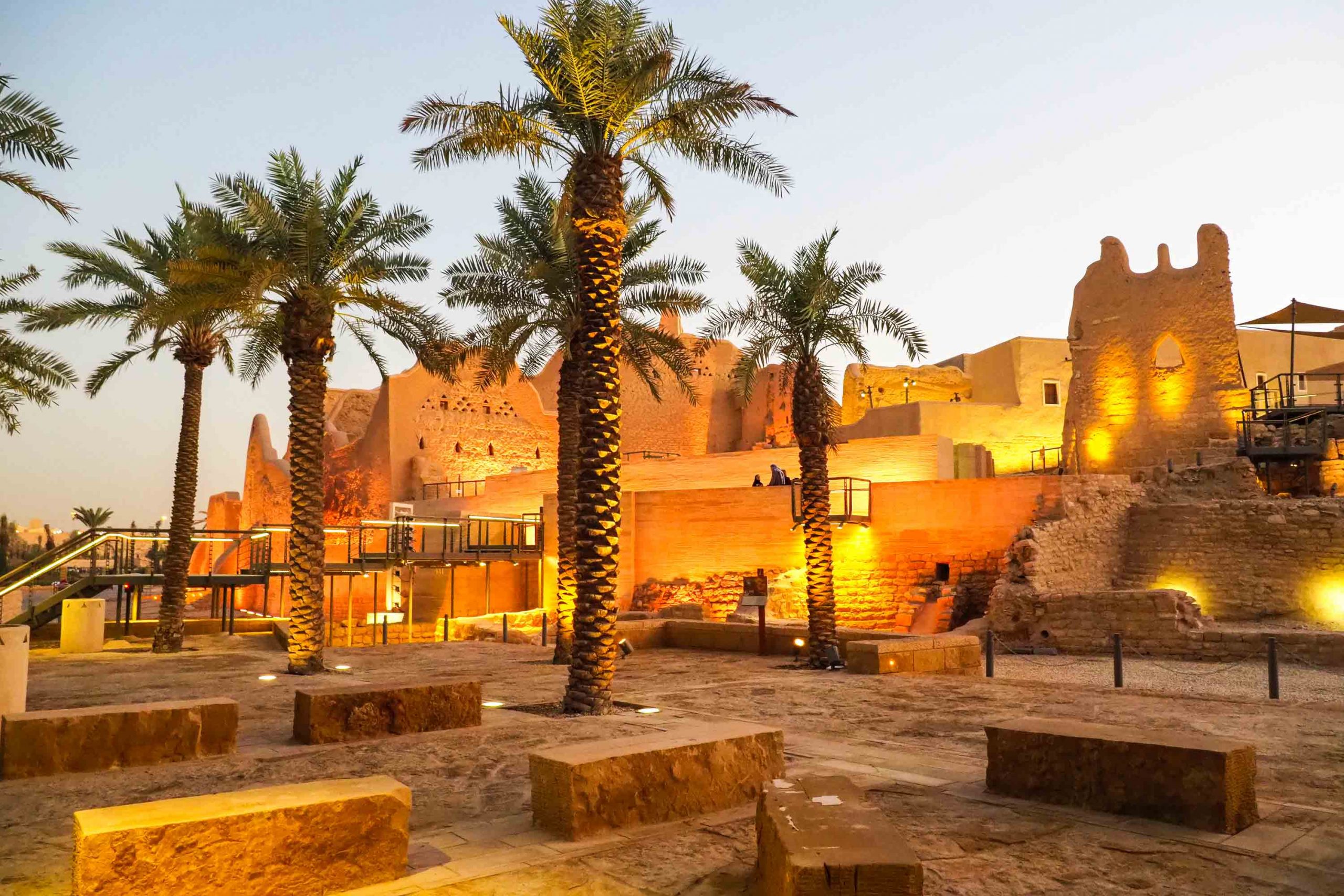

Saudi Arabia welcomed 122 million visitors in 2025, spending $81 billion — making it the fastest-growing major tourism destination on earth. From the holy cities of Mecca and Medina to the futuristic megaprojects of NEOM and The Line, the ancient Nabataean tombs of AlUla to the coral reefs of the Red Sea, the Kingdom is open to the world like never before. This is your complete guide to planning, booking, and experiencing Saudi Arabia.
- Why Visit Saudi Arabia
- Entry Requirements at a Glance
- Essential Guides
- Destinations
- Saudi Arabia by Region
- Getting There and Getting Around
- Adventures & Experiences
- Saudi Arabia’s Food Culture
- Culture, Etiquette & What to Expect
- When to Visit: Climate and Seasons
- Budgeting Your Trip
- Plan Your Trip
- Events & Entertainment
- Practical Guides
- Complete Guide: All Pages
- Saudi Arabia Visa Guide 2026
- Riyadh City Guide
- Jeddah City Guide
- AlUla Guide
- Hajj 2026 Guide
- Umrah Guide
Quick Reference
| Tourist Visa | eVisa available for 66+ countries — ~SAR 402 ($107), valid 1 year, 90 days stay |
| Currency | Saudi Riyal (SAR) — pegged at 3.75 to $1 USD |
| Language | Arabic (English widely spoken in cities and tourist areas) |
| Best Time to Visit | October to March (cooler months, Riyadh Season, Jeddah Season) |
| Capital | Riyadh (population ~8 million) |
| Size | 2.15 million km² — roughly the size of Western Europe |
| Safety | Very low crime rate — one of the safest countries for tourists globally |
| Alcohol | Prohibited — but a booming cafe, restaurant, and entertainment scene |
| Power | 220V, Type G plugs (same as UK) |
| Time Zone | AST (UTC+3) — no daylight saving |
|
MOST SEARCHED Saudi Arabia Visa Guide 2026 → eVisa in minutes for 66+ nationalities. Hajj visas, transit visas, costs, and common mistakes. |
JUNE 2026 Hajj 2026 Guide → Registration, rituals, packages, costs, and what to pack. |
PLAN YOUR TRIP 7, 10 & 14-Day Itineraries → Day-by-day routes for every trip length. |
Why Visit Saudi Arabia
Until 2019, Saudi Arabia was effectively closed to leisure tourists. The Kingdom issued no tourist visas, and the only foreign visitors were business travellers, expatriate workers, and pilgrims bound for Mecca and Medina. The launch of the eVisa in September 2019 changed everything. In just six years, Saudi Arabia has transformed from one of the hardest countries on earth to visit into one of the most ambitious tourism destinations ever conceived.
The numbers tell the story. Saudi Arabia surpassed its original Vision 2030 target of 100 million annual visitors six years ahead of schedule in 2023. The target was revised upward to 150 million. By 2025, the Kingdom welcomed 122 million visitors — 29.7 million international and 86.2 million domestic — who spent a combined SAR 300 billion ($81 billion). Saudi Arabia was ranked first globally in tourism revenue growth for 2024 and led G20 countries with a 69% growth rate in international tourist numbers compared to 2019.
What draws visitors is the sheer range of experiences packed into a country the size of Western Europe. The Kingdom spans deserts, mountains, coastlines, and ancient cities — each with a character entirely its own. In Riyadh, a gleaming capital of 8 million people, you can ride the brand-new Metro to the Diriyah heritage district where the Saudi state was founded in 1727. In Jeddah, walk the coral-stone alleyways of the UNESCO-listed Al-Balad old town, then watch Formula 1 cars scream through a street circuit on the Red Sea corniche. In AlUla, stand before 2,000-year-old Nabataean tombs carved into sandstone cliffs that rival Petra in Jordan. And in the Asir highlands around Abha, escape the heat entirely at 2,200 metres elevation among green terraces, misty peaks, and a culture distinct from anywhere else in the Arabian Peninsula.
Saudi Arabia is also building experiences that exist nowhere else. Qiddiya, the entertainment mega-city south of Riyadh, opened its Six Flags theme park in late 2025 — the first outside the United States — featuring the world’s fastest and tallest roller coaster. The Red Sea coast is being developed into a luxury resort corridor, with several properties already operational. The Diriyah Gate project is transforming 14 square kilometres around the original Saudi capital into a world-class heritage, hospitality, and cultural destination. And the eight UNESCO World Heritage Sites across the country offer thousands of years of human history, from Neolithic rock art to Nabataean engineering to Ottoman-era coral architecture.
For pilgrims, Saudi Arabia holds an importance that transcends tourism. Mecca is the holiest city in Islam, home to Masjid al-Haram and the Kaaba. Medina houses Al-Masjid an-Nabawi, the Prophet’s Mosque. Together these cities receive millions of pilgrims performing Hajj and Umrah each year. Our dedicated pilgrimage guides cover every aspect of these sacred journeys.
Entry Requirements at a Glance
The Saudi eVisa is the standard entry route for tourists. Citizens of 66+ countries can apply online in minutes. The visa costs approximately SAR 402 (around $107), which includes mandatory medical insurance. It is valid for one year with multiple entries, allowing up to 90 days of total stay per year.
Eligible nationalities include the United States, Canada, the United Kingdom, all Schengen-area countries, Australia, New Zealand, Japan, South Korea, China, Singapore, Malaysia, Brunei, Kazakhstan, and South Africa, among others. Additionally, holders of a valid US, UK, or Schengen visa that has been used at least once can apply for a Saudi eVisa regardless of nationality — a provision that effectively opens Saudi Arabia to citizens of many countries not on the primary eligibility list.
Citizens of the six GCC countries (Bahrain, Kuwait, Oman, Qatar, and the UAE) do not need a visa and can stay up to 90 days. Separate visa categories exist for Hajj pilgrims, Umrah pilgrims, business visitors, and transit passengers. Our complete visa guide covers every visa type, cost, common mistakes, and step-by-step application instructions.
What you need: a passport valid for at least 6 months beyond your intended entry date, a recent digital passport photo, and a valid email address. Processing is typically instant for eVisa-eligible nationalities. You can apply at the official Saudi eVisa portal before your trip.
Essential Guides
The six guides every visitor needs before booking.
|
Visa Guide 2026 eVisa for 66+ countries. Tourist, Hajj, transit, and business visas explained. Read Guide → |
Umrah Guide The lesser pilgrimage — rituals, best times, costs, and accommodation near the Haram. Read Guide → |
Is Saudi Arabia Safe? Crime rates, solo female safety, photography rules, and regional security. Read Guide → |
|
Cost Guide Real prices for hotels, food, transport, and activities at every budget level. Read Guide → |
Dress Code What to actually wear — by city, by season, by occasion. Abaya no longer required. Read Guide → |
Best Time to Visit Month-by-month breakdown of weather, events, crowds, and prices. Read Guide → |
Destinations
Saudi Arabia is the size of Western Europe. Each region offers something radically different.
|
Riyadh The Capital 8 million people, new Metro, Diriyah heritage district, Riyadh Season entertainment. Explore → |
Jeddah Gateway to the Holy Cities UNESCO Al-Balad old town, Red Sea corniche, F1 street circuit, best food in Saudi. Explore → |
Mecca The Holiest City in Islam Masjid al-Haram, the Kaaba, Hajj and Umrah logistics, hotels with Haram views. Muslims only. Explore → |
|
Medina The Prophet’s City Al-Masjid an-Nabawi, calmer than Mecca, excellent hotels, central area open to all faiths. Explore → |
AlUla Open-Air Museum 111 Nabataean tombs at Hegra, Elephant Rock, Maraya concert hall, luxury desert camps. Explore → |
NEOM The Future Is Being Built The $500B megaproject. Sindalah island resort is open. The Line under construction. Explore → |
|
Red Sea Coast Beaches, Diving & Coral 1,800km of pristine coastline, world-class diving, new luxury resorts opening. Explore → |
Abha & Asir The Mountain Escape Cool mountain air at 2,200m, green terraces, misty peaks, and a distinct Asiri culture. Explore → |
Dammam & Al Khobar The Eastern Province Half Moon Bay beaches, Ithra museum, Bahrain causeway day trips, Saudi Aramco country. Explore → |
|
Diriyah Birthplace of the Saudi State $63B Diriyah Gate development, At-Turaif UNESCO World Heritage Site, luxury hotels and dining. Explore → |
Taif City of Roses Mountain city at 1,900m, famous rose farms, summer escape from the heat, historic souks. Explore → |
Tabuk Gateway to NEOM Wadi Disah canyon, Hisma desert, Sharma Beach, and the gateway to NEOM’s coast. Explore → |
|
Yanbu Hidden Red Sea Gem Ancient spice port, world-class diving, Flower Festival, and quiet beaches 3 hours from Medina. Explore → |
Saudi Arabia by Region
Saudi Arabia occupies most of the Arabian Peninsula and covers 2.15 million square kilometres. The country’s geography ranges from the Red Sea coastal plains of the western Hejaz to the rocky central plateau of Najd, from the verdant southern highlands of Asir to the oil-rich Gulf coast of the Eastern Province. Understanding the regions helps you decide where to go and how long to spend.
The Hejaz: Western Saudi Arabia
The western Hejaz is the historic heartland of Islam and the most-visited region for international travellers. Mecca and Medina anchor the region as the two holiest cities in the Muslim world. Jeddah, on the Red Sea coast, serves as the commercial capital and gateway city — its UNESCO-listed Al-Balad quarter is one of the best-preserved historic districts in the Middle East, with coral-stone merchant houses, wooden lattice balconies (rawasheen), and narrow alleyways dating back centuries. The Hejaz mountains rise sharply from the coastal plain, creating the cooler highland cities of Taif (the “City of Roses” at 1,900 metres) and Al Baha. Further north, AlUla shelters the Kingdom’s most spectacular archaeological site — Hegra (Mada’in Salih), a UNESCO World Heritage Site with 111 Nabataean tombs carved into sandstone outcrops. Yanbu, the ancient spice port, offers some of the finest diving on the Red Sea.
Najd: The Central Plateau
Riyadh dominates the Najd — the rocky central plateau that stretches across much of the country’s interior. Saudi Arabia’s capital and largest city is a modern metropolis of eight million people, home to the Kingdom Centre tower, the King Abdulaziz Historical Centre, and the new six-line Riyadh Metro that opened in late 2024. Just northwest of the city, Diriyah — where the Saudi state was founded in 1727 — is being transformed by the $63 billion Diriyah Gate project into a heritage tourism destination centred on the At-Turaif UNESCO World Heritage Site. Beyond the capital, the Najd landscape is defined by vast desert plains, wadis, and the dramatic Edge of the World escarpment overlooking a 300-metre cliff face.
Asir & the Southern Highlands
The Asir region in the southwest is Saudi Arabia’s best-kept secret. Abha, the regional capital at 2,200 metres, has a climate completely unlike the rest of the country — cool, misty, and green. The surrounding mountains include Jabal Sawda, Saudi Arabia’s highest peak at approximately 3,000 metres, and terraced hillsides that resemble parts of Yemen or even Southeast Asia. The local Asiri culture is distinct, with colourful architectural traditions, unique cuisine, and a vibrant arts heritage. Asir National Park offers hiking trails, cable car rides, and panoramic views. The coastal town of Jizan and the Farasan Islands in the far south add a tropical dimension to any Asir itinerary.
The Eastern Province
Dammam and Al Khobar anchor the Eastern Province, Saudi Arabia’s Gulf coast region and the centre of the oil industry. The King Fahd Causeway connects Al Khobar to Bahrain, making day trips across the border easy. Half Moon Bay offers the best beaches on the Gulf side, while the Ithra (King Abdulaziz Centre for World Culture) in Dhahran is one of the most impressive cultural institutions in the Middle East. South of Dammam, the Al-Ahsa oasis — another UNESCO World Heritage Site and the world’s largest oasis — sustains 2.5 million date palms and offers a landscape unlike anything else in the country. Beyond Al-Ahsa, the terrain merges into the Rub’ al Khali (Empty Quarter), the world’s largest continuous sand desert.
The Northwest: Tabuk and NEOM
Tabuk province in the northwest is Saudi Arabia’s emerging adventure frontier. Wadi Disah, a dramatic canyon carved through sandstone cliffs, is one of the Kingdom’s premier hiking destinations. The Hisma desert offers Mars-like terrain of red sand and weathered rock formations. Sharma Beach, on the northern Red Sea coast, has crystal-clear waters and pristine coral reefs. And NEOM, the $500 billion megaproject, is under active construction along the coast, with its Sindalah luxury island resort already welcoming guests.
Getting There and Getting Around
Saudi Arabia’s transport infrastructure has been transformed in recent years. New airports, high-speed rail, a brand-new metro system, and expanded domestic airline routes mean that getting around this vast country is easier and more comfortable than ever before.
International flights: The main gateways are King Khalid International Airport in Riyadh (RUH), King Abdulaziz International Airport in Jeddah (JED), and King Fahd International Airport in Dammam (DMM). Saudia, the national carrier, operates direct flights from major cities worldwide, including London, New York, Paris, Istanbul, Delhi, Kuala Lumpur, and Cairo. The upcoming Riyadh Air, backed by the Public Investment Fund, is expected to add significant new international capacity. Low-cost carriers flynas and flyadeal serve domestic and regional routes, with promotional fares sometimes as low as SAR 95 ($25) one-way. Our flights guide covers airlines, routes, and booking tips, while the airport guide details terminals, transport links, and lounges at all nine international airports.
Trains: The Haramain High-Speed Railway connects Mecca, Jeddah, King Abdulaziz International Airport, and Medina at speeds up to 300 km/h. The SAR network operates passenger rail from Riyadh to Dammam (about 4 hours) and from Riyadh north to Qurayyat via Hail and Al Jouf.
Metro and buses: The Riyadh Metro opened in late 2024 with six lines, including a direct airport connection that reaches central Riyadh in approximately 23 minutes. SAPTCO operates intercity buses on a fixed network covering most major cities, plus urban bus services in Riyadh, Jeddah, and other cities. Uber and Careem work reliably in all major Saudi cities.
Driving: Renting a car is the best way to explore beyond the cities. International companies (Hertz, Budget, Avis) and local firms (Lumi, Theeb) operate at every airport. You will need an International Driving Permit alongside your home licence. Distances are large — Riyadh to Jeddah is about 950 km, Riyadh to Dammam around 400 km, and Jeddah to AlUla roughly 800 km — but the highways are modern, well-maintained, and mostly uncrowded outside urban centres. Speed cameras are common and fines are issued automatically, so stick to posted limits. Petrol is cheap by international standards. Our complete transport guide covers every option in detail.
Connectivity: Mobile coverage across Saudi Arabia is excellent, even in remote desert areas. The three main carriers — stc, Mobily, and Zain — offer tourist SIM cards and eSIMs at airports and city shops. Free Wi-Fi is available in most hotels, malls, and cafes. Our SIM card and eSIM guide compares providers, data plans, and activation steps.
Adventures & Experiences
Beyond the cities — deserts, reefs, mountain trails, and world-class luxury escapes.
Saudi Arabia’s outdoors are far more varied than most visitors expect. The 1,800 km Red Sea coastline offers diving and snorkeling among pristine coral reefs, shipwrecks, and pelagic marine life — with far fewer crowds than Egypt or the Maldives. The desert interior ranges from the sculpted sandstone canyons of Wadi Disah to the towering dune fields of the Empty Quarter, where desert safaris include dune bashing, Bedouin-style glamping, and stargazing under some of the darkest skies in the Middle East. The Asir mountains offer genuine hiking at altitude, with trails through juniper forests and past ancient stone villages. For luxury travellers, the new Red Sea and AMAALA resort developments offer overwater villas, private island retreats, and desert camps that rival the finest properties anywhere in the world. And Saudi Arabia’s eight UNESCO World Heritage Sites make for a cultural circuit that spans Neolithic rock art, Nabataean tomb engineering, Ottoman coral architecture, and the birthplace of the Saudi state.
|
OUTDOOR ADVENTURE Desert Safari → Empty Quarter expeditions, Edge of the World, dune bashing, Bedouin glamping under the stars. |
COAST & ISLANDS Beaches → Umluj, Half Moon Bay, Farasan Islands, and the pristine Red Sea coast. |
UNDERWATER Diving & Snorkeling → Red Sea diving across 5 regions, coral gardens, shipwrecks, and liveaboard expeditions. |
|
TRAILS & PEAKS Hiking → Edge of the World, Wadi Disah, Jebel Sawda, and 9 trail routes across the Kingdom. |
PREMIUM EXPERIENCES Luxury Travel → AMAALA, Red Sea resorts, AlUla desert camps, private tours — from $5K to $45K. |
CULTURAL HERITAGE UNESCO Sites → All 8 World Heritage Sites — from Hegra to Jeddah’s Al-Balad. A complete heritage circuit. |
|
CAPTURE IT ALL Photography Spots → Edge of the World, AlUla, Empty Quarter — 20 spots with GPS coordinates and golden hour tips. |
Saudi Arabia’s Food Culture
Saudi cuisine is one of the most underrated in the Middle East. The national dish is kabsa — fragrant basmati rice cooked with cardamom, cinnamon, cloves, saffron, and dried lime (loomi), served with slow-cooked lamb, chicken, or camel meat and a side of tangy tomato sauce (daqoos). Kabsa is served everywhere from street-side restaurants to five-star hotels, and every region has its own variation.
Beyond kabsa, look for jareesh (crushed wheat cooked into a savoury porridge, often served during Ramadan), mutabbaq (stuffed savoury pastry), saleeg (rice cooked in milk until creamy — a Hejazi specialty), and hanith (slow-roasted lamb cooked in underground ovens). Breakfast means ful medames (stewed fava beans), shakshuka, fresh flatbreads, labneh, honey, and dates. Street food thrives in Jeddah’s Al-Balad and Riyadh’s older neighbourhoods, where samboosa (samosa) vendors and shawarma joints are open late into the night.
Arabic coffee (gahwa) is central to Saudi hospitality. This light, cardamom-infused brew is served in tiny cups alongside dates as a gesture of welcome — refusing the first cup is considered impolite, and the tradition of the coffee pot (dallah) is so important it appears on the Saudi riyal banknotes. Saudi Arabia has also embraced specialty coffee culture, and cities like Riyadh and Jeddah now rival Melbourne and Tokyo for the quality and density of their independent coffee shops. Since alcohol is prohibited nationwide, the cafe and dining scene has evolved to fill that social space — resulting in some of the most creative non-alcoholic beverage menus anywhere in the world. Our complete food and dining guide covers dishes, restaurants, and dining customs in detail.
Culture, Etiquette & What to Expect
Saudi Arabia has changed more in the past decade than almost any country on earth. Women now drive, attend sporting events, and travel independently without a male guardian. Cinemas reopened in 2018 after a 35-year ban. Concerts, mixed-gender entertainment venues, and international cultural exhibitions have become commonplace across the country. International artists perform regularly at major festivals. The changes are real and visible — but Saudi Arabia remains a deeply conservative society rooted in Islamic tradition, and visitors should understand both dimensions.
Dress: There is no legal requirement for foreign women to wear an abaya, though modest clothing is expected throughout the country. In practice, this means covering shoulders and knees. In Mecca and Medina, stricter standards apply. Men should avoid shorts above the knee in traditional areas. Our dress code guide covers expectations by city, season, and occasion.
Prayer times: Saudi Arabia observes five daily prayers, and shops and restaurants typically close for 20–30 minutes during each prayer time. This is less strictly enforced in malls and international hotels, but plan around it, especially in smaller cities. During Ramadan, eating, drinking, and smoking in public during daylight hours is prohibited — though hotels usually offer private dining areas for non-fasting guests.
Photography: Always ask permission before photographing people, especially women. Photography of government buildings, military installations, and oil facilities is prohibited. Most tourist sites and public spaces are fine. Be aware that Saudi authorities monitor social media — avoid posting content that could be considered critical of the country, the royal family, or Islam.
Safety: Saudi Arabia has one of the lowest crime rates in the world, and violent crime against tourists is exceptionally rare. Solo female travellers will find the country welcoming and safe — locals are genuinely curious about and hospitable toward foreign visitors. Saudi hospitality (known as “diyafa”) is deeply embedded in the culture, and travellers frequently report being invited into homes for coffee and meals by complete strangers. Our safety guide provides an honest assessment of what to expect, including current regional security considerations.
When to Visit: Climate and Seasons
Saudi Arabia’s climate varies dramatically by region and altitude. The central and eastern lowlands experience extreme heat from May to September, with temperatures in Riyadh regularly exceeding 45°C (113°F). Coastal cities like Jeddah and Dammam are hot and humid year-round but slightly more moderate. The highlands around Abha and Taif stay cooler, with summer temperatures around 25–30°C (77–86°F) and occasional rain.
October to March is the ideal window for most visitors. Daytime temperatures across the central and western regions range from a comfortable 20–30°C (68–86°F), desert nights can be genuinely cold (5–10°C), and this period coincides with the main events calendar including Riyadh Season, the Jeddah F1 Grand Prix, and the Saudi Cup. AlUla is at its best from October to April, with mild days and cool evenings perfect for exploring the outdoor archaeological sites. Red Sea diving is excellent year-round, though visibility peaks from June to September when the waters are calmer.
Ramadan rotates through the calendar year (it shifts approximately 10–11 days earlier each year). During Ramadan, daytime activities are limited, many restaurants close until sunset, and the overall pace of life slows. However, the atmosphere after iftar (the evening meal breaking the fast) is magical — streets come alive, markets bustle, and families gather in parks and restaurants. Our Ramadan travel guide and month-by-month breakdown will help you plan around the seasons and religious calendar.
Budgeting Your Trip
Saudi Arabia accommodates every budget level, but it is not a budget-backpacker destination on par with Southeast Asia. The Saudi Riyal is pegged to the US dollar at 3.75 SAR per $1, making costs predictable. A 15% VAT applies to most goods and services.
Budget travellers (SAR 300–500 / $80–133 per day) can find basic hotel rooms or serviced apartments from SAR 150–250 per night, eat at local restaurants for SAR 20–40 per meal, and use public transport and intercity buses. Mid-range travellers (SAR 600–1,200 / $160–320 per day) will enjoy international hotel chains, car rental, guided tours, and excellent restaurants. Luxury travellers have almost no upper limit — five-star hotels in Riyadh and Jeddah run SAR 1,500–5,000+ per night, and ultra-premium experiences like AlUla desert camps, Red Sea island resorts, and private guided heritage tours can reach $5,000–$45,000 per trip.
Credit and debit cards (Visa, Mastercard) are accepted almost everywhere, including small shops and taxis. Apple Pay and mada (the Saudi debit network) are ubiquitous. ATMs are widely available. Tipping is not mandatory but appreciated — 10% at restaurants and SAR 5–10 for hotel staff is standard. Our detailed cost guide breaks down real prices at every tier, and the currency guide covers exchange rates, ATMs, and money-saving strategies.
Plan Your Trip
Flights, hotels, car rental, insurance — the logistics that save you time and money.
|
Hotels Guide From $50 budget stays to $5,000/night desert camps. Every city, every tier, every chain. Read Guide → |
Flights Guide Airlines, routes, prices from US/UK/Europe/Asia. Plus the new Riyadh Air. Read Guide → |
Car Rental Companies, prices, IDP requirements, speed cameras, and the best road trips. Read Guide → |
|
Travel Insurance Mandatory visa insurance, supplementary coverage, provider comparison, claims process. Read Guide → |
Dubai vs Saudi Arabia Honest side-by-side comparison — visas, costs, culture, things to do. Which should you visit? Read Guide → |
Getting Around Riyadh Metro, Haramain rail, domestic flights, Uber/Careem, and intercity buses. Read Guide → |
|
SIM Card & eSIM stc, Mobily, Zain compared. eSIM providers, airport pickup, data plans, and activation. Read Guide → |
Airport Guide All 9 international airports — terminals, transport links, lounges, and arrival tips. Read Guide → |
Currency Guide Saudi Riyal exchange rates, ATMs, cards vs cash, tipping customs, and money-saving tips. Read Guide → |
Events & Entertainment
Saudi Arabia’s entertainment revolution is in full swing. These are the headline events.
The General Entertainment Authority was established in 2016, and in just a decade Saudi Arabia has gone from having no public entertainment sector to hosting some of the world’s biggest events. Riyadh Season, running roughly from October to March each year, transforms the capital with 11 entertainment zones, international concerts, WWE and boxing events, comedy shows, and the Boulevard mega-complex. The Jeddah Corniche Circuit hosts Formula 1 on the world’s fastest street circuit. The Saudi Cup is the richest horse race on earth with a $20 million purse. Qiddiya’s Six Flags theme park opened in late 2025 as the first outside the United States. And the events calendar continues to grow, with music festivals, esports tournaments, international art exhibitions, and the countdown to Expo 2030 in Riyadh.
|
OCT 2025 – MAR 2026 Riyadh Season → 11 zones, concerts, WWE, boxing, comedy, Boulevard entertainment mega-complex. |
ANNUAL — APRIL Jeddah F1 Grand Prix → World’s fastest street circuit. Tickets, hotels, transport, and race weekend logistics. |
FEBRUARY Saudi Cup → The world’s richest horse race — $20M purse at King Abdulaziz Racecourse. |
|
EVERY NIGHT Nightlife → Boulevard, rooftop lounges, shisha, late-night dining, and the entertainment revolution. |
MONTH BY MONTH Events Calendar 2026 → Every major event in Saudi Arabia, month by month. Riyadh Season, F1, Hajj, National Day. |
Practical Guides
The details that make or break a trip — food, money, Ramadan etiquette, and what it is actually like for women travelling independently.
|
Food & Dining Guide Kabsa, jareesh, mutabbaq, Arabic coffee. Plus cafes, Ramadan iftar, and dining with no alcohol. Read Guide → |
Solo Female Travel No male guardian needed. What has actually changed, dress expectations, and honest safety advice. Read Guide → |
Ramadan Travel Guide Restaurants close by day (with exceptions). Working hours shift. How to plan around it and enjoy it. Read Guide → |
|
Shopping Guide Kingdom Centre, Al-Balad souks, oud perfumes, gold, traditional crafts, and VAT refunds. Read Guide → |
With Kids Theme parks, family resorts, age-specific activities, and practical tips for parents. Read Guide → |
Honeymoon AMAALA, desert glamping, AlUla stargazing — the most romantic escapes in the Kingdom. Read Guide → |
|
Hajj 2026 Guide The largest annual gathering on earth. Registration, rituals, packages, and health requirements. Read Guide → |
Umrah Guide The lesser pilgrimage, performed year-round. Rituals, costs, accommodation, and first-timer tips. Read Guide → |
Cost Guide Daily budgets at every level. Hotels, food, transport, activities, and tipping customs. Read Guide → |
Complete Guide to Saudi Arabia Travel: All Pages
Every guide on House of Saud’s travel section, organised by topic. Bookmark this page as your starting point.
Destination Guides
- Riyadh — The capital city: Metro, Diriyah, Boulevard, and Riyadh Season
- Jeddah — Red Sea gateway: Al-Balad UNESCO district, corniche, F1, and the best food in Saudi
- Mecca — The holiest city in Islam: Masjid al-Haram, Hajj, and Umrah logistics
- Medina — The Prophet’s City: Al-Masjid an-Nabawi and Islamic heritage
- AlUla — Hegra’s Nabataean tombs, Elephant Rock, desert camps, and the Maraya concert hall
- NEOM — The $500B megaproject: Sindalah island, The Line, and what visitors can see now
- Red Sea Coast — New luxury resorts, pristine coral reefs, and 1,800 km of coastline
- Abha & Asir — Mountain escape at 2,200m: cool air, green terraces, and Asiri culture
- Dammam & Al Khobar — Eastern Province: Half Moon Bay, Ithra museum, and Bahrain day trips
- Diriyah — Birthplace of the Saudi state: At-Turaif UNESCO site and Bujairi Terrace
- Taif — City of Roses at 1,900m: rose farms, mountain trails, and historic souks
- Tabuk — Gateway to NEOM: Wadi Disah canyon, Hisma desert, and Sharma Beach
- Yanbu — Ancient spice port with world-class diving and the annual Flower Festival
Visas & Entry
- Saudi Arabia Visa Guide 2026 — Every visa type, cost, and requirement explained
- Umrah Visa Guide — Specific requirements for Umrah pilgrimage visas
Getting There & Getting Around
- Flights Guide — Airlines, routes, and prices from US, UK, Europe, and Asia
- Airport Guide — All 9 international airports: terminals, transport, and lounges
- Getting Around Saudi Arabia — Metro, Haramain rail, domestic flights, buses, and ride-hailing
- Car Rental Guide — Companies, prices, IDP requirements, and road trip routes
Planning & Budgeting
- 7, 10 & 14-Day Itineraries — Day-by-day routes for every trip length
- Cost Guide — Real prices for hotels, food, transport, and activities at every budget level
- Currency Guide — Exchange rates, ATMs, cards vs cash, and tipping customs
- Hotels Guide — From $50 budget stays to $5,000/night desert camps
- Travel Insurance — Mandatory visa insurance and supplementary coverage compared
- SIM Card & eSIM Guide — stc, Mobily, and Zain compared, plus eSIM options
- Best Time to Visit — Month-by-month weather, events, crowds, and prices
- Dubai vs Saudi Arabia — Side-by-side comparison of visas, costs, culture, and things to do
Adventures & Outdoor Experiences
- Desert Safari — Empty Quarter, Edge of the World, dune bashing, and Bedouin glamping
- Beaches — Umluj, Half Moon Bay, Farasan Islands, and the Red Sea coast
- Diving & Snorkeling — Red Sea diving across 5 regions, with coral gardens and shipwrecks
- Hiking — Edge of the World, Wadi Disah, Jebel Sawda, and 9 trail routes
- Luxury Travel — AMAALA, Red Sea resorts, AlUla camps, and private tours
- Photography Spots — 20 locations with GPS coordinates and golden hour tips
- UNESCO World Heritage Sites — All 8 sites with visiting info and heritage circuit itinerary
Culture, Food & Lifestyle
- Food & Dining Guide — Kabsa, jareesh, Arabic coffee, cafes, and Ramadan dining
- Dress Code — What to wear by city, season, and occasion
- Shopping Guide — Souks, malls, oud, gold, crafts, and VAT refunds
- Nightlife — Boulevard, rooftop lounges, shisha, and late-night dining
- Is Saudi Arabia Safe? — Crime rates, solo female safety, and regional security
- Solo Female Travel — What has changed, dress expectations, and honest safety advice
- Ramadan Travel Guide — How to plan around fasting hours and enjoy the experience
- Honeymoon Guide — Desert glamping, stargazing, and the most romantic escapes
- Travelling with Kids — Theme parks, family resorts, and practical tips for parents
Hajj & Umrah (Islamic Pilgrimage)
- Hajj 2026 Guide — Registration, rituals, packages, costs, and health requirements
- Umrah Guide — The lesser pilgrimage: rituals, best times, costs, and accommodation
- Umrah for First Timers — Step-by-step guide for your first Umrah pilgrimage
- Umrah Packing List — Everything you need to bring for Umrah
- Umrah Costs — Detailed cost breakdown for Umrah pilgrimage
- Mecca for Muslims — Complete guide to visiting the holiest city
- Medina Guide — Visiting the Prophet’s City and Al-Masjid an-Nabawi
- Masjid al-Haram Guide — Navigating the Grand Mosque in Mecca
- Masjid an-Nabawi Guide — Visiting the Prophet’s Mosque in Medina
- Prophet’s Mosque Guide — History, layout, and visitor tips
- Mosque Etiquette — How to behave respectfully at Saudi mosques
- Umrah Visa Guide — Visa requirements specific to Umrah pilgrims
Events & Entertainment
- Events Calendar 2026 — Month-by-month guide to every major event
- Riyadh Season Guide — 11 zones, concerts, sports, and Boulevard entertainment
- Jeddah F1 Grand Prix — Tickets, hotels, transport, and race weekend logistics
- Saudi Cup — The world’s richest horse race at King Abdulaziz Racecourse
Start with the visa guide, plan your itinerary, and book your trip.
This travel hub is continuously updated by the House of Saud editorial team. 50+ guides and counting.