
Saudi Arabia’s cultural performance scene has undergone a dramatic transformation since the launch of Vision 2030, yet it remains anchored in traditions that stretch back centuries. From the hypnotic rhythm of the Ardah sword dance — inscribed on UNESCO’s Intangible Cultural Heritage list in 2015 — to world-class concerts inside the mirrored walls of Maraya in AlUla, the Kingdom now offers travellers one of the Middle East’s richest live entertainment landscapes. Whether you are building a broader Saudi Arabia travel itinerary or chasing a single unforgettable evening, this guide covers where to find authentic cultural performances, what to expect, and how to plan around the Kingdom’s packed events calendar.
Best Time to Visit: October – March (peak season for Riyadh Season, Diriyah Season, Winter at Tantora)
Getting There: Fly into Riyadh (RUH), Jeddah (JED), or AlUla (ULH) depending on the event
Visa Required: Yes — tourist e-visa available for 63 nationalities
Budget: Free – SAR 2,000+ ($55 – $530+) depending on event; many heritage festivals are free
Must-See: Ardah at Diriyah, Maraya Concert Hall in AlUla, Janadriyah National Heritage Festival
Avoid: Arriving without pre-booked tickets for major concerts — popular shows sell out weeks in advance
The Ardah: Saudi Arabia’s Iconic Sword Dance
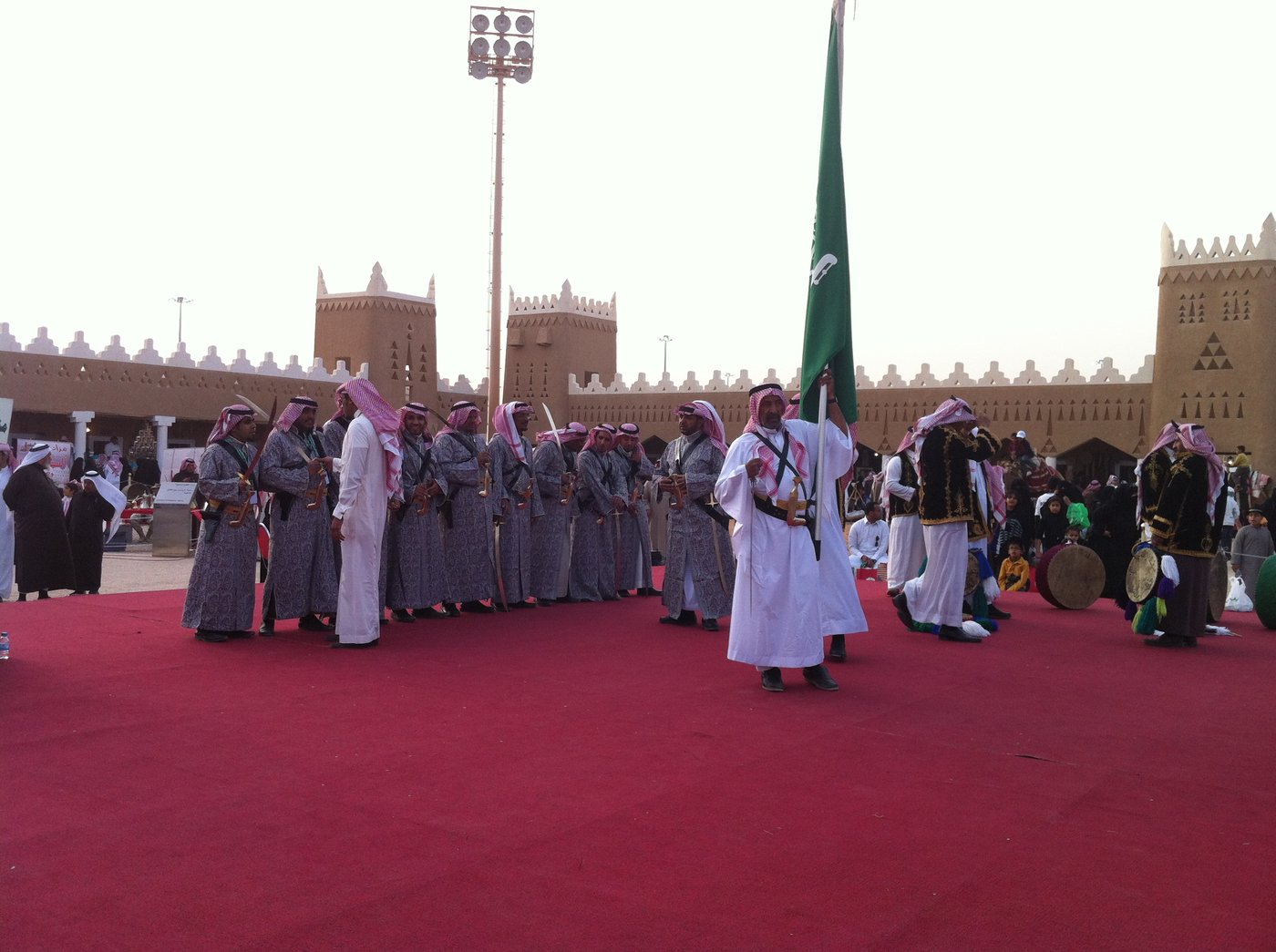
No cultural performance defines Saudi Arabia more than the Ardah (العرضة). Originating in the central Najd region as a pre-battle tribal ritual, it has evolved into the Kingdom’s national dance, performed at weddings, state ceremonies, National Day celebrations, and major festivals. Two rows of men face each other, carrying swords, while poets chant verses of courage and unity, accompanied by the deep, resonant beats of large frame drums known as tabl.
The Ardah Al-Najdiyah — the Najdi variant — was inscribed on UNESCO’s Representative List of the Intangible Cultural Heritage of Humanity in 2015, the first Saudi element to receive this designation. The recognition covers the combined art of dance, drumming, and poetry as a living tradition passed between generations. Kings and heads of state regularly participate, and you will often see the Ardah performed at the historic At-Turaif district in Diriyah, especially during Saudi Founding Day on 22 February.
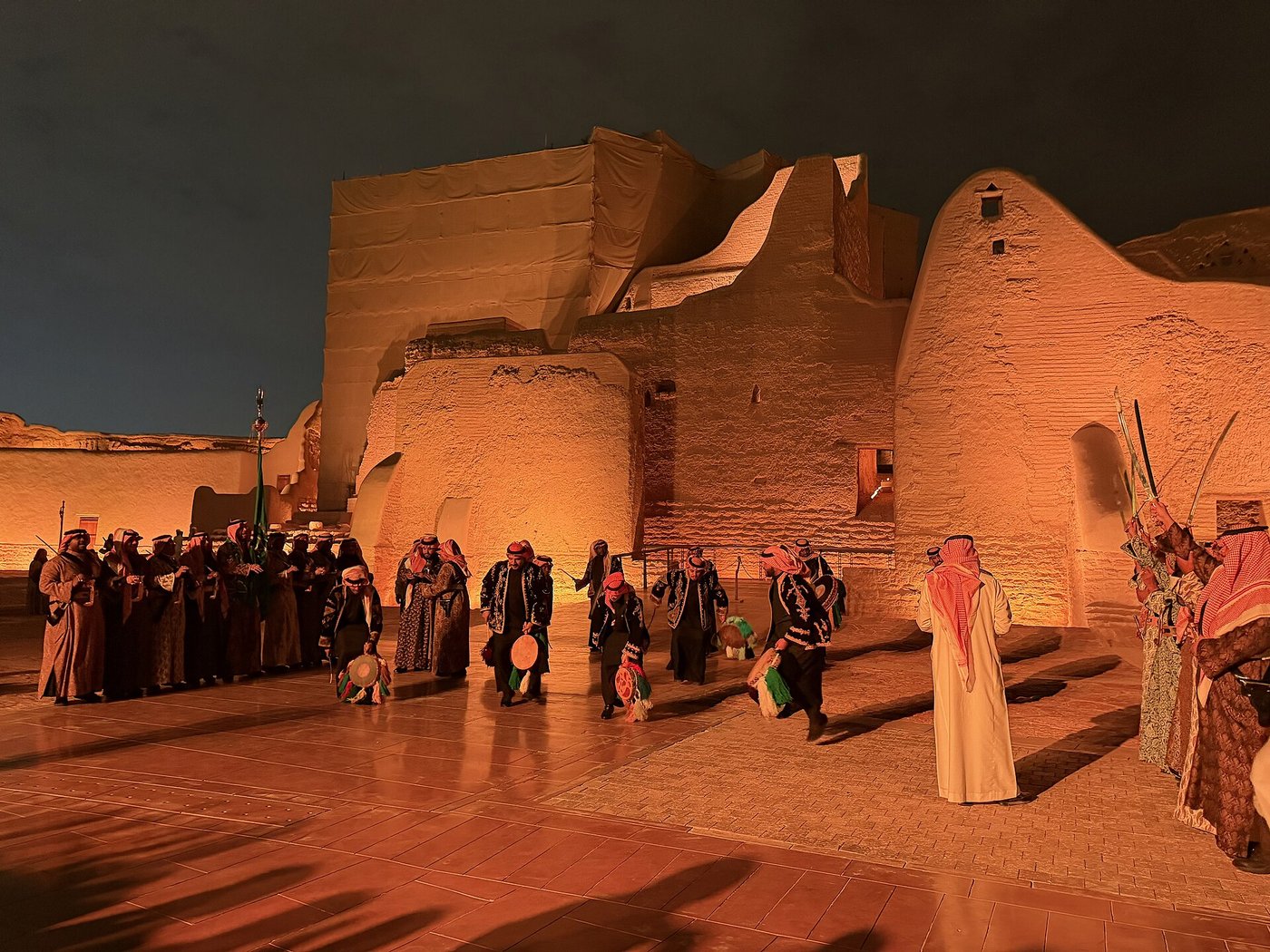
Where to See the Ardah
- Diriyah Season (November – March) — live Ardah performances in the restored At-Turaif heritage quarter
- Janadriyah National Heritage Festival (February – March) — the Kingdom’s largest heritage celebration features mass Ardah formations
- Saudi National Day (23 September) — public Ardah performances in cities nationwide
- Saudi Founding Day (22 February) — official ceremonies include Ardah at Diriyah and government buildings
- Weddings and private events — if you are invited to a Saudi wedding, you may witness an intimate Ardah
- webook.com — the Kingdom’s primary event ticketing platform
- platinumlist.net — popular for concerts and premium events
- riyadhseason.com — official portal for all Riyadh Season events
- experiencealula.com — official portal for AlUla events and Winter at Tantora
- Heritage Village, Dammam — traditional architecture, regional cuisine, and periodic live cultural performances on the Gulf coast
- Mountain heritage villages in the Asir and Al Baha regions — stone-built villages where traditional architecture and customs are preserved
- Qahwa ceremonies — Saudi coffee culture is itself a form of performance, with formal serving rituals that vary by region
- Visa: Most visitors need a tourist e-visa, available online for 63 nationalities. Processing takes minutes.
- Transport: Major cultural venues in Riyadh and Jeddah are accessible by ride-hailing apps (Uber, Careem). For AlUla, fly into Prince Abdul Majeed bin Abdulaziz Airport (ULH) — direct flights operate from Riyadh and Jeddah during winter season.
- Language: Most major venues have English signage and bilingual staff. Heritage festivals lean more heavily on Arabic, but performances are visual and musical — you do not need Arabic to appreciate them.
- Photography: Outdoor heritage performances generally welcome photography. Indoor concerts vary — check venue policy.
- Accessibility: Major venues (King Fahd Cultural Centre, Ithra, Maraya, Boulevard) are wheelchair accessible. Older heritage sites may have limited accessibility.
- Food and drink: Saudi Arabia does not serve alcohol. Venues serve Arabic coffee, fresh juices, and soft drinks. Most festival zones have extensive food courts with local and international cuisine — see our Saudi food tours guide for what to eat.
- Saudi Arabia Travel Guide 2026 — The complete guide to visiting the Kingdom
- Saudi Arabia Nightlife Guide — Entertainment, dining, and late-night culture across the Kingdom
- Concerts in Saudi Arabia 2026 — Upcoming shows and how to buy tickets
- Saudi Arabia Art Scene — Galleries, public art, and what is happening now
- Saudi Heritage Villages — Preserved village life in the mountains
- Saudi Arabia Visa Guide — Every visa type explained
Regional Folk Arts: Beyond the Sword Dance
Saudi Arabia’s thirteen regions each carry distinct performance traditions, reflecting the Kingdom’s geographic and tribal diversity. While the Ardah dominates national identity, regional folk arts offer travellers a deeper understanding of local culture.
Samri (Central Najd)
A seated performance art from the Najd heartland, Samri features two rows of performers kneeling, clapping, and swaying rhythmically while a poet chants verses of love, honour, and social commentary. Accompanied by percussion drums, it is a fixture at weddings and community gatherings. Look for Samri performances at Riyadh Season heritage zones and the Janadriyah festival.
Mizmar (Hijaz Region)
Associated with the Hijaz — Jeddah, Makkah, and Madinah — the Mizmar is both a wooden wind instrument and the name of the energetic dance performed with it. Accompanied by drums and rhythmic clapping, it is central to Hijazi celebrations. The best place to experience Mizmar is at Balad Al-Fann, a cultural festival held in Jeddah’s UNESCO-listed Al-Balad historic district, featuring over 90 events including live folk performances. Entry is free, typically open from 5 PM to 11 PM on weekends.
Al-Dara (Madinah Region)
A traditional Hejazi folk art associated with weddings and social gatherings in the Madinah region, Al-Dara features men chanting in circles with coordinated movements. It represents one of the most communal forms of Saudi performance, with the audience often drawn into participation.
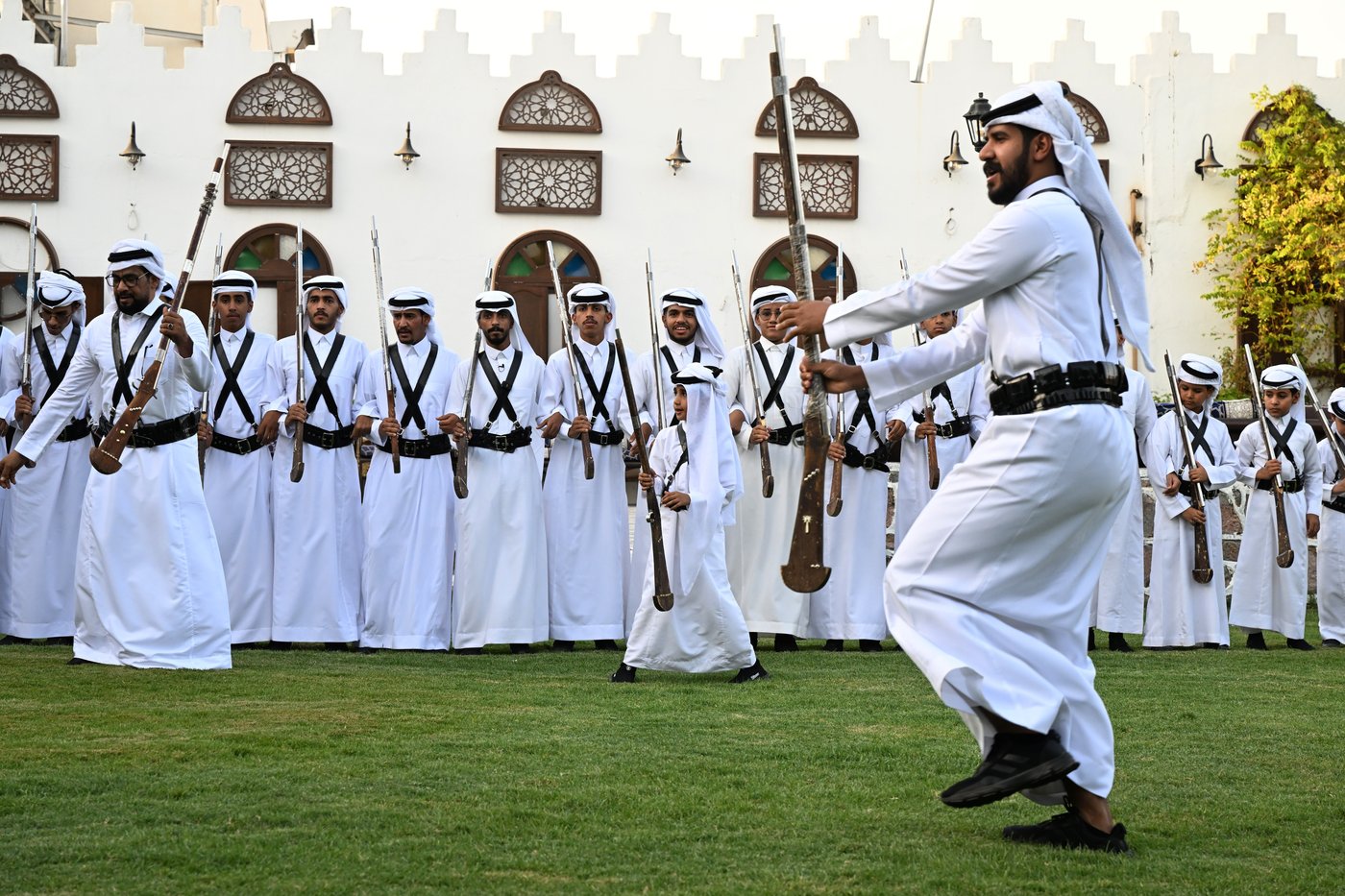
Khaleegy Dance (Eastern Province and Gulf Coast)
Predominantly a women’s dance found along the Gulf coast, the Khaleegy is characterised by flowing hair movements and graceful swaying of the thobe. Khaleeji music blends melodic ballads, rhythmic poetry, oud, and darbuka drums. You can experience Khaleeji cultural performances at Dammam and Khobar during regional festivals and at Ithra in Dhahran.
Nabati Poetry
Not a dance but a living literary performance tradition, Nabati poetry uses vernacular Bedouin Arabic to convey themes of love, morality, tribal loyalty, and the desert landscape. Deeply intertwined with musical accompaniment — typically the rababa (single-stringed spike fiddle) or oud — Nabati recitation is performed at festivals, cultural evenings, and the historic Souk Okaz festival in Taif, which recreates the pre-Islamic marketplace where poets competed for prestige.
Traditional Instruments
Understanding Saudi traditional music means knowing its instruments. If you attend a folk performance, you will likely hear some combination of these:
| Instrument | Type | Region | Context |
|---|---|---|---|
| Rababa | Single-stringed spike fiddle | Bedouin / nationwide | Solo storytelling, poetry recitation |
| Oud | Pear-shaped lute | Nationwide | Ensemble and solo; foundational in Arab music |
| Tabl | Large frame drum | Najd | Ardah performances |
| Darbuka | Goblet drum | Gulf coast / Hijaz | Khaleeji music, Mizmar |
| Mizmar | Wooden wind instrument | Hijaz | Hijazi celebrations, weddings |
Tip: If you want to see traditional instruments up close, visit the Saudi handicraft souks in Diriyah or Jeddah’s Al-Balad, where artisans still make rababa and oud by hand.
Major Cultural Festivals and Seasons
Saudi Arabia’s entertainment calendar revolves around government-backed seasonal festivals, most running during the cooler months from October to March. These are the best opportunities to see traditional performances alongside contemporary entertainment.
Riyadh Season (October – March)
The Middle East’s largest entertainment festival transforms the capital into a city of zones, concerts, and cultural programming. The 2025–2026 edition features 11 entertainment zones, over 200 concerts, 34 exhibitions, and 15 world championships. Boulevard City hosts 14 theatrical performances and 20+ concerts; Boulevard World features 24 themed sub-zones representing 15 countries. Entry to Boulevard World costs SAR 30 on weekdays and SAR 40 on weekends. See our dedicated Riyadh Season guide for zone-by-zone details and the full month-by-month events calendar.
Diriyah Season (November – March)
Set in the UNESCO-listed birthplace of the Saudi state, Diriyah Season offers a more refined, heritage-focused experience. Highlights include Layali Al-Diriyah — live performances, boutique shopping, and fine dining in the historic Al-Murayih District (now in its fifth year) — and the Diriyah Storytelling Festival, which bridges oral tradition with contemporary voices through author sessions, live performances, and workshops. The Metropolitan Opera will use the Royal Diriyah Opera House as its winter stage for five consecutive years, making Diriyah a genuine destination for world-class performing arts.
Winter at Tantora, AlUla (December – January)
Three weeks of heritage, music, art, and gastronomy set against the desert canyons of AlUla. The 2025–2026 edition runs under the theme “Winter Brings Us Together” and features open-air concerts at Shorfat Tantora in Old Town, cultural tours including the Old Town Culinary Voyage, and heritage displays with traditional crafts and storytelling. Past performers at Hegra Season and the broader AlUla Moments calendar have included Andrea Bocelli, Alicia Keys, John Legend, and regional stars Mohamed Abdo and Kadim Al Sahir.
Janadriyah National Heritage Festival (February – March)
Started in 1985, Janadriyah is one of Saudi Arabia’s most important cultural events and the single best place to see the full spectrum of traditional performing arts under one roof. Held at a dedicated heritage village outside Riyadh, the festival runs for two to three weeks and attracts millions of visitors. Expect mass Ardah formations, Samri performances, regional folk dances from all 13 provinces, camel races, traditional architecture recreations, and live craft demonstrations. Entry is typically free or very low-cost.
Jeddah Season (Summer)
Running for approximately 85 days during the summer, Jeddah Season brings live music, beach activities, family entertainment, and cultural experiences to the Red Sea coast. Highlights include theatrical and roaming performances at Forest Wonders, the Onyx Arena Summer Lineup, and Winter Wonderland (December – January). Combined with Balad Al-Fann in the historic quarter, Jeddah offers year-round cultural programming.
Souk Okaz, Taif (Summer)
Recreating the legendary pre-Islamic marketplace that served as a hub for trade, poetry, and diplomacy, Souk Okaz features live poetry competitions with renowned poets from across the Arab world. Held in Taif‘s cooler mountain climate during summer, it is the best place to experience Nabati and classical Arabic poetry as a living performance tradition.
MDLBEAST Soundstorm (December)
Saudi Arabia’s premier electronic and contemporary music festival, held at Banban, roughly 30 minutes from central Riyadh. The 2025 edition featured Cardi B, Post Malone, Calvin Harris, Halsey, and Pitbull. A Jeddah edition was added in February 2026. For full details, see our MDLBEAST Festival guide.
World-Class Venues for Cultural Performances
The construction boom driven by Vision 2030 has given Saudi Arabia a portfolio of performance venues that rival anything in the Gulf.
Maraya Concert Hall, AlUla
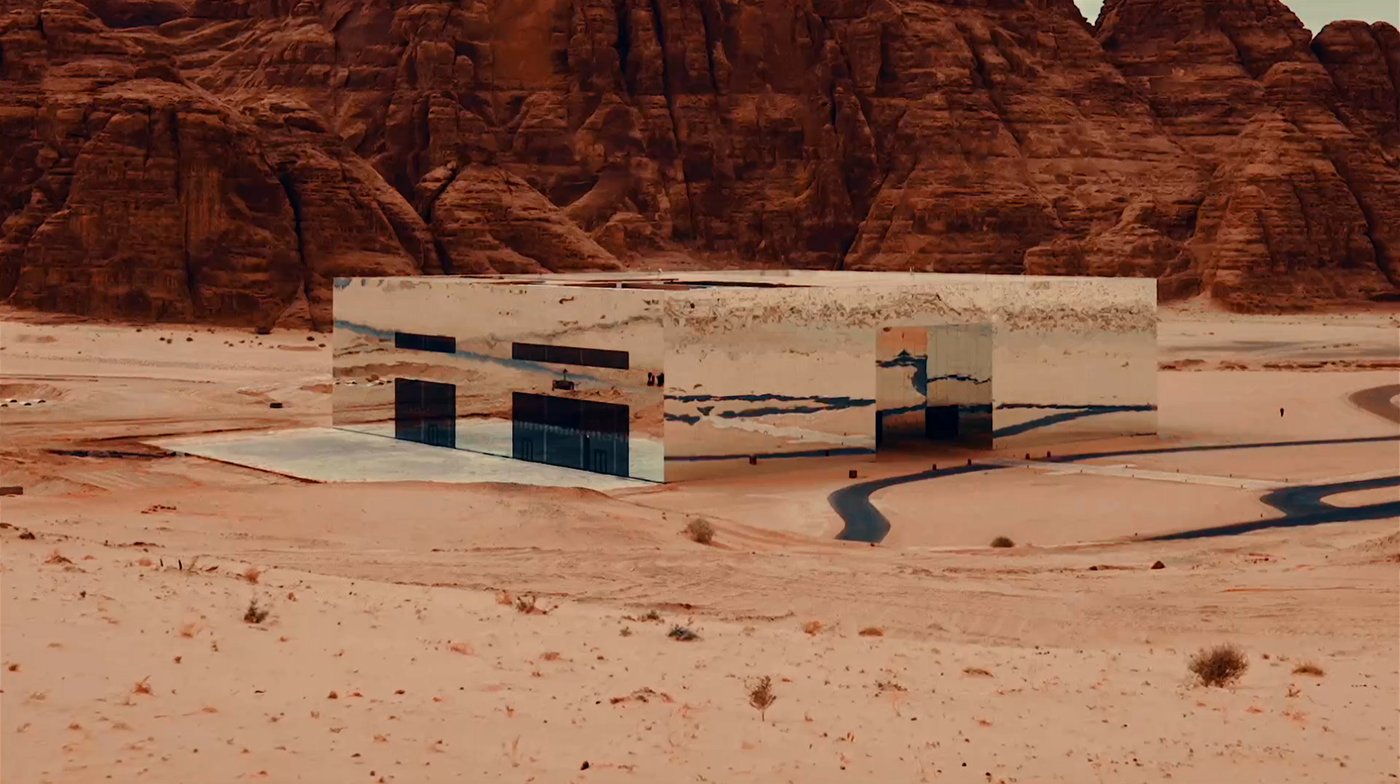
A Guinness World Record holder as the largest mirrored building in the world (9,740 square metres of mirrors), Maraya is one of the most visually striking concert halls on Earth. The 500-seat venue features a 40m x 15m stage with a retractable 800+ square metre window that opens directly onto the desert landscape. Past performers include Andrea Bocelli, Alicia Keys, Usher, and OneRepublic. The rooftop houses Maraya Social, a fine-dining restaurant by chef Jason Atherton. Located 20 minutes from central AlUla, it is the centrepiece of the AlUla entertainment scene.
King Fahd Cultural Centre, Riyadh
Riyadh’s premier performing arts venue features Salmani architecture and a main theatre accommodating up to 3,000 spectators — the third-largest theatre in the world. Recently renovated with advanced audio, video, and lighting systems, it has hosted the opera Carmen (as part of Saudi-China Cultural Year 2025) and Broadway-quality touring productions. Located in central Riyadh, it is the Kingdom’s most important venue for classical and theatrical performances.
Ithra (King Abdulaziz Center for World Culture), Dhahran
Built by Saudi Aramco in Dhahran, Ithra is one of the Kingdom’s most ambitious cultural institutions. The Winter Season 2025–2026 runs from October through April with 130+ programmes covering arts, cultural heritage, film, architecture, and design. The Ithra Theater hosts performances by Saudi and international artists. General entry to the building is free, though some performances require tickets purchased on-site. Programming includes immersive cultural days (Spain was featured in the 2025–2026 season), drone shows, live music, and family activities.
Jeddah Superdome
A 40,000-seat multi-purpose venue on Madinah Road in Jeddah, the Superdome holds two building records: the largest continuous non-segmented dome and the world’s largest geodesic dome. Opened in June 2021, it hosts concerts, exhibitions, sporting events, and conferences year-round.
The Role of the General Entertainment Authority
The transformation of Saudi Arabia’s entertainment landscape is inseparable from the General Entertainment Authority (GEA), established under Vision 2030 to develop and regulate the sector. Before 2016, public cinemas were banned, live music was effectively prohibited, and mixed-gender public entertainment was non-existent. Since then, the GEA has licensed thousands of entertainment events annually, enabled the return of cinemas (from zero screens to over 900 in under a decade — one of the world’s fastest-growing cinema markets), and oversees the seasonal festival programme. The target is to increase household entertainment spending from 2.9% to 6% of income and create over 450,000 jobs in the sector by 2030.
For travellers, this means the cultural performance scene is expanding rapidly. New venues, festivals, and events are announced regularly. Check our events calendar for the latest programming, and book through webook.com or platinumlist.net for the widest selection of cultural event tickets.
What to Expect: Dress Code and Etiquette
Saudi Arabia relaxed its dress requirements in 2019, replacing the mandatory abaya with a Public Decorum Code. At cultural events and concerts, modest dress is expected: shoulders, chest, and knees should be covered. Loose trousers, maxi dresses, long-sleeve blouses, or tunic tops are all appropriate. Hijab is not mandatory except at mosques and religious sites. Major cities — Riyadh, Jeddah, AlUla — are more flexible than conservative rural areas. For a full breakdown, see our Saudi Arabia dress code guide.
Etiquette note: At traditional performances, showing appreciation through clapping is welcome. Photography policies vary by venue — some heritage performances encourage photos, while concert venues may restrict recording. When in doubt, ask. For broader cultural guidance, read our Saudi Arabia customs and etiquette guide.
How to Buy Tickets
Most cultural events in Saudi Arabia can be booked through these platforms:
Pricing varies widely. Many heritage festivals (Janadriyah, Balad Al-Fann, Founding Day celebrations) are free. Boulevard World entry runs SAR 30–40 ($8–11). Major concerts range from SAR 200 to SAR 2,000+ ($55–$530+). Book popular acts weeks or months in advance — top shows sell out quickly. Digital e-tickets and QR codes are standard; print-at-home is rarely needed.
Budget tip: Look for early-bird pricing on webook.com and flash sales 24–48 hours before events. Group discounts are sometimes available for parties of four or more.
Best Time to Visit for Cultural Performances
| Period | What’s On | Weather |
|---|---|---|
| October – November | Riyadh Season opens, Diriyah Season begins | Warm, pleasant evenings (25–30°C) |
| December | Winter at Tantora, MDLBEAST Soundstorm, peak concert season | Cool and dry (15–22°C) — ideal |
| January – February | AlUla Arts Festival, Saudi Founding Day (22 Feb) | Cool (12–20°C) |
| February – March | Janadriyah Heritage Festival, Diriyah Season finale | Warming up (18–28°C) |
| June – August | Jeddah Season, Souk Okaz (Taif), Soundstorm Jeddah | Hot in Jeddah (35–40°C); cooler in Taif (25–30°C) |
| Ramadan and Eid | Special cultural programming at Ithra and select venues | Varies by month |
The October to March window offers the densest concentration of cultural programming and the most comfortable weather. For the broadest overview of timing your trip, see our best time to visit Saudi Arabia guide.
Heritage Villages and Living Museums
Beyond festivals and concert halls, Saudi Arabia has invested in permanent heritage spaces where traditional culture is preserved and performed year-round.
Diriyah (At-Turaif UNESCO World Heritage Site)
The birthplace of the Saudi state offers year-round heritage experiences, with cultural programming intensifying during Diriyah Season. The restored mud-brick architecture of At-Turaif provides a dramatic backdrop for Ardah performances, storytelling, and traditional craft demonstrations. Souq Al-Mawsim, the seasonal market, featured Japan as its 2025 guest of honour.
Janadriyah Heritage Village
Located outside Riyadh, this open-air museum reproduces traditional Saudi homes, shops, and markets from different regions. During the annual festival, it comes alive with craft demonstrations, traditional music, folk dances, regional cuisine, and multigenerational performances. Outside festival season, the grounds are open for guided visits.