WASHINGTON — Lindsey Graham died on Saturday with the Saudi-Israel normalization deal still open on three desks — his own, Ron Dermer’s, and Princess Reema’s. The architecture he had been assembling since mid-May required a connector who held simultaneous trust with Donald Trump, Mohammed bin Salman, and enough Democratic senators to clear a two-thirds ratification threshold. That connector is now dead, and no replacement exists in the United States Senate.
Graham’s death from aortic dissection at his Washington home on July 12 did not remove a name from a committee roster. It removed the only sitting senator who had cultivated personal rapport with MBS after publicly calling him a murderer, who had logged more than a hundred hours of golf with Trump, and who believed he could move twenty Democratic votes on a mutual defense treaty by tying it to Palestinian statehood language. His planned trips to Riyadh and Jerusalem will not happen. The September negotiation timeline he set is orphaned. The lame-duck ratification window he identified as the only viable path expires in January 2027 — and the South Carolina seat he held will be in transition through that entire period.
Table of Contents
- The Three-Way Position No One Else Held
- What Did Graham’s Normalization Framework Require?
- Who in the Senate Can Replace Graham on the Saudi File?
- The Lame-Duck Calendar Without Its Architect
- Why Does a Saudi Defense Treaty Need Sixty-Seven Votes?
- MBS Was Already Rerouting Around Israel
- Can MBS Afford Normalization While Missiles Strike Abha?
- Frequently Asked Questions
The Three-Way Position No One Else Held
Graham occupied a position in American foreign policy that depended entirely on biographical accident. He had been Trump’s most prominent Republican primary critic, then became his closest Senate confidant — a trajectory that earned a kind of trust no loyalist could claim. Senator Tim Scott estimated that Graham and Trump spent “100-plus hours golfing together,” a metric that, in Trump’s transactional framework, constitutes the deepest possible credential.
With MBS, the arc was more adversarial. After the murder of Jamal Khashoggi in October 2018, Graham called the evidence “a smoking saw, not a smoking gun” and was among the loudest Republican voices demanding accountability. That hostility evolved — as the Iran threat realigned U.S.-Saudi interests — into a functional working relationship that the crown prince could not dismiss as flattery. A senator who had called you a murderer and then came back to offer a mutual defense treaty in perpetuity carried a different kind of credibility than one who had been friendly throughout.
The third leg was the Senate itself. Graham sat on the Armed Services Committee and had spent decades building cross-aisle relationships. His normalization strategy depended on persuading Democratic colleagues to vote for a defense treaty they had publicly opposed — twenty senators had declared against it in October 2023. Graham believed Palestinian-statehood language could move those votes. Whether he was right is now untestable.
At the time of his death, Graham had already briefed three named interlocutors: Ron Dermer, Netanyahu’s strategic affairs minister and closest confidant; Princess Reema bint Bandar, Saudi Arabia’s ambassador to Washington; and Prince Faisal bin Farhan, the Saudi foreign minister. No reporting from Axios, the Jerusalem Post, or any other outlet has indicated that Graham transferred these relationships — or the deal architecture — to another Senate principal.
The Middle East briefing 3,000+ readers start their day with.
One email. Every weekday morning. Free.
“MBS is not going to recognize Israel until he gets a better outcome for the Palestinians, or he’ll get killed.” — Senator Lindsey Graham, Jerusalem Post Washington Conference, December 2025
That sentence — simultaneously frank about assassination risk and revealing of the private register Graham used when discussing MBS — has no equivalent from any other sitting member of Congress. It was not diplomatic language. It was a man who had spent enough time with the crown prince to understand, and state publicly, the domestic constraint MBS operates under.
On CBS Face the Nation on June 21, three weeks before his death, Graham stated publicly what his travel schedule confirmed privately: “I think this is going to happen [normalization] in 2026, and it can’t happen until Iran is in a box.” He was finalizing plans to visit both Riyadh and Jerusalem in the weeks ahead, with a target of opening intensive negotiations by September — a pace designed to produce a framework before the November midterms created the lame-duck session he had identified as the only viable ratification moment.
His final public remarks, made hours before he sought medical attention on July 12, carried the same blunt register. “I can’t die now,” he told attendees at a Saturday event in Washington. “I still need to do the Russia sanctions, get Iran sorted out and do Israeli-Saudi normalization.” He died later that night.
What Did Graham’s Normalization Framework Require?
Graham’s framework required three interlocking agreements: a U.S.-Saudi mutual defense treaty needing sixty-seven Senate votes for ratification, a civilian nuclear cooperation agreement (known as a 123 Agreement) permitting Saudi uranium enrichment under American oversight, and Israeli-Saudi normalization timed to a post-election Israeli government willing to engage on Palestinian statehood. Each element depended on the others, and each carried a different institutional requirement in Congress.
The defense treaty was the centerpiece and the hardest element. In March 2026, Graham made the offer directly to a Saudi audience. The treaty text was largely negotiated during the Biden administration; the Congressional Research Service documented the framework in report R48162. The document exists. What Graham was constructing was not the text but the political vehicle to ratify it.
“I am willing to make a mutual defense agreement with your country to give you protection in perpetuity… if you’re attacked by Iran, we would go to war for you.” — Senator Lindsey Graham, March 2026
The 123 Agreement carried its own proliferation politics distinct from the defense treaty debate. Riyadh has demanded enrichment rights as a precondition for any comprehensive deal — a position that alarmed nonproliferation advocates in both parties and created a separate bloc of congressional opposition.
The third element — normalization itself — Graham treated as the final domino, not the first. The defense treaty and nuclear agreement would create the security and prestige framework within which MBS could justify normalization domestically. Without them, normalization amounted to a concession with no reciprocal American commitment — a posture MBS had already rejected during the Biden administration’s attempt in 2023.
On July 22, 2026, the Trump administration signed the 123 nuclear cooperation agreement with Saudi Arabia without any of those conditions attached xe2x80x94 no normalization, no Gold Standard safeguards, no Israeli consent. The final domino Graham had reserved for last arrived without him, and without the price he had spent years trying to extract.
| Framework Element | Congressional Requirement | Current Status |
|---|---|---|
| U.S.-Saudi Mutual Defense Treaty | Two-thirds Senate vote (67 of 100) | Text exists; no Senate sponsor since July 12 |
| 123 Nuclear Cooperation Agreement | Congressional review period; committee oversight | Framework incomplete; enrichment clause unresolved |
| Israeli-Saudi Normalization | Potentially executive agreement | No Israeli government partner until post-October 27 election |
All three elements required a single driver trusted by Riyadh, Jerusalem, and enough of the Senate to carry a ratification vote. Graham was the only candidate for that role, and the role has no backup.
Who in the Senate Can Replace Graham on the Saudi File?
The position Graham held was biographical, not institutional. It cannot be filled by committee assignment or party leadership directive.
Trump’s Senate allies tend to fall into two categories. Some have the personal relationship with the president but no Gulf portfolio and no relationships with Riyadh’s decision-makers. Others hold Armed Services or Foreign Relations Committee roles but lack the kind of personal access Graham had built through years of proximity — the informal counsel that comes from being the person a president calls after a foreign leader hangs up.
The Saudi relationship is the hardest to replicate. Graham’s post-Khashoggi trajectory gave him a credibility with MBS that a senator arriving fresh to the portfolio cannot claim. The crown prince’s engagement style, filtered through a tight circle of advisors and channeled primarily through Princess Reema in Washington and Prince Faisal in Riyadh, does not accommodate rapid cultivation of new Senate principals. Reema’s most recent contact with senior American officials — a meeting with Secretary of State Rubio in early July — occurred at ambassador level, not foreign-minister level. That downgrade happened while Graham was still alive and actively working the file.
The Democratic crossover problem has not improved. Those twenty votes of opposition rested on human rights concerns that the Saudi-led coalition’s conduct in Yemen reinforced and that the current Iran-Gulf war has done nothing to alleviate. Graham’s plan to move those votes relied on Palestinian-statehood language — a formula requiring a messenger with enough personal standing on both sides of the aisle to prevent the linkage from being dismissed as political cover. That messenger function cannot be outsourced to the White House. Trump’s own relationship with Senate Democrats does not permit him to play that role.
The White House could attempt to route the deal through executive channels, bypassing the Senate entirely. But the mutual defense commitment — the element MBS most values — cannot be delivered through executive agreement. An executive memorandum on defense cooperation carries no binding force beyond the current administration. Graham understood that MBS would not accept a defense guarantee revocable by the next president. The treaty format was not Graham’s preference. It was MBS’s requirement.
The Lame-Duck Calendar Without Its Architect
Graham identified a specific window: the lame-duck session between the November 2026 midterms and the swearing-in of the new Congress on January 3, 2027. His reasoning was mechanical. The two-thirds threshold required Republican near-unanimity plus Democratic crossover. Outgoing senators, freed from reelection pressure, might be more willing to vote for a treaty they would otherwise avoid. Graham had used this logic before — it is a standard feature of ambitious Senate ratification strategies — but applying it required months of preparation that only he was positioned to conduct.
The timeline he envisioned: travel to Riyadh and Jerusalem in July or August to assess political appetite; intensive negotiations beginning in September; a framework in place before the November elections; ratification during the lame-duck. Each step assumed Graham as the Senate-side principal — briefing colleagues, managing amendments, whipping votes, maintaining back-channel contact with Dermer and Reema while formal negotiations proceeded through the State Department.
With Graham’s death on July 12, the first step — the travel — cannot occur. The September target is effectively dead. Even if another senator attempted to reconstruct the process, the lead time required to establish relationships with the Saudi and Israeli principals, brief Senate colleagues, and assemble a vote-whipping operation would push any realistic ratification attempt past January 2027.
| Date | Event | Normalization Implication |
|---|---|---|
| July 12, 2026 | Graham dies; South Carolina seat vacant | No Senate-side deal architect; planned Riyadh/Jerusalem travel cancelled |
| August 11, 2026 | South Carolina Republican primary | Seat in active political transition; no foreign policy continuity |
| October 27, 2026 | Israeli general election | Potential post-Netanyahu government; Graham’s framework assumed this opening |
| November 3, 2026 | U.S. midterm elections | Lame-duck session begins; outgoing senators potentially movable on treaty vote |
| January 3, 2027 | New Congress sworn in | Lame-duck window closes; any unratified treaty dies with the session |
The South Carolina seat compounds the problem. Governor Henry McMaster appointed Graham’s sister, Darline Graham Nordone — a commissioner for the South Carolina Commission for the Blind and a certified optician with, as the Washington Post noted, “little political history beyond praising her brother” — to hold the seat until a successor is elected. She holds no Senate committee assignments, no foreign policy experience, and no relationship with any of the deal’s principals. A Republican primary is set for August 11; the winner will appear on the November ballot. The new senator will not take office until January 2027, by which point the lame-duck window will have closed.
The arithmetic is simple and unforgiving. Graham’s death reduced the Republican caucus from 53 to 52 until Nordone’s appointment restored the count to 53. But the sixty-seven-vote threshold requires at least fourteen Democratic yes votes even with full Republican support — a margin that only personal persuasion, not party mechanics, could generate. Nordone contributes nothing to that margin.
Why Does a Saudi Defense Treaty Need Sixty-Seven Votes?
The Abraham Accords — the normalization agreements Trump brokered in 2020 with the UAE, Bahrain, Morocco, and Sudan — were executive agreements. They required no Senate vote, no committee markup, no floor debate. The president signed them and they took effect. A U.S.-Saudi mutual defense treaty operates under Article II of the Constitution, which requires the Senate to consent by a two-thirds supermajority — sixty-seven of one hundred senators. The distinction is the difference between a commitment that expires with a presidency and one that binds the United States across administrations.
MBS demanded the latter. Saudi Arabia has watched American security commitments shift with each administration — Obama’s pivot to Asia, Trump’s first-term withdrawal rhetoric, Biden’s fist-bump-then-distance cycle. A Senate-ratified treaty would be the first binding American security guarantee to a Gulf state, carrying the legal weight of the NATO Article 5 commitment. An executive agreement would carry the weight of a presidential handshake — the kind of instrument the Saudis watched collapse when Trump withdrew from the Iran nuclear deal his predecessor had signed.
The Carnegie Endowment published its assessment — “The Ratification of a Saudi-U.S. Deal Looks Increasingly Unlikely” — before the Iran-Gulf war began. The ratification environment has not since improved. Twenty Democratic votes remained the floor of the blocking coalition, and no new Democratic endorsement of the treaty has been recorded since.
Graham’s strategy to clear the sixty-seven-vote threshold rested on two propositions: that Palestinian-statehood language embedded in the normalization component would give Democratic senators political cover, and that the lame-duck session would create a temporary window when electoral accountability did not constrain votes. Both propositions required a Senate operator trusted by all parties. Both propositions assumed Graham.
The defense treaty question carries additional weight given the current bilateral strain. Saudi Arabia grounded forty-three American warplanes at Prince Sultan Air Base in May 2026 — an act designated Operation Project Freedom — and the Trump administration has not publicly reconciled the episode. The 1976/1977 SOFA governing the U.S. military presence is functionally void. Graham’s treaty was designed, in part, to replace that legal vacuum with a binding framework. Without it, the U.S.-Saudi defense relationship continues to operate on a combination of arms sales, base access agreements, and the kind of uncodified understanding that neither government can enforce against the other.
MBS Was Already Rerouting Around Israel
Even before Graham’s death, the Saudi side of the normalization equation was deteriorating in ways that no Senate architect could have reversed alone.
The Institute for National Security Studies in Tel Aviv published its August 2025 survey showing Saudi public opposition to normalization with Israel approaching 99-to-1 — described by the institute as “the sharpest recorded movement in Saudi public opinion on any foreign policy question in its survey history.” MBS has responded to that sentiment not by resisting it but by aligning with it, publicly championing Palestinian statehood and permitting anti-normalization discourse to circulate in Saudi media without the suppression that typically accompanies positions contrary to royal policy.
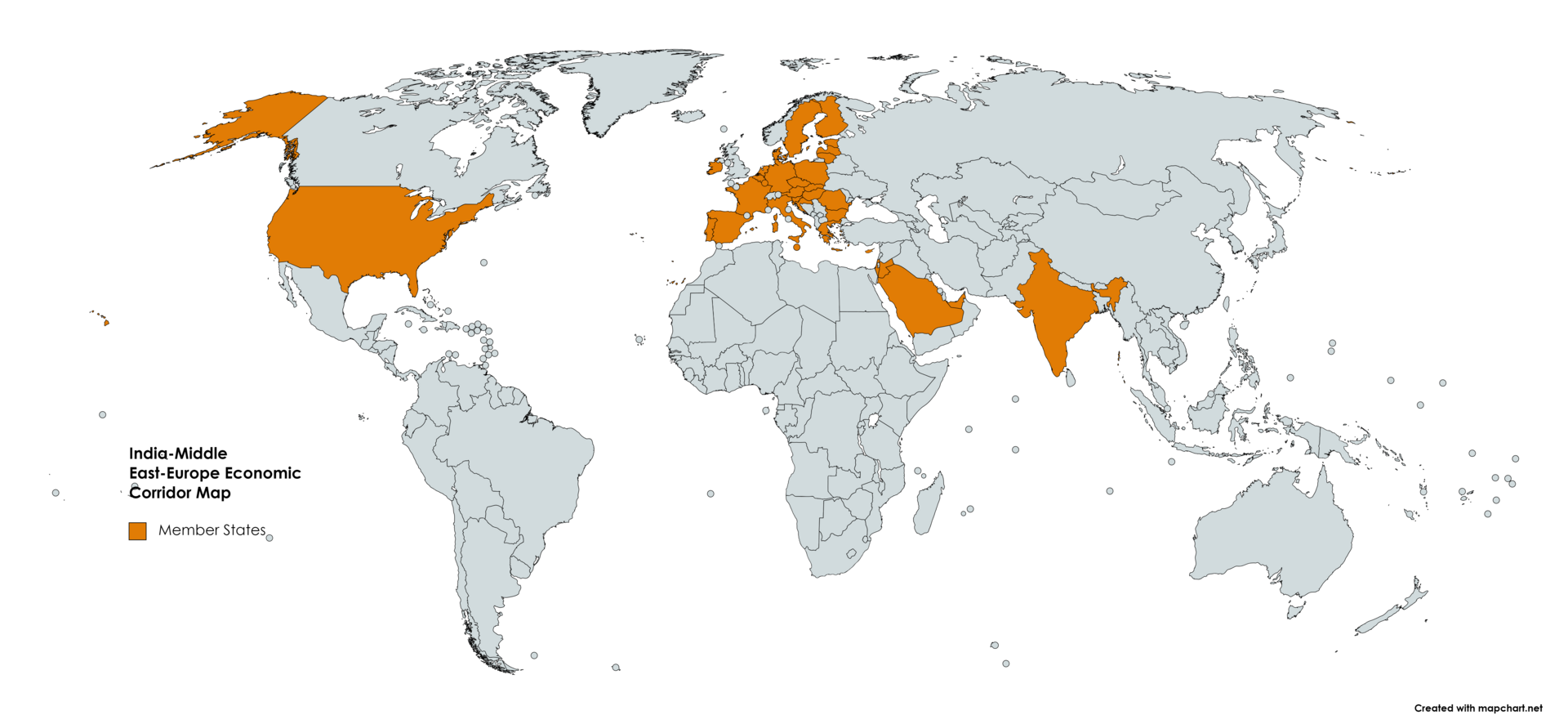
The strategic indicators reinforce the polling. Saudi Arabia has begun reassessing the India-Middle East-Europe Economic Corridor — IMEC — to route around Israel entirely. In April 2026, Turkey, Jordan, and Syria agreed on a north-south transport corridor linking to the Saudi railway network, and Riyadh announced a feasibility study for the railway section with results due by end-2026. IMEC was conceived as a normalization dividend — a physical infrastructure link connecting Saudi Arabia to Europe through Israeli territory. If the corridor reaches Europe through Syria and Turkey instead, a primary economic incentive for normalization disappears. The feasibility study deadline and Graham’s normalization timeline were running on the same calendar. The feasibility study survives.
A Saudi royal source told N12 News: “Normalization likely won’t happen under Netanyahu’s current government. But maybe it will happen before the end of October 2026 if a new government is formed that accepts the two-state principle.” A separate Saudi source told the Times of Israel after Trump’s conference call with Arab leaders that any deal must include “an irreversible pathway to a Palestinian state.”
The word “irreversible” is load-bearing. No Israeli government, including a hypothetical post-Netanyahu coalition, has offered anything approaching an irreversible commitment to Palestinian statehood. Graham’s formula — language sufficient to give MBS domestic cover and Democratic senators political cover — was an attempt to bridge a gap that may be structurally unbridgeable. The bridge required Graham’s particular credibility with both sides. Without it, the language becomes a standard diplomatic negotiation where each party’s domestic constraints are transparent and neither has incentive to move first.
MBS asked for regime change in Tehran and received a war he cannot end. The crown prince’s position has shifted from offensive ambition to defensive management — managing a military escalation with Iran, an oil price below the IMF’s $86.60 breakeven estimate, a fiscal deficit of SAR 125.7 billion in Q1 alone, and a domestic population overwhelmingly opposed to the one diplomatic initiative that would theoretically unlock the American security guarantee he seeks. Graham was the interlocutor positioned to navigate those contradictions simultaneously. No one else had standing with all three principals — MBS, Trump, and the Democratic caucus — to propose a viable sequence.
Can MBS Afford Normalization While Missiles Strike Abha?
No. The Houthi strikes on Abha Airport and King Khalid Air Base at Khamis Mushait on July 13 — one day after Graham’s death — reactivated a domestic security environment incompatible with any Israel-adjacent diplomatic posture. The Houthis formally ended the truce after Saudi runway strikes at Sanaa, and their ballistic missiles and drones struck Saudi territory for the first time since the informal ceasefire of March 2022. Saudi air defenses intercepted the ballistic missiles. The Houthi foreign ministry declared that “Saudi Arabia has announced the start of the war.”
MBS cannot pursue normalization with Israel — even in principle, even as a stated aspiration — while Houthi projectiles strike Saudi airports and the Houthi narrative frames normalization as regional betrayal. That narrative now has a domestic audience it lacked during four years of relative quiet. The resumption of strikes also reactivates the question of Saudi air defense capacity: PAC-3 interceptor stocks stand at approximately 400 of an original 2,800 — an 86 percent depletion rate. The $9 billion Foreign Military Sales package that would replenish them carries no delivery timeline before mid-2027.
Graham’s normalization framework assumed a security environment in which Saudi Arabia’s primary external threat was Iran and the appropriate response was a binding American defense guarantee. The Houthi strikes reactivated a second, closer threat — one that a U.S.-Saudi defense treaty would not directly address, since the Houthis are a non-state actor operating from Yemeni territory that no treaty language easily encompasses.
The defense posture problem compounds. Saudi Arabia did not invoke the Sakhir Declaration when Iran fired on allied installations across four countries in early July. Prince Faisal received the call from Washington but Riyadh did not receive the seat at the Islamabad negotiations. MBS is negotiating from a position of acute air-defense vulnerability, which simultaneously increases his theoretical need for an American security guarantee and decreases his domestic political space to pay the normalization price that guarantee requires.
Israeli elections scheduled for October 27 add a further dependency. Netanyahu’s Likud projects approximately 24 seats, well below the 61-seat coalition threshold. A Saudi royal source’s conditional — normalization “maybe” happening “if a new government is formed that accepts the two-state principle” — assumed both a post-Netanyahu government willing to negotiate and a Senate-side architecture capable of capitalizing on that opening. The first condition remains possible. The second collapsed on July 12.
Frequently Asked Questions
Did Graham have a Senate co-lead on the normalization file?
No public co-sponsor or co-lead has been identified in reporting from Axios, the Jerusalem Post, or congressional records. Graham operated as a solo Senate principal on the normalization architecture — an unusual posture for a treaty effort that would normally involve bipartisan co-sponsorship from the outset. His briefings with Dermer, Reema, and Faisal were conducted as one-to-one engagements, not as part of a Senate delegation. The Senate Foreign Relations Committee, which would manage the ratification process, was not formally seized of the treaty draft at the time of his death. Standard practice would have required committee referral before any floor vote — a step Graham had not yet initiated.
Could Trump deliver the defense guarantee through an executive order instead of a treaty?
Legally, yes — the president can issue executive agreements on defense cooperation without Senate involvement. Strategically, no. MBS explicitly conditioned normalization on treaty-level permanence, a position informed by the JCPOA precedent: Saudi Arabia watched the Obama administration negotiate a binding agreement with Iran, only to see the next president withdraw unilaterally. An executive agreement on defense would be subject to the same revocation risk. The existing $110 billion arms framework announced during Trump’s first term in 2017 was an executive agreement, and its implementation has been inconsistent across administrations. Graham understood that MBS would not accept a second instrument of that kind as the price for normalization.
Has any Saudi official addressed the normalization implications of Graham’s death?
As of July 14, no official Saudi statement has referenced the normalization or defense treaty implications. Princess Reema bint Bandar issued a personal condolence. The Saudi Embassy in Washington released a pro-forma statement. Neither referenced the defense treaty, the 123 Agreement, or the normalization track. The silence is consistent with Riyadh’s standard practice of not commenting on bilateral negotiations through public channels, but it also reflects the absence of a replacement interlocutor to whom the Saudis could signal continued interest.
When does the next realistic ratification window open if the lame-duck session passes without action?
Not before 2028 at the earliest. The new Congress sworn in on January 3, 2027, would require a fresh treaty introduction, new committee referrals, new sponsor identification, and a new vote-whipping operation. Congressional work products do not carry over between sessions — the Biden-era treaty text would need to be reintroduced as a new instrument. Given the two-year congressional cycle and the lead time required to build a sixty-seven-vote coalition from scratch, a realistic floor vote would not occur before the second session of the new Congress. That timeline also assumes a Senate champion emerges with the triangular credibility — Trump trust, MBS access, Democratic crossover capacity — that Graham possessed. No candidate is apparent.
Does Iran benefit from the collapse of the normalization track?
Iran’s interest in blocking Saudi-Israel normalization is structural and longstanding — a U.S.-Saudi mutual defense treaty would formalize the most binding anti-Iran regional alignment in decades. No Iranian official has publicly addressed the normalization implications of Graham’s death, and none needs to. Tehran’s diplomatic posture does not require adjustment; the vacancy in Washington accomplishes what Iranian diplomacy was already working toward. The collapse of the Senate-side architecture also reduces pressure on Iran’s own negotiating position at the Islamabad track, where the prospect of a Saudi-Israeli-American alignment had served as a background threat to Iranian interests. With that alignment now lacking its Senate vehicle, Iran’s negotiators face one fewer source of external pressure.