How a Section 123 Agreement without the Gold Standard became the linchpin of the most consequential US-Saudi bargain in a generation — and why the next ninety days will determine the nuclear future of the Persian Gulf.
On the evening of February 19, 2026, a classified notification landed on the desks of senior members of the United States Congress. The document, transmitted by the Trump administration under the procedures mandated by Section 123 of the Atomic Energy Act of 1954, formally initiated a ninety-day congressional review of a proposed Agreement for Peaceful Nuclear Cooperation between the United States and the Kingdom of Saudi Arabia. Within hours, the notification leaked. Within days, it detonated across Washington’s nonproliferation community like a shaped charge.
The reason was not the existence of the agreement itself — negotiations had been an open secret for months. The reason was what the agreement did not contain. Absent from the proposed text was the so-called “Gold Standard” prohibition on uranium enrichment and spent-fuel reprocessing, the very safeguard the United States had demanded of and received from the United Arab Emirates in its own 2009 nuclear cooperation agreement. Saudi Arabia, the world’s largest oil exporter and a kingdom whose Crown Prince has publicly vowed to match any Iranian nuclear weapon, had secured what no previous American administration was willing to grant: a legal pathway, however hedged, to enrich uranium on its own soil.
The implications radiate outward like concentric shock waves. For the Middle East, the deal redraws the nuclear map at precisely the moment Iran’s enrichment program inches toward weapons-grade capability. For the global nonproliferation regime, it threatens to shatter the precedent Washington spent two decades constructing. And for the broader architecture of US-Saudi relations — a relationship that now encompasses F-35 fighter jets, a mutual defense treaty, a trillion-dollar investment corridor, and the elusive prize of Saudi-Israeli normalization — the nuclear agreement is both the keystone and the fault line.
This analysis examines the deal from the vantage point of Riyadh, where the calculus is at once simpler and more ruthless than Washington’s debate acknowledges. For the Kingdom, this is not merely about kilowatt-hours or fuel rods. It is about sovereignty, deterrence, and the strategic autonomy that the House of Salman regards as the non-negotiable foundation of Saudi Arabia’s future as a great power.
The Deal on the Table
Section 123 of the Atomic Energy Act establishes the legal framework under which the United States may engage in significant nuclear cooperation with a foreign state. Any proposed agreement must satisfy nine nonproliferation criteria, including guarantees on the use of transferred materials, safeguards administered by the International Atomic Energy Agency (IAEA), and provisions governing enrichment and reprocessing. The President must submit the proposed agreement to Congress alongside a detailed Nuclear Proliferation Assessment Statement and a determination that the agreement promotes, and does not undermine, the common defense and security.
The Middle East briefing 3,000+ readers start their day with.
One email. Every weekday morning. Free.
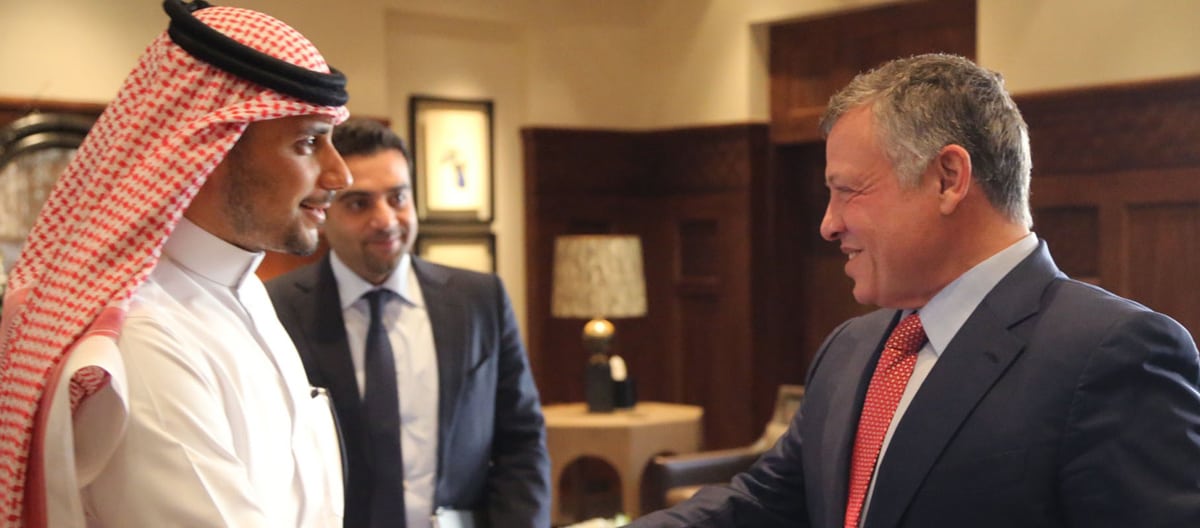
The agreement notified to Congress on February 19-20 follows a Joint Declaration on nuclear cooperation signed by President Donald Trump and Crown Prince Mohammed bin Salman in Riyadh in November 2025. That declaration, issued with considerable fanfare during Trump’s state visit, laid the diplomatic groundwork. The February notification transforms it into a binding legal instrument — or will, if Congress does not intervene within the ninety-day review window.
The text, as described by officials familiar with its contents and by fragments obtained by arms control analysts, authorizes the transfer of American nuclear technology, reactor components, and technical expertise to support Saudi Arabia’s ambitious civil nuclear program. The Kingdom’s nuclear energy body, the King Abdullah City for Atomic and Renewable Energy (KACARE), has outlined plans for sixteen nuclear reactors — a program of staggering scale that would make Saudi Arabia one of the largest nuclear energy producers in the Middle East within two decades.
But the critical provision — the one that has ignited a firestorm — is not what the agreement authorizes. It is what it declines to prohibit. Unlike the UAE 123 Agreement of 2009, the Saudi text does not include a blanket prohibition on uranium enrichment or plutonium reprocessing on Saudi territory. Instead, it reportedly relies on a framework of consultative mechanisms, future negotiations, and IAEA safeguards that critics describe as inadequate and proponents characterize as realistic.
The distinction matters enormously. Enrichment is the process by which the concentration of the fissile isotope uranium-235 is increased in natural uranium. At low enrichment levels — below five percent — the material fuels civilian power reactors. At twenty percent, it is classified as highly enriched uranium. At ninety percent, it is weapons-grade. The technical infrastructure that performs low enrichment can, with modifications and time, be reconfigured to produce weapons-grade material. This is the dual-use dilemma at the heart of every nonproliferation debate, and it is the dilemma the Gold Standard was designed to foreclose.
The Gold Standard and Why Riyadh Rejected It
The term “Gold Standard” entered the nonproliferation lexicon in 2009, when the United Arab Emirates signed a 123 Agreement with the United States that included an explicit, legally binding commitment to forgo uranium enrichment and spent-fuel reprocessing for the duration of the agreement. Abu Dhabi accepted the restriction in exchange for access to American nuclear technology and, more broadly, as a signal of its bona fides as a responsible nuclear newcomer. The Barakah Nuclear Energy Plant, which now operates four APR-1400 reactors on the Gulf coast west of Abu Dhabi, stands as the physical embodiment of that bargain.
Washington held up the UAE agreement as the model — the template that all future nuclear cooperation agreements in the Middle East would follow. The Obama administration insisted upon it. The Bush administration, in its final year, had negotiated the broad terms. Successive American officials told Saudi interlocutors, in meetings that stretched across more than a decade, that the Gold Standard was non-negotiable.
Riyadh never accepted that position. The Kingdom’s objections were consistent, principled in their own framing, and immovable. Saudi officials argued that the Gold Standard was discriminatory: it imposed on Arab states a restriction that the Nuclear Non-Proliferation Treaty (NPT) itself does not require. Article IV of the NPT affirms the “inalienable right” of all parties to develop nuclear energy for peaceful purposes, including enrichment, provided they comply with IAEA safeguards. Saudi Arabia, as an NPT signatory, viewed the Gold Standard as an extralegal demand that subordinated its sovereign rights to American political convenience.
There was also the matter of the UAE itself. Relations between Riyadh and Abu Dhabi, once characterized as an unshakable fraternal alliance, have grown complicated. The deepening fracture between the two Gulf powers over economic competition, OPEC+ strategy, and divergent foreign policy orientations has made Saudi Arabia acutely resistant to any framework that positions it as following the Emirati lead. To accept the same restrictions that Abu Dhabi accepted would, in Riyadh’s calculation, imply strategic parity with a state the Kingdom regards as a junior partner — or, increasingly, a rival.
Finally, there was the practical argument. Saudi officials contended that dependence on foreign fuel supply chains for a sixteen-reactor program would create an unacceptable strategic vulnerability. If the United States, France, or Russia were to restrict fuel deliveries for political reasons — as Washington has done with other partners in moments of geopolitical friction — the Kingdom’s entire energy diversification program could be held hostage. Indigenous enrichment capability, even at low levels, was framed as an insurance policy, not a weapons pathway.
Both the Obama and Bush administrations heard these arguments and declined. The Trump administration, operating within a far more ambitious transactional framework, reached a different conclusion.
The Grand Bargain
The nuclear agreement cannot be understood in isolation. It is one element — arguably the most consequential element — of a sprawling, multi-domain bargain between Washington and Riyadh that represents the most comprehensive restructuring of the US-Saudi relationship since the original oil-for-security compact of 1945.
The contours of this grand bargain have been taking shape since late 2023, when the Biden administration first began exploring the possibility of a US-Saudi security pact that would include Israeli normalization. That effort collapsed in the aftermath of October 7 and the subsequent war in Gaza, which rendered any Saudi move toward Israel politically untenable. Under Trump, the architecture was reassembled with different emphasis and fewer conditions.
The current framework includes several interlocking components. First, a bilateral defense treaty that would formalize the American security commitment to Saudi Arabia and, crucially, designate the Kingdom as a Major Non-NATO Ally — a status Trump conferred during the November 2025 summit. Second, the sale of F-35 Lightning II stealth fighters, a platform Saudi Arabia has sought for years and which the Kingdom’s rapidly expanding defense establishment considers essential to maintaining qualitative military parity in a region where the UAE already operates the aircraft. Third, a Saudi commitment to invest approximately one trillion dollars in the American economy over a ten-year horizon, spanning infrastructure, technology, manufacturing, and defense industrial partnerships — a figure that aligns with the strategic alliance-building Riyadh has pursued across multiple domains.
And fourth, the nuclear cooperation agreement — the keystone, because without it, senior Saudi officials have made clear, the other elements are significantly less attractive. The Kingdom is not interested in a defense pact that does not acknowledge its sovereign right to pursue the full nuclear fuel cycle. It is not interested in F-35s without the strategic depth that an indigenous nuclear capability — even a civilian one — provides. For Riyadh, the nuclear component is not a cherry on top. It is the foundation.
The question of Israeli normalization, once central to the American conception of the bargain, has receded but not vanished. The devastation in Gaza and the unfulfilled promises surrounding Palestinian statehood have made any near-term normalization announcement politically toxic for the Saudi leadership. The stubborn stalemate over Israeli resistance to the conditions Riyadh has set — including credible movement toward a Palestinian state — means that this pillar of the grand bargain remains aspirational rather than operational. Yet the nuclear deal proceeds regardless, a signal that Washington has effectively decoupled the two tracks.
The Iran Factor
No analysis of Saudi nuclear ambitions is complete without confronting the shadow that Iran casts across every calculation Riyadh makes. The proxy tensions between Saudi Arabia and Iran have defined the region’s security architecture for decades, but the nuclear dimension elevates the rivalry to an existential plane.
Iran’s nuclear program has advanced relentlessly. Tehran has enriched uranium to sixty percent purity — a technical threshold that places it within a short, technically manageable sprint to the ninety percent required for a nuclear weapon. The breakout time — the period needed to produce enough weapons-grade material for a single device — has shrunk, according to Western intelligence assessments, to a matter of weeks. The IAEA’s ability to monitor Iranian facilities has been degraded by Tehran’s restrictions on inspector access. The 2015 Joint Comprehensive Plan of Action (JCPOA), which constrained Iran’s enrichment and provided robust verification, is functionally dead, a casualty of Trump’s first-term withdrawal and subsequent failures to revive it.
This is the environment in which Crown Prince Mohammed bin Salman made his most consequential public statement on the nuclear question. In a 2018 interview, he declared with characteristic bluntness: “If Iran develops a nuclear bomb, we will follow suit as soon as possible.” The statement was not a rhetorical flourish. It was a strategic commitment, delivered by a leader who has demonstrated — through the war in Yemen, the blockade of Qatar, the restructuring of the Saudi state itself — a willingness to act on his declarations.
From Riyadh’s perspective, the logic is unforgiving. Iran sits across the Gulf with an enrichment infrastructure that the international community has failed to constrain. The JCPOA’s collapse removed the diplomatic framework that might have kept Tehran’s program in check. The possibility of an Iranian nuclear weapon is no longer a distant hypothetical; it is a near-term planning contingency. In that context, the Kingdom regards its own enrichment capability not as provocation but as prudence — the minimum threshold of strategic insurance that a responsible state acquires when confronted with a nuclear-armed adversary.
This framing is contested, of course. Critics argue that Saudi enrichment would trigger precisely the cascade of proliferation it claims to deter — that an action-reaction cycle in the Gulf would produce not stability but a multi-polar nuclear environment of extraordinary danger. The Arms Control Association has warned explicitly that the deal as structured leaves open a pathway to weapons capability, regardless of Riyadh’s stated intentions. But the Saudi counter is straightforward: the cascade has already begun, initiated not by Riyadh but by Tehran. The Kingdom is responding to a threat, not creating one.
The transatlantic realignment precipitated by the Gaza conflict has, paradoxically, strengthened Saudi Arabia’s hand on this argument. Washington’s renewed strategic investment in the Saudi relationship — driven by concerns about Chinese and Russian influence in the Gulf — has created conditions in which American policymakers are more willing to accommodate Riyadh’s nuclear demands than at any point in the past two decades.
The Pakistan Connection
On September 17, 2025, Saudi Arabia and Pakistan signed a Strategic Mutual Defense Agreement in Islamabad. The ceremony was attended by Prince Khalid bin Salman, the Saudi Minister of Defense, and his Pakistani counterpart. The agreement was described in anodyne terms — enhanced military cooperation, joint exercises, defense industrial collaboration — but its significance, read against the backdrop of the nuclear file, is considerably more layered.
The Saudi-Pakistani nuclear relationship is one of the most enduring and least transparent strategic partnerships in the world. Pakistan’s nuclear weapons program received substantial Saudi financial support in its early decades, a fact acknowledged obliquely by senior officials on both sides over the years. The question of whether that historical investment created an implicit Saudi claim on Pakistani nuclear assets — a so-called “nuclear umbrella” or, more provocatively, a warhead-on-demand arrangement — has been debated by intelligence analysts for a generation without definitive resolution.
The September 2025 defense agreement does not, by any public accounting, contain explicit nuclear provisions. But the timing is suggestive. Signed less than two months before the Trump-MBS nuclear declaration in November, the Pakistan pact can be read as a hedging strategy — a signal to Washington that Saudi Arabia has options beyond the American nuclear partnership. If the 123 Agreement were to fail in Congress, or if its provisions proved too restrictive in practice, the Pakistani relationship offers a parallel track that operates outside the NPT framework entirely.
Pakistani officials have consistently denied any arrangement to transfer nuclear weapons or materials to Saudi Arabia. Saudi officials have been equally categorical. But the structural logic of the relationship — Saudi financial resources paired with Pakistani nuclear expertise — creates a latent capability that no amount of diplomatic denial fully dispels. The September agreement, whatever its precise contents, ensures that the institutional channels through which such cooperation could flow remain open, maintained, and exercised. The Iran-Saudi war has now forced Pakistan into its most dangerous strategic decision, testing the defence pact’s nuclear ambiguity under combat conditions for the first time.
For Washington, this dynamic creates a powerful incentive to keep Saudi nuclear development within the American orbit. A 123 Agreement, even one without the Gold Standard, subjects Saudi activities to IAEA safeguards, American consent rights over transferred technology, and the broader legal architecture of the nonproliferation regime. The alternative — a Saudi program developed with Pakistani, Chinese, or Russian assistance, outside the reach of American oversight — is, from Washington’s perspective, categorically worse. This calculus, more than any other factor, explains why the Trump administration was willing to cross the enrichment threshold that its predecessors would not.
Capitol Hill Pushback
The congressional notification triggered an immediate and ferocious response from the nonproliferation caucus on Capitol Hill. Senator Ed Markey of Massachusetts, the most vocal congressional critic of nuclear cooperation with Saudi Arabia, accused the Trump administration of “caving to the Saudis on nuclear nonproliferation” and vowed to use every procedural tool available to block the agreement.
Markey’s objection rests on substantive grounds that transcend partisan positioning. The nine nonproliferation criteria embedded in Section 123 of the Atomic Energy Act were designed to ensure that American nuclear cooperation does not contribute to weapons proliferation. The absence of the Gold Standard, Markey and his allies argue, fails to meet the spirit — and potentially the letter — of those criteria. They point to the UAE precedent as proof that the restriction is achievable and to Saudi Arabia’s refusal to sign an Additional Protocol with the IAEA as evidence that Riyadh’s commitment to transparency is insufficient.
The ninety-day review clock imposes a hard deadline. During this period, Congress may pass a joint resolution of disapproval to block the agreement. The procedural path is narrow: such a resolution would require majority votes in both chambers and, almost certainly, enough votes to override a presidential veto. In the current political environment, with a Republican majority in the Senate and a slim Republican margin in the House, the odds of a successful block are long but not negligible.
The dynamics are complicated by the fact that opposition to the deal does not break neatly along party lines. Some Republican senators, particularly those with strong ties to the defense industry and the Gulf states, support the agreement as a strategic necessity. Others, including senators with hawkish views on Iran, are uneasy about granting enrichment rights to any Middle Eastern state, viewing it as a concession that could ultimately benefit Tehran by legitimizing the principle of regional enrichment. On the Democratic side, opposition is more unified but lacks the votes to act unilaterally.
Beyond the formal review process, opponents have additional levers. Congressional hearings will provide a platform for public scrutiny of the agreement’s terms. The Nuclear Proliferation Assessment Statement, which the administration is required to submit alongside the agreement, will be dissected by arms control experts and former officials. And the broader political environment — in which Saudi Arabia’s human rights record, the war in Yemen, and the Khashoggi affair continue to generate bipartisan discomfort — ensures that the debate will extend well beyond the technical provisions of the nuclear text.
The administration’s strategy, according to officials involved in the process, is to frame the agreement as the least-bad option. The argument proceeds as follows: Saudi Arabia will pursue nuclear energy regardless of American cooperation. If the United States does not provide the technology and the framework, competitors — Russia, China, South Korea, France — will step in without any of the nonproliferation conditions that the 123 Agreement imposes. Better, the administration contends, to have Saudi nuclear development occur under American oversight, with IAEA safeguards and contractual consent rights, than to cede the field to partners with fewer scruples and less leverage.
Riyadh’s Strategic Calculus
Viewed from Riyadh, the nuclear file is inseparable from the broader transformation that Mohammed bin Salman has imposed on Saudi Arabia over the past decade. The Crown Prince’s Vision 2030 program is, at its core, a wager on diversification — economic, technological, and strategic. Nuclear energy is a pillar of that diversification, but it is also a symbol of the kind of state MBS intends to build: technologically sovereign, strategically autonomous, and no longer dependent on any single external patron for its security or its energy future.
The sixteen-reactor program planned under KACARE is not a vanity project. Saudi Arabia’s domestic energy consumption is enormous and growing. The Kingdom currently burns approximately one million barrels of oil equivalent per day to generate electricity, power desalination plants, and cool buildings in a climate where summer temperatures routinely exceed fifty degrees Celsius. Every barrel burned domestically is a barrel unavailable for export — a direct reduction in government revenue. Nuclear energy, which produces zero carbon emissions during operation and provides baseload power at scale, addresses both the fiscal and the environmental imperatives simultaneously.
But the strategic logic extends beyond energy economics. For the Saudi leadership, the ability to enrich uranium — even at low levels, even under safeguards — represents a form of strategic insurance that complements but does not replace conventional military capabilities. The Kingdom has invested heavily in modernizing its armed forces, as demonstrated at the World Defense Show and through the international defense partnerships it has cultivated. But conventional forces do not deter a nuclear-armed adversary. Only nuclear capability — or the credible latent capacity to achieve it — provides that deterrent.
This is the logic that animates the Saudi position, and it is a logic that the Kingdom’s leadership has articulated with increasing explicitness. Saudi Arabia does not claim to seek nuclear weapons. It claims the sovereign right to the full fuel cycle, including enrichment, for peaceful purposes — a right enshrined in the NPT. But the ambiguity is the point. The possession of enrichment infrastructure creates what strategists call a “latent deterrent” — the demonstrated capacity to produce weapons-grade material, even if the political decision to do so has not been taken. Japan operates under a similar logic, maintaining enrichment and reprocessing capabilities that give it a theoretical breakout capacity measured in months rather than years. Saudi Arabia aspires to the same strategic posture.
The institutional reshuffling within the Saudi government has reinforced this trajectory. Key portfolios have been consolidated under figures loyal to the Crown Prince, ensuring that the nuclear program, like every other major strategic initiative, operates under centralized direction. The days of bureaucratic fragmentation and competing princely fiefdoms that characterized earlier Saudi nuclear aspirations are over. The current program reflects a unified strategic will, resourced at scale and backed by the full authority of the state.
What Comes Next
The ninety-day congressional review window that opened on February 19 will close in late May 2026. Between now and then, several dynamics will determine whether the agreement survives and, if it does, what shape the nuclear future of the Middle East will take.
The most immediate variable is the congressional debate itself. Opponents will seek to generate enough political pressure to force the administration into concessions — perhaps a side agreement or executive commitment that imposes additional restrictions on Saudi enrichment activities, even if these are not embedded in the 123 Agreement text. The precedent for such side arrangements exists; they were employed in the US-India nuclear deal of 2008. Whether the Saudi side would accept supplementary restrictions, having fought for decades to avoid the Gold Standard itself, is an open question. Riyadh has demonstrated a willingness to negotiate on terms but an unwillingness to compromise on the principle of sovereign enrichment rights.
The second variable is Iran. Any significant development in the Iranian nuclear file during the review period — a further increase in enrichment levels, a reduction in IAEA access, or, most dramatically, evidence of weaponization activities — would strengthen the administration’s argument that the Saudi deal is a necessary response to a deteriorating threat environment. Conversely, a diplomatic breakthrough with Tehran, however unlikely in the current climate, could undermine the urgency argument and embolden congressional opponents.
The third variable is the broader US-Saudi relationship. The grand bargain of which the nuclear deal is a component depends on sustained political will on both sides. If the defense pact stalls, if the F-35 sale encounters congressional resistance, or if the promised Saudi investment in the American economy fails to materialize at the anticipated scale, the political coalition supporting the nuclear agreement could fragment. Each element of the bargain reinforces the others; the weakening of any one component places the entire structure under stress.
For the region, the implications are profound. The Gulf states are watching with acute attention. The UAE, having accepted the Gold Standard, faces a difficult choice: accept that its precedent has been broken and seek to renegotiate its own agreement, or maintain its current framework and accept a relative disadvantage vis-a-vis Saudi Arabia. The existing tensions between Riyadh and Abu Dhabi will be exacerbated by this asymmetry, adding a nuclear dimension to an already complex rivalry.
Turkey, Egypt, and other regional states with dormant or nascent nuclear ambitions will draw their own conclusions. If Saudi Arabia secures enrichment rights through a 123 Agreement with the United States, the precedent will be invoked by every state that follows. The Gold Standard, already strained, may become effectively unenforceable — a relic of an era when Washington possessed the leverage to impose restrictions that its partners now refuse to accept.
Iran’s response is the most consequential unknown. Tehran could interpret the Saudi deal as validation of its own enrichment program, arguing that the United States has effectively conceded the principle that Middle Eastern states may enrich uranium on their own territory. Alternatively, hardliners in Tehran could use the Saudi deal as justification for further escalation — a step toward weaponization framed as a defensive response to a new Saudi nuclear capability. Either reading accelerates the regional dynamic that nonproliferation advocates most fear: a multi-state nuclear competition in the most volatile region on earth.
And then there is the deeper question, the one that underlies every technical provision and political maneuver: what kind of nuclear state does Saudi Arabia intend to become? The answer, for now, is deliberately ambiguous. Riyadh seeks the infrastructure and the capability while reserving the decision on its ultimate use. That ambiguity is not a bug in the Saudi strategy. It is the strategy — a calculated maintenance of optionality that keeps adversaries uncertain, partners engaged, and the Kingdom’s own strategic future open.
The next ninety days will not resolve that ambiguity. They will, however, determine whether it is sustained within the architecture of the American-led nonproliferation order — or outside it. For Washington, the gamble is that engagement produces restraint. For Riyadh, the gamble is that sovereignty, once secured, provides security. For the Middle East, the gamble is that a region already saturated with conventional weapons, proxy conflicts, and existential rivalries can absorb a nuclear dimension without igniting.
History suggests that such gambles rarely produce the outcomes their architects intend. But history also suggests that they are taken nonetheless, driven by the logic of power, the imperatives of survival, and the conviction — shared by statesmen across centuries and civilizations — that the most dangerous course is the one that leaves the future in someone else’s hands.
House of Saud will continue to provide in-depth coverage of the US-Saudi nuclear agreement, congressional developments, and regional implications as the ninety-day review period unfolds. For background on the strategic context, see our analyses of the House of Salman’s consolidation of power and the mid-term assessment of Vision 2030.
The nuclear dimension of Saudi Arabia’s security architecture took on new urgency in March 2026, when Pakistan formally invoked its mutual defense pact with the Kingdom after Iranian strikes hit Saudi territory. While the bilateral agreement makes no explicit mention of nuclear weapons, Pakistan’s arsenal of 170 warheads now looms as an implicit factor in the regional balance of power.
The destruction of Iran’s enrichment facilities at Natanz and Fordow during Operations Midnight Hammer and Epic Fury has paradoxically strengthened the case for Saudi nuclear development while removing the original justification for it. A full analysis of how Iran’s nuclear ruins threaten Saudi Arabia reveals the radiological and strategic risks that now shape Riyadh’s nuclear calculus.