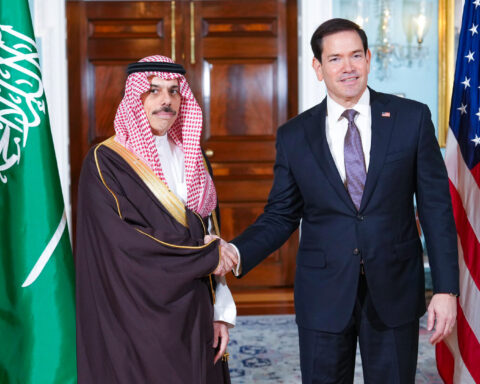
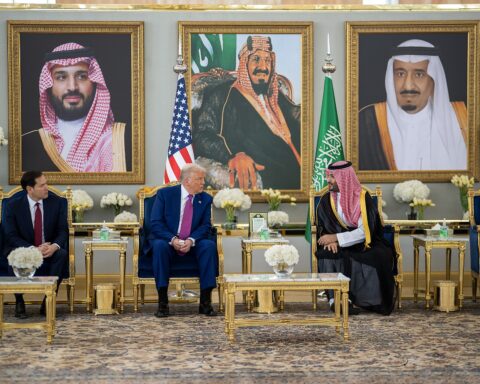
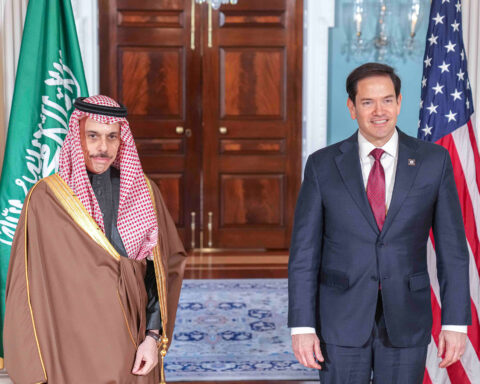
RIYADH — The war that was supposed to pave the road to Saudi-Israeli normalization has instead demolished it. Eleven days into the US-Israeli campaign against Iran, Crown Prince Mohammed bin Salman has not moved closer to recognizing Israel. He has moved further away than at any point since the Abraham Accords were signed in September 2020. An August 2025 Washington Institute poll found that 99 percent of Saudi citizens view normalization with Israel negatively, and Riyadh’s foreign policy has aligned with that sentiment with a speed that suggests the crown prince was waiting for precisely this kind of exit ramp.
The implications extend far beyond bilateral relations. The collapse of the Saudi-Israel normalization track dismantles the central pillar of Trump administration Middle East strategy, reshapes the regional alliance architecture that took five years to build, and hands Beijing and Moscow an opening they have been angling for since the 2023 Saudi-Iranian rapprochement. Riyadh now identifies more risks than opportunities in a deal with Israel, according to an assessment by Israel’s own Institute for National Security Studies published in February 2026, and the war has given MBS the political cover to say so publicly.
Table of Contents
- What Changed Between Saudi Arabia and Israel Since the War Started?
- How Did Netanyahu’s War-to-Peace Theory Collapse?
- The Normalization Readiness Index
- Why Does MBS Now See More Risk Than Reward in the Israel Deal?
- What Are Saudi Arabia’s Non-Negotiable Conditions for Normalization?
- How Did Saudi Public Opinion Turn So Decisively Against Israel?
- The Trump Factor and Washington’s Shrinking Leverage
- The Contrarian Case for Why This War Actually Freed MBS
- What Replaced the Israel Deal in Saudi Foreign Policy?
- The Regional Realignment That Buried the Abraham Accords Expansion
- Can Saudi-Israel Normalization Ever Be Revived?
- Frequently Asked Questions
What Changed Between Saudi Arabia and Israel Since the War Started?
The transformation in Saudi-Israeli relations over the past eleven days ranks among the most dramatic diplomatic reversals in modern Middle Eastern history. Before the US-Israeli strikes on Iran began on February 28, 2026, Riyadh and Tel Aviv were cooperating quietly on intelligence sharing, coordinating diplomatic positions through Washington, and inching toward what both Trump and Netanyahu described as an inevitable normalization agreement. Saudi and Israeli intelligence services had coordinated on the push for action against Iran, according to reporting by the Washington Post, creating an impression of strategic convergence that made normalization appear closer than ever.
That impression has been shattered. Saudi Arabia now occupies the opposite end of the diplomatic spectrum from Israel on nearly every active question in the Middle East. The Kingdom has condemned Israeli strikes on Qatar, a fellow GCC member state. It has intensified diplomatic engagement with Iran through daily contact with Tehran’s ambassador in Riyadh. It has co-led a Saudi-French initiative on Palestinian statehood recognition. And MBS himself, according to multiple regional sources cited by Bloomberg, has privately called Israeli actions in Gaza “genocide against the Palestinians.”
The shift is not merely rhetorical. In January 2026, the Anti-Defamation League issued what it called an “unprecedented” statement expressing alarm over the intensification of antisemitic discourse in Saudi Arabia and growing public attacks on the Abraham Accords by prominent Saudi figures. Saudi state-controlled media, which had been gradually warming to the possibility of Israeli ties since 2020, reversed course decisively after October 7, 2023, and the reversal has only accelerated since the Iran war began.
Three specific developments over the past two weeks confirm the depth of the rupture. First, Saudi Foreign Minister Prince Faisal bin Farhan declared at a GCC emergency session on March 6 that normalization “is not on the table” and cannot be discussed while “Israel continues to act as an unrestrained regional actor.” Second, Riyadh rejected Israel’s December 2025 recognition of Somaliland, calling it a violation of Somali sovereignty — a position that put Saudi Arabia directly at odds with Israeli diplomatic strategy. Third, Saudi Arabia actively condemned the Israeli strikes on Iranian territory that triggered the current conflict, describing them as destabilizing to regional security.
The Middle East briefing 3,000+ readers start their day with.
One email. Every weekday morning. Free.
| Date | Event | Direction |
|---|---|---|
| Sep 2020 | Abraham Accords signed (UAE, Bahrain) — Saudi Arabia notably absent but permitted overflights | Warming |
| Mar 2023 | China-brokered Saudi-Iran rapprochement — reduced urgency for anti-Iran alignment with Israel | Cooling |
| Sep 2023 | MBS tells Fox News normalization “gets closer every day” | Warming |
| Oct 2023 | Hamas attack on Israel and subsequent Gaza war — normalization talks suspended | Rupture |
| Oct 2024 | Faisal bin Farhan declares normalization “off the table” without Palestinian state | Cooling |
| Jan 2026 | ADL warns of rising antisemitic discourse in Saudi media | Cooling |
| Feb 2026 | INSS assessment: Riyadh sees “more risks than opportunities” in normalization | Cooling |
| Feb 28, 2026 | US-Israeli strikes on Iran — Saudi Arabia condemns destabilization | Rupture |
| Mar 2026 | Saudi Arabia engages Iran backchannel daily, condemns Israeli strikes on Qatar | Rupture |

How Did Netanyahu’s War-to-Peace Theory Collapse?
Israeli Prime Minister Benjamin Netanyahu built his case for the Iran campaign partly on the premise that destroying Iran’s military capability would remove the primary obstacle to Saudi-Israeli normalization. On March 3, five days into the war, Netanyahu told the Knesset that the strikes would “pave the way for many peace treaties” and that Saudi Arabia had “a lot to gain” from Iran’s weakening. He predicted normalization would be “very close” once the Iranian threat was neutralized, according to reporting by Haaretz.
The theory rested on a logical but ultimately flawed assumption: that Saudi Arabia’s reluctance to normalize was principally driven by fear of Iranian retaliation. Remove Iran from the equation, the reasoning went, and Riyadh’s path to recognition would be clear. Netanyahu made this argument explicitly during a February 2025 White House press conference with Trump, where he framed the normalization-through-strength thesis as the centerpiece of a new regional order.
The theory collapsed for three reasons. First, the war did not remove Iran from the equation — it brought Iranian missiles and drones directly onto Saudi soil. Since March 1, Iran has struck Saudi Arabia’s eastern oil infrastructure, residential areas in Al-Kharj, and launched drone swarms toward Shaybah and the diplomatic quarter in Riyadh. Two foreign nationals were killed and twelve injured in the Al-Kharj strike alone. Saudi Arabia is now simultaneously a de facto target of the war Netanyahu started and the diplomatic mediator trying to end it. Normalizing with the country that triggered this devastation is politically impossible.
Second, the theory ignored the Palestinian dimension entirely. Netanyahu’s coalition government, which includes far-right ministers Itamar Ben Gvir and Bezalel Smotrich, has categorically refused to accept any pathway to Palestinian statehood. The Saudi condition for normalization — an “irreversible” commitment to a sovereign Palestinian state along 1967 borders with East Jerusalem as its capital — is one that Netanyahu’s government cannot and will not meet. The war has not changed this fundamental arithmetic. If anything, Israel’s expanded military operations have hardened Saudi insistence on the Palestinian condition.
Third, Netanyahu underestimated the degree to which the war would alienate Saudi Arabia from Israel politically. The Israeli strikes on Iran hit targets across eight countries, including GCC member states that Saudi Arabia is treaty-bound to defend. Israel’s bombing of sites in Qatar — a nation with which Saudi Arabia recently signed historic defense cooperation agreements — crossed a line that Riyadh views as a direct affront to Gulf sovereignty.
The idea that destroying Iran would automatically produce Saudi-Israeli peace reflects a fundamental misunderstanding of what Riyadh actually wants. The Palestinian issue is not a bargaining chip — it is the price of admission.
Middle East Institute analysis, March 2026
The Normalization Readiness Index
To assess how far Saudi-Israel normalization has retreated, it is useful to evaluate the key prerequisites across five dimensions: leadership willingness, public legitimacy, external pressure, strategic benefit, and Palestinian progress. Each factor can be scored from one to five, with five indicating maximum readiness for normalization and one indicating near-total obstruction.
| Dimension | Pre-Oct 2023 Score | Current Score (Mar 2026) | Key Driver of Change |
|---|---|---|---|
| Leadership Willingness | 4 | 1 | MBS shifted from “getting closer every day” to “genocide” rhetoric |
| Public Legitimacy | 2 | 1 | 99% negative view in Aug 2025 poll; ADL flagged antisemitic discourse Jan 2026 |
| US Pressure Effectiveness | 4 | 2 | Trump acknowledged Riyadh “not ready”; dropped normalization as condition for nuclear deal |
| Strategic Benefit to Saudi Arabia | 3 | 1 | INSS: “more risks than opportunities”; Israel seen as unrestrained actor |
| Palestinian Progress | 2 | 1 | Netanyahu coalition blocks statehood; Gaza devastation hardened Saudi position |
| Composite Index | 15/25 | 6/25 | Aggregate decline of 60% — from “difficult but possible” to “effectively dead” |
The composite score of six out of twenty-five represents the lowest readiness level since the Abraham Accords were first conceived. Before October 2023, the index stood at fifteen — reflecting genuine if conditional Saudi willingness, moderate US leverage, and at least some perceived strategic benefit. The Gaza war alone dropped the score to approximately nine. The Iran war has pushed it to six, a level at which normalization is not merely unlikely but structurally impossible under current conditions.
The most consequential decline is in leadership willingness, which has fallen from four to one. Before the Gaza war, MBS was personally invested in the normalization process. He described it as integral to Vision 2030’s economic transformation agenda and to securing the US defense pact and civil nuclear agreement that Riyadh covets. That personal investment has evaporated. The crown prince reportedly told advisors that normalization efforts “put his life at risk,” according to the INSS assessment published in February 2026 — a remarkable statement from a leader whose security apparatus is among the most formidable in the Middle East.
Why Does MBS Now See More Risk Than Reward in the Israel Deal?
The calculus that drove MBS toward normalization was always transactional rather than ideological. Saudi Arabia sought three specific deliverables from the United States in exchange for recognizing Israel: a formal mutual defense treaty comparable to NATO Article 5, access to civilian nuclear technology including domestic enrichment capability, and a massive arms package including advanced fighter aircraft. Israel was the price of admission for benefits that Riyadh could not obtain any other way.
The Iran war has disrupted this equation in two ways. First, several of the benefits Saudi Arabia sought are now being offered or negotiated independently of normalization. Trump, according to the Times of Israel, is “no longer demanding Saudis recognize Israel” as a condition for the nuclear deal with the US, reportedly separating the two tracks in response to the war. The defense cooperation has deepened dramatically without normalization — the US has deployed a third carrier strike group to the Gulf, integrated Saudi air defenses into the Combined Air Operations Center, and fast-tracked weapons deliveries that were previously linked to normalization progress.

Second, the risks of normalization have multiplied. Recognition of Israel while Israeli bombs fall on Muslim countries — including Saudi Arabia’s own GCC partners — would be an act of political self-destruction. A December 2023 poll by the Arab Center Washington found that 96 percent of Saudis opposed normalization with Israel, a figure that has almost certainly increased further during the Iran war as Saudi civilians have been killed and injured by the consequences of a conflict Israel helped initiate.
The regional dimension compounds the domestic risk. Saudi Arabia has spent four years rebuilding relationships that were damaged by its earlier drift toward Israel. The 2023 rapprochement with Iran, brokered by China, was MBS’s signature diplomatic achievement. Thawing ties with Turkey produced a presidential visit by Erdogan. The reconciliation with Qatar after the 2017-2021 blockade culminated in landmark defense and intelligence-sharing agreements and a high-speed rail deal signed in December 2025. Normalizing with Israel now would jeopardize all of these relationships simultaneously.
There is also the Saudi-UAE competition to consider. The INSS noted that from Riyadh’s perspective, “Israel has chosen a side in the dispute — the Emirati one.” The UAE’s normalization with Israel in 2020, which produced bilateral trade surging from tens of millions to an estimated $3 billion annually by 2023, gave Abu Dhabi a strategic advantage that Riyadh initially sought to match. But the war has reframed that advantage as a liability. The UAE’s close ties to Israel have complicated its position within the GCC at precisely the moment when Gulf unity matters most.
What Are Saudi Arabia’s Non-Negotiable Conditions for Normalization?
Saudi Arabia’s conditions for normalization with Israel have hardened into what amounts to a set of impossible demands given the current Israeli government’s composition. Prince Faisal bin Farhan has articulated these conditions publicly and repeatedly, leaving no room for creative ambiguity.
The primary condition is the establishment of an independent Palestinian state along the 1967 borders with East Jerusalem as its capital. This is not a starting position for negotiations — it is, in bin Farhan’s words at the United Nations in July 2025, “unequivocal and non-negotiable.” He stated that normalization “can only come through the establishment of a Palestinian state” and that this position “is based on a strong conviction that only through the establishment of a Palestinian state and only through addressing the legitimate rights of the Palestinian people to self-determination can we have sustainable peace and real integration in the region.”
The secondary conditions are equally demanding. Saudi Arabia requires the end of the war in Gaza and the alleviation of Palestinian suffering as preconditions before talks can even begin. Only after those conditions are met, bin Farhan said, “then we have to talk about the establishment of the Palestinian state. And once that is achieved, then obviously we can talk about normalization.” The sequential nature of these conditions means that normalization sits at the end of a chain of prerequisites, each of which is individually difficult and collectively improbable.
| Saudi Condition | Netanyahu Coalition Position | Gap |
|---|---|---|
| Sovereign Palestinian state on 1967 borders | Ben Gvir and Smotrich reject any Palestinian state; Netanyahu coalition cannot survive the vote | Unbridgeable |
| East Jerusalem as Palestinian capital | Israel claims undivided Jerusalem as eternal capital; Basic Law codifies this | Unbridgeable |
| End of Gaza war and humanitarian relief | Netanyahu has expanded operations, not contracted them | Widening |
| Israel must act as “restrained” regional actor | Israel launched war on Iran without full GCC consultation; struck Qatar | Widening |
| “Irreversible” pathway to statehood (not just verbal commitment) | No mechanism exists to bind future Israeli governments | Structural |
The word “irreversible” is the most significant qualifier. Previous rounds of normalization diplomacy allowed for constructive ambiguity — vague commitments to a “pathway” that could mean different things to different audiences. Saudi Arabia has closed that loophole. By demanding irreversibility, Riyadh is insisting on structural guarantees that no Israeli government has ever been willing to provide, and that the current coalition is constitutionally incapable of offering.
This hardening of conditions is itself a signal. When a state demands terms it knows its counterpart cannot accept, the demand functions as a polite refusal. The conditions are not designed to produce an agreement. They are designed to explain why an agreement is impossible while placing the blame squarely on Israel.
How Did Saudi Public Opinion Turn So Decisively Against Israel?
The collapse of Saudi public support for normalization is among the most dramatic opinion shifts recorded in recent Middle Eastern polling. In 2020, when the Abraham Accords were signed, approximately 41 percent of Saudis expressed some degree of support for the normalization framework, according to Washington Institute polling. By August 2025, that figure had fallen to one percent positive, with 99 percent of respondents viewing normalization negatively.
The trajectory is worth examining in detail. A 2022 Washington Institute poll found that 38 percent of Saudis opposed recognizing Israel — a figure that rose to 68 percent during the early months of the Gaza war in late 2023. A separate Arab Center Washington survey from December 2023 found 96 percent opposition to normalization. By mid-2024, a Times of Israel report noted that most Saudis considered Israel, not Iran, the greatest threat to regional stability — with 33 percent naming Israel compared to 25 percent for Iran.
Several factors drove this reversal. The Gaza war, which has killed over 40,000 Palestinians according to health authorities in the territory, generated visceral public anger across the Arab world. Saudi social media, which operates within strict government-defined boundaries, nonetheless reflected genuine popular fury. State-controlled media shifted its framing from cautious openness toward Israel to emphasis on human rights violations and humanitarian consequences. Prominent Saudi figures who had previously advocated for normalization reversed their positions publicly.
The Iran war has intensified these dynamics. Iranian missiles and drones striking Saudi territory — killing two people in Al-Kharj and threatening critical infrastructure from Ras Tanura to Riyadh itself — are a direct consequence of the war that Israel initiated alongside the United States. For ordinary Saudis, the connection between Israeli action and their own vulnerability is visceral and immediate. The percentage of Saudis who would oppose normalization during an active conflict in which Israeli actions have brought war to their own residential neighborhoods can safely be assumed to exceed even the 99 percent recorded before the fighting began.
MBS operates within a political system where public opinion matters differently than in a democracy but still matters. The crown prince’s legitimacy rests on a compact with the Saudi population: economic modernization, social reform, and national security in exchange for political quiescence. Normalizing with Israel while the Saudi public overwhelmingly opposes it — and while the consequences of Israeli military action are literally landing on Saudi soil — would violate that compact in a way that even the Kingdom’s most powerful ruler in decades cannot afford.
The Trump Factor and Washington’s Shrinking Leverage
The Trump administration entered office in January 2025 with Saudi-Israeli normalization as a signature foreign policy goal. Trump himself described it during the campaign as the “deal of the century” and framed it as the natural extension of the Abraham Accords he brokered in his first term. The expectation was that the close personal relationship between Trump and MBS would be sufficient to push the deal across the finish line.
A year later, Trump has effectively abandoned normalization as a near-term objective. In November 2025, visiting Riyadh for the Saudi-US Investment Forum, Trump publicly acknowledged that Saudi Arabia would “join the Abraham Accords in your own time” — a statement that marked a significant retreat from his earlier insistence on rapid progress. More consequentially, according to the Times of Israel, Trump is “no longer demanding Saudis recognize Israel” as a condition for the bilateral nuclear deal that Riyadh wants.

The separation of the nuclear deal from normalization represents a strategic victory for Riyadh and a defeat for the normalization architecture. The original framework — nuclear technology and a defense pact in exchange for recognizing Israel — gave Washington leverage over both parties. By decoupling the nuclear track, Trump has given Saudi Arabia most of what it wanted without requiring the one concession that MBS is unwilling to make.
The war has further eroded US leverage. Washington needs Saudi cooperation on oil production, regional stability, intelligence sharing on Iranian targets, and logistical support for US forces now deployed across the Gulf. The US embassy in Riyadh was itself targeted by Iranian drones, and American service members have been killed and injured on Saudi soil. Pressuring Riyadh on normalization at a moment when the Kingdom is absorbing missile strikes as a consequence of American and Israeli action is diplomatically impossible.
Congress, meanwhile, has fractured on the question. Senator Lindsey Graham threatened to block the US-Saudi defense pact over Riyadh’s refusal to strike Iran directly — a demand that simultaneously illustrates Congressional frustration and its irrelevance to Saudi decision-making. The Congressional Research Service’s 2025 report on possible US-Saudi agreements noted that ratification of any defense treaty faces steep political hurdles in the Senate, further diminishing the value of the normalization-for-defense-pact trade.
The Contrarian Case for Why This War Actually Freed MBS
The conventional narrative frames the collapse of normalization as a setback for Saudi Arabia. MBS wanted the defense pact, the nuclear deal, and the international legitimacy that recognition of Israel would confer. The war, in this reading, destroyed a deal that served Saudi interests.
The evidence suggests otherwise. The Iran war may have given MBS the most valuable commodity in diplomacy: a legitimate reason to walk away from a deal he never truly wanted on the terms being offered.
Consider the pre-war dynamics. MBS told Fox News in September 2023 that normalization “gets closer every day.” But privately, according to multiple accounts including the INSS assessment, he expressed deep ambivalence. He reportedly told advisors that the effort “put his life at risk” — an extraordinary admission from a leader who had already survived the October 2023 political earthquake without significant damage. The problem was not the concept of normalization but its conditions: Netanyahu’s government could not deliver on Palestinian statehood, and without that deliverable, MBS could not sell the deal to his own population.
The war resolved this impasse by making it unnecessary for MBS to say no. He does not need to reject the deal — the deal has been made impossible by circumstances beyond his control. Iran is attacking Saudi territory because of a war Israel started. Israeli strikes hit GCC member states. Saudi civilians are dead. Under these conditions, normalization is self-evidently impossible, and no Saudi leader would be expected to pursue it. The war provides political cover that MBS could not create on his own without directly confronting both Washington and Tel Aviv.
Meanwhile, the benefits Saudi Arabia sought from normalization are arriving through alternative channels. The defense relationship with the US has deepened dramatically during the war — three carrier strike groups, integrated air defense, accelerated weapons deliveries — without requiring Israeli recognition. The nuclear deal track has been separated from normalization. International legitimacy is being earned through Riyadh’s role as the region’s lead diplomatic mediator, a role that would be impossible if Saudi Arabia were simultaneously normalizing with the country that started the war.
Even the economic dimension has shifted. The $45 billion in bilateral trade that Israeli officials estimated from normalization looks modest compared to the economic leverage Saudi Arabia now commands as the world’s swing oil producer during a supply crisis. Aramco’s spare capacity, deployed at precisely the right moment, has given Riyadh more influence over global markets than any normalization agreement could provide.
What Replaced the Israel Deal in Saudi Foreign Policy?
Saudi Arabia has not simply abandoned normalization. It has replaced it with a coherent alternative regional strategy that achieves many of the same objectives through different means. The architecture of this replacement strategy became visible during the first week of the Iran war and has crystallized rapidly since.
The first pillar is GCC military solidarity. The extraordinary session of GCC foreign ministers on March 6, which invoked collective defense provisions, established Saudi Arabia as the security anchor of the Gulf for the first time since 1990. The joint defense council announced enhanced intelligence sharing, updated joint defense plans, coordinated air force exercises, and a unified diplomatic posture at the United Nations. This solidarity was previously fracturing along Saudi-UAE and Saudi-Qatar fault lines. The war healed those divisions overnight.
The second pillar is the Saudi-Pakistani defense axis. The Strategic Mutual Defence Agreement signed in September 2025 was invoked within days of the Iranian attacks, bringing Islamabad’s military capabilities — including its nuclear deterrent — into the Saudi security framework. This represents a fundamentally different approach to regional security than the Israel-alignment model. Pakistan provides credible military partnership without the domestic political costs that Israeli recognition would entail.
The third pillar is diplomatic mediation. Saudi Arabia’s daily engagement with Iran through the Riyadh ambassador channel has positioned the Kingdom as the war’s most credible peace broker. While Oman runs the most established backchannel to Tehran, Saudi Arabia’s direct line carries more weight because Riyadh has more to offer both sides. This mediating role is incompatible with normalization — and considerably more valuable to Saudi interests in the current crisis.
The fourth pillar is the Saudi-Qatar rapprochement. The landmark defense, intelligence-sharing, and high-speed rail agreements signed with Doha in December 2025 signaled a decisive pivot away from the Saudi-Emirati-Israeli alignment that characterized the early Abraham Accords period. MBS and Qatari Emir Tamim bin Hamad Al Thani have built a partnership that explicitly counters the UAE-Israel axis, creating a new power center in the Gulf that does not require Israeli involvement.
| Objective | Normalization Route | Current Alternative | Status |
|---|---|---|---|
| US defense guarantee | Mutual defense treaty linked to Israel recognition | De facto wartime integration; nuclear deal decoupled from normalization | Partially achieved without Israel |
| Nuclear technology | US civilian nuclear deal conditioned on normalization | Trump dropped Israel condition for nuclear track | On track without Israel |
| Regional security | Anti-Iran alliance with Israel | GCC collective defense + Pakistan defense pact + Iran mediation | Operational |
| Economic integration | Bilateral trade with Israel (~$45B estimated) | Oil leverage, GCC economic unity, non-aligned trade partnerships | Exceeded by oil premium |
| International legitimacy | Recognition by/of Israel signals moderation | Wartime mediation role signals responsible leadership | Achieved without Israel |
The Regional Realignment That Buried the Abraham Accords Expansion
The Abraham Accords’ expansion model depended on a specific regional configuration: moderate Arab states aligning with Israel against Iran under American patronage. The Iran war has not merely disrupted this configuration — it has replaced it with a fundamentally different alignment pattern.
The original Abraham Accords architecture, which normalized relations between Israel and the UAE, Bahrain, Morocco, and Sudan in 2020, was built on the premise that Iran represented a shared existential threat. Gulf states calculated that Israeli intelligence capabilities, technology partnerships, and the implicit US security guarantee that accompanied normalization justified the domestic political costs of recognizing Israel. Saudi Arabia was expected to be the capstone of this architecture — the prize that would validate the entire framework.
That framework now faces collapse from within. Bahrain, a signatory to the Abraham Accords, has come under direct Iranian attack during the current war and has recalled its ambassador from Israel. The UAE, whose bilateral trade with Israel surged to $3 billion annually post-normalization, is facing public pressure to freeze economic ties. Morocco’s normalization remains intact but has produced limited strategic value. Sudan’s transitional government, embroiled in civil war, has deprioritized the relationship entirely. Kazakhstan’s January 2026 accession to the Accords — the first expansion in years — focuses narrowly on cybersecurity and water management with Israel, not the grand strategic alignment that the framework originally envisioned.
The replacement architecture is distinctly non-Israeli. The Baker Institute’s 2025 analysis identified five reasons why the Abraham Accords are “ceding ground to Arab-Iranian de-escalation”: reduced threat perception of Iran following the 2023 rapprochement, declining US influence, the Gaza war’s impact on Arab public opinion, the Saudi-UAE rift, and the rise of alternative partnership models with China and Russia. The Iran war has amplified every one of these factors.
China’s role deserves particular attention. Beijing brokered the 2023 Saudi-Iranian deal that began the process of de-coupling Gulf security from the Israel-alignment model. During the current war, China has dispatched a peace envoy to Riyadh and positioned itself as an alternative mediator. For Saudi Arabia, which imports more Chinese goods than from any other trading partner and sells more oil to China than to any other buyer, Beijing offers a partnership model that requires no concessions on Israel and imposes no conditions on Palestinian policy.
The Quincy Institute’s 2026 analysis asked a pointed question: “Are Qatar and Saudi Arabia reassessing their reliance on the US?” The answer, visible in the realignment patterns of the past eleven days, is yes. Not abandoning the US relationship — which remains indispensable for defense — but diversifying away from a framework in which American patronage requires Israeli recognition as the entry fee.
Can Saudi-Israel Normalization Ever Be Revived?
Normalization between Saudi Arabia and Israel is not permanently dead. It is, however, in a condition that will require years of changed circumstances to reverse. The path back to the negotiating table requires shifts on multiple dimensions that are currently moving in the wrong direction.
The most critical variable is the Palestinian question. No Saudi leader will normalize with Israel while the images from Gaza remain fresh in Arab memory and while the Israeli government includes ministers who openly advocate annexation of the West Bank. A change in Israeli government — one willing to commit credibly to Palestinian statehood — is a necessary but not sufficient condition. Saudi Arabia would also need to see tangible progress, not merely declarations of intent.
The second variable is the conclusion of the Iran war and a period of regional stabilization. Saudi Arabia cannot normalize with Israel while the consequences of Israeli-initiated military action are actively threatening Saudi citizens, infrastructure, and sovereignty. Even after a ceasefire, the political toxicity of the association will take years to dissipate.
The third variable is domestic opinion management. MBS has allowed — and in some cases encouraged — Saudi public discourse to move sharply against Israel. Reversing that current requires a deliberate propaganda campaign that the crown prince cannot launch until external conditions change first. The 99 percent opposition figure represents a ceiling against which any normalization effort will crash.
Applying the Normalization Readiness Index framework, the minimum viable score for serious negotiations is approximately fourteen out of twenty-five. The current score of six requires an improvement of 133 percent across multiple dimensions — a process that would take, under optimistic assumptions, three to five years of favorable conditions that do not currently exist.
| Scenario | Required Conditions | Timeframe | Probability |
|---|---|---|---|
| Near-term revival (2026-2027) | Ceasefire, new Israeli government, Palestinian statehood pathway, public opinion shift | 1-2 years | Under 5% |
| Medium-term revival (2028-2030) | Stable post-war order, moderate Israeli government, incremental Palestinian progress, managed public opinion | 3-5 years | 15-25% |
| Long-term revival (2030+) | Generational shift, two-state framework, Saudi economic need, sustained US pressure | 5+ years | 30-40% |
| Permanent collapse | Continued Israeli far-right governance, no Palestinian progress, alternative Saudi security architecture matures | Indefinite | 30-40% |
The most consequential finding is the probability of permanent collapse — estimated between 30 and 40 percent. This scenario becomes increasingly likely with each month that the current conditions persist. Saudi Arabia’s alternative security architecture, once fully operational, reduces the incentive for normalization to a point where the political costs will always outweigh the diminishing benefits. If MBS successfully secures the US defense pact and nuclear deal without Israeli recognition — and the war’s trajectory suggests he is on track to do so — the entire rationale for normalization evaporates.
For the House of Saud, the strategic calculation has shifted permanently. The Abraham Accords were conceived in an era of Saudi-Israeli convergence against Iran. The Iran war has produced the opposite of what its architects intended: not convergence but estrangement, not a new Middle Eastern order built on the Abraham Accords but one built on their ruins.
Frequently Asked Questions
Is Saudi Arabia’s normalization with Israel officially dead?
Saudi Arabia has not formally declared normalization dead, but Foreign Minister Faisal bin Farhan stated in March 2026 that it is “not on the table.” The Kingdom has set conditions — including the establishment of a sovereign Palestinian state — that the current Israeli government cannot meet. Combined with 99 percent Saudi public opposition and the ongoing Iran war, normalization is effectively frozen for the foreseeable future, with revival requiring fundamental shifts in Israeli politics, regional stability, and Saudi public sentiment that are years away at minimum.
Why did Netanyahu believe the Iran war would lead to Saudi normalization?
Netanyahu argued that destroying Iran’s military capability would remove the primary obstacle to Saudi-Israeli ties by eliminating the shared threat that had previously motivated Saudi caution. He told the Knesset on March 3, 2026, that the war would “pave the way for many peace treaties.” This theory collapsed because the war brought Iranian attacks directly onto Saudi soil, deepened Saudi public hostility toward Israel, and failed to address the Palestinian statehood condition that Riyadh considers non-negotiable. The war made normalization harder, not easier.
What does Saudi Arabia want instead of normalization with Israel?
Saudi Arabia is pursuing an alternative regional strategy that achieves normalization’s objectives without requiring Israeli recognition. This includes de facto US defense integration during the war, a nuclear deal decoupled from Israeli conditions, GCC collective security under Saudi leadership, the Pakistan defense pact, diplomatic mediation positioning with Iran, and the Saudi-Qatar rapprochement. Riyadh calculates that these alternatives deliver equivalent strategic benefits without the domestic political costs that recognition of Israel would impose.
How did Saudi public opinion on Israel change so dramatically?
Saudi public support for normalization fell from approximately 41 percent in 2020 to just 1 percent positive by August 2025, according to Washington Institute polling. The primary driver was the Gaza war beginning in October 2023, which generated overwhelming anger across the Arab world. The percentage opposing recognition of Israel rose from 38 percent in 2022 to 68 percent during the Gaza conflict and continued climbing. By 2025, 33 percent of Saudis named Israel as the greatest threat to regional stability, surpassing Iran at 25 percent.
Could a new Israeli government revive the normalization process?
A change in Israeli government is necessary but not sufficient for normalization revival. A successor government would need to commit credibly and irreversibly to Palestinian statehood along 1967 borders with East Jerusalem as the capital — a position no Israeli government has ever adopted. Even then, Saudi public opinion would need time to shift, the war’s consequences would need to fade, and MBS would need to determine that the strategic benefits outweigh the costs. The Normalization Readiness Index suggests a minimum three-to-five-year timeline under optimistic conditions, with a 30-40 percent probability of permanent collapse.
What role does China play in the normalization collapse?
China has been a significant factor in reducing Saudi incentives for Israeli normalization. The war has also exposed a fundamental divergence between US and Saudi war aims that complicates Washington’s ability to offer security guarantees as a normalization incentive. Beijing brokered the 2023 Saudi-Iranian rapprochement that began the de-coupling of Gulf security from the Israel-alignment model. During the Iran war, China dispatched a peace envoy to Riyadh and positioned itself as an alternative mediator. China offers Saudi Arabia a major-power partnership model that requires no concessions on Israel, imposes no conditions on Palestinian policy, and comes with the world’s largest consumer market for Saudi oil. This alternative reduces Washington’s leverage to pressure Riyadh on normalization. Saudi Arabia’s ability to shape these diplomatic narratives is amplified by MBS’s expanding media empire, which has become a strategic weapon in its own right during the Iran conflict.