
Table of Contents
RIYADH — GCC Secretary-General Jasem Al-Budaiwi called Iran’s drone strikes on the UAE and Kuwait “treacherous” on May 10 — the seventh time in eleven weeks the Secretariat has deployed that exact word in a formal condemnation since the war began on February 28. What he did not say matters more: the statement dropped the Article 51 collective self-defense invocation from the GCC’s own March 1 Ministerial declaration, left Qatar off the header despite a drone hitting a cargo vessel in Qatari waters the same day, and committed exactly zero GCC military resources to anything.
The full statement title — “HE GCCSG Condemns in the Strongest Terms the Egregious Iranian Attacks on the UAE and Kuwait; Affirms that Iran’s Treacherous Approach Seeks to Destabilise Regional Security” — reads like an escalation only if you have not read the previous six (GCC Secretariat via GlobalSecurity.org, May 10, 2026). The drone strikes hit as Iran simultaneously submitted its ceasefire counter-proposal through Pakistan, a compellence-and-negotiation move that landed on three GCC states while Tehran positioned itself as the reasonable party at the table. The gap between the GCC’s chosen rhetoric and its withheld authority is not accidental. It is Saudi Arabia’s mediation interest expressed through the institution it dominates.
Seven Times “Treacherous” — and Counting
The word “treacherous” first appeared in a GCC Secretariat statement on March 3, 2026, five days after Iran’s opening strikes: “Continuous Cowardly and Treacherous Iranian attacks on GCC states, Targeting Civilian Facilities and Diplomatic Mission Premises” (GCC-SG.org). It reappeared on March 7, condemning strikes on Bahraini buildings housing Qatari Amiri Naval Forces. On March 12, Al-Budaiwi welcomed a UNSC resolution condemning “Treacherous Iranian Attacks” — a vote backed by 136 member states, which the GCC Secretariat called “unprecedented international consensus.” March 17 covered attacks on the UAE and other Council states. March 19 targeted Kuwait’s Mina Abdullah and Mina Al Ahmadi refineries. The April 2 UNSC briefing demanded the Security Council “Take All Measures to Ensure Immediate Cessation of Treacherous Iranian Aggressions.”
May 10 makes seven. A word that describes both the first week of war and the seventy-first day is not evidence of escalating anger — it is evidence of a fixed lexicon. The GCC Secretariat has found its ceiling adjective and returned to it with the regularity of a press release template, because “treacherous” is the fiercest word that carries no operative consequence. It condemns without authorizing, denounces without committing, and sounds fierce enough for the domestic audiences of six member states while remaining precisely meaningless in international law.
The scale of what that word is being asked to cover has grown enormously. Arab News analysis puts total Iranian drone and missile attacks on GCC states at 4,391 since February 28 — 83% of Iran’s total fire in the conflict. That is roughly 60 strikes per day, sustained across eleven weeks, absorbed by the institutional language of a body whose strongest public response has been a single adjective used on rotation. The vocabulary has not kept pace with the violence because it was never designed to.
What Did Al-Budaiwi’s Statement Actually Authorize?
The operative clause of the May 10 statement reads: Al-Budaiwi “underlined the full support of the GCC member states for the UAE and the State of Kuwait in all measures they undertake to maintain their security and stability, as well as the safety of their citizens and residents” (GCC Secretariat, May 10, 2026). This is solidarity language, not collective authorization language. It endorses whatever the UAE and Kuwait independently decide to do — without GCC member states taking on any obligation to act collectively, contribute resources, share intelligence, or integrate air defense. It is diplomatic applause directed at two members who intercepted drones with their own systems.
The Middle East briefing 3,000+ readers start their day with.
One email. Every weekday morning. Free.
The broader quote reinforces the pattern: “Iran’s treacherous approach seeks systematically to undermine the stability and security of the region and weaken regional security, in blatant violation of the principles of international law, the Charter of the United Nations, and the principles of good neighbourliness.” The framing invokes international law without invoking any specific legal authority for a collective response. It names the UN Charter without invoking the charter article — Article 51 — that would authorize collective self-defense. The omission is precise enough to be drafted by lawyers, and it almost certainly was.
The GCC’s Joint Defense Agreement, signed in 2000 and modeled loosely on NATO’s Article 5, commits member states to “take any necessary action, including use of military force, to repel such aggression.” The Washington Institute characterizes this commitment as “an exercise in ambiguity” — a “flexible political commitment rather than arrangements for immediate mobilization.” Implementation requires consensus through the Joint Defense Council, which effectively gives any member state a veto. The structural limitations of the GCC as a collective security architecture have been evident throughout the conflict. What the May 10 statement does not address is why its own language has retreated from the stronger legal framework the Secretariat deployed eleven weeks ago.
Why Did the GCC Drop Its Article 51 Language?
On March 1, 2026 — three days into the war — the GCC’s 50th Extraordinary Ministerial Council meeting produced language that went further than anything the Secretariat has said since. The Ministers explicitly invoked Article 51 of the UN Charter, declaring that GCC states “reserve their legal right to respond…individually and collectively, in the event of aggression.” They affirmed that “the security of its member states is indivisible, and any attack on any member state is a direct attack on all GCC states, in accordance with the GCC Charter and the Joint Defense Agreement” (GCC-SG.org, QNA, Voice of Emirates, March 2, 2026). That is collective self-defense language — the legal basis under international law for joint military action.
The May 10 statement contains none of it. No Article 51 reference. No “indivisible security.” No “attack on one is attack on all.” After eleven weeks and 4,391 documented attacks, the GCC’s institutional language has not escalated to match the violence — it has de-escalated below its own prior commitments. The March 1 Ministerial spoke like an alliance preparing for collective defense. The May 10 Secretariat statement spoke like a diplomatic body issuing a press release.
Two developments explain the regression. The April 8 ceasefire — however fragile — created a diplomatic frame that collective defense language would undermine. And the 4th round of Oman-hosted US-Iran talks, which concluded on May 11 after more than three hours, produced no agreement but sustained what both sides described as “difficult but constructive” engagement (PBS NewsHour, Times of Israel, May 11). Donald Trump gave the ceasefire “approximately a 1% chance of living” in comments to CNN and NBC on May 11. The GCC’s institutional architecture is calibrated to protect whatever marginal life remains in that process, and Article 51 invocations are incompatible with that calibration.
Al-Budaiwi himself framed the underlying tension at the UNSC on April 2: “We are not facing a fleeting crisis, but a true test of the international system’s credibility. Either collective security is upheld in practice, or it is left to the equations of power alone” (GCC Secretariat via GlobalSecurity.org, April 2, 2026). Six weeks later, his own Secretariat answered that question. The GCC has left it to the equations of power — specifically Saudi power, exercised bilaterally through channels the Secretariat’s statements are designed not to disrupt. The structural vetoes within Iran’s own system make the negotiation fragile enough without the GCC adding legal escalation from its side.
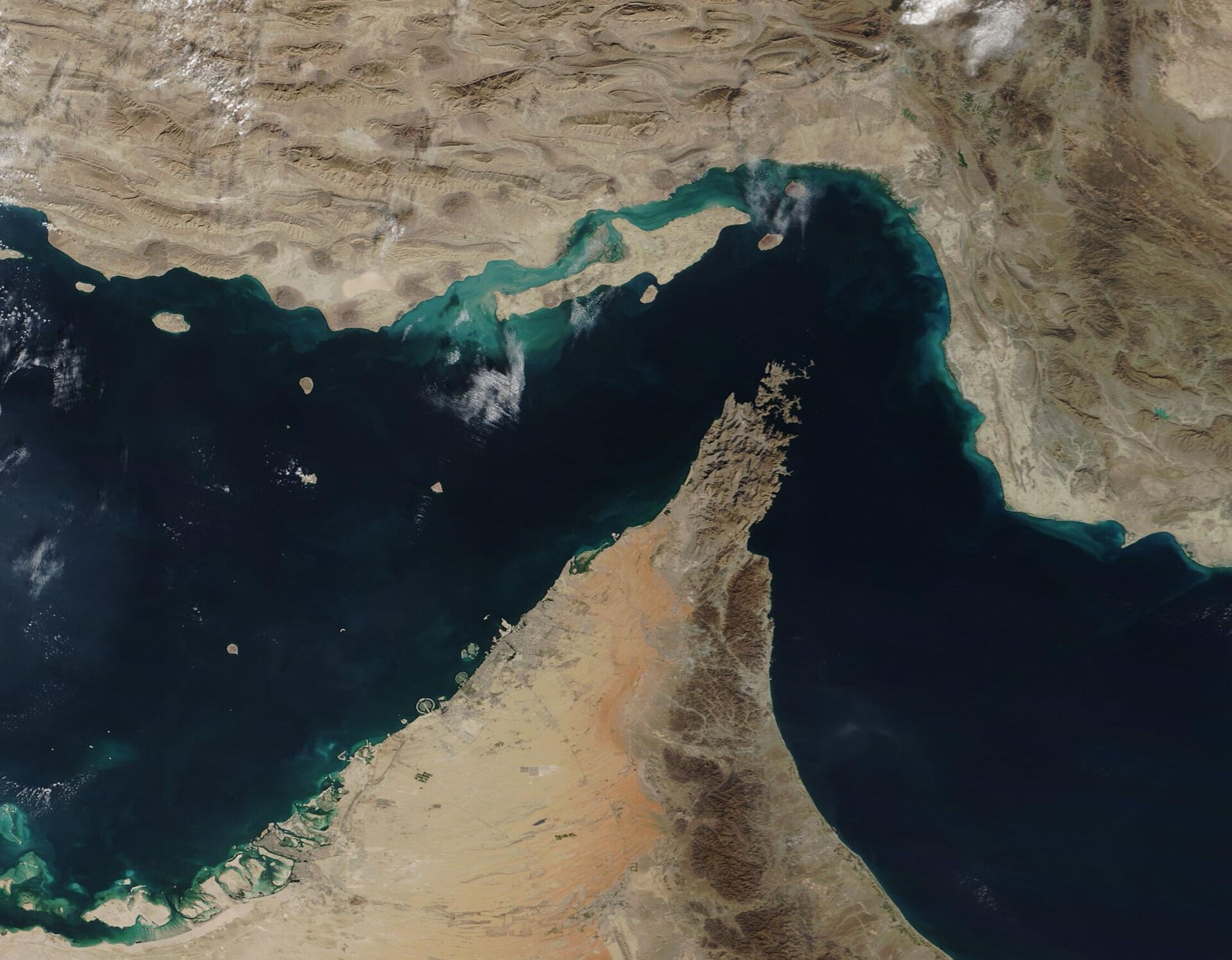
Iran, for its part, has not claimed responsibility for the May 10 strikes. Tehran maintains it “tightened control of the strait after what it calls ‘unprovoked aggression’ by the US and Israel and in response to Washington’s blockade of Iranian shipping, which Tehran says violates the ceasefire” (PBS NewsHour, May 10). Its ceasefire counter-proposal — submitted the same day the drones hit — offered HEU dilution and transfer to a third country with a return clause, deferred nuclear issues to Phase 2, and demanded the US blockade be lifted first (CBC News, Boston Globe, May 10). Trump called it “TOTALLY UNACCEPTABLE!” on social media. The proposal’s design ensured rejection while creating the appearance of Iranian flexibility.
Why Was Qatar Left Off the Condemnation?
The statement’s header names two countries: the UAE and Kuwait. Qatar does not appear, despite the Qatar Defense Ministry confirming that a drone struck a cargo vessel 23 nautical miles — approximately 43 kilometres — northeast of Doha in Qatari waters on May 10. The UK Maritime Trade Operations Centre independently confirmed the incident (PBS NewsHour, May 10). The fire was contained and no casualties were reported, but the strike represents a direct attack on a vessel operating in the sovereign maritime zone of a GCC member state. Qatar’s Foreign Ministry called it “a dangerous and unacceptable escalation that threatens the security and safety of maritime trade routes and vital supplies in the region” (Reuters/PBS, May 10).
The omission tracks to Qatar’s dual role in the crisis. Qatar is simultaneously a GCC member under Iranian fire and an active ceasefire mediator. Axios reported on May 9 — the day before the strikes — that US envoy Steve Witkoff and Secretary of State Marco Rubio met a Qatari mediator in Miami to discuss the ceasefire framework. Naming Qatar as a victim in the GCC Secretariat header would formally document the mediator as a target, complicating Doha’s intermediary role at precisely the moment its diplomatic services were being used by both Washington and the parties.
Saudi Arabia’s separate MFA condemnation, issued May 11, covered the gap. The Saudi statement named all three targets — UAE, Qatar, and Kuwait — and “affirmed full support for Gulf security” (Voice of Emirates, May 11). Where the Secretariat edited Qatar out, Riyadh wrote it back in through bilateral channels. Prince Faisal bin Farhan called the Qatari Foreign Minister on May 10, the same day as the strikes, to discuss “regional security and stability.” The call is behavioral evidence of what the institutional statement was drafted to conceal: Saudi bilateral diplomacy is doing the work that GCC mechanisms are designed not to do.
Kuwait’s Calculated Restraint
Kuwait’s response to its first airspace breach since the April 8 ceasefire was defined by what it withheld. Brigadier General Saud Abdulaziz Al-Otaibi confirmed that the armed forces “detected a number of hostile drones in Kuwaiti airspace, which were dealt with in accordance with established procedures,” adding that “the armed forces affirm their full readiness to maintain the security of the homeland” (Kuwait Ministry of Defense via X, May 10, 2026). The word “Iranian” does not appear in the statement. Kuwait did not identify the attacker, did not summon the Iranian ambassador, and did not invoke any collective defense pact — bilateral or multilateral. Fortune described the incident as the first Kuwaiti airspace breach since the April 8 ceasefire, confirming the significance of the event Kuwait itself chose to minimise.
“Established procedures” is the language of military professionalism, not political escalation. Kuwait treated the airspace violation as an operational incident managed within existing defense postures, not as a threshold event requiring a new political response. The UAE took a different approach: Abu Dhabi not only confirmed its own drone interceptions but separately condemned the incursion into Kuwaiti airspace as a “violation of sovereignty” (Tribune India/ANI, May 10). The UAE was willing to say about Kuwait’s sovereignty what Kuwait itself chose not to say about Iran — a diplomatic asymmetry that reflects Kuwait’s more cautious orientation toward the ceasefire process and its historically less confrontational posture with Tehran.
Kuwait’s restraint is consistent with a GCC in which individual member states calibrate their responses independently rather than through collective mechanisms. The Secretariat’s condemnation provided diplomatic cover for Kuwait to remain silent on attribution, because the institutional statement had already named Iran. Kuwait got the benefit of GCC-level denunciation without the bilateral cost of being the state that pointed the finger.
Kuwait’s calculated restraint on May 10 proved short-lived. Two days later, on May 12, Kuwait disclosed that it had arrested four IRGC officers who physically infiltrated Bubiyan Island on May 1, opening fire on Kuwaiti soldiers during a nominal ceasefire — the first confirmed armed IRGC incursion onto GCC sovereign territory. Kuwait invoked Article 51 of the UN Charter in its formal protest, shifting from calculated silence to a legal reservation of the right to use force. The 11-day gap between the May 1 infiltration and the May 12 announcement tracks the same diplomatic logic as the May 10 drone silence: Kuwait released information at the moment when maximum disclosure no longer compromised the ceasefire framework it had been protecting. Iran’s counter-move came the next day: Foreign Minister Araghchi posted on X calling the detained officers “citizens,” accusing Kuwait of an “unlawful attack,” and formally reserving Iran’s “right to respond” — converting a captured-espionage embarrassment into a hostage-diplomacy frame. The full mechanics of that inversion are in Araghchi Calls Captured IRGC Colonels “Citizens”: Iran’s Bubiyan Hostage Frame.

Where Saudi Mediation Meets the GCC Ceiling
The common thread linking the Secretariat’s boilerplate, Qatar’s omission, and Kuwait’s silence runs through Riyadh. Saudi Arabia’s MFA statement on May 11 was broader than the GCC statement in geographic scope — covering all three targets — and narrower in operative commitment, offering pure bilateral solidarity with no mention of collective mechanisms (Voice of Emirates). The Saudi response operates on a separate track from the Secretariat, and that separation is the design, not a failure of coordination. Riyadh’s mediation interest requires the GCC institutional posture to remain precisely where it is: condemnatory enough to demonstrate unity, restrained enough not to trigger any sequence that would complicate ongoing negotiations.
The 4th round of Oman-hosted US-Iran talks concluded on May 11 with no agreement, but both sides described the discussions as a basis for continued engagement (PBS NewsHour, Times of Israel). That thread depends on the GCC not activating the very mechanisms its own charter provides. The Washington Institute’s characterization of the Joint Defense Agreement — an architecture built on deliberate ambiguity, as detailed above — captures something the Secretariat’s drafters understand intuitively: that ambiguity is the operating principle, not a design flaw. A defense pact requiring consensus through the Joint Defense Council is one that Saudi Arabia can effectively veto by declining to build that consensus — and Riyadh has consistently chosen restraint over collective escalation throughout the conflict.
The Peninsula Shield Force — renamed the Unified Military Command in January 2021 — has never been activated for interstate aggression collective defense. Its only operational deployment, to Bahrain in March 2011, was framed as internal security assistance at Bahrain’s bilateral request under a separate GCC Internal Security Agreement. No Article 51 notification was filed with the UN Security Council. The GCC has a collective defense architecture that has never been collectively invoked for collective defense, and the May 10 statement keeps that record intact. The security architecture MBS is building runs through bilateral agreements and ad hoc coalitions, not through a Secretariat whose strongest weapon remains a seven-time adjective.
Trump gave the ceasefire a 1% survival probability. The GCC’s institutional vocabulary is built to protect that 1% — which is why a secretary-general reaches for the word “treacherous” for the seventh time, because it is the fiercest word he is permitted to use, and because the word he used in March that actually carried legal weight has been quietly retired.
Frequently Asked Questions
Has the GCC ever activated its Joint Defense Agreement for external aggression?
No. The Joint Defense Agreement’s only operational invocation — the deployment of Peninsula Shield Force units to Bahrain in March 2011 — was framed as internal security assistance at Bahrain’s bilateral invitation under a separate GCC Internal Security Agreement, not as a collective defense response to external state aggression. Bahrain did not file an Article 51 notification with the UN Security Council. The force’s headquarters at Hafr al-Batin in Saudi Arabia commands a standing GCC contingent of approximately 30,000 troops drawn from member states, but the unit has never been deployed against an external state actor.
What military capabilities does the GCC Unified Military Command maintain?
The GCC Unified Military Command — renamed from Peninsula Shield Force in January 2021 — operates a joint operations centre and conducted Exercise Arabian Gulf Shield 1 in 2023. Individual member states, however, maintain separate bilateral defense agreements with the United States, United Kingdom, and France that provide more operationally reliable defense commitments than the GCC’s multilateral architecture. The US alone maintains over 30,000 troops across GCC bases, including Al Udeid Air Base in Qatar and Naval Support Activity Bahrain, dwarfing the Unified Military Command’s standing capacity.
How many UN Security Council resolutions have addressed the Iran-GCC conflict?
The UNSC passed a resolution on March 12, 2026, condemning Iranian attacks on GCC states with support from 136 member states. Russia and China abstained but did not veto — a marked departure from their historical pattern of blocking Iran-related resolutions, reflecting the scale of civilian infrastructure targeting. Al-Budaiwi described the vote as “unprecedented international consensus.” A second binding resolution has not followed, despite the GCC Secretariat’s April 2 call for the Council to “Take All Measures to Ensure Immediate Cessation” of attacks.
What is Iran’s stated legal basis for the Hormuz restrictions?
Iran’s Persian Gulf Strait Authority (PGSA), established on May 5, 2026, frames the Hormuz restrictions as sovereign institutional administration through a civilian regulatory body rather than a military blockade. Tehran characterizes the restrictions as reciprocal — arguing that since the US naval blockade (effective April 13) restricts Iranian vessels, Iran may regulate transit through its territorial waters under UNCLOS provisions governing innocent passage. International law scholars, including James Kraska of the US Naval War College, have argued there is “no legal basis under international law” for unilateral transit charges or selective passage denial through an international strait.
Why did Saudi Arabia issue a separate condemnation from the GCC statement?
Saudi Arabia’s bilateral MFA statement on May 11 served a structurally different purpose from the GCC Secretariat’s institutional response. The Saudi statement named all three strike targets — UAE, Qatar, and Kuwait — closing the gap created by Qatar’s omission from the Secretariat header. It also allowed Riyadh to position itself as the security guarantor for all Gulf states while maintaining its separate diplomatic track with Tehran through intermediaries. The dual-statement pattern — institutional GCC condemnation plus Saudi bilateral condemnation — has recurred throughout the conflict, with the Saudi statement consistently broader in scope. The Bubiyan Island infiltration of May 1 — the first IRGC covert ground operation on GCC territory — demonstrated the same pattern: GCC secretariat condemnation, individual bilateral condemnations, and Kuwait’s own formal summons on May 13 that reserved escalation options without exercising them.