{“content”: “
Contents
n
- n
- What Does Major Non-NATO Ally Status Actually Confer?
- Eighty-One Years and No Treaty
- The $142 Billion Headline and the $30 Billion Reality
- Can Pakistan Offer What Washington Won’t?
- The Nuclear Door Left Open
- Does Saudi Arabia Have the Money for This Deal?
- The Shanghai Office and the Lane Washington Left Open
- How Does Tehran Read the MNNA Gap?
- Frequently Asked Questions
- n
n
The Middle East briefing 3,000+ readers start their day with.
One email. Every weekday morning. Free.
n
n
n
n
n
n
n
n
n
n
n
n
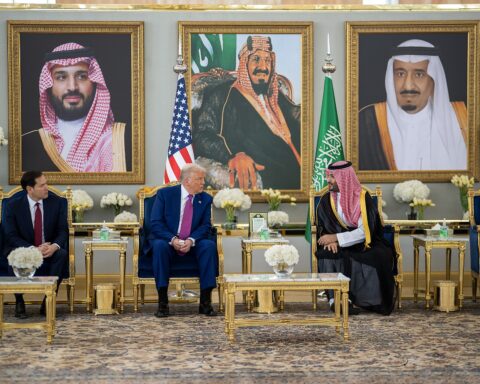
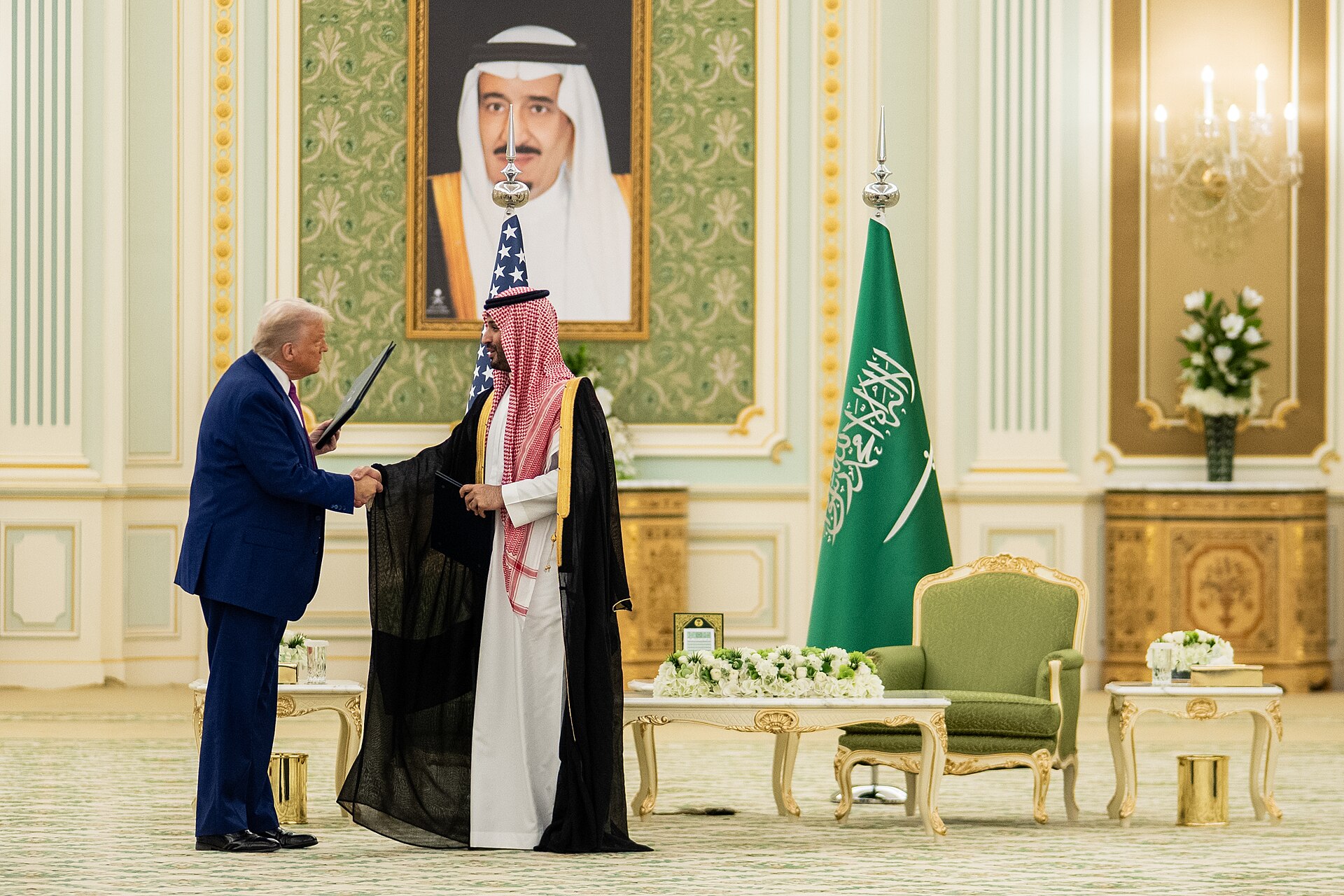
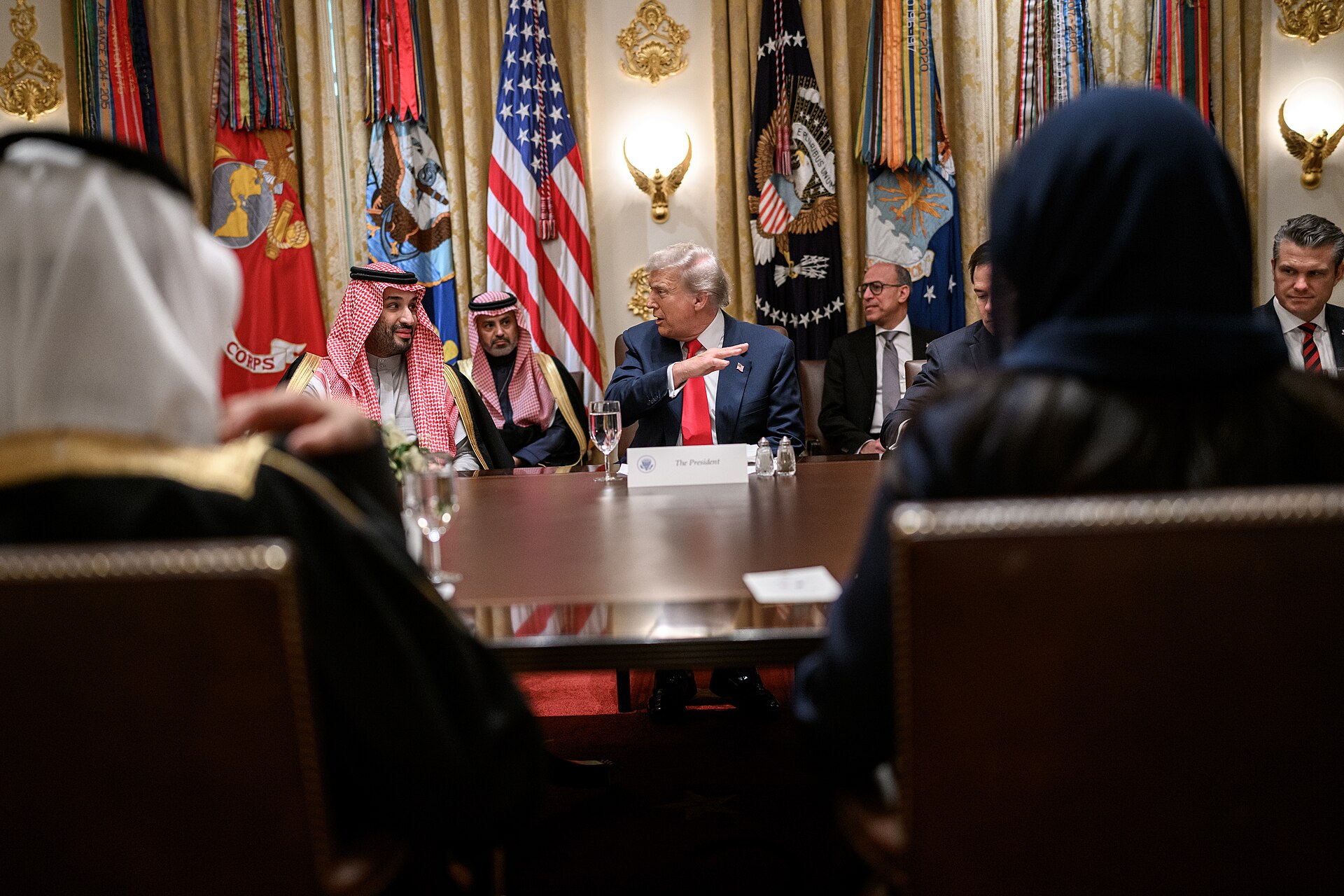
RIYADH u2014 A year ago today, in Riyadh, Donald Trump and Mohammed bin Salman signed what the White House called “the largest defense cooperation agreement in history.” The headline figure was $142 billion in arms sales. The legal obligation it created for the United States to defend Saudi Arabia was zero.
n
Four months later, Trump signed Presidential Determination No. 2026-03, formally designating Saudi Arabia as America’s 20th Major Non-NATO Ally u2014 an executive action published in the Federal Register on January 23, 2026. Within six weeks, Iranian ballistic missiles were striking Eastern Province oil infrastructure, Patriot batteries were burning through interceptors faster than they could be restocked, and the ten specific privileges conferred by MNNA status u2014 cooperative research agreements, surplus equipment access, depleted uranium ammunition purchases u2014 were doing precisely nothing to stop any of it.
n
This month, the gap became operational in both directions. Saudi Arabia suspended US military access to Prince Sultan Air Base and national airspace in early May, forcing the abandonment of Operation Project Freedom u2014 the American Hormuz escort mission launched on May 4. Reports indicated MBS was privately urging Trump to continue striking Iran while simultaneously denying the base access those operations required. The MNNA created no obligation for Washington to fight for Riyadh, and it created none for Riyadh to host Washington’s operations. After 75 days of war, both sides are acting on that reality. The independent offensive operations Riyadh conducted during that same period — striking Iranian territory under Operation Epic Fury while denying US basing for Project Freedom — are examined in Operation Epic Fury: Saudi Arabia Was Bombing Iran While Calling for Peace.
The base-access veto that preceded the $142 billion deal by nine days — including the PSAB timeline, what the two Trump-MBS phone calls resolved, and how geography made Prince Sultan irreplaceable — is analysed in detail in Prince Sultan Air Base and the Price of American Access.
n
What Does Major Non-NATO Ally Status Actually Confer?
n
The MNNA programme was born in 1987 as the Sam Nunn Amendment (10 U.S.C. Section 2350a), designed to give non-NATO partners access to cooperative defence research with the Pentagon. It has since expanded through the Foreign Assistance Act (22 U.S.C. Section 2321k) into a designation carrying ten statutory privileges: cooperative R&D with the Department of Defense, bidding rights on DoD maintenance contracts abroad, counterterrorism research participation, priority delivery of surplus military equipment, depleted uranium ammunition purchases, war reserve stockpile hosting on Saudi territory, equipment loans for testing and evaluation, reciprocal training arrangements, expedited satellite technology exports, and eligibility for Foreign Military Financing.
n
Every item on that list concerns procurement and cooperation. None involves the commitment of American troops, aircraft, or ships. The State Department’s own language is unambiguous: MNNA provides “military and economic privileges” but “does not entail any security commitments to the designated country.” The designation is a queue position, not a shield.
n
n
“[The MNNA designation is] a favourite tool of US presidents to cap off major visits with a symbolic flourish to indicate elevated relations. [It] does not provide any special or enforceable security guarantees, nor is it a binding treaty.”
n
u2014 Tressa Guenov, former Deputy Assistant Secretary of Defense, Atlantic Council (November 2025)n
n
n
Guenov also observed that Saudi Arabia “already enjoyed many of the designation’s practical benefits before the determination was signed.” The kingdom is the world’s largest Foreign Military Sales cash customer, with over $129 billion in active government-to-government cases. Unlike Egypt u2014 which has collected roughly $1.3 billion per year in direct American military financing since its own 1987 MNNA designation u2014 Saudi Arabia pays full price for its weapons, every time. The MNNA changes where Riyadh sits in the procurement queue. What it does not change is whether anyone arrives when the missiles start landing.
n
Eighty-One Years and No Treaty
n
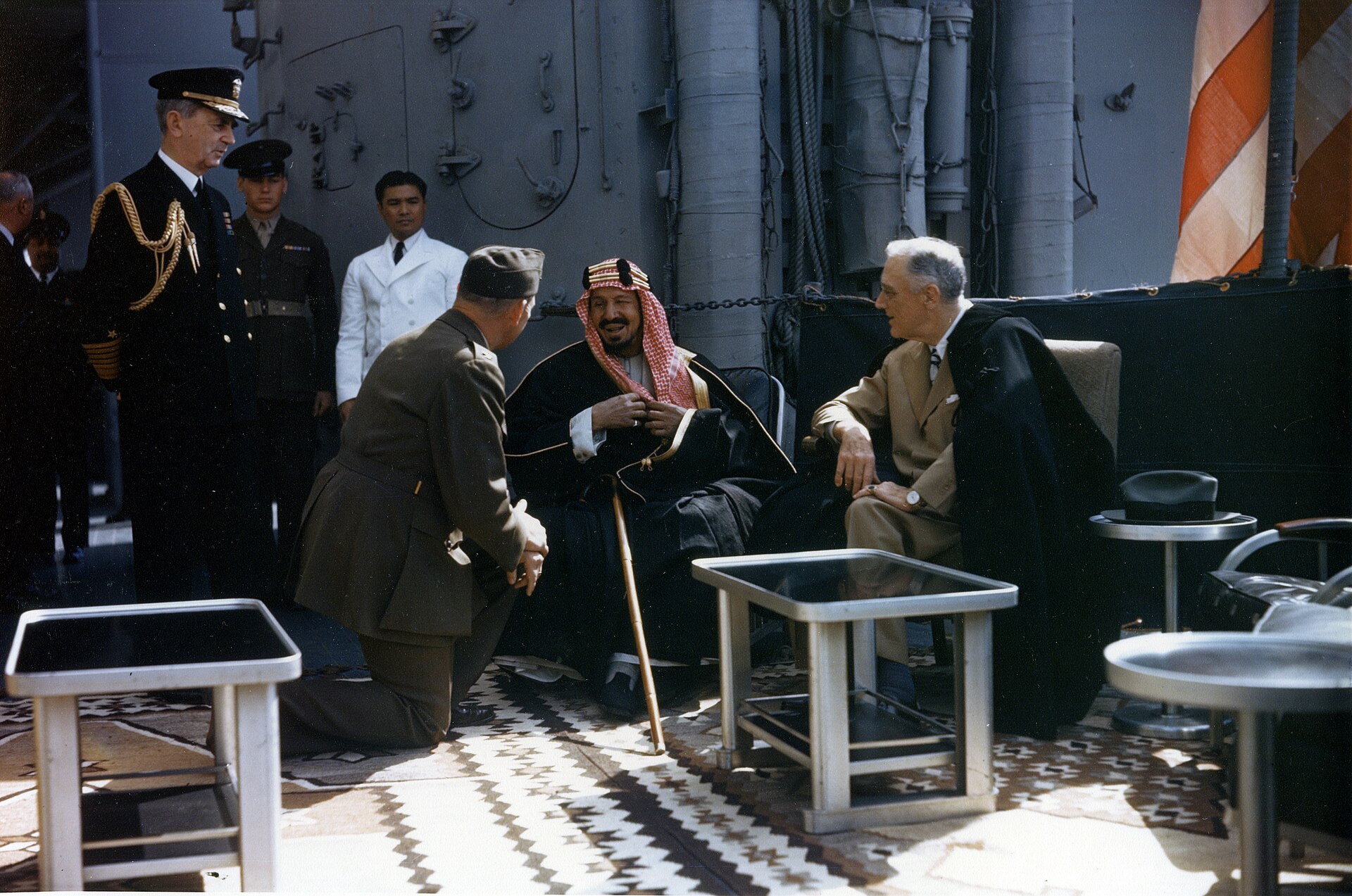
On February 14, 1945, aboard the USS Quincy in Egypt’s Great Bitter Lake, Franklin Roosevelt met King Abdul Aziz Ibn Saud u2014 the first encounter between an American president and a Saudi king. What they established was an understanding, not a treaty: American security attention in exchange for access to the largest proven oil reserves on earth. Eighty-one years later, no American president has submitted a mutual defence treaty with Saudi Arabia to the Senate for ratification. The relationship has survived the 1973 oil embargo, the Iraqi invasion of Kuwait, September 11, and the 2019 Abqaiq strike without once being codified into a binding alliance.
n
The institutional record is a study in deliberate ambiguity. The 1951 Dhahran Airfield Agreement gave the US base access and established the Military Training Mission but contained no defence commitment. The classified 1974 arrangement between Treasury Secretary William Simon and the Saudi government routed petrodollars into American Treasury securities u2014 a financial mechanism, not a military one. When Saddam Hussein crossed into Kuwait in 1990 and the US deployed half a million troops to defend the kingdom, the legal basis u2014 as the Wilson Center documented u2014 was “a one paragraph letter of just three sentences.” Not a treaty, not a formal agreement, not a ratifiable instrument of any kind.
n
n
The closest any administration came was 2023. Biden’s team drafted a defence cooperation framework tied to Saudi-Israeli normalisation and a Palestinian state pathway, with Riyadh demanding a pact modelled on the US-Japan Treaty of Mutual Cooperation and Security u2014 a Senate-ratified commitment carrying real force obligations. The effort collapsed after October 7. Trump’s return produced the November 2025 Strategic Defence Agreement, signed alongside the MNNA designation at the White House, which remained an executive-level document rather than anything requiring the Senate’s two-thirds vote. On May 12, 2026, Saudi Foreign Minister Prince Faisal bin Farhan stated that normalisation with Israel requires “the creation of a fully sovereign Palestinian state before any peace talks.” The normalisation-for-treaty pipeline that Biden’s framework depended on is functionally closed, and with it the most plausible route to a binding American defence commitment.
n
The $142 Billion Headline and the $30 Billion Reality
n
The $142 billion arms package signed a year ago spans five domains u2014 air and missile defence, F-15 upgrades, advanced munitions, armed drones, and transport aircraft u2014 and represents what the Stimson Center described as “an expression of long-term ambition.” The institute placed the figure in context: between 2017 and 2025, across Trump’s first-term $110 billion headline deal with Riyadh, the Defence Security Cooperation Agency formally notified Congress of $34.6 billion in Foreign Military Sales. Completed transactions ran to approximately $30 billion. The gap between announced figures and executed sales is a structural feature of these agreements, not an anomaly.
n
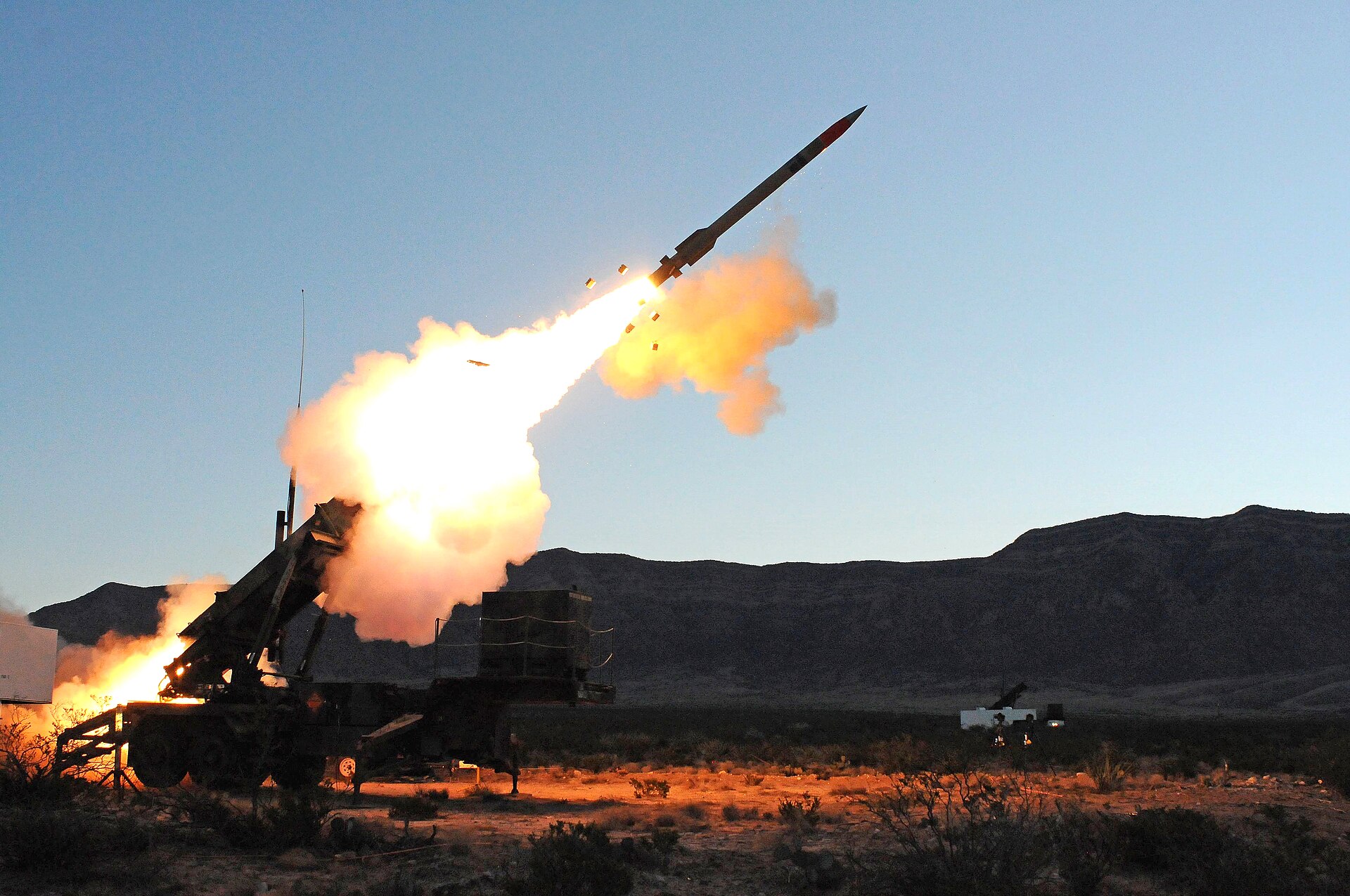
That does not mean the current deal is empty. The PAC-3 MSE component u2014 730 interceptor missiles worth $9 billion, formally approved by DSCA on January 30, 2026 u2014 is the most operationally urgent line item in the entire package. Saudi Arabia’s Patriot stocks are estimated at roughly 14 per cent of pre-war levels after 75 days of intercepting Iranian ballistic missiles. The urgency behind that drawdown rate is inseparable from the intelligence picture Riyadh holds: classified assessments show Iran retains 70 percent of its pre-war missile stockpile despite CENTCOM’s 85 percent factory-destruction figure, meaning the threat the PAC-3s are meant to intercept has not been reduced at the rate Washington’s public testimony implies. The 48 F-35A Lightning II fighters approved in March 2026 carry a price tag of $5.3 to $5.7 billion but will not reach Saudi Arabia before 2029 at the earliest. The interceptors are needed this month. The F-35s are needed this decade.
n
n
The Iran war has turned the procurement pipeline into an emergency conveyor. In Q1 2026, US global Foreign Military Sales approvals surged past $45 billion, with 81 per cent directed at the Middle East. Lockheed Martin received a $4.76 billion contract for PAC-3 MSE production in April; RTX landed $905 million for the LTAMDS next-generation radar on April 16. What was a letter of intent is becoming a wartime stockpile replenishment operation u2014 but a supply chain, however urgently it operates, is not a security guarantee, and the powers watching Riyadh’s air defence inventories deplete have drawn their own conclusions.
n
Can Pakistan Offer What Washington Won’t?
n
On September 17, 2025, at Al-Yamamah Palace in Riyadh, Saudi Arabia and Pakistan signed the Strategic Mutual Defence Agreement. The SMDA’s operative clause treats “any aggression against either country as an aggression against both” u2014 language that mirrors NATO’s Article 5 more directly than anything in the 81-year US-Saudi relationship. On the same day this editorial publishes u2014 May 13, 2026 u2014 Bloomberg reported that Pakistan is signalling Turkey and Qatar may join the pact, potentially transforming a bilateral agreement into a multilateral defence architecture that Washington has no seat in.
n
Pakistan Defence Minister Khawaja Muhammad Asif, speaking on local television on May 12, called the expansion “currently in the process of being finalised” and described potential Turkish and Qatari accession as “a welcome development.” He used the phrase “an Islamic pact similar to NATO” u2014 framing that CSIS subsequently analysed as potentially “the first step in a NATO-style alliance” independent of the American security framework. Qatar’s own parallel leverage u2014 built not on a treaty but on the $38 billion expansion of Al Udeid Air Base signed May 14 u2014 operates through a different mechanism entirely: how Doha converts basing dependency into ceasefire leverage is the subject of a separate analysis. Pakistan’s transformation from ceasefire mediator into Saudi Arabia’s treaty-bound security partner is the most underreported strategic development of the conflict, and the Bloomberg report’s timing u2014 published on the anniversary of the $142 billion deal u2014 underlines a comparison neither Washington nor Riyadh appears eager to make explicit.
n
n
The irony is structural. Pakistan has been a Major Non-NATO Ally since 2004 u2014 and its experience illustrates the designation’s fragility. The Trump administration froze all US security assistance to Islamabad in January 2018, and Congress has introduced bills to revoke Pakistan’s MNNA in 2017, 2019, 2021, and 2023 u2014 none of which passed, but all of which made the point. The country offering Saudi Arabia the Article 5-equivalent treaty that Washington has withheld for eight decades cannot reliably access its own American security benefits. What makes Pakistan credible to Riyadh is not its MNNA card. It is its nuclear arsenal, its 650,000-strong military, and its willingness to put mutual-defence language into a signed document u2014 three things the American MNNA framework does not offer and, in the case of the first two, cannot replicate.
n
The Nuclear Door Left Open
n
The Section 123 nuclear cooperation framework, announced during MBS’s November 2025 White House visit, may prove more consequential than the arms deal itself u2014 and has received a fraction of the scrutiny. The proposed agreement does not impose what arms control specialists call the “Gold Standard.” When the United States and the United Arab Emirates signed their 123 agreement in 2009, Abu Dhabi committed to forgo uranium enrichment and reprocessing entirely and to adopt the IAEA Additional Protocol. The draft US-Saudi agreement carries no equivalent restriction. The Arms Control Association reported in March 2026 that the framework “does not expressly forbid uranium enrichment” and, once bilateral IAEA safeguards are in place, “will open the door for Saudi Arabia to acquire uranium enrichment technology or capabilities u2014 possibly even from the United States.”
n
n
“We want to go for the full cycle, from producing uranium, to enriching the uranium, to using the uranium.”
n
u2014 Saudi Energy Minister Prince Abd al Aziz bin Salman Al Saud (2019, repeated 2023)n
n
n
That demand predates the Iran war by years. The Stimson Center’s Nour Eid argued in a 2026 analysis that Saudi Arabia’s nuclear trajectory “will not depend on Iran or the war’s outcome,” characterising the enrichment ambition as structural u2014 rooted in Vision 2030 and the kingdom’s broader technological sovereignty programme u2014 rather than as a reactive hedge against Tehran. Once the agreement is delivered to Congress, it triggers a mandatory 90-day review period. Representative Brad Sherman has already reintroduced the “No Nuclear Weapons for Saudi Arabia Act,” demanding Additional Protocol ratification and a permanent enrichment renunciation. The Senate Foreign Relations Committee leadership has stated independently that any deal must meet the Gold Standard. The political fight is active and the outcome uncertain.
n
The nonproliferation asymmetry, however, is already producing consequences in Tehran. The United States is demanding Iran halt all enrichment while building a framework that permits Saudi enrichment u2014 a contradiction that materially strengthens the “double standard” narrative Iranian hardliners have pressed for years. Ebrahim Rezaei, spokesman of Iran’s parliamentary National Security and Foreign Policy Committee, questioned in May the value of Iran remaining in the Nuclear Non-Proliferation Treaty and stressed the need to preserve Iran’s nuclear “achievements.” The 123 agreement was designed to draw Saudi Arabia deeper into Washington’s strategic orbit. Its enrichment provisions risk handing Tehran its strongest nonproliferation argument in a generation. The structural mechanics of that asymmetry u2014 how the 123 agreementu2019s omissions operate in parallel with the Muscat ceasefire demands u2014 are analysed in the Saudi 123 nuclear agreement and Washingtonu2019s two-tier nuclear framework.
n
Does Saudi Arabia Have the Money for This Deal?
n
Saudi Arabia’s Q1 2026 budget deficit hit 125.7 billion riyals u2014 $33.5 billion u2014 the largest quarterly shortfall on record and more than double the same period a year earlier. That single quarter consumed 76 per cent of the full-year deficit projection, a projection drafted before Iranian missiles began hitting Eastern Province oil infrastructure in late February. Oil revenues fell 3 per cent year-on-year even as military spending surged 26 per cent. Public debt rose by 150 billion riyals in three months, reaching 1.67 trillion riyals. The government’s approved borrowing plan for 2026 calls for $58 billion in financing u2014 bonds, sukuk, loans, and export credit facilities u2014 to cover the projected deficit and debt service.
n
The production damage is driving the numbers. Saudi crude output fell from 10.4 million barrels per day in February to 7.25 million in March u2014 a 30 per cent drop u2014 with the Khurais field alone losing 300,000 barrels per day and no repair timeline announced. Asia-bound exports declined 38.6 per cent. Goldman Sachs estimates the war-adjusted deficit at 6.6 per cent of GDP, double the official 3.3 per cent figure. The $142 billion arms deal requires sustained annual outlays over many years against a revenue base that is contracting and a cost base u2014 between war expenditures, Vision 2030 commitments, and rising debt service u2014 expanding simultaneously.
n
The Stimson Center noted that the $142 billion headline figure represents 176 per cent of Saudi Arabia’s entire 2024 defence budget. Even in peacetime, execution rates ran at roughly a quarter of announced totals. In wartime, the operationally urgent components u2014 the 730 PAC-3 MSE interceptors above all u2014 will be prioritised by necessity, while longer-dated items like the F-35 fleet and SeaGuardian drones compete for funding against an increasingly strained treasury. The headline was always aspirational. The war has made even a fraction of it a fiscal challenge, and the tension between immediate defence needs and long-term programme affordability is one that no procurement designation can resolve.
n
The Shanghai Office and the Lane Washington Left Open
n
Six days before the first anniversary of the Riyadh summit, Saudi Arabia’s Public Investment Fund opened a new office in Shanghai u2014 its second on the Chinese mainland, reporting to the existing Beijing operation led by Lily Cong. The fund described the office’s purpose as expanding “the ability to execute deals inside China while attracting Chinese companies and capital into Saudi Arabia.” PIF Governor Yasir Al Rumayyan affirmed the fund’s “continued commitment to international investment despite associated geopolitical and economic pressures.” Translated from sovereign-wealth language into plain English: the Iran war has not slowed the PIF’s eastward expansion, and the MNNA designation has not redirected it.
n
The timing carried its own message. Saudi Arabia has maintained BRICS observer status throughout the conflict, pursued yuan-settled oil transactions with Chinese buyers, and built PIF partnerships with Chinese financial institutions worth more than $50 billion. The Shanghai Gold Exchange International offers a yuan-to-gold conversion pathway available to sovereign participants. None of this activity violates the MNNA framework, because the MNNA governs defence procurement u2014 not trade, not sovereign investment, not currency settlement. The designation secures a position in Lockheed Martin’s order book. It imposes no constraints on what the PIF does with Chinese venture capital or how Riyadh responds to Moscow’s studied silence on the war u2014 Russia’s refusal to condemn Iranian strikes while maintaining its OPEC+ partnership with the kingdom operates in the same unregulated lane.
n
Beijing’s response to the MNNA designation was instructive: no diplomatic protest, no public objection, no counter-measure. China cannot sell Saudi Arabia PAC-3 missiles and does not try. What it offers u2014 infrastructure partnerships, AI capacity, semiconductor co-development, an alternative financial architecture u2014 sits in categories the MNNA does not touch. Riyadh’s hedging is a rational response to a security framework that delivers interceptor missiles for the Hajj cordon but declines to attach the treaty commitment those interceptors were designed to compensate for.
n
How Does Tehran Read the MNNA Gap?
n
On September 16, 2019 u2014 two days after Iranian drones and cruise missiles knocked 5.7 million barrels per day of Saudi oil production offline at Abqaiq and Khurais, the largest supply disruption in modern oil history u2014 Donald Trump was asked whether the attack constituted an assault on the United States. His answer drew a line that Iran’s military planners have been operating on ever since.
n
n
“That was an attack on Saudi Arabia, and that wasn’t an attack on us. But we would certainly help them.”
n
u2014 President Donald Trump, September 16, 2019n
n
n
The “help” was hardware: 3,000 additional troops, one THAAD battery, two Patriot batteries, two fighter squadrons. No American retaliatory strike against Iran was launched. The Carter Doctrine u2014 Jimmy Carter’s 1980 declaration that any attempt by an outside force to gain control of the Persian Gulf “will be regarded as an assault on the vital interests of the United States of America, and such an assault will be repelled by any means necessary, including military force” u2014 went uninvoked. Five per cent of global oil supply was taken offline by a direct Iranian-attributed attack on Saudi territory, and the American response was to ship more equipment and present Riyadh with the bill.
n
Iran’s hardliners absorbed that data point and have been operating on its implications since February 28. The IRGC’s wartime conduct u2014 from the declaration of “full authority” over the Strait of Hormuz to the reversal of Foreign Minister Araghchi’s “completely open” assurance within hours to the double blockade that has reduced Hormuz transits to 3.6 per cent of pre-war baseline u2014 proceeds from a consistent operational assessment: Washington will supply weapons to Riyadh but will not enter direct combat with Tehran to defend Saudi territory. Iran International reported on May 11, 2026, that hardliners are pushing further escalation precisely because they read the ceasefire’s collapse as evidence of American overextension. Iran’s declared HEU stockpile sits at 440.9 kilograms enriched to 60 per cent u2014 roughly 25 days from weapons-grade by IAEA estimates u2014 and inspectors have been locked out of Iranian nuclear facilities since the war began.
n
The MNNA designation has not altered this reading. Iran’s military leadership has spent seven years u2014 from the unanswered Abqaiq strike through 75 days of the current war u2014 watching American hardware arrive in Saudi Arabia while American forces refrain from retaliatory action against Iran. For the IRGC’s operational planners, the gap between a procurement relationship and a defence treaty is not a legal abstraction. It is the operational space inside which they have been conducting this war, and nothing signed in Washington on January 13 has narrowed it. What the Reuters disclosure has now added to that calculus is a second layer: how the IHL classification changes Saudi Arabia’s strategic position by making its economic infrastructure legally targetable under the laws of armed conflict.
n
Frequently Asked Questions
n
Is MNNA status permanent?
n
No. The president can revoke MNNA designation unilaterally with 30 days’ written notice to Congress u2014 the same mechanism used for granting it. This has happened once: Afghanistan’s MNNA status, granted by President Obama in July 2012, was formally terminated by President Biden via Presidential Determination on September 23, 2022, following the Taliban takeover. Congress has also repeatedly introduced legislation to revoke Pakistan’s MNNA u2014 bills were filed in 2017 by Representatives Ted Poe and Rick Nolan (H.R. 3000), and again in 2019, 2021, and 2023 by Representative Andy Biggs (H.R. 80). None passed, but they demonstrate that legislative challenges to MNNA status are a recurring feature of the programme. Saudi Arabia’s designation is a presidential executive act, not a ratified treaty, and carries no structural protection against reversal by a future administration.
n
Does Israel have MNNA status?
n
Technically, yes u2014 Israel was one of the six countries listed in the original 1987 legislation. In practice, Israel operates under a separate and far more powerful framework: the Qualitative Military Edge guarantee, codified in US law through multiple statutes including the 2008 Naval Vessel Transfer Act, which requires that all American arms sales in the Middle East be evaluated against their potential impact on Israel’s military superiority. Israel also receives $3.3 billion per year in Foreign Military Financing under a ten-year memorandum of understanding signed in 2016, rising to $3.8 billion u2014 making it the largest recipient of direct US military aid globally. The MNNA designation is functionally irrelevant for Israel; the QME framework and direct financing commitments exceed anything the MNNA programme provides, which is partly why the $142 billion Saudi deal drew immediate concern from Israeli defence officials about erosion of that edge.
n
How does Saudi Arabia’s MNNA compare to the UAE’s security relationship with the United States?
n
The comparison reveals a notable asymmetry. The UAE signed its Section 123 nuclear cooperation agreement with Washington in 2009 under the “Gold Standard” u2014 committing to forgo all uranium enrichment and reprocessing entirely and to adopt the IAEA Additional Protocol. This remains the most restrictive nuclear framework any US partner has accepted. However, the UAE has never been designated a Major Non-NATO Ally. Saudi Arabia now holds MNNA status alongside a nuclear cooperation framework that, according to the Arms Control Association, does not forbid enrichment. In effect, the UAE accepted tighter nuclear constraints without receiving MNNA procurement benefits, while Saudi Arabia received both the procurement designation and a more permissive nuclear pathway. Neither country possesses a mutual defence treaty with the United States, and the Washington Institute for Near East Policy has noted that both sides have “agreed that the 80-year ‘oil-for-security’ formula has had its time” while the replacement architecture remains incomplete.
n
What would a formal US-Saudi mutual defence treaty require?
n
A mutual defence treaty is an Article II instrument under the US Constitution, requiring a two-thirds vote of the Senate u2014 67 senators u2014 for ratification. The Biden administration explored this route in 2023 and 2024, drafting a framework that would have linked a defence commitment to Saudi-Israeli normalisation and a pathway to Palestinian statehood. Semafor reported in September 2024 that senators from both parties expressed openness to a treaty vote, suggesting the political obstacle was not the Senate itself but the conditions attached. The effort collapsed after October 7, 2023, severed the normalisation pathway that served as the treaty’s political vehicle. Under current conditions u2014 with Saudi Arabia conditioning normalisation on full Palestinian statehood and the Quincy Institute describing Riyadh’s guarantee demand as driven by “deep-seated fear of American abandonment” u2014 assembling 67 Senate votes for a standalone Saudi defence treaty carries no visible political path to completion.
n
The diplomatic context for MBS’s latest strategic play — using the first US-Syria presidential meeting in 25 years as a platform to consolidate broker capital ahead of Iran negotiations — is examined in MBS Brokered the First US-Syria Meeting in 25 Years. The Prize Was Never Syria.
The PAC-3 depletion facing Hajj 2026 is the concrete expression of the interceptor gap this piece traced through the DSCA sales queue: Saudi Arabia’s Hajj air defence gap maps the 80â150 rounds remaining in the Hejaz allocation and why the Camden production ceiling forecloses replenishment before May 26.
n
The PAC-3 depletion facing Hajj 2026 is the concrete expression of the interceptor gap this piece traced through the DSCA sales queue: Saudi Arabia’s Hajj air defence gap maps the 80u201350 rounds remaining in the Hejaz allocation and why the Camden production ceiling forecloses replenishment before May 26.
The PAC-3 resupply timeline has now become the binding constraint on Saudi Arabia’s second-round capacity. Trump returns threatening Iran — Saudi Arabia has no margin for a second round maps how the Camden production ceiling, Yanbu loading capacity, and production losses combine to limit Riyadh’s options as Trump signals renewed strikes.