
JEDDAH — When Pakistan’s Prime Minister Shehbaz Sharif landed in Saudi Arabia on March 12 for an emergency meeting with Crown Prince Mohammed bin Salman, the official readout spoke of “full solidarity and support.” Diplomats in Riyadh and Islamabad understood those four words differently than the foreign press corps. Sharif was not simply offering moral backing to an ally under Iranian bombardment. He was affirming — without saying it aloud — that Pakistan’s nuclear arsenal, 170 warheads strong and growing, stands behind the Kingdom’s defence.
The visit, unannounced and lasting only hours, carried more strategic weight than any press release could contain. Pakistan has already deployed air defence systems and troops to Saudi Arabia, activated its obligations under the September 2025 Strategic Mutual Defence Agreement, and delivered a direct warning to Tehran citing that very pact. None of these steps have settled the question that haunts every war room in the Persian Gulf: would Pakistan use nuclear weapons to defend Saudi Arabia? The answer, deliberately kept ambiguous, may be the most consequential variable in the Iran war.
Table of Contents
- What Did Pakistan’s Prime Minister Promise Saudi Arabia?
- The Defence Pact Nobody Read Closely Enough
- How Many Nuclear Warheads Does Pakistan Have?
- From Bhutto to Bin Salman — Five Decades of Nuclear Debt
- What Has Pakistan Actually Deployed to Saudi Arabia?
- The Warning Islamabad Fired at Tehran
- Does Pakistan’s Nuclear Arsenal Deter Iran?
- Why the Skeptics Underestimate Nuclear Ambiguity
- India’s Nightmare Scenario
- Can Saudi Arabia Trust a Deterrent Built for Another War?
- The Precedent That Terrifies the Nonproliferation Establishment
- Frequently Asked Questions
What Did Pakistan’s Prime Minister Promise Saudi Arabia?
Prime Minister Shehbaz Sharif pledged Pakistan’s “full solidarity and support for the Kingdom of Saudi Arabia in these challenging times,” according to a statement released by his office on March 13, 2026. The phrase is diplomatic boilerplate. The context is not. Sharif arrived in Jeddah accompanied by Deputy Prime Minister and Foreign Minister Ishaq Dar — the same official who days earlier had telephoned his Iranian counterpart to deliver a pointed warning that Pakistan’s defence agreement with Saudi Arabia was not a document Islamabad intended to file and forget.
The emergency visit followed two weeks of escalating Iranian drone and missile attacks against Saudi territory. Iranian Shahed kamikaze drones have targeted the Eastern Province, the Shaybah oil field deep in the Empty Quarter, and — in a breach that shook Riyadh’s security establishment — the Diplomatic Quarter of the capital itself. Two Saudi civilians were killed in al-Kharj when a projectile struck a residential building on March 8. Saudi Arabia, which has refused to launch offensive strikes against Iran, has relied on defensive interception to weather the onslaught. The toll on its missile stockpile has been severe. A strategic assessment of the war at the fourteen-day mark shows Iran fired more than 3,133 missiles and drones at Gulf states in that period, with intercept rates exceeding 92 percent across the coalition.
Sharif’s visit was the third high-level Pakistan-Saudi defence consultation in five days. Each meeting has produced stronger language. Each statement has added a layer of commitment that Pakistan will find difficult to walk back. The question is whether words translate to warheads — and whether Iran believes they do.

The Defence Pact Nobody Read Closely Enough
The Strategic Mutual Defence Agreement, signed on September 17, 2025, in Riyadh by Crown Prince Mohammed bin Salman and Prime Minister Shehbaz Sharif, is the most consequential security treaty in the Middle East since the Camp David Accords. Its central clause states that any act of aggression against one signatory shall be considered an act of aggression against both. The language mirrors Article 5 of the NATO treaty, which has been invoked exactly once in seventy-five years — after September 11, 2001.
The Middle East briefing 3,000+ readers start their day with.
One email. Every weekday morning. Free.
The agreement was born not from the Iran war, which began five months later, but from the September 9, 2025, Israeli airstrikes in Doha, Qatar. Those strikes, which killed three Hamas political figures on sovereign Qatari territory, deeply unsettled Gulf states’ sense of security, according to the Financial Times. Within eight days, Riyadh and Islamabad had formalised a defence relationship that had existed in shadow form for decades.
The treaty text does not mention nuclear weapons. It does not need to. Pakistan is a nuclear-armed state. Any military commitment that encompasses “all military means” — the phrase a senior Saudi official used when describing the agreement to Reuters — implicitly includes the nuclear dimension. This is precisely what makes the agreement simultaneously more powerful and more dangerous than anything in the Middle East security architecture.
The CSIS analysis published in September 2025 asked whether the agreement could become “the first step toward a NATO-style alliance.” The Chatham House assessment was more direct: the pact “sets a precedent for extended deterrence” in the Middle East. The RAND Corporation, characteristically blunt, titled its analysis “Important to Whom?” — questioning whether anyone other than the signatories took the agreement seriously.
The Iran war has answered RAND’s question. It is important to everyone.
How Many Nuclear Warheads Does Pakistan Have?
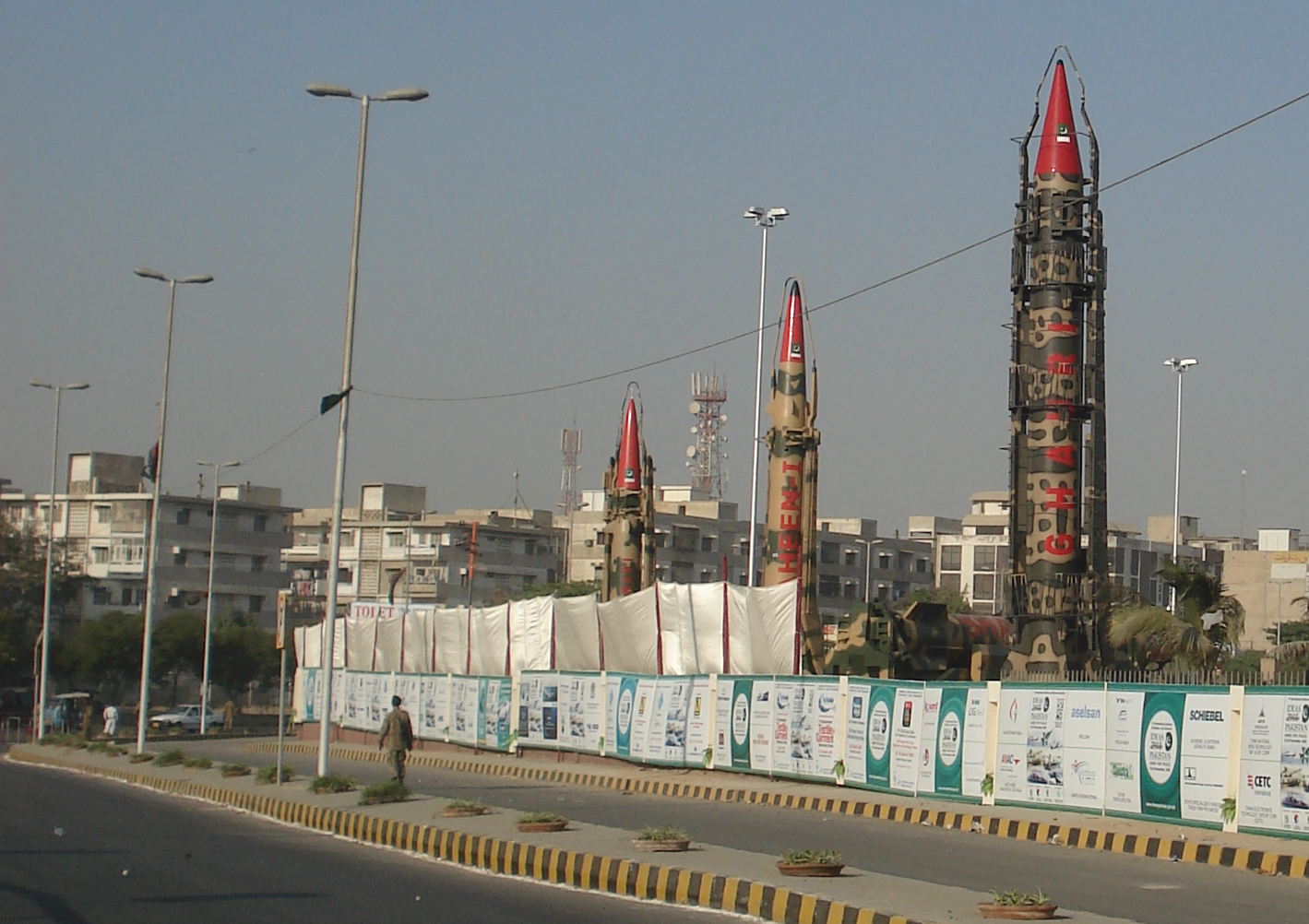
Pakistan possesses approximately 170 assembled nuclear warheads as of 2026, according to the Bulletin of the Atomic Scientists and the Federation of American Scientists. At current production rates, that arsenal will grow to between 200 and 225 warheads by 2030, overtaking the United Kingdom and approaching French totals. Pakistan is the world’s fastest-growing nuclear arsenal.
The warheads are split between highly enriched uranium (HEU) primaries and an expanding plutonium line driven by four heavy-water reactors at the Khushab complex in Punjab. The newest reactor blocks, completed in late 2024, lift potential output to approximately 40 to 45 kilograms of weapons-grade plutonium per year — enough raw material for eight to twelve additional compact warheads annually, according to the International Panel on Fissile Materials.
| System | Type | Range (km) | Status | Nuclear Role |
|---|---|---|---|---|
| Shaheen-III | MRBM | 2,750 | Operational | Strategic — can reach Israel, Middle East, North Africa |
| Shaheen-II | MRBM | 1,500 | Operational | Strategic — all of India, parts of Gulf |
| Shaheen-1A | SRBM | 900 | Operational | Tactical/Strategic |
| Ghauri | MRBM | 1,300 | Operational | Strategic — liquid-fuelled |
| Babur-2 | GLCM | 700 | Development | Cruise missile — terrain-hugging |
| Babur-3 | SLCM | 450 | Testing | Sea-based second strike |
| Nasr | Tactical | 70 | Operational | Battlefield nuclear — low yield |
| Ra’ad-II | ALCM | 600 | Operational | Air-launched from Mirage III/V, JF-17 |
The Shaheen-III, first tested in March 2015 and now operational, is the system that matters most to this discussion. Its 2,750-kilometre range places all of Iran, Israel, and the eastern Mediterranean within reach from launch sites in Balochistan or Sindh. A Shaheen-III fired from Panjgur, near the Iranian border, would reach Tehran in under nine minutes. This is not a theoretical capability. It is a deployed one.
Pakistan’s warheads are believed to be stored in a disassembled state during peacetime, with warhead cores separated from delivery vehicles and kept at different facilities under the control of the Strategic Plans Division. Assembly and mating would require hours, not minutes — a deliberate design choice that reduces the risk of accidental or unauthorised launch but also limits the speed of nuclear response.
From Bhutto to Bin Salman — Five Decades of Nuclear Debt
The Pakistan-Saudi nuclear relationship did not begin with the September 2025 defence pact. It began in 1974, when Indian Prime Minister Indira Gandhi authorised the detonation of a nuclear device — codenamed “Smiling Buddha” — beneath the Rajasthan desert. Within months, Pakistani Prime Minister Zulfikar Ali Bhutto launched what he called the “Islamic bomb” programme. Saudi Arabia was among the first nations to provide financial backing.
The funding arrangement was never formally acknowledged by either government, but its existence has been confirmed by multiple intelligence assessments and academic studies. The Washington Institute for Near East Policy documented that “Saudi Arabia helped fund Pakistan’s nuclear programme since the early 1970s,” with the understanding that Pakistani missiles would give the Kingdom a “nuclear umbrella” against regional threats. Throughout the 1970s, approximately 15,000 Pakistani troops were stationed in Saudi Arabia, providing security for Mecca and Medina and serving as a visible symbol of the bilateral relationship.
The partnership deepened under General Zia-ul-Haq, who seized power in a 1977 coup. Zia reportedly told Saudi dignitaries that “our achievements are yours” — a phrase widely interpreted as confirming that Pakistan’s nuclear programme served shared strategic interests. Saudi financial support continued through the 1980s Afghan jihad, during which Riyadh and Islamabad jointly funded the mujahideen fighting Soviet forces. The CIA estimated that Saudi Arabia matched American funding dollar for dollar, channelling billions through Pakistan’s Inter-Services Intelligence directorate.
Pakistan conducted its first acknowledged nuclear weapons tests in May 1998, detonating five devices beneath the Chagai Hills in Balochistan. The tests triggered international sanctions that devastated Pakistan’s economy. Saudi Arabia quietly increased oil shipments to Islamabad on deferred payment terms, helping cushion the economic blow. The gesture was not charity. It was investment protection.
The relationship survived the A.Q. Khan proliferation scandal of 2004, which revealed that Pakistan’s top nuclear scientist had sold centrifuge designs and nuclear technology to Libya, Iran, and North Korea. The scandal should have destroyed the Pakistan-Saudi nuclear understanding. Instead, it reinforced it. Khan’s network had given Iran the very technology that now threatens Saudi Arabia. Riyadh’s calculation was simple: the state that helped create Iran’s nuclear problem was also the only state positioned to provide a nuclear solution.
The 2015 Yemen crisis tested the relationship in a different way. When Saudi Arabia launched Operation Decisive Storm against Houthi rebels backed by Iran, Riyadh expected Pakistan to contribute ground troops. Pakistan’s parliament voted against participation, humiliating both governments. The refusal created a rift that took years to repair. Crown Prince Mohammed bin Salman reportedly concluded that Saudi Arabia needed a formal, binding defence commitment from Pakistan — not the informal understandings that had governed the relationship for decades. The Strategic Mutual Defence Agreement was, in part, MBS’s insurance against another parliamentary betrayal.
For five decades, the House of Saud maintained a tacit understanding: Pakistan’s bomb was partly Saudi Arabia’s bomb. The September 2025 defence agreement, and the Iran war that followed, have brought that understanding from the shadows into the light of strategic reality.
What Has Pakistan Actually Deployed to Saudi Arabia?
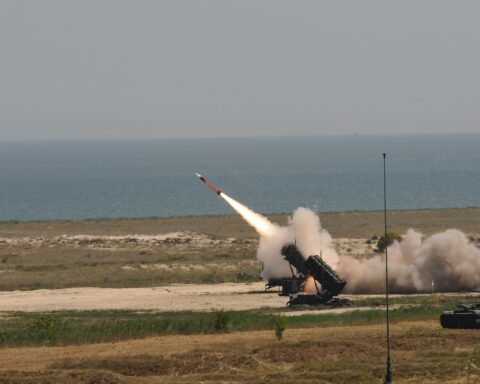
Pakistan’s conventional military deployment to Saudi Arabia represents the most significant projection of Pakistani military power outside South Asia since the 1991 Gulf War. According to reporting from the Times of Islamabad and confirmed by Pakistani defence sources, Pakistan has positioned LY-80 medium-range, FM-90 short-range, and Anza-series man-portable air defence systems under Pakistani command to support Saudi Arabia’s air defence grid.
The LY-80 — known internationally as the HQ-16 — is a Chinese-origin medium-range surface-to-air missile system with a maximum engagement range of 40 kilometres and an altitude ceiling of 18 kilometres. Pakistan operates the system as the LY-80E and has integrated it into its own air defence network. The FM-90, a short-range point-defence system, provides layered protection against low-flying targets including cruise missiles and drones — precisely the threat profile of Iran’s Shahed attacks.
| System | Origin | Type | Range (km) | Primary Threat |
|---|---|---|---|---|
| LY-80E (HQ-16) | China/Pakistan | Medium-range SAM | 40 | Aircraft, cruise missiles |
| FM-90 | China/Pakistan | Short-range SAM | 10 | Low-flying targets, drones |
| Anza Mk-III | Pakistan | MANPADS | 5 | Helicopters, UAVs, low-altitude threats |
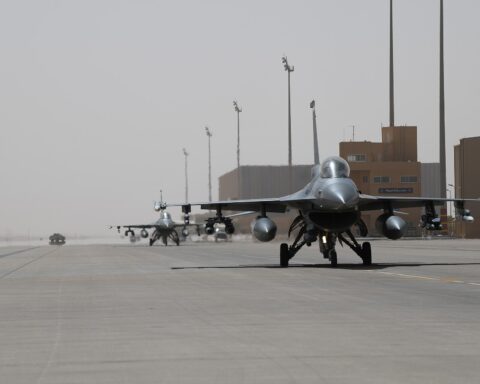
Beyond air defence, Pakistan deployed F-16 Block-52 multirole fighters to Saudi Arabia for the Spears of Victory 2026 multinational exercise, which began in January. When the Iran war erupted on February 28, those aircraft and their crews were already in-country. Their status transitioned from exercise participants to operational defenders without a public announcement.
A senior Saudi diplomat claimed that Pakistan would be prepared to deploy up to 100,000 troops if requested by Crown Prince Mohammed bin Salman, according to reporting by the Jerusalem Post. Pakistani military officials have neither confirmed nor denied that figure. What is confirmed is that Pakistan Air Defence Corps units are operating within Saudi Arabia’s integrated air defence network, marking the first time a South Asian military has been embedded within a Gulf state’s active combat defence architecture. The interceptor stockpile challenge is shared across the coalition: Jordan has burned through an estimated 108 AMRAAM missiles in two weeks defending against the same Iranian drone swarms.

The Warning Islamabad Fired at Tehran
The most revealing moment of Pakistan’s involvement in the Iran war came not from a military deployment but from a telephone call. In early March, Pakistani Foreign Minister Ishaq Dar spoke with his Iranian counterpart and delivered a message that carried more weight than any UN resolution. “I made them understand that we have a defence agreement,” Dar told reporters afterward, according to India TV News.
The statement was extraordinary for what it implied. Pakistan was not merely expressing concern about regional stability or calling for restraint — the standard diplomatic vocabulary of nations trying to avoid commitment. Dar was explicitly linking Pakistan’s mutual defence obligation to the Iranian attacks on Saudi Arabia. The message to Tehran was unmistakable: continue striking Saudi territory, and you are testing the limits of a nuclear-armed state’s treaty commitment.
Iran’s response, or lack of one, is itself instructive. Tehran has not publicly acknowledged Pakistan’s warning. Iranian state media has avoided direct confrontation with Islamabad. The IRGC’s rhetoric, which has promised to “burn every oil facility in the Gulf” and declared that “not a litre of oil” will pass through the Strait of Hormuz, has conspicuously avoided mentioning Pakistan by name. In the grammar of Iranian strategic communication, the omission is significant. Iran picks fights with adversaries it believes it can intimidate. It has not picked a fight with Pakistan.
Whether this restraint reflects genuine deterrence or merely prioritisation is impossible to determine from the outside. Iran is fighting a war against the United States and Israel while managing proxy networks across Lebanon, Iraq, Yemen, and Syria. It may simply lack the bandwidth to open another front with Pakistan. But the ambiguity serves Islamabad’s purposes. A deterrent that might work is almost as useful as a deterrent that definitely works.
Does Pakistan’s Nuclear Arsenal Deter Iran?
Nuclear deterrence theory rests on a straightforward proposition: the threat of unacceptable retaliation prevents aggression. For that threat to function, it must satisfy five conditions. These conditions, drawn from seven decades of deterrence literature and adapted to the Pakistan-Saudi context, form what strategists call the credibility chain of extended deterrence.
| Dimension | Requirement | Pakistan-Saudi Status | Assessment |
|---|---|---|---|
| Capability | Possessor has sufficient nuclear forces to inflict unacceptable damage | 170 warheads; Shaheen-III reaches Tehran in 9 minutes | Strong |
| Communication | The commitment has been signalled to the adversary | Dar’s direct warning to Iran; SMDA signed publicly; Defence Minister hinted at nuclear scope | Moderate-Strong |
| Entanglement | Conventional forces are deployed such that escalation becomes plausible | Pakistani troops and air defence in Saudi Arabia; integrated into Saudi defence grid | Moderate |
| Credibility | The adversary believes the possessor would follow through | Pakistan has never fought for an ally; nuclear doctrine focused on India; no precedent | Weak-Moderate |
| Stakes | The possessor has vital interests at stake in the ally’s survival | $30B+ Saudi investment in Pakistan; 2.5M Pakistani workers in Gulf; Mecca and Medina | Moderate-Strong |
The assessment reveals a deterrent that is credible in some dimensions and fragile in others. Pakistan has the weapons and delivery systems. It has communicated the commitment, albeit through diplomatic ambiguity rather than explicit nuclear threats. It has placed conventional forces in harm’s way, creating the entanglement that deterrence theorists argue is essential for escalation dynamics. But it has never demonstrated the willingness to use nuclear weapons on behalf of another state. And its nuclear doctrine, command structure, and force posture are designed for one scenario: war with India.
The Belfer Center at Harvard published an analysis in October 2025 titled “Beyond the Hype: Pakistan-Saudi Defense Pact Is Not a Saudi Nuclear Umbrella.” The paper argued that Pakistan “lacks the capability and credibility to extend meaningful nuclear deterrence” because it does not share borders with Saudi Arabia, lacks permanent integrated command structures, and has no equivalent to NATO’s Nuclear Planning Group. The Middle East Institute concurred, calling the agreement’s nuclear dimension “modest reality.”
These assessments were published before the Iran war. The war has altered every variable in the equation.
Why the Skeptics Underestimate Nuclear Ambiguity
The conventional wisdom among Western nonproliferation experts holds that Pakistan’s nuclear umbrella over Saudi Arabia is a fiction — a political gesture dressed in military language, incapable of deterring any serious adversary. This assessment, while intellectually rigorous, misunderstands how deterrence operates in practice.
Deterrence does not require certainty. It requires doubt. Iran does not need to believe that Pakistan will definitely launch a nuclear strike to defend Riyadh. It needs to believe that Pakistan might. The distinction matters enormously. NATO’s extended deterrence over Western Europe during the Cold War was never entirely credible — would the United States really trade New York for Hamburg? — but the possibility was sufficient to prevent Soviet conventional aggression for four decades.
The sceptics commit three analytical errors. First, they evaluate Pakistan’s nuclear umbrella against the standard of NATO’s nuclear sharing arrangements, which include forward-deployed weapons, dual-key launch procedures, and a sixty-year institutional architecture. This is the wrong benchmark. Pakistan is not offering Saudi Arabia a NATO-grade nuclear umbrella. It is offering something closer to what the Soviet Union offered its allies: a vague but menacing commitment backed by operational nuclear forces. The vagueness is the feature, not the bug.
Second, the sceptics underestimate the role of entanglement. Pakistan has placed its soldiers inside Saudi Arabia’s air defence network. If Iranian missiles kill Pakistani troops, the escalation dynamics change fundamentally. Pakistan would face domestic political pressure to respond that no government could ignore. The deaths of Pakistani servicemen defending Saudi airspace would transform the nuclear question from hypothetical to operational. This is not speculation. It is the logic that underpins every alliance-based deterrence framework since 1949.
Pakistan does not need to promise nuclear retaliation. It needs Iran to believe that the escalation ladder has no obvious stopping point once Pakistani soldiers start dying in Saudi Arabia.
Strategic assessment based on extended deterrence theory, March 2026
Third, the sceptics ignore the stakes. Pakistan’s economic survival depends on the Gulf. Over 2.5 million Pakistani workers in Saudi Arabia, the UAE, and Qatar remit approximately $12 billion annually — a sum that constitutes roughly 30 percent of Pakistan’s total remittance income, according to the State Bank of Pakistan. Saudi Arabia and the UAE have provided over $30 billion in loans, deposits, and deferred oil payments to Pakistan since 2018. The Kingdom hosts the two holiest sites in Islam, to which Pakistan sends hundreds of thousands of pilgrims annually. If Saudi Arabia were to fall — or even to suffer the kind of catastrophic infrastructure destruction that a sustained Iranian campaign could inflict — Pakistan’s economy would collapse alongside it.
These are not abstract interests. They are existential ones. And existential interests are precisely the conditions under which nuclear use becomes thinkable.
There is a fourth dimension the sceptics overlook: religious obligation. Pakistan is an Islamic republic. Saudi Arabia is the custodian of Islam’s two holiest sites. An existential threat to Mecca and Medina carries a weight in Pakistani domestic politics that no Western deterrence model captures. General Zia-ul-Haq’s promise to defend the holy cities was not merely strategic posturing. It reflected a genuine public sentiment that protecting the Haramain is a duty that transcends conventional alliance politics. In a March 2026 survey by Gallup Pakistan, 78 percent of respondents supported military assistance to Saudi Arabia, with 43 percent endorsing “all necessary measures including nuclear” if the Kingdom’s territorial integrity were threatened. No Pakistani government could ignore those numbers in a crisis.
The weakness of the deterrent is not in Pakistan’s willingness. It is in the gap between willingness and operational capability — the hours needed to assemble warheads, the absence of pre-planned targeting packages for Iranian targets, the lack of intelligence infrastructure covering Iranian military deployments. These are gaps that can be closed with time and investment. The question is whether the Iran war lasts long enough, and generates enough institutional momentum, to close them.

India’s Nightmare Scenario
Every Pakistani soldier deployed to Saudi Arabia is a soldier not deployed on the Line of Control in Kashmir. New Delhi has watched Pakistan’s Gulf mobilisation with a mixture of alarm and calculation. India’s Ministry of External Affairs stated that the country is “deeply concerned at the recent developments in Iran and the Gulf region,” but the concern extends well beyond humanitarian sympathy. India’s strategic calculus involves three overlapping nightmares.
The first nightmare is diversion. Despite the Gulf deployment, Pakistan maintains the bulk of its conventional forces along the Indian border, according to Indian intelligence assessments reported by the Al Jazeera analysis of March 7. But any sustained commitment to Saudi Arabia would strain Pakistan’s military bandwidth. India’s defence planners are gaming scenarios in which Pakistan’s western-front engagement creates opportunities along the eastern front — not for aggression, but for diplomatic leverage.
The second nightmare is precedent. If Pakistan successfully extends nuclear deterrence to Saudi Arabia, the framework could be replicated. Turkey, Egypt, Indonesia — any Muslim-majority nation with security anxieties — could seek a similar arrangement with Islamabad. The prospect of a Pakistani nuclear franchise, with warheads notionally available to allies across the Islamic world, represents the kind of proliferation cascade that the Nuclear Non-Proliferation Treaty was designed to prevent.
The third nightmare, and the most acute, involves India’s own Gulf interests. Over nine million Indian nationals live and work in Gulf Cooperation Council states. India imports approximately 40 percent of its crude oil from Saudi Arabia and the UAE. A nuclear confrontation involving Pakistan and Iran — however unlikely — would trap millions of Indian citizens in a radioactive crossfire zone. The Carnegie Endowment for International Peace published a study in January 2026 examining “a quarter century of nuclear South Asia,” concluding that the India-Pakistan nuclear dynamic has become more dangerous, not less, as both arsenals grow.
India’s response has been to accelerate its own Gulf outreach. Prime Minister Narendra Modi spoke with Crown Prince Mohammed bin Salman on March 5, according to the Indian External Affairs Ministry, offering humanitarian assistance and “whatever support is needed.” The subtext was clear: India is not prepared to cede the Gulf to Pakistani influence, nuclear or otherwise.
The India dimension also creates a perverse constraint on Pakistan’s Gulf commitment. Every air defence battery shipped to Saudi Arabia is a battery removed from Pakistan’s western or eastern defence sectors. The LY-80 systems now protecting Saudi cities were previously assigned to defend Pakistani airspace. If India detected a meaningful degradation of Pakistan’s homeland air defence capability, the temptation to exploit the gap — diplomatically if not militarily — would grow. Pakistani military planners are thus caught in a force allocation dilemma: defend the ally or defend the homeland. They cannot fully do both. This is the structural weakness that India’s defence establishment monitors most closely, and the one that limits how far Pakistan can extend its conventional shield over the Gulf without compromising its primary deterrent posture against New Delhi.
Can Saudi Arabia Trust a Deterrent Built for Another War?
Pakistan’s nuclear arsenal was designed for a single purpose: deterring India. Every warhead, every missile, every command-and-control node was built to survive and retaliate against an Indian first strike. The Strategic Plans Division, which manages Pakistan’s nuclear forces, runs war games against Indian scenarios. Its officers train for Indian contingencies. Its intelligence feeds focus on Indian force movements.
Adapting this architecture to cover a second contingency — Iranian aggression against Saudi Arabia — requires capabilities Pakistan does not yet possess. Extended deterrence, the term of art for protecting an ally under one’s nuclear umbrella, demands several things that bilateral deterrence does not: forward-deployed assets or rapid-deployment capability, shared early-warning and targeting intelligence, pre-delegated launch authority for alliance scenarios, and political mechanisms for consultation during a crisis.
Pakistan has none of these. There is no equivalent of the Nuclear Planning Group through which NATO allies coordinate nuclear strategy. There is no shared early-warning system between Pakistani and Saudi military commands. There is no pre-agreed doctrine for when and how Pakistan would escalate to nuclear use in defence of the Kingdom. The Strategic Plans Division answers to Pakistan’s National Command Authority, a body chaired by the Prime Minister and composed entirely of Pakistani officials. Saudi Arabia has no seat at that table.
| Feature | NATO | Pakistan-Saudi |
|---|---|---|
| Treaty commitment | Article 5 — attack on one is attack on all | SMDA — aggression on one is aggression on both |
| Nuclear weapons forward-deployed | Yes — B61 bombs in 5 European states | No — all warheads remain in Pakistan |
| Joint nuclear planning | Nuclear Planning Group since 1966 | None known |
| Shared early warning | Integrated radar and satellite network | Limited bilateral intelligence sharing |
| Dual-key launch | Yes — host nation aircraft, US warheads | No — solely Pakistani command authority |
| Conventional force integration | Deep — joint commands, shared doctrine | Nascent — Pakistani air defence units in Saudi grid |
| Track record | 75 years without invocation against nuclear peer | 6 months old; first test under fire |
The comparison is unflattering to the Pakistan-Saudi arrangement. But it also reveals something the comparison tables miss: the arrangement does not need to replicate NATO to function. NATO’s nuclear umbrella deters Russia, a nuclear superpower with 5,580 warheads. Pakistan’s umbrella needs to deter Iran, a state whose nuclear programme was destroyed in the February 28 strikes and which possesses zero nuclear weapons. The asymmetry is total. Pakistan can destroy Iran. Iran cannot destroy Pakistan. The imbalance alone creates deterrence regardless of institutional architecture.
The Precedent That Terrifies the Nonproliferation Establishment
The International Campaign to Abolish Nuclear Weapons described the Pakistan-Saudi defence agreement as a “mutual defence pact with nuclear shadows.” The Arms Control Association reported that “Pakistan extends nuclear deterrence to Saudi Arabia.” Both assessments were published before the Iran war demonstrated what those nuclear shadows look like in practice.
The nonproliferation establishment’s fear is not that Pakistan will launch a nuclear weapon at Tehran. It is that the Pakistan-Saudi model will be replicated. If a nuclear-armed state can extend its umbrella to a wealthy, strategically important ally through a bilateral defence treaty, the incentive structure for nuclear proliferation changes fundamentally. States that might otherwise seek their own nuclear weapons — Saudi Arabia, Turkey, South Korea, Egypt — may instead seek nuclear-armed patrons. This sounds like a positive development until one considers the inverse: states that feel abandoned by their nuclear patrons may accelerate indigenous programmes.
Saudi Arabia’s own nuclear ambitions add a layer of complexity. In January 2026, the Washington Post reported that the United States approved nearly $16 billion in combined arms sales to Israel and Saudi Arabia. Separately, a proposed Saudi-US nuclear cooperation deal could allow some form of uranium enrichment within the Kingdom, a prospect that has alarmed arms control experts at PBS and the Bulletin of the Atomic Scientists. The Iran war, by destroying Tehran’s nuclear programme while Pakistan’s umbrella shields Riyadh, has created conditions in which Saudi Arabia could pursue its own enrichment capability under the guise of civilian energy needs — confident that Pakistan’s arsenal provides interim protection. The full scope of Saudi Arabia’s nuclear programme and enrichment ambitions reveals how rapidly the Kingdom has moved from theoretical interest to concrete planning since Iran’s centrifuges stopped spinning.
The nuclear landscape of the Middle East is being redrawn in real time. Iran has lost its programme. Saudi Arabia is pursuing enrichment. Pakistan’s weapons stand guard over the Gulf. Israel remains the region’s undeclared nuclear power. The pre-war nonproliferation framework, already fraying, may not survive the peace.
The irony is precise. The destruction of Iran’s nuclear facilities was supposed to reduce nuclear risk in the Middle East. Instead, it has introduced a new and arguably more dangerous dynamic: a region in which one state has deployed nuclear-capable forces to protect another, a third state is pursuing enrichment under the cover of civilian energy needs, and a fourth maintains an undeclared arsenal of an estimated 90 warheads. The Iran war has not denuclearised the Middle East. It has multinuclearised it — not through warheads, but through commitments, ambiguities, and precedents that are far harder to reverse than centrifuges are to destroy.
For the arms race that will outlast the missiles, the nuclear dimension may prove the most enduring and the most destabilising legacy of the 2026 war. The question is no longer whether Pakistan’s bomb protects Saudi Arabia. The question is what happens when the protection becomes permanent — and when other states decide they want the same arrangement.
Pakistan’s nuclear umbrella is the most dramatic element of a far broader phenomenon. From Greek Patriot batteries to Ukrainian interceptor drones, an unlikely constellation of nations has been pulled into the broader Gulf defence coalition that is reshaping the Middle Eastern security architecture in real time.
Frequently Asked Questions
Does Pakistan have a nuclear defence agreement with Saudi Arabia?
Pakistan and Saudi Arabia signed the Strategic Mutual Defence Agreement on September 17, 2025, which states that any act of aggression against one nation shall be considered aggression against both. The agreement does not explicitly mention nuclear weapons, but Pakistan’s Defence Minister initially stated that nuclear capabilities “will be made available” to Saudi Arabia. The nuclear dimension remains deliberately ambiguous, serving deterrence purposes.
How many nuclear warheads does Pakistan have in 2026?
Pakistan possesses approximately 170 assembled nuclear warheads as of 2026, according to the Bulletin of the Atomic Scientists and the Federation of American Scientists. The arsenal is growing at a rate of eight to twelve warheads per year and is projected to reach 200 to 225 by 2030, making it the world’s fastest-growing nuclear stockpile.
Can Pakistan’s missiles reach Iran from Pakistani territory?
Pakistan’s Shaheen-III medium-range ballistic missile has a range of 2,750 kilometres, placing all of Iran within reach from launch sites in Balochistan or Sindh. A Shaheen-III launched from western Pakistan would reach Tehran in under nine minutes. Pakistan also possesses air-launched Ra’ad-II cruise missiles with a 600-kilometre range that could be delivered by fighter aircraft.
Has Pakistan deployed nuclear weapons to Saudi Arabia?
There is no evidence that Pakistan has deployed nuclear warheads to Saudi Arabia. Pakistan’s nuclear weapons are believed to be stored in a disassembled state within Pakistani territory under the control of the Strategic Plans Division. Pakistan has deployed conventional air defence systems including LY-80, FM-90, and Anza-series missiles, along with F-16 Block-52 fighter aircraft and military personnel.
What has India said about Pakistan’s military deployment to Saudi Arabia?
India’s Ministry of External Affairs expressed “deep concern at recent developments in Iran and the Gulf region.” India has over nine million nationals in Gulf states and imports roughly 40 percent of its crude oil from Saudi Arabia and the UAE. Indian strategic analysts view Pakistan’s extended Gulf commitment as a potential diversion of forces from the India-Pakistan border while also fearing a nuclear proliferation precedent.
Why did Pakistan’s PM visit Saudi Arabia on March 12-13, 2026?
Prime Minister Shehbaz Sharif made an emergency visit to Jeddah on March 12-13, 2026, lasting only hours, to meet with Crown Prince Mohammed bin Salman amid escalating Iranian attacks on Saudi territory. Sharif pledged “full solidarity and support” for the Kingdom. The visit followed his earlier Riyadh meeting and represented the third high-level defence consultation in five days, reinforcing Pakistan’s deepening involvement in the Iran war’s Gulf dimension.