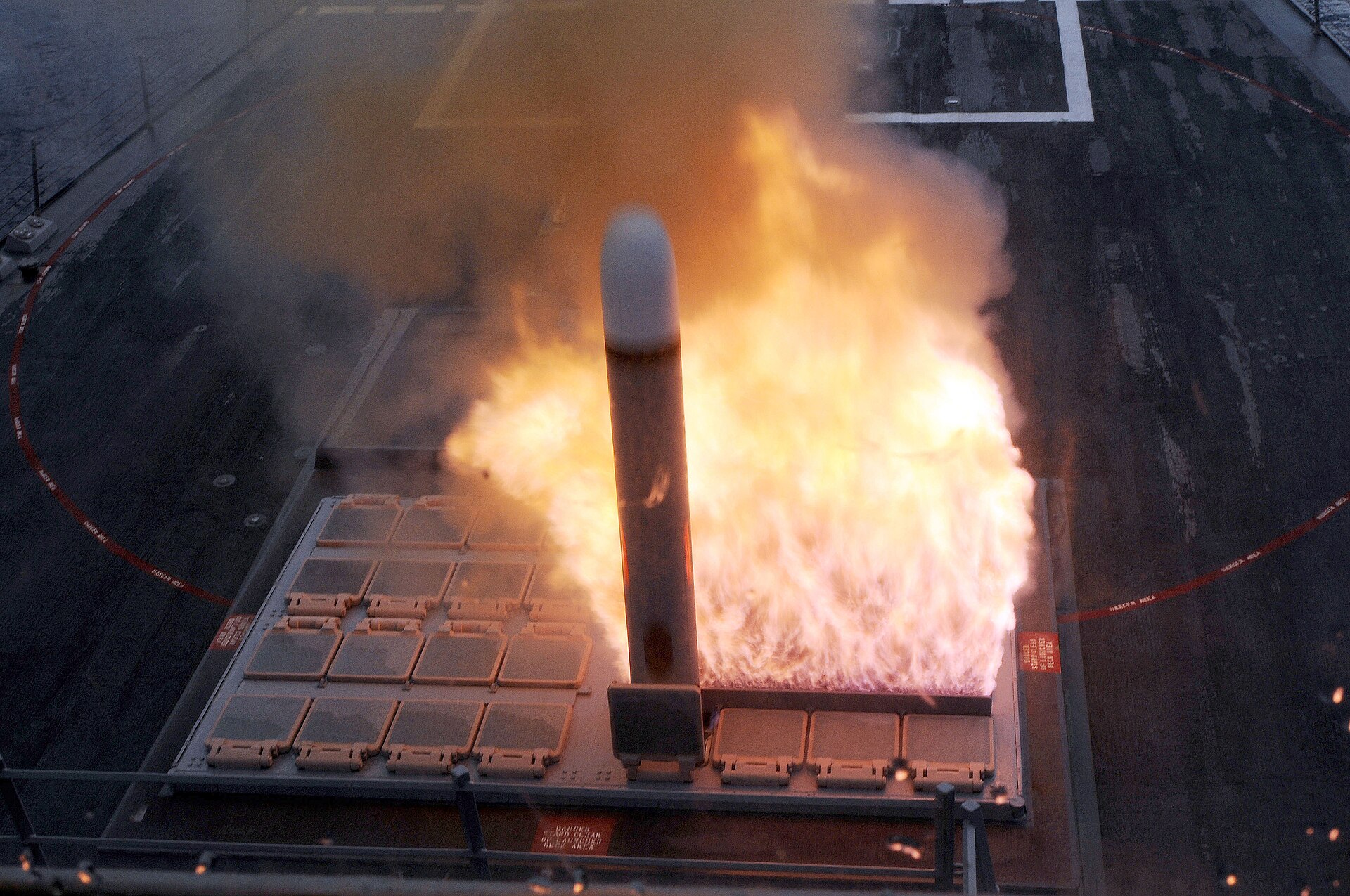

A Tomahawk cruise missile launches from a US Navy guided-missile destroyer, representing the military strike capability behind Trump 48-hour ultimatum to Iran over Hormuz. Photo: US Navy / Public Domain

Trump Gives Iran 48 Hours to Open Hormuz or Lose Its Power Grid

Trump threatens to obliterate Iran power plants including Bushehr nuclear reactor if Hormuz not reopened in 48 hours. What the deadline means for Saudi oil.

WASHINGTON — President Donald Trump issued a 48-hour ultimatum to Iran on Saturday demanding the full reopening of the Strait of Hormuz, threatening to “hit and obliterate” Iranian power plants if Tehran fails to comply. The threat, delivered via Truth Social from Trump’s Florida residence, marks the most explicit deadline of the three-week-old conflict and directly targets civilian infrastructure that supplies electricity to 88 million Iranians.

“If Iran doesn’t FULLY OPEN, WITHOUT THREAT, the Strait of Hormuz, within 48 HOURS from this exact point in time, the United States of America will hit and obliterate their various POWER PLANTS, STARTING WITH THE BIGGEST ONE FIRST!” Trump wrote. Iran’s largest power facility is the 1,000-megawatt Bushehr Nuclear Power Plant on the Persian Gulf coast, raising immediate questions about whether the threat extends to a civilian nuclear installation.

The ultimatum landed as the Iran war entered its fourth week with no ceasefire in sight, oil prices hovering above $113 per barrel, and the Strait of Hormuz effectively closed to non-Iranian commercial shipping since early March. For Saudi Arabia, the calculus is straightforward: the Hormuz blockade has cut the Kingdom’s primary oil export route, forced Aramco onto its backup East-West pipeline to the Red Sea port of Yanbu, and left the Eastern Province under daily drone bombardment. A resolution of the Hormuz crisis would restore billions in daily oil revenue. An escalation targeting Iranian power plants could trigger retaliation against the very Gulf energy infrastructure Saudi Arabia has spent three weeks defending.

What Did Trump Threaten to Do to Iran’s Power Plants?

Trump’s threat to obliterate Iranian power plants represents a significant escalation in the rhetoric of the three-week conflict. The president issued the ultimatum via Truth Social on Saturday, March 22, while spending the weekend at his Mar-a-Lago residence in Florida. The 48-hour clock began ticking at approximately midday Eastern Time, placing the deadline at around midday on Monday, March 24.

The threat specifically named power plants as targets and indicated a sequence of escalation, with the largest facility struck first. In a separate statement on Friday, Trump had elaborated on the scale of destruction the United States could inflict on Iran’s electricity grid. “We could take apart their electric capacity within one hour, and it would take them 25 years to rebuild it,” Trump told reporters, according to CNN. He suggested the strikes could target “sections of Tehran and other places” to disable Iran’s electrical systems, though he said the United States would ideally prefer not to pursue that option.

The ultimatum arrived just 24 hours after Trump appeared to signal a possible drawdown, telling reporters on Friday that the administration was considering “winding down” military operations in the Middle East, Reuters reported. The abrupt reversal from de-escalation language to the most aggressive deadline of the war caught analysts off guard.

Trump has faced mounting domestic pressure to address soaring energy prices. Average US gasoline prices have climbed more than 40 percent since the conflict began on February 28, according to the American Automobile Association, driven primarily by the effective closure of the Strait of Hormuz. Congressional Democrats and several Republican lawmakers have called for immediate action to stabilize oil markets, with Senator Lindsey Graham explicitly urging strikes on Iranian military infrastructure tied to the blockade.

Aerial view of the Ras Tanura oil refinery and storage facilities in Saudi Arabia Eastern Province, a key piece of energy infrastructure threatened by the Hormuz blockade
Saudi Aramco’s Ras Tanura oil refinery and export terminal in Saudi Arabia’s Eastern Province. The facility, one of the world’s largest, has been targeted by Iranian drones since the war began. Photo: Public Domain

Why Is the Strait of Hormuz Still Closed After Three Weeks?

The Strait of Hormuz, the 21-mile-wide channel between Iran and Oman through which roughly 20 million barrels of oil pass daily under normal conditions, has been effectively blockaded since the first week of the conflict. Oil tanker transits plunged 86 percent from the 2026 average within days of the war’s outbreak, according to Anadolu Agency. On March 1 alone, only three tankers carrying 2.8 million barrels crossed the waterway, down from a pre-war daily average of approximately 19.8 million barrels.

More than 700 non-Iranian tankers have accumulated at the chokepoint, distributed across the Persian Gulf, Gulf of Oman, and Arabian Sea, according to shipping data compiled by Lloyd’s List. The backlog includes 334 crude oil tankers, 109 vessels carrying dirty petroleum products, and 263 transporting clean petroleum products.

Iran’s Islamic Revolutionary Guard Corps Navy has demanded that all non-Iranian vessels seek permission before transiting the strait, effectively asserting sovereign control over an international waterway. The IRGC has laid mines in the approach channels, attacked commercial vessels with fast boats and drones, and maintained a threat posture with anti-ship cruise missiles deployed along the Iranian coastline.

The United States and 22 allied nations, including the United Kingdom, Germany, France, Japan, and Australia, have expressed readiness to ensure safe passage through the strait, but no multinational naval force has yet attempted to escort commercial shipping through the mined waters. The UK Maritime Trade Operations has classified the threat level across the Gulf, Strait of Hormuz, and Gulf of Oman as “critical,” citing 21 confirmed attacks on commercial vessels and offshore infrastructure since March 1.

Strait of Hormuz Disruption — Key Figures
Metric Pre-War Average Current (March 21) Change
Daily oil transit 19.8 million b/d ~2.8 million b/d -86%
Daily vessel transits ~100 ~15 -85%
Tankers queued 0 700+ N/A
Brent crude price $71/bbl (Feb 27) $113.71/bbl +60%
Economic cost (daily) N/A ~$2 billion N/A

What Is the Bushehr Nuclear Power Plant and Why Is It the First Target?

Iran’s largest power plant is the Bushehr Nuclear Power Plant, a 1,000-megawatt facility on the Persian Gulf coast in Bushehr Province, approximately 300 miles southeast of Tehran. Commissioned in September 2011 after decades of construction delays, it is Iran’s only operational civilian nuclear power station and has generated more than 72 billion kilowatt-hours of electricity since coming online, according to the Atomic Energy Organization of Iran. That output is equivalent to saving roughly 110 million barrels of oil.

Trump’s pledge to strike “the biggest one first” almost certainly refers to Bushehr, which raises a set of complications distinct from targeting conventional gas-fired power stations. The facility is a Russian-designed VVER-1000 reactor, and Moscow retains a fuel supply agreement with Tehran. Striking a civilian nuclear reactor would risk radioactive contamination of the Persian Gulf, potentially affecting desalination plants in Kuwait, Bahrain, Qatar, and Saudi Arabia’s Eastern Province. The prevailing northwesterly winds could carry fallout directly toward Saudi Arabia’s population centers along the Gulf coast.

The International Atomic Energy Agency, which monitors the Bushehr facility, has not publicly commented on Trump’s threat. After earlier US-Israeli strikes on Iran’s Natanz nuclear enrichment site, the IAEA confirmed it received “no indication of damage” to enrichment infrastructure but expressed concern about the escalating targeting of nuclear-adjacent facilities.

A scale model of Iran Bushehr Nuclear Power Plant showing the reactor dome and containment building
A scale model of Iran’s Bushehr Nuclear Power Plant, the country’s only operational civilian nuclear reactor. The 1,000-megawatt facility on the Persian Gulf coast is likely the first target identified in Trump’s ultimatum. Photo: Wikimedia Commons / CC BY-SA 2.0

Iran’s broader electricity infrastructure is already under severe strain. Approximately 80 percent of Iran’s power generation depends on natural gas, according to the International Energy Agency, and the Israeli strike on the South Pars gas processing complex at Asaluyeh on March 18 damaged four plants that treat gas from the offshore field straddling the Iran-Qatar maritime boundary. South Pars supplies the bulk of natural gas used to heat homes and generate electricity across Iran, and the damage has compounded pre-existing shortages that left millions of Iranians experiencing rolling blackouts before the war began.

Two additional units at Bushehr — Bushehr-2 and Bushehr-3 — were under construction and had been expected to triple the site’s generating capacity to 3,000 megawatts by 2027, according to the Nuclear Threat Initiative. The construction timeline is now irrelevant if the existing reactor becomes a target.

How Has Saudi Arabia Been Affected by the Hormuz Blockade?

Saudi Arabia’s response to the Hormuz blockade has centered on its 750-mile East-West pipeline, known as the Petroline, which connects the oil-rich Eastern Province at Abqaiq to the Red Sea port of Yanbu. Aramco CEO Amin Nasser confirmed on March 10 that the pipeline network would reach full capacity within days, S&P Global reported. Yanbu averaged 2.2 million barrels per day in the first nine days of March, more than double its pre-war throughput, according to Argus Media.

The port’s two terminals — Yanbu North and Yanbu South — have a combined nominal loading capacity of approximately 4.5 million barrels per day, though market sources told Argus Media the operationally tested maximum is closer to 4 million barrels per day. Before the war, Saudi Arabia exported approximately 6 million barrels per day through the Strait of Hormuz. The pipeline bypass can replace roughly two-thirds of that volume at best, leaving a daily shortfall measured in millions of barrels.

The workaround has itself come under attack. On March 19, Iranian drones struck the SAMREF oil refinery in Yanbu, a 400,000-barrel-per-day joint venture between Saudi Aramco and ExxonMobil, according to Anadolu Agency. The strike, which caused limited damage, briefly halted crude oil loadings at the nearby Red Sea port. It was the first time during the conflict that Iran had hit a major oil facility on the Red Sea coast, demonstrating that the Yanbu bypass is not beyond Tehran’s reach.

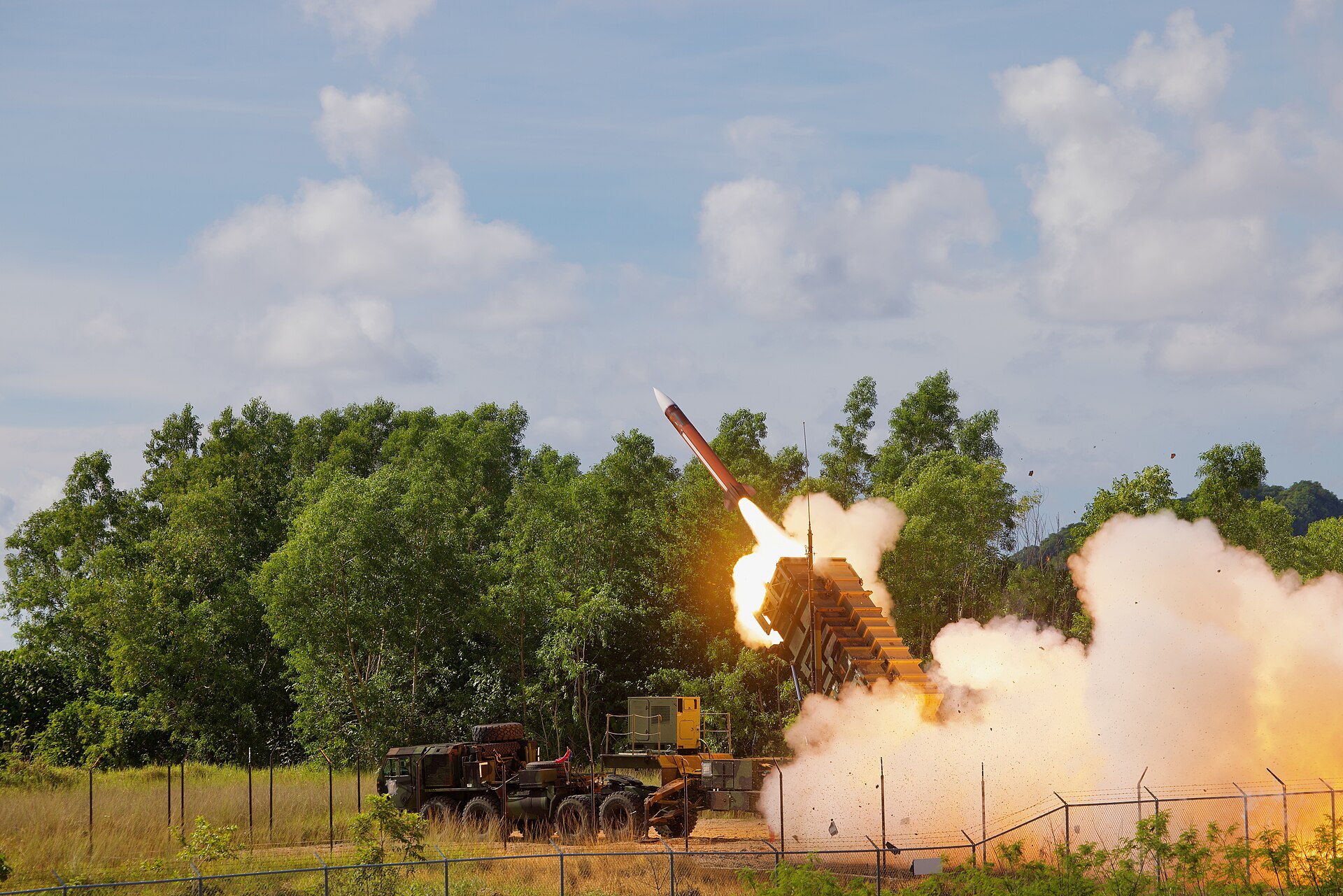
Saudi Arabia’s Eastern Province has borne the heaviest burden. The Saudi Ministry of Defense announced on March 21 that air defenses intercepted and destroyed 20 Iranian drones targeting oil installations in the Eastern Province, according to Qatar News Agency. Earlier that day, Saudi forces had destroyed six additional drones in a separate wave. Saudi air defense systems, supplemented by US Patriot batteries and a Greek-operated Patriot unit, have intercepted the vast majority of incoming threats, but the volume of daily attacks — nearly 100 drones on one day, according to Bloomberg — has stretched the missile defense umbrella to its operational limits.

On the diplomatic front, Saudi Arabia expelled Iran’s military attaché and four embassy staff members on March 21, giving them 24 hours to leave the Kingdom, according to Al Jazeera. The Saudi Ministry of Foreign Affairs cited “repeated Iranian attacks” on Saudi territory as justification, making the Kingdom the second Gulf state to take such action after Qatar expelled Iran’s military and security attachés following the missile strike on the Ras Laffan LNG facility.

The nuclear-powered aircraft carrier USS Enterprise steams through the Persian Gulf during flight operations
A US Navy aircraft carrier steams through the Persian Gulf. The United States has deployed additional amphibious assault ships and approximately 2,500 Marines to the region as Trump’s 48-hour deadline approaches. Photo: US Navy / Public Domain

Iran Warns the Region Will ‘Go Dark’ if Power Grid Is Struck

Iran’s response to Trump’s threat came swiftly. Ali Larijani, Secretary of Iran’s Supreme National Security Council, warned via X that striking Iran’s power grid would trigger cascading failures across the Middle East. “If they do that, the whole region will go dark in less than half an hour,” Larijani wrote, according to Anadolu Agency. He contended that such a regional blackout would leave “US servicemen running for safety.”

Larijani’s claim carries a degree of technical plausibility. Iran’s electricity grid is interconnected with Iraq, Turkey, Afghanistan, Pakistan, Armenia, Azerbaijan, and Turkmenistan through cross-border transmission lines. A sudden collapse of Iran’s generating capacity could destabilize the Iraqi grid, which imports significant volumes of Iranian electricity, and potentially cascade into disruptions across interconnected systems. Iraq’s national grid has relied on Iranian power imports to cover chronic shortfalls, with some estimates placing the dependency at 30 to 40 percent of Iraq’s total supply during peak demand months.

Iranian President Masoud Pezeshkian has not publicly responded to the power plant threat specifically. Earlier in the conflict, Pezeshkian apologized for strikes on Middle Eastern neighbors and pledged that Tehran would stop firing at countries not aiding the US-Israeli operation, according to Bloomberg. Saudi Arabia rejected the assurance, with the Saudi Foreign Ministry stating that Iranian attacks had continued and were based on “flimsy pretexts that have no basis in reality.”

A senior Saudi official, speaking to Asharq Al-Awsat on condition of anonymity, warned that if Iran expands its targeting of critical infrastructure, “the response will no longer be merely declarative.” Crown Prince Mohammed bin Salman and Egyptian President Abdel Fattah el-Sisi issued a joint statement on Saturday condemning “repeated Iranian hostile attacks against Gulf Cooperation Council countries and their vital and civil installations,” Asharq Al-Awsat reported. Sisi reiterated that Egypt stands with the Kingdom “against any threat to its sovereignty and security.”

Oil Prices and the $2 Billion Daily Cost of Hormuz

Global oil markets have absorbed three weeks of supply disruption with predictable consequences. Brent crude rose from an average of $71 per barrel on February 27 to $94 per barrel by March 9, according to the US Energy Information Administration. Prices continued climbing, briefly touching $120 per barrel before easing to approximately $113.71 per barrel as of March 19, Fortune reported. The surge represents a more than 60 percent increase from pre-war levels.

The economic cost of the Hormuz closure runs to approximately $2 billion per day in lost trade value, according to estimates cited by Anadolu Agency. The IEA’s March 2026 Oil Market Report projected that global oil supply would plunge by 8 million barrels per day during March, with curtailments in the Middle East only partially offset by higher output from non-OPEC+ producers and an emergency release of 400 million barrels from strategic reserves coordinated by the IEA.

OPEC+ agreed on March 1 to increase collective production by 206,000 barrels per day for April, a modest response to a disruption measured in millions of barrels, according to Bloomberg. The organization’s next production decision is scheduled for April 5, by which time Trump’s deadline will have passed and the market will know whether the threat was carried out.

Trump’s administration has attempted short-term relief measures. The White House temporarily lifted sanctions on Iranian crude already loaded on vessels, though Iran’s oil ministry claimed it had minimal crude in floating storage, Reuters reported. The administration also signaled it would accelerate permits for domestic production, though any supply impact from new drilling is months away.

US Sends Thousands More Marines as Deadline Approaches

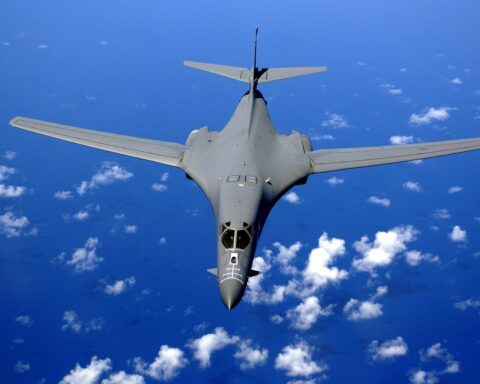
The Pentagon announced on Friday the deployment of three additional amphibious assault ships and approximately 2,500 Marines to the Middle East, according to NBC News. The deployment adds to an already substantial US military presence in the region, which includes multiple carrier strike groups, bomber squadrons operating from Diego Garcia and Al Udeid Air Base in Qatar, and ground-based air defense systems distributed across Saudi Arabia, the UAE, Bahrain, and Kuwait.

The additional Marine deployment suggests the administration is preparing for scenarios beyond airstrikes on power plants. Amphibious assault ships carry Marine expeditionary units capable of seizing coastal facilities, conducting mine-clearing operations, and establishing forward operating positions — capabilities directly relevant to reopening the Strait of Hormuz by force.

The Pentagon confirmed on Friday that US forces had struck underground coastal facilities in Iran storing anti-ship cruise missiles used to threaten commercial shipping in the strait, according to the Associated Press. The strikes followed an earlier CENTCOM operation that destroyed an underground Iranian missile facility, part of a campaign to degrade the IRGC’s ability to enforce the blockade.

Saudi Arabia has opened King Fahd Air Base in Taif to US forces for operations against Iran, Anadolu Agency reported on March 21, citing Iranian state broadcaster ParsToday. The base, located in the western Hejaz region far from Iran’s missile and drone reach, provides a staging area for air operations without the vulnerability of Eastern Province installations closer to the Iranian border.

Iran’s military capabilities, while degraded by three weeks of sustained US-Israeli bombardment, remain potent. The IRGC launched two ballistic missiles at the Diego Garcia military base in the Indian Ocean on March 21, according to CBS News, doubling the known range of Iran’s strike capability. On the same day, Iranian missiles struck communities near Israel’s Dimona nuclear research center, injuring at least 64 people, PBS reported. Israel’s military acknowledged it was unable to intercept the missiles that hit the southern cities of Dimona and Arad.

What Happens When the 48 Hours Expire?

Trump’s ultimatum creates a binary outcome that the administration will confront on or around Monday, March 24. If Iran reopens the Strait of Hormuz — an outcome that would require withdrawing IRGC naval assets, ceasing mine-laying operations, and lifting the demand for transit permissions — the crisis de-escalates and oil markets stabilize. No analyst contacted by Reuters or Bloomberg assessed this outcome as likely.

If the deadline passes without Iranian compliance, Trump faces a choice between executing the threat and absorbing the credibility cost of an empty ultimatum. Striking Iranian power plants would plunge the country into darkness but could also trigger the cascading regional effects Larijani warned about, disrupt electricity supplies to US-allied Iraq, and potentially contaminate the Persian Gulf if Bushehr is targeted.

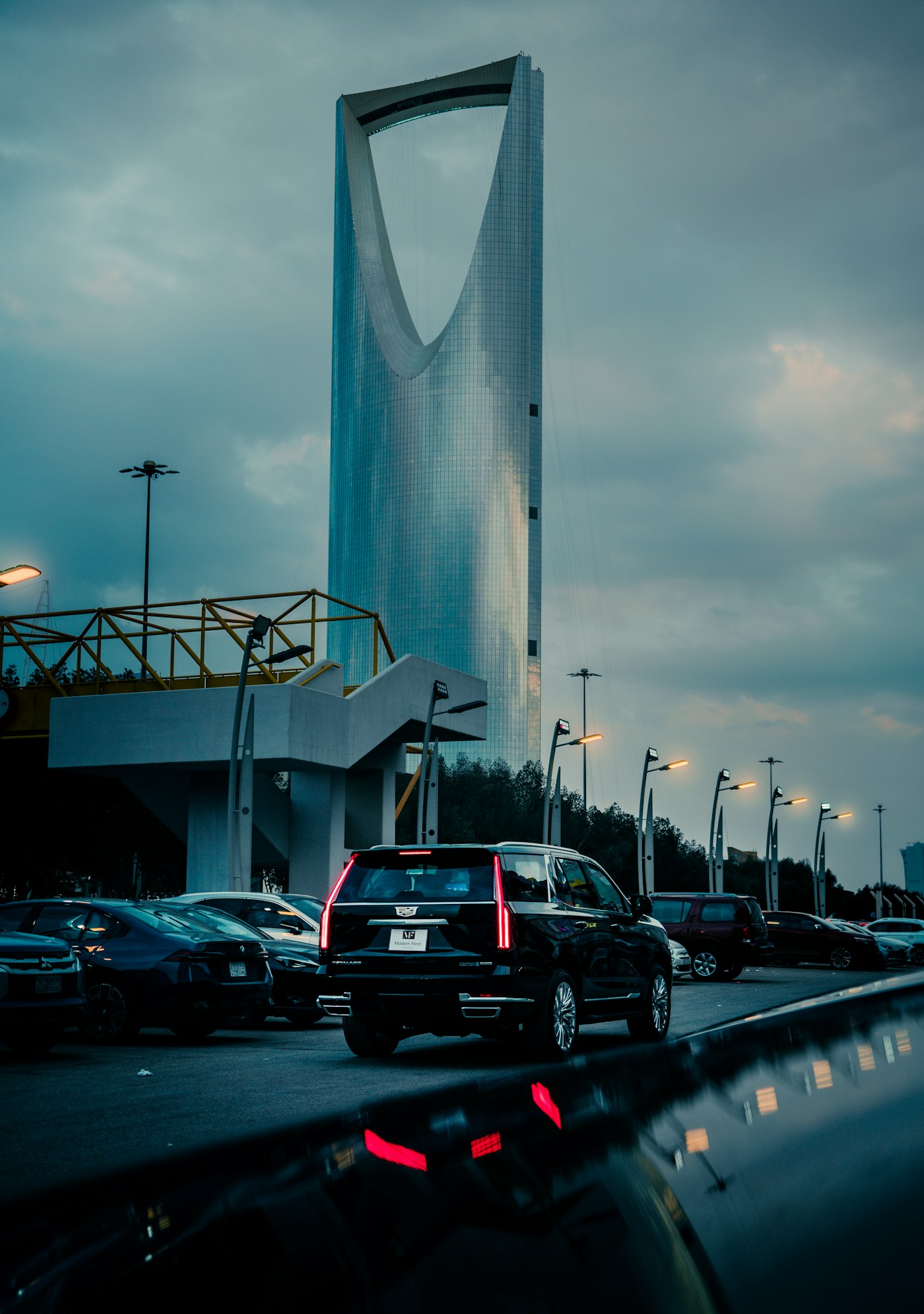
For Saudi Arabia, both outcomes carry risks. A successful strike campaign that forces Hormuz open would restore the Kingdom’s primary export route and relieve the pressure on Yanbu. An escalation that provokes Iranian retaliation against Gulf power grids, desalination plants, or additional oil infrastructure could transform a manageable war into a humanitarian crisis affecting the 35 million people who depend on Saudi Arabia’s water and electricity systems.

Crown Prince Mohammed bin Salman has spoken regularly with Trump throughout the conflict, urging harsh action against Iran, the New York Times reported. MBS reportedly conveyed the advice of the late King Abdullah: “Cut off the head of the snake.” Whether that counsel extends to striking a nuclear reactor 300 miles from Saudi Arabia’s coastline remains the Kingdom’s most consequential unanswered question.

Frequently Asked Questions

What exactly did Trump threaten to do?

Trump threatened via Truth Social to “hit and obliterate” Iran’s power plants if Tehran does not fully reopen the Strait of Hormuz within 48 hours. He specified that strikes would begin with Iran’s largest power facility, widely understood to be the 1,000-megawatt Bushehr Nuclear Power Plant on the Persian Gulf coast. Trump separately stated the US could dismantle Iran’s electric capacity “within one hour” and that it would take 25 years to rebuild.

Why does the Hormuz blockade matter for Saudi Arabia?

The Strait of Hormuz is Saudi Arabia’s primary oil export route, carrying roughly 20 million barrels per day under normal conditions. The blockade has forced Aramco to rely on its East-West pipeline to the Red Sea port of Yanbu, which can handle approximately 4 million barrels per day at maximum capacity — roughly two-thirds of Saudi Arabia’s pre-war export volume through the strait. The shortfall costs the Kingdom billions in daily revenue.

Could striking Bushehr cause radioactive contamination in the Gulf?

Nuclear experts have warned that a military strike on the Bushehr reactor could release radioactive material into the atmosphere and the Persian Gulf. The facility sits on the Iranian coastline, and prevailing winds could carry contamination toward Kuwait, Bahrain, Qatar, and Saudi Arabia’s Eastern Province. The IAEA has not publicly commented on the risk, but the scenario has drawn comparisons to the Chernobyl and Fukushima disasters.

What has Iran said in response to the threat?

Ali Larijani, Secretary of Iran’s Supreme National Security Council, warned that if the US strikes Iran’s power grid, “the whole region will go dark in less than half an hour.” Iran’s electricity grid is interconnected with Iraq, Turkey, and several neighboring countries, and a sudden collapse could cascade into regional blackouts. Larijani said such a scenario would leave US servicemen in the region scrambling for safety.

How many Marines has the US deployed to the region?

The Pentagon announced the deployment of three additional amphibious assault ships and approximately 2,500 Marines to the Middle East on March 21, adding to an already substantial US military presence that includes multiple carrier strike groups, bomber squadrons, and ground-based air defense systems across Saudi Arabia, the UAE, Bahrain, and Kuwait.

A Patriot PAC-2 interceptor missile launches from a mobile launcher during a live fire exercise, demonstrating the air defense systems protecting Gulf desalination infrastructure. Photo: US Army / Public Domain
Previous Story

Week Three Killed Saudi Arabia's Neutrality

Satellite night view of Jubail industrial city on Saudi Arabia Persian Gulf coast showing concentration of desalination and petrochemical infrastructure. Photo: NASA / ISS / Public Domain
Next Story

The War MBS Didn't Want Is Building the Economy He Did

Latest from Iran War