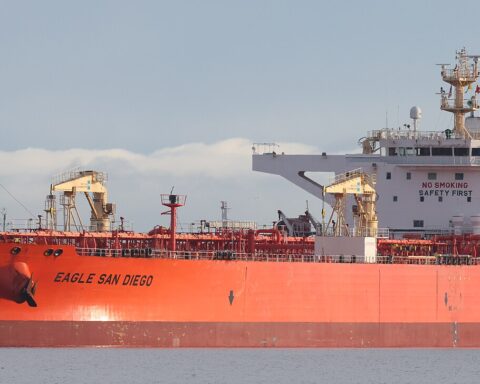

The supertanker AbQaiq approaches an offshore crude oil loading terminal in the Persian Gulf. Named for the key Saudi Aramco oil processing facility, the vessel represents the export infrastructure at the heart of Saudi Arabia revenue model.

The $79 Barrel: Saudi Arabia’s Oil Recovery Arrives at the Worst Possible Moment

EIA projects Brent falling to $79/bbl by 2027 as Saudi production recovery floods an oversupplied market. Why the timing breaks Vision 2030's financial architecture.
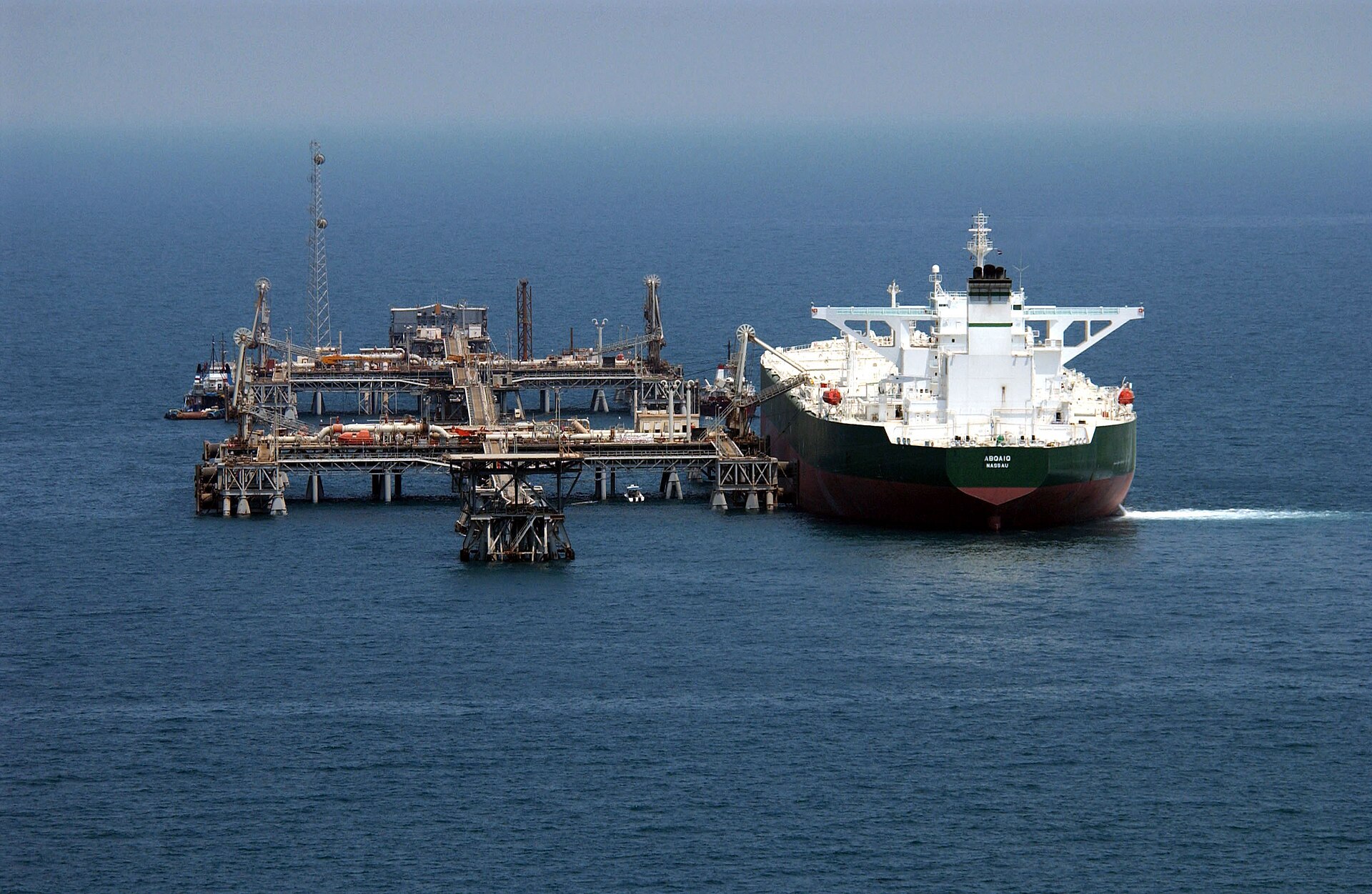
The supertanker AbQaiq approaches an offshore crude oil loading terminal in the Persian Gulf. Named for the key Saudi Aramco oil processing facility, the vessel represents the export infrastructure at the heart of Saudi Arabia revenue model.
The supertanker AbQaiq maneuvers toward an offshore crude oil loading terminal in the Persian Gulf — the export pathway that Saudi Arabia’s 6.768 million barrels per day of current production must navigate to reach global markets. At the EIA’s projected $79 average for 2027, those barrels will generate roughly $53 billion less annual revenue than the kingdom needs to fund its war, its megaprojects, and its sovereign wealth fund simultaneously. Photo: U.S. Navy / Public Domain

DHAHRAN — The U.S. Energy Information Administration projects Brent crude falling to $89 per barrel by the fourth quarter of 2026 and averaging $79 through 2027 — prices that would blow through Saudi Arabia’s fiscal breakeven at exactly the moment the kingdom’s ceasefire production recovery floods an already oversupplied global market. The kingdom posted a first-quarter deficit of 125.7 billion riyals ($33.5 billion) — more than double Q1 2025 and already 194 percent of the official full-year deficit target — while Brent was still trading above $100, before the price decline the EIA describes has even begun.

Conflict Pulse IRAN–US WAR
Live conflict timeline
Day
83
since Feb 28
Casualties
13,260+
5 nations
Brent Crude ● LIVE
$113
▲ 57% from $72
Hormuz Strait
RESTRICTED
94% traffic drop
Ships Hit
16
since Day 1

The trap is structural, not cyclical: Saudi Arabia’s restoration of war-idled Aramco capacity, including 300,000 barrels per day at Khurais and millions more across the broader production system, is timed to arrive as the EIA projects global inventories swinging from deficit to surplus by Q4 2026. The kingdom will pump more barrels at the exact moment the market can least absorb them, mechanically deepening a price collapse that Vision 2030‘s financial architecture — deliberately sequenced around a gradual revenue decline in the late 2020s — was never designed to survive as an abrupt shock arriving years ahead of schedule.

What Does the EIA Forecast Actually Project?

The EIA’s May 2026 Short-Term Energy Outlook projects Brent crude falling from approximately $106 per barrel in mid-2026 to $89 by Q4 2026, then averaging $79 through 2027. The mechanism is a global inventory swing from an 8.47 million barrel-per-day draw in Q2 to a 1.99 million barrel-per-day surplus in Q4 as Middle Eastern production normalizes after the ceasefire.

The May 12 outlook tells a story of two halves that the full-year average obscures entirely. Brent holds at approximately $106 per barrel through May and June, sustained by the supply deficit the Iran war created — the EIA calculates a global inventory draw of 8.47 million barrels per day in Q2, a figure reflecting the near-total shutdown of Hormuz transit traffic and the scramble for alternative supply routes that has defined the conflict’s economic footprint since the first Iranian strikes in late February. That deficit is not a market malfunction; it is the mathematical expression of pulling roughly half of the Persian Gulf’s export capacity offline for three months.

By Q4, the arithmetic inverts entirely. Middle Eastern producers bring capacity back online, Hormuz traffic gradually resumes — the EIA assumes it returns to pre-conflict levels “later this year” — and global inventories swing to a build of 1.99 million barrels per day, a surplus large enough to push Brent to $89. The full-year 2026 average of $95 is a statistical artifact, dragged upward by the elevated first half and masking a second-half collapse that is the operative number for fiscal planners in Riyadh. The 2027 projection of $79 — an annual average, meaning actual monthly prices could dip materially lower — is the price at which Saudi Arabia’s spending commitments exceed its revenue capacity on every credible measure except the one the government published.

The EIA is explicit about what it doesn’t know. “The timing of resumed oil flows through the Strait of Hormuz and the subsequent rate at which Middle Eastern producers restore output are key factors influencing EIA’s price forecast through year end,” the agency wrote, adding that some producers “will not see their production levels return to pre-conflict levels during the STEO forecast period.” Aramco CEO Amin Nasser reinforced this on May 12, warning that even with an immediate Hormuz reopening, recovery could “drag into 2027” given the approximately 1 billion barrel cumulative supply deficit, with only 2 to 5 vessels transiting the strait daily versus the normal 70.

The HOS Daily Brief

The Middle East briefing 3,000+ readers start their day with.

One email. Every weekday morning. Free.

Three Breakeven Prices, One Fiction

Saudi Arabia’s fiscal position in 2026 can be understood through three numbers that correspond to three versions of reality, each progressively more embarrassing to the official narrative that the kingdom’s finances are on track. The government built its 2026 budget on an assumed oil price of $72 per barrel — a figure that was a political fiction when published, has been overtaken by events in both directions (first by war-elevated prices above $100, soon by a collapse the EIA projects will fall through every floor except the fictional one), and serves primarily to ensure that the published deficit projection of 65 billion riyals ($17 billion) bears no relationship to operational reality. The IMF’s fiscal breakeven estimate of $86.60 per barrel accounts for the government’s disclosed expenditure obligations and revenue structure but excludes PIF capital transfer requirements that the kingdom treats as off-balance-sheet. Bloomberg’s estimate, which includes those transfers, places the true breakeven at $111 per barrel — a price that Brent has not sustained since the early weeks of the Hormuz crisis and that the EIA projects it will not revisit during the forecast period.

The Q1 2026 fiscal results, reported by Al Jazeera on May 6, demonstrate which of these numbers corresponds to what is actually happening. The kingdom ran a deficit of 125.7 billion riyals in a single quarter — more than double Q1 2025 — with oil revenues down 3 percent year-on-year even while Brent traded above $100, a reflection of the production constraints the war imposed on Aramco’s export volumes. Military spending rose 26 percent, total government spending rose 20 percent, and these are not discretionary increases; they are the fiscal signature of a kingdom at war, establishing an expenditure floor that does not shrink when oil prices do.

Each $10 per barrel decrease in oil price widens the Saudi deficit by approximately 50 billion riyals — the asymmetry is driven by the royalty structure governing Aramco’s payments to the state.

— Tim Callen, Visiting Fellow, Arab Gulf States Institute in Washington

Callen’s arithmetic, applied to the EIA’s 2027 average of $79, implies an annual deficit approaching 200 billion riyals ($53 billion), which would exceed the 2015 record of $98 billion and force a drawdown of SAMA’s $451.1 billion in foreign exchange reserves at a rate materially faster than the 2015-2016 episode, because the wartime defense baseline creates an expenditure floor that did not exist when oil last collapsed a decade ago.

Saudi Arabia Fiscal Breakeven Estimates vs. EIA Price Forecast, 2026-2027
Measure Price / Value Source Implication at $79/bbl (2027)
Official budget assumption $72/bbl Saudi Ministry of Finance Technically above — but Q1 deficit of 125.7B riyals is already 194% of the 65B-riyal full-year target
IMF fiscal breakeven $86.60/bbl IMF, 2026 $7.60/bbl below breakeven — ~38 billion riyals additional deficit
Bloomberg breakeven (incl. PIF transfers) $111/bbl Bloomberg, 2026 $32/bbl below breakeven — ~160 billion riyals additional deficit
EIA Brent Q4 2026 $89/bbl EIA STEO, May 12, 2026 Below IMF breakeven by Q4; on track for $79 annual average in 2027
EIA Brent 2027 average $79/bbl EIA STEO, May 12, 2026 Projected annual deficit ~200 billion riyals ($53 billion) per AGSI model
AGSI deficit sensitivity 50 billion riyals per $10/bbl decline Tim Callen, AGSI Asymmetric due to Aramco royalty structure

Why Does the Ceasefire Recovery Deepen the Price Collapse?

Saudi Arabia’s restoration of 4 to 5 million barrels per day of war-idled capacity — including 300,000 barrels per day at Khurais — is timed to arrive as the EIA projects global markets flipping from a deficit of 8.47 million barrels per day to a surplus of 1.99 million barrels per day by Q4 2026. More Saudi barrels entering an oversupplied market mechanically accelerate the price decline Riyadh cannot afford at its current spending levels.

This is the specific convergence that no analysis has named. Saudi Arabia was pumping 6.768 million barrels per day in late April — roughly 56 percent of its approximately 12 million barrel-per-day normal capacity — with 300,000 barrels per day offline at Khurais and no publicly announced restoration timeline, the Saudi Ministry of Energy stating only that it will provide a completion date “once full operational capacity is re-established.” The East-West Pipeline was restored to 7 million barrels per day capacity on April 12, and the Manifa field recovered, but Aramco was still routing 60 to 70 percent of export volumes through the pipeline reroute to Yanbu on the Red Sea coast — a logistical workaround that functioned under crisis conditions but that cannot substitute indefinitely for direct Gulf export access.

EIA map of selected oil and gas pipeline infrastructure in the Middle East, showing Saudi Arabia East-West pipelines, Ras Tanura export terminal, Yanbu terminal on the Red Sea, and the Strait of Hormuz chokepoint.
The EIA and IEA’s map of Middle East oil and gas pipeline infrastructure. The East-West Pipeline — labeled here and restored to 7 million barrels per day capacity on April 12 — runs from the Eastern Province fields through the Hejaz to the Yanbu export terminal on the Red Sea, bypassing the Strait of Hormuz entirely. Saudi Arabia was routing 60 to 70 percent of exports through this corridor under crisis conditions; Ras Tanura, the Gulf’s largest crude export facility, remains the primary terminus for capacity restoration. Map: U.S. Energy Information Administration / International Energy Agency / Public Domain

The ceasefire dividend — the restoration of those missing barrels — is the production recovery that Riyadh has been counting on to restore revenue since the first missiles hit Ras Tanura. But the EIA’s own model identifies this recovery as the primary mechanism that flips global inventories from deficit to surplus, and the timing is not approximate: it is Q4 2026, the same quarter the EIA projects Brent falling to $89. Saudi Arabia’s production restoration does not happen despite the price collapse; it is the supply-side driver of it, adding barrels to a market the EIA already projects will be oversupplied by 2 million barrels per day even before Saudi capacity is fully restored.

The infrastructure for recovery exists — the East-West Pipeline is operational, Manifa is back, and Khurais restoration would add another 300,000 barrels per day whenever it arrives. What does not exist is a market capable of absorbing the recovery at a price that covers the kingdom’s expenditure commitments, and no ceasefire agreement or OPEC+ communiqué can manufacture demand that the global economy is not generating. Saudi Arabia will recover its production capacity in full, perhaps by early 2027 if Nasser’s timeline holds, but the market those barrels enter will not be the $106 market of mid-2026 — it will be the $79 market the EIA projects for 2027, and every additional Saudi barrel will push it lower.

The Sequencing Logic Vision 2030 Was Built On

Vision 2030’s implicit financial architecture — never published as a single document but reconstructable from a decade of PIF capital allocation decisions, Aramco dividend policy, and megaproject timelines — rested on a burn sequence that was elegant in theory and is now collapsing in practice. Oil revenues would fund PIF’s capital deployment in Phase 1 (2016-2025), the fund would diversify sufficiently by 2026-2030 to generate returns independent of oil price cycles, and the megaproject capital deployment driving non-oil revenue would be substantially complete before the oil revenue cliff arrived, giving the new economic base time to mature into a genuine fiscal backstop.

The EIA forecast compresses that window to near-zero. PIF’s liquid assets are already committed, its cash reserves at their lowest since 2020. The war reversed non-oil growth momentum and redirected capital toward defense procurement at rates that have consumed the fiscal space megaproject deployment was supposed to occupy. And the megaproject timelines have been pushed out by years — NEOM’s The Line reduced to 2.4 kilometers of completed foundation, its 2030 population target collapsed from 1.5 million to under 300,000, its completion horizon extended to 2045 for the original 170-kilometer vision, headcount cut to approximately one-third, and no new contracts awarded in March 2026. A leaked 2023 board presentation projected the eventual total cost at $8.8 trillion through 2080, with Phase 1 alone requiring $370 billion through 2035.

KAPSARC — the King Abdullah Petroleum Studies and Research Center, a government-funded Saudi think tank — projected in 2022 that the kingdom’s economy would be “60 percent more resilient to oil price shocks by 2030” as a result of Vision 2030 reforms. That projection assumed PIF’s asset base would mature, non-oil revenue would scale, and megaproject capital deployment would be substantially complete by 2030 — and the Iran war and the EIA’s price forecast have jointly falsified all three assumptions, testing a resilience that was not scheduled to exist for another four years against a shock arriving this quarter.

The EIA’s $79 projection does not merely test MBS‘s economic vision; it tests it on a timeline that the vision’s own architects acknowledged it could not survive. The oil revenue cliff was supposed to arrive gradually, in the early 2030s, with warning, after the diversification infrastructure was in place. Instead it arrives abruptly in Q4 2026, into a fiscal architecture that is still under construction, with the tools that were supposed to absorb the impact either incomplete, committed elsewhere, or broken by three months of war.

Can PIF Still Function as a Fiscal Backstop?

PIF’s cash reserves fell to approximately $15 billion by late 2024 — their lowest since 2020 — with roughly 40 percent of its $925 billion nominal assets tied to Aramco equity that declines in value alongside oil prices. The fund mandated 20 percent spending cuts across more than 100 portfolio companies and formally exited LIV Golf, leaving minimal capacity to absorb a fiscal shock of the magnitude the EIA projects.

The headline AUM of $925 billion obscures a composition problem that becomes existential when liquidity is the binding constraint. That 40 percent Aramco exposure creates a pro-cyclical trap in which the sovereign wealth fund’s balance sheet deteriorates at exactly the moment the state needs it most — as oil prices fall, Aramco’s valuation falls, and PIF’s nominal asset base shrinks in tandem with the revenue shortfall it is supposed to cover. Another 30 to 35 percent consists of domestic project valuations dependent on continued government spending, spending that is being cut. Genuinely diversified international assets represent roughly a quarter of the total — approximately $230 billion at current valuations — and it is only those assets that could theoretically function as a countercyclical buffer, though liquidating them at speed would carry material market impact costs.

PIF Governor Yasir Al Rumayyan acknowledged the constraint in October 2025, stating the fund was “finalising a revised 2026-2030 strategy with capital expenditure cuts of up to 15 percent.” Annual capital expenditure has already fallen from a pre-war range of $40 to $50 billion to $30 to $38 billion, with the gap absorbed by defense cost escalation — wartime spending estimated at $90 to $100 billion annually versus the pre-war budget of $74.76 billion, a differential that consumes virtually every riyal PIF’s budget reductions were supposed to free up.

The LIV Golf exit crystallized the shift in priorities. PIF stated that the “substantial investment required by LIV Golf over a longer term is no longer consistent with the current phase of PIF’s investment strategy” — language that describes, without quite naming, a fund that has run out of room for discretionary bets. Investment Minister Khalid Al Falih acknowledged publicly that PIF should “scale back spending and make room for private capital” because “giga-projects have been taking a lot of resources from the government.” When the governor of a $925 billion fund is talking about budget cuts and the investment minister is acknowledging that flagship projects are draining the state, the fund is not functioning as a backstop for anything — it is the institution that needs backstopping.

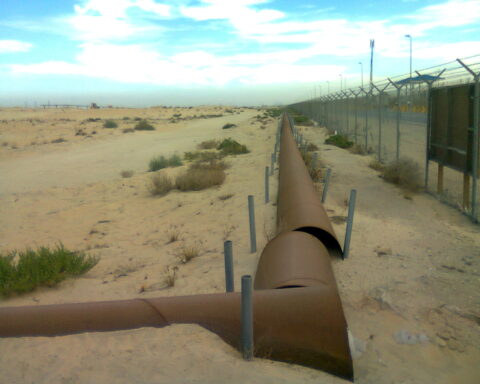
Saudi Aramco elevated pipeline rack at the Jubail Industrial City complex on the Persian Gulf coast. The pipeline infrastructure represents billions in capital investment by Aramco and the Public Investment Fund across Saudi Arabia industrial heartland.
Saudi Aramco’s elevated pipeline rack at Jubail Industrial City on the Persian Gulf coast — the physical infrastructure of the oil revenue model that Vision 2030 was designed to eventually supersede. PIF’s $925 billion nominal asset base includes roughly 40 percent exposure to Aramco equity, creating a pro-cyclical trap: as oil prices fall toward the EIA’s $79 projection, both the kingdom’s direct revenue and its sovereign wealth fund’s balance sheet deteriorate simultaneously. Photo: Suresh Babunair / Wikimedia Commons / CC BY 3.0

The UAE Exit and the End of OPEC Discipline

OPEC+ approved a June production increase of 188,000 barrels per day on May 3 — a routine adjustment that arrives into a market the EIA projects will be oversupplied by Q4. The more consequential development preceded it by two days: the UAE formally exited OPEC on May 1, removing quota constraints entirely and institutionalizing the free-rider problem Saudi Arabia spent decades trying to prevent through a cartel structure it largely underwrote.

Abu Dhabi has invested to expand production capacity from 3 to 5 million barrels per day by 2027, and is now free to pursue that expansion without output restrictions, quota negotiations, or the political obligations that historically constrained its behavior within OPEC. The EIA projects OPEC spare capacity dropping from 3.8 million to 2.5 million barrels per day in 2027 with the UAE’s departure, but the figure understates the supply-side problem because the UAE’s unconstrained production adds to the global surplus without the compensating cuts a cartel member would theoretically accept. Every barrel Abu Dhabi pumps above its former quota pushes Brent further below the breakeven Saudi Arabia needs to fund its war and its megaprojects simultaneously.

The causation is worth tracing because it forms a closed loop. Saudi Arabia built OPEC’s production discipline architecture to prevent precisely this scenario — unconstrained supply driving prices below fiscal breakeven — and the kingdom’s own wartime production cuts created the conditions for the UAE’s departure. The war made Saudi output unreliable, and unreliable Saudi output made OPEC quotas irrelevant to Abu Dhabi, and the UAE’s exit ensures that even a post-ceasefire OPEC cannot coordinate the supply restraint necessary to defend $86 oil, let alone $111. The cartel’s most powerful member hollowed out the cartel’s enforcement mechanism by fighting a war it did not start and could not avoid.

What Policy Tools Does Riyadh Have Left?

The crisis response tools deployed in 2015-2016 — fuel subsidy cuts, reserve drawdowns, defense spending reductions, and international borrowing — are largely exhausted or unavailable in 2026. Subsidies were already restructured in Vision 2030’s first phase, defense cannot be cut during active conflict, and SAMA reserves of $451 billion face a faster drawdown rate than a decade ago due to the wartime expenditure baseline.

When Brent fell from $114 to a low of $27 in the last major crash, the kingdom ran a record $98 billion deficit, burned more than $150 billion in SAMA reserves over eighteen months (falling from a peak near $737 billion to $536 billion), cut spending by 14 percent across defense and fuel subsidies, launched domestic bond auctions, borrowed $26 billion internationally, and raised fuel prices between 67 and 133 percent. The domestic shock — the recognition that the oil-dependent fiscal model was terminal — became the political foundation for both Vision 2030 and Mohammed bin Salman‘s consolidation of power, precisely because the crisis made the case for radical reform more convincingly than any white paper could.

Each of those tools is now degraded, exhausted, or structurally unavailable. Fuel subsidies were restructured in Vision 2030’s first phase and further increases during wartime carry political risks the 2015 cuts did not, because the social contract MBS struck with the Saudi public assumed the pain of reform would precede the dividend, not recur. The reserve buffer exists — $451 billion is not trivial — but at wartime expenditure rates the arithmetic is substantially less forgiving than 2014, and the bond market remains accessible: Riyadh is already planning record international borrowing of $25 billion in 2026, but borrowing against a structural deficit rather than a cyclical one creates a debt trajectory that ratings agencies will eventually price.

Saudi Arabia Crisis Response Tools: 2015-2016 vs. 2026
Policy Tool 2015-2016 Deployment 2026 Availability
Fuel subsidy cuts Gasoline +67%, diesel +79%, ethane +133% Already executed in Vision 2030 Phase 1 — minimal room
SAMA reserve drawdown ~$737B peak; fell to $536B in 18 months ($150B+ burned) $451B available, but wartime defense baseline accelerates burn rate
Defense spending cuts Cut as part of 14% across-the-board reduction Unavailable — active conflict, $90-100B+ annual baseline
International borrowing $26B by 2016 $25B planned for 2026 — accessible but creates structural debt
Megaproject deferral Not applicable (pre-Vision 2030) Available for some projects, but self-defeating: cancels the non-oil revenue source
Aramco IPO / asset sales Announced 2016, executed 2019 Aramco already listed; PIF international asset sales possible but fire-sale risk

The kingdom is willing to defer or cancel projects without blinking if economic value fails to materialise.

— Mohammed Al Jadaan, Saudi Finance Minister

Al Jadaan’s statement reads differently when the EIA is projecting $79 oil than when Brent was trading above $100. The projects Saudi Arabia can cancel — the more speculative phases of the entertainment and tourism buildout, NEOM’s extended timeline — are precisely the ones designed to generate the non-oil revenue that would close the gap the oil price decline creates, making their cancellation a self-defeating response to the revenue problem they were built to solve. And the projects the kingdom cannot cancel — Expo 2030 facilities, World Cup 2034 infrastructure — carry fixed international deadlines and reputational obligations that do not respond to commodity prices.

The Naimi Precedent and Why It Cannot Be Repeated

In November 2014, Saudi oil minister Ali al-Naimi announced the kingdom would maintain production at 9.7 million barrels per day regardless of demand — a deliberate market-share strategy designed to crush higher-cost producers, principally U.S. shale, and reassert OPEC pricing power. Saudi Arabia increased exports by 460,000 barrels per day in 2015, helped drive Brent from $114 to $27, and paid for it with the fiscal crisis that necessitated the invention of a new national economic model as a political response. The strategy succeeded in the narrow sense that dozens of U.S. shale operators went bankrupt, but the price Saudi Arabia paid — the record deficit, the reserve drawdown, the domestic austerity — was severe enough that MBS built an entire modernization program on the premise that it could never happen again.

The Naimi play is closed in 2026 for reasons that compound rather than merely accumulate. Repeating it — flooding the market to eliminate competitors — would constitute an open admission that Vision 2030 has failed to diversify revenue after a decade of implementation, an admission that is politically impossible for the man who staked his legitimacy on the program’s success. The reserve buffer has been partially drawn since 2014, the wartime defense baseline creates an annual expenditure floor that Naimi’s peacetime Saudi Arabia could not have imagined, and the megaproject commitments the kingdom cannot exit — Expo 2030, World Cup 2034, the irreducible infrastructure core that NEOM still requires even at reduced scope — represent minimum spending obligations that did not exist when Naimi made his gamble.

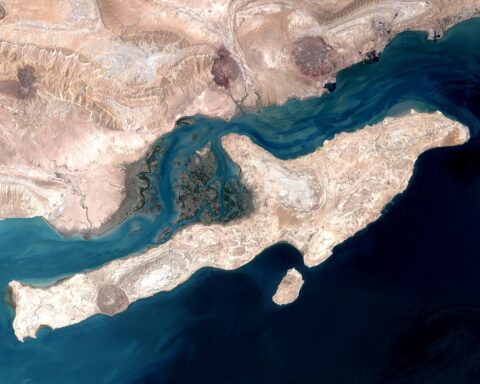
Planet Labs satellite imagery of the Khurais Oil Processing Facility in Saudi Arabia, which adds approximately 1.2 million barrels per day to Saudi capacity. The article describes 300,000 barrels per day offline at Khurais with no announced restoration timeline.
Planet Labs satellite imagery of the Khurais Oil Processing Facility northwest of Riyadh — the facility at the center of the ceasefire recovery timing problem. Khurais came online in 2009 with 1.2 million barrels per day capacity; when Ali al-Naimi flooded the market in 2014, the full weight of Saudi export capacity was available as a strategic weapon. In 2026, with 300,000 barrels per day still offline here and the kingdom already at 56 percent of its 12 million barrel-per-day nameplate, the Naimi playbook is simply closed. Photo: Planet Labs, Inc. / Wikimedia Commons / CC BY-SA 4.0

When Naimi broke the market in 2014, SAMA held reserves near their all-time peak and the kingdom’s largest discretionary expenditure was a fuel subsidy that could be cut; when the EIA’s projected collapse begins in Q4 2026, SAMA will hold substantially less, and the kingdom’s largest expenditures — a war, a World Cup, an Expo, and the irreducible skeleton of an $8.8 trillion megacity — cannot be cut at all. The 60 percent resilience to oil shocks that KAPSARC promised by 2030 would need to materialize four years early; it has not materialized at all.

Frequently Asked Questions

Does Iran benefit from delaying the Hormuz reopening?

Directly and measurably. When Iran’s foreign minister announced on April 17 that Hormuz was “open for the duration of the ceasefire,” Brent fell 11 percent within days — a real-time demonstration of the pricing power Tehran holds over the negotiating timeline. Every failed or protracted negotiating round buys Iran weeks of $105-110 oil versus months of $79-89 oil, creating a structural incentive to keep the reopening slow, conditional, and reversible. The PGSA maritime security architecture Iran has established at the strait gives it the operational tools to modulate transit flow without formally closing anything, maintaining control while technically complying with ceasefire terms.

What happened to Aramco’s dividend payments in 2025?

Aramco’s total dividends fell from $124.3 billion in 2024 to $85.5 billion in 2025 — a $38.8 billion reduction that hit the Saudi state and PIF directly, since the government holds approximately 98.5 percent of Aramco’s shares between direct state ownership and PIF’s stake. The dividend cut preceded the Iran war and reflected Aramco’s own capital expenditure needs and the broader normalization of oil markets in late 2024. At the EIA’s projected $79 average for 2027, further dividend pressure is virtually certain, compounding the fiscal damage from lower direct oil revenues with reduced PIF income from its single largest holding.

Could Russia coordinate with Saudi Arabia to defend prices through production cuts?

Russia’s incentives run in the opposite direction. Moscow built its 2026 federal budget on an assumed Urals crude price of $59 per barrel; the Iran war delivered Urals to approximately $116 by early April, a windfall that Russia could not fully capitalize on because Ukrainian drone strikes on refining infrastructure and a surge in maritime insurance costs constrained its ability to increase exports. Russia benefits structurally from prolonged Gulf disruption keeping prices elevated and has zero economic incentive to facilitate the clean Hormuz reopening that would accelerate the EIA’s projected price decline. Any OPEC+ coordination on production restraint would require Russian compliance, which recent history — particularly the 2020 Saudi-Russian price war — suggests is available only when Moscow’s own fiscal needs align.

Does Saudi Arabia’s low production cost provide any buffer against the price decline?

Aramco’s upstream lifting cost is roughly $3 per barrel — among the lowest of any major producer globally, and a structural advantage that means Saudi Arabia will never be priced out of production the way U.S. shale operators were in 2015-2016. But the per-barrel margin is irrelevant to the fiscal question, because the government’s spending commitments require revenue equivalent to $86-111 per barrel across the full production base (depending on which breakeven estimate one uses), and the production base has been approximately halved by war. The cost advantage ensures Aramco remains profitable at virtually any Brent price above $20; it does not ensure the Saudi state can fund a $90 billion defense budget, a $30 billion megaproject pipeline, and a sovereign wealth fund recapitalization simultaneously at $79.

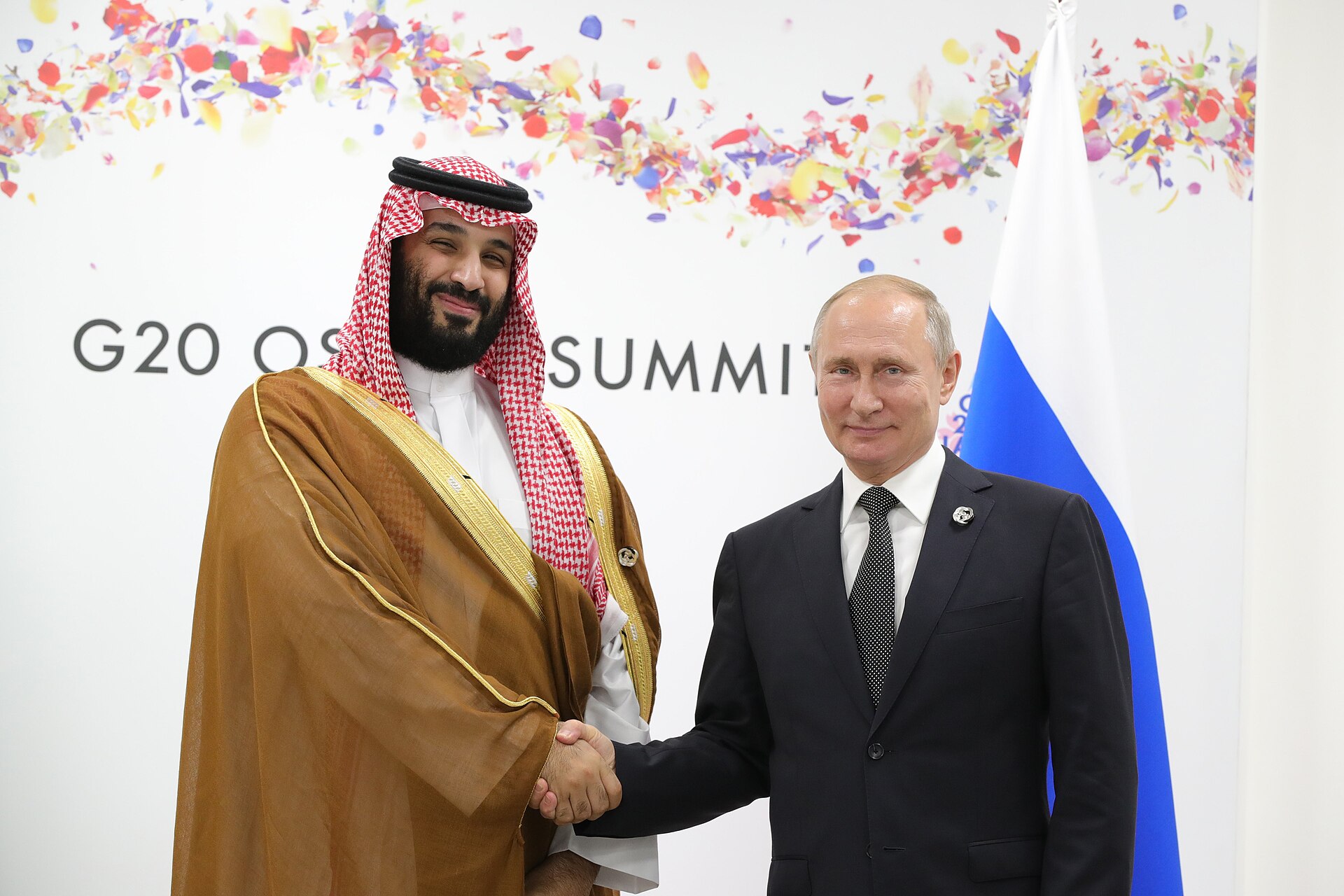
Saudi Crown Prince Mohammed bin Salman shakes hands with Russian President Vladimir Putin at the G20 Osaka Summit, June 2019 — bilateral diplomacy that typifies the coalitions MBS built before the Iran war ceasefire
Previous Story

MBS Spent 52 Days Building a Ceasefire Netanyahu Never Signed

Latest from Energy & Oil

The HOS Daily Brief

The Middle East briefing 3,000+ readers start their day with.

One email. Every weekday morning. Free.

Something went wrong. Please try again.