Table of Contents
DHAHRAN — Iran fired roughly 90 projectiles at Gulf infrastructure between March 28 and April 1, a fraction of the 480 ballistic missiles it launched on the war’s opening day, but the strikes that landed hit airports, energy terminals, telecommunications hubs, and a specific Aramco-ExxonMobil refinery at Yanbu with a precision that the first week’s barrages never achieved. The shift — from volume-based saturation to what Western defense analysts at the Stimson Center have described as deliberate “economic targeting” of irreplaceable nodes — represents a qualitative change in the threat facing Saudi Arabia’s oil export architecture, one that interceptor success rates cannot answer.
The distinction matters because Saudi Aramco’s ability to move crude to global markets depends on a small number of fixed, identifiable chokepoints — chief among them Ras Tanura, the world’s largest offshore loading terminal, which sits 150 to 200 kilometres from Iranian territorial waters and handles up to 9 million barrels per day through just four Sea Island berths. A precision campaign does not need to overwhelm the air defense shield protecting that facility; it needs to put one correctly aimed warhead onto one of those berths, and the math changes for every tanker captain and insurance underwriter on the planet. Dated Brent closed at $141 a barrel on April 2, and the price already reflects a market that understands this logic even if intercept-rate headlines do not.
Fewer Missiles, More Hits
Iran’s ballistic missile launch rate has collapsed approximately 94 percent from its Day 1 peak, falling from roughly 480 launches on February 28 to between 20 and 30 per day by late March, according to tallies compiled by the Jerusalem Post and RFE/RL. The total count since the war began — approximately 2,410 missiles and 3,560 drones, per Bloomberg and CSIS estimates — is not the story. The trajectory within those numbers is: Iran is not running out of ammunition so much as it is spending it differently, concentrating fewer rounds on targets selected for their economic irreplaceability rather than their proximity to military installations.
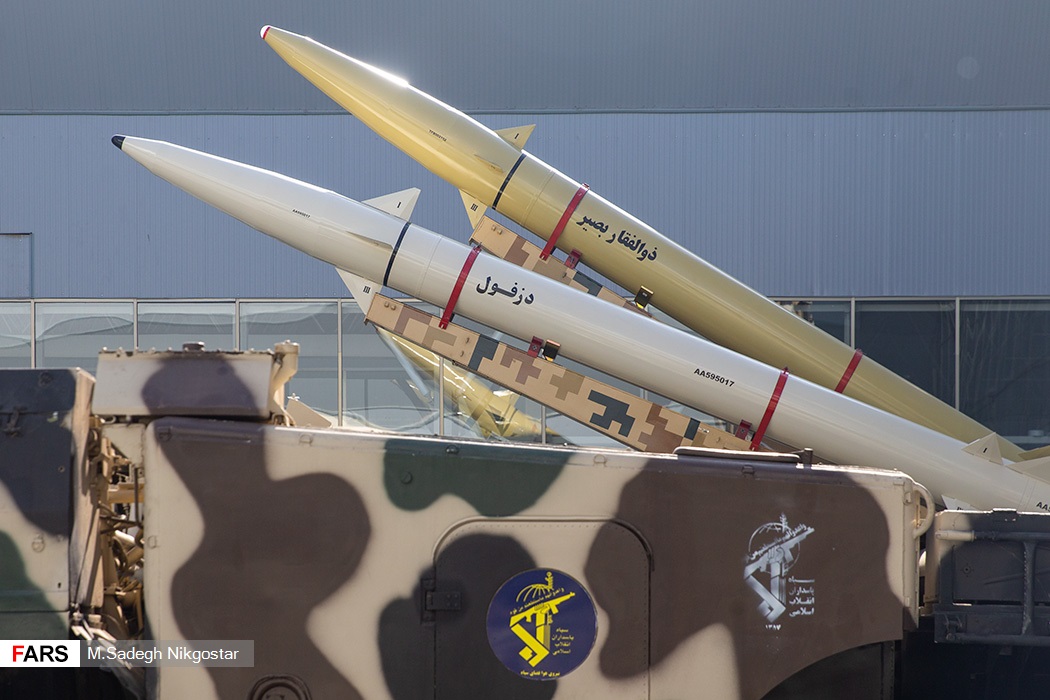
Open-source strike data compiled by the FDD Long War Journal shows a sharp increase in hit effectiveness after approximately March 10, with as many as 25 percent of missiles penetrating defensive screens — a rate that Bloomberg’s analysts described by noting that “a degraded Iran firing fewer and better aimed missiles and drones at carefully selected, fixed targets is getting more effective at imposing costs.” The improvement coincides with Iran’s documented use of Zolfaghar ballistic missiles guided by China’s BeiDou-3 satellite navigation system, which Modern Diplomacy reported on April 1 have demonstrated circular error probable — the radius within which half of all rounds land — of less than 5 to 10 metres, accurate enough to strike specific buildings and individual radar antennas.
That level of precision turns the targeting calculus inside out. When Iran was lobbing hundreds of missiles per day in the war’s first week, the question was whether Saudi air defenses could maintain their intercept rate against sheer volume. Now the question is what happens when even a handful of the 20 to 30 daily launches are aimed at structures where a single hit causes weeks of downtime — and the answer, as the 2019 Abqaiq-Khurais attack demonstrated, is that the damage compounds far beyond the blast radius.
What Changed After March 10?
The shift was doctrinal, not accidental. In January 2026 — before the current war — Iran formally declared a new strategic posture it called “active and unprecedented deterrence,” explicitly superseding the “strategic patience” framework that had governed its regional behavior for years, as Al Jazeera reported on March 6. Iranian Foreign Minister Abbas Araghchi told interviewers that Tehran had spent “two decades studying US wars to build a system capable of continued fighting even if the capital was bombed,” centred on what he called a “decentralised mosaic defence” — a distributed command architecture designed to keep firing even after American and Israeli strikes destroyed western-positioned launch infrastructure.
The Middle East briefing 3,000+ readers start their day with.
One email. Every weekday morning. Free.
Bloomberg reported on March 25 that Iran responded to those strikes by shifting launches to Khorramshahr-series missiles fired from hardened bases in eastern Iran, beyond the reach of the US and Israeli air campaigns that had degraded its western launch sites. The geographic adjustment was paired with the targeting adjustment: fewer total launches, but aimed at what CSIS analysts described as targets chosen so that “each target category serves a distinct coercive purpose — attacks on military installations raise risks to U.S. personnel, while strikes on airports and ports signal to Gulf governments that hosting U.S. forces carries direct economic consequences.” The think tank added that “disruptions to LNG and oil infrastructure send a warning far beyond the Middle East.”
TRENDS Research and Advisory, the Abu Dhabi-based strategic consultancy, went further, arguing that Iran’s infrastructure targeting campaign is “the logical culmination of a doctrinal trajectory embedded in the Islamic Republic’s strategic culture” — one that traces directly to the War of the Cities from 1984 to 1988 and the Tanker War, when Iran carried out 168 attacks on commercial shipping to establish the principle that energy chokepoints are strategic targets, not collateral damage. The Stimson Center’s assessment was blunter: “The economic targeting was not incidental. It was the strategy.”
The Ras Tanura Problem
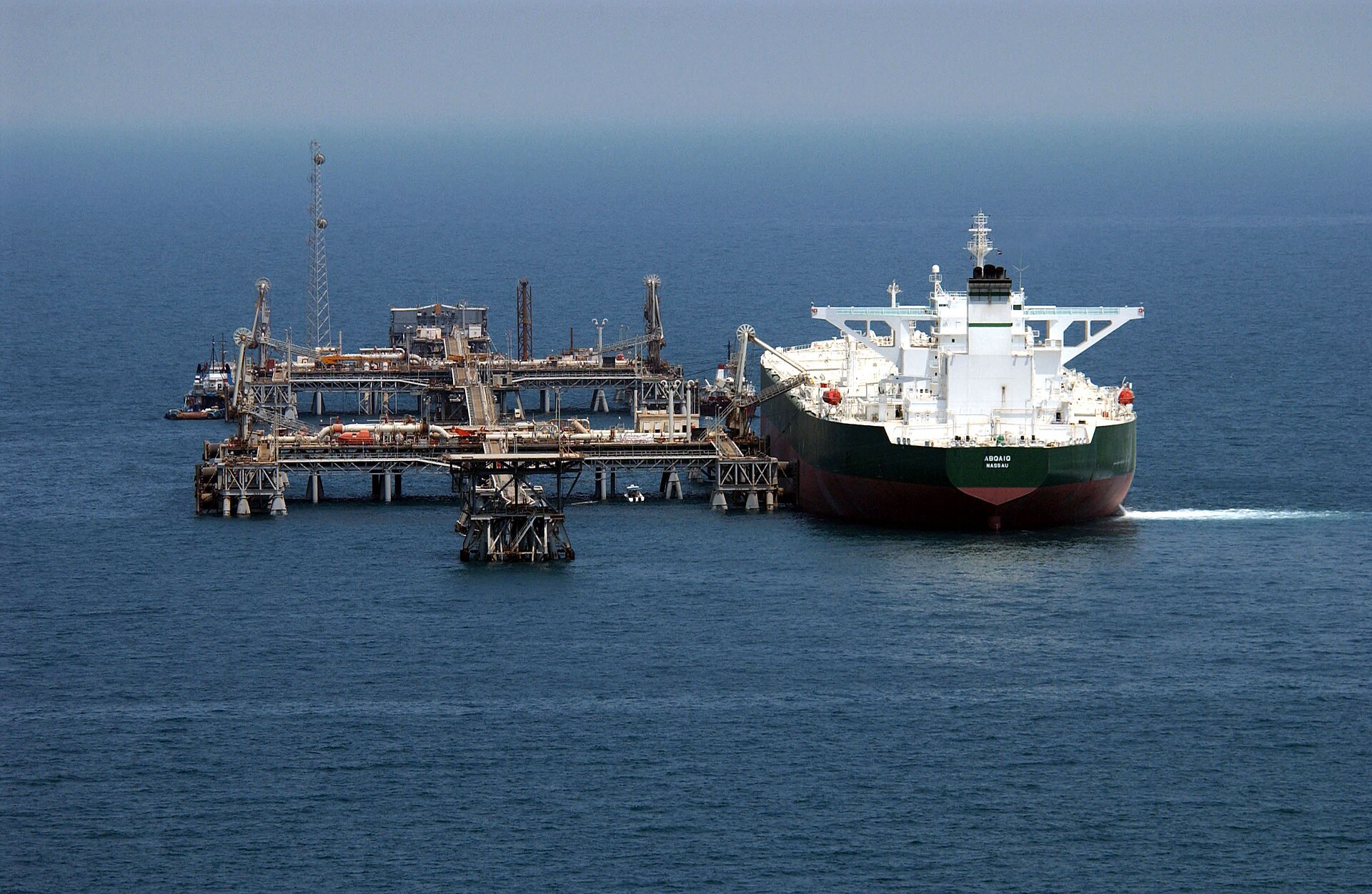
Ras Tanura is not merely a large oil facility — it is the single point through which the largest volume of Saudi crude reaches the world, and its physical layout makes it uniquely vulnerable to the kind of precision targeting Iran has now demonstrated it can execute. The terminal’s four Sea Island offshore berths can load 16 very large crude carriers simultaneously, with 50 million barrels of onshore storage and a 550,000 barrel-per-day refinery, according to CSIS and the terminal’s own specifications. All of that sits within range of every missile system Iran has used in this war, with flight times that compress the warning window for interception.
The facility has already been hit. On March 2, two Iranian drones were intercepted over Ras Tanura, but falling debris caused a contained fire that led Aramco to shut the refinery for approximately one week as a precautionary measure, The National reported. That was a near-miss by drones that were successfully intercepted, and it still took 550,000 barrels per day offline for seven days. The 2019 Abqaiq-Khurais attack — a single coordinated drone and cruise missile strike against inland processing facilities, with no follow-on pressure and full access to spare parts — knocked out 5.7 million barrels per day, halved Saudi output, and required more than 10 weeks for full recovery. The conditions in 2026 are worse in every measurable dimension: Iran can and does follow up with additional strikes, Hormuz traffic has fallen 94 percent since March 1, and spare-parts supply chains run through a war zone.
A BeiDou-3-guided Zolfaghar with a 5-to-10-metre CEP does not need to destroy a Sea Island berth — it needs to damage the loading arms, piping manifolds, or mooring dolphins badly enough that VLCCs cannot safely dock, and because those structures sit on fixed platforms in open water, they cannot be hardened, relocated, or hidden. The question confronting Aramco’s export planners is not whether the shield over Ras Tanura can stop 95 percent of incoming projectiles; it is what happens when the 5 percent that gets through is aimed at a specific berth rather than the general facility.
Can the East-West Pipeline Take the Load?
Saudi Arabia’s contingency for a Hormuz closure or an Eastern Province disruption has always been the East-West Pipeline — the Petroline system that carries approximately 7 million barrels per day from the eastern oil fields to the Red Sea port of Yanbu, bypassing the Strait of Hormuz entirely. It is the sole functional alternative to Gulf-facing export infrastructure, and Iran has already struck it. On March 19, Iranian drones hit the SAMREF refinery at Yanbu — the Saudi Aramco-ExxonMobil joint venture — causing what official statements described as minimal damage, according to the Times of Israel. A subsequent ballistic missile was intercepted over the port itself during the March 28 to April 1 escalation window, and a drone struck the refinery again.
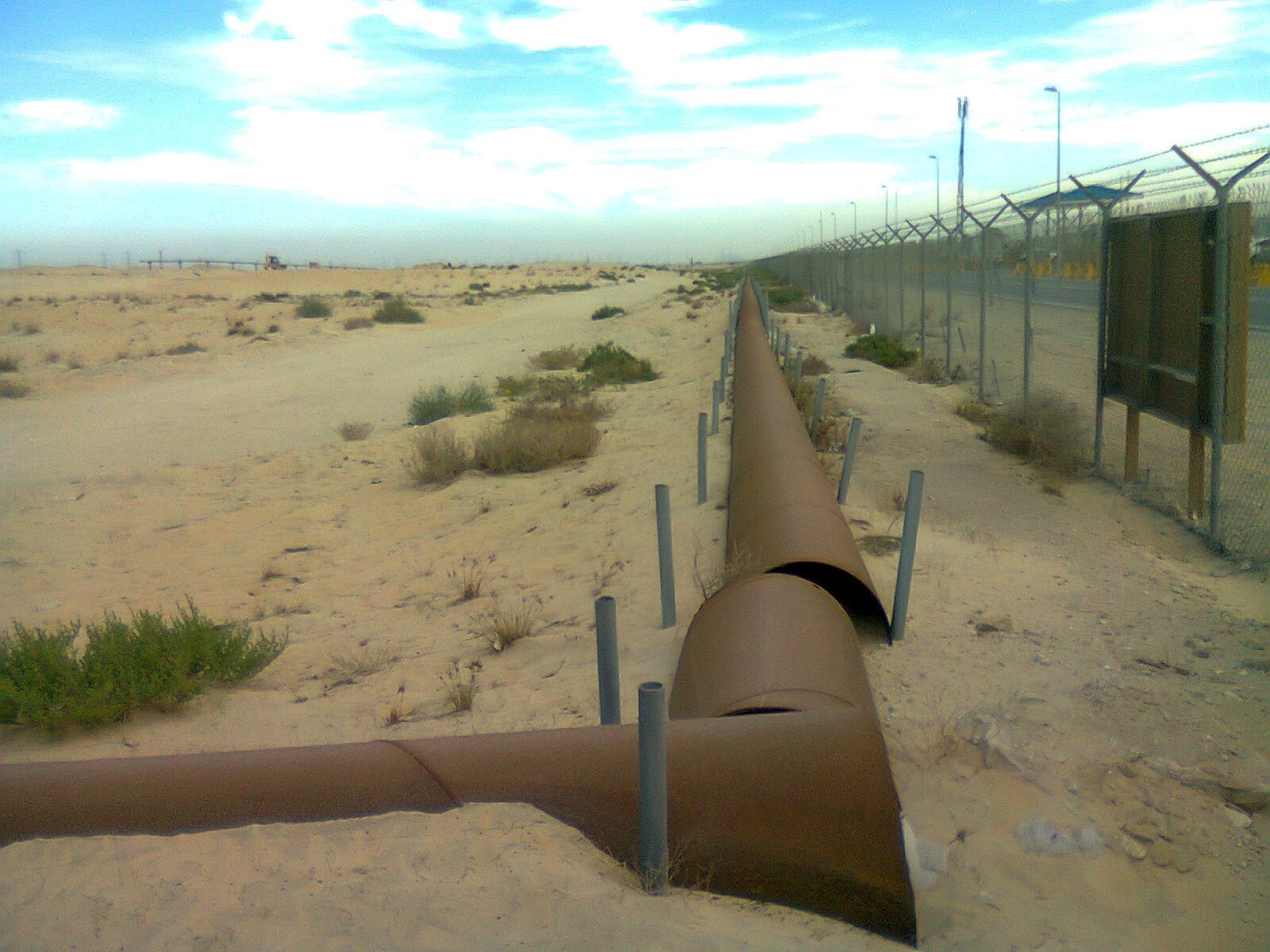
The pipeline’s vulnerability is structural, not incidental. It runs roughly 1,200 kilometres across open desert, above ground for substantial stretches, and terminates at a port complex whose receiving, storage, and loading facilities are as fixed and identifiable as Ras Tanura’s. If Iran can put a Zolfaghar onto a specific building in the Eastern Province, it can put one onto a pumping station in the desert or a loading berth at Yanbu — and the East-West Pipeline does not have a backup. When CSIS analysts warned that strikes on oil infrastructure “send a warning far beyond the Middle East,” this is what they meant: Saudi Arabia’s two export routes are both within demonstrated Iranian targeting capability, and degrading one increases dependency on the other, which has also been hit.
The Doctrine Behind the Targeting
The IRGC is not merely executing this campaign — it is, according to multiple intelligence assessments, now running the Iranian state. A Washington Post report citing US intelligence from March 16 predicted “a weakened but more hard-line government in Tehran, backed by the powerful IRGC” that is “taking an even greater role in domestic affairs of the state.” The Eurasia Review confirmed on April 2 that an IRGC military council has taken de facto control, vetoing President Pezeshkian’s appointments and cutting him off from Supreme Leader Mojtaba Khamenei. Ahmad Vahidi, appointed IRGC commander on March 1, “practically controls the country,” according to the Times of Israel.
The IRGC’s institutional identity is built around the doctrine now being executed. On March 29, an IRGC statement carried by Al Jazeera framed strikes on UAE and Bahrain aluminium facilities as legitimate because they were “linked to US war” operations — extending the target set from military and energy infrastructure to civilian industrial capacity. On April 1, the IRGC went further, declaring 18 American technology companies — including Apple, Google, Meta, Microsoft, Amazon AWS, and Nvidia — “legitimate targets,” stating that “since the main element in designing and tracking terror targets are American ICT and AI companies… the main institutions effective in terrorist operations will be our legitimate targets.” An Amazon AWS building in Bahrain was subsequently struck, as Time reported.
That doctrine appears to have worked at the strategic level. A US intelligence assessment dated April 2 found that roughly half of Iran’s ballistic missile launchers remain intact after five weeks of strikes — a finding that directly validates the IRGC’s dispersion and concealment calculus, and that contradicts White House claims about the campaign’s effectiveness.
The escalation in target categories follows the same logic as the precision shift: an IRGC that controls the state, faces no domestic political constraint from Pezeshkian’s civilian government, and has absorbed weeks of American and Israeli airstrikes without losing its eastern launch capability has no institutional reason to pull back from a campaign it views as doctrinally justified and operationally effective. The GCC’s challenge is not that Iran is firing blindly — it is that the body choosing the targets is both the military command and the government, with a strategic culture that treats infrastructure warfare as a proven instrument dating back four decades.
Why Intercept Rates No Longer Matter
GCC states have intercepted an estimated 1,200 ballistic missiles and the majority of Shahed-series drones since February 28, according to Bloomberg and CSIS tallies — numbers that produce an intercept rate most defense ministries would publicise. But the rate is a measure of the wrong thing when the adversary’s strategy has shifted from saturation to precision. GCC PAC-3 interceptor stocks have fallen to approximately 400 rounds, a finite number that Iran can drain through continued launches — even at the reduced rate of 20 to 30 missiles per day — while only needing one correctly aimed warhead to reach Ras Tanura’s loading infrastructure, or one drone to strike a pumping station on the East-West Pipeline.
The Abqaiq precedent makes the recovery timeline concrete. That 2019 attack — 18 drones and 7 cruise missiles, a single salvo with no follow-up — took 5.7 million barrels per day offline and required more than 10 weeks to restore full capacity, at a time when Saudi Arabia had unimpeded access to international supply chains, no ongoing conflict, and no threat of follow-on strikes. In 2026, every one of those conditions is reversed: Iran has demonstrated follow-on capability, Hormuz is effectively closed, supply chains are disrupted, and the same spare parts and specialised components that Aramco sourced globally in 2019 must now navigate a war zone. A strike on a Ras Tanura Sea Island berth would not replicate Abqaiq — it would be Abqaiq with the exits blocked.
Qatar’s experience demonstrates the pattern at work. Ras Laffan — the LNG facility that supplies approximately 20 percent of global output — was forced to halt operations after Iranian drone strikes, The National reported on March 2. Salalah Port in Oman was hit. Jebel Ali Port in Dubai caught fire from interception debris, according to the FDD Long War Journal. Each of these facilities was struck or damaged not by overwhelming force but by individual projectiles reaching individual targets, and each one imposed costs — in downtime, in insurance premiums, in the quiet decisions of shipping companies to route elsewhere — that no intercept-rate statistic captures. The war’s economic damage is being measured in barrels not loaded and tankers not dispatched, not in missiles stopped overhead.
Frequently Asked Questions
How does Iran’s current missile accuracy compare to its capabilities during the 2020 Ain al-Asad strike?
The January 2020 strike on Ain al-Asad airbase in Iraq, launched in retaliation for the killing of Qassem Soleimani, used Qiam and Fateh-110 missiles that hit within roughly 20 to 30 metres of their targets — considered a strong performance at the time. The BeiDou-3-guided Zolfaghar missiles documented in 2026 by Modern Diplomacy achieve a CEP of 5 to 10 metres, representing a two-to-fourfold improvement in accuracy that analysts attribute to the integration of Chinese satellite navigation and likely improvements in terminal guidance. The difference between 25-metre accuracy and 5-metre accuracy is the difference between hitting a facility and hitting a specific piece of equipment inside it.
What would a successful strike on a Ras Tanura Sea Island berth do to global oil markets?
Each of Ras Tanura’s four Sea Island berths handles loading for multiple VLCCs simultaneously, and the loading arms and manifold piping are precision-engineered systems that cannot be replaced with off-the-shelf components. Marine terminal engineers consulted by industry publications have noted that damage to a single berth’s loading infrastructure could take that berth offline for months, reducing the terminal’s throughput by 25 percent per berth lost. With Hormuz traffic already down 94 percent, Dated Brent at $141 per barrel, and the East-West Pipeline’s Yanbu terminus already struck, even a partial reduction in Ras Tanura’s capacity would remove a volume of export capability that no other producer can replace on a timeline shorter than several months.
Has Saudi Arabia dispersed its oil storage to reduce vulnerability?
Aramco maintains strategic storage facilities at multiple locations including Ras Tanura’s 50-million-barrel tank farm, inland facilities, and reserves held in international locations such as Okinawa, Japan and Rotterdam, Netherlands, under commercial storage agreements. However, storage dispersal does not address the terminal bottleneck: crude oil in tanks is useless if the loading infrastructure that puts it onto tankers is damaged, and Saudi Arabia’s export-capable terminals remain concentrated at Ras Tanura, Ju’aymah, and Yanbu — three facilities, all of which are within demonstrated Iranian strike range.
Could Saudi Arabia rapidly build alternative export terminals?
Constructing a new deepwater crude loading terminal capable of handling VLCCs requires three to five years under peacetime conditions, according to industry engineering estimates, encompassing environmental permitting, dredging, subsea pipeline installation, and the fabrication of specialised loading equipment. Saudi Arabia’s Red Sea coastline offers potential sites, but the same supply-chain disruptions affecting spare-parts procurement apply to new construction, and any new terminal would face the same targeting threat unless Iran’s precision strike capability is neutralised — a condition that US and Israeli airstrikes have not achieved after more than a month of bombardment of Iranian launch sites.
What role does China’s BeiDou-3 system play in Iran’s precision improvement?
BeiDou-3, China’s global satellite navigation system that achieved full operational capability in 2020, provides positioning accuracy of approximately 2.5 metres in the Asia-Pacific region — comparable to US GPS. Modern Diplomacy’s April 1 reporting on Zolfaghar missile accuracy strongly suggests that Iranian integration of BeiDou-3 receivers into missile guidance packages has been the primary technical enabler of the precision shift, replacing Iran’s previous reliance on less accurate inertial navigation systems. Beijing has not publicly acknowledged authorising Iranian military use of BeiDou-3, but the system’s signals are available to civilian users globally, and the conversion of civilian receivers to military guidance applications is a well-documented practice across multiple state missile programmes. The Saudi response to the growing precision threat — including a 10-year defense pact with Ukraine covering interceptor drones and electronic warfare systems — is detailed in the analysis of MBS’s multi-supplier air defense strategy. That escalation reached its peak on April 4, when Iran launched a record 79-projectile barrage at the UAE — 23 ballistic missiles and 56 drones — in a single 24-hour period. The UAE’s interceptor stockpile arithmetic and the four-day escalation pattern that produced the record barrage are examined in full here.