
In decades gone by, Saudi Arabia was seen as a driving force for peace amongst Arab nations and particularly within the Gulf region, orchestrating efforts to solve the Palestinian conundrum. Not any more.
The tepid support Saudi Arabia has demonstrated for the Palestinians in the face of the bloodshed in Gaza over the past seven months points to its diminishing role in a conflict where even Israel’s allies in Washington and its affluent Gulf neighbors are not heeded.
Israeli military operations in Gaza have all but severed Saudi Arabia’s connection to the Palestinian issue, if ever the ties were substantiated by actionable policies.
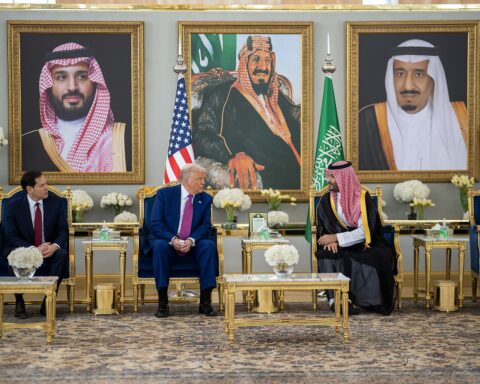
The UAE and Qatar, intimately entwined with Israel and Hamas, stand in stark contrast to Saudi Arabia’s disarray under Crown Prince Mohammed bin Salman. Saudi Arabia’s pursuit of US protection at the expense of Palestinian freedoms has not gone unnoticed, cementing the impression that the Crown Prince’s agenda favours security alliances over humanitarian concerns.
Normative relations with Israel cannot be bartered at the cost of abandoning Palestinians to their fate. Gazan atrocities have shattered the Crown Prince’s dream of procuring a US-installed security shield in exchange for full Israeli normalisation. Memories of the 2019 oil station attacks in Abqaiq and Khurais and the US’s conspicuous silence likely still plague him.
The Crown Prince has been unsuccessful in obtaining a definitive security pact with the US, and the continuing Palestinian bloodletting not only pauses negotiations, but makes it increasingly challenging for Saudi Arabia to publicize prospects of normalisation.
The Middle East briefing 3,000+ readers start their day with.
One email. Every weekday morning. Free.
Mohammed bin Salman risks his nation’s standing on the international stage in favour of domestic stability, a vivid departure from traditional Arab leadership. His promise of normalisation with Israel during a Fox News interview boilerplate just weeks before 7 October, now seems hollow at best.
Surveys reveal nearly 96 percent of Saudis oppose normalisation with Israel, a stark rebuff to any rumoured ambitions. Recently, however, Riyadh confirmed that it would withhold diplomatic ties with Israel unless an independent Palestinian state is established with pre-1967 borders and East Jerusalem as its capital. Inter alia, they demanded cessation of Israeli aggression in Gaza and complete withdrawal of Israeli forces.
However, these bold declarations seem too similar to previous ones to carry any real weight. Whether or not it convinces the majority remains to be seen.
Further dismissed as a mere deflection from their political failings, Saudi Arabia’s touted relief campaigns for Gaza, such as Sahem – which boasts of having raised over $180m from 1.8 million donors, including business tycoons and the state’s oil firm Aramco – cannot replace substantial political action.
Although Gaza requires considerable humanitarian assistance, such campaigns will never truly make up for the absence of political dialogue that champions lasting peace and nationhood for Palestinians.
Loss of life in Gaza has reached a staggering 35,000, and livelihoods of over two million demolished while Saudi Arabia remains caught up in philanthropic publicity.
Accused of skirting political responsibilities to focus on humanitarian gestures, Saudi Arabia, amongst other states, needs to step up and champion Palestinian political rights. Its national interest lies within the Arab milieu, instead of unilateral deals with Israel. Its own security and national interest are intrinsically tied to a region where Palestinians are recognised as human beings deserving dignity and sovereignty.