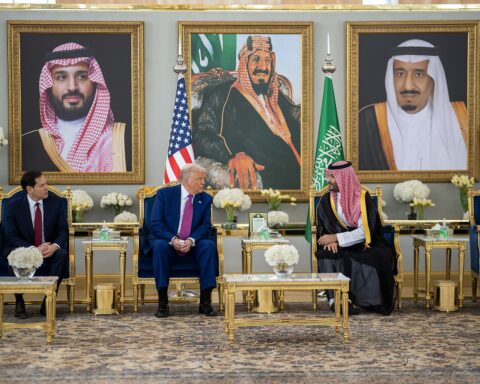
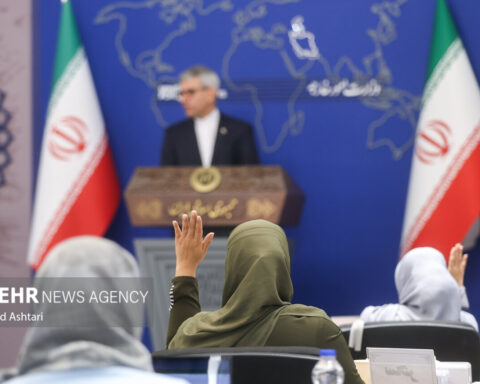
RIYADH — Washington demands unconditional surrender from Iran. Riyadh wants the missiles to stop falling on its desalination plants. That gap between American war aims and Saudi survival interests now represents the most consequential strategic divergence in the 80-year history of the US-Saudi alliance, and it is widening with every sortie the Pentagon flies over Tehran.
On March 6, President Donald Trump declared there would be “no deal with Iran except UNCONDITIONAL SURRENDER.” Four days later, Defense Secretary Pete Hegseth pledged the “most intense day of strikes” yet as the US military targeted Iran’s navy, ballistic missile stocks, and military-industrial base. The White House projects another four to six weeks of sustained bombardment. Saudi Arabia, absorbing Iranian retaliatory fire across its entire eastern seaboard, has reached a different calculation: every additional week of American escalation multiplies the risk that the Kingdom’s critical infrastructure — not Iran’s — becomes the war’s defining casualty.
What follows is an examination of why the United States and Saudi Arabia are fighting different wars with incompatible endgames, how the precedents of Iraq and Libya frame the nightmare scenario Riyadh cannot ignore, and what the three most likely outcomes of this divergence mean for the Kingdom’s security, economy, and strategic autonomy.
Table of Contents
- What Does Washington Actually Mean by ‘Unconditional Surrender’?
- How Did Saudi Arabia End Up on the Wrong Side of Its Own Ally’s War?
- The Four Wars Being Fought Simultaneously
- Why Does Saudi Arabia Need This War to End More Than America Does?
- The Iraq Precedent Saudi Arabia Cannot Ignore
- What Would a Collapsed Iran Mean for the Kingdom?
- The Graham Ultimatum and the Alliance Under Strain
- Can Saudi Diplomacy Outrun American Firepower?
- The Endgame Compatibility Matrix
- What History Reveals About Unconditional Surrender Demands
- The Contrarian Case for Why Washington’s Maximalism Might Serve Riyadh
- Three Scenarios for the War’s End
- Frequently Asked Questions
What Does Washington Actually Mean by ‘Unconditional Surrender’?
The phrase “unconditional surrender” carries a weight in military history that the current administration appears to invoke deliberately and interpret loosely. White House press secretary Karoline Leavitt defined it as President Trump determining “that Iran can no longer pose a threat to the U.S. and our troops in the Middle East.” She enumerated four operational objectives: destroying Iran’s navy, eliminating its ballistic missile capability, ensuring Tehran cannot obtain a nuclear weapon, and weakening its regional proxy networks.
Defense Secretary Hegseth framed the campaign through three military goals during his March 10 Pentagon briefing: continuing to degrade Iran’s missile and drone infrastructure, striking the Iranian navy, and dismantling Iran’s military-industrial base. He simultaneously denied and acknowledged regime change in a single sentence that captured the administration’s strategic ambiguity: “This is not a so-called regime change war, but the regime sure did change, and the world is better off for it.”
Trump himself offered a remarkably elastic definition. “Unconditional surrender could be that they announce it,” he told Axios. “But it could also be when they can’t fight any longer because they don’t have anyone or anything to fight with.” He then added that after surrender, “GREAT & ACCEPTABLE Leader(s)” must be selected — language that implies Washington intends to shape Iran’s post-war political order.
The Middle East briefing 3,000+ readers start their day with.
One email. Every weekday morning. Free.
The operational gap between “destroying a navy” and “selecting acceptable leaders” is the gap between a military campaign and a nation-building project. The first requires weeks. The second required two decades in Iraq and Afghanistan, and it failed in both.
Eleven days into Operation Epic Fury, the Pentagon has lost seven American service members, with roughly 140 wounded, according to the Department of Defense. Iran’s state media reports over 1,230 killed by US and Israeli strikes. The operation’s name — Epic Fury — may inadvertently describe the war’s trajectory more accurately than its architects intended.

How Did Saudi Arabia End Up on the Wrong Side of Its Own Ally’s War?
The Saudi position in this conflict is a paradox that decades of alliance management never anticipated: the Kingdom’s most important security partner launched a war that directly endangered the Kingdom’s most vital infrastructure, and then demanded gratitude for doing so.
The timeline matters. In March 2023, Saudi Arabia and Iran signed a Chinese-brokered rapprochement agreement that reopened embassies and reduced regional tensions. Three years of Gulf-Iran détente followed, during which Crown Prince Mohammed bin Salman invested heavily in the premise that diplomacy, not confrontation, would neutralize the Iranian threat.
Then came February 28, 2026. The Washington Post reported that both Saudi and Israeli governments had lobbied Trump to strike Iran, though Riyadh swiftly and emphatically denied the claim. The truth likely sits between these competing narratives. Princeton’s Bernard Haykel, widely considered one of the most authoritative voices on Saudi strategic thinking, told Bloomberg that MBS “was against this war” — a claim grounded in the Crown Prince’s awareness that Iran possesses an arsenal of short-range missiles capable of devastating Saudi energy and water infrastructure, and that Riyadh has no effective method of defending against swarm attacks.
Whether MBS quietly encouraged the strikes while publicly opposing them, or whether Washington acted with minimal Saudi consultation, the result is identical: Saudi Arabia is absorbing Iranian retaliatory fire across its entire territory without having any meaningful input into the war’s objectives, timeline, or endgame conditions.
Since March 1, Iran has launched ballistic missiles at Prince Sultan Air Base (where American troops are stationed), cruise missiles near Al Jouf, drone swarms targeting the Shaybah oil field, and 15 drones aimed at Riyadh’s diplomatic quarter. Two foreign nationals — one Indian, one Bangladeshi — were killed when a projectile struck a residential building in Al-Kharj. Iran’s Foreign Minister Abbas Araghchi apologized for striking Middle Eastern neighbors, claiming the attacks targeted only nations “aiding the US-Israeli operation.” Saudi officials dismissed this as “flimsy pretexts that have no basis in reality.”
The Four Wars Being Fought Simultaneously
The Iran conflict is not one war. It is four interlocking confrontations, each with different participants, different objectives, and different timelines. Saudi Arabia is a combatant in three of them and a hostage in the fourth.
| Conflict | Belligerents | Objective | Saudi Role | Duration Risk |
|---|---|---|---|---|
| Air War | US/Israel vs. Iran | Destroy military capacity | Bystander/host | 4-6 weeks (Pentagon estimate) |
| Retaliatory War | Iran vs. Gulf States | Punish US allies, deter | Primary target | Until ceasefire or exhaustion |
| Economic War | Iran vs. Global markets | Raise costs via Hormuz closure | Major victim | Months to years |
| Political War | US Congress vs. Saudi | Force Saudi belligerency | Defendant | Ongoing |
The air war is Washington’s war — fought from altitude, at a distance, against a list of predetermined targets. The Pentagon can absorb the cost. Seven American casualties in eleven days is tragic but strategically tolerable for a military that lost 4,488 lives over twenty years in Iraq. The retaliatory war, by contrast, is Saudi Arabia’s war — and it is being fought against the Kingdom’s most vulnerable infrastructure at point-blank range.
The preliminary Pentagon investigation into the Minab school strike that killed 175 Iranian children has added a moral dimension to this strategic divergence, forcing Riyadh to weigh its dependence on American military hardware against the reputational cost of silent alignment with the deadliest civilian casualty event of the war.
The economic war transcends both. Brent crude surged past $126 per barrel on March 8, the highest price in over four years, after the Strait of Hormuz effectively closed to commercial traffic. The IRGC declared the strait blocked on March 2; tanker traffic dropped approximately 70 percent within hours, and over 150 commercial vessels anchored outside the strait to avoid the risk zone. Saudi Arabia, which exports roughly 6 million barrels per day, has been forced to reduce output as onshore storage fills.
The political war is the quietest and potentially the most damaging. Senator Lindsey Graham’s public threat to kill the proposed US-Saudi defense pact unless Riyadh commits military forces to strike Iran represents a new category of pressure. It transforms the alliance from a shield into a lever — and it signals that Washington views Saudi neutrality not as prudent restraint, but as betrayal.
Why Does Saudi Arabia Need This War to End More Than America Does?
The United States is fighting a war of choice at standoff range. Saudi Arabia is enduring a war of consequence at zero range. That asymmetry explains why Riyadh’s tolerance for prolonged conflict is measured in weeks, while Washington’s is measured in months.
Three categories of vulnerability make the Kingdom’s position uniquely precarious.
Infrastructure Exposure
Saudi Arabia’s critical infrastructure was built for efficiency, not resilience. The Kingdom depends on desalinated water for approximately 70 percent of its drinking supply, with major plants concentrated along the Gulf coast — the same coastline facing Iranian missile batteries across a body of water narrower than 200 miles at its widest. Fortune reported that a strike on a small number of centralized facilities “can produce a humanitarian crisis affecting millions.” The precedent already exists: Iran struck a Bahraini desalination plant on March 2, demonstrating both the capability and the willingness to target water infrastructure.
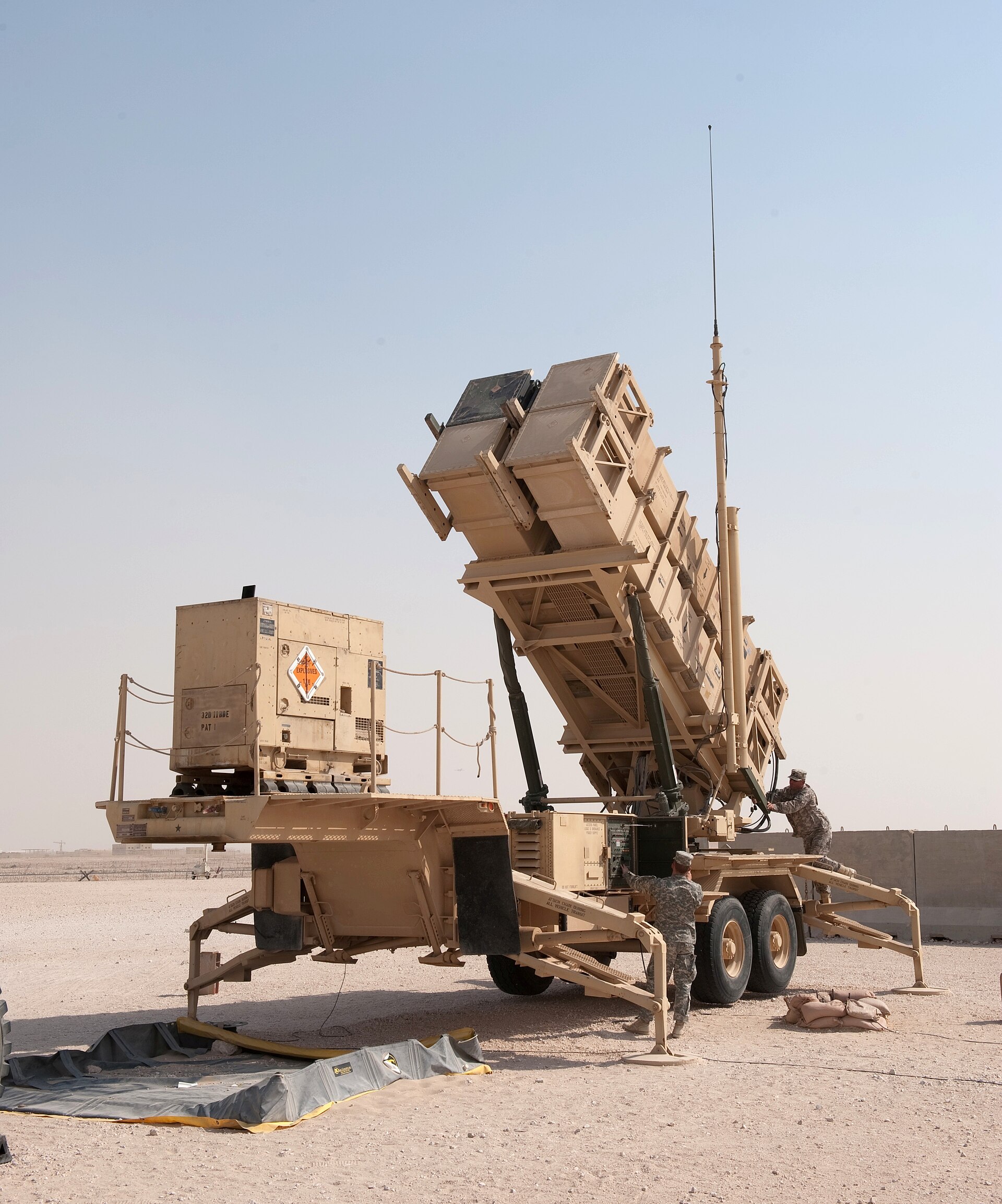
Aramco’s facilities present a similarly concentrated target set. The Ras Tanura refinery complex, the world’s largest oil export terminal, was hit by drones in the first week of the war. The Shaybah field, deep in the Empty Quarter, has faced nine intercepted drone attacks. Each successful intercept depletes a Patriot or THAAD missile costing between $2 million and $13 million; each Shahed drone costs Iran approximately $20,000 to produce. The arithmetic is lethally simple.
Interceptor Depletion
Saudi Arabia’s air defense shield — a combination of Patriot PAC-3, THAAD, and Shahine systems — has performed admirably, intercepting ballistic missiles, cruise missiles, and drone swarms across thousands of kilometers of defended airspace. But performance and sustainability are different measures. Every fired interceptor must be replaced from a supply chain that begins in American factories operating at peacetime production rates. The Pentagon itself faces a shortage of Patriot interceptors, which is precisely why Ukraine’s offer to sell cheap drone-killing interceptors generated such urgent Saudi interest.
Economic Hemorrhage
The war’s economic damage to Saudi Arabia operates on three levels. Direct costs include interceptor expenditure and infrastructure repair. Indirect costs include the oil revenue lost to Hormuz closure and production cuts. Opportunity costs include the foreign investment, tourism revenue, and megaproject momentum being eroded by every day the conflict continues. Vision 2030’s entire architecture depends on foreign confidence in Saudi stability — precisely the quality a war of indefinite duration destroys. Iran’s military command compounded these pressures on March 11 by declaring Gulf banks and financial institutions as legitimate military targets, directly threatening the physical infrastructure of Saudi Arabia’s financial sector.
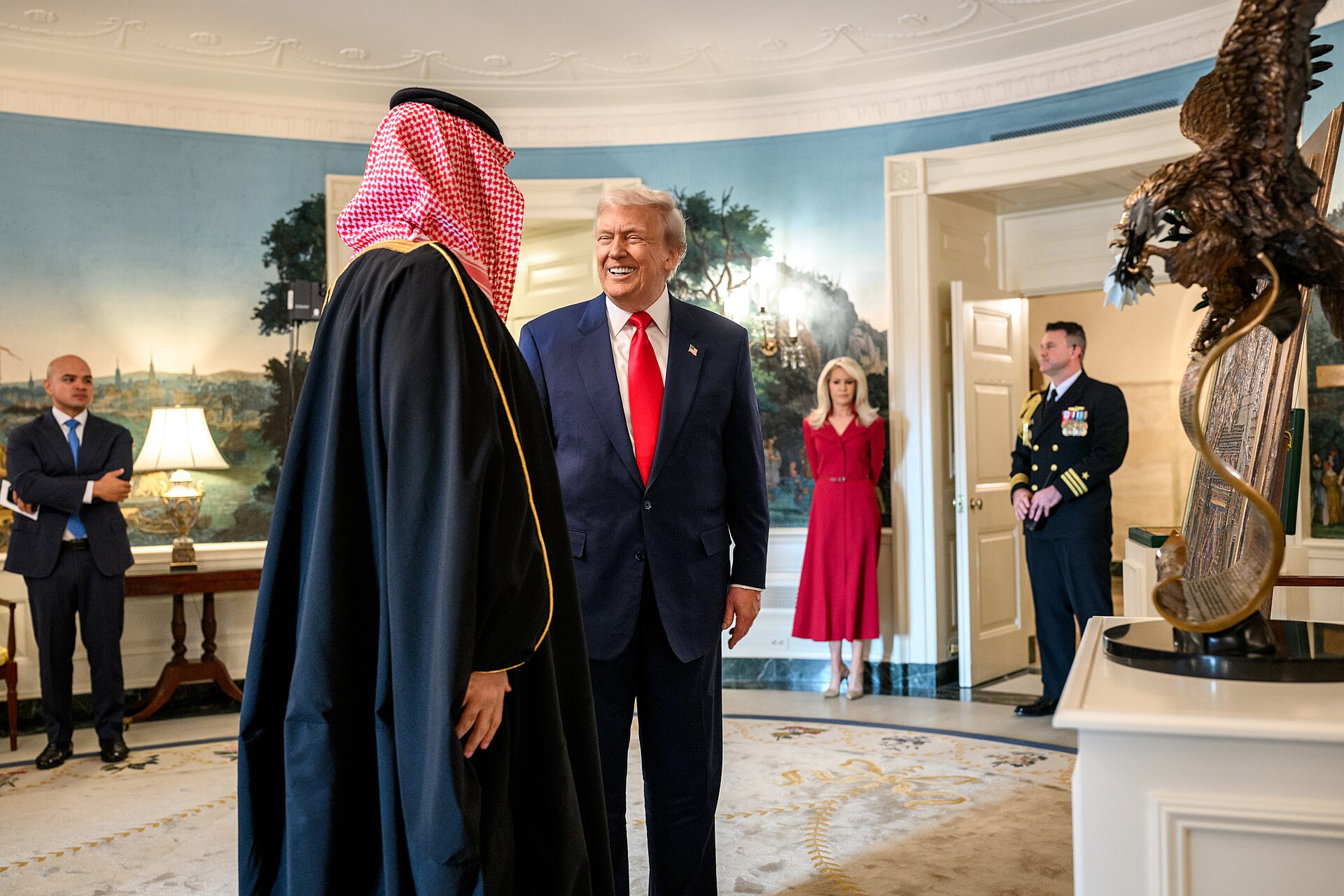
The Iraq Precedent Saudi Arabia Cannot Ignore
Every senior Saudi official who served during the 2003 Iraq War carries the same institutional memory: the United States achieved total military victory in 21 days, and the ensuing chaos lasted two decades. That precedent now dominates Riyadh’s strategic calculations more than any other factor in the current conflict.
The Iraq parallel is not abstract. The United States spent $2 trillion and 4,488 American lives remaking Iraq. The result, as of 2026, is an authoritarian state governed by political parties with deep institutional ties to Tehran, where Iranian-backed militias operate openly on Iraqi soil. The country the US fought to liberate from dictatorship became the primary vector for Iranian influence in the Arab world. For Saudi Arabia, which shares a 814-kilometer border with Iraq, that outcome was a strategic catastrophe — one that took years to mitigate and has never been fully reversed.
Iran is larger than Iraq by a factor of four in population (88 million versus 22 million in 2003), possesses a more developed industrial base, controls more complex ethnic and sectarian fault lines (Persians, Azeris, Kurds, Balochis, Arabs), and sits atop a proxy network that spans Lebanon, Syria, Iraq, Yemen, and Gaza. If state collapse in a 22-million-person Iraq produced a generation of regional instability, the collapse of an 88-million-person Iran could produce something without modern precedent.
Libya reinforces the lesson. NATO-assisted regime change in 2011 killed Muammar Gaddafi and destroyed the existing order. Libya remains a failed state fifteen years later, divided between competing governments, with its oil infrastructure intermittently offline and its coastline serving as a primary transit route for human trafficking into Europe. The fundamental error, as multiple post-mortem analyses have concluded, was the assumption that destroying the existing order creates space for something better. It does not. It creates space for whoever is best organized, best armed, and most willing to fill the vacuum.
In Iran, the organization best positioned to fill a post-regime vacuum is not a liberal democratic movement. It is the IRGC’s Quds Force and its network of provincial militias — the same entities the current air campaign is designed to weaken but cannot eliminate from altitude alone.
What Would a Collapsed Iran Mean for the Kingdom?
A collapsed Iranian state would generate five immediate security threats for Saudi Arabia, each more dangerous than the current war.
First, a refugee crisis. Iran’s 88 million citizens would seek stability across every border. While the primary flow would move toward Turkey, Iraq, and Afghanistan, the Gulf’s labor-dependent economies would face secondary migration pressure that their immigration systems are not designed to absorb. The GCC accepted virtually zero refugees from the Syrian civil war; an Iranian exodus would be exponentially larger and geographically closer.
Second, uncontrolled proxy activation. Iran’s proxy network currently operates under centralized command from Tehran. That command structure constrains as much as it enables — Tehran has repeatedly restrained Hezbollah, the Houthis, and Iraqi militias from escalation that would not serve Iranian strategic interests. Remove the command node, and each proxy becomes an independent actor pursuing its own survival logic. The Houthis, already debating internally whether to restart Red Sea attacks, would face no restraining hand.
Third, nuclear proliferation. Iran’s nuclear program has been a primary justification for the current campaign. But destroying a state’s nuclear infrastructure is not the same as destroying its nuclear knowledge. Iranian nuclear scientists who survive the conflict would represent the world’s most valuable proliferation risk — and in a collapsed-state scenario, no government would exist to prevent their dispersal. For Saudi Arabia, which has publicly stated it would pursue its own nuclear capability if Iran acquired weapons, a proliferated Iranian nuclear diaspora represents an existential security threat.
Fourth, the loss of a diplomatic counterparty. Saudi Arabia’s entire post-2023 Iran strategy depended on the existence of a functioning Iranian government with which agreements could be reached and enforced. A collapsed state has no foreign minister to call, no intelligence service to maintain a backchannel with, and no authority capable of guaranteeing that missiles will stop launching from Iranian territory.
Fifth, the precedent itself. If the United States can destroy the government of an 88-million-person country through two weeks of air strikes, every Middle Eastern state — including Saudi Arabia — must recalculate its vulnerability to American power. The deterrent effect cuts both ways.
The Graham Ultimatum and the Alliance Under Strain
Senator Lindsey Graham’s public demand that Saudi Arabia commit military forces to strike Iran, or face “consequences” including the potential death of the proposed US-Saudi defense pact, represents a qualitative shift in alliance dynamics that extends well beyond one senator’s rhetoric.
Graham’s logic is transactional: the United States provides Saudi Arabia’s security umbrella; Saudi Arabia should therefore fight when America fights. “Why should Washington maintain a security pact with a country unwilling to join a fight of mutual interest?” he asked on March 9. The question resonated across Capitol Hill, where both parties harbor decades of accumulated frustration with Saudi Arabia’s tendency to accept American protection while pursuing independent foreign policies.
But Graham’s framing inverts the alliance’s actual structure. The US-Saudi defense relationship has always been a trade — security for oil market stability, arms sales for petrodollar recycling, military access for diplomatic alignment. At no point in its history has the compact required Saudi Arabia to join American offensive operations against a third country. The Kingdom contributed logistics, basing, and intelligence to the 1991 Gulf War because Iraqi troops had invaded Kuwait, a GCC member. It provided overflight rights and basing for Operation Enduring Freedom because the post-9/11 security environment demanded it. But active belligerency against a neighboring state with which Saudi Arabia had recently normalized relations — at the instruction of a US senator rather than in response to Saudi strategic interest — would be without precedent.
The irony of Graham’s position was not lost on MAGA-aligned Republicans. Representative Anna Paulina Luna publicly criticized the senator, writing that “Lindsey Graham does NOT tell the President what to do, nor does he control Congress.” The intra-Republican division reflects a deeper tension: Trump’s base elected him partly on the promise of ending foreign entanglements, yet his administration is prosecuting the largest US military operation since Iraq while a senior Republican senator demands that Arab allies join the fight.
For Riyadh, the Graham ultimatum clarifies a choice MBS has spent years trying to avoid: choosing between the American security relationship and Saudi strategic autonomy. The war is forcing that choice in real time.
Can Saudi Diplomacy Outrun American Firepower?
Saudi Arabia is attempting something no American ally has successfully done during a US military campaign: negotiate with the enemy faster than the Pentagon can destroy it. The effort is real, urgent, and running against a clock set in Washington rather than Riyadh. The stakes of this diplomatic race became clearer on March 10, when Trump and Putin discussed a quick end to the Iran war in their first phone call of 2026, with Moscow positioning itself as a potential intermediary.
Foreign Minister Prince Faisal bin Farhan has maintained direct contact with Iranian Foreign Minister Abbas Araghchi throughout the conflict. According to Bloomberg, Saudi officials deployed their diplomatic backchannel “with greater urgency” as the war entered its second week. The channel involves security agencies and diplomats, though it remains unclear whether higher-ranking officials — meaning MBS and Iran’s new Supreme Leader Mojtaba Khamenei — have communicated directly.
Faisal bin Farhan’s message to Tehran has been consistent: Saudi Arabia is open to mediation for de-escalation, but will respond if Iranian attacks on its energy infrastructure continue. The dual posture — offering a diplomatic hand while displaying a military fist — mirrors the classic Saudi approach to regional crises. It worked with Qatar in 2017-2021. It worked with Iran itself in 2023. Whether it can work during an active shooting war with a superpower conducting daily bombing runs overhead is the question of this conflict.
Saudi diplomacy has allies. China’s special envoy for the Middle East, Zhai Jun, met Faisal bin Farhan in Riyadh on March 8, signaling Beijing’s willingness to reprise its 2023 broker role. Oman’s backchannel to Tehran — historically the most reliable quiet conduit in the Gulf — remains active. France, Russia, and China have all contacted Iran regarding a ceasefire, according to Iranian Deputy Foreign Minister Kazem Gharibabadi.
But Iran’s response has been categorical rejection. Parliament Speaker Mohammad Bagher Ghalibaf — a former IRGC commander and now a key power center following Khamenei’s death — stated that “Certainly we aren’t seeking a ceasefire. The aggressor must be punished.” Foreign Minister Araghchi has said Tehran sees no reason to negotiate with a country that “attacked us in the middle of negotiations” — a reference to the 2018 JCPOA withdrawal and the February 28 strikes themselves. The trauma of broken American commitments runs deep enough to override rational interest in ending the bombardment.
Saudi diplomacy’s fundamental constraint is structural: Riyadh can offer Tehran an off-ramp, but it cannot guarantee the off-ramp’s terms. Only Washington can do that, and Washington has explicitly stated it will accept nothing short of unconditional surrender.
The Endgame Compatibility Matrix
The gap between US and Saudi war objectives is not a matter of emphasis or sequencing. It is a fundamental incompatibility between two allies pursuing mutually exclusive outcomes. Mapping these objectives reveals the structural impossibility of a resolution that satisfies both capitals simultaneously.
| Objective | Washington’s Position | Riyadh’s Position | Tehran’s Position | Alignment |
|---|---|---|---|---|
| War Duration | 4-6 more weeks acceptable | End immediately | Fight until “aggressor punished” | 0% aligned |
| Iran’s Government | New “acceptable” leadership | Any stable counterparty | Current regime survives | 0% aligned |
| Iran’s Military | Permanently dismantled | Weakened enough to deter | Rebuilt and strengthened | 33% aligned |
| Nuclear Program | Destroyed completely | Destroyed or verifiably constrained | Accelerated to deterrence | 67% aligned |
| Strait of Hormuz | Reopened under US control | Reopened immediately | Leverage maintained | 67% aligned |
| Proxy Networks | Dismantled globally | Weakened in Yemen/Iraq | Maintained as deterrent | 33% aligned |
| Post-War Order | US-shaped transition | Stable regional balance | Regime survival + deterrence | 0% aligned |
| Saudi Role | Active military participant | Neutral mediator | Collateral damage recipient | 0% aligned |
The matrix reveals that Washington and Riyadh agree on only two objectives with any meaningful alignment: reopening the Strait of Hormuz and constraining Iran’s nuclear program. On every other dimension — war duration, regime outcomes, the role of force, post-war governance, and Saudi Arabia’s own posture — the two allies occupy not just different positions but opposing ones.
This incompatibility is not a communication failure. It reflects a structural divergence in strategic interest that predates the current crisis. The United States is a global power that can absorb the costs of regional transformation because it does not live in the region. Saudi Arabia is a regional power that must live with the consequences of that transformation for generations. The US can declare victory and withdraw. Saudi Arabia cannot withdraw from its own neighborhood.
What History Reveals About Unconditional Surrender Demands
The phrase “unconditional surrender” has been deployed three times in modern American military history. Each case illuminates the gap between the demand and its consequences.
Franklin Roosevelt demanded unconditional surrender from Germany and Japan at the 1943 Casablanca Conference. The policy extended both wars — historians including John Keegan and Max Hastings have argued that Germany fought months longer because the Wehrmacht’s officer corps saw no negotiated alternative — but it ultimately produced the most successful post-war reconstructions in history. The critical difference: the United States committed to multi-decade military occupations, spent the modern equivalent of $150 billion on the Marshall Plan, and maintained security guarantees that persist eight decades later.
George W. Bush sought regime change in Iraq without formally demanding unconditional surrender, but the practical result was identical: the existing government was destroyed, no transition authority was prepared, and the occupation that followed cost $2 trillion over twenty years without producing a stable democratic ally. Iraq remains, in 2026, within Iran’s sphere of influence — the precise outcome the invasion was designed to prevent.
Obama’s Libya intervention in 2011 avoided the language of surrender entirely but achieved the same practical end: the destruction of the existing state without a plan for what followed. Libya has been in a three-way civil war since 2014.
The pattern is consistent. Unconditional surrender succeeds when the victor commits to decades of reconstruction, security guarantees, and institutional rebuilding. It catastrophically fails when the victor expects the defeated population to self-organize into a friendly government. Trump has simultaneously demanded unconditional surrender and promised that “we are not going to nation-build in Iran.” History suggests those two commitments are irreconcilable.
For Saudi Arabia, the relevant question is not whether the United States can force Iran’s surrender — American military power makes that plausible over a sufficient timeline — but whether the aftermath will resemble postwar Japan or postwar Iraq. An 88-million-person country bordering eight nations, with ethnic minorities that straddle every border, and a military-intelligence apparatus that has spent four decades cultivating regional proxy networks, does not suggest the Japanese model.
The Contrarian Case for Why Washington’s Maximalism Might Serve Riyadh
The consensus among Gulf policy analysts is that Washington’s war aims represent a strategic nightmare for Saudi Arabia. But there is an evidence-backed counter-argument that Riyadh’s protests may be more performative than genuine, and that a maximally weakened Iran — even a chaotic one — serves long-term Saudi interests more than the status quo ante.
Consider the pre-war security environment. Iran’s missile arsenal threatened every Saudi city and industrial facility. The Houthis, armed and directed by Tehran, had demonstrated the ability to strike Aramco facilities in 2019, forcing a temporary 50 percent reduction in Saudi oil output. Iranian-backed militias in Iraq operated with impunity along Saudi Arabia’s northern border. The 2023 rapprochement did not eliminate these threats; it merely lowered the probability of their activation.
A post-war Iran stripped of its navy, ballistic missile stocks, nuclear infrastructure, and proxy command networks would be, by any measure, less threatening to Saudi Arabia than the pre-war version. The chaos premium — the risk of state collapse, refugee flows, and proxy fragmentation — may be lower than the permanent threat premium Saudi Arabia was paying before the war began.
There is a second argument. Saudi Arabia’s diplomatic protestations position the Kingdom as a responsible neutral and potential mediator — a posture that enhances its regional standing regardless of the war’s outcome. If Iran collapses, Saudi Arabia positioned itself as the voice of restraint. If Iran survives weakened, Saudi Arabia can claim credit for moderating the conflict. The worst outcome for Riyadh is not American maximalism but American abandonment — a premature withdrawal that leaves a wounded, vengeful, and still-armed Iran focused on the Gulf state that hosted the bases from which the strikes were launched.
This counter-argument has limits. A chaotic Iran produces uncontrollable threats that no amount of Saudi diplomatic positioning can mitigate. But it suggests that Riyadh’s private calculations may be more nuanced than its public objections indicate — and that the Kingdom’s real fear is not American victory but American inconsistency.
Three Scenarios for the War’s End
The Iran war’s conclusion will follow one of three paths, each with distinct implications for Saudi Arabia.
Scenario One: Negotiated Ceasefire (Probability: 25-35%)
Iran agrees to a cessation of hostilities in exchange for a partial lifting of the unconditional surrender demand. Trump, who told advisors the war could be declared “very complete” at any point, redefines victory to mean the destruction of Iran’s nuclear and naval capabilities without insisting on political transition. Saudi Arabia and Oman broker the final terms. Hormuz reopens within weeks.
Saudi implications: Best-case outcome. Iran is weakened but functional. Diplomatic channels survive. Oil revenue resumes. Vision 2030 timeline slips by months, not years. The alliance with Washington is strained but intact.
Scenario Two: Grinding Attrition (Probability: 40-50%)
Iran refuses to surrender, and the US continues strikes for four to eight weeks until Iran’s military infrastructure is degraded below operational threshold. Hormuz remains closed or restricted throughout. Oil stays above $100. Iran’s government survives in diminished form, capable of governance but incapable of projecting military power for years. Mojtaba Khamenei consolidates control as wartime Supreme Leader.
Saudi implications: Painful but manageable. Infrastructure damage accumulates. Interceptor stocks decline. Economic costs are severe but finite. The post-war regional order favors Saudi Arabia strategically but at enormous financial cost. The Kingdom emerges as the Gulf’s dominant power but in a poorer, more volatile region.
Scenario Three: Regime Collapse (Probability: 15-25%)
Sustained bombardment, combined with internal unrest and the loss of leadership coherence following Khamenei’s death, produces a collapse of the Iranian state. Multiple factions — IRGC remnants, ethnic separatist movements, opposition groups — contest control of territory and military assets. Nuclear knowledge disperses. Proxies go freelance. The refugee crisis begins.
Saudi implications: Worst-case outcome. The war’s end becomes the beginning of a larger regional crisis. Saudi Arabia faces a failed state of 88 million people across the Gulf, uncontrolled proxy violence in Yemen and Iraq, potential nuclear proliferation, and a refugee flow that destabilizes every neighboring country. The costs of this scenario are measured in decades, not dollars.
| Factor | Negotiated Ceasefire | Grinding Attrition | Regime Collapse |
|---|---|---|---|
| Oil Revenue Impact | -15% (3-6 months) | -35% (6-12 months) | -50%+ (years) |
| Infrastructure Damage | Minimal, repairable | Moderate, costly | Severe, ongoing risk |
| Vision 2030 Delay | 6-12 months | 2-3 years | 5+ years or permanent |
| Regional Standing | Enhanced (mediator) | Mixed (endured but weakened) | Dominant but in ruins |
| Iran Threat Level | Reduced (medium-term) | Eliminated (5-10 years) | Replaced by chaos |
| Alliance with US | Strained but intact | Recalibrated, transactional | Permanently altered |
The probability-weighted outcome favors Scenario Two — grinding attrition — which is precisely the scenario Saudi Arabia is least prepared for. It is too long to be tolerable and too short to be catastrophic. It degrades Saudi resources without destroying them, weakens the alliance without breaking it, and produces a regional order that is better for Saudi Arabia on paper but worse in practice than the pre-war status quo.
The United States can declare victory from ten thousand miles away. Saudi Arabia must live with the definition of victory Washington chooses — and the rubble it leaves behind.
Analysis, March 2026
What began on February 28 as an American-Israeli military operation against Iranian nuclear and military infrastructure has become, by Day 11, a test of something far more consequential: whether the world’s most important bilateral alliance can survive its two members wanting fundamentally different things from the same war. The answer will shape the Middle East’s security architecture for the next generation.
For Mohammed bin Salman, the calculus is stark. Saudi Arabia entered this decade with a grand bargain — American security for Saudi modernization. That bargain assumed the security would be defensive and the modernization would proceed uninterrupted. The Iran war has violated both assumptions simultaneously. The Crown Prince who built his domestic legitimacy on economic transformation and social liberalization now faces a reality in which his country’s future depends not on his own vision, but on how a former television host in Washington defines the word “surrender.”
Frequently Asked Questions
What does the US mean by unconditional surrender from Iran?
The White House has defined unconditional surrender as the point at which Iran “can no longer pose a threat to the US and our troops in the Middle East.” Specifically, this means destroying Iran’s navy, eliminating its ballistic missile capability, preventing nuclear weapon acquisition, and weakening regional proxy networks. President Trump has also stated that new “acceptable” Iranian leadership must be selected post-surrender, suggesting political transition beyond purely military objectives.
Why does Saudi Arabia oppose the US war aims in Iran?
Saudi Arabia’s opposition stems from three concerns: the Kingdom is absorbing Iranian retaliatory strikes that intensify with each American escalation; a prolonged war threatens Saudi infrastructure including desalination plants that supply 70 percent of the Kingdom’s drinking water; and the historical precedent of regime change in Iraq and Libya suggests that destroying the Iranian state could create a failed state of 88 million people on Saudi Arabia’s doorstep, replacing a manageable threat with an uncontrollable one.
How has the Iran war affected Saudi Arabia’s economy?
The economic impact has been severe across multiple dimensions. Brent crude surged past $126 per barrel following the Strait of Hormuz closure, but Saudi Arabia cannot export through the strait, forcing production cuts as storage fills. Direct military costs include interceptor missiles worth $2-13 million each being expended against $20,000 Iranian drones. Foreign investment sentiment has deteriorated, tourism has collapsed, and Vision 2030 megaproject timelines face delays ranging from months to years depending on the conflict’s duration.
Could the Iran war lead to Iranian state collapse?
Regime collapse remains a minority probability scenario at 15-25 percent, according to regional analysts, but it cannot be excluded. Iran’s population of 88 million, ethnic diversity spanning Persians, Azeris, Kurds, Balochis, and Arabs, and the presence of armed IRGC provincial militias create conditions where sustained bombardment combined with leadership disarray could fragment central authority. The appointment of Mojtaba Khamenei as Supreme Leader represents continuity, but wartime succession under bombardment has not historically produced institutional stability.
What is the Graham ultimatum and why does it matter for Saudi Arabia?
Senator Lindsey Graham publicly threatened on March 9 to kill the proposed US-Saudi defense pact unless Saudi Arabia commits military forces to strike Iran. The ultimatum matters because it transforms the alliance from a mutual security arrangement into a test of Saudi willingness to follow American military directives. It signals that elements of the US Congress view Saudi neutrality as betrayal rather than prudence, and it forces Riyadh to choose between American alliance obligations and its own strategic interest in avoiding direct confrontation with Iran.