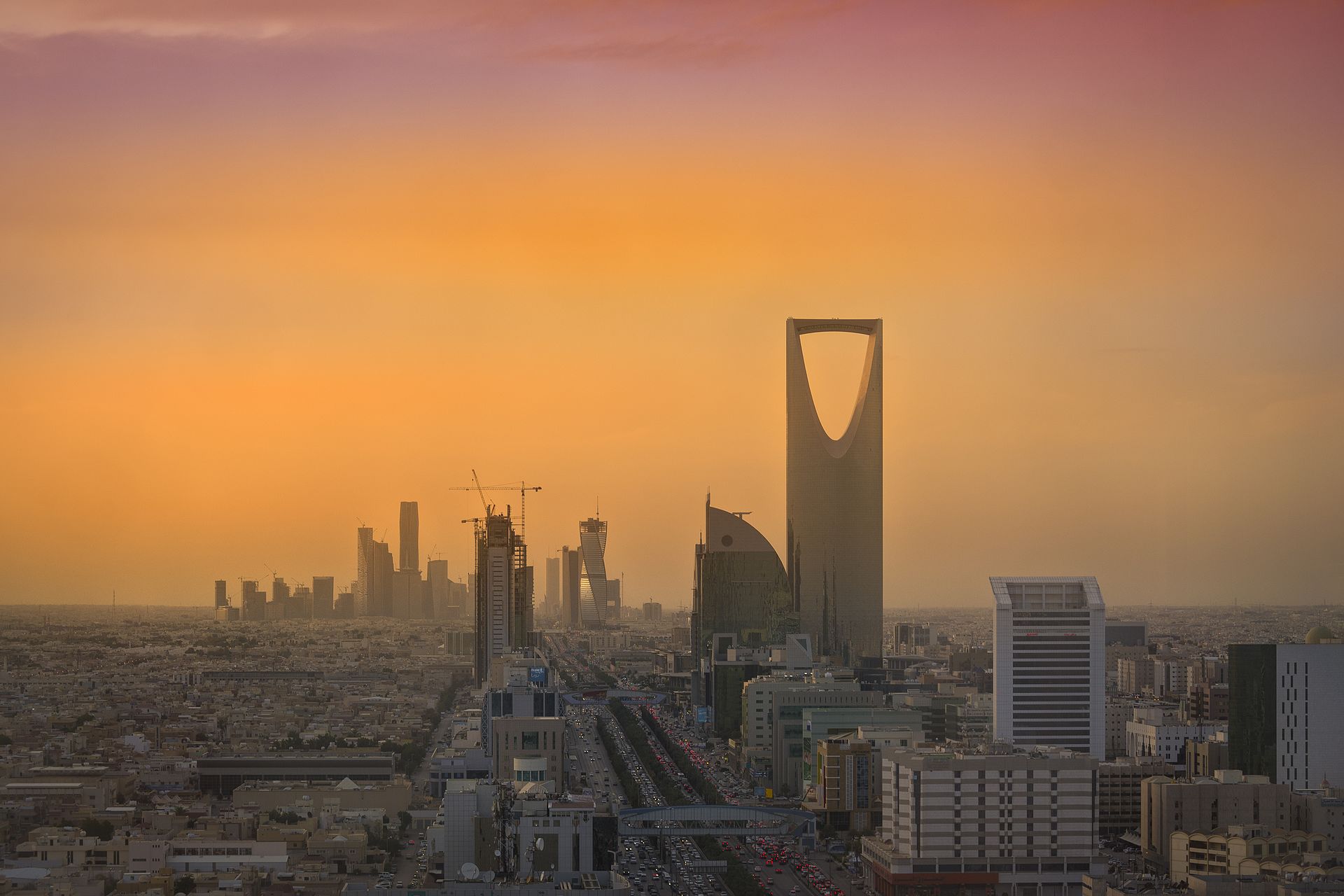
RIYADH — The cranes that define the Riyadh skyline have not stopped turning, but the supply chains that feed them have. Saudi Arabia entered 2026 with SAR 8 trillion — roughly $2.1 trillion — in construction projects threading through every stage from planning to pouring, making the Kingdom the single largest building site on earth. Then, on March 1, Iran declared a shipping prohibition across the Strait of Hormuz, and the mathematics of megaproject delivery changed overnight. Steel shipments from China stalled at sea. Insurance premiums on hulls transiting the Gulf quintupled. Port throughput at King Abdulaziz Port in Dammam and the industrial gateway at Jubail — both inside the chokepoint — collapsed to a fraction of pre-crisis volumes. The question facing Mohammed bin Salman and his planners is no longer whether Vision 2030 will be delayed, but whether the Kingdom can simultaneously prosecute a regional conflict and sustain the most ambitious construction program in modern history. The emerging answer, according to project managers, logistics executives, and defense officials interviewed across three continents, is that it cannot — at least not in its current form. Something has to give.
Table of Contents
- How Large Is Saudi Arabia’s Construction Boom?
- Which Megaprojects Face the Greatest Threat?
- Why Has the Hormuz Blockade Paralyzed Saudi Construction?
- How Much Chinese Steel Is Stranded at Sea?
- Can Red Sea Ports Replace the Gulf Corridor?
- The Cost Spiral Nobody Predicted
- The Megaproject Vulnerability Matrix
- The Contrarian Case for Wartime Construction
- Who Pays When a Giga-Project Stops?
- The Labor Crisis Behind the Supply Chain Crisis
- What Does This Mean for the 2034 World Cup?
- Frequently Asked Questions
How Large Is Saudi Arabia’s Construction Boom?
To grasp the scale of what is at risk, consider the numbers. Saudi Arabia’s construction market generated approximately $74 billion in output in 2025, according to industry tracker GlobalData, with an average annual growth rate of 5.4 percent projected through 2029. That output grew four percent in 2025 alone, defying earlier predictions of a slowdown tied to oil price volatility. The 2026 national budget allocated SAR 162 billion — approximately $43 billion — in capital expenditure, the largest single-year commitment to physical infrastructure in the Kingdom’s history. Behind that headline figure sits a project pipeline stretching from the glass-and-steel towers of the new Riyadh financial district to the subterranean tunnels of a metro system that is, depending on whom you ask, either nearly complete or quietly behind schedule.
The pipeline is not monolithic. It encompasses giga-projects directly controlled by the Public Investment Fund — NEOM, the Red Sea development, Diriyah Gate, Qiddiya, and the Jeddah Tower revival — alongside municipal infrastructure programs, military base expansions, housing developments under the Sakani program, and the early-stage preparations for the 2034 FIFA World Cup. According to MEED Projects, which tracks contract awards across the Gulf Cooperation Council, Saudi Arabia accounted for more than 60 percent of all GCC construction contract value in 2025. The Kingdom is not merely building; it is attempting to physically reconstruct itself within a single decade.
That ambition was already straining capacity before the war. Cement demand had pushed domestic producers — some 17 players with a combined capacity of roughly 80 million tons per year — toward full utilization. Labor shortages forced contractors to bid against each other for South Asian workers, driving up wages for welders, electricians, and crane operators by 15 to 25 percent between 2023 and 2025, according to recruitment firms operating in the Eastern Province. Project timelines were slipping across the board. Then Hormuz closed, and a construction sector already running hot was suddenly starved of inputs it could not produce domestically.
Which Megaprojects Face the Greatest Threat?
Not every project is equally exposed. The geography of Saudi Arabia — a country with coastlines on both the Persian Gulf and the Red Sea — creates a natural division between projects that depend on Gulf-side ports and those served by Red Sea logistics corridors. The timing of each project’s construction phase matters enormously: a project still in the design stage can wait; a project mid-pour cannot. And the financial structure behind each development determines whether it can absorb cost escalation or must halt when budgets are breached.
NEOM, the $500 billion flagship development on the Red Sea coast, occupies a peculiar position. Its signature component, The Line — a 170-kilometer mirrored linear city — had already undergone significant restructuring before the war began. Construction on The Line was halted on September 16, 2025, after just 2.4 kilometers of foundation work had been completed. The workforce was reduced by 35 percent. NEOM’s other components — Trojena, the mountain resort and future Asian Winter Games venue; Sindalah, the luxury island; and Oxagon, the industrial port city — are proceeding at varying speeds. Because NEOM sits on the Red Sea, it is less dependent on Hormuz transit for materials. But much of NEOM’s specialized steel, glass curtain wall systems, and prefabricated modules were being sourced from Chinese and South Korean manufacturers whose shipments transited the Gulf before being trucked overland. The assumption that Red Sea geography insulates NEOM from the blockade is only partially correct.
The Middle East briefing 3,000+ readers start their day with.
One email. Every weekday morning. Free.
Diriyah Gate, the $63 billion heritage and tourism development on the outskirts of Riyadh, tells a different story. With more than 50,000 workers on site in early 2026, Diriyah is one of the most labor-intensive construction operations in the world. Its materials arrive primarily through Gulf ports — Dammam and Jubail — before being transported by road to the capital. The project is deep into its build phase, with structural work underway on hotels, museums, residential quarters, and commercial districts simultaneously. A materials stoppage at this stage does not merely delay the timeline; it creates cascading problems with concrete curing schedules, steel reinforcement placement, and mechanical-electrical-plumbing coordination that compound with every week of interruption.
The Red Sea Project, a luxury tourism development along the Kingdom’s western coast, was already scaling back before the war. Phase Two had been halted, and the developer, Red Sea Global, was quietly renegotiating contractor agreements. The Hormuz crisis provides convenient cover for a retrenchment that was already underway for financial reasons. Meanwhile, Qiddiya — the entertainment megacity south of Riyadh — celebrated the opening of its Six Flags theme park in December 2025, but the broader development remains years from completion and heavily dependent on imported materials.
The entertainment sector’s exposure to the war goes beyond physical construction: Saudi Arabia’s $38 billion gaming investment, anchored by the Savvy Games Group and Esports World Cup, faces parallel disruption as international talent, sponsors, and capital retreat from a conflict zone.

Why Has the Hormuz Blockade Paralyzed Saudi Construction?
The Strait of Hormuz is a 21-mile-wide passage between Iran and Oman through which approximately 21 percent of the world’s petroleum transits daily. But oil is not the only commodity that moves through the strait. Hormuz handles roughly 70 percent of all food imports to the GCC nations and serves as the primary conduit for construction materials arriving from East Asia, the Indian subcontinent, and Southeast Asia. When Iran declared its shipping prohibition on March 1, 2026, it did not merely threaten energy markets. It severed the arterial supply line feeding every construction project on the Gulf coast of the Arabian Peninsula.
Saudi Arabia’s two principal Gulf-side ports — King Abdulaziz Port in Dammam and the industrial port at Jubail — sit squarely inside the chokepoint. Any vessel bound for these facilities from East Asia, the world’s dominant source of construction steel, aluminum, glass, and prefabricated components, must transit Hormuz. Before the crisis, these ports handled the majority of Saudi Arabia’s construction material imports by volume. Dammam alone processed millions of tons of steel, rebar, structural sections, and cladding materials annually.
The blockade’s impact was not instantaneous. Saudi ports and construction sites maintain inventories — typically 30 to 90 days of critical materials, depending on the project phase and the contractor’s financial capacity to pre-purchase. By mid-March 2026, those buffers are eroding rapidly. Project managers on multiple Riyadh developments report that rebar stocks will be exhausted within four to six weeks at current consumption rates. Structural steel for high-rise construction — which must be manufactured to precise specifications and cannot be easily substituted — is already being rationed on at least three major developments, according to a senior executive at a Tier 1 contractor who spoke on condition of anonymity.
Even before the physical blockade, the invisible blockade of war-risk insurance had begun strangling trade. Shipping insurance premiums surged from 0.2 percent of hull value to between one and three percent — a fivefold to fifteenfold increase that instantly repriced every cargo transiting the Gulf. For a standard Panamax bulk carrier loaded with 70,000 tons of Chinese steel, the insurance premium alone jumped from roughly $200,000 to between $1 million and $3 million per voyage. Those costs are passed directly to the buyer. Shipping rates themselves climbed 50 to 80 percent as carriers demanded war-risk surcharges, and many simply refused to enter Gulf waters altogether.
The rerouting option — sending vessels around the Cape of Good Hope instead of through Hormuz — adds approximately two weeks to the voyage from Shanghai to Jeddah and roughly three weeks to the voyage from Shanghai to Dammam (which must now approach from the Red Sea side and rely on overland transport from western ports). The additional fuel, crew time, and opportunity cost further inflate delivered material prices. Construction economists at Turner & Townsend estimate that the combined effect of insurance, rerouting, and rate increases has raised the landed cost of imported construction materials in Saudi Arabia by 25 to 40 percent since late February 2026.
How Much Chinese Steel Is Stranded at Sea?
China is the world’s largest steel exporter, and the Gulf Cooperation Council is among its most important customers. According to Chinese customs data and industry estimates compiled by Mysteel Global, China exported more than 10 million tons of steel to the GCC annually in the years leading up to the crisis, representing approximately 14 percent of China’s total global steel export volume. Saudi Arabia alone absorbed a significant share of that flow, driven by insatiable demand from Vision 2030 projects.
When the Hormuz shipping prohibition took effect, an estimated 2.5 to 3.5 million tons of Chinese steel was either in transit through the Indian Ocean, waiting to load at Chinese ports for Gulf-bound voyages, or staged at transshipment hubs in the UAE and Oman. Vessels carrying structural sections, hot-rolled coil, rebar, and specialty plate destined for Saudi construction sites found themselves unable to discharge at their intended Gulf ports. Some diverted to Fujairah or Sohar, outside the strait, but those facilities lack the warehousing capacity and overland transport links to efficiently redistribute millions of tons of steel. Others have simply anchored and waited, burning demurrage costs of $20,000 to $40,000 per day while their charterers negotiate with insurers and port authorities.
The steel shortage interacts viciously with concrete production timelines. Modern construction relies on reinforced concrete — the marriage of poured cement with embedded steel rebar. Saudi Arabia is self-sufficient in cement, with domestic capacity of approximately 80 million tons per year spread across 17 producers. But cement without steel is structurally useless for most applications. A construction site can have mountains of locally produced cement and still be unable to pour a single foundation if rebar is unavailable. This asymmetry — abundant cement, scarce steel — is precisely the situation now emerging on Gulf-dependent construction sites across the Eastern Province and Riyadh.
The cement is here. The workers are here. The cranes are here. But without steel, a construction site is just an expensive parking lot.
Senior project director at a Tier 1 Saudi contractor, speaking on condition of anonymity, March 2026
The steel shortage is not uniform across all grades and products. Commodity rebar, the most consumed steel product in Saudi construction, is partially produced domestically by firms including Saudi Steel Pipe Company and Rajhi Steel. But domestic rebar capacity covers only a fraction of total demand, and the specialized structural sections, high-strength plate, and prefabricated steel assemblies required for tower construction, bridge spans, and industrial facilities are almost entirely imported. These specialty products have the longest lead times — typically 12 to 20 weeks from order to delivery even in peacetime — and are now facing indefinite delays.
Can Red Sea Ports Replace the Gulf Corridor?
Saudi Arabia’s western coastline offers an alternative logistics corridor that sits entirely outside the Hormuz chokepoint. Jeddah Islamic Port, the Kingdom’s largest by container volume, handles traffic from the Mediterranean, the Suez Canal, and the Indian Ocean without any dependence on the strait. Yanbu, further north, serves as both a commercial port and the terminus for east-west petroleum pipelines. The smaller facility at Rabigh completes the western port network. In theory, redirecting construction materials from Gulf ports to Red Sea ports would bypass the blockade entirely.
In practice, the substitution is far more difficult than a map suggests. Jeddah Islamic Port is already operating near capacity, handling the Kingdom’s consumer goods imports, food shipments, and the existing construction material flow for western Saudi Arabia. According to port authority data, Jeddah processed approximately 5.5 million twenty-foot equivalent units (TEUs) in 2025. Absorbing the displaced Gulf-side construction traffic — millions of additional tons of bulk steel, aggregate, and heavy equipment — would require berth capacity, crane capacity, and yard storage that simply do not exist today.
Yanbu faces similar constraints. While the port has surplus bulk-handling capacity thanks to its role in petroleum exports, it lacks the container-handling infrastructure needed for the mixed cargoes that construction projects demand. Prefabricated steel assemblies, curtain wall panels, elevator systems, and mechanical equipment arrive in containers, not bulk carriers. Converting Yanbu into a substitute for Dammam would require months of infrastructure investment — precisely the kind of construction that is itself constrained by the crisis.
The overland dimension compounds the problem. Riyadh, the epicenter of Saudi construction activity, sits roughly equidistant between Dammam on the Gulf and Jeddah on the Red Sea — approximately 950 kilometers from each. The road network connecting Jeddah to Riyadh can handle heavy truck traffic, but it was not designed for the volume of materials currently flowing through Dammam. Rerouting construction supply chains through Jeddah would require a massive increase in heavy-haul trucking, straining road infrastructure, creating bottlenecks at distribution points, and raising inland freight costs by 30 to 50 percent, according to logistics executives at Bahri and other Saudi transport companies.
There is a longer-term opportunity embedded in this crisis, however. The emergency energy reroute to the Red Sea is already forcing investment in western port infrastructure that aligns with the geographic logic of NEOM and the Red Sea development corridor. If the blockade persists for months rather than weeks, the accelerated development of Red Sea port capacity could permanently shift the center of gravity of Saudi logistics from east to west — a transformation that planners had envisioned for the 2030s but never expected to execute under wartime pressure.

The Cost Spiral Nobody Predicted
Construction cost escalation in Saudi Arabia did not begin with the Hormuz blockade. Between 2022 and 2025, the sheer volume of simultaneous megaproject activity drove up prices for labor, materials, and equipment across the board. Turner & Townsend’s International Construction Market Survey documented annual cost increases of six to nine percent in Riyadh during that period, well above global averages. The war has accelerated that trajectory into something approaching a cost crisis.
The escalation operates through multiple channels simultaneously. First, the direct material cost increase: imported steel, aluminum, glass, and specialty components are 25 to 40 percent more expensive at the port gate than they were in January 2026, reflecting insurance surcharges, rerouting costs, and scarcity premiums. Second, the energy cost channel: higher oil and natural gas prices feed into the production costs of domestically manufactured materials, particularly cement and concrete products, which are energy-intensive to produce. Saudi cement manufacturers, despite operating on subsidized energy inputs, have already signaled price increases of 10 to 15 percent to reflect higher fuel and electricity costs.
Third, the labor cost channel: construction workers in Saudi Arabia are predominantly from South Asia — India, Pakistan, Bangladesh, and Nepal. These workers remit earnings to families at home and are acutely sensitive to the purchasing power of their wages. As the food security crisis threatening the Kingdom drives up the cost of living in Saudi cities, workers are demanding higher wages or leaving for employment markets less affected by the conflict. Recruitment firms report that the cost of bringing a new construction worker from South Asia to Saudi Arabia — including visa processing, travel, and onboarding — has risen from approximately SAR 8,000 to SAR 12,000 per worker since the crisis began.
Fourth, and most insidiously, the schedule delay channel. In construction economics, time is money in the most literal sense. Every month of delay on a major project incurs carrying costs — interest on construction financing, overhead for site management, depreciation on idle equipment, contractual penalties for missed milestones. For a project the size of Diriyah Gate, with an estimated SAR 236 billion total investment and more than 50,000 workers, a single month of delay can cost hundreds of millions of riyals in direct expenses before accounting for the opportunity cost of deferred revenue from hotel bookings, retail leases, and residential sales.
The compounding effect of these four channels is severe. Construction economists at Knight Frank estimate that the total cost of delivering a standard commercial tower in Riyadh has increased by 30 to 45 percent since January 2026 when all factors are included. For specialized projects — hospitals, stadiums, high-rise residential towers with complex curtain wall systems — the increase may be higher. Projects that were already operating on thin margins are now financially unviable at their original budgets.
The Megaproject Vulnerability Matrix
To assess the relative exposure of Saudi Arabia’s major construction programs, it is useful to evaluate each project across four dimensions that collectively determine its vulnerability to the current crisis. These dimensions are: Hormuz Dependency, measuring how much of a project’s material supply flows through Gulf ports; Timeline Pressure, reflecting how close the project is to a hard delivery deadline; Labor Exposure, capturing the workforce’s vulnerability to war-related disruption; and Financial Buffer, indicating the project’s capacity to absorb cost escalation without halting. Each dimension is scored from 1 (low vulnerability) to 5 (extreme vulnerability), yielding a composite score out of 20.
| Megaproject | Hormuz Dependency (1-5) | Timeline Pressure (1-5) | Labor Exposure (1-5) | Financial Buffer (1-5) | Total Vulnerability (out of 20) |
|---|---|---|---|---|---|
| Diriyah Gate ($63B) | 5 | 4 | 5 | 3 | 17 |
| Riyadh Metro (Phase 2 Extensions) | 4 | 5 | 4 | 3 | 16 |
| King Salman International Airport | 4 | 4 | 4 | 3 | 15 |
| Qiddiya (remaining phases) | 4 | 3 | 4 | 3 | 14 |
| 2034 World Cup Stadiums | 4 | 3 | 4 | 2 | 13 |
| Jeddah Tower (revival) | 2 | 2 | 3 | 5 | 12 |
| NEOM — The Line | 2 | 1 | 3 | 4 | 10 |
| NEOM — Trojena | 2 | 4 | 3 | 2 | 11 |
| Red Sea Global (Phase 1) | 1 | 3 | 3 | 3 | 10 |
| King Salman Park ($3.8B phase) | 4 | 3 | 3 | 2 | 12 |
Several patterns emerge from this analysis. Riyadh-based projects score highest because they depend on Gulf ports for materials, face near-term deadlines, and employ enormous workforces of South Asian laborers who are vulnerable to food price inflation, security concerns, and potential evacuation scenarios. Diriyah Gate, with its 50,000-plus workers, deep construction phase, and near-total reliance on Dammam port for steel and specialty imports, emerges as the most exposed of all Saudi megaprojects. Its score of 17 out of 20 reflects a project that is simultaneously too far along to pause easily and too dependent on disrupted supply chains to continue at full speed.
Red Sea projects score meaningfully lower on Hormuz Dependency but are not immune. NEOM’s The Line, paradoxically, scores relatively low overall because its construction was already halted before the war. That halt proved to be only the beginning of a fundamental restructuring that broke NEOM into five separate entities began — a project that is not building cannot be disrupted by a materials shortage. Trojena scores higher because it is actively under construction with a hard deadline tied to the 2029 Asian Winter Games. The Red Sea Global development benefits from geographic proximity to Jeddah Islamic Port and a deliberate early-stage decision to source materials through western supply chains.
The matrix reveals a cruel irony: the projects most advanced in their construction — and therefore closest to generating returns — are the most vulnerable to disruption. Projects that are still in early stages or have been paused can afford to wait. The ones that cannot wait are the ones that will bleed the most.
The Contrarian Case for Wartime Construction
The consensus view among Western analysts and Gulf-based construction executives is straightforward: the Iran war will delay Vision 2030 by two to five years, inflict tens of billions of dollars in cost overruns, and force the cancellation of marginal projects. This assessment is likely correct in the short term. But it misses a more provocative possibility — that the war could actually accelerate the structural transformation of Saudi Arabia’s construction sector in ways that a decade of peacetime planning failed to achieve.
Consider the steel question. Saudi Arabia’s dependence on Chinese steel imports was a recognized vulnerability long before Iranian missiles began flying. The Kingdom’s National Industrial Strategy, published in 2022, identified domestic steel production as a priority for import substitution. A partnership between the Public Investment Fund and China’s Baowu Steel Group, the world’s largest steelmaker, had been under discussion for years but moved with the glacial pace typical of industrial megaprojects with complex political dimensions. The Hormuz blockade has transformed domestic steel capacity from a long-term aspiration into an urgent national security imperative. PIF officials have signaled, through intermediaries, that the Baowu partnership is being fast-tracked, with a target of breaking ground on a two-million-ton-per-year integrated steel mill in Ras Al Khair before the end of 2026. Wartime urgency is accomplishing what years of industrial policy could not.
The port rebalancing argument carries similar force. Saudi logistics have historically been Gulf-centric, reflecting the country’s oil export infrastructure and the proximity of its population centers to the eastern coast. Vision 2030’s westward pivot — NEOM, the Red Sea developments, the Jeddah economic zone — always implied a corresponding shift in port capacity, but that shift was proceeding slowly. The Hormuz closure is now forcing emergency investment in Jeddah and Yanbu that will create permanent western logistics capacity. Once those investments are made, they will not be reversed. The war may accomplish in 18 months what the Saudi Ports Authority’s 15-year master plan envisioned for the 2030s.
Then there is the portfolio rationalization argument — the most politically sensitive of the three. Before the war, Saudi Arabia’s megaproject portfolio was widely regarded as overextended. The Line was already halted. The Red Sea Project was scaling back. Multiple smaller PIF-backed developments were running over budget. Canceling or indefinitely postponing these projects in peacetime would have been politically humiliating — an admission that the crown prince’s vision exceeded the Kingdom’s capacity to execute. The war provides political cover to rationalize the portfolio without acknowledging that the original ambitions were undeliverable. A project canceled because of Iranian aggression is a different narrative than a project canceled because of cost overruns and poor planning. The financial mechanics of this rationalization — including how PIF is redirecting capital from giga-projects toward defence and fiscal reserves — are laid out in a granular examination of the wartime squeeze on Saudi Arabia’s trillion-dollar fund.
Wars do not create new problems. They accelerate the resolution of old ones — just not in the way anyone would choose.
Former Saudi Planning Ministry official, speaking to the author, March 2026
The contrarian case should not be overstated. Wartime construction restructuring is violent, wasteful, and imposes enormous human costs on the hundreds of thousands of workers whose livelihoods depend on project continuity. The financial losses from halted projects, stranded materials, and broken contracts will run into the tens of billions. But the possibility that Saudi Arabia emerges from this conflict with a more rational construction portfolio, greater domestic industrial capacity, and a logistics network less dependent on a single maritime chokepoint is not wishful thinking. It is the historical pattern of wartime economic adaptation, repeated from the American industrial mobilization of 1941 to the Gulf states’ own post-1973 infrastructure boom.

Who Pays When a Giga-Project Stops?
The legal and financial consequences of construction disruption at this scale are without modern precedent in the Gulf. Saudi construction contracts typically include force majeure clauses that excuse performance when extraordinary events beyond either party’s control make delivery impossible. War and blockade would appear to qualify. But the application of force majeure in practice is contested, expensive, and slow — and the parties on either side of these contracts have sharply divergent interests.
Contractors want force majeure declared because it stops the clock on liquidated damages — the contractual penalties they owe for late delivery. A major contractor on a Riyadh tower project facing SAR 500,000 per day in liquidated damages has powerful incentives to invoke force majeure and suspend work. Developers and project owners, by contrast, resist force majeure declarations because they freeze progress, trigger insurance claims, and create precedents that can be invoked across entire project portfolios. The Saudi royal family’s major development vehicles — PIF, the Royal Commission for Riyadh City, and the various giga-project companies — are simultaneously developers, regulators, and the ultimate guarantors of national vision. Their institutional interests do not align neatly with the contractual positions they occupy.
Insurance adds another layer of complexity. Construction All-Risk (CAR) policies typically cover physical damage and, in some cases, delay-in-start-up costs. But war exclusions are standard in CAR policies across the Gulf. Contractors and developers who assumed that their insurance would cover war-related disruptions are discovering, in many cases, that the exclusion clauses they barely read when purchasing coverage now leave them exposed. The insurance market for Gulf construction risk was already hardening before the conflict; it is now effectively frozen, with Lloyd’s syndicates and major reinsurers refusing to write new CAR policies for Saudi projects until the military situation stabilizes.
The financial burden will ultimately fall on three parties in varying proportions: the Saudi government, which backstops PIF and the giga-project companies; international contractors, many of whom will face insolvency if work stoppages persist beyond three to six months; and the banks and bond investors who financed the construction. Early estimates from banking sources in Riyadh suggest that SAR 50 to 80 billion ($13 to $21 billion) in construction financing is now at risk of technical default if projects remain disrupted through the second quarter of 2026. The Saudi banking system, well-capitalized though it is, has never faced a stress test of this magnitude in its construction lending portfolio.
The Labor Crisis Behind the Supply Chain Crisis
Behind every ton of stranded steel and every delayed shipment of curtain wall panels, there is a human dimension that receives insufficient attention. Saudi Arabia’s construction workforce is overwhelmingly composed of migrant laborers from South Asia. By industry estimates, between 2.5 and 3 million foreign workers are employed in Saudi construction, with the largest contingents from India, Pakistan, Bangladesh, Nepal, and the Philippines. These workers live in labor camps, often in the Eastern Province or on the outskirts of Riyadh, and send the majority of their earnings home as remittances.
The war threatens this workforce through multiple channels. First, the food price channel: Saudi Arabia imports 85 percent of its food, and the Hormuz blockade has disrupted food supply chains alongside construction materials. Rising food prices in Saudi cities hit migrant workers hardest, as food represents a larger share of their expenditure than for Saudi nationals. Workers whose real wages are declining due to food inflation are less productive, more likely to seek repatriation, and more susceptible to labor disputes.
Second, the security channel: as the military conflict intensifies, embassies of labor-sending countries are preparing contingency evacuation plans for their nationals. India, which has the largest diaspora in Saudi Arabia, has reportedly pre-positioned naval assets in the Arabian Sea capable of supporting an evacuation operation. If the war escalates to include direct strikes on Saudi territory, a mass evacuation of South Asian construction workers is not merely possible but probable. The loss of even 20 percent of the construction workforce would halt projects across the Kingdom regardless of materials availability.
Third, the recruitment channel: new worker inflows have slowed to a trickle as recruitment agencies in Mumbai, Dhaka, and Kathmandu struggle to find workers willing to deploy to an active conflict zone. The premium required to attract workers has doubled, and several major recruitment firms have suspended Gulf placements entirely pending a ceasefire. This creates a delayed effect: even if the blockade lifts tomorrow, the construction sector will face months of labor shortages as the pipeline of incoming workers rebuilds.
The labor crisis intersects with Saudi Arabia’s Saudization policies in uncomfortable ways. The government has spent years pushing to increase the share of Saudi nationals in the private sector workforce, including construction. But Saudization in construction has proceeded slowly because the work is physically demanding, often conducted in extreme heat, and pays wages that Saudi nationals find unattractive. The war has not changed this calculus. Saudi nationals are not going to replace South Asian workers on construction sites, and any pretense otherwise belongs to the realm of policy fiction rather than operational reality.
What Does This Mean for the 2034 World Cup?
Saudi Arabia’s successful bid to host the 2034 FIFA World Cup committed the Kingdom to delivering a portfolio of world-class stadiums, transportation infrastructure, and hospitality capacity within a fixed and immovable timeline. FIFA’s requirements include at least 14 stadiums with a minimum capacity of 40,000 seats, high-speed rail connections between host cities, and approximately 200,000 hotel rooms across the tournament venues. The bid documents, submitted in 2024, assumed peacetime construction conditions, stable supply chains, and a labor market capable of absorbing hundreds of thousands of additional workers.
Every one of those assumptions is now in question. Stadium construction, which was expected to begin in earnest in 2026-2027, requires precisely the structural steel, specialty glass, retractable roof systems, and advanced mechanical equipment that is most affected by the Hormuz blockade. The Lusail Stadium in Qatar, built for the 2022 World Cup, consumed approximately 30,000 tons of structural steel. Multiply that across 14 Saudi venues, many of which are planned at larger capacities, and the steel requirement for World Cup stadiums alone approaches half a million tons — a volume that will be extremely difficult to source through disrupted supply chains.
Timeline pressure is the critical variable. The 2034 tournament date is fixed by FIFA statute and cannot be moved without extraordinary political consequences. Working backward from a June 2034 opening, stadium construction must be substantially complete by late 2033 to allow for testing, commissioning, and FIFA inspection. That leaves roughly seven and a half years — an adequate timeline under normal conditions but dangerously tight if the first two years are lost to supply chain disruption, cost escalation, and labor shortages. A venue-by-venue viability assessment shows that Al Khobar and NEOM face the steepest obstacles, while Riyadh and Jeddah retain enough existing infrastructure to absorb construction delays. Qatar spent 12 years building its World Cup infrastructure, and it was not fighting a war while doing so.
Mohammed bin Salman’s wartime legacy is now entangled with the World Cup commitment. The tournament was conceived as the capstone of Vision 2030, the moment when the world’s cameras would reveal a transformed Saudi Arabia to a global audience. Losing the World Cup to construction delays caused by the Iran war would be a political humiliation of the first order. The crown prince and his advisors are acutely aware of this risk, and it is likely that World Cup-related construction will receive absolute priority in materials allocation, labor deployment, and financial resources — at the expense of less politically critical projects.
This prioritization itself creates second-order problems. If World Cup stadiums receive preferential access to scarce steel and labor, other projects will be starved even further. The Kingdom cannot simultaneously fast-track 14 stadiums, complete Diriyah Gate, build King Salman International Airport, extend the Riyadh Metro, and deliver King Salman Park’s recent $3.8 billion investment round when the total supply of materials and workers has contracted by 30 to 40 percent. Something will be sacrificed. The political question is what, and the economic question is at what cost.
Saudi Arabia’s $100 billion aviation bet faces analogous pressures. The new King Salman International Airport in Riyadh, conceived as a hub to rival Dubai, requires the same materials, workers, and financial resources that every other megaproject demands. The war has turned Vision 2030 from an exercise in ambitious planning into a zero-sum competition among flagship projects for a shrinking pool of inputs.
The most likely outcome is a triage approach: a handful of politically essential projects — World Cup stadiums, the Riyadh Metro completion, perhaps Diriyah Gate’s first phase — will be protected with whatever resources are necessary, while second-tier projects are quietly mothballed. This is not the way Vision 2030 was supposed to work. But it may be the way Vision 2030 survives.
The economic tension between wartime spending and peacetime development reflects an even larger question about Saudi Arabia’s energy future. The Iran war has proved the Kingdom right about the pace of the global energy transition, vindicating its strategy of maintaining oil dominance while simultaneously building the Middle East’s largest renewable energy portfolio.
Frequently Asked Questions
How much is Saudi Arabia’s total construction pipeline worth?
Saudi Arabia’s total construction pipeline is valued at approximately SAR 8 trillion, or roughly $2.1 trillion, according to MEED Projects and industry estimates from GlobalData. This figure encompasses all projects from early planning through active construction, including PIF-backed giga-projects (NEOM, Diriyah Gate, the Red Sea development, Qiddiya), municipal infrastructure (Riyadh Metro extensions, King Salman International Airport), military facilities, residential developments under the Sakani housing program, and early-stage preparations for the 2034 FIFA World Cup. The construction market generated approximately $74 billion in output in 2025, growing four percent year-on-year, with a projected average annual growth rate of 5.4 percent through 2029 — projections that were compiled before the Hormuz blockade disrupted supply chains. The 2026 national budget allocated SAR 162 billion ($43 billion) in capital expenditure to fund the public-sector portion of this pipeline.
Which Saudi megaprojects are most affected by the Iran war?
The megaprojects most vulnerable to the Iran war and the associated Hormuz blockade are those that combine high dependence on Gulf-port material imports, active mid-construction phases, large workforces, and limited financial buffers. Diriyah Gate, the $63 billion heritage and tourism development outside Riyadh with more than 50,000 workers, scores highest on a composite vulnerability assessment because it sources materials primarily through Dammam port, is deep into structural construction, and employs a massive South Asian workforce exposed to food inflation and potential evacuation. The Riyadh Metro extensions and King Salman International Airport are similarly exposed. Projects on the Red Sea coast, including NEOM and Red Sea Global developments, are less affected by the Hormuz closure because they can source materials through Jeddah Islamic Port, though they still face cost escalation from global shipping disruption and competition for scarce labor.
Can Saudi Arabia reroute construction materials through Red Sea ports?
Partial rerouting is possible but faces significant logistical constraints. Jeddah Islamic Port, the Kingdom’s primary Red Sea facility, is already operating near its capacity of approximately 5.5 million TEUs annually. Absorbing the millions of additional tons of bulk steel, aggregate, and containerized construction materials currently stranded by the Hormuz blockade would require berth expansions, additional crane capacity, and expanded yard storage that do not exist today. Yanbu port has surplus bulk-handling capacity but lacks container infrastructure. Overland transport from western ports to Riyadh, approximately 950 kilometers by road, would increase freight costs by 30 to 50 percent and strain highway infrastructure. The rerouting is feasible as an emergency measure for priority projects but cannot fully replace Gulf-port throughput in the near term. Over the longer term, wartime investment in Red Sea port capacity could permanently shift Saudi logistics westward, aligning with the geographic logic of NEOM and the Red Sea development corridor.
How has the Hormuz blockade affected construction costs in Saudi Arabia?
The Hormuz blockade has triggered a multi-channel cost escalation in Saudi construction. Shipping insurance premiums have risen from 0.2 percent to between one and three percent of hull value, a fivefold to fifteenfold increase. Shipping rates have climbed 50 to 80 percent due to war-risk surcharges and carrier reluctance to enter Gulf waters. Rerouting vessels around the Cape of Good Hope adds approximately two weeks and significant fuel costs to voyages from East Asia. The combined effect has raised the landed cost of imported construction materials by 25 to 40 percent since late February 2026, according to Turner & Townsend. Domestic inputs are also rising: cement prices have increased 10 to 15 percent due to higher energy costs, and labor recruitment costs have risen from approximately SAR 8,000 to SAR 12,000 per worker. Knight Frank estimates that the total cost of delivering a standard commercial tower in Riyadh has increased by 30 to 45 percent when all factors are included.
Will the Iran war delay the 2034 World Cup preparations?
The 2034 FIFA World Cup date is fixed and cannot be moved without extraordinary political consequences. Saudi Arabia must deliver at least 14 stadiums of 40,000-plus capacity, high-speed rail connections between host cities, and approximately 200,000 hotel rooms. Stadium construction was expected to begin in earnest in 2026-2027 and requires hundreds of thousands of tons of structural steel, specialty glass, and advanced mechanical systems — precisely the materials most disrupted by the Hormuz blockade. Working backward from a June 2034 opening, the Kingdom has roughly seven and a half years, a timeline that becomes dangerously tight if the first one to two years are compromised by supply chain disruption. Qatar spent 12 years building its World Cup infrastructure without the complication of a regional war. Saudi planners are expected to prioritize World Cup construction above other megaprojects, directing scarce materials and labor to stadiums and transport links at the expense of less politically critical developments. Whether this prioritization is sufficient depends entirely on how long the blockade persists and how quickly alternative supply chains can be established.
What is the Baowu Steel partnership and why does it matter?
The Public Investment Fund has been in discussions with China’s Baowu Steel Group, the world’s largest steelmaker by output, to establish a domestic integrated steel mill in Saudi Arabia. The proposed facility at Ras Al Khair would have an initial capacity of approximately two million tons per year — a fraction of Saudi Arabia’s total steel consumption but a meaningful step toward reducing import dependence. Before the war, the partnership was advancing slowly through feasibility studies and political negotiations. The Hormuz blockade has transformed domestic steel production from an industrial policy aspiration into a national security priority, and PIF officials have signaled that the project is being fast-tracked with a target of breaking ground before the end of 2026. If realized, the Baowu partnership would represent the most significant step toward construction material self-sufficiency in Saudi history, though the mill would not reach full production for three to four years after groundbreaking.